Categories
Algo Trading

How to Source Market Data for Algo Trading?

Algo trading involves the use of computer programs or ‘algorithms’ to execute orders in the financial markets (stocks, currencies, commodities, derivatives, etc.) based on pre-defined conditions. These conditions include price, timing, and quantity instructions. It’s become extremely popular among many traders globally due to its high speed and efficiency. And one could argue that the first step in algo trading is collecting market data! This data has to be accurate and precise to form an effective algo trading system.

The amount and type of data required depends on your approach to algo trading, i.e. whether you code your strategy or use pre-built strategies. Traders using third-party platforms need not worry about collecting data. In this article, we will provide a complete overview of various market data sources, the associated costs, and a detailed analysis to help you make informed decisions

What is Market Data and Why Do We Need it?

Just as good-quality ingredients are crucial for cooking up a delicious meal, high-quality market data is essential for backtesting and executing successful trades. Market data refers to trading-related information on the prices and volume reported by exchanges (like NSE or BSE in India). Without this data, a trader won’t be able to form any strategy or place orders in the market. 

A trader needs to collect three types of market data for algo trading; real-time data, delayed data, and historical data. Real-time data is used while a trader executes an order, it is taken into account at the time of the trade. Delayed data refers to market data made available after a short period, usually ranging from 1 minute to 15 minutes. Historical data (collected from past events) is used for analysis and backtesting strategies. It checks whether the strategy would have worked well in previous markets and gives a green signal to the trader. 

Why Good Quality Market Data is Important for Trading:

  • Forming your Strategy and Backtesting: By collecting past market data, traders can notice patterns and form strategies. These strategies can be backtested to gain confidence and make sure there are no major flaws. A trader must always backtest their strategy before deploying it in the current market.

    Read: Ultimate Guide to Backtesting Algo Trading Strategies
  • Monitor and Adapt: Regularly analysing and gathering market information allows traders to make timely adjustments as the market fluctuates. This is where real-time market data becomes essential. On the other hand, delayed data is typically used for research, analysis, and educational purposes. Examples of institutions that offer delayed data are Yahoo Finance, Bloomberg, and Reuters.
  • On-spot Execution: Real-time market data allows traders to execute trades on time, reducing slippages and increasing accuracy. If there is latency (lag), orders will be placed based on delayed information which can reduce profits. 

Market data is very crucial to the entire trading process. You can make informed decisions and execute trades with the right sources to collect this data. Let us see what these sources are!

Sources of Market Data for Algo Trading

Now that we have understood the importance of market data, let us break down the sources and costs involved in collecting market data:

1. Stock Exchanges 

In India, traders can access market information from stock exchanges like the National Stock Exchange (NSE) or Bombay Stock Exchange (BSE). NSE Data & Analytics Ltd provides market data from the NSE, including quotes and data across the capital market (equities), currency derivative market (CDS), futures and options (F&O), and much more. The data is available in different levels: Level 1 shows the best buy and sell prices, Level 2 displays up to five top prices, Level 3 covers up to twenty, and tick-by-tick data captures every single market movement.

The cost of directly collecting information is quite high. However, brokers access live data provided through subscriptions to the NSE. Apart from that, for real-time stock-wise data, NSE charges a tariff of ₹10,000 per year for a single stock and ₹25,000 per year for up to 5 stocks (with an add-on of ₹2,500 per stock for up to 10 stocks). 15-minute delayed data is provided at ₹1,00,000 per year for the Capital Market and F&O segment. Historical trade data for researchers’ use is provided at ₹18,000 annually in the capital market and F&O segment. [These costs are as of August 2024].

Traders who wish to enhance the speed and efficiency of trade execution and obtain an edge over other traders will have to pay a fee for co-location services and set up advanced infrastructure to access the data as well.

[Co-location refers to the service of setting up servers closer to the exchange. This improves connectivity and reduces latency or delays in collecting data.]

BSE has its own set of tariffs that are different from NSE. Collecting data officially from the stock exchange is quite costly and complex. As a result, this source is mostly used by big institutions rather than retail traders. 

2. Authorised Data Vendors

Data vendors are companies that specialise in providing essential market data, which includes real-time and historical information about financial instruments such as stocks, commodities, and currencies. Authorised by the stock exchange, these companies distribute accurate real-time and historical data without much latency or delays. They provide Open, High, Low and Close (OHCL) price, End of Day (EOD) data, and volume data. Data vendors also help integrate various software platforms needed for charting and technical analysis. 

Platforms like TrueData, Global Datafeeds, and Accelpix offer market data services through monthly subscriptions, with costs varying based on the segment and features you need. These platforms not only provide raw data but also decode it to reveal patterns that traders can analyse.

Data vendors provide an all-in-one solution for acquiring market data, ensuring traders receive comprehensive information from start to finish. This option is ideal for institutional traders who require large volumes of data for efficient analysis.

Broker Platforms 

Several brokers in India provide trading APIs that allow users to build custom trading platforms and automate their strategies. [An API is a set of protocols and tools that enables software to interact with data vendors and place orders on different trading platforms, exchanges, or brokers.] These platforms usually allow users to access data free of cost after signing up. They provide all the necessary information like ask/bid price, volumes, OHLC, last traded prices, etc, in a user-friendly and easy-to-read interface. 

Zerodha Kite, Upstox, Fyers, and 5paisa Capital are some examples of such data service providers. They also provide historical data in the capital market ranging from 1-day to 5-year trends, along with the execution services to carry out your trade. These companies collect their data from official sources and restructure it for the retail market, making it the optimal choice for individual traders. 

Conclusion

Market data is an indispensable part of algo trading. Whether you code your own strategy or use existing strategies, regular market data is extremely essential to execute successful trades. In trading, one must move quickly and make dynamic decisions, which is possible by keeping a check on data trends. 

Stock exchanges and data vendors are great sources for institutions. Retain traders can use broker APIs as it’s more economical. As a trader, you must be quick and analytical, and good-quality data is the way to go!

Categories
Algo Trading

How to Evaluate an Algo Trading Strategy?

In the fast-paced world of algo trading, evaluating or judging your strategies is essential to stay ahead. By carefully understanding and analysing the key metrics that matter, you can sharpen your decisions and fine-tune your approach. This can lead to better trading outcomes. In today’s article, we’ll explore the crucial metrics you should keep in mind to elevate your algo trading game!

Key Metrics to Evaluate an Algo Trading Strategy 

1. Profit & Loss:

    Profit & loss (P&L) is probably the simplest metric that can be used to describe any trading strategy. While evaluating P&L, don’t just focus on the absolute numbers. Instead, consider the following factors:

    • Absolute P&L: The total amount of money made or lost by the strategy. This provides a very basic measure of profitability.
    • Relative P&L: The return as a percentage of the initial investment. This gives a sense of how effectively it uses capital.
    • P&L Distribution: It refers to how profits and losses are allocated across various trades or periods. A strategy with consistent, moderate profits is generally preferable to one with long losses and occasional large gains.
    • Annualised return and monthly return: This also helps an investor estimate performance over time, hence delivering valuable insights into the strategy for long-term growth as well as consistency monthly.

    P&L itself is a key metric, but it should not be regarded in isolation. A strategy with high returns but at extreme risk is most likely unsustainable in the long term. You must analyse P&L with other metrics like Sharpe Ratio and Maximum Drawdown to get a more complete picture of strategy performance and its risk profile.

    2. Sharpe Ratio:

      The Sharpe ratio is a major metric for risk-adjusted returns. It measures excess return against one unit of deviation in investment strategy, thereby providing insight into how well the strategy rewards the risk it is taking on.

      Let’s make it simple: Imagine you’re playing a game where you can win or lose money. Sharpe Ratio is a way to measure your performance at the game. It looks at two things:

      1. How much money you won: The more you won, the better.
      2. How risky the game was: If you took big risks to win, that’s not as good.

      So, a higher Sharpe Ratio means you won a lot of money, but you didn’t take too many risks.

      The formula to calculate the Sharpe ratio is:

      Sharpe Ratio = Rp – Rf / σp

      Where,
      Rp = Portfolio Return
      Rf = Risk-free rate
      σp = The standard deviation of the portfolio’s excess return

      A higher Sharpe ratio indicates better risk-adjusted performance. A Sharpe ratio of more than 1.0 can be considered acceptable while having a ratio above 2.0 is very good. This is an important metric that will let you effectively compare strategies with different risk profiles. For example, if you have two strategies that are very close in terms of P&L results, you will almost always find that the one with the higher Sharpe Ratio is the better one. This shows better risk management and consistent returns, both crucial for long-term trading success.

      However, the Sharpe ratio has its shortcomings. It assumes a normal distribution of returns and uses standard deviation as a measure of risk. The Sortino Ratio solves this by looking only at downside volatility, offering a more accurate measure of risk in cases where protecting against losses is the primary concern.

      3. Maximum Drawdown:

        Maximum drawdown (MDD) is a key risk metric that shows the biggest drop in a portfolio or strategy’s value from its highest point to its lowest. Usually, it is expressed in percentage terms and shows the worst case you may face with a certain strategy. Suppose your strategy’s value reached ₹1,00,000 and then fell to ₹80,000 before resuming its upward trend; the maximum drawdown here would be 20%.

        There are a variety of reasons why understanding MDD is important:

        • Risk Assessment: It will help you get an idea of the possible downside risk that exists concerning your strategy. A low MDD is good and suggests your strategy won’t face major losses during market swings.
        • Psychological Impact: Large drawdowns are tough to digest. When you experience one, you are most likely to abandon a good strategy. Staying with a low MDD will help you adhere to the strategy in bad times.
        • Recovery Time: The larger the drawdown, the harder and longer it will take to recover losses. A strategy with frequent small drawdowns may be easier to manage and recover from than one with infrequent but deep drawdowns.

        When evaluating MDD, consider both its magnitude and frequency. A strategy with high MDD might offer strong returns, but the risk may not be worth it for conservative investors. The strategy should balance potential returns with MDD to match your risk profile and long-term goals.

        4. Win Rate:

          One of the major metrics is the win rate, also referred to as the hit rate or success rate. It defines the ratio of trades that emerge victorious. To calculate the win rate, you can use this formula: 

          Win Rate = (Number of Winning Trades / Total Number of Trades) x 100

          While having a high win rate may be attractive, it is always important to consider this measure together with other metrics. A strategy with a high win rate that wins small and loses big can still be unprofitable.

          For example, if your strategy wins 70% of the time but only makes small profits on those trades while taking larger losses on losing trades, it could be less profitable than a strategy with a 50% win rate but a higher average win/loss ratio.

          The optimal win rate would depend on the type of strategy that one is using. For example, high-frequency trading (HFT) strategies generally have an extremely high winning rate with small profits per trade. These strategies rely on a high volume of trades to grow profit. Trend-following strategies can make up for a poor win rate by holding larger profits on the winning trades. 

          When evaluating your strategy, it’s important to balance the win rate and trade frequency. If your strategy trades infrequently, it needs a higher win rate or larger average wins to stay profitable. This balance is crucial for the overall success and viability of your trading strategy.

          5. Expectancy Ratio:

            The Expectancy Ratio is a vital metric for evaluating the long-term profitability of a trading strategy. It estimates how much you can expect to make (or lose) for every trade executed. The formula to calculate the Expectancy Ratio is:

            Expectancy = (Win rate × Average win) – (Loss rate × Average loss)

            A positive expectancy indicates that your strategy is more likely to make profits over time. The higher the expectancy, the better the performance of the strategy. It gives a clearer picture when compared to only looking at individual trades or win rates alone.

            6. CALMAR Ratio: 

              The CALMAR Ratio is used to evaluate the risk-return profile of a strategy by comparing its annualised return to its maximum drawdown (MDD). It is a useful metric for determining how well a strategy is compensating for the risk it takes. The formula is:

              CALMAR Ratio = Annualised Return / Maximum Drawdown

              A higher CALMAR ratio indicates that the strategy is delivering better returns relative to the risks it undertakes. This metric is particularly useful for long-term investors who need to balance returns with the risks they’re willing to tolerate.

              7. Max Time Taken to Recover from Drawdown:

                This metric measures how long it takes for a strategy to recover from its maximum drawdown and return to its previous peak value. It gives insight into how quickly a strategy can bounce back from losses, which is essential for maintaining profitability and managing expectations. A shorter recovery time is generally preferable, indicating a more resilient strategy.

                Conclusion

                To summarise, evaluating an algo trading strategy involves key metrics that provide a complete picture. Start with Profit and Loss (P&L) to measure overall profitability and use the Sharpe ratio to assess risk-adjusted returns. Check Maximum Drawdown to understand potential losses and consider backtesting to see past performance. Finally, evaluate the win rate and average win/loss ratio to measure trade consistency and quality. Balancing these factors helps ensure your strategy is both profitable and aligned with your long-term goals.

                By examining these metrics, traders can gain a comprehensive view of your strategy’s effectiveness. Balancing performance with risk management helps refine strategies to meet financial goals and adapt to market conditions, ensuring both profitability and resilience!

                Categories
                Algo Trading

                What are the Key Components of a Successful Algo Trading System?

                Algo trading has revolutionised financial markets by enabling the execution of complex strategies with greater precision and speed. In this article, we’ll break down the essential components of a simple algo trading system. We’ll explore the tools and platforms that work together to create a seamless trading ecosystem. Get an in-depth understanding of building and optimising your algo trading setup!

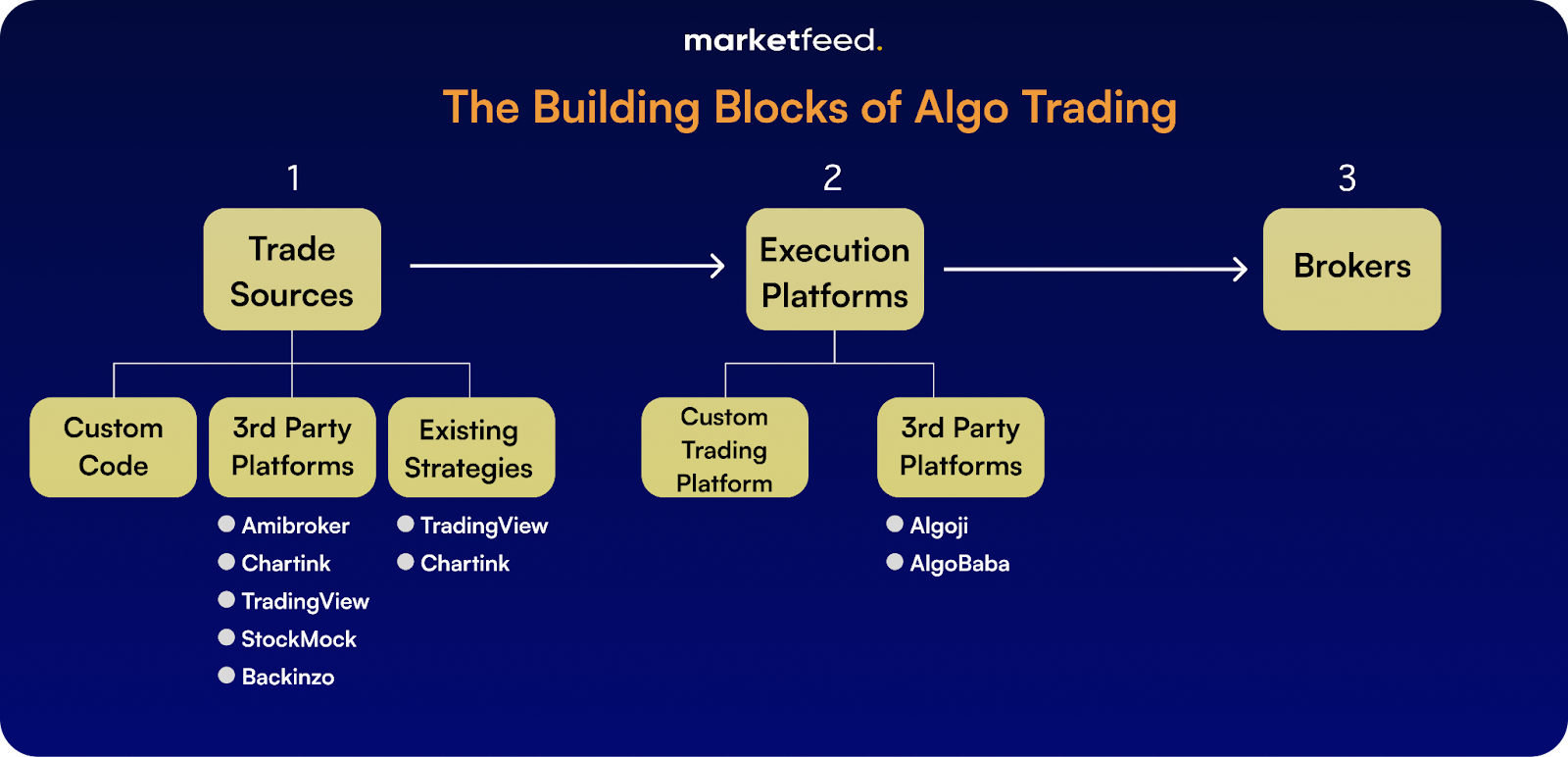
                The Building Blocks of Algo Trading

                This image represents significant components of an algo trading system, categorising them into three broad parts: trade sources, execution platforms, and brokers.

                algo trading system | marketfeed

                1. Trade Sources:

                An algo trading system must be backed by dependable data sources and trading signals. These resources provide important data and insights that enable traders to construct algo trading strategies, backtest them, and run them efficiently. In this stage, traders can have three approaches: custom code, custom strategies on third-party platforms, and using pre-built strategies available on these platforms. Let’s explore these approaches in depth:

                Custom Code:

                First, using fully custom code offers maximum flexibility. Traders can code highly tailored strategies that closely conform to their trading goals using programming languages like Python. Everything from the smallest detail of data processing to the execution will be under one’s control. However, this approach requires a good deal of programming knowledge and expertise in financial markets.

                Developing Custom Strategies on Third-Party Platforms:

                Secondly, some traders like to develop their custom strategies on third-party platforms. These offer powerful tools and interfaces for creating and testing trading algorithms. Some of them are:

                • Amibroker: It’s a comprehensive desktop-based software designed for stock analysis and algo trading. The platform offers extensive customisation in technical analysis and strategy development.
                • Chartink: With its easy-to-use interface and a wide array of technical indicators, Chartink assists traders in creating and scanning for specific trading setups without having to write code.
                • TradingView: Intended for those traders who would like to code their strategies in the Pine Script and share them with the global community. The platform offers basic backtesting facilities.
                • StockMock: It is designed especially for backtesting any option strategy and provides a user-friendly interface to test trade ideas.
                • Backinzo: This all-in-one solution offers flexible backtesting and seamless integration with most data providers, making it the ideal choice for traders seeking detailed and accurate evaluations of their trading strategies.
                • Algotest: AlgoTest makes it easier for retail traders by including many pre-built strategies and easy-to-use tools, allowing them to go through the entire backtesting process.

                Use Existing Strategies from Third-Party Platforms

                Many traders opt to use existing strategies on third-party platforms. This can save time and reduce the complexity of developing a strategy from scratch. Platforms like Chartink and Tradingview offer a wide range of pre-built algorithms that can be adopted or customised to fit specific trading goals.

                Each approach offers distinct advantages, allowing traders to build, test, and execute strategies that can thrive in competitive markets. You can choose either approach based on your expertise, resources, and objectives.

                2. Execution Platforms:

                After developing and perfecting a trading strategy, the next crucial step is execution. This is where execution platforms come in, effectively connecting strategy development with the actual execution of trades on the exchange.

                One of the main ways to achieve this is by developing and coding a personal trading execution platform. In this way, one exercises maximum control and personalisation, and any trader can tailor the execution process to their liking. A trader who codes his execution logic can optimise for speed and minimise slippage. They can ensure trading strategies are executed precisely as intended. However, creating a custom execution platform is quite a resource and expertise-intensive. So this would be more suitable for advanced traders or big financial institutions that have teams of in-house developers.

                Alternatively, many traders opt for third-party execution platforms that simplify things and lighten the technical burden. Platforms like AlgoJi and AlgoBaba offer robust execution capabilities without asking traders to build it all from scratch:

                • AlgoJi: Offers advanced execution tools and analytics, making it ideal for traders who need precision and performance in executing complex strategies.
                • AlgoBaba: AlgoBaba bridges the gap between strategy development and execution. It enables traders to automate their trades with minimal setup. By using their execution platform “STOXXO”, traders can automate their strategies quickly and efficiently with a user-friendly interface and smooth broker integration.

                3. Brokers:

                A broker plays a crucial role in providing direct access to the markets and executing trades. When choosing a broker, it’s important to pick one with strong API capabilities. This allows smooth integration with your algo trading system, ensuring efficient and reliable trade execution.

                [An API is a set of protocols and tools that enable the software to interact with and place orders on different trading platforms, exchanges, or brokers.]

                A broker’s API acts as the medium between your strategy and the markets. A well-designed API enables real-time communication with the broker’s platform, ensuring fast and precise trade execution. This is crucial because delays or errors during execution can lead to missed opportunities or unexpected losses. Choosing a broker with a strong API ensures a reliable trading system, even in the most volatile market conditions.

                A broker with strong API support provides detailed documentation, examples, and technical assistance, making it easier to set up and maintain your algo trading system. This reduces the time and effort needed for integration, allowing you to focus on refining your trading models rather than dealing with technical issues. For success in algo trading, it’s essential to partner with a broker committed to API performance and support.

                Conclusion

                While having a great strategy is important, success isn’t guaranteed by this single aspect of algo trading. Good data quality and low latency (responses with minimal delay) are essential in building trading algorithms. Ensuring compliance with regulations and proper reporting will help avoid legal complications. A solid system with backup servers minimises downtime and keeps trades running smoothly. You’ll also need to continuously optimise your strategy since markets are changing constantly, and adapting will keep you profitable. Use a prominent cybersecurity solution to protect your private algorithms and safeguard trading systems.

                Building a successful algo trading system requires a careful blend of strategy, technology, and compliance. By integrating reliable data sources, choosing the right execution platforms, and partnering with a broker that offers strong API support, traders can create a strong algo trading system. As you navigate the world of algo trading, these foundational elements will help you maintain an edge, adapt to changes, and achieve sustained profitability!

                Categories
                Algo Trading

                Common Misconceptions About Algo Trading: Debunked

                Are you curious about the buzz surrounding algo trading? You’re not alone! In recent years, this innovative approach to trading has taken India by storm, captivating both big institutions and individual traders. But with all the hype, you could easily get caught up in certain misunderstandings or misconceptions surrounding algo trading. In this article, we’re pulling back the curtain on algo trading. We’ll bust common misconceptions and shed light on the real challenges and limitations of this trading approach. Whether you’re a seasoned pro or just starting out, get ready to see algo trading in a whole new light!

                Misconception 1: Algo trading is a completely hands-off approach to trading

                A common misconception about algo trading is that it is a completely hands-off approach. Many traders believe that once the algorithm has been set up, they can just sit back and watch profits roll in. Yes, algorithms automate trade execution, but they still need constant monitoring and management.

                Market conditions are dynamic, and an algorithm that performs well under one scenario can turn out unexpectedly under another. That is why you need to keep an eye on your algo trading system. Issues like network delays, order errors, or misconfigurations can cause problems that require immediate attention. 

                Creating a successful algorithm requires months of research, coding, and backtesting. Even after it goes live, you need to stay updated on changes in technology, regulations, and market conditions.

                The following points could help reduce potential losses:

                • Set alerts for technical issues and system failures to resolve them quickly.
                • Your algo trading strategies must be reviewed periodically and optimised.
                • Keep yourself updated on regulatory changes and market events.

                Misconception 2: Algo trading guarantees risk-free returns

                Another common myth is that algo trading ensures risk-free, out-of-the-world returns. Many traders fall victim to misconceptions fueled by people on social media who propagate unrealistic promises and exaggerated profit projections. However, the fact of the matter is that algo trading carries risks, just like any other trading activity, and does not guarantee success.

                An algo trading strategy succeeds when you thoroughly backtest them using high-quality data, implement measures to manage risk and adapt to changing market conditions. Even the most sophisticated algos are bound to lose during periods of high market volatility or unexpected events. One should have realistic expectations and a clear understanding of the risks involved when working on algo trading. You must also consider the various costs involved in algo trading, including brokerage, platform charges, taxes, etc., which can significantly impact returns.

                Misconception 3: Algo trading is easy and offers continuous scalability.

                Many new traders think that algo trading is easy and has unlimited potential in scaling up. This is a big misconception.

                Firstly, creating a successful algorithm and strategy is not simple. It requires a thorough understanding of financial markets, quantitative analysis, and programming. Even with these skills in place, developing an algorithm that constantly performs well is tough. It involves extensive optimisation, validation, and backtesting to ensure reliability.

                Secondly, there are limitations to scaling up an algo trading strategy or system. As you increase the volume of trades, you may encounter problems like slippage, market volatility, and technical issues. Large volumes can move market prices and reduce your profitability. Additionally, higher trade volumes can strain your trading infrastructure and cause delays. While scaling up, you might face practical challenges that can negatively affect your overall performance.

                Traders need to understand these limitations and design strategies with realistic expectations for scalability. To make your trading scalable, consider the following:

                • Account for market liquidity and order execution while developing trading algorithms.
                • Invest in strong trading infrastructure to handle higher volumes, and implement monitoring and adjustment strategies to minimise market impact.

                Misconception 4: DIY algo trading platforms deliver the best results

                Do-it-yourself (DIY) algo trading platforms like uTrade Algos, Tradetron, and Algo Test allow traders (especially beginners) to create and run their strategies seamlessly. Such platforms offer tools and predefined strategies or templates that you can customise to fit your needs.

                However, there is a common misconception that DIY algo trading platforms will work flawlessly without any issues. While these platforms offer a range of powerful features, they also come with their own set of limitations. One significant risk is the potential misuse of out-of-the-box features if they are not managed properly. These platforms provide predefined strategies and templates that can be customised, but they may not always fit perfectly with your specific trading goals or market conditions. Simply relying on pre-built solutions without proper testing can lead to suboptimal results and unexpected issues.

                Do note that DIY platforms can help you achieve profitability if used properly. Understanding their features in-depth can help you set realistic expectations and use these tools more effectively. To get the most out of DIY platforms:

                • Test and customise: Do not run on default settings. Optimise and fine-tune them as per your goals in trading and prevailing market conditions.
                • Understand limitations: Many algo trading platforms could lack the flexibility or sophistication of a completely customised solution.
                • Monitor and adjust: To remain effective, performance should be reviewed regularly and adjusted to accommodate changing market conditions.

                Misconception 5: Assuming exact returns as that of backtest results

                Backtesting is essential in developing any algo trading strategy. It involves running the algorithm/strategy on historical data to determine how well it might have performed and detect weaknesses. However, relying on backtest results alone can be misleading!

                Backtest results can be very deceiving for several reasons. They are based on historical data, and there is no guarantee that past success will repeat. An algorithm that looks great in backtesting might fail in live trading due to changes in market dynamics or data quality issues. 

                Another risk is overfitting, where an algorithm focuses too much on historical data and gives prominence to random fluctuations rather than real patterns. To avoid this, use strong validation techniques and out-of-sample testing to ensure your algorithm remains robust and adaptable. Regularly update your strategies to keep them relevant, and don’t forget to factor in transaction costs, slippage, and market impact.

                To learn more about backtesting, out-of-sampling testing, and other best practices please read this article: The Ultimate Guide to Backtesting Algo Trading Strategies

                Misconception 6: Algo trading is an easy path to trading success

                Many people believe that algo trading is an easy path to make big profits without much effort. With sophisticated algorithms, it’s tempting to think that automated trading is the simplest path to earn easy money. However, this is a misconception that often leads to disappointment.

                Algo trading is anything but an easy route to success. To create and run a profitable algo trading system, one must have extensive knowledge of the financial markets, data analysis, and coding. Traders should put many hours into researching, backtesting, and optimising strategies. Even with all this work, there are no guarantees, as market conditions can change unexpectedly.

                Additionally, algo trading faces challenges like technical glitches. You’ll need to keep your algorithms updated. An algorithm that isn’t optimised, monitored and adjusted regularly can quickly become ineffective. So while algo trading is a powerful tool, it doesn’t ensure easy success or continuous profits.

                Conclusion

                The advantages of algo trading include its efficiency, lack of emotional bias, and potential profitable returns. However, it’s not free of challenges and misconceptions. Success in algorithmic trading means continuous efforts with realistic expectations and careful management. It’s not a “set it and forget it” method to trading, but requires constant monitoring and maintenance. You also need to be aware of the key risks involved. One has to have a clear head while approaching algo trading. It’s not an automatic way to gain easy profits, but a sophisticated way requiring commitment and expertise.

                If you’re interested in algo trading, it’s important to develop, test, and maintain your algorithms to make them work effectively. Remember that it’s difficult to scale it up due to market dynamics and technological limits. You need years of specialised knowledge to create effective algorithms. While backtesting is useful, its effectiveness depends on how critically its results are interpreted and how they are used with other assessment methods. By clearing up common misconceptions and using a realistic & informed approach, traders can balance the benefits and challenges of algo trading to achieve long-term success!

                Categories
                Algo Trading

                Charting the Course: What’s the Future of Algo Trading in India?

                Algorithmic trading (or algo trading) is rapidly gaining popularity worldwide and transforming financial markets. It involves the use of automated, pre-programmed trading instructions and sophisticated computer software to execute lightning-fast trades and profit from patterns in the market. In this article, we explore the evolution of algo trading. We’ll offer a comprehensive look at its past, present, and future— and whether it represents the future of trading!

                Before we dive into the world of algo trading and its future outlook, it’s important to take a step back. Let’s first understand the origins of the Indian stock market and see how far it’s come!

                The Evolution of the Stock Market in India

                India’s stock markets began during colonial rule when the East India Company first offered shares and bonds. The stock exchanges we see today, like BSE and NSE, came into existence only in the 19th and 20th centuries. Initially, brokers would verbally negotiate prices and shout their offers to place orders on the trading floor. These exchanges would then issue paper share certificates, which were at the risk of being misplaced or lost. Fast forward a few years and brokers could place orders over the telephone.

                Eventually, the introduction of Demat accounts in 1996 allowed shares to be traded electronically. This changed the landscape of the Indian stock market by increasing transparency and reducing broker-made errors.

                In 2008, the Securities & Exchange Board of India (SEBI) facilitated the implementation of Direct Market Access (DMA). This allowed institutions to go past the broker and directly place orders on the stock exchanges. The lack of a middleman or intermediary completely shifted the market dynamics!

                And the next revolution to take the market by storm was algo trading! Algorithms, or computer programs, shape our daily lives, influencing how we think and perform everyday tasks. Algo trading falls under this category and has become a valuable tool for traders. Let’s learn more about it!  

                So What is Algo Trading?

                Trading has evolved over the past few years owing to rapid advancements in technology and growing competition. Algo trading is a result of this progress. It’s a method of executing orders in the financial markets (stocks, currencies, commodities, derivatives, etc.) using pre-programmed trading instructions. Some of its benefits are:

                • Greater speed and efficiency in carrying out the trades.
                • Elimination of human errors and misjudgement.
                • Algorithms can process large volumes of data and recognise patterns that human traders might overlook. 
                • Helps to diversify your portfolio.

                Algo Trading: A Journey from Past to Present

                If history is known to repeat itself, wouldn’t you rather use past data and patterns to analyse candles than stay anxiously glued to the screen, looking for entry points? This is exactly why algo trading has been gaining popularity. Let’s see how it all began!

                Algo trading can be traced back to the 1970s when the New York Stock Exchange (NYSE) used algorithms that consisted of simple rules to govern their trading strategies. This enabled traders to mechanically and seamlessly place orders when prices were favourable. Over time, experts further explored the benefits of algorithms, transforming them into tools that learn from past patterns and analyse markets.

                Algo trading entered the Indian market in the late 2000s when High-Frequency Trading (HFT) became possible after the introduction of DMA. By 2010, this form of trading started gaining popularity, mostly among big institutions and High Networth Individuals (HNIs).

                The emergence of Application Programming Interface (API) has enabled a more holistic growth in algo trading. An API is a set of protocols and tools that allow software to interact with and place orders on different trading platforms, exchanges, or brokers. Various discount brokers like Zerodha, Upstox, and Angel One offer APIs, which allow individuals like you and me access to the algo trading market.

                Also read: What’s the History of Algo Trading in India?

                Recent Advances in Algo Trading

                The advancements in API made algo trading a much more attractive option to retail traders in India. With the market being highly competitive, many started to dabble in algo trading to adapt, implement better strategies, and gain an edge over others. The Covid-19 pandemic was the prime opportunity for this! With access to new technologies and the main element of being at home, traders had the incentive to take on new challenges. 

                However, SEBI hasn’t set clear regulations for retail algo traders yet. While it is not illegal, the lack of a governing body poses a threat to many. To combat this until firm regulations are in place, many algo trading platforms have sprung up, allowing individual traders to create, test, and deploy algo trading strategies. Tradetron, Utrade Algos, AlgoTest, and QuantMan are examples of such platforms.

                Also read: Top 5 Trading Platforms For Beginners in India 

                Looking Forward: Future Predictions on Algo Trading

                Algo trading is a transformative field with the potential to reshape the entire financial market. India ranks among the top 10 countries globally in technological advancements and AI research funding. With benefits like enhanced decision-making, reduced burden on investors and traders, and early risk identification, it’s no wonder that algo trading is gaining attention!

                The growing success stories of retail investors in the West, combined with increased interest in financial markets and advancements in artificial intelligence (AI) and machine learning (ML), are major factors fueling the algo trading boom. Innovations such as robo-trading and quant trading represent significant progress, optimising the potential for making profits by placing multiple orders simultaneously— one to capture gains and another to limit losses.

                SEBI is also taking steps to make algo trading more accessible. There have been talks of introducing regulations on algo trading for retail traders, which could improve its legitimacy and credibility among Indians.

                With such steps and exciting opportunities, algo trading offers a unique approach compared to the traditional methods!

                Conclusion

                We are rapidly moving toward an automated world where technology plays an integral role in our daily lives. People are constantly seeking ways to take advantage of patterns and trends, minimising the time spent on manual analysis. Algorithms have emerged as powerful tools in this pursuit! 

                However, like many tech innovations, algorithms present a paradox: we can’t live without them, yet they challenge the irreplaceable value of human judgment. While automation simplifies tasks, the unique insights and intuition of the human mind remain essential. The key to progress lies in finding the right balance between these factors.

                Currently, algo trading strategies contribute to nearly 50-55% of the total trading volume in India, according to data from the Association of National Exchanges Members of India (ANMI). However, only about 10% of the retail trading volume is driven by algo trading. With ongoing support from SEBI through evolving regulations, inspiring success stories, and promising results, algo trading is set to gain even more popularity in the coming years. These factors will likely encourage more people to embrace algo trading, further boosting its adoption!

                Categories
                Algo Trading

                Discover Success Stories in Algo Trading. What to Learn from Them?

                Are you curious about algo trading but feeling uncertain or sceptical? You’re not alone. In a world where computers seem to rule the markets, it’s natural to wonder: Can real people still succeed in algo trading? Many traders are intrigued by the potential of algo trading but hesitate to dive in, unsure of whether it truly delivers results. The good news is that real success stories in algo trading can offer valuable insights and inspiration. In this article, we’ll explore how traders have harnessed the power of algorithms to achieve remarkable success, helping you decide if algo trading is the right path for you!

                Success Story 1: Jim Simons & Medallion Fund

                The first success story takes us into quantitative investing and the iconic Medallion Fund, run by US-based Renaissance Technologies. Founded in 1982 by mathematician James Harris Simons, Renaissance Technologies has become synonymous with the success of algo trading.

                The Medallion Fund, founded in 1988 and usually viewed as the most successful hedge fund in history, sets itself apart with complex mathematical models and algorithms to locate and exploit market inefficiencies. Its performance has been nothing less than astounding, returning an average of about 66% per annum before fees over the last three decades!

                What makes the Medallion Fund popular is its data analysis approach. Renaissance hires numerous scientists, mathematicians, and engineers to work through massive volumes of historical data in search of patterns and correlations. This helps them develop predictive models that guide trading decisions. The algorithms evolve with time, adapting to the new market conditions and changes in data inputs.

                The success of Renaissance Technologies and the Medallion Fund has generated enormous wealth for its investors. But more importantly, it has extended the limits on quantitative finance. Its story shows us how deep mathematics and computer science can be applied to financial markets to deliver astounding results.

                To know more about Jim Simons and his success story, you can go through this article:

                Who is Jim Simons: The Mathematician Who Cracked Wall Street?

                Success Story 2: Two Sigma Investments – The Power of Machine Learning

                The second case study concerns Two Sigma Investments, a hedge fund and technology company that has made its mark by applying machine learning to algo trading. New York-based Two Sigma was created in 2001 by John Overdeck and David Siegel. Since then, it has become one of the world’s largest hedge funds, with over $60 billion under management.

                The success of Two Sigma has been based on the ability to process and analyse huge structured and unstructured data. Algorithms of this company scan through traditional financial data and alternative sources like satellite imagery, social media sentiment, and even weather! Two Sigma’s algorithms are better positioned to make informed trading decisions by identifying correlations and patterns that human traders might miss. 

                Over the years, Two Sigma has outperformed traditional hedge funds and market indices. Its flagship funds have delivered high-ended double digits, even under difficult market conditions. Such performance has attracted massive attention from institutional investors and helped Two Sigma grow its assets under management rapidly.

                The case of Two Sigma demonstrates how vital the merging of machine learning and big data analytics into algo trading can be. This example also documents the power of interdisciplinary approaches to finance and underlines how technology innovation is increasingly key to generating returns in modern markets.

                Success Story 3: Virtu Financial – High-Frequency Trading Mastery

                Our third success story is that of US-based Virtu Financial, taking us into the world of high-frequency trading (HFT). Founded in 2008 by Vincent Viola, Virtu has grown to become one of the most successful electronic market-making firms in the world, providing ultra-fast algo trading strategies.

                The success of Virtu Financial can be attributed to its ability to execute trades at mind-boggling speeds and volumes. It has developed algorithms where razor-thin price discrepancies across markets and asset classes could be pinpointed and subsequently exploited. In most cases, the discrepancies last fractions of a second, but Virtu’s high-speed systems can profit from them.

                What differentiates Virtu in this space is not just its execution speed, but the consistency and quality of its risk management. In the company’s IPO filing in 2014, the company mentioned that there had been just one losing trading day out of nearly 1,300 trading days over four years! That is a testament to Virtu’s algo strategies and risk management systems. In 2022, Virtu Financial generated $2.5 billion in revenue, with a net income of approximately $452 million! The firm has consistently maintained high profitability, thanks to its efficient trading algorithms and infrastructure.

                The example of Virtu Financial illustrates how much high-frequency trading algorithms can affect financial markets. It highlights how technological capabilities can help create new-age business models within the world of finance. It also stresses the role of speed, accuracy, and risk management within trading environments!

                Success Story 4: Nitesh Khandelwal & QuantInsti

                While we’ve discussed top performers in the global algo trading landscape, India has its own success stories. One notable figure is Nitesh Khandelwal, co-founder of QuantInsti, a leading institute in quantitative finance and algo trading.

                Nitesh Khandelwal hails from Kota, Rajasthan. He completed his Electrical Engineering from IIT Kanpur in 2005 and post-graduation from IIM Lucknow in 2007. Khandelwal developed an interest in algo trading during his MBA days. He initially planned a startup in algo trading with friends, but faced regulatory challenges as SEBI had not yet allowed this form of trading in India. He worked at ICICI Treasury and later headed a team of traders at a proprietary desk in Mumbai. When SEBI finally permitted algo trading in 2008, Khandelwal and his team launched iRageCapital in September 2009, focusing on algo trading consulting.

                Despite initial challenges, iRageCapital grew to become a respected name in the market. Khandelwal also co-founded QuantInsti, a training business in algo trading, which now has a global presence in 140 countries. Khandelwal emphasises the importance of statistical abilities, technology, and domain knowledge for success in algo trading. He believes that even retail traders can become successful algo traders with the right training and tools.

                Nitesh Khandelwal’s journey highlights the evolution of algo trading in India and the importance of perseverance and innovation in overcoming regulatory and market challenges!

                Conclusion

                The stories of Renaissance Technologies, Two Sigma Investments, and Virtu Financial show us the transformational power of algo trading. These firms have moved the boundaries in quantitative finance and trading technology. Their successes reflect some central themes:

                1. The strength that comes from combining expertise in mathematics, computer science, and finance.
                2. The importance of quickly mastering and analyzing large amounts of data.
                3. The need for constant innovation to stay ahead in ever-changing markets.

                These firms have changed market dynamics by boosting efficiency and liquidity. Alongside trading algorithms, advanced risk management systems play a key role in their success. As algo trading evolves, the combination of AI, machine learning, and quantum computing will unlock new possibilities in finance. These success stories highlight the immense potential of blending human creativity with scientific methods, inspiring the next generation of traders and tech experts.

                Categories
                Algo Trading

                Python for Algo Trading Strategies: Libraries and Frameworks

                Many traders love Python for its simplicity and robust library ecosystem, harnessing its power and flexibility in deploying algo trading strategies. Python is a popular programming or coding language used by beginners and experts alike to create a wide variety of applications; from web development to data analysis and artificial intelligence. In this article, we will cover major Python libraries and frameworks that traders use to create, test, and run algo trading strategies. We’ll cover all areas: data analysis, technical analysis, backtesting, and machine learning, making it an all-inclusive resource for beginner and professional traders within the algo trading landscape.

                Why is Python the Most Preferred Coding Language in Algo Trading?

                There are many alternative coding languages like C++, Java, R, and MATLAB but have you wondered why Python is the most popular language used in algo trading? Several characteristics of Python make it the crowd-favourite. One of the main reasons is that Python is open-source, which means traders can modify and build their strategies. 

                Python is less complicated. It uses libraries that increase code readability and reduce the size of the code. So algo traders can save a lot of time while coding and strategising. The array of libraries that Python provides for algo trading also makes it one of the most highly efficient languages for backtesting and live trading. 

                Which Python Libraries are Useful for Algo Trading?

                Before learning about Python libraries, you should know what a library is. Libraries are collections of pre-written code, usually in classes, functions, and modules, that programmers use without writing the code from scratch. Each coding language (like Python) has a wide range of libraries. Some of the popular Python libraries used on algo trading are: 

                1. NumPy 

                NumPy is one the most commonly used libraries for algo trading. It is the fundamental library used for computing in Python. Algo traders use this for numerical computations, data manipulation, preprocessing, and scientific computing. Remember, this library is more effective when it’s paired with other libraries like Pandas or Scikit-Learn. We will learn about them below. To install Numpy, you need to execute “pip install numpy” in a command-line interface or terminal (Command Prompt on Windows or Terminal app on macOS.

                [Before running the command, make sure that you have pip installed. You can check by typing pip –version in your terminal. If it’s not installed, you may need to install it first.]

                2. Pandas

                Pandas helps in structured data manipulation and analysis. It is generally used in conjunction with NumPy. This library handles missing data, eliminates noisy data, and resamples data to different calculations. Its data structures like DataFrame and series allow traders to handle time-series data easily. Traders extensively use Pandas for data processing, feature engineering, and backtesting. You need to execute “pip install pandas” to install this.

                3. LightGBM

                LightGBM is a popular machine-learning library in Python developed by Microsoft. It manages large data sets and high dimensional data, making it one of the best choices for algo traders. LightBGM is a highly efficient and fast implementation of gradient boosting making the process optimised. Algo traders wishing to use this library can install it using “pip install lightgbm”

                4. Zipline

                Zipline is an open-source library built in Python. Traders use this to develop, backtest and execute trading strategies. This is the best generalist trading strategy with more than 13,000 stars on GitHub. It provides an inclusive framework for backtesting and built-in support for various types of data. It has data bundles to access historical data and pipelined API for complex factor modelling. You can install this using “pip install zipline” or “pip install zipline-reloaded”.

                5. Backtrader

                Backtrader is an open-source library for strategy development. This provides a wide range of adat feeds, making it a versatile choice for both live trading and backtesting. It offers a user-friendly API that makes implementing the strategies easier and supports various data formats like CSV, Pandas DataFrame, and online data sources. Backtrader has an active community, making it easier for retail traders to start and get support. You need to use “pip install backtrader” to use this.

                6. Ta-lib

                Ta-lib is used extensively for technical analysis. It consists of over 150 technical indicators. Its candlestick pattern recognition can identify over 60 candlestick patterns. Ta-lib can easily integrate with libraries like Pandas, NumPy, and Backtrader for better performance. 

                7. Fast-trade 

                Fast-trade is a Python library developed for algo trading, focusing mainly on efficient backtesting and strategy development. It uses NumPy for performance and works with OHLCV (open, high, low, close, volume) data. It provides access to various technical indicators, including tools for creating, testing, and visualising trading strategies against historical data. As it is open source, it is open to customisation and contributions from the community. Fast-trade helps balance performance with flexibility and will support traders & developers working in the algo trading domain.

                8. Tulip Indicators

                Tulip Indicators is a well-known, open-source library used for technical analysis in algo trading. It hosts a collection of more than 100 technical indicators and claims high performance with low memory usage. This includes moving averages, oscillators, volatility measures, and other mathematical functions common in trading strategies. One can easily integrate Tulip Indicators into trading systems and backtesting frameworks.

                Which Python Frameworks Do Traders Use in Algo Trading?

                1. Backtrader 

                Backtrader is a Python framework for strategy development, testing, and execution. It has a user-friendly API to create trading systems, backtest them on historical data, or even live trade. Backtrader supports a wide array of data feeds, brokers, and analysers, hence it is versatile for various trading scenarios. The event-driven architecture allows easy implementation of complex strategies. It possesses plotting facilities with clear visualisation of backtest results. What differentiates Backtrader from other libraries is its flexibility, thorough documentation, and great community support. 

                2. QuantConnect (Lean) 

                QuantConnect is an integrated algo trading platform to be used with Lean (an open-source engine). It is a cloud-based environment where one can design, backtest, and go live to trade with quantitative trading algorithms on many asset classes like equities, forex, and cryptocurrencies. QuantConnect provides access to huge amounts of historical data and support for many programming languages like C#, Python, and F#. It differs from others because of its ability to smoothly transition from backtesting to live trading. This platform offers a marketplace for sharing and discovering trading algorithms.

                3. Freqtrade 

                Freqtrade is an open-source cryptocurrency trading bot written in Python. The application targets the crypto market exclusively and supports various exchanges through the ccxt library. Freqtrade features backtesting, hyperopt, edge positioning, and risk management tools. It allows the user to build a strategy based on indicators and supports both spot and futures trading. Freqtrade is famous for the activeness of its development process, extensive documentation, and strong community support— thus very popular in the crypto algorithmic trader community. 

                4. Hummingbot 

                Hummingbot is a free source, community-driven framework aimed at creating and running crypto trading bots. It supports several exchanges and strategies, such as market making, arbitrage, and liquidity mining. Hummingbot is a decentralised and democratised algo trading platform in the cryptocurrency space. This has both a command-line interface and a very user-friendly Graphical User Interface, making it easy to use by both expert programmers and people who have never programmed before. One essential factor of this platform is transparency. It gives users the power to audit its code and contribute to its development. Hummingbot also provides educational resources and a supportive community for algo traders.

                What are Other Coding Language Options for Algo Trading?

                • C++: This is preferred for high-frequency trading systems where microsecond performance matters. Its low-level control and speed make it ideal for implementing complex algorithms and handling large volumes of market data efficiently.
                • Java: It is widely used in large-scale trading systems due to its scalability. Java’s extended libraries make it an ideal platform for building a reliable multi-threaded trading application that can handle advanced order management.
                • R: Quantitative analysts widely use it for statistical modelling and backtesting trading strategies. Its powerhouse of data manipulation and visualisation features makes it excellent for exploratory data analysis and developing statistical trading models.
                • MATLAB: Researchers and academics typically use it for developing and testing trading algorithms. Its presence of financial toolboxes enables a user to prototype quantitative strategies efficiently and analyse financial time series.

                Conclusion

                Python is the language of choice for algorithmic trading due to its simplicity, versatility, and strong support in libraries or frameworks. It’s open source and enjoys good support from various communities.

                Although Python is the dominant language, C++, Java, R, and MATLAB still have their unique flavour, which only they can bring at certain points in the process of creating a trading system based on an algorithm. The choice of language usually rests on the specific requirements of the trader, the complexity of the strategies, and the trading infrastructure.

                As the field of quantitative trading evolves, it is of utmost importance that traders stay updated on the latest tools and technologies. Whether a complete newbie or one wanting to improve their existing strategies, the resources and frameworks mentioned in this article could guarantee success in the world of algo trading. 

                FAQs

                1. Why is Python the most preferred language for algo trading?

                Python is the most popular language for algo trading due to its simplicity, open-source nature, and extensive libraries that support numerical computing, data analysis, backtesting, and machine learning. It allows traders to quickly develop and modify trading strategies with minimal coding effort, making it an efficient choice compared to languages like C++, Java, R, and MATLAB.

                2. What are the essential Python libraries used in algo trading?

                Some of the most commonly used Python libraries for algo trading include:

                • NumPy – For numerical computations and data manipulation.
                • Pandas – For structured data analysis and time-series processing.
                • LightGBM – A machine-learning library optimised for large datasets
                • Zipline – An open-source library for backtesting and executing trading strategies.

                3. What are some Python frameworks that traders use in algo trading?

                Traders use several Python frameworks for strategy development, testing, and live execution, including:

                • Backtrader – A user-friendly framework for backtesting and live trading
                • QuantConnect (Lean) – A cloud-based platform for backtesting and live trading across multiple asset classes
                • Freqtrade – A trading bot framework specifically designed for cryptocurrency trading
                • Hummingbot – A decentralised framework for building and running crypto trading bots
                Categories
                Algo Trading

                Which are the Best Books to Learn Algo Trading?

                “The more that you read, the more things you will know. The more that you learn, the more places you’ll go.”

                Are you eager to dive into the world of algo trading but don’t know where to start? You’re not alone! Many aspiring traders seek reliable resources to learn about this exciting and complex field. And books can be a great place to start! In today’s article, we will look at books which can help you master algo trading from the basics.

                Top Books on Algo Trading for Beginners

                If you are a beginner and want to learn the basics of algo trading, these books are for you:

                1. “Building Winning Algorithmic Trading Systems” by Kevin J. Davey

                Kevin Davey is a professional trader and a top-performing systems developer. He is the author of 4 best-selling books on trading & investing and is recognised as a thought leader in algorithmic trading system development. This book is like a journal or diary that describes his adventure in the world of trading. It clearly describes the development of trading systems and talks about practical strategies & potential dangers. This is a good starter for beginners in the iterative process of designing and testing feasible algo trading systems.

                2. Algorithmic Trading: Winning Strategies and Their Rationale” by Ernie Chan

                Ernie Chan is considered a legend in the world of algo trading. He holds a PhD in Physics from Cornell University and has extensive experience working as a quantitative researcher for prominent investment banks such as Credit Suisse, Morgan Stanley, and Millennium Partners. In this book, he lays out the basics of the field for a beginner. It provides a solid volume of strategies and risk management tools. Moreover, Chan’s approach is practical and accessible to people who have no background in programming.

                Top Books on Algo Trading for Intermediates

                If you’re someone who knows the basics of the stock market/algo trading and is looking to improve your knowledge, then these are the books you can check out:

                1. “Machine Learning for Algorithmic Trading” By Stefan Jansen

                Stefan is the founder and CEO of Applied AI, which builds solutions using machine learning for leading industries. This book forms an important link between machine learning and trading. Jansen shows how one can comprehensively implement machine learning techniques in algorithmic trading. Handling data, feature engineering, and model optimisation make the book an important tool for traders who aim to add advanced analytical means to their trading strategies.

                2. “Python for Finance: Mastering Data-Driven Finance” by Yves Hilpisch

                Dr Yves J. Hilpisch is the founder and managing partner of The Python Quants, a group that focuses on using open-source technologies for financial data science, algorithmic trading, and computational finance. This book will be useful for any trader who’s serious about improving their coding skills. It focuses on Python for financial applications, with special emphasis on algo-trading.

                3. “Algorithmic Trading and DMA: An Introduction to Direct Access Trading Strategies” by Barry Johnson

                This is a foundational text that provides a comprehensive overview of algorithmic trading and direct market access (DMA). It is designed to introduce both beginners and experienced traders to the intricacies of these rapidly evolving fields. The book explains how markets function at a granular level, providing a solid base for understanding algorithmic trading strategies. It covers a variety of strategies, from basic to advanced, equipping readers with practical knowledge.

                Top Books on Algo Trading for Advanced Learners

                If you are someone who wants to master algo trading, then you definitely need to check these books out:

                1. “Advances in Financial Machine Learning” by Marcos López de Prado

                Marcos López de Prado currently serves as Global Head of Quantitative Research & Development at the Abu Dhabi Investment Authority. This book is for professional traders who know machine learning and want to implement it in financial markets. De Prado raises practical issues with the implementation of machine learning in trading, discussing typical risks and solutions. The book is full of deep insights and will be highly relevant to mature traders in the Indian market who want to use big data in their strategies.

                2. “The Science of Algorithmic Trading and Portfolio Management” by Robert Kissell

                Robert Kissell has over 20 years of professional experience specialising in economics, quantitative modelling, statistical analysis, and risk management. He has written a comprehensive book on advanced trading analytics, model validation, and risk analysis. If you are an advanced trader looking to get deeper into the intricacies of algorithmic trading systems and portfolio management, it’s a must-read. The book is aimed at those who intend to improve their trading strategies and analytical skills.

                Conclusion

                The algo trading domain is vast. The books described in the article— the foundational ones that introduce the basics to advanced works on cutting-edge machine learning applications— are of great value to traders at all levels. These books will help you build a strong theoretical base and give you insights to apply them in live markets. Moreover, you can upskill on risk management strategies and portfolio optimisations. 

                Books give you great knowledge, but hands-on practice is just as important in algo trading. As you learn, remember that markets change often. You’ll need to keep learning and trying new things. You might come back to these books many times. You’ll also find new information as this exciting field grows and changes. Keep exploring and learning as you go on your algo trading journey!

                FAQs

                1. Which book should I start with if I am completely new to algo trading?

                “Building Winning Algorithmic Trading Systems” by Kevin J. Davey could be a great starting point into the world of algo trading. It explains the basics in an easy-to-understand way and helps you develop a strong foundation.

                2. Can I learn algo trading just by reading books?

                Books are a great resource, but practical experience is key. Try applying what you learn by backtesting strategies, using trading simulators, or enrolling in online courses.

                3. Do I need to know programming to understand these books on algo trading?

                Not all of them! Some beginner-friendly books focus on trading concepts without coding, while others introduce Python and machine learning for advanced strategies.

                Categories
                Algo Trading

                Essential Resources to Learn Algo Trading: Courses & Tutorials

                The field of algo trading is rapidly evolving every day and it has become necessary to master it to remain competitive in the Indian stock market ecosystem. Whether you are a beginner who is eager to grasp the basics or a professional planning to gain an edge over others, there’s always scope to learn something new. In this article, let’s look at how online courses and informative tutorials can guide you through every level to master algo trading. 

                Beginner Level Courses & Tutorials

                If you are a beginner and want to learn the basics of algo trading, these are some sources which will help you build a strong foundation:

                1. Udemy 

                Udemy offers a wide range of algo trading courses targeting beginner traders. You can gain lifetime access to resources to learn at your own pace. 

                The courses on Udemy will teach you how to create trading bots for exchanging stocks and build Python-based trading algorithms. You can join hundreds of algo trading courses (most of them are paid ones) and learn from experienced professionals. Some of the popular courses are:

                • Algorithmic Trading A-Z: This will teach you the basics of algo trading, how to build your own truly data-driven trading bot, and how to create, test, implement & automate unique algo trading strategies. 
                • Algorithmic Trading Options for the Indian Stock Market: This course is specially designed for options algo trading in Indian markets. It focuses on teaching and implementing algo trading strategies using Zerodha and Angel One APIs. It also emphasises risk management and the practical application of options trading tools. 

                2. Algorithmic Trading YouTube Playlist by Dhan

                This is a complete guide/playlist by the YouTube channel of Dhan, an online stock trading and investing platform. It is a completely Hindi-based tutorial that will provide insights on algo trading. The information provided ranges from the introduction of algo trading and basics of Application Programming Interface (API) to algo trading strategies with live market charts.

                [An API is a set of protocols and tools that enable the software to interact with and place orders on different trading platforms, exchanges, or brokers.]

                Check out the playlist: What is Algorithmic Trading? Basics of APIs Explained in Hindi – Beginners Guide | Dhan

                3. Algorithmic Trading Module by NSE

                This course aims to provide students with NSE Academy Certification in Financial Markets (NCFM). This is a self-learning course, and you will be given a solid syllabus on algo trading, order types, trading strategies and architecture, and audit & compliance processes. 

                This is a paid course worth ₹7,670. At the end, students have to take an examination of 100 questions and 60 minutes will be provided. The passing percentage of this exam is 60%. The certificate obtained after passing this exam will be valid for 3 years. 

                To learn more about the course, check NSE’s official website.

                4. Algo Trading for Beginners by Pushkar Raj

                This a collaboration between stock market educator Pushkar Raj Thakur and Sharique Samsudheen, the CEO & co-founder of marketfeed. This video explains everything about algo trading, clarifying misconceptions and explaining its basics. It covers strategy creation, backtesting, and automation. Sharique shares a specific intraday option selling strategy for Bank Nifty, detailing its rules, backtested performance, and considerations for traders. The emphasis is on understanding the process and developing strategies on your own, rather than relying on others.

                Don’t forget to watch the video: Algo Trading Strategy for Beginners | How to Make Money in the Share Market?

                5. PGPAT by the Indian Institute of Quantitative Finance

                The Post Graduate Program in Algorithmic Trading (PGPAT) is an online program offered by the Indian Institute of Quantitative Finance (IIQF), Mumbai. The course is taught by highly qualified and experienced market practitioners to produce industry-ready algo-trader professionals at the Master’s level. 

                Any fresh graduates, management students, finance professionals, prop traders, or any retail trader can join this course. After completing this course, students can join the trading desks of various financial institutions, either in India or at global locations. They can set up their independent prop desks for algos. 

                To get more information about the course, check IIFQ’s official website.

                Advanced Level Courses & Tutorials

                If you are a trader with intermediate algo trading knowledge looking to advance your skills, here are valuable resources to help you master the art of algo trading:

                1. Coursera

                Coursera’s a great platform to learn algo trading concepts from industry experts. You can enroll for courses designed by faculties of top universities or global institutions. These courses cover a wide range of topics— from quantitative trading strategies to financial modelling and machine learning. You can also gain a foundational understanding of the various tools used in the field. If you are looking for a platform for a structured path to learn algorithmic trading with proper certifications, then Coursera might be the best option for you. 

                Some of the best algo trading courses are paid and some are free to pursue. A few of the best-rated and reviewed popular courses are:

                • Trading Algorithms: This algo trading course is designed by the Indian School of Business (ISB) and provides information on trading algorithms, advanced trading algorithms, and trading strategies in emerging markets.

                To explore more algo trading courses on Coursera, click here.

                2. Executive Programme in Algorithmic Trading (EPAT):

                This is a high-ranking, investment-oriented algorithmic trading program offered by QuantInsti (a pioneering institute in quantitative finance and algo trading). The cost of this program is around ₹3 lakhs – purely for professionals! It focuses on quantitative techniques, machine learning, and strategy development. EPAT provides students with the skills necessary for developing and managing advanced algo trading systems.

                To know more about this course, check out their website.

                3. Machine Learning and Quant Strategies with Python by freeCodeCamp.org

                With more than 6 lakh views, this video discusses algorithmic trading strategies using machine learning and quantitative methods in Python, focusing on factors and portfolio optimisation. You will learn about the best trading algorithms and strategies to enhance your financial toolkit. You’ll explore the Unsupervised Learning Trading Strategy, utilising S&P 500 stock data to master features, indicators, and portfolio optimisation. This is the best for beginners looking for a tutorial in English.

                Take a look at the video: Algorithmic Trading – Machine Learning & Quant Strategies Course with Python

                Conclusion 

                Algo trading helps you in various aspects of trading. You can learn it for free, whether you’re just starting or already know a lot. Websites like Coursera and Udemy have classes you can take. Institutions like IIQF and NIFM help you learn and try it out yourself. You can also watch videos on YouTube to learn how algo trading works and pick up useful tips.

                To keep up with the changing world of finance, it’s important to keep learning new skills. This is your chance to learn about algo trading and come up with new ideas. Don’t miss out on this opportunity to grow!

                Learn Algo Trading – FAQs

                1. Do I need programming knowledge to start algo trading?

                Not necessarily. Many platforms offer no-code algo trading solutions. However, learning Python or other programming languages can help you create and customize your own trading strategies.

                2. Are free algo trading courses as good as paid ones?
                Free courses are great for learning the basics, but paid courses often provide structured content, certifications, and hands-on experience. If you’re serious about algo trading, investing in a paid course may be beneficial.

                3. How long does it take to master algo trading?

                It depends on your background and learning pace. Beginners may take a few months to grasp the basics, while professionals refining their strategies may take years of practice and continuous learning.

                Categories
                Algo Trading

                Is Algo Trading Profitable? Unveiling the Truth!

                Algorithmic (algo) trading has been a hot topic in financial markets, gaining attention among Indians over the past 3-4 years. And why wouldn’t it be? Algo trading offers impressive speed and accuracy in executing trades. By relying on algorithms, traders can stick to predefined strategies without being influenced by emotions or market sentiments. But here comes a million-dollar question: is algo trading profitable? In this article, we explore the profit potential of algo trading using real data, expert insights, and real-life examples.

                Understanding Algo Trading

                Before getting into profitability, let us clearly define algorithmic trading. Algo trading is a method of trading wherein computer programs or “algorithms” are used to execute trades in the financial markets (stocks, futures & options, commodities, etc.) as per set criteria/rules. Such algorithms are based on complex mathematical models involving statistical analysis and technical indicators, which help them make very quick decisions on trades.

                Here’s an example: suppose you want to trade a “Reliance” stock; you can ask your algorithm to calculate its 50-day and 200-day Simple Moving Average (a trading indicator). You can add a condition that a buy signal is generated as soon as the 50-day SMA crosses the 200-day SMA, and correspondingly, the sell signal when the SMA goes low. Orders can be executed automatically at lightning-fast speeds based on these signals.

                The Debate Over Profitability in Algo Trading

                The probability of making profits in algo trading generally depends on two major elements:

                1. Knowledge of Securities and Technical Analysis:

                Technical analysis requires powerful insights that human and algo traders use when making decisions. Algorithms do this by analysing tons of historical data in milliseconds through a process called backtesting.

                2. No Emotional Bias:

                One of the greatest strengths of algo trading is the ability to remove human emotions from the equation. A great algorithmic system will constantly seek profitable trades at precise times based on the set rules— free from the influence of personal fear and greed.

                Success Stories in the Algo Trading Space

                Here are some good examples to prove the potential of making profits through algorithmic trading: 

                1. Jim Simons and Renaissance Technologies

                US-based hedge fund Renaissance Technologies, founded by mathematician Jim Simons, is well-known for its Medallion Fund. This fund has been an outperformer through advanced quantitative models and algorithmic strategies. Simons himself is one of the most successful traders in the world. 

                To read more about Simons and his story, read this article: Who is Jim Simons: The Mathematician Who Cracked Wall Street?

                2. Quant Research and Trading Firms

                Companies like AlphaGrep, Graviton, and Tower Research have based their success on advanced trading algorithms. Such companies demonstrate how robust quantitative research can gain considerable profit through algorithmic trading.

                Credibility in the Algo Trading Space

                Even though these stories of institutional success sound impressive, in most cases, individual traders have made mixed statements about algo trading. However, it should be noted that high success is correlated to a high degree of quantitative skills and knowledge.

                Many algo-traders and firms in India and internationally publish verified profit and loss statements in hopes of being better fundraisers. A few YouTubers and influencers share the results of their trades, though one should be very careful about verifying such claims independently!

                Expert Comments and Reality Checks

                Experts in this field insist that algo trading is a profitable business but certainly not any get-rich-quick type. We would encourage you to consider the following points:

                • Skill and Knowledge Requirements: If you want to become profitable in algo trading, you’ll need deep knowledge of quantitative methods, programming, and market dynamics. It’s certainly not a playground for casual enthusiasts or people who want to get-rich-quickly.
                • Regulatory Scenario: SEBI has framed regulations & guidelines on algorithmic trading (mostly for big financial institutions). These regulations are primarily aimed at safeguarding fair market practices and the protection of investors.
                • Success Rate: It should be noted that the success rate in algo trading, like conventional trading, remains skewed. Although some traders are successful with steady profits, most beginners and occasional traders are unsuccessful due to a lack of necessary expertise and time commitment.

                Is Algo Trading for You?

                You can choose an algo trading strategy based on the following factors:

                • Skill Set and Commitment: You must be willing to build up the required quantitative analysis and programming skills. Most successful algo traders have mathematical, statistical, or computer science backgrounds.
                • Financial Resources: Algorithmic trading requires a considerable upfront investment in technology, data, and education. Are you willing to spend the necessary funds?
                • Risk Tolerance: While algorithms can automate risk management, a key component of trading is losses. Are you prepared to withstand the potential financial and emotional stress?

                Resources for New Algo Traders

                If you’re interested in algo trading, here are some resources that could prove useful:

                1. Courses: There are a lot of paid and free online courses through which you can learn the basics and advanced aspects of algo trading.

                2. Backtesting tools: Platforms like AlgoTest allow you to backtest the algorithms against historical data and develop/fine-tune your strategies.

                3. Continuous Learning: Stay updated on the latest happenings in financial markets, programming languages, and quantitative methods from credible online resources and industry publications.

                Conclusion: Can Algo Trading Result in Profits?

                Algorithmic trading can be profitable for people who have the right skills, mindset, and resources. However, it’s certainly not an easy way to get rich. Success in algo-trading would demand: 

                1. Strong background in quantitative methods and programming

                2. Continuous learning and adaptation to market changes

                3. Rigorous back-testing and risk management

                4. Compliance with regulatory requirements

                5. Realistic expectations and patience

                The potential returns of algorithmic trading are huge for skilled traders who can navigate the challenges. However, you must explore this field with a clear understanding of the challenges and commitments required for success

                Keep in mind that the road to profitability in trading, whether algo or manual, lies essentially in your understanding of the market dynamics. Applying sound strategies consistently and maintaining discipline in the approach is very essential.

                With credible sources having verified results and continuous improvements, it’s not impossible that aspiring algo traders could bring their platform up to the level of a successful quant trader. Algorithms may indeed be the future of trading; however, profitability is timelessly linked to the skill, knowledge, and dedication of the trader.

                Categories
                Algo Trading

                Common Mistakes to Avoid in Algo Trading in India

                If you’re a trader navigating the complex financial markets, you must have heard about algo trading. It is the latest revolution where trades are executed with the help of computer “algorithms” or automated systems. If manual trading feels like a big hassle now due to your busy schedules, it’s time to consider algo trading! There are primarily two ways to participate in algo trading in India:

                1. Complete DIY (do-it-yourself): In this approach, you need to create a trading strategy from scratch, code your algorithm (yes, it requires extensive technical knowledge), test it, and deploy it on your own.

                2. Use dedicated platforms: Various algo trading platforms in India offer built-in strategies and tools to test & execute trades seamlessly.

                But regardless of the methods you practice, errors are not just inevitable— they’re an essential part of the learning process. In this article, we will discuss various mistakes traders make while practising algo trading. We will also see how you can avoid those mistakes to have a more profitable trading journey. 

                What Are The Common Mistakes Algo Traders Make?

                If you choose the DIY approach, here are some common mistakes you could make while practising algo trading:

                1. Poor backtesting

                Backtesting is the process of testing the trading strategy/algorithm using historical data to predict its effectiveness in live markets. It’s like rewinding the clock and watching your strategy play out, trade by trade! 

                Poor backtesting can mislead traders, causing them to overestimate a strategy’s real-world performance. Having limited historical data or ignoring noisy data (​​those containing errors, missing values, or irrelevant information) could lead to losses or sub-optimal results. Moreover, excessive testing or under-testing may also create problems during live trading. 

                Traders often expect backtesting results to work out exactly as planned. However, such results often fail to capture the full complexity of live markets, including unexpected events, sudden shifts in liquidity, or changes in market sentiment.

                To learn more about backtesting, please go through this article: Backtesting Algo Trading Strategies.

                How to Avoid This?

                • Focus on the key principles of backtesting like defining objectives and choosing appropriate parameters & indicators. Ensure your historical data is accurate and complete (use reliable data sources from reputable providers).
                • Backtesting for longer periods (>3-5 years) helps build confidence that the strategy will perform well in various real-world market cycles.
                • Don’t use all your data for backtesting. Divide it into two sets: in-sample (for developing the strategy) and out-of-sample (for testing its performance on unseen data). This method will help you understand how well the strategy adapts to new market conditions.

                2. Neglecting transaction costs and slippages

                While backtesting, many traders forget to account for slippages or transaction costs like brokerage charges, taxes, and commissions. Traders need to incorporate these estimates into their models while backtesting. Neglecting this can lead to overestimating profits. Strategies can look extremely powerful and profitable on paper, but missing transaction fees can lead to reduced profits or even losses. 

                [A “slippage” occurs when the price at which your order is executed does not match the price at which it was requested.]

                How to Avoid This?

                • Include and modify the trading algorithm to incorporate these costs to ensure the results will give more realistic net profits. Estimate slippage based on historical data, trade size, etc.
                • Test with different cost conditions to figure out the perfect strategy. Look out for latency (delays) in order placement and execution!

                3. Over-optimisation

                Also known as curve fitting, this occurs when the algorithms are too excessively fine-tuned to historical data. The algorithm might fail to figure out new market conditions due to over-optimisation.

                For example, consider an algo trader developing a moving average crossover strategy for the HDFC stock. Starting with a simple 50-day and 200-day moving average, he optimises his strategy extensively using 12 years of historical data (2010-2022). 

                Then, he adjusts parameters, adds filters for volatility & volume, and eventually creates a complex strategy that uses 73-day and 187-day moving averages. This strategy promised an impressive 40% annual return in backtests. However, when deployed in 2023, it quickly lost 17% in the first three months, failing to adapt to new market conditions. This strategy fell victim to overfitting by being too precisely calibrated to past data, ignoring market noise, and becoming overly complex!

                How to Avoid This?

                • Start with a basic strategy with limited parameters. Look for reasonable strategy performance with acceptable risk metrics. Only add new conditions or features if they deliver better results over time.
                • Use out-of-sampling testing and maintain cross-validation techniques.
                  [Out-of-sample testing is a kind of testing you do on unknown data to know whether a backtested strategy is strong enough to work in a live market environment. Cross-validation is used to assess how well a trading strategy or algorithm will perform on new, unseen data.] 

                4. Incomplete technological knowledge

                Ignoring the technical aspects of algo trading can lead to errors, bugs, or faulty trade executions. Investors must have excellent coding skills (unless they use a third-party platform). Additionally, they need to be well-versed in data handling and all the software required for algo trading.

                How to Avoid This?

                • Stay updated with all the latest technological advancements in the field of financial markets & algo trading. Practice coding and improve your skills regularly.
                • Look for alternate platforms where you can use their in-built strategies or strategy builder for creating and deploying. Eg: AlgoBulls.
                • Consult experts in the areas you lack and attend various lectures, talks and seminars on algo trading.

                5. Insufficient risk management

                Risk management plays a very crucial role in algo trading. Failing to set stop-loss parameters or having a faulty algorithm could even wipe out your entire trading capital. Concentrating risk in a single strategy, asset class, or market sector increases vulnerability to specific market events. Moreover, many traders fail to account for low-probability, high-impact events (black swans), which can lead to significant losses when these events occur.

                How to Avoid This?

                • Use position-sizing (allocating a predetermined percentage of your capital to each trade), portfolio diversification, and set stop loss (SL) rules to reduce the potential risks and implement operational risk management strategies like recovery and backup systems, backup power sources, etc.
                • Make sure your algo trading strategies adapt to changing market conditions and economic events. Keep track of news and trends which can create market volatility.

                6. Poor Trade Execution

                We feel trade execution is the most important step in algo trading. A well-designed strategy can identify profitable opportunities. But if execution is poor, you might not capture those gains. For example, an algorithm aiming to buy at a specific price point might miss the opportunity entirely if execution is slow or inefficient.

                How to Avoid This?

                • Invest in high-performance hardware and software, co-location services, and low-latency network solutions to improve the infrastructure.
                • Improve order execution by carefully selecting appropriate order types, and setting stop-loss orders and developing effective order routing algorithms. 

                7. Lack of monitoring

                A trader’s work is not completed after the algorithm is deployed, they can’t just relax. You could incur losses if you fail to keep track of your algorithm or conduct regular checks for glitches. Failing to monitor the trade performance and not optimising the technical indicator parameters/conditions could cause severe issues in the long run. Not having a backup plan or alerting systems can result in losses or low profits.

                How to Avoid This?

                • Use real-time risk management in trading, implement monitoring tools and set up alerts to evaluate real-time performance.
                • Implement regular reviews, and performance assessments and make necessary timely changes to optimise the probability of making profits.

                Mistakes to Avoid While Using Third-Party Platforms

                One of the biggest mistakes algo traders make is falling victim to mis-selling. This mostly comes from the platforms that offer trading strategies or algorithms. In most cases, this comes as:

                • Inflated performance claims: Most of these platforms or vendors will exaggerate the historical return of their algorithms by presenting overly optimistic back-test results that do not include real-world factors.
                • Lack of transparency: Sellers rarely disclose the exact methodology of their algorithm, which might make it difficult for buyers to check and validate certain claims or even know the risks involved.
                • Not considering individual suitability: Most buyers never check whether the pre-made algorithm fits their risk tolerance, capital, or trading goals.
                • Underestimating challenges in implementation: Most traders underestimate the technical expertise required to properly implement and maintain the purchased algorithms.

                Traders should properly research all algo trading platforms, demand complete documentation of their services & costs, and verify the performance claims independently.

                Conclusion

                In the world of algo trading, mistakes are inevitable and part of the learning process. However, true growth comes from recognising these errors and avoiding them in the future. The path to becoming a successful trader can be challenging, but with the right mindset and tools, you can confidently navigate the complexities of the market. We’ve highlighted several common mistakes traders often encounter and practical solutions to overcome them. Remember, knowledge is power, but the application of that knowledge leads to success!

                How will you use these insights to refine your trading approach and build a more robust strategy? Let us know in the comments down below!

                Frequently Asked Questions (FAQs)

                1. What is the biggest mistake beginners make in algo trading?

                The most common mistake beginners make while starting algo trading is poor backtesting (testing the trading strategy/algorithm using historical data to predict its effectiveness in the live markets). Moreover, many traders either over-optimise their strategy based on past data (curve fitting) or forget real-world factors like transaction costs (brokerage) and slippages. This leads to unrealistic expectations or even losses in live trading.

                2. How can I prevent over-optimisation (curve fitting) in my trading algorithm?

                To avoid over-optimisation, start with a simple strategy using limited parameters (rules) and only add more rules if it improves performance consistently. Use out-of-sample testing and cross-validation techniques to ensure your strategy adapts to real market conditions rather than just historical data.

                3. Why is it important to monitor your trading algorithm even after deploying it?

                Algo trading isn’t a “set it and forget it” system. Markets change, errors can happen, and external factors can impact performance. Regular monitoring, alerts, and adjustments help keep your strategy profitable and running smoothly.

                Categories
                Algo Trading

                What are the Popular Technical Indicators Used in Algo Trading?

                There is a famous quote by John J Murphy, a leading financial analyst from the US: “Technical analysis is a skill that improves with experience and study. Always be a student, and keep learning.” Today, let’s dive into the world of technical indicators and understand their role in a trader’s journey. This in-depth article explores popular technical indicators used in algo trading strategies!

                What is Technical Analysis?

                Before learning about technical indicators, let’s first dive into the basics of technical analysis. It’s essentially the practice of using historical price and volume data to form analysis and forecast the direction or trend of stock prices (or any other financial security/asset), which can ultimately be used to make trading decisions.

                Technical analysis can be seen as the study of collective investor psychology or sentiment, closely related to behavioural finance. We humans (and maybe automated trading systems) determine prices in the stock market. The price is set at the equilibrium (a state of balance) between supply and demand at any given moment.

                What are Technical Indicators?

                Technical indicators are mathematical tools or calculations derived from a financial asset’s (stock, index, etc.) historical price and volume data. It is used to predict market trends or volatility. These are more advanced than price action methods as they use mathematical calculations to predict a stock’s future movement. 

                Technical indicators can be primarily classified into four types:

                • Volume
                • Trend
                • Momentum
                • Volatility

                Want to learn more? Click here to explore our dedicated article on technical indicators!

                Why Do We Need Technical Indicators in Algo Trading?

                Algo trading executes orders in the financial markets (stocks, currencies, commodities, derivatives, etc.) using automated or pre-programmed trading instructions. The ‘algorithm’ places orders based on specific rules and criteria. These criteria include price, timing, and quantity instructions. You can incorporate technical analysis and indicators into your algorithms. They offer an objective and rule-based approach to trading. Algo traders can implement such methods to manage risk before executing buy or sell orders.

                You can train your algorithm to analyse data and generate signals based on asset price movements. [Typically, there are three main types of trends: uptrend, downtrend, and sideways.] These analyses show the historical behaviour of an asset and its major fluctuations. This makes processing pattern identification and trend recognition easier for the algorithms.

                Traders can easily implement technical indicators using various programming languages and algo trading platforms. Most of these indicators are versatile and applicable across different markets, making them valuable for diversified algo trading strategies.

                Let’s look at some popular traders’ choice of trend indicators: 

                1. Moving Averages

                A moving average is the average of the closing prices of a security/asset (index, stock, F&O, etc.) over a specified period. It is an indicator that helps traders determine the trend in the market and identify key levels of support and resistance.

                • There are primarily two types of moving averages: Simple Moving Averages (SMA) and Exponential Moving Averages (EMA).
                • The SMA is calculated as the mathematical average of prices over a certain period, while the EMA gives higher weightage to recent prices.
                • If the price is above the moving average, it’s an uptrend. If the price is below the moving average, it’s a downtrend. You can also combine and use two or more moving averages.
                moving average - technical indicators used in algo trading | marketfeed

                The chart displays a 20-period moving average based on the closing prices of the last twenty 5-minute candles. If you switch to a daily timeframe, the average will be calculated using the closing prices of the previous twenty one-day candles.

                • Bonus: Traders can use two major signals in their algo: Golden Cross and the Death Cross. Golden cross is a buy signal that is executed when the 50-day SMA crosses above the 200-day SMA. Death cross is a sell signal executed when the 50-day SMA goes below the 200-day SMA.

                Here’s an Example!

                Let us assume that you want to trade in ‘Reliance’ stock. You can define your algorithm rules to execute buy orders when a Golden Cross occurs and execute sell orders when a Death Cross occurs.

                2. Supertrend 

                A supertrend is a simple line used to indicate the market trend. This is one of the most used trend-following indicators in algo trading. It can also act as support or resistance.

                • The line changes its colour between green and red based on the price moment in the underlying security.
                • If the price is below the Supertrend line (in red), it indicates bearishness or a downtrend. On the other hand, if the price is above the Supertrend (in green), it indicates bullishness or up-trend.
                • Supertrend will tell you to initiate a position or give you the confidence to stay in the trade till the trend sustains.
                • You can use TradingView to apply Supertrend or any such indicator.
                supertrend - technical indicators used in algo trading | marketfeed

                When observing the above chart of Bank Nifty, we can see that the Supertrend line is green when the price is above the line and red when the price is below the line. It also recommends when to buy and sell.

                Here’s an Example!

                Suppose you want to trade in ‘Tata Power’ stock. You can code your trading algorithm using this indicator in such a way that it executes buy signals when the price is above the Supertrend line and generates sell signals if the price is below the Supertrend line.

                3. Average Directional Index (ADX)

                Traders use the ADX indicator to identify the strength of a trend, making it a valuable tool for avoiding sideways markets and improving trading decisions. During analysis, we can adjust the indicator settings based on time frames and market conditions to maximise its full potential.

                Generally, traders use ADX with Directional Indicator (DI) lines for better results. This consists of three parts:

                1. ADX line: This measures the strength of the trend and it ranges from 0 to 100. The higher the value, the stronger the trend.
                1. Positive DI (+DI): This is an upward directional line that measures the strength of the upward trend.
                1. Negative DI (-DI): It is a downward directional line that measures the strength of the downtrend. 

                What are ADX Values? 

                ADX values help to predict trend strength:

                • Traders use directional lines to predict the upward or downward trend. When the +DI line is above the -DI line, the asset is experiencing an upward trend and vice versa.
                • While ADX is effective in avoiding sideways markets, traders need to be aware of the potential drawbacks such as missed price moves during transitioning phases.
                • Combining ADX with other indicators like RSI and MACD will give better results and ensure risk management for traders. This will help them confirm trends and avoid false signals.
                • Consider an example of HDFC stock with ADX and DI lines:
                adx - technical indicators used in algo trading | marketfeed

                Here’s an Example!

                If you wish to trade Wipro stock. You can include this indicator with DI lines and train your algorithm to generate a buy signal when the +DI line crosses above the -DI line and ADX suggests a strong trend. It should execute a sell order when the +DI line is below the -DI line and ADX indicates a strong trend in the opposite direction.

                4. Parabolic SAR:

                Parabolic SAR (Stop and Reverse) is a trend strength indicator. This is also used as a trend reversal indicator. It is widely used to calculate stop-loss orders and reverse points, which helps traders identify trends and make trading decisions. It is plotted as a series of dots which help traders analyse an asset.

                • This is constructed to set trailing stop-loss points. This indicator moves with the asset price and helps traders by booking profits by adjusting the stop-loss levels as the trend progresses.
                • The dots play an important role in deciding the trend of the asset. If the dots remain below the asset price, the uptrend is constant and intact. On the other hand, if the dots are positioned above the asset’s price, it indicates a downward trend.
                • Parabolic SAR and Acceleration Factor (AF) are directly proportional to the sensitivity to price changes. The higher the AF, the indicator is more sensitive to price changes. A lower AF reduces the sensitivity.

                [Acceleration factor is the parameter used to calculate SAR, determining how SAR dots adjust to changes in trends and price changes.]

                • This is also useful for figuring out potential trend reversals. This indicator gives signals for entering or exiting a trader, which will help traders manage their risks.
                • Like ADX, this will also give its best performance when combined with other indicators like Moving Averages.
                • Here is an example of Tata Steel stock with the Parabolic SAR dots indicating upward and downward trends.
                parabolic SAR | marketfeed

                Let’s look at an example!

                Suppose you have decided to trade Infosys Ltd stock. You need to develop your algorithm such that it executes a buy order when SAR dots below the price are detected and executes sell orders when SAR dots above the price are observed. 

                Expand Your Knowledge

                The indicators we have mentioned above are all trend-based. Now, let’s look at some of the popular indicators that are based on volume, volatility, and momentum:

                📍Bollinger Bands: A volatility indicator that provides information about market volatility and predicts price movements.

                📍On-balance volume (OBV): OBV is a volume indicator which uses volume flow to predict changes in stock price.

                📍Relative Strength Index (RSI): A momentum indicator that identifies when an asset/security is over-bought or oversold.

                Conclusion

                There is absolutely no doubt that technical indicators are powerful tools that can enhance your algo trading strategies. They provide objective, data-driven insights, momentum, and a well-defined approach to decision-making. The evolving financial market offers a wide range of indicators that traders can choose from. 

                Technical analysis provides crucial inputs for algo trading systems, but it’s also important that we don’t solely rely on them. No indicator is perfect, accurate, or yields 100% results all the time. They are additional tools to reduce the probability of making losses and enhance the decision-making process of trading algorithms. Combining these indicators with other factors like fundamental analysis, market sentiment, and proper risk management in your algorithmic trading systems is essential.