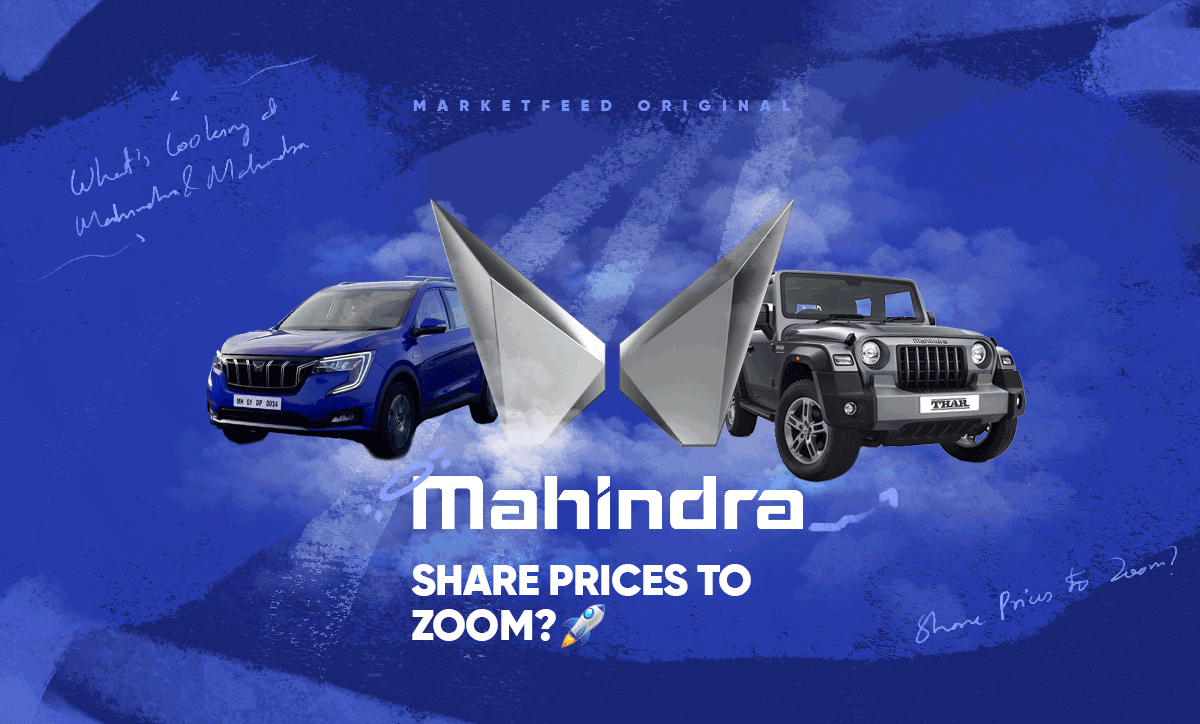
Mahindra & Mahindra also known as M&M is well recognized for its flagship vehicles like the Bolero, Thar, and XUV series. While the company has faced stiff competition from companies like Maruti Suzuki, Hyundai, and Tata Motors, things seem to be changing gradually. The automaker has recently announced the launch of its new vehicle, the XUV 700. Starting at just Rs 11.99 lakh (ex-showroom price), XUV 700 has sent petrol heads abuzz because of the dazzling features it offers. The company has also seen immense growth in its commercial vehicle, electric vehicle, and farm sector equipment segments. In this piece, we discuss how Mahindra is revamping its strategy and how it could add to its profitability in the coming years.
What’s Cooking?
Farm Equipment Sector
Mahindra is the largest farm equipment manufacturer in India. As of June 2021, it holds a 41.8% market share in FES, the highest in the last eight quarters. India had a healthy monsoon this year. The ongoing monsoons coupled with the upcoming rabi Kharif sowing season can give a boost to this segment.
New Launches
The company launched the updated versions of their flagship PVs, Mahindra Thar, and Mahindra Bolero Neo. With high demand, the Mahindra Thar has a 10 month waiting period while the Bolero Neo already had 4000 bookings before the first model hit the showroom. The company has launched its latest SUV variant, XUV 700. The variant comes with features that were seldom seen in earlier models. One can expect a huge waiting period since the launch of XUV 700 has set the auto market abuzz. The XUV 700 is expected to contribute significantly in terms of sales.
In the small commercial vehicle segment, the company launched its ‘Supro Profit’ range of trucks in July. The vehicle was met with a healthy demand in the market.
Electric Vehicle
The company is forraying into a different segment of electric vehicles (EVs). Mahindra’s Reva, e3o, and e-Verito were a huge success in the segment. Nonetheless, it hasn’t been able to compete with counterparts such as Tata’s Nexon or Tigor EV. Apart from passenger vehicles, Mahindra is one of the few companies that manufacture electric three-wheelers/rickshaws. As public transportation in India is shifting gears and progressing towards electric vehicles, a boost in sales of this particular segment could contribute immensely to revenue flow.
Mahindra CEO Anish Shah has said the company plans to invest Rs 3,000 crores in its EV-arm over a period of three years. The company has also set a goal of having 5 lakh electric vehicles on road in India by 2025.
Financial Performance and Future Prospects
In the first quarter of FY22, M&M’s profit was Rs 423.9 crore against a loss of Rs (-)97.6 crore in the same quarter last year. The company’s revenue for Q1 FY22 was up 17.24% and Operating Expenses went up by 24.57% over the same period.
However, M&M’s share price hasn’t performed well as compared to the NIFTY Index. As of June 29, 2021, M&M’s share price has only returned 25.36% over a year, compared to NIFTY 50 return of 45%. In 2013, M&M had acquired South Korean automaker Ssangyong for Rs 32,000 crore. Ssangyong remained a liability for M&M all these years contributing hugely to M&M’s losses. The company filed for bankruptcy in December 2020.
The last quarter has been fruitful for Mahindra & Mahindra. There has been a significant boost in sales in the Farm Equipment Sector (FES). In the Commercial Vehicle (CV) segment, the company has launched the Mahindra Supro Profit. Mahindra has also launched the latest version of their flagship Passenger Vehicles(PVs) – Thar and the Bolero Neo. The company is planning to draw competition by launching more vehicles in the SUV and the EV segment by the end of 2021.
While companies like Maruti Suzuki and Hyundai rule the auto sector in India, their focus has not been on EVs as such. Mahindra on the other hand has already invested Rs 500 crore in Research and Development (R&D) for EVs. With a lineup of new vehicles, Mahindra’s focus on EV and recovering auto market indicate a healthy revenue growth for the company.
MRF Q1 Results: Net profit rises 12-fold YoY to Rs 166 crore
MRF Limited reported a 1,130% YoY jump in consolidated net profit to Rs 165.58 crore for the quarter ended June (Q1 FY22). However, net profit has declined by 50.15% when compared to the previous quarter. Its revenue from operations rose 70% YoY to Rs 4,184 crore during the same period. EBITDA grew 49.2% YoY to Rs 2,460.7 crore in Q1. The tyre manufacturer’s total expenses increased by 63.5% YoY to Rs 4,054.24 crore during the April-June quarter of FY22.
Amara Raja Batteries to acquire 11.36% stake in Log 9 for Rs 37 crore
Amara Raja Batteries Ltd (ARBL) will invest ~Rs 37 crore for acquiring an 11.36% stake in Log 9 Materials Scientific Pvt Ltd, a Bengaluru-based battery-tech and deep-tech startup. ARBL is expected to be the primary partner for scaling up the manufacturing operations of Log 9’s battery and fuel cell technologies. The investment is part of ARBL’s ‘Energy & Mobility’ strategy, which focuses on entering into green technologies and solutions.
AstraZeneca Pharma Q1 Results: Net profit falls 45% YoY to Rs 10.24 crore
AstraZeneca Pharma India Ltd reported a 45.62% YoY decline in net profit to Rs 10.24 crore for the quarter ended June (Q1 FY22). Net profit has declined by 62.45% when compared to the previous quarter. Its revenue from operations fell 9.3% YoY to Rs 175.4 crore during the same period. The pharma company’s board has declared an interim dividend of Rs 2 per share.
Govt looks to cut import duties on electric cars to as low as 40%: Report
According to a report from Reuters, India is considering slashing import duties on electric cars to as low as 40%. The government plans to cut the tax rate from 60% to 40% for electric cars under $40,000 (~Rs 29.69 lakh). For EVs valued at more than $40,000, the Centre is looking at cutting the rate from 100% to 60%. This comes days after Tesla Inc appealed for a cut in India’s import duties. The EV giant argued that lowering import duties on EVs to 40% would make them more affordable and boost sales.
Subex Q1 Results: Net profit falls 11% YoY to Rs 13.48 crore
Subex Ltd reported an 11.08% YoY decline in consolidated net profit to Rs 13.48 crore for the quarter ended June (Q1 FY22). Net profit has declined by 13.6% when compared to the previous quarter. Its total income fell 2.62%% YoY (or 10.8% QoQ) to Rs 87.31 crore during the same period. Subex is an enterprise software company that provides digital trust products to communication service providers.
Equity mutual fund inflows surge more than three-fold in July
Investment into equity mutual funds surged more than three-fold in July amidst optimism about the economy, as restrictions eased after the second wave of Covid-19. Net inflows into equity and equity-linked schemes jumped ~277% over the preceding month to Rs 22,583.5 crore in July 2021. This is the fifth-straight month of inflows into the category and is the highest since April 2018. The data was released by the Association of Mutual Funds in India (AMFI).
Balrampur Chini Mills Q1: Net profit falls 44% YoY to Rs 77 crore
Balrampur Chini Mills Ltd reported a 44.7% YoY decline in consolidated net profit to Rs 77.92 crore for the quarter ended June (Q1 FY22). Net profit has declined by 67.34% when compared to the previous quarter. Its revenue from operations fell 20.2% YoY to Rs 1,140.44 crore during the same period. The company’s board has approved a proposal to buy back up to 52.5 lakh equity shares at a maximum price of Rs 410 per share. The Board of Directors has also approved a further expansion of ethanol production from 840-kilo litre per day (KLPD) to 1,050 KLPD.
Shree Cements Q1 Results: Net profit rises 91% YoY to Rs 630 crore
Shree Cements Ltd reported a 91.11% YoY increase in consolidated net profit to Rs 629.9 crore for the quarter ended June (Q1 FY22). Net profit has declined by 21.1% when compared to the previous quarter. Its total income rose 44.5% YoY (but declined by 13.3% QoQ) to Rs 3,775.9 crore during the same period.
Clean Science and Tech Q1 Results: Net profit rises 30% YoY to Rs 54 crore
Clean Science and Technology Ltd reported a 30.3% YoY increase in consolidated net profit to Rs 54.6 crore for the quarter ended June (Q1 FY22). Net profit has increased by 2.7% when compared to the previous quarter. Its revenue from operations rose 29.62% YoY (or 9.2% QoQ) to Rs 146.4 crore during the same period. Clean Science and Tech is a specialty chemical manufacturer based in Pune, Maharashtra.
CarTrade Tech IPO subscribed 41% on first day of bidding
The Rs 2,998.5 crore initial public offering (IPO) of CarTrade Tech was subscribed 41% on the first day of bidding. Retail investors have subscribed 0.8% against their reserved portion. Non Institutional investors (NIIs) and Qualified Institutional Buyers (QIBs) have subscribed 3% and 1%, respectively, against their reserved portions. To learn more about the IPO, click here.
Meanwhile, the Rs 5,000 crore initial public offering (IPO) of Nuvoco Vistas Corp was subscribed 16% on the first day of bidding. Retail investors have subscribed 31% against their reserved portion. Non Institutional investors (NIIs) have subscribed 1% against their reserved portion.
Indian Hotels Q1 Results: Net loss at Rs 277 crore
The Indian Hotels Company Ltd (IHCL) reported a consolidated net loss of Rs 277 crore for the quarter ended June (Q1 FY22). It had posted a net loss of Rs 279.9 crore in the corresponding quarter last year (Q1 FY21). Its revenue from operations jumped 139% YoY to Rs 344.55 crore in Q1 FY22. IHCL is a hospitality company that manages a wide portfolio of hotels, resorts, spas, etc. It is a subsidiary of the Tata Group.
The quarterly results of Tata Motors for Q1FY22 are out. The results aren’t that impressive, yet still better than the previous quarter. The company stares at a shortage of chips necessary to make cars. In addition, the COVID-19 imposed lockdowns have hugely impacted sales volume. The company’s cash cow, Jaguar-Land Rover’s (JLR) financial and operational performance seem dicey but are better than the last financial year.
According to a Bloomberg study, out of the 32 analysts tracking the Tata Motors stock, 20 have recommended a ‘BUY’ rating for it. The question is, despite being in Rs 4,450 crore loss in the first quarter of 2021, why are analysts recommending a ‘BUY’ for Tata Motors? Can the company come out of its losses in the near future? Does the company hold a hidden potential that general investors aren’t noticing? Let us dig deeper into the company.
How Has The Company Performed In Q1FY22?
The Tata Motors Group’s business is broadly divided into two parts. Jaguar Land Rover (JLR) and Tata Motors Limited (TML). JLR has operations all over the world and mainly manufactures high-end cars. TML on the other hand manufactures cars, trucks, buses, and even has a vehicle financing business, mostly in India.
The total revenue of the group was up by ~105% YoY. As compared to the previous quarter, revenue went down by ~25%. Net loss decreased by 41.48% QoQ and by 47.25% YoY.
JLR’s performance accelerated this quarter. As compared to Q1 FY21, JLR’s UK sales (units sold) were up +187%, North America +51%, Europe +124%, China +14% and Overseas +71%. Overall retail sales of JLR were up 68% over one year. The revenue for JLR was up 73.7% YoY, while its loss narrowed down by £303 million (~73%) over a year’s time.
Speaking of standalone results of TML. The company’s revenue increased by 343% YoY. The company’s pre-tax loss narrowed down to Rs 1,289 crore vs. a loss of Rs 2,141 crore in Q1 FY21. TML’s Electric Vehicle (EV) business delivered 5x revenue growth and the highest quarterly sales at 1,715 units.
Why Is Tata Motors Analysts’ Favourite?
Presently, Tata Motors faces three major challenges. Global semiconductor shortage, the impact of the COVID-19 pandemic, and debt management.
Every car requires a semiconductor chip for its vital functions. There is a global shortage and that has impacted the biggest players in the automotive industry throughout the globe. You can read more on the global semiconductor shortage over here. Moving forward, the global semiconductor shortage is likely to ease by year-end. Since this is a global crisis, major auto manufacturers are likely to invest in ramping up the supply of this chip. Tata Motors is handling the chip shortage in an efficient manner. It is using the existing stock to build vehicles that give higher profit margins. This way, Tata Motors can enhance profitability as well as cost-efficiency.
Coming to cost-cutting measures, JLR needs to sell a minimum number of cars every year in order to be profitable. This is because irrespective of the number of cars it produces, there are some ‘fixed’ costs attached to running a factory. In FY21, JLR reduced this ‘breakeven’, where it now only needs to sell 400,000 units to be profitable, instead of the earlier 600,000 units.
While the supply chain for the production of vehicles remains slow, Tata Motors has retail pending orders for more than one lakh units. This is the highest the company has ever received. If things go around smoothly and India manages to curb COVID-19 and ramp up the vaccination drive, one can expect Tata Motors to start operating at maximum capacity, naturally adding to profit margins. The government has come out in support of the auto industry by notifying a Production Linked Incentive (PLI) scheme for the auto sector, especially in the EV segment. Besides, Tata Motors (Tata Electric) is the largest manufacturer of EVs in India.
Tata Motors, including JLR, is a debt-laden company. The company has promised to be zero-debt by 2024. It had managed to reduce its debt quarter after quarter throughout FY2020, reducing debt by at least Rs 7500 crore. Tata Sons Chairman has recently reaffirmed its plans to go debt-free by 2024.
Conclusion
Looking at the brokerage and analyst reports, we see one common thing. None of them are thinking short-term. Almost all brokerages seem to have a long-term approach to the company. Analysts are expecting the chip shortage to end soon. As it should, having eaten up 30% of JLR’s past projected sales. The world’s largest semiconductor chipmakers viz. TSMC (Taiwan), NXP (Europe), and Intel (US) are ramping up production. We can expect an improvement in that area.
Tata is taking stringent cost-cutting measures, as mentioned in the previous section. There has been a surge of orders for Tata Motors. In the domestic market, Tata Motors witnessed a 19% month-on-month growth. It sold 51,981 units of vehicles in July 2021 as compared to 27,024 units sold in July 2020. Its passenger vehicle sales witnessed a 25% month-on-month growth selling 30,185 units of passenger vehicles as compared to 24,110 units in June this year.
So if sales are growing, debt is going down, then what could stop Tata Motors from becoming profitable? In the short term, it could be the rapid growth of different mutated variants of the COVID-19 virus. Another lockdown could obstruct just about any other industry. As long as the COVID-19 virus remains under check, Tata Motors could practically achieve its goal of going debt-free by 2024 and possibly turn into a profitable company sooner.
Countries around the world are making a conscious effort to transition from polluting combustible fuel-powered vehicles to electric vehicles (EVs) or those that run on various green fuels. India has also announced plans to de-carbonise within the next 30 years. Our country’s target of achieving 175 gigawatts (GW) of renewable energy capacity by 2022 has received a major boost through the provisions of the Union Budget 2021-22 as well.
People’s preferences are slowly changing, and we are witnessing a surge in EV sales globally. Automakers are also investing heavily towards the development of technology that allows cars to run on green fuels. Companies such as Toyota and Hyundai have developed vehicles that run on the most abundant element in the universe— Hydrogen. It is considered to be a breakthrough in the future of transportation (after EVs). Let us have an understanding of how hydrogen-powered cars work. Let us also find out if it will be a viable option for India.
Hydrogen as a Fuel: Features and Types
Hydrogen is the most common element in the universe. However, it only exists in the form of combinations with other elements. Hydrogen is commonly extracted from compounds such as water, and the extraction process can be quite energy-intensive. The sources and processes by which hydrogen is derived are categorised using colour tabs. Hydrogen produced from fossil fuels (primarily natural gas) is called grey hydrogen. Blue hydrogen is one that is generated from fossil fuels with carbon capture and storage options. Hydrogen generated from renewable power sources (solar, wind, geothermal) is called green hydrogen.
The concept of hydrogen-powered vehicles primarily revolves around the third method of deriving hydrogen. The main advantage of green hydrogen is that it is a clean-burning molecule. It can help reduce carbon emissions in sectors such as iron and steel, chemicals, and transportation.
How Do Hydrogen Fuel Cells Work?
Unlike solar or wind power, hydrogen is not a source of energy. It is an energy carrier. In order to power vehicles, a device known as fuel cell stack converts hydrogen fuel into electricity. A fuel cell converts chemical energy into electrical energy using oxidising agents through an oxidation-reduction reaction. Fuel cell-based vehicles combine hydrogen and oxygen to produce electricity to power the electric motor in vehicles. As they use electricity to run, we could say that hydrogen-powered vehicles are essentially electric vehicles (EVs).
This electric-chemical reaction is much more efficient or cleaner than combustion (burning petrol). Thus, cars or trucks that run with the help of hydrogen fuel cells have a near-zero carbon footprint.
Fuel cell electric vehicles (FCEVs) such as Toyota Mirai, Honda Clarity, and Hyundai Nexo use hydrogen gas to power an on-board electric motor. Interestingly, FCEVs have a much better range when compared to Tesla cars or other EV models. It only requires 5 minutes to refuel, unlike Teslas, which could take over an hour to fully recharge (depending on the trip). Also, FCEVs provide about five times better energy storage per unit volume and weight than battery-powered electric vehicles (BEVs). This means that such cars have more space for other features and can easily be used for long drives.
Challenges
The technology behind hydrogen-powered vehicles is still under developmentand is yet to be scaled-up. So far, Honda, Toyota, and Hyundai are the only automakers that are selling FCEVs commercially. At the same time, they are producing a very limited number of such cars. Only 25,000 hydrogen fuel cell vehicles were sold globally by the end of 2020. During the same period, the number of EVs sold was 8 million. A major challenge in the adoption of FCEVs is the lack of fuelling station infrastructure. There are less than 500 operational hydrogen stations in the world today. These stations are mostly found in Europe, Japan, and South Korea.
Another concern over hydrogen fuel cell vehicles is safety. Hydrogen is pressurised and stored in a cryogenic tank, which is a tank used to store materials at very low temperatures. The hydrogen is then fed to a lower-pressure cell and put through an electric-chemical reaction to generate electricity. There can be a risk of explosions due to these chemical reactions. However, Hyundai and Toyota have stated that the safety and reliability of hydrogen fuel tanks are similar to that of standard CNG engines.
India’s National Hydrogen Energy Mission
In the recent budget presentation, Finance Minister Nirmala Sitharaman launched a National Hydrogen Energy Mission, which will provide a road-map for using hydrogen as an energy source. The government has allocated Rs 1,500 crore towards the development of renewable energy sources. And, a significant amount out of this will be utilised for the Hydrogen Energy Mission. It would specifically focus on green hydrogen and how it can be used for increasing our country’s renewable energy capacity. This mission will provide a significant boost to the chemical, steel, and transportation industries.
Last year, Delhi became the first Indian city to operate buses running on hydrogen-blended compressed natural gas (H-CNG). H-CNG is a mix of 18% hydrogen in CNG. NTPC Limited is operating a pilot project to run 10 hydrogen fuel cell-based electric buses and fuel cell electric cars in Leh and Delhi. The power major is also considering setting up a green hydrogen production facility in Andhra Pradesh. Indian Oil Corporation (IOC) is planning to set up a dedicated unit to produce hydrogen to run buses at its research & development (R&D) centre in Faridabad, Haryana. Thus, we can see that India has already started tapping into the potential of hydrogen as an energy source. However, the fact remains that we must find a method to bring down the cost of producing or deriving green hydrogen.
Conclusion
Various industry experts have said that FCEVs are more likely to disrupt the automobile sector than battery-powered cars. This is because of major advantages such as very low refueling time, better range, and comparatively low prices. These factors pose a threat to electric vehicles (EVs) globally. Large automobile manufacturers such as Mercedes-Benz, GMC, and BMW (that have transitioned to developing EVs) have now created a separate team/segment dedicated to FCEVs.
In India, we would be able to see more hydrogen-powered vehicles plying on our roads in the near future. However, there is still a long way to go until this becomes a reality. The challenges faced by the launch of FCEVs have to be addressed in-depth. Automakers and government agencies must join forces to set up a vast network of hydrogen stations. This would encourage more companies to manufacture FCEVs at affordable prices. Most importantly, there must also be adequate measures to develop hydrogen fuel cell technology.
Let us look forward to seeing how India implements these ambitious goals to reduce overall carbon emissions to protect the environment.
On February 15, Jaguar Land Rover (JLR) announced a highly strategic plan that could accelerate the struggling carmaker’s revival. With the support of its parent company, Tata Motors, JLR would now focus on the production of electric cars. Governments and stakeholders around the world have welcomed this decision with open arms. Let us understand how this UK-based luxury car brand aims to achieve this huge task.
The Roadmap
Thierry Bolloré, the new Chief Executive Officer of Jaguar Land Rover, has laid out his vision for the luxury carmaker. The company’s ‘Reimagine Strategy’ centres around the electrification of both Land Rover and Jaguar brands. It would be based on separate architectures with two clear and unique personalities. The strategy will involve a deeper collaboration and knowledge-sharing with Tata Group companies to improve sustainability and reduce emissions. JLR will focus on adopting next-generation technology that would cater to the demands of its customers. A centralised team will be assembled to develop pioneering innovations in engineering, manufacturing, services, and much more.
JLR said it is committed to phasing out its internal-combustion cars by 2026. It is also making a heavy investment in hydrogen fuel cell technology. The company’s first fuel cell electric vehicle (FCEV) prototype is likely to run on UK roads by the end of 2021. This can be linked to the firm’s plans of becoming a net-zero carbon business by 2039.
All Jaguar models and 60% of Land Rover models will be completely electric by 2030. Jaguar will become an electric-only luxury brand from 2025, while Land Rover will launch six EV variants within the next five years. These models will be built on the Modular Longitudinal Architecture (MLA), which is an advanced platform used in electric and hybrid vehicles. The company would invest £2.5 billion (~Rs 25,270 crore) every year into electrification and related technologies.
Moreover, the automaker said it is on the path towards securing double-digit EBIT (earnings before interest and tax) margins and positive cash flow. JLR aims to become a negative net debt company by 2025.
JLR: Struggling to Improve Sales
Jaguar Land Rover contributes more than 79% to the total revenue of Tata Motors (as of FY20). However, the subsidiary has been bleeding money due to poor sales. While its operations in China (through Chery Jaguar Land Rover) are doing comparatively better, JLR has turned out to be a huge burden for Tata Motors. The effects of the Covid-19 pandemic and the uncertainty surrounding Brexit had a devastating impact on its production activities. During the previous financial year, the company had reported a loss of £3.6 billion (Rs 34,424 crore)!
JLR aims to address this issue with its latest strategy. The luxury automaker believes that their electric line-up will receive greater demand in key markets of the United Kingdom and China. It has already focused on establishing cost control measures, such as cutting 2,000 jobs globally. Interestingly, the sale of JLR vehicles in China showed a 19% YoY increase during the October-December quarter (Q3 FY21). The company’s global sales are showing a minor recovery as well. In the Indian context, JLR believes that the infrastructure surrounding EVs would improve significantly within the next decade. Thus, the company would be well-positioned to launch its electric Jaguar and Land Rover models in our country. Notably, the company plans to kickstart its India operations by launching the Jaguar I-Pace (which won the World Car of the Year Award in 2019) by March 2021.
Tackling Tough Competition in the EV Market
The announcement surrounding JLR’s ‘Reimagine’ strategy comes at a time when Tesla Inc is all set to launch a factory in Bengaluru. As we know, Tesla has a giant lead in the global electric vehicle race. It has established a strong presence in the US, Europe, and China. marketfeed had prepared an in-depth analysis of Tesla prior to its entry into India. You can read it here. Similarly, Mercedes-Benz has announced that it will launch an electric variant of each car in its current portfolio. The Germany-based automaker has 10 all-electric versions scheduled for launch by 2022 and a total of 25 EVs under development. General Motors, which failed to build a presence in India, also said it would completely electrify its line-up by 2035. US-based Ford plans to switch to an all-electric range in Europe by 2030.
Major auto companies such as Hyundai Motor, Renault-Nissan, and Volkswagen also produce some of the best electric cars globally. Thus, we can see that Jaguar Land Rover will face stiff competition in the electric car market.
However, this is where Tata Motors’ strong EV expertise would come in handy. It has a vast global experience and a better understanding of consumer expectations from diverse markets. Tata Motors has been able to design and develop low-cost EV technology and meet the expectations of Indian customers. The company’s Tata Nexon EV emerged as the best-selling electric car in India in 2020. The share of EVs in Tata Motor’s overall sales last year was 43.3%! Interestingly, sales data of the October-December quarter (Q3) showed that over 50% of retail sales of JLR came from electric vehicles. The knowledge-sharing of Tata Motor’s EV technology would help JLR obtain an edge over its competitors.
Conclusion
JLR has set its mission to become one of the most profitable and sustainable luxury manufacturers in the world. The carmaker is confident that this strategy will have a more sustainable and positive impact on the environment. With a strong management team and support from Tata Motors, the company is ready to face heavy competition from its peers. Let us look forward to seeing how the company executes its plans to disrupt the global EV market. And hoping that the trend of competing companies pushing for better technologies benefits the world as a whole. Let us hope that EVs are the future, and that is indeed the right move.
1. U.S. Yields Slip From One-Year High; Stocks Drop
Treasury yields retreated from their highest in a year on Wednesday, while European stocks edged lower as investors assessed a busy day for earnings. The Stoxx 600 Index slipped amid a mixed bag of corporate results. S&P 500 futures were flat, while the yield on benchmark 10-year Treasuries dipped to around 1.28% after touching the highest since February 2020. The three-month implied volatility on 10-year swap rates jumped, signalling that U.S. Treasuries are in for more wild gyrations. The dollar strengthened.
Futures on the S&P 500 Index were little changed at 9:06 a.m. London time.
The Stoxx Europe 600 Index sank 0.2%.
The MSCI Asia Pacific Index increased by 0.1%.
The MSCI Emerging Market Index advanced 0.4%.
2. Warren Buffett’s Berkshire Reveals Three New Secret Buys
Warren Buffett’s Berkshire Hathaway cut its Apple holding during the last few months of the year. The conglomerate also revealed three new buys that it snapped up in secret. Berkshire bought stock in Verizon Communications, insurance broker Marsh & McLennan and Chevron, bets that were granted confidential status and not revealed in a third-quarter regulatory filing. The news of the investments sent the shares of those three companies up in after-market trading. The Apple stake reduction left Berkshire with a holding valued at about $120 billion at the end of 2020, which remains Berkshire’s biggest single stock holding.
3. 10% Correction in U.S. Stocks Is ‘Very Plausible’: Citi Strategist
A 10% pullback in U.S. shares seems “very plausible” with markets balanced on a risk-reward basis, according to Citigroup Inc.’s Tobias Levkovich. “Our current caution reflects several factors, including ebullient sentiment readings, stretched valuation levels and slipping earnings revision momentum,” the bank’s chief U.S. equity strategist wrote Tuesday. “With limited upside even to others’ bullish targets, a neutral stance is realistic.” U.S. stocks are not in a bubble and comparisons with the early 2000s don’t stack up as the economy is exiting, not entering, a recession and the Federal Reserve isn’t raising rates, according to Levkovich. That suggests a deep selloff in stocks is unlikely, he said.
4. Penny Stock Craze at Boiling Point: SEC Eyes Social Media
Penny stocks are an area where sentiment remains boiling hot, earning the scrutiny of federal regulators. Way-off-exchange venues, where lightly regulated companies have repeatedly been drawn into social media-fueled trading vortexes, saw more than 1 trillion shares change hands in December for the first time in a decade. The mayhem has caught the eye of the Securities and Exchange Commission, which last week suspended trading in SpectraScience Inc. — a firm that had surged 633% in 2021 to just over two-tenths of a cent before the halt. The SEC’s order noted that while the company hadn’t filed reports in years and its phone number doesn’t work, “social media accounts may be engaged in a coordinated attempt to artificially influence” its share price.
5. Baidu’s Back With an $80 Billion Rally and Electric Car Ambition
For two decades, Baidu has largely been viewed as an online marketing company selling ads within its web search results. Now, the internet company is ready to make the case that it has more to offer. Shares of China’s largest search engine firm have surged nearly threefold since their mid-March lows when the worst of the Covid-19 pandemic forced marketers and brands to tighten their budgets. Since then, advertising has staged a recovery, while Baidu’s years of investments in artificial intelligence is starting to bear fruit as it monetizes the technology in electric vehicles and smart speakers. The rally has emboldened the 21-year-old company to tap capital markets with a slew of financing plans, including a potential second listing in Hong Kong.
6. Saudi Wealth Fund Made $3.3 Billion Bet on Video-Game Makers
Saudi Arabia’s sovereign wealth fund is pursuing investments in an industry long favoured by Crown Prince Mohammed bin Salman: video games. The Riyadh-based Public Investment Fund acquired more than $3 billion worth of stock in three U.S. video-game makers during the fourth quarter. They include Activision Blizzard, Electronic Arts and Take-Two Interactive. The sovereign wealth fund, also known as PIF, is chaired by Prince Mohammed, credited video games with sparking ingenuity and that his favourite diversion is Call of Duty series, Activision’s best-selling franchise.
7. Cathay Pacific Traffic Numbers Plunged to New Lows in January
Cathay Pacific Airways flew an average of just 981 passengers a day in January, the first time the number dropped below 1,000 since June, and its load factor was the lowest on record at just 13.3%. The Hong Kong-based airline has been reporting huge drops in passenger traffic in the months since the coronavirus emerged in China in early 2020. It flew a total of 30,410 passengers in January, a 99% slump from a year earlier. Revenue passenger kilometres fell 98.7%.
8. Citi Loses Bid to Recoup Massive Mistake in Surprise Ruling
Citigroup unexpectedly lost a legal battle to recover half a billion dollars it sent Revlon lenders after the embarrassing blunder forced it to answer to regulators and tighten its internal controls. U.S. District Judge Jesse Furman on Tuesday ruled that 10 asset managers for the lenders — which include Brigade Capital Management, HPS Investment Partners and Symphony Asset Management — don’t have to return $504 million that Citibank said it mistakenly transferred in August while trying to make an interest payment. He said they shouldn’t have been expected to know that the transfer, which totalled more than $900 million before some lenders returned their share.
9. Ford Going Almost Fully Electric by End of Decade in Europe
Ford will drastically overhaul its business in Europe, where it didn’t sell a single fully electric vehicle last year, vowing to go almost entirely electric by the end of the decade. One of the first steps in the transformation announced Wednesday will be to plow $1 billion into a German assembly plant that will start making an all-electric model in two years. By mid-2026, all passenger cars Ford sells will be plug-in hybrids or fully electric. By 2030, Ford’s passenger-vehicle range will be completely all-electric — one of the more demanding road maps among Europe’s major incumbent carmakers. Only its smaller but strategically important commercial-vehicle business will sell some vans and trucks that lack a plug by then.
10. Sweden Toughens Curbs; New EU Vaccine Deal: Virus Update
Sweden fleshed out tougher new measures to help the country cope with a potential Covid-19 resurgence in response to “a concerning” increase over the past week. The European Union finalized an agreement with Pfizer and BioNTech SE for 200 million more doses of their vaccine, locking in a second-quarter supply boost as countries struggle to speed up their immunization drives. New Zealand is ending a three-day lockdown in Auckland after authorities expressed confidence that the latest community outbreak is contained. The U.K. is preparing plans for a testing blitz to lift its lockdown.
It’s no secret that many northern states of India lead the chart of the most polluted cities in the world. Delhi and the NCR region (Noida, Greater Noida, Faridabad and others) becomes a gas chamber during the winter season. AQI index is an index which measures how polluted the air of that place is. The value of index ranges from 0 to 500. Refer to the table below.
Levels of Concern
Values of Index
Good
0 to 50
Moderate
51 to 100
Unhealthy for Sensitive Groups
101 to 150
Unhealthy
151 to 200
Very Unhealthy
201 to 300
Hazardous
301 and higher
As you can see AQI index above 301 is termed as ‘hazardous’. If we elaborate, this index number means ‘Health warning of emergency conditions: everyone is more likely to be affected.’ You would be surprised to know that for many days, this index goes to as high as 500 and even surpasses that level during the morning and evening time. Last year, the situation was so bad that the Delhi government had to shut down schools and colleges and request everyone to stay home for a few days.
Due to Covid-19 pandemic, the world was forced to wear a mask on their faces. But this practice was not new to the Delhites. They have been covering their faces with a mask for the last 2-3 years during the winter season. There are many reasons why the national capital becomes a gas chamber and pollution coming out from vehicles is one of those reasons.
“Switch Delhi” campaign begins
Switch Delhi is an electric vehicle mass awareness campaign started by the state government of Delhi. It aims to increase awareness about the needs of electric vehicles due to current pollution level. The Delhi Government aims to have at least 5 lakh electric vehicles by 2024, that is, at least 25% of the total vehicles in the state. This is a massive target because this number stands at a mere 0.2% (as of August 2020).
With this policy, the Delhi government has declared that they want delivery companies like food delivery and e-commerce logistics providers to shift to 50% of their fleet to electric by March 2023. Also, they want this to extend to 100% of all the vehicles by March 2025.
To monitor the implementation and progress of this policy, an electric vehicle board will be formed within the transport department. On top of it, recently the Delhi government announced that all the cars hired by them will be an electric vehicle in the next six months. On 5th February, they floated India’s biggest tender for EV charging. In this tender, they have laid out the plan to build 500 charging points at 100 locations in Delhi.
Attracting Incentives
As humans, we have a tendency to go behind offers. Whenever we see a discount, we favour going towards that product rather than a similar product without discount. This is one of the best ways you market the goods or service you have. The government of Delhi knew that to make people change their habit, they have to roll out incentives. And, not only incentives but also some financial incentives.
You would be happier when you receive Rs 100 cashback from Paytm rather than Rs 100 off on some shopping. Similar is the case here. With the new EV policy, they have kept in mind that their main aim is to generate higher demand. This demand will be created when people are incentivised to come forward and switch to EVs in mass number. Here is what the state government is offering to the people of Delhi.
The financial incentive of up to Rs 30,000 on battery-powered two-wheelers, autos and e-rickshaws.
The financial incentive of up to Rs 1.5 lakh for new electric cars in the state.
A waiver of the registration fee and road tax.
A purchase incentive of Rs 10,000 per kWh of battery capacity for first 1,000 cars subject to a cap of Rs 1,50,000 per vehicle.
A scrapping incentive of up to Rs 5,000 for leaving old cars and switching to EVs.
Mandatory for new home and workplace parking to reserve 20% of parking for electric vehicles.
100% subsidy for the purchase of charging equipment costing up to Rs 6,000 per unit. This benefit will be provided to the first 30,000 charging points at homes and workplaces.
Why This Helps You
The government came out with the initial announcement of its new EV policy in August last year. Since then, 6,000 new EVs have already been added on its roads. Waiving the road tax and registration fees is a big decision.
With this announcement, every stock catering to the Electric Vehicle segment should rally. And more than just short term, these stocks have the potential to be wealth creators in the long run. You can look into these battery stocks, along with power distribution companies and many many more.
The road tax levied on vehicles generally ranges from 4% to 10% of the cost of the vehicle. The registration fees could cost up to Rs 3,000. Thus, all these are reducing the charge which one will occur if they purchase petrol or a diesel car. All these are the areas where the government earns money. They are cutting off on their income so that people can be attracted towards EVs.
The efforts show that Delhi is serious about leading India’s shift to Electric Vehicles. As the demand for these EVs is created, companies will come up with new products in their portfolio. The rising pollution level in the capital of the nation is hazardous and life-threatening. Yes, the pollution level won’t be decreased fully but a switch to EVs will surely have a massive effort.
Being a Delhite myself, I feel this is a very important step to promote Electric vehicles. Let’s hope that this model becomes successful so that it can be implemented nation-wide. Until, next time.
Tesla Inc, the world’s largest electric car manufacturer, has shown massive growth since its very inception. The company has created a revolution through its unique ecosystem and has made electric vehicles popular. It has been able to expand to more than 40 countries around the world. Tesla, which has a market cap of more than $560 billion, is all set to debut on the S&P 500 Index on December 21.
Over the last few years, the potential buyers and fans of Tesla have been eagerly waiting for the company to make a grand entry into India. In October, Elon Musk had even sent a tweet saying that Tesla would begin its India operations in 2021! However, there are many hurdles that our country needs to overcome to make this a reality. Let us learn more about Tesla and the reasons why India could be a difficult market for the company to enter.
Company Profile – Tesla Inc.
Way back in 2003, two individuals by the name of Martin Eberhard and Marc Tarpenning had the vision of creating a car company. At the same time, these individuals were committed to making a difference and saving the environment. They believed that electric vehicles (EV) would be the future of commuting. And thus, they created Tesla Motors. The company was named after visionary scientist, Nikola Tesla.
Soon after the launch of the company, Elon Musk joined Tesla in 2004, after investing $6.3 million. With brilliant engineers and support from Musk, they began their venture towards disrupting the EV sector. They entered into a partnership with the UK-based Lotus Cars and launched the Tesla Roadster in 2008. This was an amazing achievement by the company, as it was one of the first electric cars which had a perfect blend of style and high-performance. It could go from 0-100 mph in 3.2 seconds. They were able to introduce the technology that would facilitate long-distance travel on a single charge. Tesla launched its own electric motors, transmission, and high-powered batteries.
The Tesla Models
In 2012, they introduced the Tesla Model S, which was the first luxury electric sedan on the market. However, the cost of both the Roadster and Model S was more than $1 million. With the intention of introducing slightly affordable cars, they launched new versions of the Model S. The P90D can go from 0 to 60 mph in just 2.8 seconds! The highly popular Model X, which has stylish ‘falcon wings’, was introduced in 2015. One of the company’s most popular and widely sold cars is the Model 3, which was launched in the US market in 2017. Last year, they also launched the Model Y. The Tesla Cybertruck is scheduled to be released in late 2021.
Tesla = Undefeatable?
You may know them for their high performance and longer battery life, but all these cars are also loaded with amazing features. They have the Autopilot mode, Ludicrous mode, summon feature, and all cars come with frequent software updates. Over the last 2 years, Tesla’s Model 3 has been the best-selling electric car in the world. The company has also announced plans to provide customization services to Tesla cars (including the Cybertruck) for its customers.
They have the largest chain of fast-charging stations – ‘The Supercharger’. They operate more than 16,000 Supercharger charging points globally. With the necessity to expand and supply more Tesla batteries, they have built 4 Gigafactories. These factories have a total area of 5.3 million sq ft and are located in the US, China, and Germany. This is exactly why Tesla has very little competition and remains at the top of EV manufacturers of the world. In 2019, Tesla stood in the first position in terms of global sales. The total sales during the year hit a record high of 367,820 units.
Why Hasn’t Tesla Entered India Yet?
Recently, hundreds of Tesla fans in India tweeted at Elon Musk and asked him when Tesla would begin its operations in India. Here is what Musk tweeted in response:
This is big news not just for the people waiting to get their hands on a luxury electric car like Tesla, but also for the entire electric vehicles (EV) industry in India. However, there are several issues that we need to address:
Government Policies
Through his tweets, Elon Musk has addressed concerns regarding the current policies surrounding EV charging stations and high imports of car parts in India. The import tax structure in our country is very high. For cars that cost more than $40,000 (Rs 30 lakh), import tax is 100%. It is 60% for cars that cost less than $40,000 (Rs 30 lakh). When the cost is so high, Indians will refrain from buying Tesla cars.
Fun fact: As of now, only a handful of people such as Mukesh Ambani (of course!) and 2 Bollywood actors own a Tesla in India.
It should be noted that companies such as Tesla usually fund the construction of its factories with the sales revenue from the country where the factory is going to be built. With the high import tax and no sales, Tesla would refrain from building a factory in India.
Norway is the best example of a country that has introduced policies to promote the use of electric vehicles. The people who own EVs in Norway do not have to pay registration fees or tolls. They get free parking and free charging facilities. Most importantly, the government ensures that such citizens receive a tax deduction on their income. This has been the main reason why Norway is the biggest market for Tesla.
Affordability
Let us look at a scenario. The average income of a person in our country is $2,338 or Rs 1.72 lakh per annum. The Tesla Model 3, which is their most sold car globally, has a base price of $39,990. On conversion, the car will cost Rs 29.48 lakh in India. Do bear in mind that this is their cheapest car. It would take an average Indian would take more than 16 years to save up enough to buy a Tesla. And, this is after ignoring basic expenses such as rent, food, transportation, phone bill, etc.
In developed countries such as America (wherein the average income is 17 times higher than that of India), people will find it much easier to buy Tesla’s cars. Also, the main highlight is that the cost of charging EV’s are very cheap.
Infrastructure
The most important infrastructure that is required for the Electric Vehicles is charging stations. According to government estimates, India currently has around 250 charging stations. It has been estimated that our country would require more than 1 lakh stations to meet the charging requirement of electric cars. This means that the electric car manufacturers themselves will have to invest money and build a strong network of EV charging stations.
The sales figures for electric cars in India show a very sad state. India has barely sold 8,000 electric cars in the last 2 years. This also discourages companies such as Tesla to even think about entering the Indian market.
The Autopilot feature in Tesla cars is specifically designed to ensure smooth and safe travel. It includes advanced features such as traffic-aware cruise, lane-centering, self-parking, automatic lane changes, and much more. Tesla’s Autopilot and summon features would not make any sense in our country, where you know that roads are filled with potholes. The roads are very narrow and crowded with people and other vehicles. Also, the Indian government currently does not allow self-driving cars to ply on Indian roads.
Hope for a Better Future
As we can see, there are major challenges that we need to collectively overcome to ensure that electric vehicles in India receive a massive boost. Thankfully, our Government has started to come up with multiple green initiatives to promote the use of EVs in India. In November 2020, the Government stated that it will provide the infrastructure to set up around 69,000 electric vehicle charging stations across India. Many Indian automobile manufacturers (such as Tata Motors) have partnered with state governments to set up similar infrastructure as well.
The Delhi State Government has introduced an Electric Vehicle Policy to boost the sales and use of EVs, to decrease the pollution crisis in the city. The people who buy any type of electric vehicle are provided with benefits or subsidies. Currently, EV buyers are also exempted from paying road tax and registration fees. Policies like this will have to be made popular in all states of India. Indian citizens must also try to cultivate the mentality of buying EVs and reducing pollution levels.
There is high optimism that such initiatives will help in creating a major demand for EVs. Many EV startups in India are planning to launch their products soon. Tata’s Nexon EV sales has crossed the 2,000 unit sales mark last week, and this is very encouraging. After seeing the potential market size in India, manufacturers may gain confidence to increasing EV sales.
Even with all these policies and infrastructure in place, it would definitely be interesting to see how Tesla would enter the Indian market. Things will look more promising in case the company decides to establish one of their Gigafactories in India. However, will it be worth the wait? Will an average Indian be able to secure his dream and own a Tesla car in the near future? Only time will tell.
Hitachi ABB Power Grids has signed a Memorandum of Understanding (MoU) with Ashok Leyland and Indian Institute of Technology, Madras (IITM) for an e-mobility pilot project. The stock price of ABB Power Grids has surged over 34% in 3 days. The stock price of Ashok Leyland also moved up 7% in the previous 3 trading sessions. The agreement is to build up an electric bus (e-bus) pilot to support sustainable in-camps transport facilities.
Hitachi ABB Power Grids is aiming to provide a zero-emissions mass public transportation bus system. Chief Technology Officer of Ashok Leyland said that this agreement will help them in embedding innovative and smart technologies to nurture the smart e-mobility ecosystem in India. A professor from IIT-M is also hoping to study and understand how the right technology can enable an efficient transport system without damaging the environment.
Last year the Ministry of Science and Technology set up a solar energy harnessing centre at the Indian Institute of Technology, Madras. India is targeting to increase the usage of electric vehicles to 30 per cent by 2030. So there will be a huge demand for electric vehicles.
To know more about the memorandum of understanding between Ashok Leyland and ABB Power grids click here.