Categories
Editorial

The Coal Mine Auction Explained – All You Need to Know

The Indian Government is currently conducting the first-ever commercial auction of its coal mines. Recently, you may have also read that listed companies have won the right to operate these mines. What could have made the Government take such a big step in opening up coal to private players? How will the private companies benefit from it? What will happen to Coal India? Let us dive deep and understand how this process would work.

A Brief History of Our Coal Industry

Our country has been truly blessed with some of the greatest resources known to man. And, one such important and highly useful resource is coal. We have a long history with coal mining that dates back to the 1770s. The British East India Company was one of the first enterprises to tap into the coal industry.  In the 1900s, there was a great demand for coal during the World Wars. As we know, it was used to power steam engines in Indian Railways even into the 1990s.

After Independence, the coal mining sector was largely supported by the Five-Year Development Plans of the Central Government. Technological improvements were also introduced in order to increase the efficiency of coal production. 

There was a dark side to coal mining as well. In the 1970s, it had been found that many private players were adopting unscientific mining practices. The workers were highly exploited with poor work conditions. This became a matter of great concern for the Indian Government. Under the Indira Gandhi administration in the 1970s, it was decided that coal mines will be nationalised. They introduced the Coal Mines (Nationalisation) Act in 1973. In two main phases, operations of most private coal mines were handed over to the state governments. To increase the overall operational efficiency of the coal sector, Coal India Limited (CIL) was established in 1975.

Is the Coal Industry Declining in India?

Let us take a look at some important figures surrounding the coal industry. India has the fifth-largest coal reserves in the world. In 2019, it was estimated that the country had reserves amounting to 106 billion tonnes. The states such as Jharkhand, Chhattisgarh, Odisha, and Telangana have the largest deposits of coal.  India is also the second-largest producer of coal, after China. It is the main source of electricity generation in our country and accounts for more than 70% of the total domestic supply. Coal India Limited contributes around 82% of the total coal production in India. This listed firm has also turned out to be the largest coal-producing company in the world.

Despite these very impressive figures, the coal industry in India has been declining. Even though we have a high reserve of coal, we are actually importing coal from other countries. Over the last few years, it has been estimated that India is importing around 240 million tonnes of coal per year. And, the cost of acquiring this coal has been valued at Rs 1.7 lakh crore

The main requirement for India is coking coal, which is a key raw material that is used in the production of steel. It has been found that the availability of high-quality coking coal is limited in our country, and is almost entirely imported. These are very shocking expenses for a country that has been boasting about its coal reserves for decades. Due to all these reasons, there was no option for the Government, than to introduce concrete steps to discover new reserves and improve domestic production. 

The Coal Mine Auction

The government has now realized that the coal industry should receive another massive boost. Earlier this year, the central government announced plans to open up the country’s coal reserves (mines/blocks) to the private sector. Under the Atmanirbhar Bharat Abhiyan, around 41 coal mines (or coal blocks) will be auctioned off to companies that have a previous history of mining activities. The main priority is to ensure that we limit the import of coal from other countries and become self-sufficient in coal production. 

These auctions invite participants to place bids on the coal mines that are located in different parts of the country. Successful bidders will receive leasing rights for a specific period, from the state governments. The important fact to be noted here is that it would be the first time that private players are allowed to mine coal for commercial purposes, without any restrictions on its end-use. The private companies can also sell the produced coal to other entities. 

The earlier mechanism worked in such a way that companies had to pay a fixed amount of Rs 150 per tonne of coal produced, to the government. Now, as per the specified rules for the takeover, private companies will only have to share a percentage of their sales revenue (from coal production) with the government. The final bid that a private company makes in the auction would be the percentage of their revenue that will be shared with the government. What this means is that higher the percentage of revenue a company is willing to offer the government (in the auction), higher are the chances of them winning a particular coal block/mine.

Will Coal India be Affected?

We learned that Coal India Limited (CIL) accounts for 82% of India’s coal production. With the introduction of the coal auctions, the government has removed the monopoly status of Coal India. However, it was only an unwritten rule that Coal India would be the dominant entity in the coal industry. The lockdown restrictions amidst the Covid-19 pandemic had also caused negative effects for the company. The company’s total production activities had declined by more than 25% this year. It has been facing issues concerning its cash reserves, which means that the company has not been able to obtain cash for its short-term needs. They were also found to be one of the biggest polluters in the country. All these factors have led to the downfall of the company.

Since Coal India is currently not efficient in its operations, some competition from private players will help the industry utilise India’s core resources to its fullest.

Recent Developments

The auction of 41 coal blocks was launched by Prime Minister Narendra Modi in June 2020. However, it received very little interest from private players during the initial stages. This led the government to reduce the number of coal mines for auction to 38. In September, the Coal Ministry announced that it had received 76 bids from various private companies for only 23 coal mines. The remaining coal mines/blocks did not receive any bids. Interestingly, it was reported that the Adani Group placed the highest number of bids as compared to other private companies. They had placed a bid on 12 coal mines. 

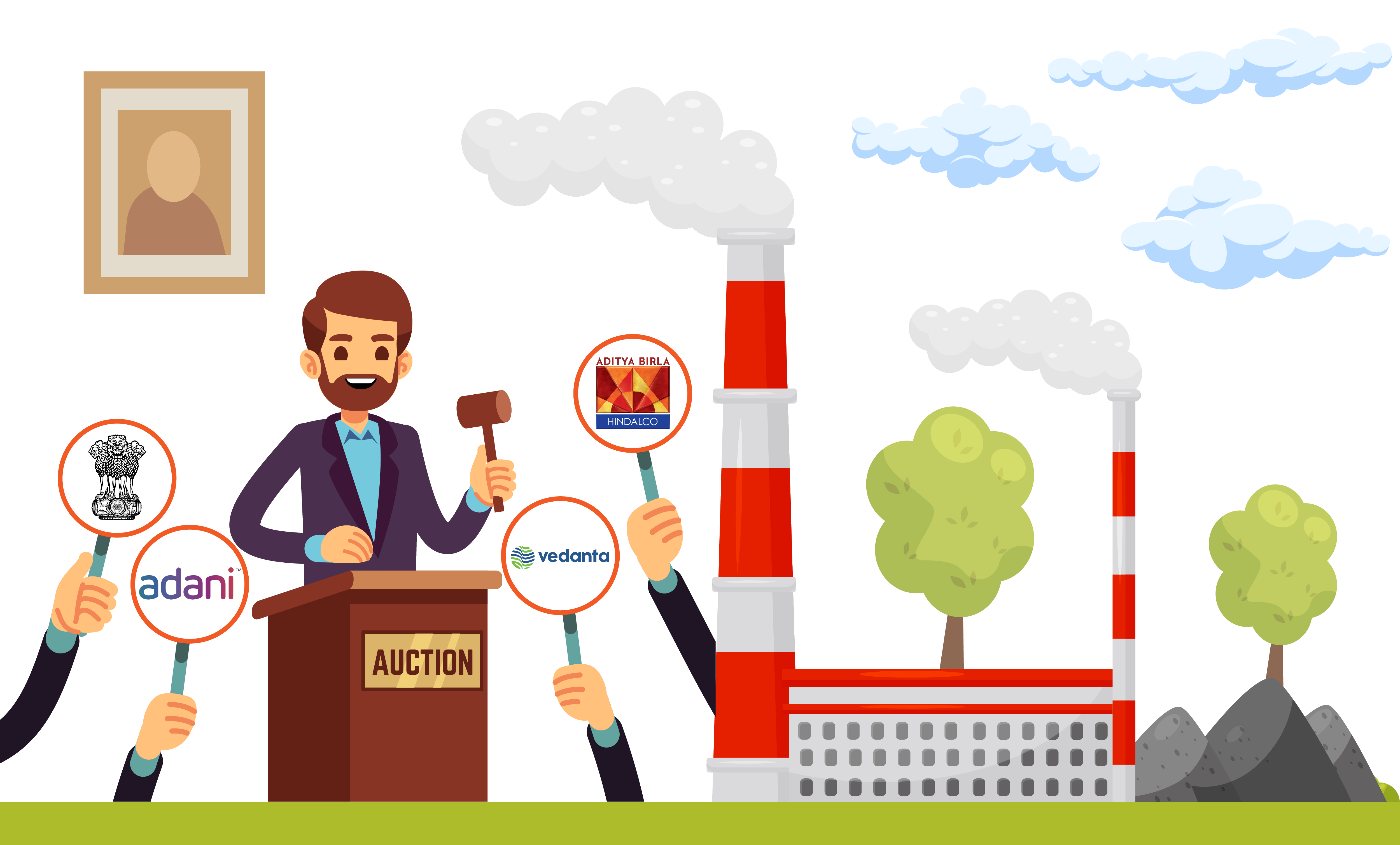
On 3rd November, reports came flying about stating that listed companies such as Vedanta and Hindalco had placed the winning bids for acquiring the coal mines. This means that they will be among the first private sector companies to operate coal mines in India with no restrictions on its end-use. Vedanta Ltd has placed the winning bid for the Radhikapur West Coal Block in Odisha. Hindalco has won the right to operate the Chakla Coal Block in Jharkhand. Other companies such as Aurobindo Realty and Infrastructure Pvt Ltd. and JMS Mining Pvt Ltd have also won bids for coal mines in Maharashtra. It certainly seems that the auctioning process of coal mines has seen great demand from many private players.

Conclusion

This new initiative by the government is all set to provide major support to improve the production of coal in India. It is surely of vital importance that we become self-sufficient in this field and cut high import costs. However, some important questions arise here- is the government too late to make these changes? Or, were all these steps necessary in the current scenario?

Our country is currently seeing a shift towards renewable energy sources. The cost of producing power through cleaner sources has become less expensive. This could be one reason why most companies stayed away from placing bids on the coal mines. Another factor to be considered is the health factors surrounding coal mining in India. Most people from villages that have coal mines are facing respiratory issues. All these make us wonder if the government is making the right decision to hand over coal mining operations to the private entities. A system could be kept in place wherein the companies are monitored and held accountable for their actions.

As the auction process goes on, we can see that more publicly-traded companies have won the rights to the coal mines spread across the country. Let us wait and watch for the final results and announcements that will be made in the coming days.

Categories
Market News Top 10 News

Adani Ports’ Net Profit Rises 32% YoY – Top Indian Market News

Adani Ports Q2 Results: Net Profit rises 32% YoY to Rs 1,394 crore

Adani Ports & Special Economic Zone Ltd. reported a 31.57% year-on-year increase in consolidated net profit at Rs 1,393.69 crore, for the quarter ended September (Q2). The revenue from operations increased by 3% YoY to Rs 2,902.52 crore, during the same period. The company has stated that its market share in India’s overall cargo has increased to 24%, as compared to 21% in Q1 of the current financial year.

Read more here.

Vedanta, Hindalco win in commercial coal mine auctions

Vedanta Ltd. and Hindalco Industries Ltd. are among the first private companies chosen to operate coal mines in India. The Government had allocated 38 coal mines in the country for auction to the private sector. Vedanta Ltd has placed the winning bid for the Radikapur West Coal Block in Odisha. Hindalco has won the right to operate the Chakla Coal Block in Jharkhand.

Read more here.

PVR Q2 Results: Net Loss stands at Rs 184 crore

PVR Limited reported a consolidated net loss of Rs 184 crore, for the quarter ended September (Q2). The consolidated revenue of the multiplex operator was at Rs 40.4 crore, during the same period. PVR has stated that most of its theatres have reopened, under the Unlock 5.0 guidelines. They are optimistic for a gradual improvement in revenues over the next few months.

Read more here.

Ajanta Pharma Q2 Results: Net Profit up by 45% YoY

Ajanta Pharma Limited reported a 45% year-on-year (YoY) increase in net profit at Rs 170 crore, for the quarter ended September (Q2). The company’s revenue has increased by 11% YoY to Rs 715 crore, during the same period. The Board of Directors of Ajanta Pharma has approved an interim dividend of Rs 9.50 per share. They have also announced a share buyback of 7.35 lakh equity shares, at a price of Rs 1,850 per share.

Sun Pharma Q2 Results: Net Profit jumps 70% YoY to Rs 1,813 crore

Sun Pharmaceutical Industries Ltd. reported a 70.4% year-on-year (YoY) increase in consolidated net profit to Rs 1,813 crore, for the quarter ended September. The drug firm’s consolidated revenue from operations has increased by 5.3% YoY to Rs 8,553 crore, during the same period. The share price of Sun Pharma saw a rise of 3.85%, and closed at Rs 487.45 on the NSE today.

Read more here.

Muthoot Finance Q2 Results: Net profit rises 2.5% to Rs 931 crore

Muthoot Finance Ltd. reported a 2.5% year-on-year (YoY) increase in consolidated net profit at Rs 930.81 crore, for the quarter ended September (Q2). The company has posted a 17.4% YoY increase in total income to Rs 2,824.19 crore, during the same period. The non-banking financial company has also recorded its highest-ever quarter-on-quarter (QoQ) growth in its gold loan portfolio.

Read more here.

TCS partners with B3i to launch solutions for insurance industry

Tata Consultancy Services (TCS) has partnered with B3i Services AG to design, develop, and launch ecosystem innovations for the insurance industry. The partnership will be aimed at providing solutions to improve the digital systems of insurers, brokers, and industry service providers. B3i is an industry-led blockchain initiative that is owned by 20 insurance companies around the world.

Read more here.

Dabur Q2 Results: Net Profit rises 20% YoY to Rs 483 crore

Dabur India Ltd. reported a 20.6% year-on-year (YoY) increase in consolidated net profit to Rs 482.86 crore, for the quarter ended September (Q2). The company’s consolidated revenue has increased by 14% YoY to Rs 2,516.04 crore, during the same period. The e-commerce business of Dabur grew by 200% YoY in Q2.

Read more here.

PNB to raise Rs 7,000 crore through QIP in December

Punjab National Bank (PNB), on Tuesday, said it is planning to raise Rs 7,000 crore through qualified institutional placement (QIP) of shares by December 2020. QIP is a method that allows listed companies to raise capital from domestic markets through the issue of equity shares or any other securities. This is part of PNB’s overall plan to raise capital worth Rs 14,000 crore during the current financial year.

Read more here.

Godrej Properties Q2 Results: Net Profit declines 77% YoY to Rs 7 crore

Godrej Properties Ltd. reported a 77% year-on-year (YoY) decline in consolidated net profit at Rs 7 crore, for the quarter ended September (Q2). The real-estate company posted a 36% YoY decline in total income at Rs 238 crore, during the same period. The company has stated that construction activity has resumed across its sites, with a high increase in the workforce.

Read more here.

Meghmani Finechem expands Caustic Soda Plant 

Meghmani Finechem is expanding production at its existing Caustic Soda Plant from 2.94 lakh tonnes per annum (TPA) to 4 lakh TPA. The company is also upgrading the Captive Power Plant capacity to 123 MW (megawatts) at its production site in Gujarat. The total cost of these projects is estimated at Rs 230 crore. Meghmani Finechem is a material subsidiary of Meghmani Organics Ltd.

Read more here.

Categories
Market News Top 10 News

Finance Ministry Issues Guidelines to Implement Interest Waiver – Top Indian Market News

Finance Ministry issues guidelines to implement interest waiver on loans

Last week, the Supreme Court had asked Central Government to issue guidelines on implementing the waiver of interest on interest. Today, The Finance Ministry has issued operational guidelines on how to implement the interest waiver scheme on loans up to Rs 2 crore. The scheme can be availed by the borrowers in specified loan accounts for a period from March 1 to August 31, 2020. The waiver will also be applicable to those who had not utilized the RBI moratorium plan, and had continued with the repayment of loans.

Read more here.

Covid-19 vaccine to be available in India by June 2021: Biocon MD

Biocon Limited’s Chairperson and Managing Director, Kiran Mazumdar-Shaw, has stated that the vaccine for Covid-19 will be available in India by June 2021. The MD said that the clinical trials for the vaccine may be completed within the next 2-3 months. She further stated that the delivery of the vaccine to all Indians will be challenging.

Read more here.

Income Tax Return filing deadline extended till December 31

The last date for Income Tax Return (ITR) filing by individual taxpayers of the previous financial year (FY ’19-’20), has been extended till 31 December 2020. For those taxpayers whose accounts are yet to be audited, the deadline has been extended to January 31, 2021. The government has also extended the due date for filing GST Annual Return and Reconciliation Statement for FY19 (’18-’19) to 31 December 2020.

Read more here

Polycab India reports 14% YoY increase in net profit

Polycab India Limited on Saturday reported a 14.32% year-on-year (YoY) increase in consolidated net profit to Rs 221.6 crore, for the quarter ended September (Q2). The company’s revenue saw a fall of 6% YoY to Rs 2,113.68 crore during the same period. However, Polycab India has registered a 116.43% increase in revenue during Q2, as compared to the revenue during the previous quarter (Q1).

Read more here.

Vedanta Ltd declares interim dividend of Rs 9.5 per share

The Board of Directors of Vedanta Limited on Saturday declared an interim dividend of Rs 9.5 per share. The record date for the dividend was set for October 31, 2020. The company has stated that the dividend payout will amount to Rs 3,500 crore. The voluntary delisting of Vedanta Ltd. from the stock exchanges had failed on 10th October.

Read more here.

Tata Motors gets order for 6,413 vehicles from Andhra Pradesh Government 

Tata Motors has announced that it has secured an order of 6,413 vehicles from Andhra Pradesh State Civil Supplies Corporation. The Tata Gold Ace mini trucks will be used as mobile-dispensing units for the doorstep delivery of essential commodities in Andhra Pradesh. Tata Motors has also crossed the 40 lakh cumulative production milestone of its passenger vehicles.

Read more here.

IL&FS misses debt resolution target by Rs 7,300 crore in September quarter

The Infrastructure Leasing and Financial Services (IL&FS) Group on Saturday said it has been able to address debt of only Rs 1,460 crore, during the July-September period (Q2). Due to the impact of Covid-19, the company has missed its target of addressing debt of Rs 8,800 crore. The group has stated that the shortfall of Rs 7,300 crore will be addressed in the third and fourth quarters of the current financial year.

Read more here.

Persistent Systems Q2 Results: 18.5% YoY increase in net profit

Persistent Systems Limited has reported an 18.5% year-on-year (YoY) increase in net profit at Rs 101.99 crore, for the quarter ended September (Q2). The company’s revenue from sales saw an increase of 13.92% at Rs 1,007.75 crore, during the same period. The operating profit was up by 54.68% at Rs 122.43 crore.

Read more here.

Nestle India reports 1.37% YoY fall in net profit

Nestle India reported a 1.37% year-on-year (YoY) fall in net profit at Rs 587.09 crore, for Q3 CY21 (same as Q2 FY21 in India). The revenue of the company increased by 10% YoY to Rs 3,541.70 crore, during the same period. Nestle India has declared an interim dividend of Rs 135 per share. The company has also announced plans to invest Rs 2,600 crore over the next 3-4 years, in order to improve its manufacturing capacity in India.

Read more here.

JK Cement inaugurates grey cement grinding unit in Gujarat

JK Cement on Saturday inaugurated its new grey cement grinding unit at Balasinor in Gujarat. The new unit has a manufacturing capacity of 0.7 Million Tonnes Per Annum (MTPA). The plant has been constructed over an area of 8 hectares, at a total cost of Rs 200 crore.

Read more here.

Categories
Editorial

The Delisting Failure of Vedanta Ltd

Vedanta Limited is one of the leading mining companies based in India. It operates iron ore, gold, and aluminum mines in the states of Goa, Rajasthan, and Odisha. As you may have noticed, the company has been all over the news since May. They had announced plans of delisting its shares. But now, after almost 5 months, its delisting offer has failed. Let us understand what the process of delisting is, and why Vedanta Ltd may be investigated by the regulators on this matter. 

Index

  1. What is Delisting?
  2. Why did Vedanta decide to Delist?
  3. How does a company delist?
  4. What happened after the failure?

What is Delisting?

In simple terms, delisting refers to the permanent removal of a company’s shares from the stock exchange platform. When a company goes public, its shares get listed on the stock exchanges. Retail investors like you and I are able to buy or sell these shares. At some point in time, the company may decide to become private again. Generally, this decision is made when the company has plans to expand and restructure, or if the promoters want to raise their stake in the company. This is one type of delisting which can be categorized as voluntary delisting. Thus, they will have to delist its shares from the stock exchanges. The company’s shares will no longer be traded in the NSE or the BSE. 

The second type of delisting is involuntary delisting (or compulsory delisting). This happens when a company does not follow the rules set by the regulatory authorities such as SEBI. For example, when a company does not pay the annual listing fees to the stock exchanges, it can get delisted as a form of punishment. Involuntary delisting can also happen if a company is completely unable to pay its outstanding debts, ie, when it goes bankrupt.

In this particular case of Vedanta Ltd, the company has decided (by itself) to delist its shares from being traded in the stock exchanges.

Why did Vedanta decide to Delist?

Now, you may wonder why a company listed on the stock exchanges decides to just remove its shares from being traded. In the case of Vedanta Ltd, the share price had been around Rs 130-140 per share at the beginning of the year. In May 2020, the promoter group of Vedanta Ltd held 50.14% in the firm. Around the same time, stock prices had been trading at very low levels, as the Covid-19 pandemic had affected their production activities. The promoters decided that it was time to buy out the rest of the company. They have stated that “corporate simplification” is the main motive for delisting. Corporate simplification means that the company is planning to change its overall structure into a more efficient and organized system, which would help them to reduce costs. Experts say that this move would bring improvements to the operational and financial flexibility for this capital-intensive business. The mining industry always requires large amounts of investment to produce goods and needs a high level of plant and machinery.

It has also been reported that its parent company, Vedanta Resources, has a high debt of $ 6.7 billion (~Rs 49,186 crore), out of which $1.4 (~ Rs 10,277 crore) billion is due to be paid in the current financial year.

How does a company delist?

  1. Firstly, a Board Meeting of the promoters and directors of the company would be held, to decide whether to delist its shares or not. 
  2. If they agree to go ahead, the company informs the stock exchanges about their decision. Then, the floor price is calculated. The floor price is the minimum price at which the promoters are willing to buy shares from the public shareholders. 
  3. Once the floor price has been set, they seek approval from the shareholders. This is a very important step, as a special resolution has to be passed by the shareholders.
  4. The Board of Directors then appoints a merchant banker, who is in charge of seeking approval from the stock exchange.
  5. The promoters advertise the offer, and sends a letter detailing the floor price to all the public shareholders.
  6. If there is a majority approval by the shareholders, the Reverse Book-Building (RBB) process will be initiated. In this process, the shareholders of the company quote a price (or make bids) at which they are willing to sell their shares. Shareholders will be able to do this through an online bidding system on the stock exchanges, which will be open for a total of 5 days. A final price (also known as the discovered price) is announced on the last day of the reverse book building after all the bids have been taken into consideration.
  7. Delisting will be successful, only if the promoters buy out these shares from the shareholders, and reaches a 90% ownership in the company. Thus, the company can become private again.
  8. The company will make a final payment to the shareholders.

In normal circumstances, if the shareholders and the Board of Directors agreed on the discovered price, the delisting process would take a minimum of 8-10 weeks (from the date of announcement of shareholder approval).

On the 18th of May, the Board of Directors of Vedanta Ltd held a meeting to decide whether Vedanta Ltd should be delisted or not. They had proposed a floor price of Rs 87.25 per share. This was a 9.9% premium over the closing market price of Rs 79.6, as of 11th May 2020. This was not the final offer price for the delisting. The final offer price is determined by the merchant banker, who was appointed to carry out the Reverse book building process. In June, 93% of all shareholders and 84.3% of public shareholders had given their approval to delist the shares of Vedanta Ltd. The RBB process began on October 5th and concluded on October 9th. 

Life Insurance Corporation of India (LIC), which held 6.37% in Vedanta, offered to sell all its shares at Rs 320 per share, which was a 267% premium over the floor price of Rs 87.5. What this meant was that, if the delisting was successful, promoters would have to delist the shares at Rs 320 per share. This development was obviously not good for the promoters, as they would have to purchase the shares at such a large amount of money. As reported by major publications, shareholders could bid at an average price of anywhere between Rs 140-300 per share.

What happened after the failure?

On 10th October, Vedanta Ltd became the third company in the past two years to have an unsuccessful delisting, after INEOS Styrolution and Linde India. In a regulatory filing to the Bombay Stock Exchange (BSE), the company stated the following: Out of the 134.1 crore shares that were required to successfully delist, only 125.47 crore bids were confirmed. This means that 12.31 crore shares were not confirmed. As 90% ownership had not been secured by the promoters, the delisting offer had failed. After this announcement broke out, shares of Vedanta saw a fall of 20.43% to Rs 96.95 on 12th October.

Now, the company has to release all the shares that had been tendered (offered) by the shareholders within 10 days, and promoters cannot acquire any of these shares. However, the promoters can make a counter-offer within two working days. A counter-offer is a fresh offer that is usually made when the discovered price is not accepted. As per SEBI delisting rules, the counter offer price cannot be less than the book value of the company. It should be noted that the management has not made any announcements of a counter offer within 2 days of the delisting failure.

The main reason for the failure of the delisting process of Vedanta Ltd is not clear. Reports have stated that a technical glitch in the bidding process could have caused a wrong result. On October 9th, the bidding process was supposed to close at the end of market hours, but the shareholders were facing certain technical problems. The Bombay Stock Exchange allowed the bidding to continue till 7 PM. At a given point, it had been reported that the 90% level had crossed. However, at around 7:35 PM, the BSE website showed that only 125.47 crore shares were confirmed. Other experts have questioned the fact as to why 12.31 crore shares were not confirmed, even though the shareholders had put in a bid for it. 

The non-confirmation of such a large number of bids makes us wonder what went wrong, and at which point everything went wrong. Did the shareholders not want the company to delist? Also, even if 90% of the shares were bid, wouldn’t the final discovered price be very high compared to the promoter’s floor price? Market regulator SEBI may initiate a probe into the matter, and let us wait and watch what the management decides to do next.

Categories
Market News Top 10 News

Government announces economic stimulus to boost demand – Top Indian Market News

Government announces economic stimulus to boost demand by Rs 73,000 crore

Finance Minister Nirmala Sitharaman, on Monday, announced major schemes to boost demand in the country by nearly Rs 73,000 crore. An additional amount of Rs 25,000 crore has been allotted to the capital expenditure budget and will be spent on roads, water supply, etc. A festival advance of Rs 10,000 will also be provided to government employees to improve consumer demand.

Read more here .

Vedanta shares fall 20% in one day after delisting offer fails

Shares of Vedanta Ltd fell 20.43% to Rs 96.95 on Monday, after the company failed to delist its stock from the stock exchanges. On October 10, Vedanta Resources, in a regulatory filing, said that it had failed to receive the required number of shares to delist Vedanta Ltd. 

Read more here.

Power outage in Mumbai hits trading volumes at BSE, NSE

India’s financial capital of Mumbai faced its worst blackout in history on Monday, due to a grid failure at a Tata Power plant. The Bombay Stock Exchange (BSE) and National Stock Exchange (NSE) continued to function normally, but trading volumes dropped. Notably, shares of Tata Power fell 2% on Monday’s trade.

Read more here.

JSW Energy to invest Rs 8,860 crore in two wind power projects

JSW Energy Limited will obtain 3,150 acres of land from the Karnataka government, to set up two wind energy power projects. According to the state’s commerce and industries department, JSW Energy will invest an amount of Rs 8,860 crore for the new projects.  

Read more here.

Government to provide Rs 12,000 crore interest-free 50-year loan to states

The Finance Minister on Monday announced that a Rs 12,000 crore no-interest 50-year loan will be given to states. The loan has to be completely spent on new or ongoing capital projects. This could be a relief for the states who are at the forefront of battling the Covid-19 pandemic.

Read more here.

Mazagon Dock Shipbuilders listed at 49% premium over issue price

Shares of Mazagon Dock Shipbuilders got listed on Monday at Rs 216.25 on the BSE, which is a 49.13% premium from its issue price of Rs 145 per share. On the NSE, shares of the state-owned defense firm got listed at a premium of 48.30% against its issue price, at Rs 214.90. This means that the company made a very strong debut on the exchanges.

Read more here.

UTI AMC listed at an 11.5% discount over its issue price

Shares of UTI Asset Management Company (UTI AMC) got listed today on the BSE at a discount of 11.51%, at Rs 490.25, as compared to its issue price of Rs 554 per share. On the NSE, the shares got listed at a discount of 9.75%, at Rs 500. The Rs 2,160 crore initial public offering (IPO) of UTI AMC was subscribed 2.31 times of what was on offer. 

Read more here.

Britannia to invest Rs 550 crore in Tamil Nadu

Packaged foods company Britannia Industries said it is investing Rs 550 crore to set up a manufacturing plant in Tamil Nadu. The company has signed a Memorandum of Understanding (MoU) with the state government, and will generate direct and indirect employment for 1000 people.

Read more here.

PepsiCo raises investment at snack plant in UP to Rs 814 crore

Food and beverages company PepsiCo has increased investment at its greenfield snacks plant in Uttar Pradesh to Rs 814 crore. The company has plans to double its business in India, and is also increasing the capacity of existing food plants in West Bengal and Maharashtra.

Read more here.

Mahindra Logistics adds over 10,000 seasonal jobs ahead of festive season 

The logistics arm of Mahindra Group said it has added 10,100 seasonal jobs ahead of the festive season in India. In the last 2 years, Mahindra Logistics Limited has trained around 20,000 personnel under the Pradhan Mantri Kaushal Vikas Yojana (PMKVY). They also stated that a significant number of these new employees will be retained, amidst the Covid-19 pandemic.

Read more here.

Categories
Market News Top 10 News

Vedanta delisting offer fails – Top Indian Market News

1. Loan moratorium cannot be exceeded beyond six months: RBI tells Supreme Court

The Reserve Bank of India (RBI) filed an affidavit before the Supreme Court, stating that it cannot give more time as relief for sectors affected by the Covid-19 pandemic. It also said that it is not possible to extend the moratorium period beyond six months, as it might affect credit discipline. On October 2nd, the government had announced that interest-on-interest for loans up to Rs 2 crore will be waived off.

Read more here.

2. Vedanta delisting offer fails

Mining company Vedanta Limited’s delisting offer is deemed to have failed as per terms of delisting regulations. On Friday, the company had closed a five-day reverse book building (RBB) process. According to the BSE data, only 125.47 crore bids have been confirmed, out of the 134.1 crore shares that are needed to successfully delist. Delisting refers to the removal of a listed stock from trading on a stock exchange. Reverse book building is the process by which a company that wants to delist from the stock market, decides on the price that needs to be paid to public shareholders to buy back shares.

Read more here.

3. Fuel demand in India registers first monthly gain since June

The consumption of refined oil in India, which is a proxy for oil demand, saw a rise of 7.2% (from the previous month) to 15.47 million tonnes in September. The main reason for this could be due to the removal of coronavirus restrictions. However, the demand for fuel has declined by 4.4% from the same period last year.

Read more here.

4. FICCI fined Rs 20 lakh for violating dust control norms

The Delhi Pollution Control Committee (DPCC) has imposed a fine of Rs 20 lakh on the Federation of Indian Chambers of Commerce and Industry (FICCI). They have been found guilty of violating dust control norms at a demolition site on Tansen Marg. DPCC had earlier asked FICCI to stop work at the site for not installing anti-smog guns.

Read more here.

5. RBI appeals to Supreme Court to allow NPA classification

RBI has appealed to the Supreme Court of India to let banks classify loans as non-performing assets (NPA). It also stated that failure to lift the stay on this matter would cause huge complications for borrowers and commercial banks. The court is set to make a ruling on this matter on 13th October. 

Read more here.

6. SEBI amends debenture trustee norms to protect interest of investors

The Securities and Exchange Board of India (SEBI) has strengthened the role of debenture trustees, and have asked them to independently evaluate and monitor the asset cover. A debenture trustee is a person or entity that serves as the holder of debenture stock for the benefit of another party. This decision comes as several defaults (non-payments) were seen in the debt markets.

Read more here.

7. Bharat Biotech asked to submit Phase-2 data of Covaxin before Phase-3 trial

The Drugs Controller General of India (DGCI) has requested Bharat Biotech to submit complete data for the ongoing Phase-2 trial of its coronavirus vaccine- ‘Covaxin’. The Hyderabad-based company had applied to DGCI on 2nd October, for obtaining permission to conduct Phase-3 trials. Covaxin is being developed by Bharat Biotech in collaboration with the Indian Council of Medical Research (ICMR).

Read more here.