Categories
Editorial

SEBI’s Proposed Changes for Options Trading: What Indian Traders NEED to Know

The recent consultation paper released by the Securities & Exchange Board of India (SEBI) has raised significant concerns among options traders. It highlights seven crucial changes that would impact the way options trading is conducted in India. In this article, we’ll break down SEBI’s proposals, why they were introduced, and how these changes could impact option buyers, option sellers, and even non-directional traders.

Why Did SEBI Release This Consultation Paper?

The consultation paper has emerged as a response to perceived challenges in the Indian options trading market. SEBI’s main motivation is to improve market liquidity and help investors manage risks more effectively. This stems from the growing concern regarding substantial losses incurred by retail investors last year, amounting to a staggering ₹50,000 crore! The big winners were mostly high-frequency traders (HFTs) and algo traders.

The consultation paper aims to curb risky behaviours in index options trading, especially around expiry days when volatility spikes. By addressing these issues, SEBI hopes to create a more stable and balanced market for all participants!

The 7 Major Proposals by SEBI

1. Rationalisation of Strike Prices

SEBI observed that many traders are placing bets on far out-of-the-money (OTM) options, speculating on prices 5-6% away from the current market price or index level. This practice poses significant risks, particularly in volatile market conditions

[Far out-of-the-money (OTM) options are options with a strike price significantly higher (for calls) or lower (for puts) than the current market price of the asset. These options have a lower chance of being profitable by expiration, but they are cheaper to buy.]

SEBI’s Proposal: Strike prices will remain uniform only within a 4% range of the current spot/market price, with wider intervals beyond this range. 

[A strike price is the set price at which you can buy or sell an option. It’s the price agreed upon in advance for exercising the option, regardless of the market price.]

While SEBI’s intention is clear, they haven’t considered the role of implied volatility during market events like budget announcements or global conflicts. A rigid 4% rule could leave traders without adequate hedging options, especially in volatile markets.

2. Upfront Collection of Option Premiums from Buyers

SEBI suggests enforcing the upfront collection of premiums from option buyers. This is already a common practice among many brokers, and we find no significant issues with this proposal.

SEBI needs to provide more clarity to avoid confusing traders with the procedural changes.

[Premiums are upfront costs paid to the option seller for the right to buy (in a call option) or sell (in a put option) an asset at a specific strike price. The premium is essentially the price of the option contract.]

3. Removal of Calendar Spread Benefits on Expiry Day

SEBI noted that calendar spread traders face liquidity and basis risks, especially on expiry days. This happens because hedging strategies don’t work effectively when the market moves rapidly close to expiry.

(Basis risk is when the value of a trade doesn’t match exactly with the value of what it’s supposed to protect or track. This mismatch can cause gains or losses that weren’t expected)

SEBI’s Proposal: Removal of the margin benefit for calendar spreads on expiry days.

We believe this change penalizes experienced traders who use calendar spreads responsibly. SEBI should instead focus on cases with high basis risk or low liquidity, rather than implementing a blanket rule.

4. Intraday Monitoring of Market-Wide Position Limits

SEBI wants to monitor the 15% open interest (OI) limit for brokers on a real-time basis, not just at the end of the day. This could mean that a broker’s OI limit may be hit during the day, preventing traders from placing additional trades.

This could be a major disruption for serious traders. Imagine being unable to trade because your broker hits the OI limit midday! SEBI should ensure there are safety mechanisms in place to avoid such trading blockages.

[Open Interest (OI) is the total number of active, unsettled options or futures contracts in the market, showing market activity.]

5. Increasing Contract Size for Options Trading

SEBI proposes increasing the minimum contract size for derivatives from ₹5-10 lakh to ₹20-30 lakh. This would be a phased approach.

This will make hedging too expensive for smaller investors, pushing many option sellers out of the market. SEBI’s goal is to protect retail investors, but this proposal could force them into riskier positions or discourage participation altogether.

6. Margin Requirements for Retail Traders

SEBI is considering changing the way margin requirements are calculated for retail traders, especially around high-risk trading days such as expiry days.

While margin regulations are necessary to control risk, SEBI should carefully balance the requirements to ensure that retail traders can still participate without being forced into excessively leveraged or dangerous trades.

7. Hyperactivity Around Expiry Days

SEBI is concerned about the surge in trading activity on Wednesdays and Thursdays, when Bank Nifty and Nifty contracts expire. This creates excessive volatility.

SEBI’s Proposal: SEBI is considering measures to reduce speculative trading around expiry days to manage this volatility.

While reducing hyperactivity may reduce volatility, it could also limit legitimate trading opportunities. SEBI needs to be cautious in ensuring that the measures taken do not inadvertently stifle liquidity in the market.

Our Final Thoughts

In conclusion, the premise for the SEBI’s consultation paper is completely valid. However, the series of proposals presented could significantly impact option trading in India. The implementation requires careful consideration to avoid unintended consequences that could further disadvantage retail traders. It is essential for traders to remain informed and engaged in discussions about these changes to ensure their voices are heard.

As the trading landscape evolves, staying ahead of regulatory changes will be crucial for success. Traders are encouraged to read the consultation paper thoroughly, understand its implications, and provide feedback to SEBI, fostering a more balanced trading environment.

Watch: Option Traders are in Trouble!? Our Response to SEBI Consultation Paper | marketfeed

Categories
Editorial

The Ultimate Guide to Improving Your CIBIL Score in India

Your CIBIL score is a crucial factor that determines your creditworthiness when applying for loans, credit cards, or any other form of credit in India. A good CIBIL score can make a world of difference when it comes to the interest rates you’re offered and the chances of getting your loan approved. In this guide, we’ll break down how your CIBIL score is calculated, what factors influence it, and actionable tips you can follow to improve it in as little as 30 days.

What is a CIBIL Score?

A CIBIL score is a three-digit number that represents your creditworthiness based on your credit history. This score typically ranges from 300 to 900, with higher scores indicating a better credit profile. Banks and financial institutions rely heavily on your CIBIL score when determining whether to approve a loan or credit card application. A score above 750 is generally considered good, and a score closer to 900 increases your chances of getting approved for loans at lower interest rates.

CIBIL score | marketfeed

Why is Your CIBIL Score Important?

Your CIBIL score acts like a financial report card, much like the report cards you received in school. But instead of judging academic performance, it evaluates how responsibly you manage credit. When you apply for any loan—be it a personal loan, home loan, or even a credit card—the first thing a lender will do is check your CIBIL score. The higher your score, the more favourable terms you’ll receive. On the other hand, if your score is low, you may face higher interest rates or even loan rejection.

How is Your CIBIL Score Calculated?

Understanding the factors that affect your CIBIL score is key to improving it. There are four main components, each contributing a different weightage (%) to your overall score:

1. Payment History (30%)

Your payment history is one of the most important factors that affect your CIBIL score. It records how promptly you’ve paid your credit card bills, EMIs, and any other loan repayments. Missing even a single payment can lower your score significantly, as lenders view this as a sign of unreliability.

Tip: Always pay your bills on time. Setting up automated payments or reminders can help you avoid missing any deadlines.

2. Credit Exposure (25%)

Credit exposure refers to the total amount of credit you have used in proportion to your available credit limit. If you’re borrowing more than you can reasonably repay, banks will see you as a high-risk customer, negatively affecting your score. This may result in stricter lending terms in the future, including higher interest rates or lower credit limits.

Tip: Maintain a credit utilisation ratio below 30%. For instance, if your credit limit is ₹1 lakh, try to spend no more than ₹30,000. If you consistently spend close to your limit, consider requesting a credit limit increase or applying for additional credit cards to improve your credit utilisation ratio.

3. Credit Type and Duration (25%)

This factor looks at the types of loans you’ve taken—secured or unsecured—and how long you’ve had them. Secured loans (like home or gold loans) are backed by collateral, which makes them less risky for lenders. If you can’t repay the loan, the lender can take the collateral as payment. Meanwhile, unsecured loans, like personal loans or credit cards, are riskier. They are approved based on your creditworthiness and promise to repay. Having too many unsecured loans can lower your score.

Credit duration refers to the length of time you’ve been managing credit accounts. A longer credit history suggests that you’ve been responsible with credit for an extended period. This indicates to lenders that you’re a reliable borrower.

Tip: Keep your older credit accounts active, as they positively impact your score by showing a longer credit history.

4. Number of Credit Inquiries (20%)

Every time you apply for a loan or credit card, the lender makes a “hard inquiry” into your credit report, which can slightly lower your score. Too many hard inquiries in a short period can make you appear desperate for credit, which negatively affects your score.

Tip: Limit the number of credit applications you make and avoid unnecessary inquiries. You can monitor your score through soft inquiries, which don’t impact your credit score. Use platforms like Paytm, CRED, or Google Pay to check your score without it affecting your report.

    How to Improve Your CIBIL Score?

    Now that you know the factors affecting your CIBIL score, let’s look at some actionable tips to improve it quickly.

    1. Pay Your Bills On Time
    Late payments can severely impact your credit score. Set up reminders or auto-debits to ensure you’re never late with payments.

    2. Limit Your Credit Utilisation
    Try to keep your credit utilisation ratio below 30%. If you’re close to maxing out your credit cards, consider asking for a credit limit increase or applying for another card to spread out your expenses. However, if you’re prone to overspending, it’s better to reduce your spending before considering this option.

    3. Avoid Unnecessary Loans
    Don’t apply for loans or credit cards unless absolutely necessary. Each application triggers a hard inquiry, which can lower your score. Be strategic about when and how often you apply for credit.

    4. Don’t Close Old Credit Cards
    Closing an old credit card might seem like a good idea, but it can reduce the average age of your credit history, which can negatively affect your score. Keep your oldest cards active to maintain a healthy credit history.

    5. Take Secured Loans
    Secured loans, like gold loans or home loans, are considered less risky by lenders. They can improve your credit score more than unsecured loans like personal loans or credit cards.

      Bonus Hacks to Boost Your CIBIL Score

      If you’re looking to improve your CIBIL score quickly, here are two additional hacks:

      • FD-Backed Credit Cards:
        You can get a credit card backed by a Fixed Deposit (FD) in your name. Banks will offer a credit limit of up to 80% of your FD amount. Using this card responsibly and paying off your bills on time will improve your score.
      • Credit Piggybacking:
        If you’re just starting to build your credit history, you can improve your score by “piggybacking” on someone else’s good credit. For instance, if a parent or guardian applies for a loan with you as a guarantor, your score will benefit from their creditworthiness. This is commonly seen with education loans but can also work for credit cards.

      Final Thoughts

      Improving your CIBIL score may take time, but following these tips will ensure steady progress. Keep a close eye on your credit report, pay off debts on time, and manage your credit utilisation to maintain a healthy financial profile. Checking your credit score regularly (through free services) will help you stay on top of your credit health!

      By taking these steps, you’ll be well on your way to boosting your CIBIL score and securing better financial opportunities in the future.

      Categories
      Editorial

      Uncovering the Truth About Penny Stocks in India

      When you browse through social media, you might come across ads promising quick wealth through penny stocks. These ads claim that buying such shares for as little as ₹10 can make you a millionaire overnight. But is this too good to be true? In this article, we will dive into what penny stocks are, the risks associated with them, common myths, and how you can navigate this high-risk investment landscape.

      What are Penny Stocks?

      Penny stocks are generally understood as stocks with low prices and small market capitalisation. [Market cap is the total value of a company’s shares. It’s calculated by multiplying the number of outstanding shares by the current share price.] In India, a penny stock is often classified as one priced under ₹20 with a market cap of less than ₹100 crores. This means that even though a stock might have a very low price, such as Vodafone Idea or Yes Bank, they are not considered penny stocks because of their high market capitalisation.

      The core concept of penny stocks is that they have both a low share price and a small market cap. This makes them attractive to investors who believe they can get in at a low price and potentially ride the stock up to huge gains.

      Why are People Investing in Penny Stocks?

      Penny stocks tempt investors with the idea of making a lot of money with very little capital. Many people are drawn to these stocks after seeing ads on platforms like Instagram or through tips from Telegram groups. The idea is simple: If a stock is trading at ₹10, and it grows to ₹100, that’s a 10x return on investment.

      However, most people do not invest in penny stocks based on in-depth fundamental analysis. Instead, they are swayed by social media hype and the hope that these low-priced stocks will one day become large-cap giants like Titan or Reliance.

      Myths About Penny Stocks

      Here are some of the most common misconceptions surrounding penny stocks:

      1. Today’s Large-Cap Stocks Were Once Penny Stocks

      A common myth is that today’s large-cap companies, like Titan, were once penny stocks. This is not accurate. Most of the large companies in India listed with a market cap of at least ₹5,000 crores or more. The companies that do go public today generally have a substantial market cap before listing. So it’s incorrect to believe that every large-cap company started as a penny stock.

      2. Low Price Equals Easy Gains

      Another myth is that it’s easier for a ₹1 stock to double to ₹2 than for a ₹1,000 stock to double to ₹2,000. While both moves represent a 100% increase, the assumption that it’s easier for the lower-priced stock to grow is flawed. Stock prices reflect a company’s market cap, liquidity, and fundamental health. Penny stocks can move due to manipulation, but that doesn’t mean they are guaranteed to deliver consistent returns.

      3. Technical Analysis Works Well with Penny Stocks

      Many believe that technical analysis (reading charts, identifying patterns, and predicting future price movements) can help them navigate penny stocks. While this might hold true for highly liquid large-cap stocks, penny stocks are easily manipulated due to their low liquidity. This means technical analysis often fails in these low-cap environments.

      What are the Risks of Investing in Penny Stocks?

      Investing in penny stocks comes with significant risks that every investor should be aware of.

      1. Manipulation

      Due to their low liquidity and market cap, penny stocks are easily manipulated. Operators with large capital can buy significant quantities of the stock, drive up the price, and then sell at the peak. This could leave retail investors with steep losses. This tactic, known as “pump and dump,” is common in the penny stock world. Be wary of any penny stock with volatile price movements and no solid business fundamentals to back up those changes.

      2. Liquidity Issues

      Liquidity is a major concern with penny stocks. When there’s low liquidity, the gap between the price people are willing to buy at (bid) and the price people want to sell at (ask) can be quite large. For instance, a stock listed at ₹15 might have a seller asking for ₹18. If you place a market order, you might end up buying at ₹18 instead of ₹15. Likewise, when you try to sell, the price buyers are offering might be lower than the current price, which could cause you to lose money.

      3. Lower Regulatory Oversight

      Smaller companies often face less regulatory scrutiny. This allows for “cooking the books” or manipulating financial statements to show false profits. These fraudulent practices can inflate stock prices temporarily. But once the manipulation is exposed, the stock can crash, leading to heavy losses for investors.

      4. Lack of Long-Term Viability

      Many penny stocks lack the strong fundamentals that larger companies possess. Most of them don’t have proven business models, solid management, or consistent profits. Investing in these stocks can be like buying a lottery ticket—while there’s a chance for massive gains, the more likely outcome is losing your investment.

      How to Screen Penny Stocks?

      If you’re interested in exploring penny stocks, one way to find potential winners is by using stock screeners like screener.in. By applying filters such as a market cap under ₹100 crores and a stock price under ₹20, you can narrow down the options.

      To reduce your risk, add criteria for sales growth (over 50% in the last three years) and profit growth (over 30% in the last three years). Out of hundreds of penny stocks, only a handful will meet these conditions. And even these stocks may not necessarily be good investments, as manipulation and low liquidity can still be issues.

      Important Points to Remember While Investing in Penny Stocks

      1. Research is Crucial: Just because a stock is cheap doesn’t mean it’s a good investment. Perform fundamental analysis by looking at the company’s business model, financial health, management quality, and promoter holding.
      2. Risk Management: Never invest more than 1% of your total portfolio in penny stocks. Even if one of these stocks gives you 100x returns, you’ll still see a significant impact on your portfolio. But if the stock crashes, your losses will be limited.
      3. Stay Away from Tips and Ads: Most penny stock recommendations on Telegram groups or Instagram ads are traps. These promotions often lead to manipulation, where operators pump up the stock price and then dump it, leaving retail investors with losses.

      Also read: ‘Free Stock Tips’ on SMS/Telegram and How it Can Trap You

      Conclusion

      Penny stocks are a high-risk investment that should be approached with caution. While there is the potential for high returns, the reality is that most penny stocks are volatile, easily manipulated, and lack the fundamentals needed for long-term growth. If you choose to invest, ensure you have a solid understanding of the risks and use proper risk management strategies to protect your capital!

      Watch the full video on this topic on marketfeed’s YouTube channel: ₹10 to ₹1000 Multibagger Penny Stocks | Truth Behind Penny Stocks

      Categories
      Editorial

      Understanding Options Trading: Risks, Opportunities, and Insights

      Options traders are not a rare breed in India. According to a recent SEBI report, there are over 92 lakh options traders, just in the index options segment. However, a shocking statistic looms over the market: 90% of traders lose money, with more than ₹50,000 crore lost last year! To put that into perspective, the amount lost surpasses the total budget of the Mumbai Metro Rail Project. This raises a critical question—is options trading the right choice for you?

      In this article, we’ll break down:
      1. What options trading is and how it’s being practised today
      2. Why options trading is often considered a risky practice
      3. Whether options trading is suitable for you

      What is Options Trading?

      At its core, an option is a financial derivative product that gives the buyer the right, but not the obligation, to buy or sell an underlying asset at a specified price before a certain date. It was initially created as a hedging tool, designed to protect investors from unexpected market movements. Let’s look at an example of hedging:

      Imagine you have a large investment in mutual funds tied to NIFTY50 stocks, and you suspect the market might crash soon. To protect your portfolio, you could buy a put option. A put option increases in value when the market falls, acting like insurance for your investments. So if the market drops, the gains from the put option can help offset your losses.

      [A put option gives the buyer the right to sell an asset at a specific price before a certain date, typically used when the buyer expects the asset’s price to fall]

      Unfortunately, many traders today don’t use options for hedging but for speculative purposes. They aim to profit from price movements in the market. They buy call options when they think the market will go up and buy put options when they expect a decline. While this speculative approach may seem straightforward, it often leads to significant financial losses for traders, especially those who lack experience.

      Why Do So Many Traders Lose Money in Options Trading?

      The harsh reality is that most traders are unprepared for the complexities of options trading. Despite being regulated by SEBI, options trading is seen as a risky venture. The truth is, options trading can be dangerous if you approach it without the right knowledge and mindset. Here are three major reasons why options trading can be considered a “bad product” for many traders:

      1. Low Entry Barrier

      One of the biggest issues with options trading in India is the incredibly low entry barrier. You can start trading options with just ₹1,000, which makes it accessible to virtually anyone. Stories of auto drivers or college students trading options on their phones have become common. But this accessibility is a double-edged sword.

      Imagine if anyone could drive a supercar in India without a license. The result would be chaos. Similarly, inexperienced traders jump into options trading without proper education, training, or strategy, leading to massive losses. In contrast, in countries like the U.S., traders need to meet strict criteria before they can engage in serious options trading. This includes having a net worth of $1 million or more and a min. of $25,000 in the trading account at all times!

      We believe that SEBI should try to introduce such criteria and increase the entry barrier into the Indian derivatives market! This could protect less experienced investors from significant financial losses.

      2. Not a Zero-Sum Game

      Options trading is often described as a “zero-sum game,” meaning one trader’s profit is another trader’s loss. But the reality is even worse. With high brokerage fees, taxes, and regulatory charges, options trading in India becomes a negative-sum game. Even if you win trades, a significant portion of your profits gets eaten up by these charges.

      For example, let’s say you make ₹1,000 in profit from a trade. After paying brokerage fees, taxes, and other charges, your actual gain might be significantly lower—perhaps even turning into a loss. This is one of the lesser-known reasons why so many traders struggle to make consistent profits in options trading.

      3. Rampant Scams and Mis-selling

      Another critical issue in the Indian options market is the prevalence of scams and mis-selling. Many fraudulent actors sell “get-rich-quick” schemes, offering trading tips or strategies that promise to turn small investments into massive returns. These scammers often operate on social media platforms like Telegram, luring people with false promises. SEBI has attempted to regulate this space, but scamsters are still finding ways to trick people into losing money.

      But Is Options Trading Really All That Bad?

      Traders who approach the market with caution and knowledge will be able to make profits. Trading can be more convenient than owning & operating a business if you have the right skill set! Let’s see the various advantages of options trading:

      1. Flexibility

      Options trading allows for significant flexibility. You can trade from the comfort of your own home or from anywhere in the world. All you need is a stable internet connection and access to a broker.

      2. Scalability

      You can start with a modest capital (say, ₹10,000) and gradually scale up to larger amounts as you gain experience. The market has enough liquidity to absorb even large trades, so you can grow your capital over time.

      3. Lower Fixed Costs

      Unlike many business ventures that require significant overhead costs like rent and salaries, options trading carries no fixed costs. You can operate with minimal expenses, risking only the capital you choose to invest.

      Is Options Trading Right for You?

      So, is options trading right for you? It depends. While it offers advantages like scalability, flexibility, and low fixed costs, it’s essential to approach options trading with caution. It’s still a legitimate way to make money. But without the right skills, mindset, and understanding of the market, you risk joining the 90% of traders who lose money.

      If you’re serious about options trading, consider the following:

      1. Educate Yourself: Before you start, learn about the market, strategies, and the risks involved. Don’t jump in without proper preparation.

      2. Start Small: Don’t invest large sums of money in the beginning. Start with a small amount and scale up gradually as you gain experience. That being said, you will need a huge capital to make enough returns to make options trading a full-time career.

      3. Be Cautious of Scams: Stay away from tipsters and scammers who promise quick returns. Stick to legitimate sources of information and avoid “get-rich-quick” schemes.

      Final Thoughts

      Options trading is not inherently a bad product, but it requires a responsible and informed approach. It can be a profitable avenue in the market for those who approach it with caution, knowledge, and a well-defined strategy. As the market continues to evolve, so too should the strategies and mindsets of those who participate in it. If you believe you possess the right mindset and skill set, options trading may offer an exciting opportunity to explore!

      Remember to do thorough research, seek guidance when needed, and continuously educate yourself to navigate the ever-changing landscape of options trading!

      Watch the full video on this topic on marketfeed’s YouTube channel: Options Trading: Hidden Risk or Money Minting Opportunity?

      Categories
      Algo Trading

      How are APIs Used in Algo Trading? Broker APIs Explained

      Humans communicate with each other to share information, but have you wondered how computers do it? Application Programming Interfaces or APIs allow computer programs or components to communicate and connect seamlessly with each other. They help improve everyday life and business operations by simplifying processes, improving accessibility, and fostering innovation. 

      In today’s fast-paced financial markets, algo trading has become increasingly popular among traders. At the heart of this revolution lies a powerful tool: APIs. While APIs serve various purposes in the trading ecosystem, Broker APIs are the key drivers behind the rise of retail algo trading. In this article, we dive into the world of Broker APIs, exploring how they function as the gateway to algo trading.

      What are APIs? 

      In the field of web development, an Application Programming Interface (API) is a set of tools that enables multiple software to communicate with each other using a set of protocols. They allow applications to share real-time information and work dynamically with each other, essentially forming a chain for communicating. While a user interface (UI) connects a computer to a person, an API connects different software. Here’s an example:

      Imagine you are in a huge library with thousands of books. Instead of searching through an endless number of books to find the one you want, you can approach the librarian. They would have a database to search where each book is. Now, replace the library with computer programs and the librarian with an API. Therefore, APIs guide developers to what they need in complex sets of programs, highlighting important connections while skipping unnecessary details.

      APIs are integral to many everyday activities, simplifying tasks such as online payments and navigation through services like Google Maps. Due to its efficiency and benefits, APIs have gained popularity in algo trading as well. Let us further explore how APIs are used in the trading world!

      API and Algo Trading

      Algo trading is a method where trades are executed automatically using computer programs or ‘algorithms’. These algorithms consist of instructions relating to time, volume, and price targeted to execute the order. The algorithms function based on the conditions added to them. 

      Algo trading has recently gained popularity among market participants in India over the past few years. Currently, 50-55% of the total trading volume in India is executed using algo trading systems! Meanwhile, in the US, algo trades account for nearly 60-70% of the total trade volume!

      Also read: How to Get Started with Algo Trading in India?  

      APIs play a crucial role in connecting traders, brokers, and markets— ensuring timely data collection and order execution. They are the reason algo trading is possible, especially for retail traders! Whether you code your strategy or use pre-built strategies on third-party platforms, APIs are responsible for connecting the trading logic/algo to the exchange. APIs come in use at every stage of the algo trading process by connecting all components in the trading ecosystem.

      Institutional traders use various APIs like Risk Management API, Portfolio Optimisation API, Sentiment Analysis API, News API, etc. to backtest and execute their strategies.

      Among the various types of APIs used in trading, Broker APIs have emerged as the most important tool for retail algo traders in India. They are particularly advantageous for retail traders, streamlining the integration of various APIs into a single, user-friendly tool. Broker APIs serve as the critical link between a trader’s algorithm and the broker’s trading platform, enabling the seamless execution of trades.

      What are Broker APIs?

      Broker APIs are specific types of APIs provided by brokerage firms (like Zerodha, Upstox, Fyers, etc.) that allow traders to interact with the broker’s trading platform. Unlike general APIs, Broker APIs are tailored for trading activities, offering key features like order execution, portfolio management, and real-time data access. These APIs are designed to facilitate smooth communication between the trader’s algorithm and the broker’s platform.

      Key Features of Broker APIs:

      • Market Data: Retrieving real-time and historical price data.
      • Order Execution: Place, modify, and track buy/sell orders. You can even specify order types (market, limit, stop, etc.), and set parameters such as quantity and price.
      • Portfolio Management: Access account information such as available margins, open positions, and real-time profit/loss.
      • Risk Management: Implement stop-loss, take-profit levels, and position-sizing rules.

      Some Examples of Broker APIs in India:

      1. Zerodha Kite API: Known for its simplicity and comprehensive documentation, this API allows the automation of advanced trading strategies.
      2. Upstox Pro Developer API: Offers tools for creating custom algorithms, appealing to both new and experienced traders.
      3. Angel One Smart API: Accessible for traders looking to integrate algo trading without additional costs.
      4. Fyers API: Designed to facilitate algo trading and integration with various trading platforms.

      Broker APIs offer a comprehensive solution for algo traders, providing access to all essential market data and tools. To select the right API, consider your specific trading needs, the level of customization available, the ease of use, and the associated costs.

      Conclusion 

      APIs have become vital in today’s digital world, powering everything from basic online payments to advanced systems like algo trading. While their role in algo trading has transformed the financial landscape by providing real-time data and fast trade execution, there are challenges. You may need technical skills to use them effectively, and issues like glitches, slippages, bugs, and security risks remain concerns.

      Despite these hurdles, the benefits of APIs in algo trading are undeniable. They empower traders to streamline operations and adapt to the fast-paced financial environment. As algo trading continues to gain traction, especially in the Indian market, APIs will propel this change forward!

      Categories
      Editorial

      5 Critical Mistakes SIP Investors Must Avoid

      Investing through Systematic Investment Plans (SIPs) can be a powerful way to grow your wealth over time. However, many investors unknowingly make mistakes that can severely limit their returns. These mistakes often allow brokers or banks to benefit at your expense, leaving you with lower profits than expected. In this article, we’ll explore five common mistakes SIP investors make and how to avoid them. Learn how to maximise your profits and safeguard your financial future!

      1. Choosing Regular Mutual Funds Over Direct Mutual Funds

      One of the most common mistakes investors make is not understanding the difference between regular and direct mutual funds. Regular mutual funds involve a middleman—often an agent or broker—who takes a commission on your investments. This commission can range from 1% to 1.5% or even higher, depending on the mutual fund scheme. Over time, this seemingly small percentage can have a massive impact on your returns.

      For example, if you invest ₹10,000 every month in a regular mutual fund with a CAGR (Compound Annual Growth Rate) of 22.8%, your returns after 20 years could amount to ₹4.63 crores. However, if you had chosen a direct mutual fund with a slightly higher CAGR of 24.6%, your returns would have increased to ₹6.33 crores— a difference of ₹2 crores!

      Solution: Always opt for direct mutual funds when possible. You can easily switch from regular to direct funds by stopping your regular SIPs and starting new ones with direct funds. While there may be a small tax implication, the long-term benefits are worth it.

      How to Identify Regular and Direct Mutual Funds?

      When investing, look for clear indicators on the mutual fund’s platform. Most reputable mutual fund houses will display both regular and direct options. If you’re approached by a bank or broker, they will likely recommend regular funds. If you prefer to manage your investments independently, opt for direct mutual funds to enhance your returns.

      2. Selecting IDCW Mutual Funds Instead of Growth Plans

      Another common mistake is choosing Income Distribution cum Capital Withdrawal (IDCW) mutual funds instead of Growth Plans. IDCW funds distribute dividends to investors, which might seem attractive for those seeking regular income. However, this option can hinder the compounding benefits of your investment, ultimately reducing your long-term returns. In contrast, growth mutual funds reinvest profits back into the fund, allowing your investment to compound over time.

      For instance, an HDFC Flexi Cap mutual fund with an IDCW option might yield a 12% CAGR, whereas the same fund with a growth option could yield over 23% CAGR. The difference in returns can be substantial over time. Moreover, the taxation on IDCW could further reduce your net gains.

      Solution: Always choose the growth option if your goal is long-term wealth creation. This allows your returns to compound within the fund, leading to higher gains over time.

      3. Lack of Diversification: Investing Solely in Small-Cap Funds

      Diversification is a fundamental principle of investing that many SIP investors overlook. Investors often get swayed by the impressive returns of small-cap funds, leading them to allocate all their investments into these high-risk funds.

      While small-cap funds may have outperformed the market recently, they can also be highly volatile. Investing all your money in small caps without diversifying into large-cap or mid-cap funds exposes you to increased risk. During market downturns, small-cap funds often underperform, which can lead to significant losses.

      Solution: Diversify your investments across large-cap, mid-cap, small-cap, and flexi-cap funds. You can also consider a portfolio that includes various asset classes, such as gold and debt instruments. For example, gold often performs well during market crashes. This provides a safety net that can be leveraged when equity investments decline in value. This strategy allows you to capitalise on different market conditions and helps mitigate risks.

      Identifying Overlap in Mutual Funds

      Even when diversifying, it’s crucial to ensure that your funds are not investing in the same underlying stocks. Use platforms to check the fund’s holdings and understand their investment philosophy. If multiple funds have significant overlaps in their holdings, it reduces the effectiveness of your diversification strategy.

      4. Not Having an Emergency Fund

      Investing in SIPs without first establishing an emergency fund is a mistake that can jeopardise your financial goals. Life is unpredictable, and an unexpected event, such as job loss or a medical emergency, could force you to sell or liquidate your SIP investments prematurely. This could result in losses, as you may need to sell your holdings during a market downturn.

      Solution: Before starting any long-term investments, ensure you have an emergency fund in place. This fund should be easily accessible and sufficient to cover at least six months of living expenses. You can keep this fund in a high-interest savings account or a liquid mutual fund.

      5. Ignoring Health and Term Insurance

      Many individuals are eager to grow their wealth through SIPs but overlook the importance of protecting themselves and their families against unforeseen events. Health emergencies can arise at any time. Without proper insurance, you may be forced to dip into your investments to cover medical expenses.

      For instance, let’s say you’ve been investing ₹10,000 monthly in SIPs, targeting ₹6.33 crores over 20 years. However, a health emergency after five years forces you to withdraw from your SIPs, leaving you with only ₹11.8 lakhs—far below your goal.

      Solution: Ensure you have a comprehensive health insurance plan and a term insurance policy before committing to long-term SIP investments. If you have limited funds, it’s better to reduce your SIP contributions to allocate some funds towards insurance premiums. This safety net will protect your investments and help you stay on track to achieve your financial goals.

      Conclusion

      Investing in SIPs can be a rewarding strategy for wealth accumulation, but it’s essential to avoid common mistakes that can undermine your efforts. By understanding the differences between regular and direct mutual funds, choosing the right fund type, diversifying your investments, establishing an emergency fund, and securing adequate insurance, you can enhance your investment outcomes significantly.

      Take the time to review your current investment strategy and make necessary adjustments to avoid these mistakes. By doing so, you will not only protect your wealth but also maximise your potential returns over the long term. Start today by addressing these critical areas and watch your investments flourish!

      Watch the full video on marketfeed’s YouTube channel: SIP Mistakes to Avoid in 2024 | marketfeed

      Categories
      Algo Trading

      How to Source Market Data for Algo Trading?

      Algo trading involves the use of computer programs or ‘algorithms’ to execute orders in the financial markets (stocks, currencies, commodities, derivatives, etc.) based on pre-defined conditions. These conditions include price, timing, and quantity instructions. It’s become extremely popular among many traders globally due to its high speed and efficiency. And one could argue that the first step in algo trading is collecting market data! This data has to be accurate and precise to form an effective algo trading system.

      The amount and type of data required depends on your approach to algo trading, i.e. whether you code your strategy or use pre-built strategies. Traders using third-party platforms need not worry about collecting data. In this article, we will provide a complete overview of various market data sources, the associated costs, and a detailed analysis to help you make informed decisions

      What is Market Data and Why Do We Need it?

      Just as good-quality ingredients are crucial for cooking up a delicious meal, high-quality market data is essential for backtesting and executing successful trades. Market data refers to trading-related information on the prices and volume reported by exchanges (like NSE or BSE in India). Without this data, a trader won’t be able to form any strategy or place orders in the market. 

      A trader needs to collect three types of market data for algo trading; real-time data, delayed data, and historical data. Real-time data is used while a trader executes an order, it is taken into account at the time of the trade. Delayed data refers to market data made available after a short period, usually ranging from 1 minute to 15 minutes. Historical data (collected from past events) is used for analysis and backtesting strategies. It checks whether the strategy would have worked well in previous markets and gives a green signal to the trader. 

      Why Good Quality Market Data is Important for Trading:

      • Forming your Strategy and Backtesting: By collecting past market data, traders can notice patterns and form strategies. These strategies can be backtested to gain confidence and make sure there are no major flaws. A trader must always backtest their strategy before deploying it in the current market.

        Read: Ultimate Guide to Backtesting Algo Trading Strategies
      • Monitor and Adapt: Regularly analysing and gathering market information allows traders to make timely adjustments as the market fluctuates. This is where real-time market data becomes essential. On the other hand, delayed data is typically used for research, analysis, and educational purposes. Examples of institutions that offer delayed data are Yahoo Finance, Bloomberg, and Reuters.
      • On-spot Execution: Real-time market data allows traders to execute trades on time, reducing slippages and increasing accuracy. If there is latency (lag), orders will be placed based on delayed information which can reduce profits. 

      Market data is very crucial to the entire trading process. You can make informed decisions and execute trades with the right sources to collect this data. Let us see what these sources are!

      Sources of Market Data for Algo Trading

      Now that we have understood the importance of market data, let us break down the sources and costs involved in collecting market data:

      1. Stock Exchanges 

      In India, traders can access market information from stock exchanges like the National Stock Exchange (NSE) or Bombay Stock Exchange (BSE). NSE Data & Analytics Ltd provides market data from the NSE, including quotes and data across the capital market (equities), currency derivative market (CDS), futures and options (F&O), and much more. The data is available in different levels: Level 1 shows the best buy and sell prices, Level 2 displays up to five top prices, Level 3 covers up to twenty, and tick-by-tick data captures every single market movement.

      The cost of directly collecting information is quite high. However, brokers access live data provided through subscriptions to the NSE. Apart from that, for real-time stock-wise data, NSE charges a tariff of ₹10,000 per year for a single stock and ₹25,000 per year for up to 5 stocks (with an add-on of ₹2,500 per stock for up to 10 stocks). 15-minute delayed data is provided at ₹1,00,000 per year for the Capital Market and F&O segment. Historical trade data for researchers’ use is provided at ₹18,000 annually in the capital market and F&O segment. [These costs are as of August 2024].

      Traders who wish to enhance the speed and efficiency of trade execution and obtain an edge over other traders will have to pay a fee for co-location services and set up advanced infrastructure to access the data as well.

      [Co-location refers to the service of setting up servers closer to the exchange. This improves connectivity and reduces latency or delays in collecting data.]

      BSE has its own set of tariffs that are different from NSE. Collecting data officially from the stock exchange is quite costly and complex. As a result, this source is mostly used by big institutions rather than retail traders. 

      2. Authorised Data Vendors

      Data vendors are companies that specialise in providing essential market data, which includes real-time and historical information about financial instruments such as stocks, commodities, and currencies. Authorised by the stock exchange, these companies distribute accurate real-time and historical data without much latency or delays. They provide Open, High, Low and Close (OHCL) price, End of Day (EOD) data, and volume data. Data vendors also help integrate various software platforms needed for charting and technical analysis. 

      Platforms like TrueData, Global Datafeeds, and Accelpix offer market data services through monthly subscriptions, with costs varying based on the segment and features you need. These platforms not only provide raw data but also decode it to reveal patterns that traders can analyse.

      Data vendors provide an all-in-one solution for acquiring market data, ensuring traders receive comprehensive information from start to finish. This option is ideal for institutional traders who require large volumes of data for efficient analysis.

      Broker Platforms 

      Several brokers in India provide trading APIs that allow users to build custom trading platforms and automate their strategies. [An API is a set of protocols and tools that enables software to interact with data vendors and place orders on different trading platforms, exchanges, or brokers.] These platforms usually allow users to access data free of cost after signing up. They provide all the necessary information like ask/bid price, volumes, OHLC, last traded prices, etc, in a user-friendly and easy-to-read interface. 

      Zerodha Kite, Upstox, Fyers, and 5paisa Capital are some examples of such data service providers. They also provide historical data in the capital market ranging from 1-day to 5-year trends, along with the execution services to carry out your trade. These companies collect their data from official sources and restructure it for the retail market, making it the optimal choice for individual traders. 

      Conclusion

      Market data is an indispensable part of algo trading. Whether you code your own strategy or use existing strategies, regular market data is extremely essential to execute successful trades. In trading, one must move quickly and make dynamic decisions, which is possible by keeping a check on data trends. 

      Stock exchanges and data vendors are great sources for institutions. Retain traders can use broker APIs as it’s more economical. As a trader, you must be quick and analytical, and good-quality data is the way to go!

      Categories
      Algo Trading

      How to Evaluate an Algo Trading Strategy?

      In the fast-paced world of algo trading, evaluating or judging your strategies is essential to stay ahead. By carefully understanding and analysing the key metrics that matter, you can sharpen your decisions and fine-tune your approach. This can lead to better trading outcomes. In today’s article, we’ll explore the crucial metrics you should keep in mind to elevate your algo trading game!

      Key Metrics to Evaluate an Algo Trading Strategy 

      1. Profit & Loss:

        Profit & loss (P&L) is probably the simplest metric that can be used to describe any trading strategy. While evaluating P&L, don’t just focus on the absolute numbers. Instead, consider the following factors:

        • Absolute P&L: The total amount of money made or lost by the strategy. This provides a very basic measure of profitability.
        • Relative P&L: The return as a percentage of the initial investment. This gives a sense of how effectively it uses capital.
        • P&L Distribution: It refers to how profits and losses are allocated across various trades or periods. A strategy with consistent, moderate profits is generally preferable to one with long losses and occasional large gains.
        • Annualised return and monthly return: This also helps an investor estimate performance over time, hence delivering valuable insights into the strategy for long-term growth as well as consistency monthly.

        P&L itself is a key metric, but it should not be regarded in isolation. A strategy with high returns but at extreme risk is most likely unsustainable in the long term. You must analyse P&L with other metrics like Sharpe Ratio and Maximum Drawdown to get a more complete picture of strategy performance and its risk profile.

        2. Sharpe Ratio:

          The Sharpe ratio is a major metric for risk-adjusted returns. It measures excess return against one unit of deviation in investment strategy, thereby providing insight into how well the strategy rewards the risk it is taking on.

          Let’s make it simple: Imagine you’re playing a game where you can win or lose money. Sharpe Ratio is a way to measure your performance at the game. It looks at two things:

          1. How much money you won: The more you won, the better.
          2. How risky the game was: If you took big risks to win, that’s not as good.

          So, a higher Sharpe Ratio means you won a lot of money, but you didn’t take too many risks.

          The formula to calculate the Sharpe ratio is:

          Sharpe Ratio = Rp – Rf / σp

          Where,
          Rp = Portfolio Return
          Rf = Risk-free rate
          σp = The standard deviation of the portfolio’s excess return

          A higher Sharpe ratio indicates better risk-adjusted performance. A Sharpe ratio of more than 1.0 can be considered acceptable while having a ratio above 2.0 is very good. This is an important metric that will let you effectively compare strategies with different risk profiles. For example, if you have two strategies that are very close in terms of P&L results, you will almost always find that the one with the higher Sharpe Ratio is the better one. This shows better risk management and consistent returns, both crucial for long-term trading success.

          However, the Sharpe ratio has its shortcomings. It assumes a normal distribution of returns and uses standard deviation as a measure of risk. The Sortino Ratio solves this by looking only at downside volatility, offering a more accurate measure of risk in cases where protecting against losses is the primary concern.

          3. Maximum Drawdown:

            Maximum drawdown (MDD) is a key risk metric that shows the biggest drop in a portfolio or strategy’s value from its highest point to its lowest. Usually, it is expressed in percentage terms and shows the worst case you may face with a certain strategy. Suppose your strategy’s value reached ₹1,00,000 and then fell to ₹80,000 before resuming its upward trend; the maximum drawdown here would be 20%.

            There are a variety of reasons why understanding MDD is important:

            • Risk Assessment: It will help you get an idea of the possible downside risk that exists concerning your strategy. A low MDD is good and suggests your strategy won’t face major losses during market swings.
            • Psychological Impact: Large drawdowns are tough to digest. When you experience one, you are most likely to abandon a good strategy. Staying with a low MDD will help you adhere to the strategy in bad times.
            • Recovery Time: The larger the drawdown, the harder and longer it will take to recover losses. A strategy with frequent small drawdowns may be easier to manage and recover from than one with infrequent but deep drawdowns.

            When evaluating MDD, consider both its magnitude and frequency. A strategy with high MDD might offer strong returns, but the risk may not be worth it for conservative investors. The strategy should balance potential returns with MDD to match your risk profile and long-term goals.

            4. Win Rate:

              One of the major metrics is the win rate, also referred to as the hit rate or success rate. It defines the ratio of trades that emerge victorious. To calculate the win rate, you can use this formula: 

              Win Rate = (Number of Winning Trades / Total Number of Trades) x 100

              While having a high win rate may be attractive, it is always important to consider this measure together with other metrics. A strategy with a high win rate that wins small and loses big can still be unprofitable.

              For example, if your strategy wins 70% of the time but only makes small profits on those trades while taking larger losses on losing trades, it could be less profitable than a strategy with a 50% win rate but a higher average win/loss ratio.

              The optimal win rate would depend on the type of strategy that one is using. For example, high-frequency trading (HFT) strategies generally have an extremely high winning rate with small profits per trade. These strategies rely on a high volume of trades to grow profit. Trend-following strategies can make up for a poor win rate by holding larger profits on the winning trades. 

              When evaluating your strategy, it’s important to balance the win rate and trade frequency. If your strategy trades infrequently, it needs a higher win rate or larger average wins to stay profitable. This balance is crucial for the overall success and viability of your trading strategy.

              5. Expectancy Ratio:

                The Expectancy Ratio is a vital metric for evaluating the long-term profitability of a trading strategy. It estimates how much you can expect to make (or lose) for every trade executed. The formula to calculate the Expectancy Ratio is:

                Expectancy = (Win rate × Average win) – (Loss rate × Average loss)

                A positive expectancy indicates that your strategy is more likely to make profits over time. The higher the expectancy, the better the performance of the strategy. It gives a clearer picture when compared to only looking at individual trades or win rates alone.

                6. CALMAR Ratio: 

                  The CALMAR Ratio is used to evaluate the risk-return profile of a strategy by comparing its annualised return to its maximum drawdown (MDD). It is a useful metric for determining how well a strategy is compensating for the risk it takes. The formula is:

                  CALMAR Ratio = Annualised Return / Maximum Drawdown

                  A higher CALMAR ratio indicates that the strategy is delivering better returns relative to the risks it undertakes. This metric is particularly useful for long-term investors who need to balance returns with the risks they’re willing to tolerate.

                  7. Max Time Taken to Recover from Drawdown:

                    This metric measures how long it takes for a strategy to recover from its maximum drawdown and return to its previous peak value. It gives insight into how quickly a strategy can bounce back from losses, which is essential for maintaining profitability and managing expectations. A shorter recovery time is generally preferable, indicating a more resilient strategy.

                    Conclusion

                    To summarise, evaluating an algo trading strategy involves key metrics that provide a complete picture. Start with Profit and Loss (P&L) to measure overall profitability and use the Sharpe ratio to assess risk-adjusted returns. Check Maximum Drawdown to understand potential losses and consider backtesting to see past performance. Finally, evaluate the win rate and average win/loss ratio to measure trade consistency and quality. Balancing these factors helps ensure your strategy is both profitable and aligned with your long-term goals.

                    By examining these metrics, traders can gain a comprehensive view of your strategy’s effectiveness. Balancing performance with risk management helps refine strategies to meet financial goals and adapt to market conditions, ensuring both profitability and resilience!

                    Categories
                    Algo Trading

                    What are the Key Components of a Successful Algo Trading System?

                    Algo trading has revolutionised financial markets by enabling the execution of complex strategies with greater precision and speed. In this article, we’ll break down the essential components of a simple algo trading system. We’ll explore the tools and platforms that work together to create a seamless trading ecosystem. Get an in-depth understanding of building and optimising your algo trading setup!

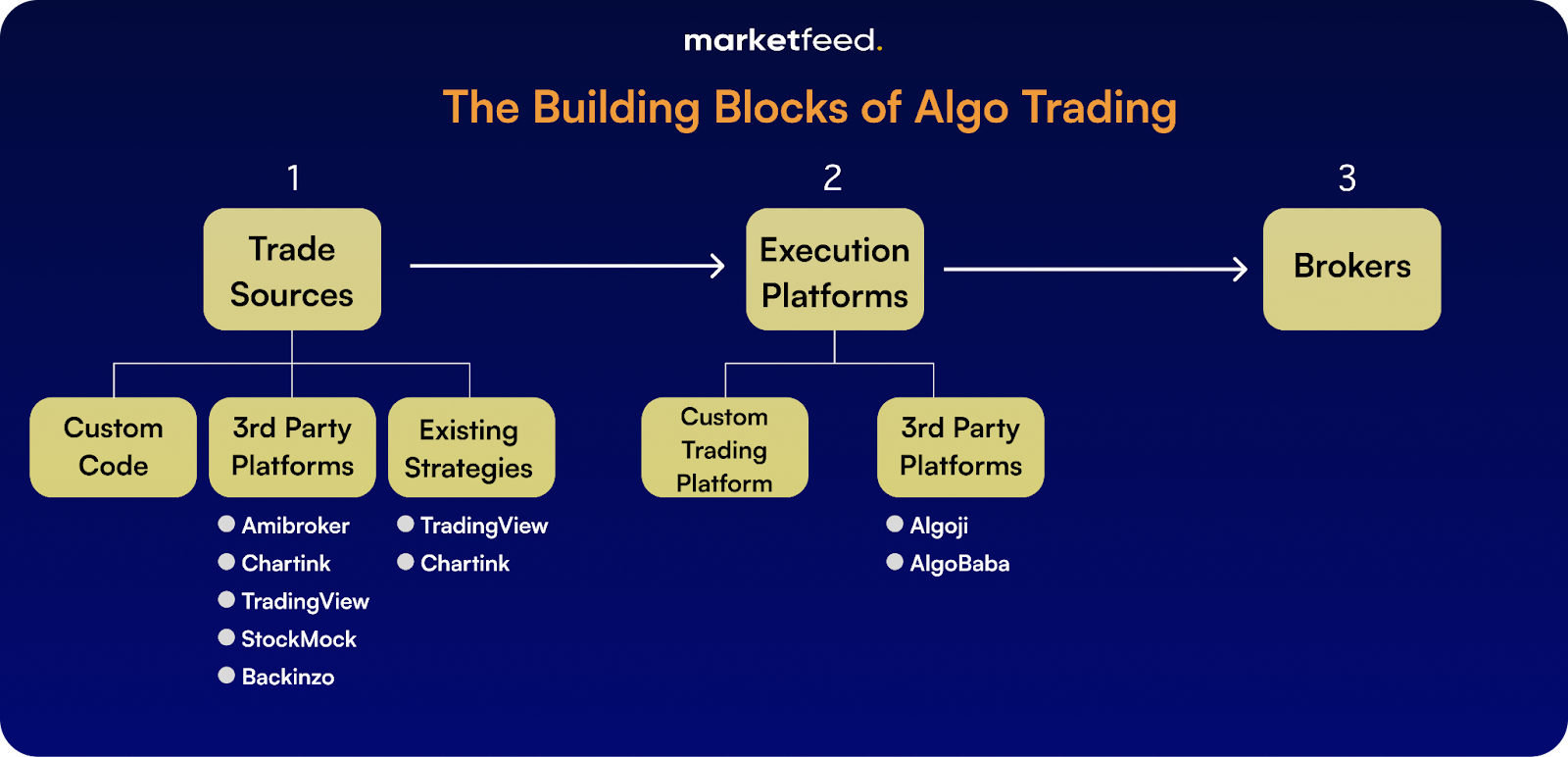
                    The Building Blocks of Algo Trading

                    This image represents significant components of an algo trading system, categorising them into three broad parts: trade sources, execution platforms, and brokers.

                    algo trading system | marketfeed

                    1. Trade Sources:

                    An algo trading system must be backed by dependable data sources and trading signals. These resources provide important data and insights that enable traders to construct algo trading strategies, backtest them, and run them efficiently. In this stage, traders can have three approaches: custom code, custom strategies on third-party platforms, and using pre-built strategies available on these platforms. Let’s explore these approaches in depth:

                    Custom Code:

                    First, using fully custom code offers maximum flexibility. Traders can code highly tailored strategies that closely conform to their trading goals using programming languages like Python. Everything from the smallest detail of data processing to the execution will be under one’s control. However, this approach requires a good deal of programming knowledge and expertise in financial markets.

                    Developing Custom Strategies on Third-Party Platforms:

                    Secondly, some traders like to develop their custom strategies on third-party platforms. These offer powerful tools and interfaces for creating and testing trading algorithms. Some of them are:

                    • Amibroker: It’s a comprehensive desktop-based software designed for stock analysis and algo trading. The platform offers extensive customisation in technical analysis and strategy development.
                    • Chartink: With its easy-to-use interface and a wide array of technical indicators, Chartink assists traders in creating and scanning for specific trading setups without having to write code.
                    • TradingView: Intended for those traders who would like to code their strategies in the Pine Script and share them with the global community. The platform offers basic backtesting facilities.
                    • StockMock: It is designed especially for backtesting any option strategy and provides a user-friendly interface to test trade ideas.
                    • Backinzo: This all-in-one solution offers flexible backtesting and seamless integration with most data providers, making it the ideal choice for traders seeking detailed and accurate evaluations of their trading strategies.
                    • Algotest: AlgoTest makes it easier for retail traders by including many pre-built strategies and easy-to-use tools, allowing them to go through the entire backtesting process.

                    Use Existing Strategies from Third-Party Platforms

                    Many traders opt to use existing strategies on third-party platforms. This can save time and reduce the complexity of developing a strategy from scratch. Platforms like Chartink and Tradingview offer a wide range of pre-built algorithms that can be adopted or customised to fit specific trading goals.

                    Each approach offers distinct advantages, allowing traders to build, test, and execute strategies that can thrive in competitive markets. You can choose either approach based on your expertise, resources, and objectives.

                    2. Execution Platforms:

                    After developing and perfecting a trading strategy, the next crucial step is execution. This is where execution platforms come in, effectively connecting strategy development with the actual execution of trades on the exchange.

                    One of the main ways to achieve this is by developing and coding a personal trading execution platform. In this way, one exercises maximum control and personalisation, and any trader can tailor the execution process to their liking. A trader who codes his execution logic can optimise for speed and minimise slippage. They can ensure trading strategies are executed precisely as intended. However, creating a custom execution platform is quite a resource and expertise-intensive. So this would be more suitable for advanced traders or big financial institutions that have teams of in-house developers.

                    Alternatively, many traders opt for third-party execution platforms that simplify things and lighten the technical burden. Platforms like AlgoJi and AlgoBaba offer robust execution capabilities without asking traders to build it all from scratch:

                    • AlgoJi: Offers advanced execution tools and analytics, making it ideal for traders who need precision and performance in executing complex strategies.
                    • AlgoBaba: AlgoBaba bridges the gap between strategy development and execution. It enables traders to automate their trades with minimal setup. By using their execution platform “STOXXO”, traders can automate their strategies quickly and efficiently with a user-friendly interface and smooth broker integration.

                    3. Brokers:

                    A broker plays a crucial role in providing direct access to the markets and executing trades. When choosing a broker, it’s important to pick one with strong API capabilities. This allows smooth integration with your algo trading system, ensuring efficient and reliable trade execution.

                    [An API is a set of protocols and tools that enable the software to interact with and place orders on different trading platforms, exchanges, or brokers.]

                    A broker’s API acts as the medium between your strategy and the markets. A well-designed API enables real-time communication with the broker’s platform, ensuring fast and precise trade execution. This is crucial because delays or errors during execution can lead to missed opportunities or unexpected losses. Choosing a broker with a strong API ensures a reliable trading system, even in the most volatile market conditions.

                    A broker with strong API support provides detailed documentation, examples, and technical assistance, making it easier to set up and maintain your algo trading system. This reduces the time and effort needed for integration, allowing you to focus on refining your trading models rather than dealing with technical issues. For success in algo trading, it’s essential to partner with a broker committed to API performance and support.

                    Conclusion

                    While having a great strategy is important, success isn’t guaranteed by this single aspect of algo trading. Good data quality and low latency (responses with minimal delay) are essential in building trading algorithms. Ensuring compliance with regulations and proper reporting will help avoid legal complications. A solid system with backup servers minimises downtime and keeps trades running smoothly. You’ll also need to continuously optimise your strategy since markets are changing constantly, and adapting will keep you profitable. Use a prominent cybersecurity solution to protect your private algorithms and safeguard trading systems.

                    Building a successful algo trading system requires a careful blend of strategy, technology, and compliance. By integrating reliable data sources, choosing the right execution platforms, and partnering with a broker that offers strong API support, traders can create a strong algo trading system. As you navigate the world of algo trading, these foundational elements will help you maintain an edge, adapt to changes, and achieve sustained profitability!

                    Categories
                    Algo Trading

                    Common Misconceptions About Algo Trading: Debunked

                    Are you curious about the buzz surrounding algo trading? You’re not alone! In recent years, this innovative approach to trading has taken India by storm, captivating both big institutions and individual traders. But with all the hype, you could easily get caught up in certain misunderstandings or misconceptions surrounding algo trading. In this article, we’re pulling back the curtain on algo trading. We’ll bust common misconceptions and shed light on the real challenges and limitations of this trading approach. Whether you’re a seasoned pro or just starting out, get ready to see algo trading in a whole new light!

                    Misconception 1: Algo trading is a completely hands-off approach to trading

                    A common misconception about algo trading is that it is a completely hands-off approach. Many traders believe that once the algorithm has been set up, they can just sit back and watch profits roll in. Yes, algorithms automate trade execution, but they still need constant monitoring and management.

                    Market conditions are dynamic, and an algorithm that performs well under one scenario can turn out unexpectedly under another. That is why you need to keep an eye on your algo trading system. Issues like network delays, order errors, or misconfigurations can cause problems that require immediate attention. 

                    Creating a successful algorithm requires months of research, coding, and backtesting. Even after it goes live, you need to stay updated on changes in technology, regulations, and market conditions.

                    The following points could help reduce potential losses:

                    • Set alerts for technical issues and system failures to resolve them quickly.
                    • Your algo trading strategies must be reviewed periodically and optimised.
                    • Keep yourself updated on regulatory changes and market events.

                    Misconception 2: Algo trading guarantees risk-free returns

                    Another common myth is that algo trading ensures risk-free, out-of-the-world returns. Many traders fall victim to misconceptions fueled by people on social media who propagate unrealistic promises and exaggerated profit projections. However, the fact of the matter is that algo trading carries risks, just like any other trading activity, and does not guarantee success.

                    An algo trading strategy succeeds when you thoroughly backtest them using high-quality data, implement measures to manage risk and adapt to changing market conditions. Even the most sophisticated algos are bound to lose during periods of high market volatility or unexpected events. One should have realistic expectations and a clear understanding of the risks involved when working on algo trading. You must also consider the various costs involved in algo trading, including brokerage, platform charges, taxes, etc., which can significantly impact returns.

                    Misconception 3: Algo trading is easy and offers continuous scalability.

                    Many new traders think that algo trading is easy and has unlimited potential in scaling up. This is a big misconception.

                    Firstly, creating a successful algorithm and strategy is not simple. It requires a thorough understanding of financial markets, quantitative analysis, and programming. Even with these skills in place, developing an algorithm that constantly performs well is tough. It involves extensive optimisation, validation, and backtesting to ensure reliability.

                    Secondly, there are limitations to scaling up an algo trading strategy or system. As you increase the volume of trades, you may encounter problems like slippage, market volatility, and technical issues. Large volumes can move market prices and reduce your profitability. Additionally, higher trade volumes can strain your trading infrastructure and cause delays. While scaling up, you might face practical challenges that can negatively affect your overall performance.

                    Traders need to understand these limitations and design strategies with realistic expectations for scalability. To make your trading scalable, consider the following:

                    • Account for market liquidity and order execution while developing trading algorithms.
                    • Invest in strong trading infrastructure to handle higher volumes, and implement monitoring and adjustment strategies to minimise market impact.

                    Misconception 4: DIY algo trading platforms deliver the best results

                    Do-it-yourself (DIY) algo trading platforms like uTrade Algos, Tradetron, and Algo Test allow traders (especially beginners) to create and run their strategies seamlessly. Such platforms offer tools and predefined strategies or templates that you can customise to fit your needs.

                    However, there is a common misconception that DIY algo trading platforms will work flawlessly without any issues. While these platforms offer a range of powerful features, they also come with their own set of limitations. One significant risk is the potential misuse of out-of-the-box features if they are not managed properly. These platforms provide predefined strategies and templates that can be customised, but they may not always fit perfectly with your specific trading goals or market conditions. Simply relying on pre-built solutions without proper testing can lead to suboptimal results and unexpected issues.

                    Do note that DIY platforms can help you achieve profitability if used properly. Understanding their features in-depth can help you set realistic expectations and use these tools more effectively. To get the most out of DIY platforms:

                    • Test and customise: Do not run on default settings. Optimise and fine-tune them as per your goals in trading and prevailing market conditions.
                    • Understand limitations: Many algo trading platforms could lack the flexibility or sophistication of a completely customised solution.
                    • Monitor and adjust: To remain effective, performance should be reviewed regularly and adjusted to accommodate changing market conditions.

                    Misconception 5: Assuming exact returns as that of backtest results

                    Backtesting is essential in developing any algo trading strategy. It involves running the algorithm/strategy on historical data to determine how well it might have performed and detect weaknesses. However, relying on backtest results alone can be misleading!

                    Backtest results can be very deceiving for several reasons. They are based on historical data, and there is no guarantee that past success will repeat. An algorithm that looks great in backtesting might fail in live trading due to changes in market dynamics or data quality issues. 

                    Another risk is overfitting, where an algorithm focuses too much on historical data and gives prominence to random fluctuations rather than real patterns. To avoid this, use strong validation techniques and out-of-sample testing to ensure your algorithm remains robust and adaptable. Regularly update your strategies to keep them relevant, and don’t forget to factor in transaction costs, slippage, and market impact.

                    To learn more about backtesting, out-of-sampling testing, and other best practices please read this article: The Ultimate Guide to Backtesting Algo Trading Strategies

                    Misconception 6: Algo trading is an easy path to trading success

                    Many people believe that algo trading is an easy path to make big profits without much effort. With sophisticated algorithms, it’s tempting to think that automated trading is the simplest path to earn easy money. However, this is a misconception that often leads to disappointment.

                    Algo trading is anything but an easy route to success. To create and run a profitable algo trading system, one must have extensive knowledge of the financial markets, data analysis, and coding. Traders should put many hours into researching, backtesting, and optimising strategies. Even with all this work, there are no guarantees, as market conditions can change unexpectedly.

                    Additionally, algo trading faces challenges like technical glitches. You’ll need to keep your algorithms updated. An algorithm that isn’t optimised, monitored and adjusted regularly can quickly become ineffective. So while algo trading is a powerful tool, it doesn’t ensure easy success or continuous profits.

                    Conclusion

                    The advantages of algo trading include its efficiency, lack of emotional bias, and potential profitable returns. However, it’s not free of challenges and misconceptions. Success in algorithmic trading means continuous efforts with realistic expectations and careful management. It’s not a “set it and forget it” method to trading, but requires constant monitoring and maintenance. You also need to be aware of the key risks involved. One has to have a clear head while approaching algo trading. It’s not an automatic way to gain easy profits, but a sophisticated way requiring commitment and expertise.

                    If you’re interested in algo trading, it’s important to develop, test, and maintain your algorithms to make them work effectively. Remember that it’s difficult to scale it up due to market dynamics and technological limits. You need years of specialised knowledge to create effective algorithms. While backtesting is useful, its effectiveness depends on how critically its results are interpreted and how they are used with other assessment methods. By clearing up common misconceptions and using a realistic & informed approach, traders can balance the benefits and challenges of algo trading to achieve long-term success!

                    Categories
                    Algo Trading

                    Charting the Course: What’s the Future of Algo Trading in India?

                    Algorithmic trading (or algo trading) is rapidly gaining popularity worldwide and transforming financial markets. It involves the use of automated, pre-programmed trading instructions and sophisticated computer software to execute lightning-fast trades and profit from patterns in the market. In this article, we explore the evolution of algo trading. We’ll offer a comprehensive look at its past, present, and future— and whether it represents the future of trading!

                    Before we dive into the world of algo trading and its future outlook, it’s important to take a step back. Let’s first understand the origins of the Indian stock market and see how far it’s come!

                    The Evolution of the Stock Market in India

                    India’s stock markets began during colonial rule when the East India Company first offered shares and bonds. The stock exchanges we see today, like BSE and NSE, came into existence only in the 19th and 20th centuries. Initially, brokers would verbally negotiate prices and shout their offers to place orders on the trading floor. These exchanges would then issue paper share certificates, which were at the risk of being misplaced or lost. Fast forward a few years and brokers could place orders over the telephone.

                    Eventually, the introduction of Demat accounts in 1996 allowed shares to be traded electronically. This changed the landscape of the Indian stock market by increasing transparency and reducing broker-made errors.

                    In 2008, the Securities & Exchange Board of India (SEBI) facilitated the implementation of Direct Market Access (DMA). This allowed institutions to go past the broker and directly place orders on the stock exchanges. The lack of a middleman or intermediary completely shifted the market dynamics!

                    And the next revolution to take the market by storm was algo trading! Algorithms, or computer programs, shape our daily lives, influencing how we think and perform everyday tasks. Algo trading falls under this category and has become a valuable tool for traders. Let’s learn more about it!  

                    So What is Algo Trading?

                    Trading has evolved over the past few years owing to rapid advancements in technology and growing competition. Algo trading is a result of this progress. It’s a method of executing orders in the financial markets (stocks, currencies, commodities, derivatives, etc.) using pre-programmed trading instructions. Some of its benefits are:

                    • Greater speed and efficiency in carrying out the trades.
                    • Elimination of human errors and misjudgement.
                    • Algorithms can process large volumes of data and recognise patterns that human traders might overlook. 
                    • Helps to diversify your portfolio.

                    Algo Trading: A Journey from Past to Present

                    If history is known to repeat itself, wouldn’t you rather use past data and patterns to analyse candles than stay anxiously glued to the screen, looking for entry points? This is exactly why algo trading has been gaining popularity. Let’s see how it all began!

                    Algo trading can be traced back to the 1970s when the New York Stock Exchange (NYSE) used algorithms that consisted of simple rules to govern their trading strategies. This enabled traders to mechanically and seamlessly place orders when prices were favourable. Over time, experts further explored the benefits of algorithms, transforming them into tools that learn from past patterns and analyse markets.

                    Algo trading entered the Indian market in the late 2000s when High-Frequency Trading (HFT) became possible after the introduction of DMA. By 2010, this form of trading started gaining popularity, mostly among big institutions and High Networth Individuals (HNIs).

                    The emergence of Application Programming Interface (API) has enabled a more holistic growth in algo trading. An API is a set of protocols and tools that allow software to interact with and place orders on different trading platforms, exchanges, or brokers. Various discount brokers like Zerodha, Upstox, and Angel One offer APIs, which allow individuals like you and me access to the algo trading market.

                    Also read: What’s the History of Algo Trading in India?

                    Recent Advances in Algo Trading

                    The advancements in API made algo trading a much more attractive option to retail traders in India. With the market being highly competitive, many started to dabble in algo trading to adapt, implement better strategies, and gain an edge over others. The Covid-19 pandemic was the prime opportunity for this! With access to new technologies and the main element of being at home, traders had the incentive to take on new challenges. 

                    However, SEBI hasn’t set clear regulations for retail algo traders yet. While it is not illegal, the lack of a governing body poses a threat to many. To combat this until firm regulations are in place, many algo trading platforms have sprung up, allowing individual traders to create, test, and deploy algo trading strategies. Tradetron, Utrade Algos, AlgoTest, and QuantMan are examples of such platforms.

                    Also read: Top 5 Trading Platforms For Beginners in India 

                    Looking Forward: Future Predictions on Algo Trading

                    Algo trading is a transformative field with the potential to reshape the entire financial market. India ranks among the top 10 countries globally in technological advancements and AI research funding. With benefits like enhanced decision-making, reduced burden on investors and traders, and early risk identification, it’s no wonder that algo trading is gaining attention!

                    The growing success stories of retail investors in the West, combined with increased interest in financial markets and advancements in artificial intelligence (AI) and machine learning (ML), are major factors fueling the algo trading boom. Innovations such as robo-trading and quant trading represent significant progress, optimising the potential for making profits by placing multiple orders simultaneously— one to capture gains and another to limit losses.

                    SEBI is also taking steps to make algo trading more accessible. There have been talks of introducing regulations on algo trading for retail traders, which could improve its legitimacy and credibility among Indians.

                    With such steps and exciting opportunities, algo trading offers a unique approach compared to the traditional methods!

                    Conclusion

                    We are rapidly moving toward an automated world where technology plays an integral role in our daily lives. People are constantly seeking ways to take advantage of patterns and trends, minimising the time spent on manual analysis. Algorithms have emerged as powerful tools in this pursuit! 

                    However, like many tech innovations, algorithms present a paradox: we can’t live without them, yet they challenge the irreplaceable value of human judgment. While automation simplifies tasks, the unique insights and intuition of the human mind remain essential. The key to progress lies in finding the right balance between these factors.

                    Currently, algo trading strategies contribute to nearly 50-55% of the total trading volume in India, according to data from the Association of National Exchanges Members of India (ANMI). However, only about 10% of the retail trading volume is driven by algo trading. With ongoing support from SEBI through evolving regulations, inspiring success stories, and promising results, algo trading is set to gain even more popularity in the coming years. These factors will likely encourage more people to embrace algo trading, further boosting its adoption!

                    Categories
                    Algo Trading

                    Discover Success Stories in Algo Trading. What to Learn from Them?

                    Are you curious about algo trading but feeling uncertain or sceptical? You’re not alone. In a world where computers seem to rule the markets, it’s natural to wonder: Can real people still succeed in algo trading? Many traders are intrigued by the potential of algo trading but hesitate to dive in, unsure of whether it truly delivers results. The good news is that real success stories in algo trading can offer valuable insights and inspiration. In this article, we’ll explore how traders have harnessed the power of algorithms to achieve remarkable success, helping you decide if algo trading is the right path for you!

                    Success Story 1: Jim Simons & Medallion Fund

                    The first success story takes us into quantitative investing and the iconic Medallion Fund, run by US-based Renaissance Technologies. Founded in 1982 by mathematician James Harris Simons, Renaissance Technologies has become synonymous with the success of algo trading.

                    The Medallion Fund, founded in 1988 and usually viewed as the most successful hedge fund in history, sets itself apart with complex mathematical models and algorithms to locate and exploit market inefficiencies. Its performance has been nothing less than astounding, returning an average of about 66% per annum before fees over the last three decades!

                    What makes the Medallion Fund popular is its data analysis approach. Renaissance hires numerous scientists, mathematicians, and engineers to work through massive volumes of historical data in search of patterns and correlations. This helps them develop predictive models that guide trading decisions. The algorithms evolve with time, adapting to the new market conditions and changes in data inputs.

                    The success of Renaissance Technologies and the Medallion Fund has generated enormous wealth for its investors. But more importantly, it has extended the limits on quantitative finance. Its story shows us how deep mathematics and computer science can be applied to financial markets to deliver astounding results.

                    To know more about Jim Simons and his success story, you can go through this article:

                    Who is Jim Simons: The Mathematician Who Cracked Wall Street?

                    Success Story 2: Two Sigma Investments – The Power of Machine Learning

                    The second case study concerns Two Sigma Investments, a hedge fund and technology company that has made its mark by applying machine learning to algo trading. New York-based Two Sigma was created in 2001 by John Overdeck and David Siegel. Since then, it has become one of the world’s largest hedge funds, with over $60 billion under management.

                    The success of Two Sigma has been based on the ability to process and analyse huge structured and unstructured data. Algorithms of this company scan through traditional financial data and alternative sources like satellite imagery, social media sentiment, and even weather! Two Sigma’s algorithms are better positioned to make informed trading decisions by identifying correlations and patterns that human traders might miss. 

                    Over the years, Two Sigma has outperformed traditional hedge funds and market indices. Its flagship funds have delivered high-ended double digits, even under difficult market conditions. Such performance has attracted massive attention from institutional investors and helped Two Sigma grow its assets under management rapidly.

                    The case of Two Sigma demonstrates how vital the merging of machine learning and big data analytics into algo trading can be. This example also documents the power of interdisciplinary approaches to finance and underlines how technology innovation is increasingly key to generating returns in modern markets.

                    Success Story 3: Virtu Financial – High-Frequency Trading Mastery

                    Our third success story is that of US-based Virtu Financial, taking us into the world of high-frequency trading (HFT). Founded in 2008 by Vincent Viola, Virtu has grown to become one of the most successful electronic market-making firms in the world, providing ultra-fast algo trading strategies.

                    The success of Virtu Financial can be attributed to its ability to execute trades at mind-boggling speeds and volumes. It has developed algorithms where razor-thin price discrepancies across markets and asset classes could be pinpointed and subsequently exploited. In most cases, the discrepancies last fractions of a second, but Virtu’s high-speed systems can profit from them.

                    What differentiates Virtu in this space is not just its execution speed, but the consistency and quality of its risk management. In the company’s IPO filing in 2014, the company mentioned that there had been just one losing trading day out of nearly 1,300 trading days over four years! That is a testament to Virtu’s algo strategies and risk management systems. In 2022, Virtu Financial generated $2.5 billion in revenue, with a net income of approximately $452 million! The firm has consistently maintained high profitability, thanks to its efficient trading algorithms and infrastructure.

                    The example of Virtu Financial illustrates how much high-frequency trading algorithms can affect financial markets. It highlights how technological capabilities can help create new-age business models within the world of finance. It also stresses the role of speed, accuracy, and risk management within trading environments!

                    Success Story 4: Nitesh Khandelwal & QuantInsti

                    While we’ve discussed top performers in the global algo trading landscape, India has its own success stories. One notable figure is Nitesh Khandelwal, co-founder of QuantInsti, a leading institute in quantitative finance and algo trading.

                    Nitesh Khandelwal hails from Kota, Rajasthan. He completed his Electrical Engineering from IIT Kanpur in 2005 and post-graduation from IIM Lucknow in 2007. Khandelwal developed an interest in algo trading during his MBA days. He initially planned a startup in algo trading with friends, but faced regulatory challenges as SEBI had not yet allowed this form of trading in India. He worked at ICICI Treasury and later headed a team of traders at a proprietary desk in Mumbai. When SEBI finally permitted algo trading in 2008, Khandelwal and his team launched iRageCapital in September 2009, focusing on algo trading consulting.

                    Despite initial challenges, iRageCapital grew to become a respected name in the market. Khandelwal also co-founded QuantInsti, a training business in algo trading, which now has a global presence in 140 countries. Khandelwal emphasises the importance of statistical abilities, technology, and domain knowledge for success in algo trading. He believes that even retail traders can become successful algo traders with the right training and tools.

                    Nitesh Khandelwal’s journey highlights the evolution of algo trading in India and the importance of perseverance and innovation in overcoming regulatory and market challenges!

                    Conclusion

                    The stories of Renaissance Technologies, Two Sigma Investments, and Virtu Financial show us the transformational power of algo trading. These firms have moved the boundaries in quantitative finance and trading technology. Their successes reflect some central themes:

                    1. The strength that comes from combining expertise in mathematics, computer science, and finance.
                    2. The importance of quickly mastering and analyzing large amounts of data.
                    3. The need for constant innovation to stay ahead in ever-changing markets.

                    These firms have changed market dynamics by boosting efficiency and liquidity. Alongside trading algorithms, advanced risk management systems play a key role in their success. As algo trading evolves, the combination of AI, machine learning, and quantum computing will unlock new possibilities in finance. These success stories highlight the immense potential of blending human creativity with scientific methods, inspiring the next generation of traders and tech experts.