Categories
Editorial

Understanding Momentum Investing: Riding the Wave for Profitable Returns

Investing in the stock market can be a daunting task, especially with numerous complicated strategies and theories out there. A simple approach that has gained popularity among traders and investors is momentum investing. This strategy involves buying stocks that are on an upward trend and selling them when they reach a higher price. Unlike the traditional “buy low, sell high” mantra, momentum investing focuses on “buying high and selling higher.” In this article, we dive into why this strategy works and how you can implement it in your trading portfolio.

What is Momentum Investing?

Momentum investing, or “riding the wave,” capitalises on the psychological and technical factors that drive stock prices. The idea is simple: instead of trying to swim to the shore against the tide, ride the wave that takes you there. The key to momentum investing is understanding why stocks continue to rise after hitting new highs. It’s a strategy that involves buying stocks that are trending upward and selling them once they reach a higher price. By riding the wave of momentum, investors aim to maximise profits in a shorter timeframe.

Imagine being a surfer riding a wave toward the shore. Instead of struggling against the current, you harness the power of the wave to propel you forward. Similarly, momentum investing allows traders to benefit from the prevailing market direction. The strategy is built on three core principles:

1. Herd Mentality

One of the primary reasons momentum investing works is due to herd mentality. When a stock’s price rises significantly, it often attracts the attention of retail investors. This phenomenon, commonly known as FOMO (Fear of Missing Out), drives more investors to buy into the stock. This further pushes its price upward. Headlines often highlight increased market participation during all-time highs, showcasing the surge of new investors.

2. Technical Factors

Technical analysis plays a crucial role in momentum investing. For instance, if a stock or index breaks through a significant resistance level, such as the Nifty 50 crossing 22,150, it can trigger a short squeeze. Short sellers, who have bet against the stock, may be forced to buy back shares to cover their losses, adding more buying pressure and driving the stock price even higher. This is similar to the infamous GameStop short squeeze, where retail investors caused a massive rally by buying up shares.

3. Insider Activity

Insider trading, though illegal, still occurs and can significantly impact stock prices. Insiders with privileged information may buy shares ahead of a positive announcement, causing the stock price to rise before the news becomes public. This early buying creates momentum, which can attract other investors who follow the price and volume data, unaware of the underlying reason for the price increase.

Research Supporting Momentum Investing

Numerous studies have shown that investing in stocks with positive momentum often yields better returns than buying stocks at 52-week lows. This trend can be attributed to the reasons mentioned above, where the market’s collective behaviour pushes the stock price higher. However, it’s essential to note that momentum investing can work both ways. The same factors that drive a stock up can also accelerate its decline, especially when the market turns bearish.

Practical Examples

To illustrate the effectiveness of momentum investing, let’s look at two prominent examples: SBI and HDFC Bank.

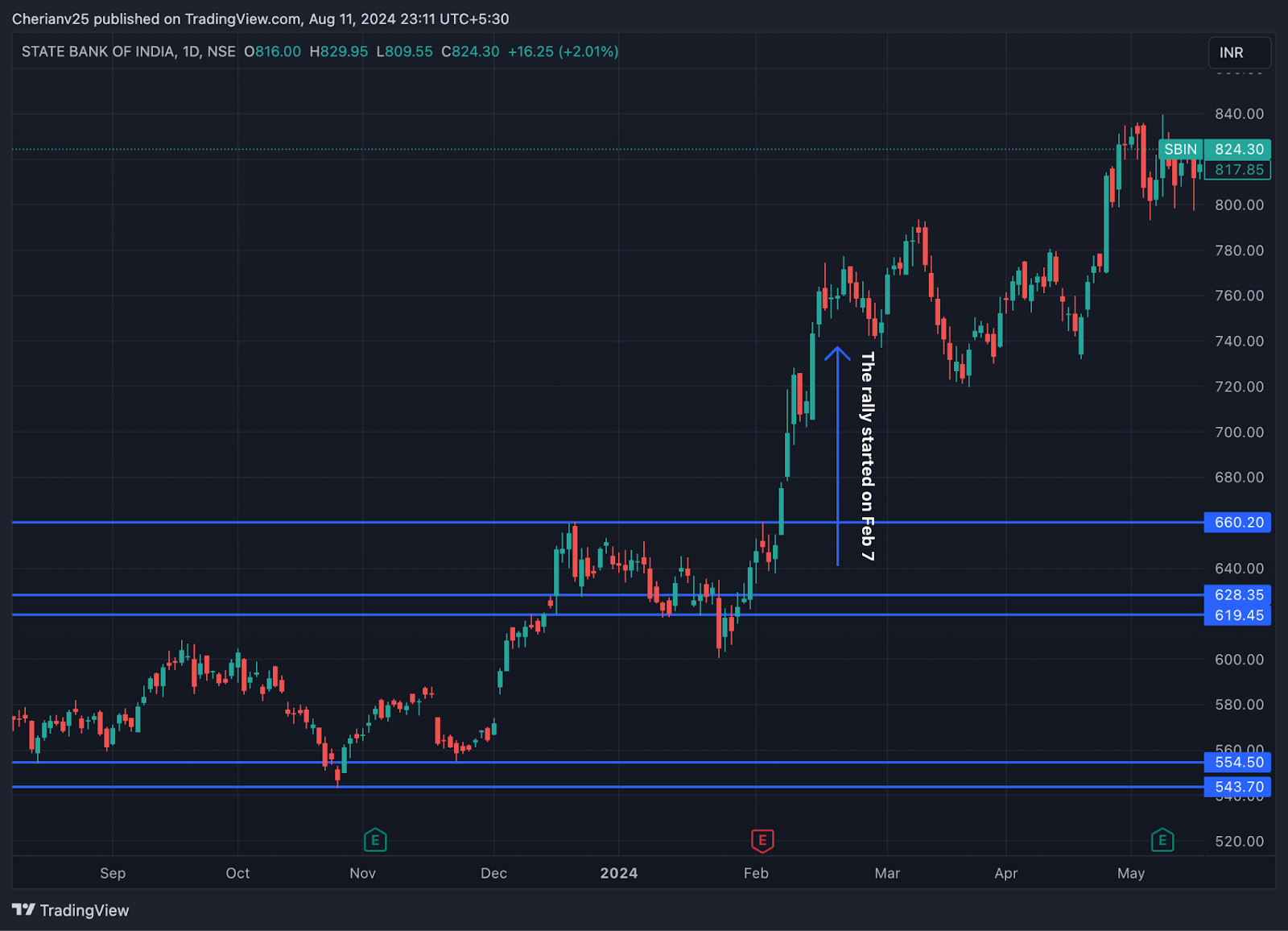
1. SBI: On February 7, 2024, the stock broke its all-time high. Within 7-8 days, it delivered a return of 12.86%. This surge was fueled by the factors discussed earlier, showcasing the power of momentum in a bullish market.
SBI stock chart - momentum investing | marketfeed

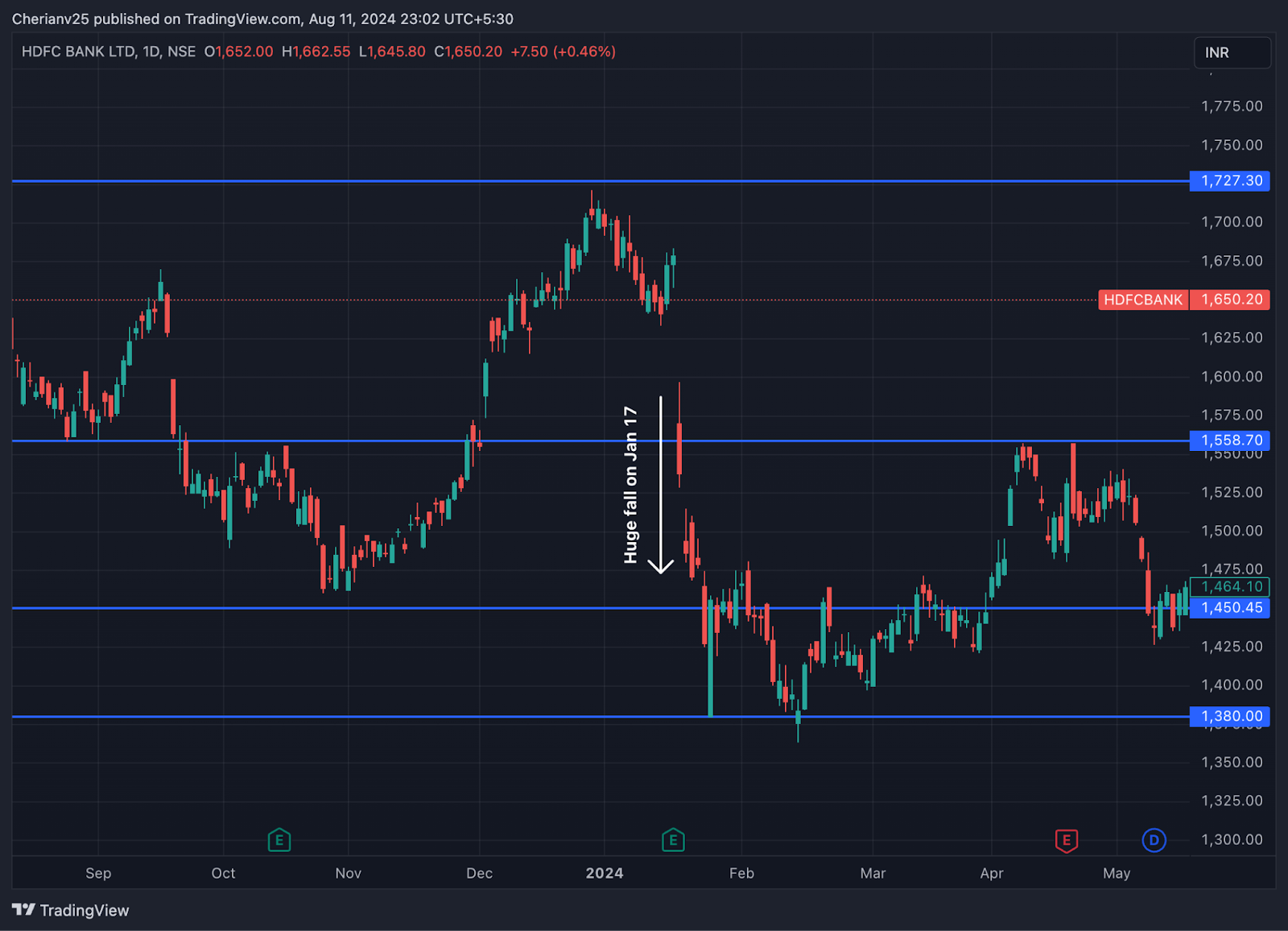
2. HDFC Bank: In contrast, HDFC Bank experienced a breakdown, resulting in an 8% decline. This example highlights the risks associated with catching a “falling knife,” where buying into a declining stock can lead to further losses.
HDFC Bank stock chart | marketfeed

Sectoral Rotation and Momentum Investing

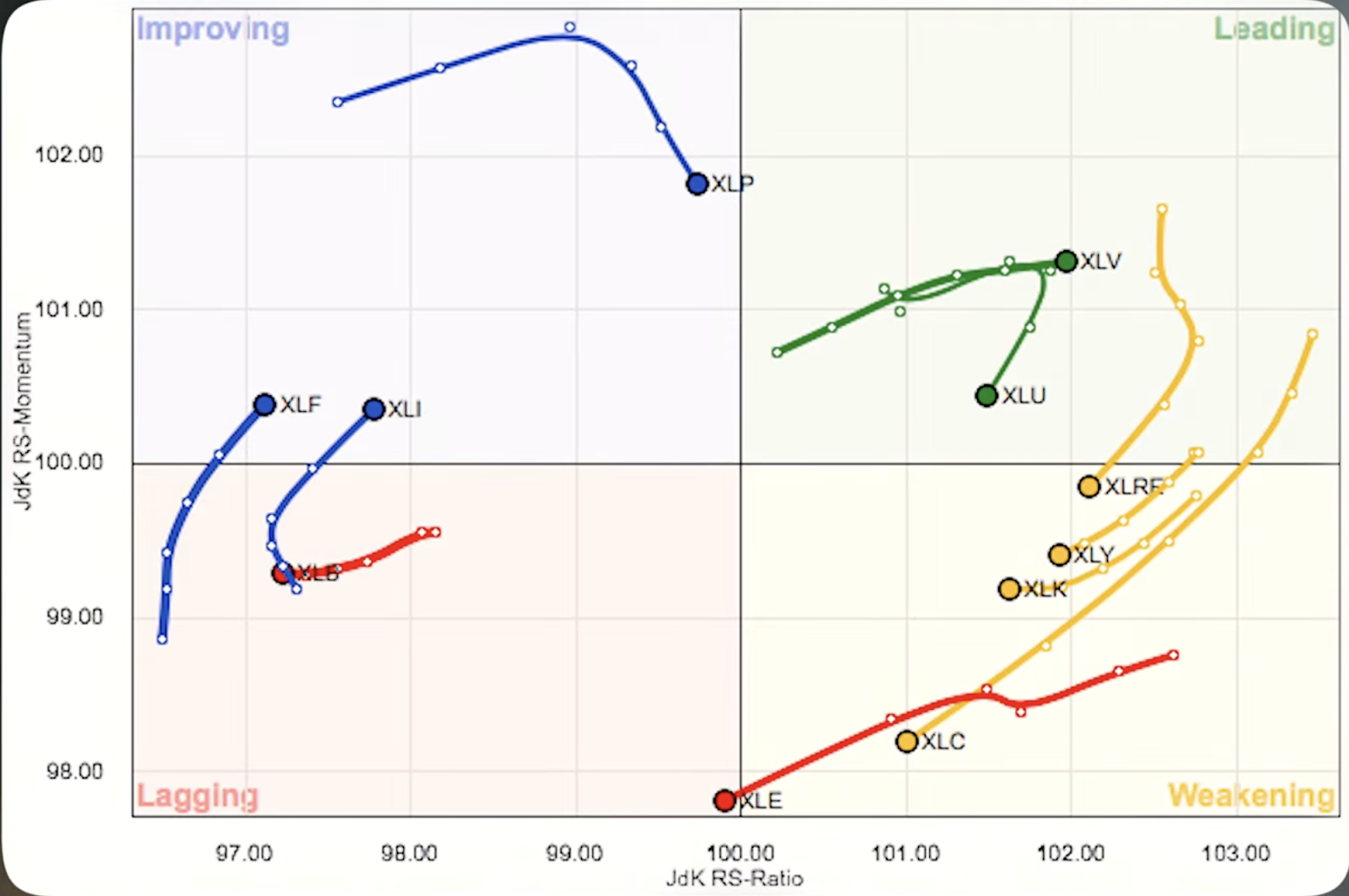
Sectoral rotation involves shifting investments across different sectors based on their performance. The market can be divided into four quadrants: leading, weakening, lagging, and improving. Investors often debate whether to invest in leading sectors or chase lagging sectors for potential rebounds. For momentum investors, the focus is generally on stocks in the leading quadrant, as they are more likely to continue their upward trajectory.
sectoral rotation - momentum investing | marketfeed
Sectoral Rotation of Stock Markets – Quadrants

How to Identify High-Momentum Stocks?

To identify stocks with strong momentum, follow these steps:

1. Look for unusually high price changes: Start by identifying stocks with significant price changes, typically 3-5% in a day (focus on Nifty 500 stocks, avoid micro-caps.). This change should not be due to news or result announcements, as these can be temporary.
2. Check for high trading volume: Ensure that the stock has unusually high trading volume, indicating strong investor interest. Compare the volume on the day of the breakout with the average volume over the last several days.
3. Breakout Confirmation: Confirm the breakout by analysing the stock’s chart patterns, such as trend lines or horizontal lines. Be cautious of fake breakouts and set appropriate stop-loss levels to mitigate risks.

Simply add these filters on a stock screening platform (like screener.in) to identify momentum stocks.

Limitations of Momentum Investing

While momentum investing can be highly profitable, it does have its limitations. This strategy tends to work best in trending or bullish markets. In contrast, long-term consolidation phases can lead to false breakouts and increased risk.

Here are some strong measures you can take to mitigate risks while momentum trading:

  • Set stop-loss orders to protect against downturns.
  • Monitor market conditions to identify trends.
  • Use daily candlesticks for short-term trades.
  • Apply weekly or monthly charts for longer-term analysis.
  • Avoid this strategy during periods of long-term consolidation

Conclusion

Momentum investing is a powerful strategy that can yield substantial returns in the short and medium term. Investors can make informed decisions by understanding the psychological and technical factors driving stock prices. Always remember to use screeners and implement robust risk management strategies to enhance the effectiveness of momentum investing!

As you explore momentum investing, remember to stay updated on market trends and be prepared to adapt your strategies as conditions change. With careful analysis and a commitment to continuous learning, you can harness the power of momentum investing in your stock market journey!

Watch: Momentum Investing Strategy using Price and Volume! | marketfeed

Categories
Algo Trading

Python for Algo Trading Strategies: Libraries and Frameworks

Many traders love Python for its simplicity and robust library ecosystem, harnessing its power and flexibility in deploying algo trading strategies. Python is a popular programming or coding language used by beginners and experts alike to create a wide variety of applications; from web development to data analysis and artificial intelligence. In this article, we will cover major Python libraries and frameworks that traders use to create, test, and run algo trading strategies. We’ll cover all areas: data analysis, technical analysis, backtesting, and machine learning, making it an all-inclusive resource for beginner and professional traders within the algo trading landscape.

Why is Python the Most Preferred Coding Language in Algo Trading?

There are many alternative coding languages like C++, Java, R, and MATLAB but have you wondered why Python is the most popular language used in algo trading? Several characteristics of Python make it the crowd-favourite. One of the main reasons is that Python is open-source, which means traders can modify and build their strategies. 

Python is less complicated. It uses libraries that increase code readability and reduce the size of the code. So algo traders can save a lot of time while coding and strategising. The array of libraries that Python provides for algo trading also makes it one of the most highly efficient languages for backtesting and live trading. 

Which Python Libraries are Useful for Algo Trading?

Before learning about Python libraries, you should know what a library is. Libraries are collections of pre-written code, usually in classes, functions, and modules, that programmers use without writing the code from scratch. Each coding language (like Python) has a wide range of libraries. Some of the popular Python libraries used on algo trading are: 

1. NumPy 

NumPy is one the most commonly used libraries for algo trading. It is the fundamental library used for computing in Python. Algo traders use this for numerical computations, data manipulation, preprocessing, and scientific computing. Remember, this library is more effective when it’s paired with other libraries like Pandas or Scikit-Learn. We will learn about them below. To install Numpy, you need to execute “pip install numpy” in a command-line interface or terminal (Command Prompt on Windows or Terminal app on macOS.

[Before running the command, make sure that you have pip installed. You can check by typing pip –version in your terminal. If it’s not installed, you may need to install it first.]

2. Pandas

Pandas helps in structured data manipulation and analysis. It is generally used in conjunction with NumPy. This library handles missing data, eliminates noisy data, and resamples data to different calculations. Its data structures like DataFrame and series allow traders to handle time-series data easily. Traders extensively use Pandas for data processing, feature engineering, and backtesting. You need to execute “pip install pandas” to install this.

3. LightGBM

LightGBM is a popular machine-learning library in Python developed by Microsoft. It manages large data sets and high dimensional data, making it one of the best choices for algo traders. LightBGM is a highly efficient and fast implementation of gradient boosting making the process optimised. Algo traders wishing to use this library can install it using “pip install lightgbm”

4. Zipline

Zipline is an open-source library built in Python. Traders use this to develop, backtest and execute trading strategies. This is the best generalist trading strategy with more than 13,000 stars on GitHub. It provides an inclusive framework for backtesting and built-in support for various types of data. It has data bundles to access historical data and pipelined API for complex factor modelling. You can install this using “pip install zipline” or “pip install zipline-reloaded”.

5. Backtrader

Backtrader is an open-source library for strategy development. This provides a wide range of adat feeds, making it a versatile choice for both live trading and backtesting. It offers a user-friendly API that makes implementing the strategies easier and supports various data formats like CSV, Pandas DataFrame, and online data sources. Backtrader has an active community, making it easier for retail traders to start and get support. You need to use “pip install backtrader” to use this.

6. Ta-lib

Ta-lib is used extensively for technical analysis. It consists of over 150 technical indicators. Its candlestick pattern recognition can identify over 60 candlestick patterns. Ta-lib can easily integrate with libraries like Pandas, NumPy, and Backtrader for better performance. 

7. Fast-trade 

Fast-trade is a Python library developed for algo trading, focusing mainly on efficient backtesting and strategy development. It uses NumPy for performance and works with OHLCV (open, high, low, close, volume) data. It provides access to various technical indicators, including tools for creating, testing, and visualising trading strategies against historical data. As it is open source, it is open to customisation and contributions from the community. Fast-trade helps balance performance with flexibility and will support traders & developers working in the algo trading domain.

8. Tulip Indicators

Tulip Indicators is a well-known, open-source library used for technical analysis in algo trading. It hosts a collection of more than 100 technical indicators and claims high performance with low memory usage. This includes moving averages, oscillators, volatility measures, and other mathematical functions common in trading strategies. One can easily integrate Tulip Indicators into trading systems and backtesting frameworks.

Which Python Frameworks Do Traders Use in Algo Trading?

1. Backtrader 

Backtrader is a Python framework for strategy development, testing, and execution. It has a user-friendly API to create trading systems, backtest them on historical data, or even live trade. Backtrader supports a wide array of data feeds, brokers, and analysers, hence it is versatile for various trading scenarios. The event-driven architecture allows easy implementation of complex strategies. It possesses plotting facilities with clear visualisation of backtest results. What differentiates Backtrader from other libraries is its flexibility, thorough documentation, and great community support. 

2. QuantConnect (Lean) 

QuantConnect is an integrated algo trading platform to be used with Lean (an open-source engine). It is a cloud-based environment where one can design, backtest, and go live to trade with quantitative trading algorithms on many asset classes like equities, forex, and cryptocurrencies. QuantConnect provides access to huge amounts of historical data and support for many programming languages like C#, Python, and F#. It differs from others because of its ability to smoothly transition from backtesting to live trading. This platform offers a marketplace for sharing and discovering trading algorithms.

3. Freqtrade 

Freqtrade is an open-source cryptocurrency trading bot written in Python. The application targets the crypto market exclusively and supports various exchanges through the ccxt library. Freqtrade features backtesting, hyperopt, edge positioning, and risk management tools. It allows the user to build a strategy based on indicators and supports both spot and futures trading. Freqtrade is famous for the activeness of its development process, extensive documentation, and strong community support— thus very popular in the crypto algorithmic trader community. 

4. Hummingbot 

Hummingbot is a free source, community-driven framework aimed at creating and running crypto trading bots. It supports several exchanges and strategies, such as market making, arbitrage, and liquidity mining. Hummingbot is a decentralised and democratised algo trading platform in the cryptocurrency space. This has both a command-line interface and a very user-friendly Graphical User Interface, making it easy to use by both expert programmers and people who have never programmed before. One essential factor of this platform is transparency. It gives users the power to audit its code and contribute to its development. Hummingbot also provides educational resources and a supportive community for algo traders.

What are Other Coding Language Options for Algo Trading?

  • C++: This is preferred for high-frequency trading systems where microsecond performance matters. Its low-level control and speed make it ideal for implementing complex algorithms and handling large volumes of market data efficiently.
  • Java: It is widely used in large-scale trading systems due to its scalability. Java’s extended libraries make it an ideal platform for building a reliable multi-threaded trading application that can handle advanced order management.
  • R: Quantitative analysts widely use it for statistical modelling and backtesting trading strategies. Its powerhouse of data manipulation and visualisation features makes it excellent for exploratory data analysis and developing statistical trading models.
  • MATLAB: Researchers and academics typically use it for developing and testing trading algorithms. Its presence of financial toolboxes enables a user to prototype quantitative strategies efficiently and analyse financial time series.

Conclusion

Python is the language of choice for algorithmic trading due to its simplicity, versatility, and strong support in libraries or frameworks. It’s open source and enjoys good support from various communities.

Although Python is the dominant language, C++, Java, R, and MATLAB still have their unique flavour, which only they can bring at certain points in the process of creating a trading system based on an algorithm. The choice of language usually rests on the specific requirements of the trader, the complexity of the strategies, and the trading infrastructure.

As the field of quantitative trading evolves, it is of utmost importance that traders stay updated on the latest tools and technologies. Whether a complete newbie or one wanting to improve their existing strategies, the resources and frameworks mentioned in this article could guarantee success in the world of algo trading. 

FAQs

1. Why is Python the most preferred language for algo trading?

Python is the most popular language for algo trading due to its simplicity, open-source nature, and extensive libraries that support numerical computing, data analysis, backtesting, and machine learning. It allows traders to quickly develop and modify trading strategies with minimal coding effort, making it an efficient choice compared to languages like C++, Java, R, and MATLAB.

2. What are the essential Python libraries used in algo trading?

Some of the most commonly used Python libraries for algo trading include:

  • NumPy – For numerical computations and data manipulation.
  • Pandas – For structured data analysis and time-series processing.
  • LightGBM – A machine-learning library optimised for large datasets
  • Zipline – An open-source library for backtesting and executing trading strategies.

3. What are some Python frameworks that traders use in algo trading?

Traders use several Python frameworks for strategy development, testing, and live execution, including:

  • Backtrader – A user-friendly framework for backtesting and live trading
  • QuantConnect (Lean) – A cloud-based platform for backtesting and live trading across multiple asset classes
  • Freqtrade – A trading bot framework specifically designed for cryptocurrency trading
  • Hummingbot – A decentralised framework for building and running crypto trading bots
Categories
Algo Trading

Which are the Best Books to Learn Algo Trading?

“The more that you read, the more things you will know. The more that you learn, the more places you’ll go.”

Are you eager to dive into the world of algo trading but don’t know where to start? You’re not alone! Many aspiring traders seek reliable resources to learn about this exciting and complex field. And books can be a great place to start! In today’s article, we will look at books which can help you master algo trading from the basics.

Top Books on Algo Trading for Beginners

If you are a beginner and want to learn the basics of algo trading, these books are for you:

1. “Building Winning Algorithmic Trading Systems” by Kevin J. Davey

Kevin Davey is a professional trader and a top-performing systems developer. He is the author of 4 best-selling books on trading & investing and is recognised as a thought leader in algorithmic trading system development. This book is like a journal or diary that describes his adventure in the world of trading. It clearly describes the development of trading systems and talks about practical strategies & potential dangers. This is a good starter for beginners in the iterative process of designing and testing feasible algo trading systems.

2. Algorithmic Trading: Winning Strategies and Their Rationale” by Ernie Chan

Ernie Chan is considered a legend in the world of algo trading. He holds a PhD in Physics from Cornell University and has extensive experience working as a quantitative researcher for prominent investment banks such as Credit Suisse, Morgan Stanley, and Millennium Partners. In this book, he lays out the basics of the field for a beginner. It provides a solid volume of strategies and risk management tools. Moreover, Chan’s approach is practical and accessible to people who have no background in programming.

Top Books on Algo Trading for Intermediates

If you’re someone who knows the basics of the stock market/algo trading and is looking to improve your knowledge, then these are the books you can check out:

1. “Machine Learning for Algorithmic Trading” By Stefan Jansen

Stefan is the founder and CEO of Applied AI, which builds solutions using machine learning for leading industries. This book forms an important link between machine learning and trading. Jansen shows how one can comprehensively implement machine learning techniques in algorithmic trading. Handling data, feature engineering, and model optimisation make the book an important tool for traders who aim to add advanced analytical means to their trading strategies.

2. “Python for Finance: Mastering Data-Driven Finance” by Yves Hilpisch

Dr Yves J. Hilpisch is the founder and managing partner of The Python Quants, a group that focuses on using open-source technologies for financial data science, algorithmic trading, and computational finance. This book will be useful for any trader who’s serious about improving their coding skills. It focuses on Python for financial applications, with special emphasis on algo-trading.

3. “Algorithmic Trading and DMA: An Introduction to Direct Access Trading Strategies” by Barry Johnson

This is a foundational text that provides a comprehensive overview of algorithmic trading and direct market access (DMA). It is designed to introduce both beginners and experienced traders to the intricacies of these rapidly evolving fields. The book explains how markets function at a granular level, providing a solid base for understanding algorithmic trading strategies. It covers a variety of strategies, from basic to advanced, equipping readers with practical knowledge.

Top Books on Algo Trading for Advanced Learners

If you are someone who wants to master algo trading, then you definitely need to check these books out:

1. “Advances in Financial Machine Learning” by Marcos López de Prado

Marcos López de Prado currently serves as Global Head of Quantitative Research & Development at the Abu Dhabi Investment Authority. This book is for professional traders who know machine learning and want to implement it in financial markets. De Prado raises practical issues with the implementation of machine learning in trading, discussing typical risks and solutions. The book is full of deep insights and will be highly relevant to mature traders in the Indian market who want to use big data in their strategies.

2. “The Science of Algorithmic Trading and Portfolio Management” by Robert Kissell

Robert Kissell has over 20 years of professional experience specialising in economics, quantitative modelling, statistical analysis, and risk management. He has written a comprehensive book on advanced trading analytics, model validation, and risk analysis. If you are an advanced trader looking to get deeper into the intricacies of algorithmic trading systems and portfolio management, it’s a must-read. The book is aimed at those who intend to improve their trading strategies and analytical skills.

Conclusion

The algo trading domain is vast. The books described in the article— the foundational ones that introduce the basics to advanced works on cutting-edge machine learning applications— are of great value to traders at all levels. These books will help you build a strong theoretical base and give you insights to apply them in live markets. Moreover, you can upskill on risk management strategies and portfolio optimisations. 

Books give you great knowledge, but hands-on practice is just as important in algo trading. As you learn, remember that markets change often. You’ll need to keep learning and trying new things. You might come back to these books many times. You’ll also find new information as this exciting field grows and changes. Keep exploring and learning as you go on your algo trading journey!

FAQs

1. Which book should I start with if I am completely new to algo trading?

“Building Winning Algorithmic Trading Systems” by Kevin J. Davey could be a great starting point into the world of algo trading. It explains the basics in an easy-to-understand way and helps you develop a strong foundation.

2. Can I learn algo trading just by reading books?

Books are a great resource, but practical experience is key. Try applying what you learn by backtesting strategies, using trading simulators, or enrolling in online courses.

3. Do I need to know programming to understand these books on algo trading?

Not all of them! Some beginner-friendly books focus on trading concepts without coding, while others introduce Python and machine learning for advanced strategies.

Categories
Editorial

Unlocking the Potential of the Covered Call Strategy in India: A Step-by-Step Guide

As an investor, you may be constantly looking out for strategies that offer consistent returns with manageable risks. One such strategy that offers a unique approach to generating income is the covered call strategy. It’s widely recognised globally, but not as popular in India. This approach could be particularly appealing to those who prefer a less hands-on investment method. In this article, we will dive into the covered call strategy, explain its mechanics, and explore its advantages and disadvantages.

The Basics of a Call Option

Before diving into the covered call strategy, it’s crucial to understand what a call option is. A call option is a financial contract that gives a buyer the right, but not the obligation, to buy an underlying asset (like a stock) at a predetermined price (strike price) within a specified time frame. For this right, the buyer pays a premium to the seller.

Let’s look at a simple example. Imagine you’re interested in buying a used car. You negotiate with a seller and agree to pay a token amount to secure the right to buy the car at a specified price by the end of the month. This token amount is similar to the premium paid for a call option. If you decide to buy the car, you pay the agreed price. But if you choose not to, the seller keeps the token amount.

In the stock market, when you purchase a call option for a stock, you are essentially paying for the right to buy that stock at a predetermined price within a specific timeframe. If the market price exceeds this strike price, you can exercise your option and purchase the stock at a lower price.

The Covered Call Strategy Explained

The covered call strategy involves owning shares of a fundamentally strong stock while simultaneously selling call options on that stock. This approach is similar to earning rental income from a property; just as a landlord collects rent from tenants, you can collect premiums from the options you sell.

How to Deploy a Covered Call Strategy?

1. Select a Stock: The first step in deploying a covered call strategy is to choose a fundamentally strong stock. For instance, HDFC Bank, a well-established Nifty 50 company, is an ideal candidate due to its robust fundamentals and steady growth potential.

2. Buying the Stock: Purchase the stock in sufficient quantities to form at least one lot (e.g., 550 shares of HDFC Bank) at say ₹1,500 per share. This investment is similar to acquiring a commercial property.

3. Selling Call Options: After buying the stock, sell call options on it. Going back to our example, we can sell HDFC Bank call options with a strike price of ₹1,700. This strike price is chosen based on the expectation that the stock will not exceed this price significantly within the option’s timeframe (there will be an expiry date for the contract).

4. Generating Income: The premium received from selling call options acts as rental income. If the stock price remains below the strike price, the call options expire worthless, and you retain the premium. If the stock price exceeds the strike price, you sell the stock at the strike price, thus capping your profit but still securing a gain.

When selling call options, suppose you receive a premium of ₹8 per share for a 1.5-month period. Over a year, this could amount to approximately ₹25,000 to ₹30,000 in premium income. This translates to an expected return on investment (ROI) of about 3.8% to 4% annually, a figure comparable to returns from traditional commercial real estate investments.

Advantages of the Covered Call Strategy

  • Consistent Income: By selling call options regularly, you can generate consistent income from the premiums, similar to earning rent from a property.
  • Downside Protection: The premium income can offset potential losses if the stock price declines slightly.
  • Limited Risk: The primary risk is the opportunity cost of missing out on substantial gains if the stock price rises significantly above the strike price.
  • Long-Term Investment: The strategy encourages a long-term investment approach, holding fundamentally strong stocks that are likely to appreciate over time.

Disadvantages of the Covered Call Strategy

  • Limited Upside Potential: Your profit is capped at the strike price of the sold call option. If the stock price soars, you miss out on higher gains.
  • Stock Selection: The success of this strategy hinges on selecting the right stock. Buying a stock at an overvalued price can lead to losses.
  • Capital Requirements: This strategy requires a significant initial investment to buy the necessary stock quantities.
  • Management Complexity: While the strategy reduces the need for constant monitoring, it requires understanding market conditions and adjusting positions accordingly.

Investors must be aware of these risks and ensure they have a solid understanding of market conditions before implementing this strategy. Proper stock selection is crucial, as buying at a high price can significantly impact overall returns.

Enhancing Returns with Margin Pledging

One additional advantage is the ability to pledge the stock holdings to obtain margin (capital) for further trades. For instance, if you invest ₹8.25 lakhs in HDFC Bank shares, you can pledge these shares to get a margin for intraday or positional trades. This margin can be used to generate additional returns, enhancing the overall profitability of your investment.

Conclusion

The covered call strategy offers a unique blend of consistent income and long-term growth potential. This makes it an attractive option for investors seeking a stock market alternative to traditional rental income. By understanding the mechanics and carefully selecting stocks, investors can unlock significant value and generate steady returns with manageable risks.

While there are risks involved, the potential for steady income and long-term capital appreciation makes this strategy worth considering. As with any investment strategy, it’s essential to conduct thorough research, understand market conditions, and consult with financial advisors if necessary.

Whether you’re an experienced trader or a beginner looking to explore new avenues, the covered call strategy could be a valuable addition to your investment portfolio. With proper execution and management, it can help you achieve your financial goals while minimizing risk!

Watch: Rental Income through Trading? Covered Call Trading Strategy Explained | marketfeed

Categories
Editorial

How to Invest in US Stocks? A Guide for Indian Investors

Investing in US stocks is become increasingly popular among Indian investors, especially the younger generation. Despite the Indian stock market’s impressive bull run over the past few years, many are drawn to the potential higher returns of prominent US stocks like Amazon, Tesla, and Nvidia. Unfortunately, many investment apps have high fees and complicated terms that can discourage people from using them. In this article, we will explore a low-cost and efficient way to invest in US stocks from India.

Why Invest in US Markets?

Here are four compelling reasons why you can consider investing in US stocks:

1. Diversification

Diversification is a fundamental investment strategy that involves spreading investments across various assets to reduce risk. When one asset class performs poorly, another may perform well, balancing your overall portfolio. For instance, when stock markets decline, commodities like gold often rise. The US and Indian markets have low correlation, meaning their performance is not closely tied. This lack of correlation opens opportunities for true diversification. If the Indian stock market underperforms, your US investments can potentially offset those losses.

2. Currency Depreciation

The performance of the Indian Rupee against the US dollar can significantly impact investment returns. For example, if you bought US dollars when the exchange rate was ₹70 and the rate increased to ₹84, your investment appreciates without any stock market gains. This currency strength can enhance your overall returns.

3. Lower Volatility

The US market is more mature and stable compared to the Indian market. This maturity results in lower daily volatility, making it a less risky investment option. However, do remember that no investment is entirely without risk!

4. Better Valuations

US stocks often have better valuations compared to Indian stocks. Price-to-earnings (P/E) ratios in the US are generally more favourable, providing more value for your investment. For example, many US-listed companies have lower P/E ratios than Indian companies, indicating better value potential.

To learn more about P/E ratio, explore this article: How to Analyse Debt & Valuation of a Company?

How to Start Investing in the US Stock Market from India?

Many investors may wonder how to begin their investment journey in US stocks with minimal capital. Here’s a straightforward approach:

Investing Through Mutual Funds

One of the most effective ways to invest in US tech stocks is through mutual funds, specifically those focused on the NASDAQ index. The NASDAQ is renowned for its tech-heavy listings, including major players like Apple, Amazon, and Nvidia.

Here are two mutual funds that are ideal options for investing in US markets:

1. Motilal Oswal NASDAQ 100 Fund of Fund

The Motilal Oswal NASDAQ 100 Fund of Fund is a popular choice for Indian investors. This fund invests in another mutual fund that directly targets NASDAQ-listed companies. Here are some key points:

  • CAGR Returns: The fund has delivered an impressive Compound Annual Growth Rate (CAGR) of around 25% over the last five years.
  • Expense Ratio: The expense ratio is relatively low, ensuring that you get more out of your investments.
  • Minimum Investment: You can start investing with as little as ₹500.
  • Performance: Over the last year, the fund has provided more than 30% returns, demonstrating the potential of US markets.

2. ICICI Prudential NASDAQ 100 Index Fund

This fund also invests in NASDAQ companies and offers similar benefits:

  • Returns: The fund has delivered a return of 29.21% over the last year.
  • Expense Ratio: The expense ratio is slightly higher at 0.52%, but still reasonable.
  • Portfolio: The fund invests in leading tech companies like Microsoft, Apple, Nvidia, and Amazon, in proportions that mirror the NASDAQ index.

Other Options to Invest in US Stocks

In addition to the NASDAQ-focused funds, you can consider the following options:

  • Motilal Oswal S&P 500 Index Fund: This fund invests in the S&P 500 index, which includes major US companies like Microsoft and Amazon. The investment ratios differ from those in NASDAQ funds, providing additional diversity.
  • Sector-Specific Funds: Explore funds that focus on specific sectors, such as technology or healthcare, to align with your investment strategy.

How Much to Invest?

While investing in US stocks can be beneficial, it’s essential to balance your portfolio. Moderation is key! A recommended strategy is to invest no more than 15-20% of your total portfolio in US stocks. This allocation provides diversification benefits while keeping the majority of your investments within familiar markets.

Investing too heavily in foreign markets can expose you to risks you may not fully understand. While major US tech companies show strong growth potential, diversification is essential to safeguard your investments. Balancing your portfolio with a mix of domestic and international assets can lead to more stable long-term growth.

Conclusion

Investing in US markets offers numerous benefits, from diversification to access to leading technology companies. However, it’s vital to approach this opportunity with caution. Mutual funds provide a transparent and efficient means to invest, minimising risks associated with direct stock purchases.

As you embark on your investment journey, remember to conduct thorough research and consider your risk tolerance. The US market presents a wealth of opportunities, but informed decisions are crucial for success. Share this guide with fellow investors to help them navigate the complexities of investing in US stocks.

Stay informed, stay diversified, and enjoy the journey of investing in the global market!

Categories
Editorial

Union Budget 2024-25: Key Priorities for Transforming India’s Future

Finance Minister Smt. Nirmala Sitharaman presented the Union Budget for the financial year 2024-25 in Parliament on July 23, 2024. Let us take a look at some of the key highlights from the Budget presentation.

The 9 priorities of the budget are: 

1. Agriculture Transformation:

The Indian govt aims to transform agricultural research and productivity. It will support the public and private sectors by introducing 109 high-yielding crop varieties and 32 new releases of horticulture. One crore farmers will be encouraged to take up natural farming based on certification and branding. There’s a proposal to establish 10,000 bio-input centers to create a national-level micro-fertilizer and pesticide manufacturing network. There will also be efforts to increase the production, storage, and marketing of oilseeds like mustard, sesame, soybean, and sunflower.

Besides this, 400 districts and six crore farmers will be added to land registries, while Kisan Credit Cards will be enabled in five states. Shrimp production and exports will be increased under NABARD’s national cooperation policy.

The Centre will allocate ₹1.52 lakh crore to the agriculture and allied sectors.

Do look out for the stocks in the agriculture sector: UPL, Coromandel International, Rallis India, Avanti Feeds, Kaveri Seed Co, PI Industries, and Bayer CropScience.

2. Employment and Skilling

To meet the challenges on the employment front, the government has introduced three schemes:

1. All first-time entries into jobs in every formal sector will be paid one month’s wages in advance— up to ₹ 15,000, subject to a total of 2.1 crore youth (Scheme A).

2. Incentives will be provided directly to both employees and employers on a specified scale for their EPFO contribution in the first 4 years of employment. (Scheme B).

3. The government will reimburse EPFO contributions of employers up to ₹3000 per month for 2 years for all new hires. – Expected to generate 50 lakh jobs (Scheme C).

Measures that attempt to increase female workforce participation include the establishment of women’s hostels and specific programs for skilling. Over the next five years, 20 lakh youth will be skilled, with 1,000 training institutes upgraded. New courses will cater to emerging sectors, and loans up to ₹7.5 lakh will support 25,000 students annually.

3. Human Justice and Regional Development

Development initiatives have been planned under the Purvodiya program, with a focused attention on the eastern states like Bihar, Jharkhand, West Bengal, Odisha, and Andhra Pradesh. An investment of ₹26,000 crore in roadways and ₹21,400 crore in power projects will provide better connectivity through infrastructure projects. New airports and medical colleges will be established in Bihar. The govt will support the Polavaram irrigation project in Andhra Pradesh to ensure food security.

4. Manufacturing and Services

The govt has proposed to give special attention to Micro, Small & Medium Enterprises (MSMEs) through a ₹100 crore credit guarantee scheme, a new way of judging credit, and enhanced Mudra loans of up to ₹20 lakhs for those having repaid their loans earlier. An internship scheme associated with the PM package will offer one crore youth the opportunity to work in top companies for five years, with a stipend amount of ₹5,000 per month.

Under the PPP (Public-Private Partnership) mode, rental housing schemes shall be developed for industrial workers. The shipping industry will benefit from the Critical Mineral Mission aligned with technology and skill in manpower development.

5. Urban Development

Growth in urban areas will be driven by developing cities as hubs with transit-oriented plans in 14 large cities. Housing needs for one crore members will be addressed with a ₹10 lakh crore investment. This is accompanied by initiatives for transparent rental markets and improved water supply & sanitation across 100 cities through bankable projects.

6. Energy Security

The PM Surya Ghar Muft Bijli Yojana will promote rooftop solar installations for one crore households. The govt has proposed to speed up policy implementation for pumped storage, nuclear R&D, and advanced thermal power plants. The govt will scale up energy audits in industrial clusters. A joint venture between NTPC and BHEL will set up a full-scale 800-megawatt (MW) commercial plant.

Top energy-related stocks may include NTPC,  SJVN, NHPC, Tata Power, Adani Green Energy, Adani Power, Bharat Petroleum, Indian Oil Corporation, ONGC, and JSW Energy. 

7. Infrastructure

The Centre will spend ₹11.11 lakh crore on infrastructure in the next five years (which accounts for 3.4% of our GDP.) The state resource support for infra allocation is coming to a total of ₹1.5 lakh crore, including the 4th phase of Gram Sadak Yojana to improve rural connectivity. The Centre will launch Phase IV of Pradhan Mantri Gram Sadak Yojana (PMGSY) to provide all-weather connectivity to 25,000 rural habitations.

Projects at Vishnupad and Mahabodhi temples in Bihar and Nalanda will boost tourism. Financial support for projects with an estimated cost of ₹11,500 crore such as the Kosi-Mechi intra-state link and 20 other ongoing and new schemes will be provided. The govt will provide assistance for flood management and related projects in Assam, Sikkim & Uttarakhand and reconstruction and rehabilitation in Himachal Pradesh.

These are a few stocks to look out for in the Infrastructure sector: NBCC, HFCL, IRB Infra, PNC Infra, KNR Construction, PNC Infratech, RITES, Ahluwalia Contracts,  and Larsen & Toubro Ltd.

8. Innovation and R&D

This priority includes a National Research Fund with a funding pool of ₹1 lakh crore to incentivize innovation and a Space Economy Venture Capital Fund of ₹1,000 crore. The Central Govt will operationalise the Anusandhan National Research Fund to support basic research and prototype development.

9. Reforms for the Next Generation

The govt aims to introduce a new Economic Policy Framework to guide reforms focused on improving employment opportunities and sustaining high growth. This framework will boost productivity across land, labour, capital, and entrepreneurship by leveraging technology and collaboration between the Centre and states. The Centre will work on land-related reforms such as assigning Unique Land Parcel Identification Numbers (ULPIN) and digitising maps for rural areas. Urban areas will see digitisation of land records with GIS mapping. Meanwhile, the Jan Vishvas Bill 2.0 will emphasise digitisation and ease of doing business.

What are the Updates on GST?

  • Medicine and Medical Equipment: GST rate cut for three more cancer medicines.
  • X-Ray Tubes: Revision in Basic Customs Duty (BCD) on certain items to help ‘Healthcare’.
  • Critical Minerals Reduction in Customs Duty on 25 minerals to make them more easily available for Medical use.
  • Marine Products, Leather and Textile BCD on real down filling materials from duck or goose reduced to aid these industries.
  • Precious Metals BCD on gold and silver reduced to 6% and platinum to 6.4% making them cheaper
  • Oxygen-Free Copper Abolition of BCD on Oxygen-Free Copper used in the manufacture of resistors and connectors to increase capacity.
  • Ammonium Nitrate: Hiked from 7.5% to 10% to control usage.
  • Plastics and PVC: Increased BCD to control environmental pollution.
  • Telecom Equipments: Increased BCD from 10% to 15% on certain items to encourage domestic manufacturing.

Direct Tax Reforms in Union Budget 2024-25 & Other Updates

  • Standard Deduction for salaried employees: Increased from ₹50,000 to ₹75,000.
    [Standard deduction is a fixed amount of money that salaried individuals can subtract from their total income before calculating their taxes.]
  • Family Pension Deduction: Increased from ₹15,000 to ₹25,000.
  • Mutual Funds and Unit Trust of India (UTI): Abolished tax deducted at source (TDS) to attract investors.
  • Angel Tax: Abolished for all classes of investors to foster the growth of startups.
  • The Centre has proposed to remove the indexation benefit available for calculating any long-term capital gains (LTCG) presently available for property, gold and other unlisted assets (this will severely impact people who have invested in such assets as to sell during retirement). Meanwhile, the LTCG tax on immovable properties will fall from 20% to 12.5%. – Effective from July 23, 2024.

[Indexation adjusts the purchase price of an asset to adjust for inflation, thus reducing the gains and ultimately tax liability.]

Revised Tax Slabs – New Tax Regime

Income RangeRate of Tax
Up to ₹3 lakh per annumNil
₹3 lakh to ₹7 lakh per annum5%
₹7 lakh to ₹10 lakh per annum10%
₹10 lakh to ₹12 lakh per annum15%
₹12 lakh to ₹15 lakh per annum20%
Above ₹15 lakh30%

With the new tax slabs, salaried taxpayers can now save up to ₹17,500.

Revised Tax Rates for Stock Market Participants

1. Capital Gains Tax

  • Short-Term Capital Gains (STCG): The tax rate has been increased from 15% to 20%.
  • Long-Term Capital Gains (LTCG): The tax rate has been revised from 10% to 12.5%. The exemption limit of LTCG now stands at ₹1.25 lakh per annum.

2. Securities Transaction Tax (STT)

  • With effect from Oct 1, STT on the sale of options will be increased from 0.0625% to 0.01% of the option premium.
  • STT on sale of futures futures will go up from 0.0125% to 0.02% of the price at which such futures are traded.

The Way Ahead

The Union Budget 2024-25 outlines strategies to boost India’s economic growth across key sectors. It focuses on agriculture, employment, infrastructure, and innovation to create a resilient and inclusive economy. Key initiatives include agricultural transformation, employment schemes, regional development (especially in eastern states), MSME support, urban development, and energy security measures. These efforts, along with investments in skilling and innovation, reinforce the ‘Make in India’ initiative and promote sustainable growth.

Tax reforms, GST updates, and new policies aim to improve the business environment. While the plans are ambitious, their effective implementation will be crucial in shaping India’s economic future, driving growth, creating jobs, and enhancing societal well-being in the coming years.

Now let’s look forward to seeing how these strategic plans are implemented! 

Disclaimer: The stocks mentioned in the article are solely for educational purposes. Please do your own research before investing.

Categories
Algo Trading

Essential Resources to Learn Algo Trading: Courses & Tutorials

The field of algo trading is rapidly evolving every day and it has become necessary to master it to remain competitive in the Indian stock market ecosystem. Whether you are a beginner who is eager to grasp the basics or a professional planning to gain an edge over others, there’s always scope to learn something new. In this article, let’s look at how online courses and informative tutorials can guide you through every level to master algo trading. 

Beginner Level Courses & Tutorials

If you are a beginner and want to learn the basics of algo trading, these are some sources which will help you build a strong foundation:

1. Udemy 

Udemy offers a wide range of algo trading courses targeting beginner traders. You can gain lifetime access to resources to learn at your own pace. 

The courses on Udemy will teach you how to create trading bots for exchanging stocks and build Python-based trading algorithms. You can join hundreds of algo trading courses (most of them are paid ones) and learn from experienced professionals. Some of the popular courses are:

  • Algorithmic Trading A-Z: This will teach you the basics of algo trading, how to build your own truly data-driven trading bot, and how to create, test, implement & automate unique algo trading strategies. 
  • Algorithmic Trading Options for the Indian Stock Market: This course is specially designed for options algo trading in Indian markets. It focuses on teaching and implementing algo trading strategies using Zerodha and Angel One APIs. It also emphasises risk management and the practical application of options trading tools. 

2. Algorithmic Trading YouTube Playlist by Dhan

This is a complete guide/playlist by the YouTube channel of Dhan, an online stock trading and investing platform. It is a completely Hindi-based tutorial that will provide insights on algo trading. The information provided ranges from the introduction of algo trading and basics of Application Programming Interface (API) to algo trading strategies with live market charts.

[An API is a set of protocols and tools that enable the software to interact with and place orders on different trading platforms, exchanges, or brokers.]

Check out the playlist: What is Algorithmic Trading? Basics of APIs Explained in Hindi – Beginners Guide | Dhan

3. Algorithmic Trading Module by NSE

This course aims to provide students with NSE Academy Certification in Financial Markets (NCFM). This is a self-learning course, and you will be given a solid syllabus on algo trading, order types, trading strategies and architecture, and audit & compliance processes. 

This is a paid course worth ₹7,670. At the end, students have to take an examination of 100 questions and 60 minutes will be provided. The passing percentage of this exam is 60%. The certificate obtained after passing this exam will be valid for 3 years. 

To learn more about the course, check NSE’s official website.

4. Algo Trading for Beginners by Pushkar Raj

This a collaboration between stock market educator Pushkar Raj Thakur and Sharique Samsudheen, the CEO & co-founder of marketfeed. This video explains everything about algo trading, clarifying misconceptions and explaining its basics. It covers strategy creation, backtesting, and automation. Sharique shares a specific intraday option selling strategy for Bank Nifty, detailing its rules, backtested performance, and considerations for traders. The emphasis is on understanding the process and developing strategies on your own, rather than relying on others.

Don’t forget to watch the video: Algo Trading Strategy for Beginners | How to Make Money in the Share Market?

5. PGPAT by the Indian Institute of Quantitative Finance

The Post Graduate Program in Algorithmic Trading (PGPAT) is an online program offered by the Indian Institute of Quantitative Finance (IIQF), Mumbai. The course is taught by highly qualified and experienced market practitioners to produce industry-ready algo-trader professionals at the Master’s level. 

Any fresh graduates, management students, finance professionals, prop traders, or any retail trader can join this course. After completing this course, students can join the trading desks of various financial institutions, either in India or at global locations. They can set up their independent prop desks for algos. 

To get more information about the course, check IIFQ’s official website.

Advanced Level Courses & Tutorials

If you are a trader with intermediate algo trading knowledge looking to advance your skills, here are valuable resources to help you master the art of algo trading:

1. Coursera

Coursera’s a great platform to learn algo trading concepts from industry experts. You can enroll for courses designed by faculties of top universities or global institutions. These courses cover a wide range of topics— from quantitative trading strategies to financial modelling and machine learning. You can also gain a foundational understanding of the various tools used in the field. If you are looking for a platform for a structured path to learn algorithmic trading with proper certifications, then Coursera might be the best option for you. 

Some of the best algo trading courses are paid and some are free to pursue. A few of the best-rated and reviewed popular courses are:

  • Trading Algorithms: This algo trading course is designed by the Indian School of Business (ISB) and provides information on trading algorithms, advanced trading algorithms, and trading strategies in emerging markets.

To explore more algo trading courses on Coursera, click here.

2. Executive Programme in Algorithmic Trading (EPAT):

This is a high-ranking, investment-oriented algorithmic trading program offered by QuantInsti (a pioneering institute in quantitative finance and algo trading). The cost of this program is around ₹3 lakhs – purely for professionals! It focuses on quantitative techniques, machine learning, and strategy development. EPAT provides students with the skills necessary for developing and managing advanced algo trading systems.

To know more about this course, check out their website.

3. Machine Learning and Quant Strategies with Python by freeCodeCamp.org

With more than 6 lakh views, this video discusses algorithmic trading strategies using machine learning and quantitative methods in Python, focusing on factors and portfolio optimisation. You will learn about the best trading algorithms and strategies to enhance your financial toolkit. You’ll explore the Unsupervised Learning Trading Strategy, utilising S&P 500 stock data to master features, indicators, and portfolio optimisation. This is the best for beginners looking for a tutorial in English.

Take a look at the video: Algorithmic Trading – Machine Learning & Quant Strategies Course with Python

Conclusion 

Algo trading helps you in various aspects of trading. You can learn it for free, whether you’re just starting or already know a lot. Websites like Coursera and Udemy have classes you can take. Institutions like IIQF and NIFM help you learn and try it out yourself. You can also watch videos on YouTube to learn how algo trading works and pick up useful tips.

To keep up with the changing world of finance, it’s important to keep learning new skills. This is your chance to learn about algo trading and come up with new ideas. Don’t miss out on this opportunity to grow!

Learn Algo Trading – FAQs

1. Do I need programming knowledge to start algo trading?

Not necessarily. Many platforms offer no-code algo trading solutions. However, learning Python or other programming languages can help you create and customize your own trading strategies.

2. Are free algo trading courses as good as paid ones?
Free courses are great for learning the basics, but paid courses often provide structured content, certifications, and hands-on experience. If you’re serious about algo trading, investing in a paid course may be beneficial.

3. How long does it take to master algo trading?

It depends on your background and learning pace. Beginners may take a few months to grasp the basics, while professionals refining their strategies may take years of practice and continuous learning.

Categories
Algo Trading

Is Algo Trading Profitable? Unveiling the Truth!

Algorithmic (algo) trading has been a hot topic in financial markets, gaining attention among Indians over the past 3-4 years. And why wouldn’t it be? Algo trading offers impressive speed and accuracy in executing trades. By relying on algorithms, traders can stick to predefined strategies without being influenced by emotions or market sentiments. But here comes a million-dollar question: is algo trading profitable? In this article, we explore the profit potential of algo trading using real data, expert insights, and real-life examples.

Understanding Algo Trading

Before getting into profitability, let us clearly define algorithmic trading. Algo trading is a method of trading wherein computer programs or “algorithms” are used to execute trades in the financial markets (stocks, futures & options, commodities, etc.) as per set criteria/rules. Such algorithms are based on complex mathematical models involving statistical analysis and technical indicators, which help them make very quick decisions on trades.

Here’s an example: suppose you want to trade a “Reliance” stock; you can ask your algorithm to calculate its 50-day and 200-day Simple Moving Average (a trading indicator). You can add a condition that a buy signal is generated as soon as the 50-day SMA crosses the 200-day SMA, and correspondingly, the sell signal when the SMA goes low. Orders can be executed automatically at lightning-fast speeds based on these signals.

The Debate Over Profitability in Algo Trading

The probability of making profits in algo trading generally depends on two major elements:

1. Knowledge of Securities and Technical Analysis:

Technical analysis requires powerful insights that human and algo traders use when making decisions. Algorithms do this by analysing tons of historical data in milliseconds through a process called backtesting.

2. No Emotional Bias:

One of the greatest strengths of algo trading is the ability to remove human emotions from the equation. A great algorithmic system will constantly seek profitable trades at precise times based on the set rules— free from the influence of personal fear and greed.

Success Stories in the Algo Trading Space

Here are some good examples to prove the potential of making profits through algorithmic trading: 

1. Jim Simons and Renaissance Technologies

US-based hedge fund Renaissance Technologies, founded by mathematician Jim Simons, is well-known for its Medallion Fund. This fund has been an outperformer through advanced quantitative models and algorithmic strategies. Simons himself is one of the most successful traders in the world. 

To read more about Simons and his story, read this article: Who is Jim Simons: The Mathematician Who Cracked Wall Street?

2. Quant Research and Trading Firms

Companies like AlphaGrep, Graviton, and Tower Research have based their success on advanced trading algorithms. Such companies demonstrate how robust quantitative research can gain considerable profit through algorithmic trading.

Credibility in the Algo Trading Space

Even though these stories of institutional success sound impressive, in most cases, individual traders have made mixed statements about algo trading. However, it should be noted that high success is correlated to a high degree of quantitative skills and knowledge.

Many algo-traders and firms in India and internationally publish verified profit and loss statements in hopes of being better fundraisers. A few YouTubers and influencers share the results of their trades, though one should be very careful about verifying such claims independently!

Expert Comments and Reality Checks

Experts in this field insist that algo trading is a profitable business but certainly not any get-rich-quick type. We would encourage you to consider the following points:

  • Skill and Knowledge Requirements: If you want to become profitable in algo trading, you’ll need deep knowledge of quantitative methods, programming, and market dynamics. It’s certainly not a playground for casual enthusiasts or people who want to get-rich-quickly.
  • Regulatory Scenario: SEBI has framed regulations & guidelines on algorithmic trading (mostly for big financial institutions). These regulations are primarily aimed at safeguarding fair market practices and the protection of investors.
  • Success Rate: It should be noted that the success rate in algo trading, like conventional trading, remains skewed. Although some traders are successful with steady profits, most beginners and occasional traders are unsuccessful due to a lack of necessary expertise and time commitment.

Is Algo Trading for You?

You can choose an algo trading strategy based on the following factors:

  • Skill Set and Commitment: You must be willing to build up the required quantitative analysis and programming skills. Most successful algo traders have mathematical, statistical, or computer science backgrounds.
  • Financial Resources: Algorithmic trading requires a considerable upfront investment in technology, data, and education. Are you willing to spend the necessary funds?
  • Risk Tolerance: While algorithms can automate risk management, a key component of trading is losses. Are you prepared to withstand the potential financial and emotional stress?

Resources for New Algo Traders

If you’re interested in algo trading, here are some resources that could prove useful:

1. Courses: There are a lot of paid and free online courses through which you can learn the basics and advanced aspects of algo trading.

2. Backtesting tools: Platforms like AlgoTest allow you to backtest the algorithms against historical data and develop/fine-tune your strategies.

3. Continuous Learning: Stay updated on the latest happenings in financial markets, programming languages, and quantitative methods from credible online resources and industry publications.

Conclusion: Can Algo Trading Result in Profits?

Algorithmic trading can be profitable for people who have the right skills, mindset, and resources. However, it’s certainly not an easy way to get rich. Success in algo-trading would demand: 

1. Strong background in quantitative methods and programming

2. Continuous learning and adaptation to market changes

3. Rigorous back-testing and risk management

4. Compliance with regulatory requirements

5. Realistic expectations and patience

The potential returns of algorithmic trading are huge for skilled traders who can navigate the challenges. However, you must explore this field with a clear understanding of the challenges and commitments required for success

Keep in mind that the road to profitability in trading, whether algo or manual, lies essentially in your understanding of the market dynamics. Applying sound strategies consistently and maintaining discipline in the approach is very essential.

With credible sources having verified results and continuous improvements, it’s not impossible that aspiring algo traders could bring their platform up to the level of a successful quant trader. Algorithms may indeed be the future of trading; however, profitability is timelessly linked to the skill, knowledge, and dedication of the trader.

Categories
Editorial

A Simple Guide to Effortless Share Transfers via CDSL Easiest [2024]

As an investor, you’ve likely accumulated shares and mutual funds across multiple demat accounts. You could be using different brokers, opening new accounts for better services, or promotional offers. Managing this scattered portfolio can be a daunting task, but the good news is that you can now transfer your holdings from one demat account to another with ease. In this comprehensive guide, we’ll walk you through the updated process of transferring shares, stocks, and mutual funds using the CDSL Easiest platform.

What is CDSL Easiest?

Central Depository Services (India) Ltd (CDSL), India’s largest depository, offers a user-friendly platform called CDSL Easiest that streamlines the process of transferring your investments between demat accounts. Whether you’re consolidating your portfolio, gifting shares to loved ones, or simply reorganising your holdings, CDSL Easiest makes it a breeze to complete the transfer in just 10 minutes:

Step 1: Create Your CDSL Easiest Account

1. Visit the CDSL Easiest website and click on the “Register for Easiest” option. You’ll need to provide your DP ID and client ID, which you can find in the ‘Profile’ section of your broker’s website. The DP ID is the first eight digits and the client ID is the next eight digits of your Demat account number

2. Once you’ve entered this information, you’ll receive an OTP to your registered mobile number and email address. Submit the OTP to verify your registration.

3. Next, create a username, set a security question, and register the Demat account to which you want to transfer shares.

Important note: Let’s say you’re transferring holdings from a Zerodha account to an IIFL Securities account. You will need to have a CDSL Easiest account in the name of the Zerodha account from which you are transferring.

Step 2: Link Your Beneficiary Account

A major update in 2024 is the mandatory step of linking the beneficiary account before transferring shares.

1. Go to the “Transaction” tab, click on “BO Linking,” and set up the beneficiary account. Enter the Demat account number of the account you want to transfer shares into and your PAN number.

2. You will receive an email from CDSL. Follow the instructions to confirm the beneficiary addition and complete the OTP verification process.

Step 3: Transfer Your Shares

Now that your CDSL Easiest account is set up and your beneficiary account is linked, it’s time to initiate the share transfer.

1. After your account and beneficiary linking are approved (this can take up to 24 hours), log in to CDSL Easiest platform.

2. To initiate the transfer, go to the “Transaction” tab, click on “Setup,” and select the “Bulk Setup” option.

3. Select the current date or the next working market day as the execution date. Choose the account to transfer shares into and enter the ISIN (International Securities Identification Number) of the stocks you wish to transfer.

4. Verify the transaction details, commit the transaction, and complete the OTP and transaction PIN verifications.

Advantages of Using CDSL Easiest

  • The platform simplifies the share transfer process, eliminating the need for physical visits to the broker’s office.
  • There are no tax implications as you’re not selling or buying shares.
  • You can transfer shares as many times as needed.
  • Apart from a nominal stamp duty charge, there are no additional costs.

Disadvantages of Using CDSL Easiest

  • After transferring shares, the average buying price of the shares will not be available, which can complicate tax filing.
  • Some brokers may take longer to approve the CDSL Easiest account. For instance, Zerodha may take up to 48 hours.
  • The portal may not work after 5 PM
  • While there is a new option for CDSL to NSDL transfers, its reliability is yet to be tested.

Conclusion

By leveraging the CDSL Easiest platform, you can now effortlessly consolidate your investment portfolio, transfer shares between accounts, and even gift stocks to your loved ones – all without the hassle of tax implications or complex paperwork. Follow the steps outlined in this guide, and you’ll be well on your way to a simplified and organised investment journey!

Watch: Transfer Shares to any Account in Just 10 Minutes! | Demat to Demat Stock Transfer with CDSL – marketfeed

Categories
Algo Trading

Common Mistakes to Avoid in Algo Trading in India

If you’re a trader navigating the complex financial markets, you must have heard about algo trading. It is the latest revolution where trades are executed with the help of computer “algorithms” or automated systems. If manual trading feels like a big hassle now due to your busy schedules, it’s time to consider algo trading! There are primarily two ways to participate in algo trading in India:

1. Complete DIY (do-it-yourself): In this approach, you need to create a trading strategy from scratch, code your algorithm (yes, it requires extensive technical knowledge), test it, and deploy it on your own.

2. Use dedicated platforms: Various algo trading platforms in India offer built-in strategies and tools to test & execute trades seamlessly.

But regardless of the methods you practice, errors are not just inevitable— they’re an essential part of the learning process. In this article, we will discuss various mistakes traders make while practising algo trading. We will also see how you can avoid those mistakes to have a more profitable trading journey. 

What Are The Common Mistakes Algo Traders Make?

If you choose the DIY approach, here are some common mistakes you could make while practising algo trading:

1. Poor backtesting

Backtesting is the process of testing the trading strategy/algorithm using historical data to predict its effectiveness in live markets. It’s like rewinding the clock and watching your strategy play out, trade by trade! 

Poor backtesting can mislead traders, causing them to overestimate a strategy’s real-world performance. Having limited historical data or ignoring noisy data (​​those containing errors, missing values, or irrelevant information) could lead to losses or sub-optimal results. Moreover, excessive testing or under-testing may also create problems during live trading. 

Traders often expect backtesting results to work out exactly as planned. However, such results often fail to capture the full complexity of live markets, including unexpected events, sudden shifts in liquidity, or changes in market sentiment.

To learn more about backtesting, please go through this article: Backtesting Algo Trading Strategies.

How to Avoid This?

  • Focus on the key principles of backtesting like defining objectives and choosing appropriate parameters & indicators. Ensure your historical data is accurate and complete (use reliable data sources from reputable providers).
  • Backtesting for longer periods (>3-5 years) helps build confidence that the strategy will perform well in various real-world market cycles.
  • Don’t use all your data for backtesting. Divide it into two sets: in-sample (for developing the strategy) and out-of-sample (for testing its performance on unseen data). This method will help you understand how well the strategy adapts to new market conditions.

2. Neglecting transaction costs and slippages

While backtesting, many traders forget to account for slippages or transaction costs like brokerage charges, taxes, and commissions. Traders need to incorporate these estimates into their models while backtesting. Neglecting this can lead to overestimating profits. Strategies can look extremely powerful and profitable on paper, but missing transaction fees can lead to reduced profits or even losses. 

[A “slippage” occurs when the price at which your order is executed does not match the price at which it was requested.]

How to Avoid This?

  • Include and modify the trading algorithm to incorporate these costs to ensure the results will give more realistic net profits. Estimate slippage based on historical data, trade size, etc.
  • Test with different cost conditions to figure out the perfect strategy. Look out for latency (delays) in order placement and execution!

3. Over-optimisation

Also known as curve fitting, this occurs when the algorithms are too excessively fine-tuned to historical data. The algorithm might fail to figure out new market conditions due to over-optimisation.

For example, consider an algo trader developing a moving average crossover strategy for the HDFC stock. Starting with a simple 50-day and 200-day moving average, he optimises his strategy extensively using 12 years of historical data (2010-2022). 

Then, he adjusts parameters, adds filters for volatility & volume, and eventually creates a complex strategy that uses 73-day and 187-day moving averages. This strategy promised an impressive 40% annual return in backtests. However, when deployed in 2023, it quickly lost 17% in the first three months, failing to adapt to new market conditions. This strategy fell victim to overfitting by being too precisely calibrated to past data, ignoring market noise, and becoming overly complex!

How to Avoid This?

  • Start with a basic strategy with limited parameters. Look for reasonable strategy performance with acceptable risk metrics. Only add new conditions or features if they deliver better results over time.
  • Use out-of-sampling testing and maintain cross-validation techniques.
    [Out-of-sample testing is a kind of testing you do on unknown data to know whether a backtested strategy is strong enough to work in a live market environment. Cross-validation is used to assess how well a trading strategy or algorithm will perform on new, unseen data.] 

4. Incomplete technological knowledge

Ignoring the technical aspects of algo trading can lead to errors, bugs, or faulty trade executions. Investors must have excellent coding skills (unless they use a third-party platform). Additionally, they need to be well-versed in data handling and all the software required for algo trading.

How to Avoid This?

  • Stay updated with all the latest technological advancements in the field of financial markets & algo trading. Practice coding and improve your skills regularly.
  • Look for alternate platforms where you can use their in-built strategies or strategy builder for creating and deploying. Eg: AlgoBulls.
  • Consult experts in the areas you lack and attend various lectures, talks and seminars on algo trading.

5. Insufficient risk management

Risk management plays a very crucial role in algo trading. Failing to set stop-loss parameters or having a faulty algorithm could even wipe out your entire trading capital. Concentrating risk in a single strategy, asset class, or market sector increases vulnerability to specific market events. Moreover, many traders fail to account for low-probability, high-impact events (black swans), which can lead to significant losses when these events occur.

How to Avoid This?

  • Use position-sizing (allocating a predetermined percentage of your capital to each trade), portfolio diversification, and set stop loss (SL) rules to reduce the potential risks and implement operational risk management strategies like recovery and backup systems, backup power sources, etc.
  • Make sure your algo trading strategies adapt to changing market conditions and economic events. Keep track of news and trends which can create market volatility.

6. Poor Trade Execution

We feel trade execution is the most important step in algo trading. A well-designed strategy can identify profitable opportunities. But if execution is poor, you might not capture those gains. For example, an algorithm aiming to buy at a specific price point might miss the opportunity entirely if execution is slow or inefficient.

How to Avoid This?

  • Invest in high-performance hardware and software, co-location services, and low-latency network solutions to improve the infrastructure.
  • Improve order execution by carefully selecting appropriate order types, and setting stop-loss orders and developing effective order routing algorithms. 

7. Lack of monitoring

A trader’s work is not completed after the algorithm is deployed, they can’t just relax. You could incur losses if you fail to keep track of your algorithm or conduct regular checks for glitches. Failing to monitor the trade performance and not optimising the technical indicator parameters/conditions could cause severe issues in the long run. Not having a backup plan or alerting systems can result in losses or low profits.

How to Avoid This?

  • Use real-time risk management in trading, implement monitoring tools and set up alerts to evaluate real-time performance.
  • Implement regular reviews, and performance assessments and make necessary timely changes to optimise the probability of making profits.

Mistakes to Avoid While Using Third-Party Platforms

One of the biggest mistakes algo traders make is falling victim to mis-selling. This mostly comes from the platforms that offer trading strategies or algorithms. In most cases, this comes as:

  • Inflated performance claims: Most of these platforms or vendors will exaggerate the historical return of their algorithms by presenting overly optimistic back-test results that do not include real-world factors.
  • Lack of transparency: Sellers rarely disclose the exact methodology of their algorithm, which might make it difficult for buyers to check and validate certain claims or even know the risks involved.
  • Not considering individual suitability: Most buyers never check whether the pre-made algorithm fits their risk tolerance, capital, or trading goals.
  • Underestimating challenges in implementation: Most traders underestimate the technical expertise required to properly implement and maintain the purchased algorithms.

Traders should properly research all algo trading platforms, demand complete documentation of their services & costs, and verify the performance claims independently.

Conclusion

In the world of algo trading, mistakes are inevitable and part of the learning process. However, true growth comes from recognising these errors and avoiding them in the future. The path to becoming a successful trader can be challenging, but with the right mindset and tools, you can confidently navigate the complexities of the market. We’ve highlighted several common mistakes traders often encounter and practical solutions to overcome them. Remember, knowledge is power, but the application of that knowledge leads to success!

How will you use these insights to refine your trading approach and build a more robust strategy? Let us know in the comments down below!

Frequently Asked Questions (FAQs)

1. What is the biggest mistake beginners make in algo trading?

The most common mistake beginners make while starting algo trading is poor backtesting (testing the trading strategy/algorithm using historical data to predict its effectiveness in the live markets). Moreover, many traders either over-optimise their strategy based on past data (curve fitting) or forget real-world factors like transaction costs (brokerage) and slippages. This leads to unrealistic expectations or even losses in live trading.

2. How can I prevent over-optimisation (curve fitting) in my trading algorithm?

To avoid over-optimisation, start with a simple strategy using limited parameters (rules) and only add more rules if it improves performance consistently. Use out-of-sample testing and cross-validation techniques to ensure your strategy adapts to real market conditions rather than just historical data.

3. Why is it important to monitor your trading algorithm even after deploying it?

Algo trading isn’t a “set it and forget it” system. Markets change, errors can happen, and external factors can impact performance. Regular monitoring, alerts, and adjustments help keep your strategy profitable and running smoothly.

Categories
Algo Trading

What are the Popular Technical Indicators Used in Algo Trading?

There is a famous quote by John J Murphy, a leading financial analyst from the US: “Technical analysis is a skill that improves with experience and study. Always be a student, and keep learning.” Today, let’s dive into the world of technical indicators and understand their role in a trader’s journey. This in-depth article explores popular technical indicators used in algo trading strategies!

What is Technical Analysis?

Before learning about technical indicators, let’s first dive into the basics of technical analysis. It’s essentially the practice of using historical price and volume data to form analysis and forecast the direction or trend of stock prices (or any other financial security/asset), which can ultimately be used to make trading decisions.

Technical analysis can be seen as the study of collective investor psychology or sentiment, closely related to behavioural finance. We humans (and maybe automated trading systems) determine prices in the stock market. The price is set at the equilibrium (a state of balance) between supply and demand at any given moment.

What are Technical Indicators?

Technical indicators are mathematical tools or calculations derived from a financial asset’s (stock, index, etc.) historical price and volume data. It is used to predict market trends or volatility. These are more advanced than price action methods as they use mathematical calculations to predict a stock’s future movement. 

Technical indicators can be primarily classified into four types:

  • Volume
  • Trend
  • Momentum
  • Volatility

Want to learn more? Click here to explore our dedicated article on technical indicators!

Why Do We Need Technical Indicators in Algo Trading?

Algo trading executes orders in the financial markets (stocks, currencies, commodities, derivatives, etc.) using automated or pre-programmed trading instructions. The ‘algorithm’ places orders based on specific rules and criteria. These criteria include price, timing, and quantity instructions. You can incorporate technical analysis and indicators into your algorithms. They offer an objective and rule-based approach to trading. Algo traders can implement such methods to manage risk before executing buy or sell orders.

You can train your algorithm to analyse data and generate signals based on asset price movements. [Typically, there are three main types of trends: uptrend, downtrend, and sideways.] These analyses show the historical behaviour of an asset and its major fluctuations. This makes processing pattern identification and trend recognition easier for the algorithms.

Traders can easily implement technical indicators using various programming languages and algo trading platforms. Most of these indicators are versatile and applicable across different markets, making them valuable for diversified algo trading strategies.

Let’s look at some popular traders’ choice of trend indicators: 

1. Moving Averages

A moving average is the average of the closing prices of a security/asset (index, stock, F&O, etc.) over a specified period. It is an indicator that helps traders determine the trend in the market and identify key levels of support and resistance.

  • There are primarily two types of moving averages: Simple Moving Averages (SMA) and Exponential Moving Averages (EMA).
  • The SMA is calculated as the mathematical average of prices over a certain period, while the EMA gives higher weightage to recent prices.
  • If the price is above the moving average, it’s an uptrend. If the price is below the moving average, it’s a downtrend. You can also combine and use two or more moving averages.
moving average - technical indicators used in algo trading | marketfeed

The chart displays a 20-period moving average based on the closing prices of the last twenty 5-minute candles. If you switch to a daily timeframe, the average will be calculated using the closing prices of the previous twenty one-day candles.

  • Bonus: Traders can use two major signals in their algo: Golden Cross and the Death Cross. Golden cross is a buy signal that is executed when the 50-day SMA crosses above the 200-day SMA. Death cross is a sell signal executed when the 50-day SMA goes below the 200-day SMA.

Here’s an Example!

Let us assume that you want to trade in ‘Reliance’ stock. You can define your algorithm rules to execute buy orders when a Golden Cross occurs and execute sell orders when a Death Cross occurs.

2. Supertrend 

A supertrend is a simple line used to indicate the market trend. This is one of the most used trend-following indicators in algo trading. It can also act as support or resistance.

  • The line changes its colour between green and red based on the price moment in the underlying security.
  • If the price is below the Supertrend line (in red), it indicates bearishness or a downtrend. On the other hand, if the price is above the Supertrend (in green), it indicates bullishness or up-trend.
  • Supertrend will tell you to initiate a position or give you the confidence to stay in the trade till the trend sustains.
  • You can use TradingView to apply Supertrend or any such indicator.
supertrend - technical indicators used in algo trading | marketfeed

When observing the above chart of Bank Nifty, we can see that the Supertrend line is green when the price is above the line and red when the price is below the line. It also recommends when to buy and sell.

Here’s an Example!

Suppose you want to trade in ‘Tata Power’ stock. You can code your trading algorithm using this indicator in such a way that it executes buy signals when the price is above the Supertrend line and generates sell signals if the price is below the Supertrend line.

3. Average Directional Index (ADX)

Traders use the ADX indicator to identify the strength of a trend, making it a valuable tool for avoiding sideways markets and improving trading decisions. During analysis, we can adjust the indicator settings based on time frames and market conditions to maximise its full potential.

Generally, traders use ADX with Directional Indicator (DI) lines for better results. This consists of three parts:

  1. ADX line: This measures the strength of the trend and it ranges from 0 to 100. The higher the value, the stronger the trend.
  1. Positive DI (+DI): This is an upward directional line that measures the strength of the upward trend.
  1. Negative DI (-DI): It is a downward directional line that measures the strength of the downtrend. 

What are ADX Values? 

ADX values help to predict trend strength:

  • Traders use directional lines to predict the upward or downward trend. When the +DI line is above the -DI line, the asset is experiencing an upward trend and vice versa.
  • While ADX is effective in avoiding sideways markets, traders need to be aware of the potential drawbacks such as missed price moves during transitioning phases.
  • Combining ADX with other indicators like RSI and MACD will give better results and ensure risk management for traders. This will help them confirm trends and avoid false signals.
  • Consider an example of HDFC stock with ADX and DI lines:
adx - technical indicators used in algo trading | marketfeed

Here’s an Example!

If you wish to trade Wipro stock. You can include this indicator with DI lines and train your algorithm to generate a buy signal when the +DI line crosses above the -DI line and ADX suggests a strong trend. It should execute a sell order when the +DI line is below the -DI line and ADX indicates a strong trend in the opposite direction.

4. Parabolic SAR:

Parabolic SAR (Stop and Reverse) is a trend strength indicator. This is also used as a trend reversal indicator. It is widely used to calculate stop-loss orders and reverse points, which helps traders identify trends and make trading decisions. It is plotted as a series of dots which help traders analyse an asset.

  • This is constructed to set trailing stop-loss points. This indicator moves with the asset price and helps traders by booking profits by adjusting the stop-loss levels as the trend progresses.
  • The dots play an important role in deciding the trend of the asset. If the dots remain below the asset price, the uptrend is constant and intact. On the other hand, if the dots are positioned above the asset’s price, it indicates a downward trend.
  • Parabolic SAR and Acceleration Factor (AF) are directly proportional to the sensitivity to price changes. The higher the AF, the indicator is more sensitive to price changes. A lower AF reduces the sensitivity.

[Acceleration factor is the parameter used to calculate SAR, determining how SAR dots adjust to changes in trends and price changes.]

  • This is also useful for figuring out potential trend reversals. This indicator gives signals for entering or exiting a trader, which will help traders manage their risks.
  • Like ADX, this will also give its best performance when combined with other indicators like Moving Averages.
  • Here is an example of Tata Steel stock with the Parabolic SAR dots indicating upward and downward trends.
parabolic SAR | marketfeed

Let’s look at an example!

Suppose you have decided to trade Infosys Ltd stock. You need to develop your algorithm such that it executes a buy order when SAR dots below the price are detected and executes sell orders when SAR dots above the price are observed. 

Expand Your Knowledge

The indicators we have mentioned above are all trend-based. Now, let’s look at some of the popular indicators that are based on volume, volatility, and momentum:

📍Bollinger Bands: A volatility indicator that provides information about market volatility and predicts price movements.

📍On-balance volume (OBV): OBV is a volume indicator which uses volume flow to predict changes in stock price.

📍Relative Strength Index (RSI): A momentum indicator that identifies when an asset/security is over-bought or oversold.

Conclusion

There is absolutely no doubt that technical indicators are powerful tools that can enhance your algo trading strategies. They provide objective, data-driven insights, momentum, and a well-defined approach to decision-making. The evolving financial market offers a wide range of indicators that traders can choose from. 

Technical analysis provides crucial inputs for algo trading systems, but it’s also important that we don’t solely rely on them. No indicator is perfect, accurate, or yields 100% results all the time. They are additional tools to reduce the probability of making losses and enhance the decision-making process of trading algorithms. Combining these indicators with other factors like fundamental analysis, market sentiment, and proper risk management in your algorithmic trading systems is essential.

Categories
Algo Trading

What are the Most Popular Algo Trading Strategies?

In today’s dynamic financial landscape, investing and trading have become increasingly accessible. You can now participate in financial markets even with a modest capital. Trading— the strategic buying and selling of stocks, derivatives (futures & options), commodities, and other assets— offers a potential path to making an extra income. Today, traders have two choices: trade manually or deploy algo trading strategies. Let us explain… 

Manual trading is the traditional method where trades are completely executed based on human instincts and strategies. Meanwhile, algo trading is a method of executing orders in the financial markets using automated or pre-defined trading instructions. The ‘algorithm’ places orders based on specific rules and criteria, including price, timing, and quantity instructions.

You can choose either method based on your trading goals and expected outcomes.

Also read: Manual Trading vs Algo Trading: Which is Better?

A trading strategy is a baseline for any method, and in this article, we will explore the popular algo trading strategies used in the Indian markets. We will give an overview of the different strategies, their advantages, disadvantages, and characteristics.

What are Algo Trading Strategies?

Trading strategies are systematic approaches used by traders (or investors) to buy and sell financial instruments. They’re essentially plans that guide decision-making in the market based on pre-defined criteria. These strategies typically aim to maximise profits while managing risk. The first and most important step in algo trading is to create or develop a trading strategy (or select/deploy strategies crafted by experts). 

Here’s a Simple Example:

One effective strategy in stock trading is using the Simple Moving Average (SMA) crossover. [SMA is a technical indicator which calculates the average of selected prices, usually closing prices, by the number of periods in that range.] This involves tracking two different SMAs, such as the 50-day and 200-day SMAs, to identify potential buy and sell signals. Calculating and monitoring these averages manually can be challenging and time-consuming. So you can easily convert it into an algo trading strategy!

For example, if you wish to trade in ‘Reliance’ stock, you can use an algorithm to calculate its 50-day and 200-day SMAs. You can set a condition to trigger a buy signal when the 50-day SMA crosses above the 200-day SMA. Similarly, the algo can trigger a sell signal if the 50-day SMA falls below the 200-day SMA. This automated approach makes it easier to capitalise on this strategy without the hassle of manual calculations.

Such algo trading strategies will help traders execute emotion-free trades. It will help reduce human error, thereby reducing losses.

A reliable strategy will help in managing risk by limiting position sizing and defining entry & exit points. Traders with a strong strategy can monitor their performance and modify it whenever necessary. You can develop your own strategies or choose pre-defined strategies from algo trading platforms based on your analysis, goals, and objectives. If you are curious about such strategies, don’t worry, let’s dive into some of the popular ones used across the globe!

Popular Algo Trading Strategies:

Mean Reversion Strategy

In this strategy, trades are initiated/executed when asset prices are at extremes and later exited when prices restore to the mean (average price). It’s based on the idea that asset prices and other market indicators tend to fluctuate around a long-term average or “mean” value.

  • This is a preferred strategy to implement if prices fluctuate in extremes for a prolonged period.  When prices reach these extreme levels (either high or low), traders initiate their positions:

    – If prices are extremely high, they might sell (short).
    – If prices are extremely low, they might buy (long).
  • Traders generally execute quick trades in short timeframes, as a result of the high frequency of entry and exit points. They aim to close their positions when prices move back towards the average.
  • Equity curves of mean reversion strategies usually show quick profitable trades followed by occasional larger losses. However, this is mainly due to the reliance on temporary price deviation from previous averages. [Also known as “profit and loss“ curves, equity curves are the graphical representation of change in value over time.]
  • For timing mean reversion entries, market timing tools like standard deviation, local price averages, and moving averages are essential. [moving average is calculated based on the mean of a given set of prices over a period of time.]
  • For instance, consider the simple moving average of IRFC is ₹174 and its extremes are ₹192, and ₹112. If the price moves to ₹110, the algorithms buy it hoping it will go back to its average of ₹174. After buying at ₹110, the stock goes back to its moving average. Traders can close a profit in this case. Similarly, if the stock price goes above the upper limit, the algorithm exits and bounces a profit for the trader. 

Trend-Following Strategy

This involves booking profits by following the trends and market movements. There are three main types of trends in the stock market: uptrend (when the asset price is rising in value), downtrend (when price is decreasing), and sideways trend (when price remains static/in a range).

  • Traders must design the algorithm to analyse the price movements over a particular period according to their strategy and goals to book maximum profits. 
  • Traders use technical indicators like moving averages, Bollinger bands, and Ichimoku cloud to identify trend patterns.
  • It’s very important to have a risk management strategy as this method of trading has a low win ratio. [Win ratio is a metric to track the trader’s success. It is calculated by dividing total winning trades by total number of trades x 100.]
  • To illustrate, from January 11, 2024, a trend began where the railway sector’s stocks like IRFC, RVNL, IRCTC, and RCON surged. Many traders used this strategy to book maximum profits. 

Expand Your Knowledge

📍Bollinger bands consist of 3 bands middle, upper, and lower. The middle band is the 20-day moving average. The upper band is the sum of twice the standard deviation of the price to the moving average. The lower band is the difference of twice the standard deviation to the moving average.

📍Ichimoku cloud consists of 5 lines where each line represents support, trend direction, resistance levels, potential trading signals, and momentum. The cloud (moku) consists of current and historical price action.

Advanced Algo Trading Strategies:

HFT Strategy

High-frequency trading (HFT) involves algorithms to execute orders in very large volumes in high-speed time instances, usually in a fraction of a second. This requires advanced tech, high-speed internet connections, risk management, and regulatory compliance.

  • Most retail traders can’t execute an HFT strategy due to its high costs and high speed and frequency infrastructure requirements.
  • Traders exploit market inefficiencies for profit by using HFT strategies like statistical arbitrage, news-based trading, and momentum trading.
  • HFT is controversial due to its practices causing flash crashes, market volatility, or disturbing market stability. 
  • Retailers should be cautious of the risks of HFT, such as market volatility, market manipulation, and potential exploitation.

Expand Your Knowledge

📍Statistical arbitrage tradingThis strategy involves the use of statistical models to identify and exploit price fluctuations between related financial instruments or assets.

📍News-based trading: Traders create these algorithms to act instantaneously based on the latest news and announcements that may impact the prices in the market.

📌 Momentum trading: Algorithms analyse and execute trades based on short-term momentum trends in the market.

Arbitrage Strategy

The arbitrage strategy involves buying an asset at a lower price and selling it at higher prices in different exchanges/markets. Stock markets, foreign exchanges, commodity markets, and options markets. Traders use price discrepancy as an advantage to make profits.

  • The profitability of arbitrage trades depends on transaction fees impacting the overall potential profits. [Transaction fees are the charges imposed on traders to cover the operational costs faced by brokerage firms etc]
  • Traders make informed decisions by using APIs for real-time data collection. [API or Application Programming Interface is software used to access real-time data and execute trades on various trading platforms or exchanges.] 
  • Decisions made on the chain of trade based on price differences between exchanges are crucial to maximise profits.  
  • For example, consider 2 exchanges NSE and BSE, where the trading value of 1 HDFC stock is  ₹2,400 in NSE and  ₹2,430 in BSE. Then the algorithm executes buy trades of HDFC stocks from NSE and sells them in BSE, making a profit of  ₹30 per stock (excluding transaction fees). 

Why is it difficult to deploy?

Unfortunately, an arbitrage strategy is very difficult to deploy and implement due to the need to identify small price changes quickly, handle transaction fees, and meet technological requirements. Along with that rapid price fluctuations and market volatility require an infrastructure to execute precise trades.

How the 9:20 AM Straddle Strategy Popularised Algo Trading in India:

Over the past few years, the 9:20 AM Staddle strategy has gained traction in India due to its appeal of potentially generating consistent returns by capitalising on early volatility in Indian indices (particularly Bank Nifty). This strategy involves selling both call and put options at the same strike price and expiration date at or around 9:20 AM (shortly after the market opens at 9:15 AM) with pre-defined stop losses.

  • As per the strategy, orders must get executed at 9:20 AM, allowing for some initial market volatility to settle after the opening bell.
  • Generally uses at-the-money (ATM) or near-the-money options for both calls and puts.
  • This strategy does well in consolidating and directional markets as well. You may incur losses if you execute the strategy on volatile days with V and W-shaped moves.
  • Positions are usually closed within the same trading day (they are held for a short term).
  • Often implemented using algo trading systems for precise execution.

The 9:20 AM strategy served as an entry point for many retail traders into the world of algo trading in India as it has a defined entry & exit time, along with stop-loss parameters. While its effectiveness may have diminished over time due to increased adoption, it played a significant role in popularising algo trading among retail traders in the Indian market.

Click here to watch an explainer of the strategy.

Conclusion

Algo trading has shown its potential to build a successful portfolio for traders. These algorithms provide a systematic structure and unique approach to identifying market trends, managing risks, and executing trades with the highest possible accuracy. Although some strategies like HFT are more suitable for institutional traders, retail traders (individuals) can follow a simple trend-following strategy.

The world of algo trading is constantly evolving every day giving infinite opportunities for traders to create and experiment their strategies. However, despite the strategy chosen, the success rate depends on the trader’s skill, rigorous backtesting, risk management techniques, and constant modification to optimise them in the ever-changing world of financial markets.

  1. What are algo trading strategies?

    Algo trading strategies are systematic approaches used by traders (or investors) to buy and sell financial instruments. They’re essentially plans that guide decision-making in the market based on pre-defined criteria. These strategies typically aim to maximise profits while managing risk.

  2. What is mean reversion strategy?

    In mean reversion strategy, trades are initiated/executed when asset prices are at extremes and later exited when prices restore to the mean (average price). It’s based on the idea that asset prices and other market indicators tend to fluctuate around a long-term average or “mean” value.

  3. What is the 9:20 AM straddle strategy?

    The 9:20 AM staddle strategy involves selling both call and put options at the same strike price and expiration date at or around 9:20 AM (shortly after the market opens at 9:15 AM) with pre-defined stop losses.

  4. What is arbitrage strategy?

    Arbitrage is a trading strategy that involves simultaneously buying and selling assets on different markets/exchanges to profit from the price differences.