As an investor, you’ve likely accumulated shares and mutual funds across multiple demat accounts. You could be using different brokers, opening new accounts for better services, or promotional offers. Managing this scattered portfolio can be a daunting task, but the good news is that you can now transfer your holdings from one demat account to another with ease. In this comprehensive guide, we’ll walk you through the updated process of transferring shares, stocks, and mutual funds using the CDSL Easiest platform.
What is CDSL Easiest?
Central Depository Services (India) Ltd (CDSL), India’s largest depository, offers a user-friendly platform called CDSL Easiest that streamlines the process of transferring your investments between demat accounts. Whether you’re consolidating your portfolio, gifting shares to loved ones, or simply reorganising your holdings, CDSL Easiest makes it a breeze to complete the transfer in just 10 minutes:
Step 1: Create Your CDSL Easiest Account
1. Visit the CDSL Easiest website and click on the “Register for Easiest” option. You’ll need to provide your DP ID and client ID, which you can find in the ‘Profile’ section of your broker’s website. The DP ID is the first eight digits and the client ID is the next eight digits of your Demat account number
2. Once you’ve entered this information, you’ll receive an OTP to your registered mobile number and email address. Submit the OTP to verify your registration.
3. Next, create a username, set a security question, and register the Demat account to which you want to transfer shares.
Important note: Let’s say you’re transferring holdings from a Zerodha account to an IIFL Securities account. You will need to have a CDSL Easiest account in the name of the Zerodha account from which you are transferring.
Step 2: Link Your Beneficiary Account
A major update in 2024 is the mandatory step of linking the beneficiary account before transferring shares.
1. Go to the “Transaction” tab, click on “BO Linking,” and set up the beneficiary account. Enter the Demat account number of the account you want to transfer shares into and your PAN number.
2. You will receive an email from CDSL. Follow the instructions to confirm the beneficiary addition and complete the OTP verification process.
Step 3: Transfer Your Shares
Now that your CDSL Easiest account is set up and your beneficiary account is linked, it’s time to initiate the share transfer.
1. After your account and beneficiary linking are approved (this can take up to 24 hours), log in to CDSL Easiest platform.
2. To initiate the transfer, go to the “Transaction” tab, click on “Setup,” and select the “Bulk Setup” option.
3. Select the current date or the next working market day as the execution date. Choose the account to transfer shares into and enter the ISIN (International Securities Identification Number) of the stocks you wish to transfer.
4. Verify the transaction details, commit the transaction, and complete the OTP and transaction PIN verifications.
Advantages of Using CDSL Easiest
The platform simplifies the share transfer process, eliminating the need for physical visits to the broker’s office.
There are no tax implications as you’re not selling or buying shares.
You can transfer shares as many times as needed.
Apart from a nominal stamp duty charge, there are no additional costs.
Disadvantages of Using CDSL Easiest
After transferring shares, the average buying price of the shares will not be available, which can complicate tax filing.
Some brokers may take longer to approve the CDSL Easiest account. For instance, Zerodha may take up to 48 hours.
The portal may not work after 5 PM
While there is a new option for CDSL to NSDL transfers, its reliability is yet to be tested.
Conclusion
By leveraging the CDSL Easiest platform, you can now effortlessly consolidate your investment portfolio, transfer shares between accounts, and even gift stocks to your loved ones – all without the hassle of tax implications or complex paperwork. Follow the steps outlined in this guide, and you’ll be well on your way to a simplified and organised investment journey!
Whether you’re a seasoned investor or a curious newbie, navigating the world of buying and selling stocks can feel like deciphering an ancient code. But fear not! Our comprehensive guide offers step-by-step instructions and expert tips to help you buy and sell stocks.
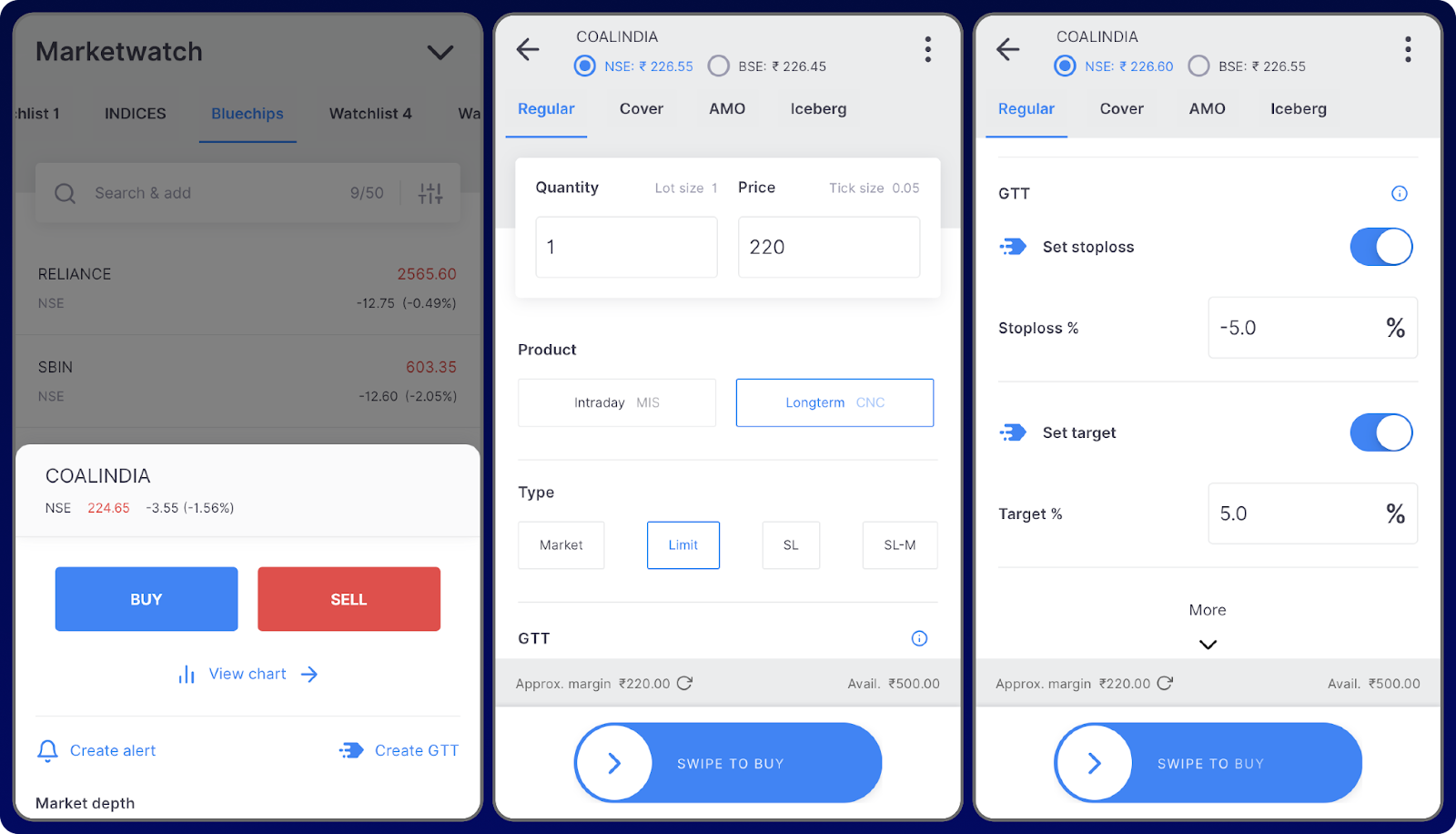
For this tutorial, we will be using Zerodha’s mobile app— Kite.
How to Buy a Stock?
Step 1: Add the stock to your watchlist
Once you perform the necessary analysis, add stocks you want to buy to a watchlist.
Step 2: Invoke the order placement window
Click on the name of the stock you want to buy and press the buy button to invoke the order placement window.
Step 3: Select the order mode
Use regular orders for now.
Step 4: Input the quantity
Enter the quantity of the stock that you want to buy.
Step 5: Select the product type
Select Longterm or CNC (Cash and Carry) product type to take delivery of the stock to your Demat account. Use MIS (Margin Intraday Square-off) for intraday order placements.
Step 6: Select the order type
To make things simple, we will select market order.
Step 7: Enter the limit price
Skip this step if you have selected a market order. Enter the price at which you want to buy the stock if you choose a limit order.
Step 8: Set GTT orders if required
Place a GTT stop loss and target order if needed.
GTT in Zerodha stands for “Good Till Triggered.” It is a feature that allows users to place an order that stays active until the trigger condition is met. The validity of the trigger is one year, and an account can have a maximum of 250 active GTTs simultaneously. GTT orders can be placed for buying or selling stocks, and they are triggered and placed only during market hours.
Step 9: Input the order validity instructions
Select day order.
Step 10: Swipe!
Swipe on the ‘Swipe to Buy’ button to place the order. The order will be immediately executed if you have placed a market order. Limit and stop-loss orders will be executed once the conditions are met.
Once the order is executed, it will show up on the positions tab under ‘Portfolio’. It will move to the holdings tab the next day. The sign “T1” will be shown beside the stock on the next day and will disappear on the third day.
How to Sell a Stock?
Follow the below steps to sell stock from your holdings:
Step 1: Invoke the order placement window
Click on the name of the stock you want to sell from your holdings and click on “Exit” to invoke the order placement window.
Step 2: Select the order mode
Use a regular order.
Step 3: Input the quantity
Enter the quantity of the stock you want to sell from your holdings.
Step 4: Select the product type
Select Longterm or CNC (Cash and Carry) product type.
Step 5: Select the order type
We will select market order for the sake of simplicity.
Step 7: Enter the Limit Price
Skip this step if you have selected a market order. Enter the price at which you want to sell the stock if you choose a limit order.
Step 8: Input the order validity instructions
Select day order.
Step 9: Swipe
Swipe on the ‘Swipe to Sell’ button to place the order.
Step 10: Authorise the transaction
CDSL TPIN is a mandatory process required for performing sell transactions online. Click on the “Continue” option. You will be redirected to CDSL’s page, where you are prompted to enter a TPIN. Next, enter the OTP you received and click on “Verify” to complete the authorization process.
Since you have a new account, you will have to generate a new TPIN by following the instructions on the screen. You will receive the TPIN via text message and email, which you should save for future transactions.
The TPIN has to be reentered every day to conduct transactions. You can pre-authorize it by using the “Authorization” option in holdings before the markets open every day.
Step 11: Swipe, again!
Once authorization is completed, swipe the ‘Swipe to Sell’ button to place the sell order.
The order will be immediately executed if you have placed a market order. Limit and stop-loss orders will be executed once the conditions are met.
What is TPIN & How to Skip it?
CDSL is a depository, and it has created a security measure called TPIN Authorization to ensure that the broker doesn’t misuse your holdings. TPIN is a crucial component of the stock trading process. It comes in the form of a six-digit passcode that must be entered to authorise the broker to sell selected stocks from your Demat account. The CDSL TPIN security mechanism enables investors to easily authorize any account-related action online.
Giving a Power of Attorney (PoA) to your broker is the only way to skip this step. Power of Attorney (POA) is a document that gives the stockbroker authorization to debit your shares from your Demat account whenever you sell your holdings. If your POA is mapped to your Zerodha account, you will be able to sell your holdings without a prompt asking you to authorize transactions using TPIN.
To give a POA, go to Zerodha’s website and download the POA form. Fill it up and physically mail it to Zerodha’s office.
In conclusion, buying and selling stocks is a very simple process. However, you have to be focused while placing orders to avoid mistakes that could lead to losses!
Have you ever wondered what the stock market is and how it works? If yes, you’re not alone. The stock market can seem confusing and intimidating for people who don’t know how it works. But don’t worry! In this article, we shall learn what the stock market is, how it works, and who market participants are.
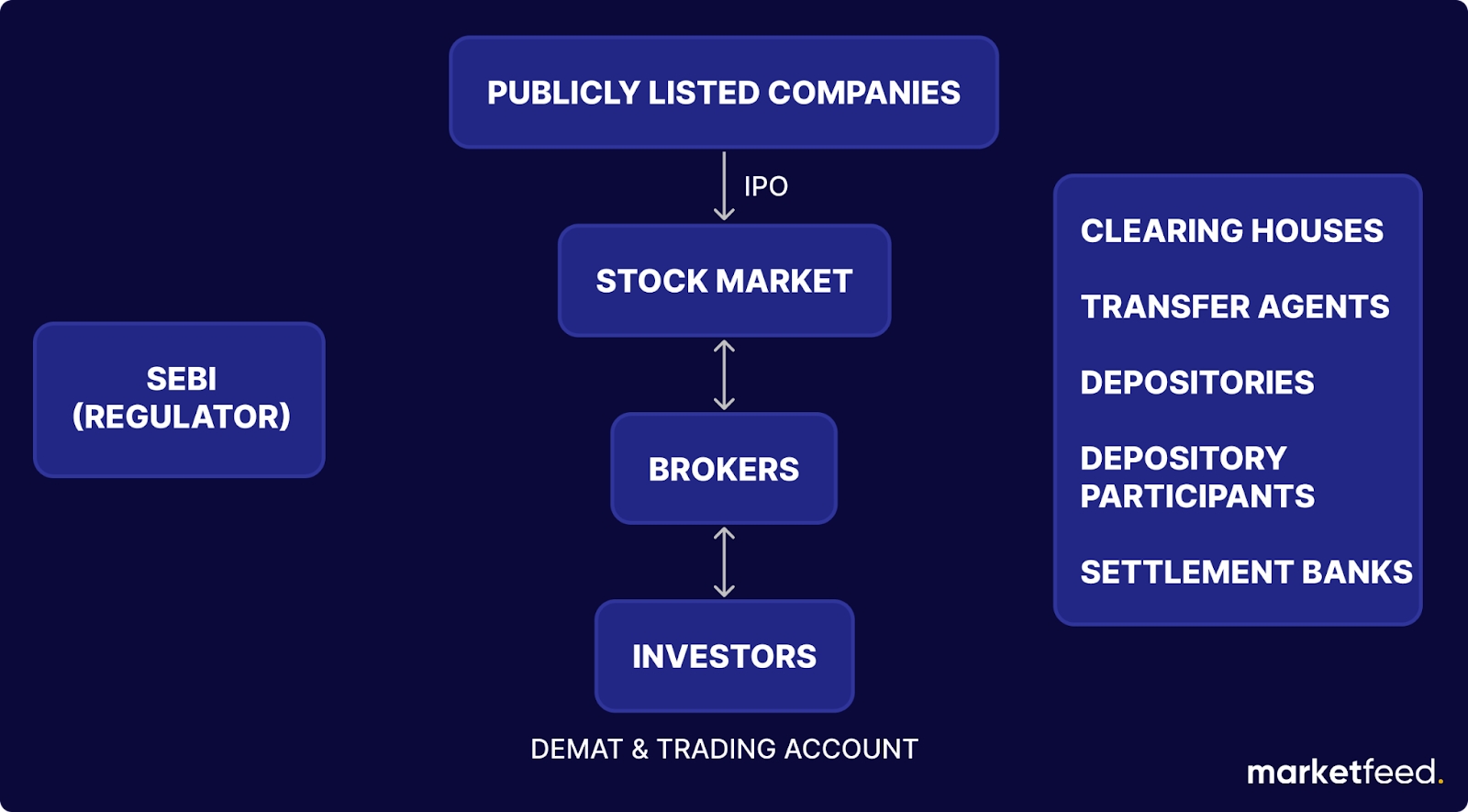
Given below are the different participants in the stock market. We’ll understand more about them through a story.
Let’s Look at a Story!
Mr. Jignesh, an owner of a renowned supermarket in Bengaluru, has been successfully running his business for the past ten years. The supermarket has been generating decent revenue and is highly profitable. His business also has goodwill (proprietary or intellectual property and brand recognition). When it comes to business, there are two things you must understand:
Ownership of a Business Jignesh completely owns and runs the supermarket, and the profit is not shared with anyone else.
Valuation of a Business Anything and everything has a value attached to it, even a business. The business has been generating income for Jignesh for the past ten years, so it is valuable. The valuation of a business is the economic value of how much a person has to pay to acquire 100% of the business from him. Let’s assume that the supermarket is valued at ₹1 crore.
Since Jignesh is growing old, he feels he doesn’t want to work as much as he did and is looking for a partner to operate the business in return for 50% of the ownership of his business. He decided to share his business with a partner, Ms. Riya.
What are Shares?
Shares represent units of ownership of a company. A shareholder is entitled to a part of the profit that the company generates.
The ownership of Jignesh’s supermarket was divided into 1000 equal shares. The value of each share can be mathematically expressed as:
Value of 1 Share = Total Valuation / Total Number of Shares
= 1,00,00,000 / 1000
= ₹10,000 per share.
Riya agreed to acquire 500 shares (50%) of the supermarket in consideration of the value of those shares in Cash.
Valuation = Total Number of Shares x Value of Each Share
Riya paid ₹50,00,000 to Jignesh, and they both became partners in the supermarket business.
A few years later, the business expanded with several profitable outlets across Bengaluru. Now, Jignesh and Riya want to open 200 more stores nationwide, for which they need a large amount of capital. The easiest way to get funding or capital is by taking out a loan from a bank and using the business’ assets as collateral. However, this carries the risk of falling into a debt trap. If they are unable to repay the loan for some reason, the assets will be seized by the bank to recover the loan. Jignesh and Rita did not want to deal with these issues.
An alternative would be to find more people who are interested in becoming part-owners of the business across Bengaluru. Even then, they may not be able to find enough people to do so. At this point, Jignesh becomes aware of the stock market. If they convert their company into a Public Limited company, they can raise capital from thousands of investors across India and other countries. The process of issuing shares to the public to raise capital for a business is known as an Initial Public Offering (IPO).
What is the Stock Market?
A stock market is a place where shares of publicly listed companies are traded. It is a physical place or institution where shares are bought and sold.
So Why Do Companies Go Public?
To Raise Capital: The company can gather funds for many objectives, such as paying liabilities (loans) and funding its future expansion projects.
Reward Founders & Early Investors: The founders and early investors of a company hold a good portion of the shares in their entity. They can sell these shares to the public and the proceeds go directly to them rather than to the company. It can be considered as a reward for all the time and effort they put in to build the company from the ground up. So going public can give them an early exit.
What are Stock Exchanges?
A stock exchange is a financial institution where different participants come together to buy and sell securities(shares). It provides the infrastructure for these activities. The term Stock Market is an umbrella term for a collection of Stock Exchanges.
The two major Stock Exchanges in India are:
Bombay Stock Exchange (BSE)
National Stock Exchange (NSE)
BSE is older than NSE, which explains why more companies are listed on the BSE than NSE.
Coming back to the story, Jignesh’s company had a total of 1000 shares, out of which they decided to issue 15% of the shares to the public. Thus, 150 shares are being offered to the public.
1000 x 15% = 150
How Many Shares Will a Company Have? Who Decides That?
A company’s promoters can decide how many shares it should have. Some firms may have thousands of shares, while others may have lakhs or even crores of shares.
For example, the valuation of Jignesh’s company was ₹1 crore in the beginning. But the business has grown over the years, and now the valuation stands at ₹2 crores, bringing the value of each share to ₹20,000.
Why do Investors Exist? What are their Objectives?
The two main objectives of investors are:
1. Capital Appreciation – When a company grows, the price of its shares increases. If investors buy the shares of a company when the prices are low and sell them when the prices increase, they can make good profits via capital appreciation.
2. Earn Dividends – When a company makes profits every year from its operations, it distributes a portion of the profits to shareholders as dividends. However, it is not necessary for them to declare dividends every year. It’s the company’s choice whether to issue dividends or not. The company may fully retain its profits for future capital needs or may give out a part of the profit and retain the rest.
In short, the objective of a public limited company is to raise capital for its funding needs and the investors’ objective is to grow their money. But the real question is, how does the stock market fit into this?
Why do Stock Markets Exist?
The stock market provides an avenue for a public company to raise capital from investors in consideration of shares. Investors will be able to grow their savings and wealth through capital appreciation and dividends. The stock market is the facilitator for the two parties.
What are Primary Market and Secondary Market?
The stock market is divided into two:
1. Primary Markets It is a market wherein a firm issues securities/shares to investors directly (via an initial public offering or IPO). These sale proceeds go directly to the issuer to finance their capital requirements.
2. Secondary Markets It is the market where previously issued securities are bought and sold among investors. These sale proceeds go to the person who holds the securities.
In our story, many people wanted to buy shares of his company after the IPO. However, the company does not issue any more shares as the IPO is already done. So these new investors can only buy the shares from those already holding them.
When such transactions happen between investors in the secondary markets, the price of the share gets updated. If an existing shareholder sells the stock to another person for ₹20,100, the price of all the shares of the company gets updated to ₹20,100. Consequently, the net worth of the shareholders increases as the price of the shares they hold increases.
Who Decides the Price of a Stock?
The two reasons which decide the price of a stock are:
Company’s Actual Valuation: A company’s value fluctuates as the revenue, profit, and goodwill change. The future prospects of the company also contribute to the valuation. If the revenue and profits go down, the valuation may also decrease, which causes the share price to drop. However, if the revenue and profit increase, the valuation could also rise.
Demand & Supply: The market forces of supply and demand also play an important role in deciding the share price. If the demand for the stock increases, then its price also increases since supply is limited. If the demand for the stock decreases, then its price also decreases since the supply is the same. Demand for the stock depends upon market sentiments, which refers to the overall attitude of investors toward the company. If the market sentiment is positive, then the demand for the stock will be high, thus driving the stock price up. Demand for the stock will be less if the market sentiment is negative.
Why Do Stock Prices Fluctuate Every Second?
The Last Traded Price (LTP) refers to the price at which the previous share transaction took place. The stock market has lakhs of participants, and transactions happen every second. If a person sells a stock for ₹150, then the LTP at the time will be ₹150. The very next second, if a stock is sold for ₹149, then the LTP changes to ₹149. This is the reason why stock prices fluctuate every second.
Who are Brokers?
If you want to buy a stock, you cannot do it directly from the stock market. We have to approach a stockbroker, and the broker will transact on our behalf. A broker is an intermediary that facilitates transactions in the stock market. If you want to buy a stock, your broker will find a seller in the stock market on your instruction and facilitate the transaction between you and the seller.
Before technology evolved, an investor had to physically visit the broker’s office and instruct them to buy the stock. The broker would then physically go around the stock market, find a seller, and conduct the transaction. But now, technology has evolved, and transactions can be conducted via our phones. Brokers are accessible on computers and smartphones, and investing & trading are as easy as ever.
It is absolutely necessary to have an account with a broker to participate in the stock market. As intelligent stock market participants, we must have multiple broking accounts for different purposes. We can use one account for our long-term investing activities and another one for trading. Successful traders use multiple broking accounts for different trading strategies.
How Does a Broker Work?
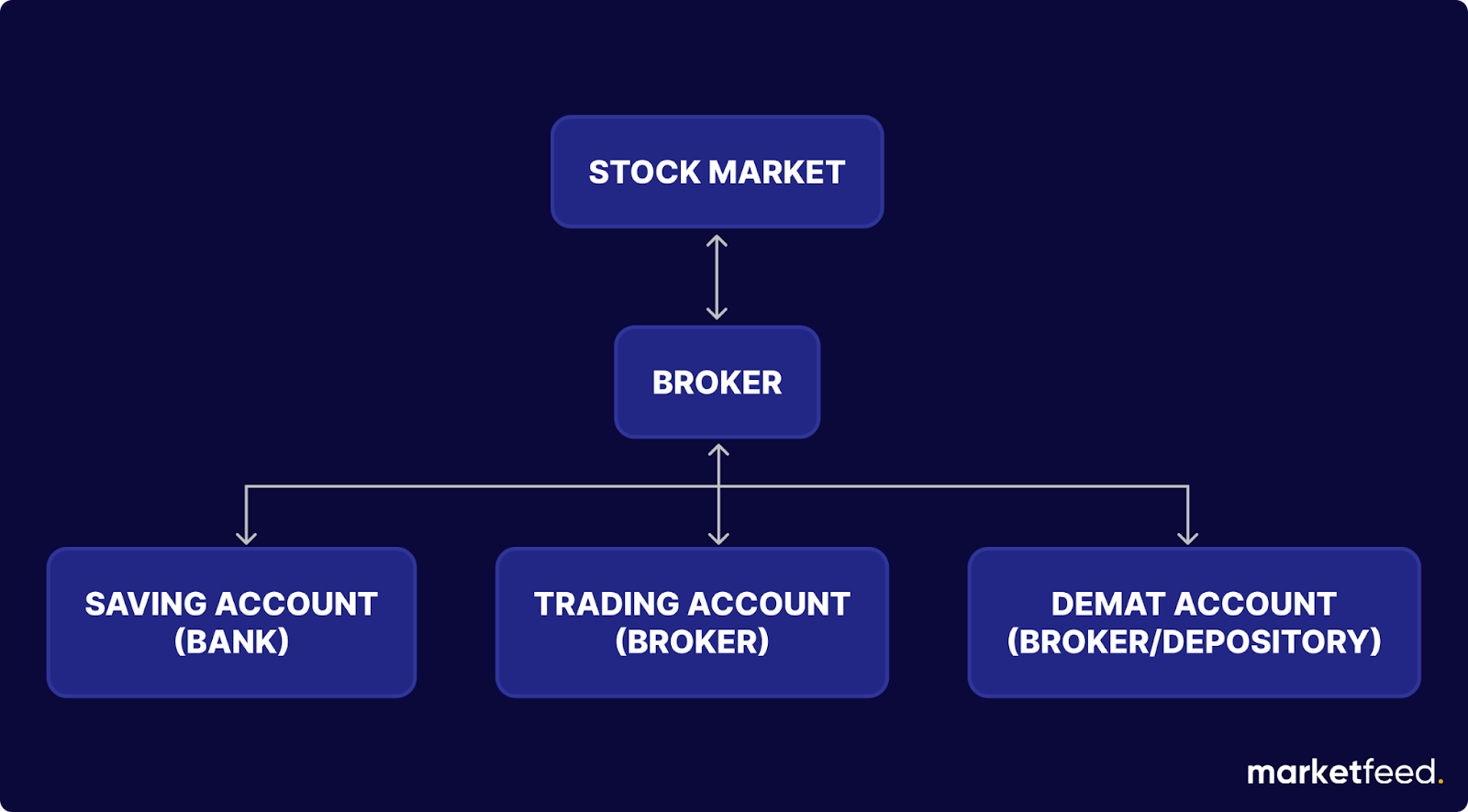
There are two accounts that we open with a broker. Even though they are two separate accounts serving different purposes, both of them come in a bundle.
1. Demat Account A Demat account or dematerialisation account allows you to hold your shares in an electronic format. It converts the physical shares into an electronic form, therefore dematerialising them. Demat accounts are maintained under depositories.
Earlier, the proof of ownership of shares, bonds, or debentures was in the form of physical share certificates. However, this system had many drawbacks, such as the risk of losing the certificate, fire hazards, getting wet, or even a mismatch in the signatures.
2. Trading Account A trading account acts as an interface between the investor’s bank savings account and a broker. For the broker to conduct trading activities on our behalf, they need money. We transfer the money we have in our savings account to a trading account with which the broker then conducts trading activities. Money can be transferred using net banking or UPI.
If we want to buy a stock, we instruct the broker to buy the stock, and the broker uses the money we have in our trading account to conduct the transaction. Similarly, when we sell a stock, the proceeds of the sale come directly into the trading account.
An Illustration to Understand How Demat & Trading Account Works
Arun wants to buy a share of Mahindra & Mahindra (M&M) from the stock market. The first step that Arun should take is to open a Demat and trading account. Arun opens a Demat & trading account with a leading broker and deposits money into his trading account by transferring from his bank savings account via UPI.
When the market opened at 9:15 AM, Arun placed an order with his broker to buy 1 quantity of M&M stock. The market price of M&M at the time was ₹1000. His trading account was debited ₹1000 by the broker to finance the transaction. Apart from this, a small amount was deducted as taxes and charges.
Even though the transaction was completed, the stock will only be transferred into his Demat account after T+1 days, which means he will receive the stock in his Demat account on the next working day.
While selecting brokers, we should choose the brokers that satisfy our various investing and trading needs. YOu can open a Demat and trading account using the links given below:
(Full disclosure: These are affiliate links. Do use the links if you wish to support us at no extra cost. ❤️)
Click here for step-by-step instructions on how to open a Demat and trading account.
What are Depositories?
If your shares are held by the broker, there is a risk of the broker running away with the shares they have. As a remedy, all Demat accounts are maintained by depositories. A depository is an institution that acts as a custodian of Demat accounts and shares. A Demat account is opened by a depository participant, who acts as an intermediary between the depository and investors.
There are two depositories in India, which are governed by the Government of India:
1. CDSL – Central Depository Services Limited 2. NSDL – National Securities Depository Limited
Who are the Other Facilitators?
The other facilitators part from brokers, depositories, and depository participants are:
Clearing Houses – It is an intermediary between buyers and sellers of financial instruments. It is an agency or separate corporation of a futures exchange responsible for settling trading accounts, clearing trades, collecting and maintaining margin monies, regulating delivery, and reporting trading data.
Transfer Agents – A transfer agent keeps records of who owns a publicly traded company’s stocks and bonds. They also ensure investors receive dividends on time.
Settlement Banks – It refers to a customer’s bank where payments or transactions are finally settled and cleared for customer use.
What is a Market Regulator?
The Indian stock market is a place where transactions worth lakhs of crores of rupees take place. The Securities and Exchange Board of India (SEBI) is a regulatory authority established under the SEBI Act 1992. It’s the principal regulator for stock exchanges in India. SEBI’s primary functions include protecting investor interests and promoting and regulating the Indian securities markets. It is a government organisation. SEBI exists as the watchdog to make sure nothing wrong is happening in such a massive money-involved ecosystem.
Throughout the article, we discussed the various participants in the stock market and how they all work together in the stock market. We’ve also understood the basics of what the stock market is, who its participants are, and how it works!
Here are some of the major updates that could move the markets tomorrow:
Adani Group launches consumer app for airports vertical
The Adani Group has rolled out Adani One, a consumer app for its airports vertical. Users will be able to book flights & cabs, shop for duty-free products, and check their flight status through the app. The app also has a loyalty program for users to earn and redeem reward points. The group currently operates seven airports in India — Mumbai, Ahmedabad, Guwahati, Lucknow, Mangalore, Jaipur, and Thiruvananthapuram.
Reliance Jio added 14.1 lakh wireless subscribers in October 2022, while Bharti Airtel gained 8 lakh subscribers. Vodafone Idea (Vi) continued to suffer heavy customer losses and is unable to compete effectively with its financially stronger rivals. Vi lost 35 lakh subscribers in Oct, further shrinking its total subscriber base to 24.56 crore. Data released by the Telecom Regulatory Authority of India (TRAI) showed that Jio and Bharti Airtel’s total user bases stood at 42.13 crore and 36.5 crore, respectively.
Car sales in India set to hit record 38 lakh units in 2022: Report
According to an Economic Times report, India’s automakers are projected to end this calendar year with sales of ~38 lakh passenger vehicles (PVs), driven by sustained demand and improved component supplies that helped them increase production. This projection exceeds the previous record by more than 4 lakh vehicles. Sales in the first 11 months of 2022 have already crossed the previous annual record of 33.9 lakh units set in 2018.
Yes Bank completes transfer of bad loans worth ₹48,000 crore to J.C. Flowers
Yes Bank completed the transfer of bad loans worth ₹48,000 crore ($5.81 billion) to private equity firm J.C. Flowers. This transaction would clean and strengthen Yes Bank’s balance sheet. The deal comes more than two years after the Reserve Bank of India stepped in to take control of the bank after a dramatic rise in bad loans alarmed investors and depositors.
Dr. Reddy’s Labs completes Phase 1 study of proposed arthritis drug
Dr. Reddy’s Laboratories Ltd has successfully completed the Phase 1 study of its proposed biosimilar of Tocilizumab. The drug is to be used to treat rheumatoid arthritis in adults. This study used a subcutaneous formulation to evaluate the pharmacokinetic equivalence, safety, and immunogenicity of the company’s Tocilizumab biosimilar candidate in comparison to reference products.
KEC International secures new orders worth ₹1,313 crore
KEC International Ltd has secured new orders worth ₹1,313 crore across various business verticals. It has secured orders for transmission & distribution projects in India, East Asia Pacific, and SAARC. These include a 220 kV gas-insulated substation (GIS) for a refinery project in India, a 500 kV transmission line in Thailand, and another 132 kV transmission line and substations in Nepal.
CDSL buys 46,000 sq. ft. office in Mumbai for ₹163 crore
Central Depository Services Ltd (CDSL) has acquired two floors of office space measuring over 46,000 sq ft carpet area in commercial tower Marathon Futurex in Mumbai’s Lower Parel for ₹163 crore. The depository services company paid stamp duty worth ₹9.79 crore for the registration of the deals that took place on December 14.
Glenmark Pharma gets USFDA approval for high blood pressure drug
Glenmark Pharmaceuticals Ltd has received final approval from the US Food & Drug Administration (USFDA) for Nicardipine Hydrochloride Capsules. The drug is used to treat high blood pressure and chest pain. The generic version of the drug achieved annual sales of ~$10.9 million for the 12 months ended Oct 2022, according to IQVIA sales data.
HDFC Bank targets issuing 10 lakh credit cards a month
HDFC Bank Ltd is looking to issue 10 lakh credit cards a month, said Parag Rao, the bank’s country head for payments business, consumer finance, digital banking & marketing. The company will announce partnerships across a range of industries from online retail to food delivery in the coming weeks to increase spending on cards. They also plan to collaborate with two airlines and a large hotel chain.
In other news, HDFC Bank is reportedly seeking to raise nearly $1 billion via an offshore loan.
HZL to spend over $1 billion on shift to battery-operated mining vehicles
Hindustan Zinc (HZL) is planning to invest over $1 billion (~₹8,270 crore) to convert its diesel-fired mining vehicles into battery-operated ones and also to fully turn a green energy user over the next five years. The company is already running four of its 900 mining vehicles on battery on a pilot basis.
Here are some of the major updates that could move the markets on Thursday:
RIL to commission new gas condensate field by year-end
Reliance Industries Ltd (RIL) will commission its deepwater MJ gas condensate field in the Bay of Bengal block KG-D6 by year-end, boosting natural gas output to 30% of India’s total. MJ is the third and last of a set of discoveries that RIL and its British partner bp are developing in the eastern offshore block. The two will use a floating production system in the Bay of Bengal to start production at the deepest gas discovery in the KG-D6 block.
Torrent Pharma Q2 Results: Net profit falls 1.3% YoY to ₹312 crore
Torrent Pharmaceuticals Ltd reported a 1.3% year-on-year (YoY) decline in consolidated net profit to ₹312 crore for the quarter ended Sept (Q2 FY23). Its revenue from operations rose 7.2% YoY to ₹2,291 crore during the same period. EBITDA stood at ₹694 crore in Q2, down 2% YoY. The company’s revenue from the Indian market grew 13% YoY to ₹1,224 crore in Q2.
Reliance Retail to expand biz in affordable toy segment via Rowan brand
Reliance Retail Ventures Ltd is expanding its business in the fast-growing toy sector through its brand Rowan to operate in the affordable segment with a smaller shop size. The company has been running its toy distribution business through Rowan. It has now brought the homegrown brand to the front end by opening its first exclusive brand outlet (EBO) at Gurugram in NCR in the previous quarter with a store size of 1,400 sq feet.
Embassy REIT to invest ₹2,200 cr in next 4 years to develop new office buildings
Embassy Office Parks REIT will invest around Rs 2,200 crore in the next four years to develop premium workspaces. The company sees tremendous growth potential in the office market despite global recessionary concerns. CEO Vikaash Khdloya said the office demand would remain strong as large global companies want to open offices in India because of the high availability of a cost-efficient talent pool and cheap rentals for premium workspaces.
CDSL Q2 Results: Net profit falls 7% YoY to ₹80 crore
Central Depository Services Ltd (CDSL) reported a 7% YoY decline in consolidated net profit to ₹80 crore for the quarter ended Sept (Q2 FY23). Its total income grew 3% YoY to ₹170 crore during the same period. Nearly 48 lakh Demat accounts were opened during Q2. CDSL facilitates holding & transacting in securities in electronic form and settlement of trades on stock exchanges.
Tata Steel’s Dutch arm to supply green steel to Ford
Tata Steel Nederland has signed an agreement with automaker Ford to supply “green” steel after 2030. The company plans to start producing green steel (steel made without using fossil fuels) in 2030 at its plant in Ijmuiden, Netherlands. The Memorandum of Understanding signed between Tata and Ford of Europe does not compel Ford to buy a specified amount of steel at a specified price.
BSE Limited has launched Electronic Gold Receipt (EGR) on its platform, a move that will help in efficient and transparent price discovery of gold. It introduced two new products of 995 and 999 purity during the Muhurat Trading session on Diwali. Trading in EGRs will be in multiples of 1 gram and deliveries in multiples of 10 grams and 100 grams.
Piramal Pharma to invest funds into expansion, acquisitions
Piramal Pharma Ltd will focus on scaling up its operations and margin growth through a combination of organic expansion and acquisitions in the areas of contract development & manufacturing services (CDMO) and complex generics. The company will invest ₹1,200 crore in antibody-drug conjugate capacity in the UK over the next 12-18 months. It is also looking to increase capacity at its Riverview unit in the US for active pharmaceutical ingredients (APIs).
Here are some of the major updates that could move the markets tomorrow:
Demat accounts cross 10 crore mark in August
The total number of Demat accounts in India crossed the 10 crore mark in August 2022. In August alone, over 7 crore active Demat accounts were registered. CDSL operated 7.16 crore Demat accounts with total assets under custody (AUC) of ₹38.5 lakh crore as of August, while NSDL had 2.89 crore accounts with AUC of ₹320 lakh crore. The culture of equity investing is slowly and steadily picking up in India, especially in Tier-2 and Tier-3 cities.
Blue Star secures two orders worth ₹390 crore from BMRCL
Blue Star Ltd has secured two orders from Bangalore Metro Rail Corporation Ltd (BMRCL) for the upcoming Pink Line of Bangalore Metro Rail Project Phase-II. The first order, worth ₹203 crore, is a turnkey project including maintenance works for Tunnel Ventilation System (TVS) and Environmental Control System (ECS) for six underground stations and associated tunnel sections.
The second order, worth ₹187 crore, is a turnkey project for Electrical & Mechanical (E&M) works for five underground stations and five elevated stations.
Suzlon secures 180.6 MW wind energy project from Sembcorp’s arm
Suzlon Energy Ltd has secured an order to set up a 180.6 megawatts (MW) wind energy project from Singapore-based Sembcorp’s arm Green Infra Wind Energy Ltd. The company will install 86 Wind Turbine Generators (WTGs) with a Hybrid Lattice Tubular (HLT) tower and a rated capacity of 2.1 MW each. The project is located at Bagalkot, Karnataka, and is expected to be commissioned in 2024.
Saregama launches feature phone with pre-loaded Hindi songs
Saregama India Ltd has launched Carvaan Mobile, a keypad feature phone with 1500 preloaded Hindi songs and two screen sizes, priced at ₹2490 and ₹1990, respectively. This is the first feature phone from the music brand. The mobile is available across retail markets and e-commerce platforms such as Amazon, Flipkart, and saregama.com. Saregama also sells Carvaan, a digital audio player with preloaded songs.
Kalpataru Power Transmission Ltd (KPTL) and its international units have secured orders worth ₹1,345 crore. The company has won orders in India and overseas markets in the transmission and distribution (T&D) business. It has also received orders for pipeline laying and metro rail electrification works in India.
Quiklyz to expand presence in the electric mobility leasing space
Quiklyz has announced its expansion plans in the electric mobility leasing space. The company will now offer customized leasing and subscription solutions for electric three-wheelers (3W) and four-wheelers (4W) to its partners. It has financed over 1000 electric vehicles over the past 12 months, including passenger vehicles and 3Ws. Quiklyz is the new-age vehicle leasing and subscription business of Mahindra & Mahindra Financial Services Ltd.
Paytm reports 72% YoY growth in merchant payment volume
Digital payments platform Paytm reported a 72% YoY growth in gross merchandise value (GMV) to ₹2.10 lakh crore for the two months ended August 2022. [GMV is the value of total payments made to merchants through app transactions or payment solutions.] The company distributed 6 million loans during the same period. The average monthly transacting users (MTU) grew 40% YoY to 7.88 crore during July-August 2022.
Specialty pharmaceutical and healthcare ingredient company Blue Jet Healthcare filed its Draft Red Herring Prospectus (DRHP) with market regulator SEBI for an initial public offer (IPO). The public issue is entirely an offer-for-sale (OFS) of up to 21.7 million shares by the promoters and other shareholders, aggregating to ₹1,800 crore.
Meanwhile, SEBI has given approval to Concord Enviro Systems (an environmental engineering solutions firm) to raise funds via an IPO.
Canara Bank hikes benchmark lending rate by up to 0.15%
Canara Bank has raised its benchmark Marginal Cost of Funds Based Landing Rate (MCLR) by up to 0.15%, a move that will make loans costlier. The one-year MCLR will be 7.75% from Wednesday onwards, compared to the existing rate of 7.65%. This rate is used to fix most consumer loans such as auto, personal, and home loans. [MCLR is the lowest interest rate that a bank can offer.]
RIL to acquire 79.4% stake in SenseHawk for $32 million
Reliance Industries Ltd (RIL) has entered into definitive agreements with US-based SenseHawk Inc. to acquire a 79.4% stake in the company for $32 million (~₹255.5 crore). SenseHawk is an early-stage developer of software-based management tools for the solar energy generation industry. It helps accelerate solar projects from planning to production by helping companies streamline processes and use automation.
ITC to acquire 16% stake in D2C brand Mother Sparsh
ITC Limited has announced plans to acquire a 16% stake in Mother Sparsh for Rs 20 crore through a share subscription agreement. Mother Sparsh is a direct-to-consumer (D2C) Ayurvedic and natural personal care brand that focuses on mother and baby care segments. ITC said the acquisition will enable access to the fast-growing D2C space in the ‘personal care’ category, which has been identified by the company as an area of interest.
Tata Group in talks to set up $300 million semiconductor assembly unit: Report
According to reports, Tata Group is in talks with three states to invest up to $300 million (~Rs 2,245 crore) to set up a semiconductor assembly and test unit. The group is holding talks with the governments of Tamil Nadu, Karnataka, and Telangana and scouting for land for the outsourced semiconductor assembly and test (OSAT) plant. An OSAT plant assembles and tests foundry-made silicon wafers, turning them into finished semiconductor chips.
Ircon International Ltd has emerged as the lowest bidder for the construction of an eight-lane access-controlled expressway in the Shirsad-Akloli section of Vadodara-Mumbai Expressway in Maharashtra. The project, floated by the National Highways Authority of India (NHAI), is valued at ~Rs 1,124 crore. IRCON has also emerged as the lowest bidder for the supply, installation, testing, and commissioning of Track Works of Standard Gauge for Chennai Metro Rail Ltd. The value of the project is Rs 337.61 crore.
Sanofi India to divest Soframycin, Sofradex brands for Rs 125 crore
Pharma major Sonafi India will divest its Soframycin and Sofradex brands to Encube Ehticals for a total consideration of Rs 125 crores. Upon completion of the transaction, Encube would acquire the right to sell and distribute the two skin ailment creams in India and Sri Lanka. The company’s board has also approved the transfer of the unregistered Intellectual Property (IP) and product inventory to Encube.
Aurionpro Solutions to acquire majority stake in Toshi Automatic Systems
Aurionpro Solutions Ltd has announced plans to acquire a majority stake (51%) in Toshi Automatic Systems Pvt Ltd (TASPL). The acquisition will allow Aurionpro to further consolidate its position as the only integrated player in the Automatic Fare Collection (AFC) & transit solutions space in India. Uttar Pradesh-based TASPL is an innovator with products and solutions in industrial, public safety, mass transit segments.
Apollo Hospitals, Amazon in talks for pharmacy business partnership: Report
Online retail giant Amazon is reportedly in talks with Apollo Hospitals for a partnership in its pharmacy business, Apollo HealthCo. Apollo Hospitals is looking to sell up to a 20% stake in its pharmacy subsidiary and wants to raise around $500 million (~Rs 3,744 crore). The subsidiary is making strategic moves to expand its online sales and working towards being a dominant omnichannel player.
CDSL becomes first depository to open 5 crore active Demat accounts
Central Depository Services (India) Limited (CDSL) has become the first depository to hold more than five crore active Demat accounts. CDSL is India’s leading and only listed depository. It provides convenient, dependable, and secure depository services at an affordable cost to all market participants. To learn more about CDSL, click here.
Vedanta promoters pledge shares to raise Rs 6,000 crore
Holding companies of Vedanta Ltd have raised $800 million (~Rs 6,000 crore) by pledging shares in the company. Promoter group firms pledged 242.26 crore shares or a 65.18% stake in Vedanta in three facility agreements to raise funds. The firm is evaluating all options including demergers, spin-offs, and strategic partnerships as part of a complete overhaul of its corporate structure. It is also looking at listing its aluminium, iron & steel, and oil & gas verticals as separate entities.
NTPC Renewable Energy signs PPA for 325 MW solar projects
NTPC Renewable Energy has signed a Power Purchase Agreement (PPA) and other project agreements with Indian Railways, Madhya Pradesh Power Management Company, and Reva Ultra Mega Solar Ltd (RUMSL) for 325 megawatts (MW) solar projects. The projects will be installed in RUMSL at Shajapur Solar Park in Madhya Pradesh
IDFC First Bank Q2 Results: Net profit rises 50% YoY to Rs 151 crore
IDFC First Bank reported a 49.6% YoY increase in net profit to Rs 151.7 crore for the quarter ended September (Q2 FY22). Its net interest income (NII) rose 27.4% YoY to Rs 2,722 crore during the same period. [NII is the difference between the interest income a bank receives on loans and the interest it pays to depositors]. The gross non-performing assets ratio (GNPA) stood at 4.27% in Q2, compared to 4.61% in the previous quarter. IDFC First Bank’s total deposits grew 20.8% YoY to Rs 83,793 crore in Q2 FY22.
Maruti Suzuki expects adverse impact on production in November
Maruti Suzuki India said it expects an adverse impact on production at two of its plants in Haryana and at Suzuki’s Gujarat plant in November on account of supply constraints of electronic components due to the global semiconductor shortage. As per current estimates, the total vehicle production volume across both locations in Haryana next month could be around 85% of the normal roll-out.
IOC Q2 Results: Net profit rises 2% YoY to Rs 6,360 crore
Indian Oil Corporation (IOC) reported a 2.1% YoY increase in net profit to Rs 6360.05 crore for the quarter ended September (Q2 FY22). Net profit increased 7% compared to the previous quarter. Its revenue from operations rose 46% YoY to Rs1.69 lakh crore during the same period. The company sold nearly 19 million tonnes (MT) of fuel in Q2, compared to 17.7 MT in the corresponding period last year. IOC’s board has declared an interim dividend of Rs 5 per share.
SEBI warns Vedanta over non-compliance with disclosure norms
The Securities and Exchange Board of India (SEBI) has warned Vedanta Ltd and Hindustan Zinc Ltd (HZL) over non-compliance with certain disclosure norms, saying it will take action if such actions were repeated in the future. The market regulator flagged Vedanta executing Rs 1,407 crore of related party transactions with associate company HZL without prior approval of the audit committee. Moreover, HZL failed to inform shareholders of the deferment of a meeting relating to a price-sensitive dividend payment.
Oberoi Realty Q2 Results: Net profit rises 94% YoY to Rs 267 crore
Oberoi Realty Ltd reported a 93.5% YoY increase in consolidated net profit to Rs 266.59 crore for the quarter ended September (Q2 FY22). Net profit increased 95% compared to the previous quarter. Its revenue from operations jumped 138.64% YoY to Rs 754.25 crore during the same period. The developer recorded bookings for 4.43 lakh sq. ft. space, taking its total bookings for the half-year ended September 2021 to 5.35 lakh sq. ft.
Rossari Biotech Q2 Results: Net profit rises 27% YoY to Rs 26 crore
Rossari Biotech Ltd reported a 26.7% YoY increase in consolidated net profit to Rs 26.23 crore for the quarter ended September (Q2 FY22). Net profit increased 7% compared to the previous quarter. Its revenue from operations jumped 124% YoY to Rs 384.52 crore during the same period. EBITDA stood at Rs 44.4 crore, a growth of 22% YoY. Rossari Biotech is a leading chemical manufacturer based in Mumbai.
LT Foods Q2 Results: Net profit rises 4% YoY to Rs 80 crore
LT Foods reported a 4.35% YoY increase in consolidated net profit to Rs 80.83 crore for the quarter ended September (Q2 FY22). Its total income rose 6.9% YoY to Rs 1,322.53 crore during the same period. Total expenses stood at Rs 1,212 crore in Q2, up 7.5% YoY. LT Foods manufacturers and markets rice under the Daawat, Royal, Heritage, and Devaaya brands in India.
CDSL Q2 Results: Net profit rises 76% YoY to Rs 85.9 crore
Central Depository Services (India) Ltd reported a 76% YoY increase in consolidated net profit to Rs 85.92 crore for the quarter ended September (Q2 FY22). Net profit increased 35% compared to the previous quarter. Its revenue from operations rose 64% YoY to Rs 145.97 crore during the same period. EBITDA stood at Rs 99 crore in Q2, a growth of 82% YoY
CHOLAFIN Q2 Results: Net profit rises 40% YoY to Rs 606 crore
Cholamandalam Investment & Finance Company reported a 40.4% YoY increase in net profit to Rs 606.54 crore for the quarter ended Sept (Q2 FY22). Its total income rose 1.2% YoY to Rs 2,470.69 crore during the same period. The company’s assets under management (AUM) stood at Rs 75,063 crore in Q2, registering a growth of 0.8% YoY.
Apollo Tyres Q2 Results: Net profit at Rs 174 crore
Apollo Tyres Ltd reported a consolidated net profit of Rs 174 crore for the quarter ended September (Q2 FY22). The company had posted a net loss of Rs 246 crore in the corresponding quarter last year. Its revenue from operations rose 18% YoY to Rs 5,077 crore in Q2 FY22. Apollo Tyres stated that some of the recent additions to its product offering are helping them extend its leadership in the commercial vehicle and passenger vehicle space in India.
Tata Motors to invest Rs 28,900 crore in JLR, domestic business in FY22
Tata Motors has announced plans to invest Rs 28,900 crore mostly for its British arm Jaguar Land Rover (JLR) and domestic business in the current financial year (FY22). The company is also looking to raise capital separately for its electric vehicle (EV) business. It is aiming for 25% sales from the EV segment in the medium to long term. Tata Motors had earlier announced that it will be launching at least 10 EV models before 2025. The automaker will also launch an EV platform for the last-mile commercial vehicles segment. They are investing in the development of hydrogen fuel cell vehicles as well.
NTPC Q1 Results: Net profit rises 18% YoY to Rs 3,411 crore
NTPC Limited reported an 18% YoY increase in consolidated net profit to Rs 3,411.56 crore for the quarter ended June (Q1 FY22). Net profit has declined by 24.9% when compared to the previous quarter. Its revenue from operations rose 14% YoY to Rs 29,888.02 crore during the same period. The company’s gross power generation increased to 71.74 billion units (BU) in Q1 FY22, compared to 60.18 BU in Q1 FY21. NTPC’s board has approved a proposal to raise up to Rs 18,000 crore through the issuance of non-convertible debentures.
Torrent Power to acquire 50-MW solar power plant from Lightsource India
Torrent Power Ltd has signed a share purchase agreement with Lighsource India and Lightsource Energy (India) for the acquisition of 100% of the share capital and all securities of LREHL Renewables India SPV 1. The special purpose vehicle (SPV) operates a 50 megawatt (MW) solar power plant in Maharashtra. It has a long-term Power Purchase Agreement with Solar Energy Corporation of India (SECI) for full capacity for a period of 25 years. The estimated enterprise value for this acquisition is ~Rs 317 crore.
IDFC First Bank Q1 Results: Net loss at Rs 630 crore
IDFC First Bank reported a net loss of Rs 630 crore for the quarter ended June (Q1 FY22). It had posted a net profit of Rs 93.55 crore in Q1 FY21 and Rs 127.81 crore in Q4 FY21 (previous quarter). The bank’s net interest income (NII) rose 25% YoY to Rs 2,185 crore in Q1 FY22. The gross non-performing assets (GNPA) ratio stood at Rs 4.61% in Q1 FY22, compared to 4.15% in the previous quarter. IDFC First Bank had created additional Covid-19 provisions of Rs 350 crore in Q1, taking the total Covid-19 provision pool to Rs 725 crore.
CDSL Q1 Results: Net profit rises 37% YoY to Rs 64 crore
Central Depository Services Ltd (CDSL) reported a 37% YoY increase in consolidated net profit to Rs 64 crore for the quarter ended June (Q1 FY22). Net profit has increased by 23% when compared to the previous quarter. Its total income rose 51% YoY to Rs 130 crore during the same period. CDSL maintains and services ~3.9 crore demat accounts of investors or beneficial owners across India.
PI Industries Q1 Results: Net profit rises 29% YoY to Rs 187 crore
PI Industries Ltd reported a 28.6% YoY increase in consolidated net profit to Rs 187.2 crore for the quarter ended June (Q1 FY22). Net profit has increased by 4.12% when compared to the previous quarter. Its total income rose 14.3% YoY to Rs 1,221.5 crore during the same period. PI Industries has entered into a business transfer agreement with Ind Swift Laboratories Ltd (ISLL) and certain promoters of ISLL for the acquisition of its API business division for Rs 1,530 crore.
Krsnaa Diagnostics to launch IPO on August 4: price band fixed at Rs 933-954 per share
Krsnaa Diagnostics Ltd will launch its initial public offering (IPO) on August 4. The company has fixed a price band of Rs 933-954 per share for its public issue. The IPO consists of a fresh issue of shares aggregating to Rs 400 crore and an offer for sale (OFS) of up to 85.3 lakh shares. The proceeds from the issue will be used for establishing diagnostics centers in Punjab, Haryana, Karnataka, and Maharashtra. A part of the proceeds will also be used to repay debt.
Meanwhile, Devyani International will also launch its IPO on August 4. It is the largest franchisee of KFC, Pizza Hut, and Costa Coffee in India. The company has fixed a price band of Rs 86-90 per share for its IPO.
Relaxo Footwear Q1 Results: Net profit rises 27.8% YoY to Rs 30.96 crore
Relaxo Footwears Ltd reported a 27.8% YoY increase in net profit to Rs 30.96 crore for the quarter ended June (Q1 FY22). Net profit has declined by 69.7% when compared to the previous quarter. Its revenue from operations rose 36.7% YoY to Rs 497.13 crore during the same period. The company’s expenses increased by 36.67% YoY to Rs 462.15 crore in Q1. Relaxo Footwears’ operations were severely disrupted during April and May due to localised lockdowns across geographies.
Rain Industries Q1 Results: Net profit jumps 786% YoY to Rs 235.29 crore
Rain Industries Ltd reported a 786.8% YoY jump in consolidated net profit to Rs 235.29 crore for the quarter ended June (Q1 FY22). Net profit has increased by 14.07% when compared to the previous quarter. Its total income rose 54.17% YoY (or 20.64% QoQ) to Rs 3,680.59 crore during the same period. Rain Industries is a leading manufacturer of calcined petroleum coke, coal tar pitch, and other high-quality basic and specialty chemicals.
Britannia Q1 Results: Net profit declines 29% YoY to Rs 387 crore
Britannia Industries Ltd reported a 28.7% YoY decline in consolidated net profit to Rs 387 crore for the quarter ended June (Q1 FY22). Its revenue from operation declined by 0.5% YoY (increased by 8.7% QoQ) to Rs 3,403.5 crore during the same period. EBITDA declined by 22.8% YoY to Rs 553.8 crore in Q1.
Have you ever wondered where the the shares you own/bought are stored? Just like a bank holds your funds, an institution called a depository keeps shares and other securities safe. In this article, we will understand what a depository is, its different types, functions, and its role in the financial markets. Additionally, we will understand a few concepts and topics related to depositories.
What are Depositories?
Depositories are institutions that hold your shares and other securities in an electronic or dematerialised (Demat) form. Brokers are privately owned companies, and entrusting them with your equity shares and other assets is risky. There exists a possibility of brokers engaging in unethical activities using your securities. Depositories exist to prevent such a risk.
A depository acts as a custodian of Demat accounts and shares. Depository participants open Demat accounts, serving as intermediaries between investors and the depository. One can store shares, exchange traded funds (ETFs,) bonds, debentures, certificates of deposits, Government Securities (GSecs), and much more in a depository.
What is Dematerialisation?
Dematerialisation is the process of converting physical paper securities (such as share certificates, bonds, and other financial instruments) into electronic or digital form. In other words, it involves the transformation of tangible paper-based assets into electronic records.
Depositories in India
In India, there are two depositories:
1. National Securities Depositories Ltd (NSDL)
NSDL is the oldest and largest depository in India. It came into existence through the Depositories Act of 1996 and commenced operations in 1996. It was the first depository to provide trading services in electronic format. According to the Securities & Exchange Board of India (SEBI), NSDL has around 2.4 crore active investors, with more than 36,123 depository participant service centres across 2,000 cities.
2. Central Depository Services Ltd (CDSL)
Established in 1999 in Mumbai, CDSL is the second-largest depository in our country after NSDL. It provides services like holding financial securities in the electronic format and facilitating trade and settlement of orders. This depository holds all types of stocks and securities. According to SEBI, CDSL has more than 5.2 crore active customer accounts with around 21,434 depository participant service centres.
In India, every broker must register with at least one of the two depositories. Brokers like Zerodha and Upstox are registered with CDSL, while Sharekhan and Kotak Securities are registered with both NSDL and CDSL. Each broker has a unique ‘DP number’ from the depository they are registered with. Some brokers are DPs at both NSDL and CDSL.
Functions of Depositories
1. Custodian
Depositories act as a custodian for your securities. It securely holds and safeguards securities, including stocks, bonds, mutual funds, and other financial instruments, on behalf of investors. This eliminates the need for physical possession of paper certificates and reduces the risk of loss, theft, or damage.
2. Dematerialisation
Dematerialisation is the process of converting financial securities in physical form into electronic format or demat form. Depositories perform dematerialisation. This conversion simplifies the process of transferring ownership and eliminates the need for physical delivery.
3. Immobilisation
Depositories immobilize physical securities, making them no longer transferable through physical means. Instead, ownership is electronically transferred, improving both security and efficiency.
4. Book-Entry System
Depositories maintain electronic records of securities ownership. They act as intermediaries in the transfer of securities between buyers and sellers. Depositories update their records to reflect changes in ownership after each transaction. This enables the seamless transfer of ownership between buyers and sellers. This book-entry system eliminates the need for physical record-keeping and reduces paperwork.
5. Settlement Services
Depositories facilitate the settlement of securities transactions by ensuring that securities are transferred from sellers to buyers and that payment is made to the sellers. This reduces settlement risks and delays.
6. Ownership Transfer Facilitation
Depositories have facilities for transferring securities from one account to another. This is especially important in the case of unlisted securities. Since unlisted securities are not publicly traded, they cannot be sold in the open market like public securities.
CDSL provides Easi/Easiest Portal to transfer securities manually.
7. Corporate action processing
Depositories process corporate actions such as dividends, stock splits, mergers, and rights issues. They ensure that shareholders receive the benefits or instructions associated with these actions.
8. Facilitation of Trading
Depositories make it easier for investors to buy and sell securities. When investors trade on stock exchanges or in over-the-counter (OTC) markets, depositories handle the transfer of ownership behind the scenes, ensuring a smooth transaction process.
9. Reduction in Settlement Risks
By providing a centralised system for settlement and record-keeping, depositories reduce the risk of settlement failures, errors, and discrepancies.
10. Proxy Voting
Some depositories offer proxy voting services. Proxy voting refers to the vote cast by one person or firm on behalf of another.
What is a Book Entry System?
Book entry is a method of electronically tracking ownership of securities, eliminating the need for physical certificates to be issued to investors. This allows investors to trade or transfer securities without having to present a paper certificate as proof of ownership. When an investor purchases a security, they receive a receipt and the information is stored electronically.
Depository vs Clearinghouse
A Depository is a facility that holds and maintains records of securities in demat form. A Clearing House is responsible for validating, clearing, and settling trades executed on a stock exchange or other trading platform.
Who are Depository Participants (DPs)?
Although Depositories are the custodian of securities, investors cannot directly interact with them. It can only be done through a depository participant (DP). The DP acts as an intermediary between the depository and investors. It’s a depository participant who opens a Demat account with a depository.
In India, most of the brokers themselves are the Depository Participants.
What are Depository Receipts (DRs)?
A Depository Receipt (DR) represents ownership in a foreign company. It’s a security that trades like an ordinary share on a local exchange. This means that publicly listed shares of a foreign company can be traded on an exchange outside its home market. To create a depository receipt, the equity shares of the foreign company are deposited in a bank (which serves as the depository) in the country where the shares will be traded. Subsequently, the depository issues receipts that represent the deposited shares.
Global Depository Receipts (GDRs)
Companies issue global depository receipts (GDRs) outside their home country and beyond the United States. The depository bank that issues GDRs is generally located (or has branches) in the countries on whose exchanges the shares are traded. A key advantage of GDRs is their exemption from foreign ownership and capital flow restrictions that the issuing company’s home country might impose since they are sold beyond its borders.
American Depository Receipts (ADRs)
An American depository receipt (ADR) is a US dollar-denominated security that trades like a common share on US exchanges. They enable foreign companies to raise capital from US investors. Note: An ADR is one form of a GDR. However, not all GDRs are ADRs because GDRs cannot be publicly traded in the United States.
Role of Depositories in Capital Markets
Depositories play a crucial role in capital markets and investment infrastructure. They provide essential services that facilitate the efficient and secure functioning of the financial markets. Their role includes various aspects of the financial system, including securities trading, settlement, and investor protection. Depositories streamline the process of holding and trading securities, enhance transparency, reduce risks, and provide valuable services to investors, issuers, and other market participants. Their role is essential in promoting market integrity and investor confidence.
CDSL or Central Depository Services Ltd is one of the two central depository services in India. You may have received several emails from them as you opened your Trading & Demat accounts. It was established in 1999 with the Bombay Stock Exchange (BSE) as its promoter. The depository became the first to hit 3 crore active users in India.
The company has given a staggering ~272% return on investment over the past year. Before this, the share price was moving pretty much in a consolidated manner. There is definitely something that has triggered retail investors across the market since such returns were not seen in the past even when CDSL had healthy financials.
From an investor’s perspective, CDSL is a ‘unique’ company. The company has a sustainable business model and stable financial growth over the years. In this piece, we discuss CDSL’s business model, financial stability, and growth prospects for the future.
CDSL’s Business Model
The profits and stock returns of CDSL have increased after the COVID-19 lockdown was imposed last year in March 2020. India has managed to add the highest-ever number of 49 lakh Demat accounts in FY 2020. The company has 589 registered Depository Participants(DPs) across India and 290 lakh investors across the country.
Speaking of Demat accounts, CDSL earns close to 60% of its revenue directly or indirectly from Demat accounts. If you look closely at the revenue breakup, CDSL earns most of its revenue from Transaction Charges and Annual Issuer Charges.
Transaction Charges
Every time a transaction takes place CDSL levies charges on it. A transaction can be buying, selling, or transfer of securities. The number of transactions has increased considerably over the past year and so has the income from the ‘Transaction Charges’ segment.
Annual Issuer Charges
Coming to the Annual Issuer Charges segment. This is the cash cow of CDSL. According to SEBI regulations all listed companies need to establish a connection with both NSDL and CDSL. Listed companies pay ‘Annual Issuer Charges’ to both NSDL and CDSL. The ‘Issuer’ over here is the company whose shares would be traded. SEBI regulates ‘Annual Issuer Charges’ and renews them every five years. This is a fee that the depository charges to listed companies for being a custodian of their shares. Remember that even though shares are ‘traded’ on stock exchanges, they are ‘stored’ in depositories, which requires complex data warehouses that need maintenance.
Largest KYC Registry
The Online Data Charges segment refers to KYC services offered by the company. ‘KYC’ or Know Your Customer is a very familiar term today. Opening a bank or Demat account or even investing in a mutual fund requires a KYC. It is a security verification process used by banks and companies to avoid financial fraud and money laundering activities. CDSL is the LARGEST KRA(KYC Registration Agency) in India holding 60% of the market share in the KYC of the capital market.
Other Income
The company offers services involving the transfer of securities during an IPO. It provides other services like hosting e-Annual General Meetings(e-AGMs) and e-voting for a nominal charge. The company also charges Electronic Consolidated Account Statements(e-CAS) that investors and traders receive every month. It also offers services for storing insurance claims and the commodities market receipts for commodities trading offered on platforms like Multi Commodity Exchange of India (MCX).
Subsidiaries
In all, the company owns three subsidiaries:
CDSL Ventures Limited (CVL)
CDSL Ventures Limited (CVL) manages the KYC (Know Your Customer) business. The company is also a vendor for GST Suvidha centres. CVL held over 216 investor records, as of March 31, 2021. The company also maintains a claim registry for life insurance companies that offer Pradhan Mantri Jeevan Jyoti Bima Yojana (PMJJBY).
CDSL Insurance Repository Limited (CIRL)
CIRL is regulated by the Insurance Regulatory and Development Authority of India (IRDAI) and is in the business of enabling policyholders to hold life policies, motor policies, health policies, and all other types of general (non-life) policies
CDSL Commodity Repository Limited (CCRL)
Just like share trading involves storing ‘share certificates’ in an electronic form. The commodities markets involve storing electronic warehouse receipts(e-NWR) for goods bought or sold. CCRL is regulated by the Warehousing Development and Regulatory Authority (WDRA) and is in the business of holding and transacting in electronic negotiable warehouse receipts (e-NWR).
Supportive Financials
The company’s revenue and net profit have grown consistently since September 2018 as shown in the chart above. The company has grown at a CAGR of close to ~16% over the past 3 years. In the most recent quarterly results for Q4FY21, the company’s revenue grew by ~51% YoY. The Net Profit grew by ~89% YoY.
CDSL has an Asset-Light Model. The company does not have to invest in heavy machinery, land, or other fixed assets. This meant that the company does not have many fixed costs associated.
CDSL’s main costs are Employee Wages and Benefits, Computer Technology Related Expenses which are largely fixed in nature. Any increase in revenue will naturally reflect on net profits.
The company operates on zero debt.
The share price of the company has increased by ~272% over the past year and ~240% over three years. This could mean your investment in the stock would have multiplied more than 3.5x had you invested in the stock.
CDSL Price and Volume Chart(Source: TradingView)
The company’s charts suggest that the stock picked up most of its activity in 2020. Trading volumes were relatively insignificant before that. The stock price is supported by strong volumes. FII or Foreign Institutional Investor’s shareholding in the company has increased by a staggering 7% in FY 2020-21.
Conclusion
Let me tell you about the risks associated with CDSL. CDSL’s profit numbers are cyclical, just like the stock market. The more people invest, the more money it makes. Any reduction in trading or delivery volumes could impact profits. For the long term, the company needs to tackle regulation by SEBI, at the same time improving its technology. The company’s expenditure on employees’ salaries has increased over the years.
The rally that CDSL saw in FY2020-21 filled many pockets. At this point, there are two possibilities, there could be profit booking which could mean that the share prices would eventually fall. The second possibility could be that the stock breaks the glass ceiling and the price would increase further. The only thing that is crystal clear is the monopoly that CDSL has in their domain, and this is likely to push long-term growth.
One can only speculate for the short term. What do you think about the stock? You may let us know in the comments section below!
GST collections in April hits new record high of Rs 1.41 lakh crore
The gross Goods and Services Tax (GST) revenue collection for the month of April 2021 hit a record high of Rs 1,41,384 crore. The breakup of the figure included Central GST at Rs 27,837 crore, State GST at Rs 35,621 crore, and Integrated GST at Rs 68,481 crore. “The improvement came despite the second wave of Covid-19 affecting several parts of the country and was indicative of the resilience of Indian businesses,” the Finance Ministry said in a statement on Saturday.
Maruti Suzuki India reported a 4.3% month-on-month (MoM) decline in total sales to 1,59,691 units in April 2021. Passenger vehicle sales fell 7% over last month (March) to Rs 1.35 lakh units during the same period. The automaker’s exports increased by 48% MoM to 17,237 units.
Tata Motors posted passenger vehicle sales of 25,095 units in April. This is a 15% decline in sales as compared to March. The company’s overall domestic sales fell 41% to 39,530 units.
Mahindra & Mahindra (M&M) posted total sales of 18,285 units in April. Its passenger vehicle sales grew 9.5% over last month. M&M’s automotive division posted sales of 36,437 units, down 9.8% as compared to March.
Escorts Limited’s agricultural machinery segment posted a 43% MoM decline in tractor sales at 6,979 units in April.
RIL emerges as India’s largest producer of medical oxygen; to produce 1,000 MT a day
Reliance Industries Ltd (RIL) has ramped up its production of medical-grade oxygen from 700 metric tonnes (MT) per day to 1,000 MT per day. This constitutes more than 11% of India’s total medical-grade liquid oxygen production. The oxygen will be provided free of cost to several state governments across the country to provide immediate relief to over 1 lakh patients on a daily basis.
HDFC Bank’s new CEO announces changes in business and leadership
Sashidhar Jagdishan, the CEO of HDFC Bank Limited, has announced strategic changes to the bank’s business model and leadership team. The lender will reorganise itself into three clear areas— business verticals, delivery channels, and technology. As part of its strategy, HDFC Bank will increase its focus on micro, small, and medium enterprises (MSME) and launch more products and services for such clients. Rahul Shukla, who is currently the head of wholesale banking, will lead the MSME and rural verticals for the bank.
According to data released by the Ministry of Power, power consumption in India grew 41% year-on-year (YoY) to 119.27 billion units (BU) in April 2021. The country’s power consumption in April last year was recorded at 84.55 BU. Peak power demand met, which is the highest supply in a day, during the first half of April remained well above the highest record of 132.20 GW in April 2020. This signifies a strong recovery in industrial and commercial demand for electricity.
Zen Technologies Q4 Results: Net profit declines 4.5% QoQ to Rs 1.83 crore
Zen Technologies Limited reported a 4.5% quarter-on-quarter (QoQ) decline in net profit to Rs 1.83 crore for the quarter ended March (Q4). Its revenue from operations rose 30% QoQ to Rs 22.44 crore during the same period. The company’s board has announced a dividend of Rs 0.10 per share. Hyderabad-based Zen Technologies designs, develops, and manufactures state-of-the-art combat training solutions for the training of defence and security forces worldwide.
CDSL Q4 Results: Net profit rises 81% YoY to Rs 51.6 crore
Central Depository Services (India) Limited (CDSL) reported an 81% YoY increase in consolidated net profit to Rs 51.6 crore for the quarter ended March (Q4). On a quarterly basis, net profit has declined by 4%. CDSL’s total revenue from operations rose 51% YoY to Rs 110.25 crore during the same period. The company’s board has recommended a final dividend of Rs 9 per share. CDSL allows investors to deposit securities by opening a Demat account. It gets its revenue from transaction charges and accounts maintenance charges.
M&M acquires remaining stake in Meru for Rs 98 crore
Mahindra & Mahindra (M&M) said it will raise its stake in app-based cab service Meru to 100%. The automaker currently holds a 43.20% stake in Meru. M&M will acquire 44.14% shares from private equity investor True North and others for an amount not exceeding Rs 76.03 crore. It will also acquire a 12.66% stake from Neeraj Gupta and Farhat Gupta (the founders of Meru) for Rs 21.63 crore.