Categories
Jargons

What is the Stock Market? How Does it Work?

Have you ever wondered what the stock market is and how it works? If yes, you’re not alone. The stock market can seem confusing and intimidating for people who don’t know how it works. But don’t worry! In this article, we shall learn what the stock market is, how it works, and who market participants are.

Given below are the different participants in the stock market. We’ll understand more about them through a story.
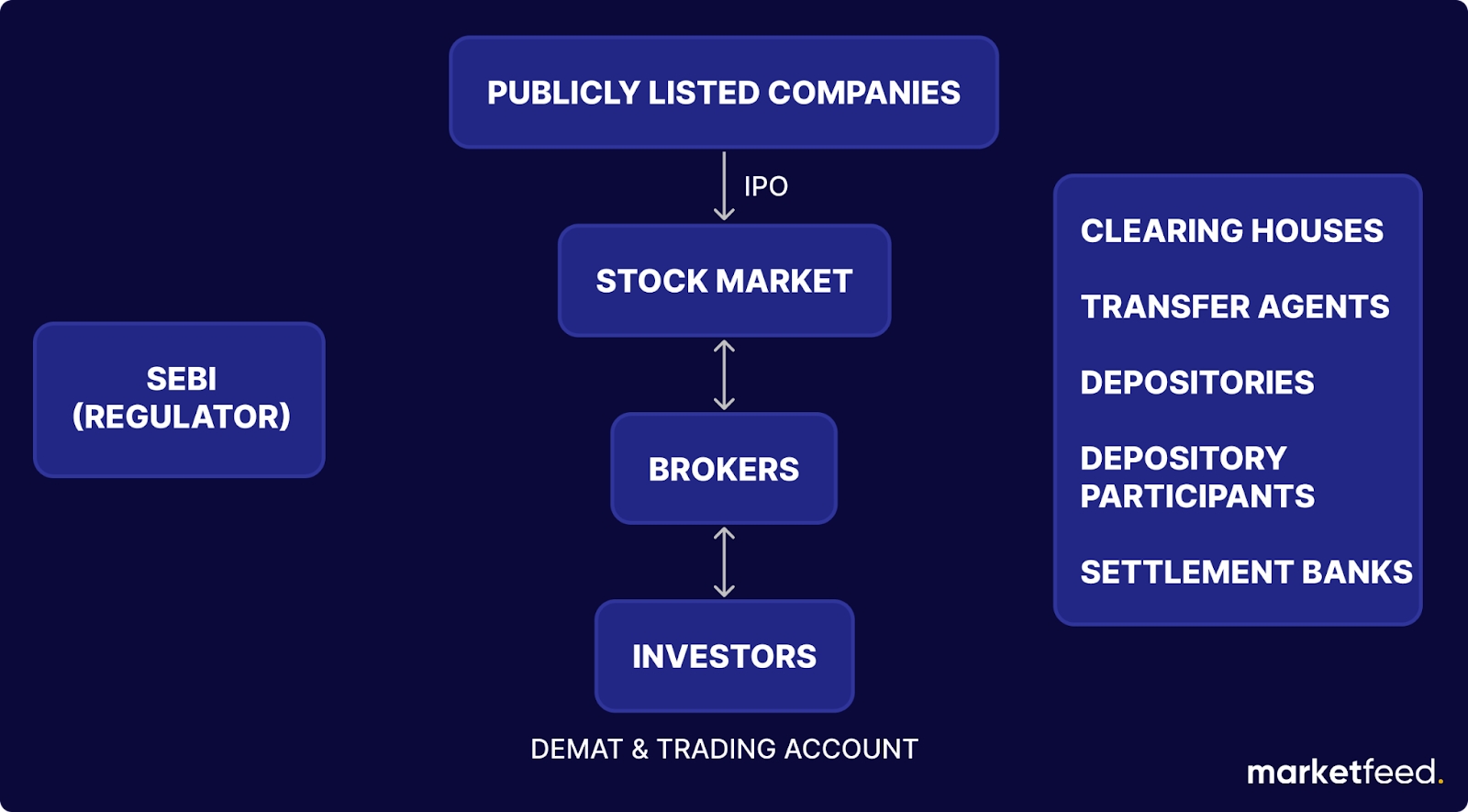
stock market participants | marketfeed

Let’s Look at a Story!

Mr. Jignesh, an owner of a renowned supermarket in Bengaluru, has been successfully running his business for the past ten years. The supermarket has been generating decent revenue and is highly profitable. His business also has goodwill (proprietary or intellectual property and brand recognition). When it comes to business, there are two things you must understand:

  • Ownership of a Business
    Jignesh completely owns and runs the supermarket, and the profit is not shared with anyone else.
  • Valuation of a Business
    Anything and everything has a value attached to it, even a business. The business has been generating income for Jignesh for the past ten years, so it is valuable. The valuation of a business is the economic value of how much a person has to pay to acquire 100% of the business from him. Let’s assume that the supermarket is valued at ₹1 crore.

    Since Jignesh is growing old, he feels he doesn’t want to work as much as he did and is looking for a partner to operate the business in return for 50% of the ownership of his business. He decided to share his business with a partner, Ms. Riya.

What are Shares?

Shares represent units of ownership of a company. A shareholder is entitled to a part of the profit that the company generates. 

The ownership of Jignesh’s supermarket was divided into 1000 equal shares. The value of each share can be mathematically expressed as:

Value of 1 Share = Total Valuation / Total Number of Shares

= 1,00,00,000 / 1000

= ₹10,000 per share.

Riya agreed to acquire 500 shares (50%) of the supermarket in consideration of the value of those shares in Cash.

Valuation = Total Number of Shares x Value of Each Share

Riya paid ₹50,00,000 to Jignesh, and they both became partners in the supermarket business. 

A few years later, the business expanded with several profitable outlets across Bengaluru. Now, Jignesh and Riya want to open 200 more stores nationwide, for which they need a large amount of capital. The easiest way to get funding or capital is by taking out a loan from a bank and using the business’ assets as collateral. However, this carries the risk of falling into a debt trap. If they are unable to repay the loan for some reason, the assets will be seized by the bank to recover the loan. Jignesh and Rita did not want to deal with these issues. 

An alternative would be to find more people who are interested in becoming part-owners of the business across Bengaluru. Even then, they may not be able to find enough people to do so. At this point, Jignesh becomes aware of the stock market. If they convert their company into a Public Limited company, they can raise capital from thousands of investors across India and other countries. The process of issuing shares to the public to raise capital for a business is known as an Initial Public Offering (IPO).

What is the Stock Market?

A stock market is a place where shares of publicly listed companies are traded. It is a physical place or institution where shares are bought and sold.

So Why Do Companies Go Public?

  • To Raise Capital: The company can gather funds for many objectives, such as paying liabilities (loans) and funding its future expansion projects.
  • Reward Founders & Early Investors: The founders and early investors of a company hold a good portion of the shares in their entity. They can sell these shares to the public and the proceeds go directly to them rather than to the company. It can be considered as a reward for all the time and effort they put in to build the company from the ground up. So going public can give them an early exit.

What are Stock Exchanges?

A stock exchange is a financial institution where different participants come together to buy and sell securities (shares). It provides the infrastructure for these activities. The term Stock Market is an umbrella term for a collection of Stock Exchanges.

The two major Stock Exchanges in India are:

  • Bombay Stock Exchange (BSE)
  • National Stock Exchange (NSE)

BSE is older than NSE, which explains why more companies are listed on the BSE than NSE. 

Coming back to the story, Jignesh’s company had a total of 1000 shares, out of which they decided to issue 15% of the shares to the public. Thus, 150 shares are being offered to the public. 

1000 x 15% = 150

How Many Shares Will a Company Have? Who Decides That?

A company’s promoters can decide how many shares it should have. Some firms may have thousands of shares, while others may have lakhs or even crores of shares. 

For example, the valuation of Jignesh’s company was ₹1 crore in the beginning. But the business has grown over the years, and now the valuation stands at ₹2 crores, bringing the value of each share to ₹20,000. 

Why do Investors Exist? What are their Objectives?

The two main objectives of investors are:

1. Capital Appreciation – When a company grows, the price of its shares increases. If investors buy the shares of a company when the prices are low and sell them when the prices increase, they can make good profits via capital appreciation.

2. Earn Dividends – When a company makes profits every year from its operations, it distributes a portion of the profits to shareholders as dividends. However, it is not necessary for them to declare dividends every year. It’s the company’s choice whether to issue dividends or not. The company may fully retain its profits for future capital needs or may give out a part of the profit and retain the rest. 

In short, the objective of a public limited company is to raise capital for its funding needs and the investors’ objective is to grow their money. But the real question is, how does the stock market fit into this?

Why do Stock Markets Exist? 

The stock market provides an avenue for a public company to raise capital from investors in consideration of shares. Investors will be able to grow their savings and wealth through capital appreciation and dividends. The stock market is the facilitator for the two parties. 

What are Primary Market and Secondary Market?

The stock market is divided into two:

1. Primary Markets
It is a market wherein a firm issues securities/shares to investors directly (via an initial public offering or IPO). These sale proceeds go directly to the issuer to finance their capital requirements.

2. Secondary Markets
It is the market where previously issued securities are bought and sold among investors. These sale proceeds go to the person who holds the securities. 

In our story, many people wanted to buy shares of his company after the IPO. However, the company does not issue any more shares as the IPO is already done. So these new investors can only buy the shares from those already holding them. 

When such transactions happen between investors in the secondary markets, the price of the share gets updated. If an existing shareholder sells the stock to another person for ₹20,100, the price of all the shares of the company gets updated to ₹20,100. Consequently, the net worth of the shareholders increases as the price of the shares they hold increases. 

Who Decides the Price of a Stock?

The two reasons which decide the price of a stock are:

  • Company’s Actual Valuation: A company’s value fluctuates as the revenue, profit, and goodwill change. The future prospects of the company also contribute to the valuation. If the revenue and profits go down, the valuation may also decrease, which causes the share price to drop. However, if the revenue and profit increase, the valuation could also rise.
  • Demand & Supply: The market forces of supply and demand also play an important role in deciding the share price. If the demand for the stock increases, then its price also increases since supply is limited. If the demand for the stock decreases, then its price also decreases since the supply is the same. Demand for the stock depends upon market sentiments, which refers to the overall attitude of investors toward the company. If the market sentiment is positive, then the demand for the stock will be high, thus driving the stock price up. Demand for the stock will be less if the market sentiment is negative. 

Why Do Stock Prices Fluctuate Every Second?

The Last Traded Price (LTP) refers to the price at which the previous share transaction took place. The stock market has lakhs of participants, and transactions happen every second. If a person sells a stock for ₹150, then the LTP at the time will be ₹150. The very next second, if a stock is sold for ₹149, then the LTP changes to ₹149. This is the reason why stock prices fluctuate every second.

Who are Brokers?

If you want to buy a stock, you cannot do it directly from the stock market. We have to approach a stockbroker, and the broker will transact on our behalf. A broker is an intermediary that facilitates transactions in the stock market. If you want to buy a stock, your broker will find a seller in the stock market on your instruction and facilitate the transaction between you and the seller. 

Before technology evolved, an investor had to physically visit the broker’s office and instruct them to buy the stock. The broker would then physically go around the stock market, find a seller, and conduct the transaction. But now, technology has evolved, and transactions can be conducted via our phones. Brokers are accessible on computers and smartphones, and investing & trading are as easy as ever. 

It is absolutely necessary to have an account with a broker to participate in the stock market. As intelligent stock market participants, we must have multiple broking accounts for different purposes. We can use one account for our long-term investing activities and another one for trading. Successful traders use multiple broking accounts for different trading strategies. 

How Does a Broker Work?
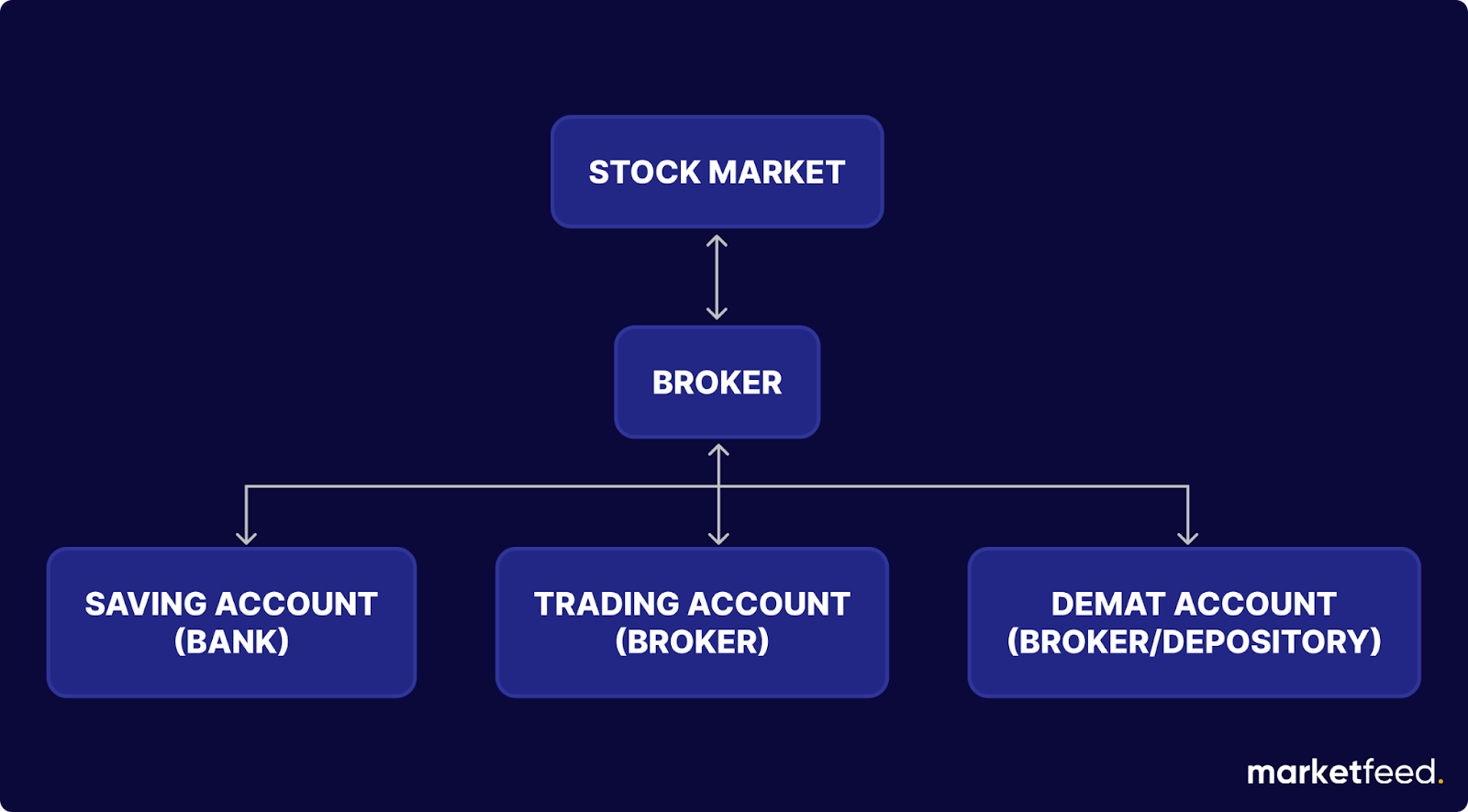
how does a stock market broker work? | marketfeed

There are two accounts that we open with a broker. Even though they are two separate accounts serving different purposes, both of them come in a bundle.

1. Demat Account
A Demat account or dematerialisation account allows you to hold your shares in an electronic format. It converts the physical shares into an electronic form, therefore dematerialising them. Demat accounts are maintained under depositories.

Earlier, the proof of ownership of shares, bonds, or debentures was in the form of physical share certificates. However, this system had many drawbacks, such as the risk of losing the certificate, fire hazards, getting wet, or even a mismatch in the signatures. 

2. Trading Account
A trading account acts as an interface between the investor’s bank savings account and a broker. For the broker to conduct trading activities on our behalf, they need money. We transfer the money we have in our savings account to a trading account with which the broker then conducts trading activities. Money can be transferred using net banking or UPI.

If we want to buy a stock, we instruct the broker to buy the stock, and the broker uses the money we have in our trading account to conduct the transaction. Similarly, when we sell a stock, the proceeds of the sale come directly into the trading account. 

An Illustration to Understand How Demat & Trading Account Works

  • Arun wants to buy a share of Mahindra & Mahindra (M&M) from the stock market. The first step that Arun should take is to open a Demat and trading account. Arun opens a Demat & trading account with a leading broker and deposits money into his trading account by transferring from his bank savings account via UPI. 
  • When the market opened at 9:15 AM, Arun placed an order with his broker to buy 1 quantity of M&M stock. The market price of M&M at the time was ₹1000. His trading account was debited ₹1000 by the broker to finance the transaction. Apart from this, a small amount was deducted as taxes and charges. 
  • Even though the transaction was completed, the stock will only be transferred into his Demat account after T+1 days, which means he will receive the stock in his Demat account on the next working day. 

While selecting brokers, we should choose the brokers that satisfy our various investing and trading needs. YOu can open a Demat and trading account using the links given below: 

Fyers (FREE) – https://bit.ly/3tx3ZJx

Zerodha – https://bit.ly/3AlErmb

Upstox – https://bit.ly/3OUAJnR

(Full disclosure: These are affiliate links. Do use the links if you wish to support us at no extra cost. ❤️)

Click here for step-by-step instructions on how to open a Demat and trading account.

What are Depositories?

If your shares are held by the broker, there is a risk of the broker running away with the shares they have. As a remedy, all Demat accounts are maintained by depositories. A depository is an institution that acts as a custodian of Demat accounts and shares. A Demat account is opened by a depository participant, who acts as an intermediary between the depository and investors. 

There are two depositories in India, which are governed by the Government of India: 

1. CDSL – Central Depository Services Limited
2. NSDL – National Securities Depository Limited
what are depositories | marketfeed

Who are the Other Facilitators?

The other facilitators part from brokers, depositories, and depository participants are: 

  • Clearing Houses – It is an intermediary between buyers and sellers of financial instruments. It is an agency or separate corporation of a futures exchange responsible for settling trading accounts, clearing trades, collecting and maintaining margin monies, regulating delivery, and reporting trading data.
  • Transfer Agents – A transfer agent keeps records of who owns a publicly traded company’s stocks and bonds. They also ensure investors receive dividends on time.
  • Settlement Banks – It refers to a customer’s bank where payments or transactions are finally settled and cleared for customer use.

What is a Market Regulator?

The Indian stock market is a place where transactions worth lakhs of crores of rupees take place. The Securities and Exchange Board of India (SEBI) is a regulatory authority established under the SEBI Act 1992. It’s the principal regulator for stock exchanges in India. SEBI’s primary functions include protecting investor interests and promoting and regulating the Indian securities markets. It is a government organisation. SEBI exists as the watchdog to make sure nothing wrong is happening in such a massive money-involved ecosystem.

Throughout the article, we discussed the various participants in the stock market and how they all work together in the stock market. We’ve also understood the basics of what the stock market is, who its participants are, and how it works!

Categories
Daily Market Feed Post Market Analysis

Muhurat Trading Gains Lost! – Post-Market Analysis

NIFTY started the day at 19,486 with a gap-down of 38 points. After opening, the index further fell nearly 80 points with volatility. Then, it consolidated throughout the day in a 25-point upward channel. Nifty closed at 19,443, down by 82 points or 0.42%.

Nifty chart November 13 - post-market analysis | marketfeed

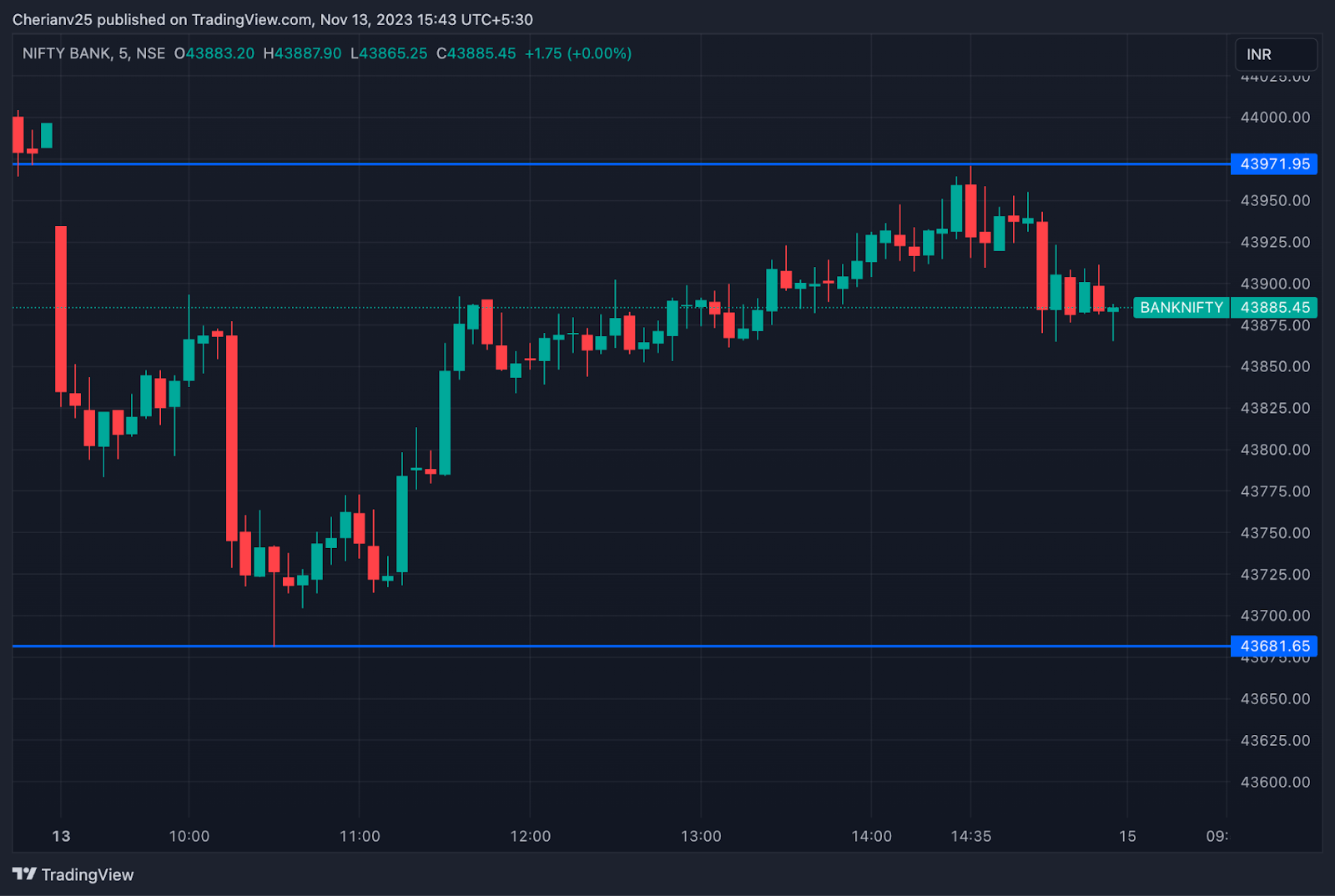
BANK NIFTY (BNF) started the day at 43,915 with a gap-down of 81.5 points. Similar to Nifty, BNF fell more than 200 points with wild moves. Then, the index rebounded 200 points in just 20-25 mins and consolidated for the rest of the day. BNF closed at 43,891, down by 105 points or 0.24%.

All indices except Nifty PSU Bank (+2.64%) and Nifty Metal (+0.37%) closed in the red.

Major Asian markets closed in the green. Germany’s DAX and UK’s FTSE100 are currently trading in the green, while France’s CAC40 is trading in the red.

Today’s Moves

Coal India (+5.29%) was NIFTY50’s top gainer. Jefferies India and other brokerages have upgraded the stock and raised their target prices on the back of strong Q2 earnings by the state-run miner.

BSE (+9.2%) hit a 52-week high of ₹2,350 after the stock exchange reported a 4x jump in its net profit to ₹118.4 crore in Q2.

Hindustan Copper (+8.07%) surged after the company’s net profit more than doubled in Q2.

SBI Life (-2.2%) was NIFTY50’s top loser. 

Glenmark Pharma (-5.03%) fell sharply after the company posted a loss in Q2 on exceptional legal costs.

Markets Ahead

On the occasion of Muhurat Trading, the Indian markets opened with a gap up (above major resistance levels). However, today’s opening brought the indices back into their original zones, suggesting the presence of selling pressure in the markets.

Nifty: Keep an eye on the resistance levels at 19,460 and 19,500. If there’s a breakout, we might see the index aiming for 19,540 and 19,600. On the other hand, the critical support for Nifty is at 19,400. If it falls below this level, potential targets could be 19,360 and 19,330.

Bank Nifty: The resistance levels to keep an eye on are at 43,900 and 44,000. A breakout might set a target at 44,000 and a larger one at 44,500. On the downside, the key support levels are at 43,800 and 43,700. If there’s a breakdown, potential targets could be 43,500 and 43,300.

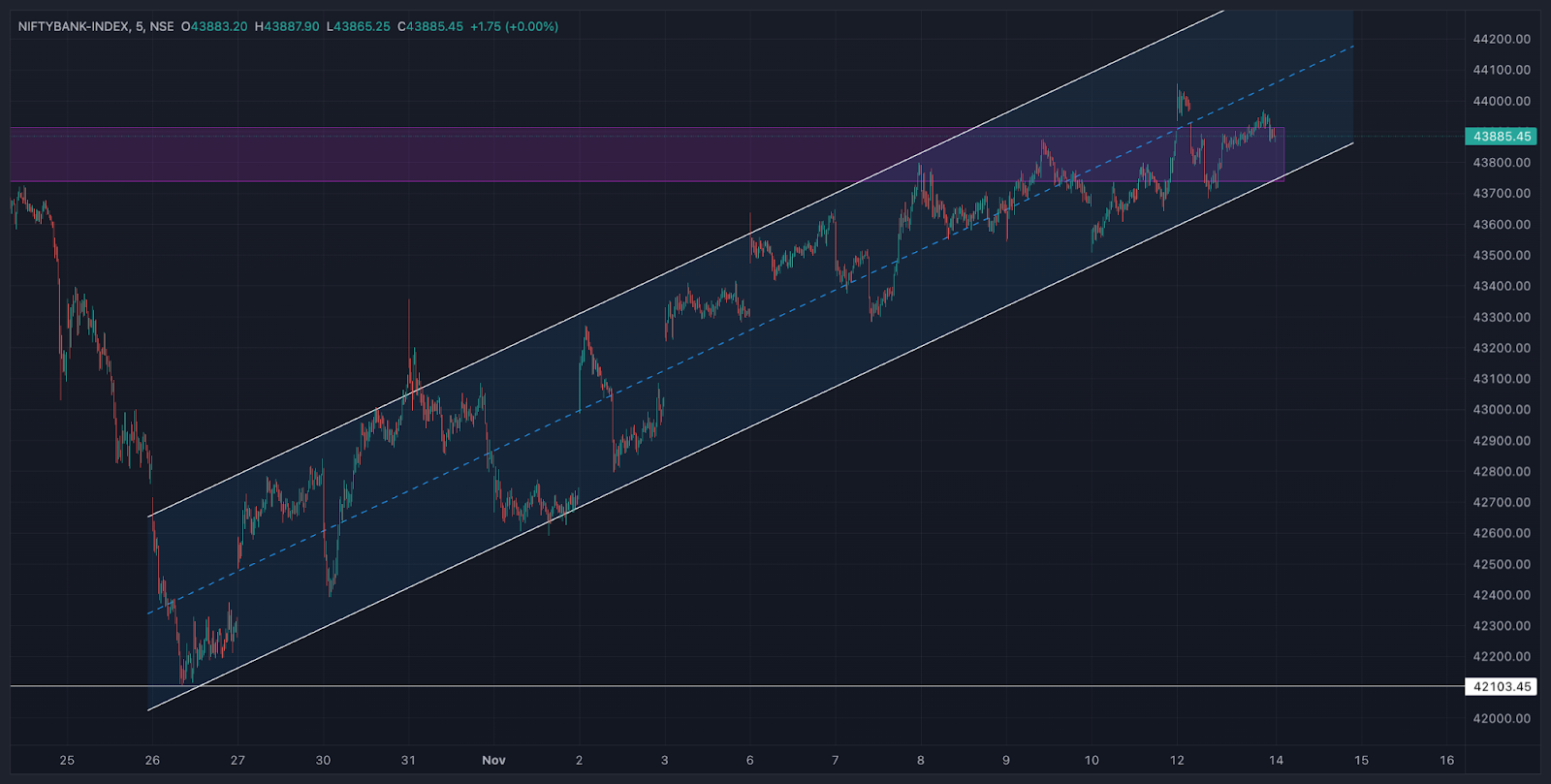
Also, watch out for this channel in BNF! 

Bank Nifty chart November 13 - post-market analysis | marketfeed

The Indian market continues to consolidate due to various factors: the sudden slowdown in Industrial Production (IIP) growth in Sept 2023, and the declining manufacturing PMI mirror global patterns influenced by rising interest rates and inflation. The weakness in the Indian Rupee has made FIIs adopt a cautious stance. However, the market’s potential decline is limited by robust Q2 earnings, economic stability, and consistent DII investments.

The markets will be closed tomorrow (Nov 14) on account of Diwali-Balipratipada! marketfeed wishes all our readers a Happy Diwali! 🪔

Please join The Stock Market Show at 7 PM on our YouTube channel.

Categories
Market News Top 10 News

Disney to Sign Multibillion-Dollar Deal With Reliance – Top Indian Market Updates

Here are some of the major updates that could move the markets on Wednesday:

Disney to sign multibillion-dollar deal with Reliance Industries

Reliance Industries Ltd (RIL) is set to acquire Walt Disney Co’s (WDC) India operations in a cash and stock deal. WDC may sell a controlling stake in the Disney Star business, which it values at around $10 billion (~₹83.1 crore). RIL views the assets at between $7 billion to $ 8 billion. The acquisition could be announced as early as next month as some of Reliance’s media units merged into Disney Star.

Read more here.

Torrent Pharma Q2 Results: Net profit rises 24% YoY to ₹386 crore

Torrent Pharma posted a 24% YoY increase in net profit to ₹386 crore for the quarter ended September (Q2 FY24); beating street estimates. The pharma company posted a net profit of ₹312 crore in Q2 last year. Its total revenue rose 16.1% YoY to ₹2,660 crore in Q2 FY24. EBITDA stood at ₹825 crore, up 36.2% YoY.

Read more here.

Lupin gets USFDA nod to market generic antifungal tablets

Lupin Ltd has received approval from the US Food & Drug Administration (USFDA) to market its generic Fluconazole tablets. The drug is used to treat fungal infections. The product will be manufactured at Lupin’s Pithampur facility in Madhya Pradesh. According to IQVIA MAT July 2023 data, the drug had an estimated annual sales of $43 million in the US.

Read more here.

Mahindra Holidays Q2 Results: Net profit falls 48% YoY to ₹21 crore

Mahindra Holidays & Resorts India Ltd (MHRIL) reported a 48% YoY decline in net profit to ₹21 crore for the quarter ended September 2023 (Q2 FY24). Net profit stood at ₹40.9 crore in the same period a year ago. Its total revenue rose 10% YoY to ₹655 crore in Q2 FY24. EBITDA stood at ₹136 crore, up 17% YoY.

Read more here.

ONGC wins bid to acquire PTC’s wind power unit for ₹925 cr

Oil and Natural Gas Corporation (ONGC) has won a bid to acquire PTC India Ltd’s wind power unit for ₹925 crore as part of its renewable energy portfolio expansion. ONGC already has 189 MW of renewable energy capacity and aims to reach 10 GW by 2030. The acquisition, which has a renewable energy portfolio of 288.8 MW, is subject to the approval of PTC’s shareholders.

Read more here.

Consumer court asks ICICI Bank to pay ₹77,000 for denying reward points

ICICI Bank has been instructed by the District Consumer Disputes Grievance Redressal Commission to pay ₹77,000 to a man from Chennai. The payment is compensation for the denial of reward points by the bank. The bank will pay ₹41,691 in reward points and an additional ₹35,000 for the deficiency in service, compensation for mental agony, and mental agony. 

Read more here.

Adani Power close to taking over Coastal Energen for ₹3,440 crore

Adani Power won a bid to take over bankrupt power company Coastal Energen for ₹3,440 crore. The interest in Coastal Energen (which is undergoing corporate insolvency) is mainly because it is among a few operational power plants for sale. Jindal Power, who also bid for the company, quit the auction.

Read more here.

IPCA Labs’ Ratlam facility gets favourable FDA classification

The USFDA has classified IPCA Laboratories Ltd’s’ Ratlam facility as ‘Voluntary Action Indicated’ (VAI) in its Establishment Inspection Report (EIR). A VAI is generally issued when the response from a plant to certain observations appears satisfactory to the regulator. The facility manufactures Active Pharma Ingredients (APIs). VAI is the second-best classification that a plant can get from the USFDA.

Read more here.

Aurobindo Pharma’s arm gets USFDA nod for testosterone cypionate injection

Aurobindo Pharma’s wholly-owned subsidiary, Eugia Pharma Specialties, has received the final approval from USFDA to manufacture and market the testosterone cypionate injection. This is bioequivalent and therapeutically equivalent to the reference listed drug, depo-testosterone injection. According to IQVIA data, the approved product has an estimated market size of $226.8 million for the 12 months ending August 2023.

Read more here.

BSE revises F&O turnover charges from Nov 1

Bombay Stock Exchange (BSE) has revised transaction charges in the equity derivatives segment, with effect from November 1, 2023. According to a BSE notice, these changes will primarily be levied on S&P BSE Sensex Options, particularly the nearest or immediate expiry contracts. The new transaction fee structure is based on the incremental billable monthly turnover (premium value).

Read more here.

Adani Ports incorporates new subsidiary

Adani Ports & Special Economic Zone Ltd (APSEZL) has incorporated a wholly-owned subsidiary company, “Udanvat Leasing IFSC Limited.” It is involved in the business of owning and leasing aircraft. The new company is situated in GIFT City, Gandhinagar, and is yet to commence operations.

Read more here.

Categories
Daily Market Feed Post Market Analysis

Fin Nifty Falls 200 Points in 10 Mins on Expiry Day! – Post-Market Analysis

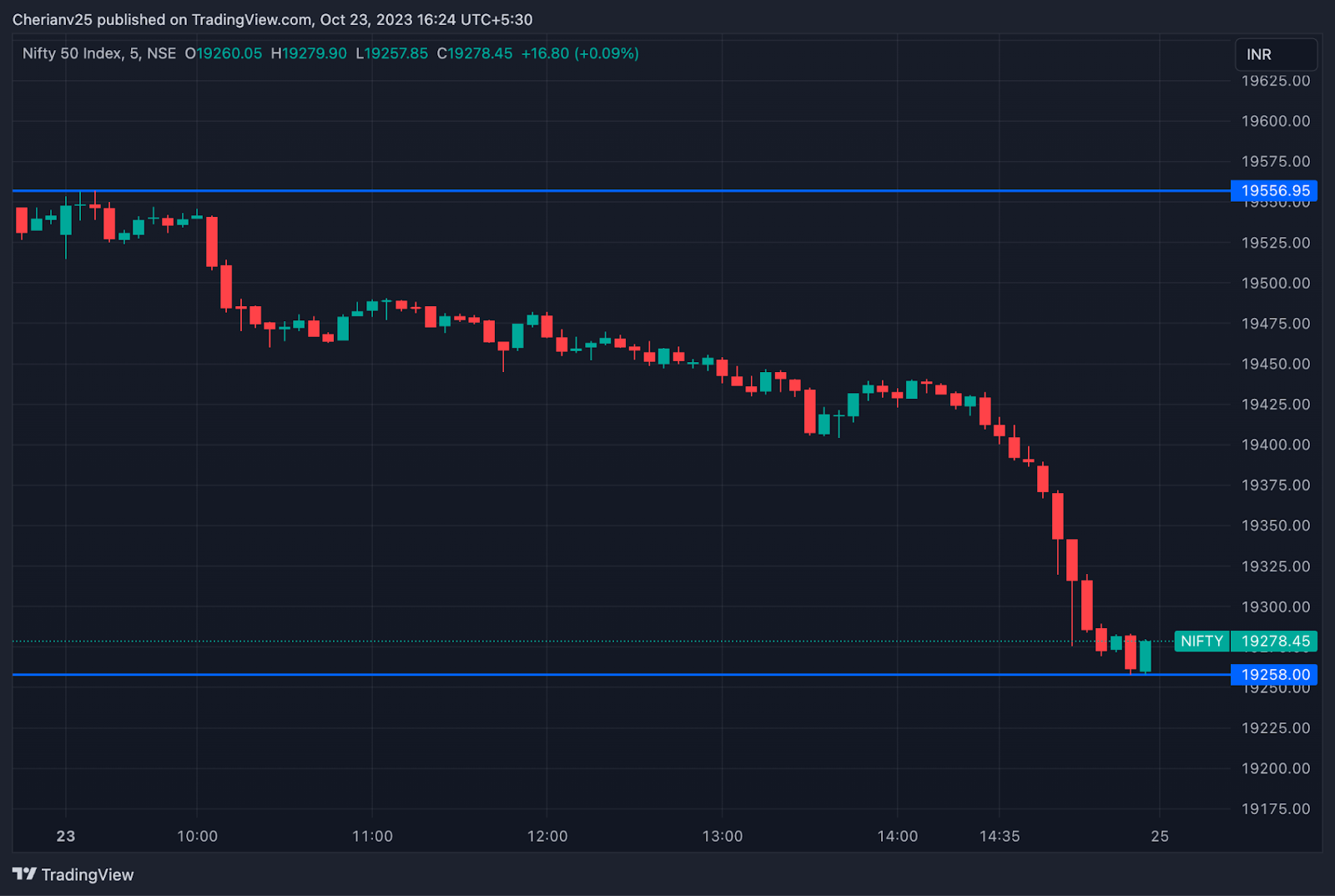
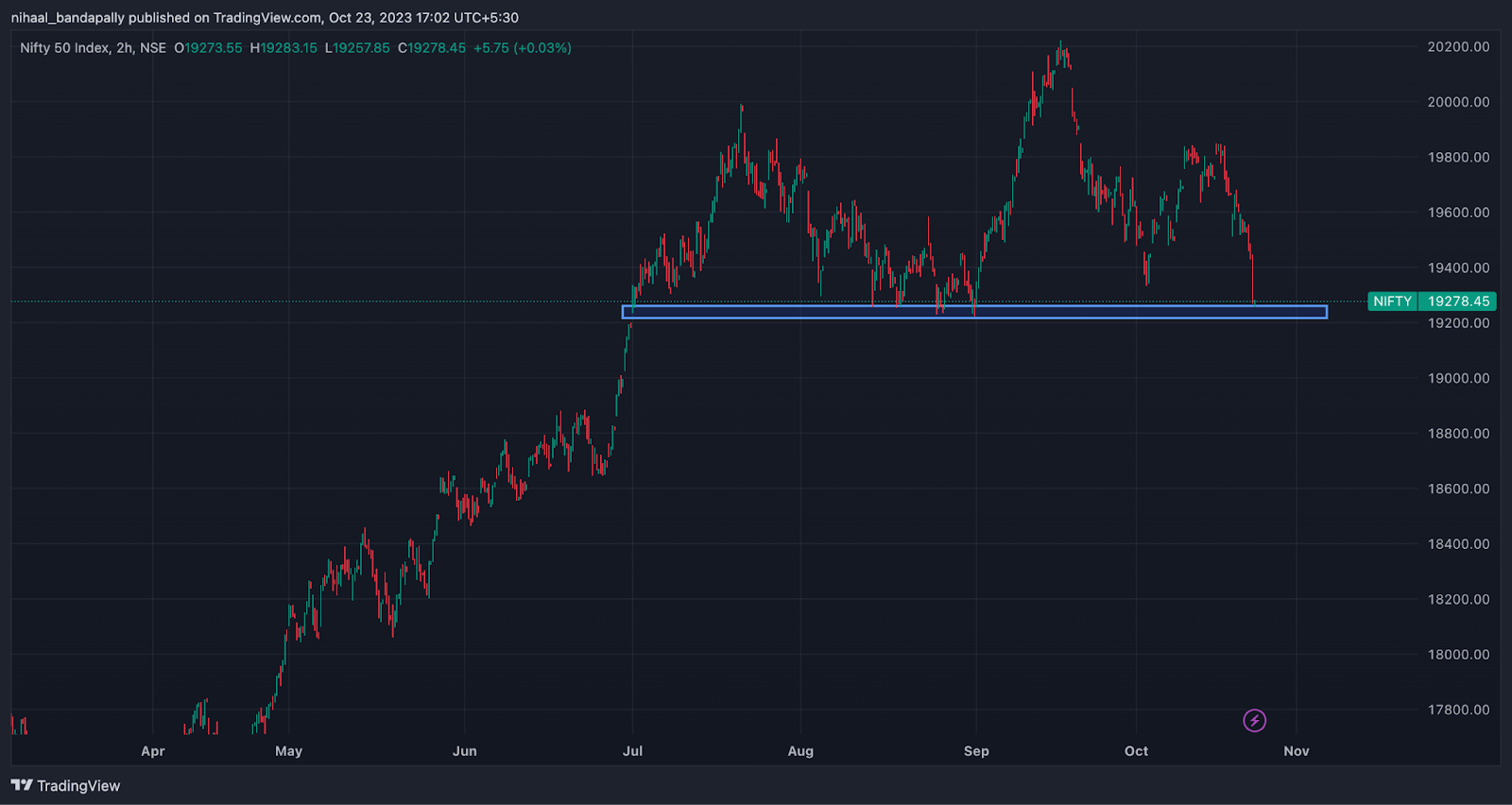
NIFTY started the day at 19,521 with a gap-down of 21 points. After a small consolidation initially, the index broke the round level support of 19,500 and continued to move down strength to 19,255 level— a fall of nearly 300 points from the day’s high! Nifty closed at 19,281, down by 260 points or 1.34%.

Nifty chart October 23 - post-market analysis | marketfeed

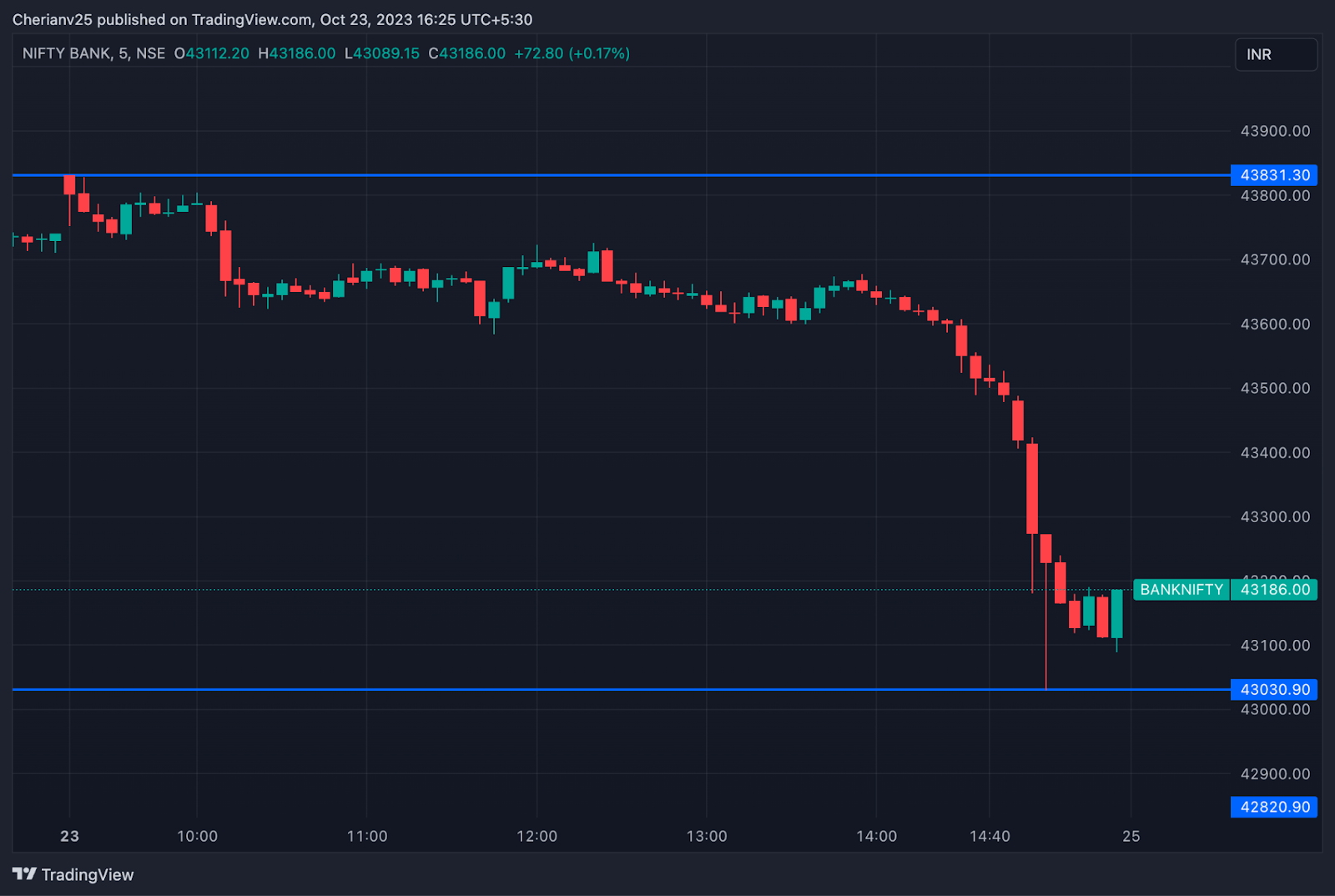
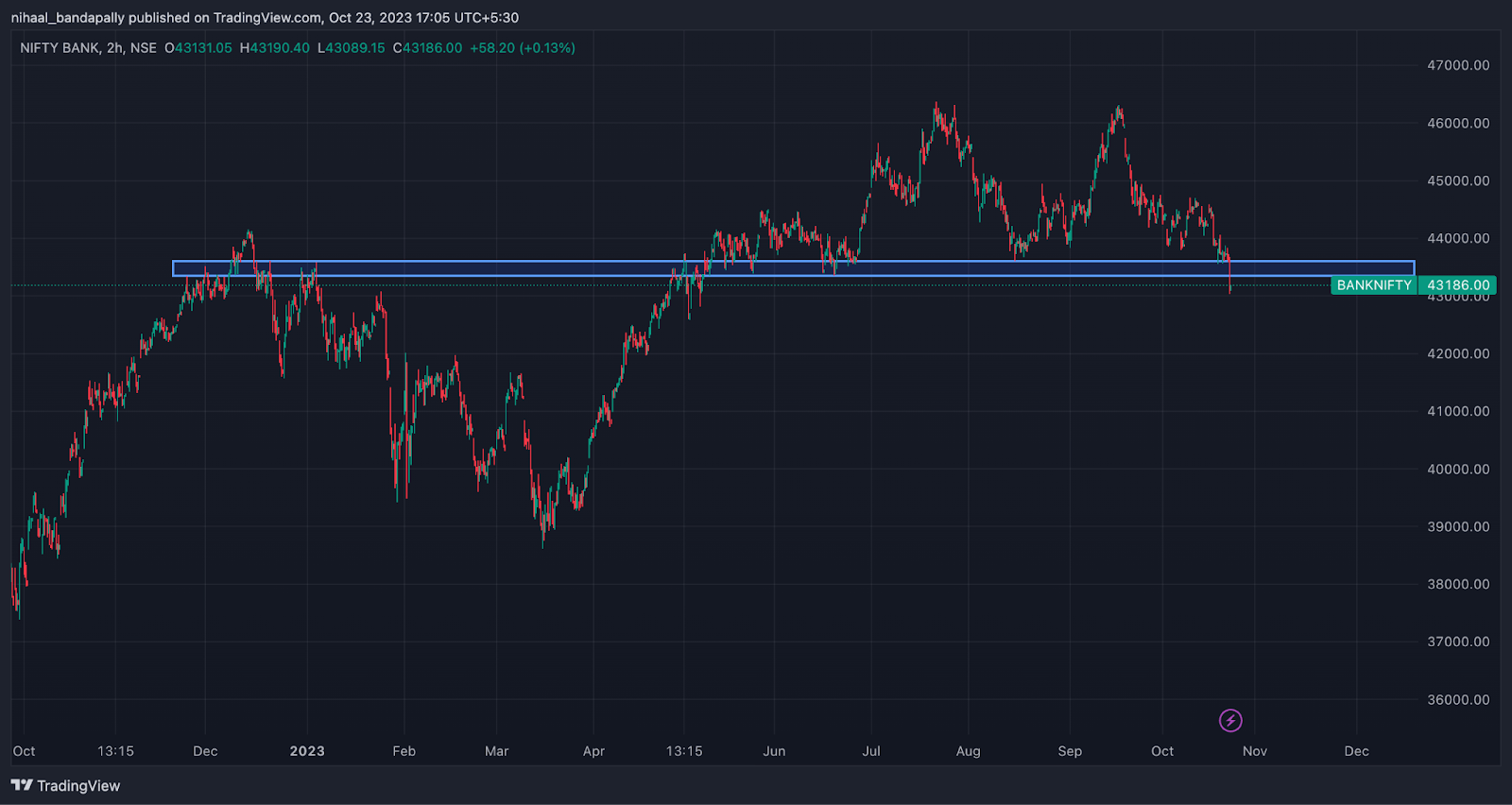
BANK NIFTY (BNF) started the day at 43,822 with a small gap-up of 99 points (near the resistance zone of 43,800). The index initially fell to the 43,600 swing low (created last Friday). Then, it mostly consolidated till 2:30 PM, post which there was a fall of more than 575 points to 43,000 levels. The intraday fall was 800 points from the day’s high to the day’s low! BNF closed at 43,151, down by 571 points or 1.31%.

Bank Nifty chart October 23 - post-market analysis | marketfeed

All major indices closed in red. Nifty Media (-4.98%), Nifty PSU Bank (-3.7%), and Nifty Metal (-3.26%) fell the most.

Major Asian markets closed in the red. European markets are currently trading in the red.

Today’s Moves

Mahindra & Mahindra (+0.4%) was NIFTY50’s top gainer.

BSE (+7.52%) moved up sharply after the exchange said it would increase transaction charges on the equity derivatives segment, with effect from November 1.

Shares of CreditAccess Grameen (+7.4%) hit a 52-week high on the back of strong Q2 results and a rise in FY24 revenue guidance.

LTI Mindtree (-3.97%) was NIFTY50’s top loser. The stock has been witnessing a correction since the IT firm reported its Q2 results last week.

Laurus Labs (-9.6%) fell sharply after the pharma company reported a decline in net profit and revenue in Q2.

Markets Ahead

The Indian stock markets were under severe selling pressure post 2:30 PM today— there was a fall of more than 550 points in Bank Nifty, 200 points in Fin Nifty, and 150 points in Nifty! Now, all these indices are at major long-term support zones. If those supports are breached, we could see more bearishness in the markets.

Nifty: As you can see in the chart below, Nifty is at a very important support zone of 19,200-250 levels. If that level is breached, the index may fall to 18,800 levels. On the other hand, the important hurdle to cross on the upper side would be 19,500 levels.

Bank Nifty: Bank Nifty broke the important support zone near 43,500. Now, the 43,000 round level can still be considered as support. If that level is breached, we could expect a further decline to 42,600 levels. Meanwhile, the important resistance to watch out for will be 43,600 levels.


Our markets fell sharply today after the benchmark 10-year US treasury note rose above 5%. Moreover, deepening conflict in the Middle East has hurt investor sentiments in the overall Asian markets.

The Indian markets will be closed tomorrow (Oct 24) on account of Dussehra!

marketfeed wishes all our readers a very happy and prosperous Dussehra!

Please join The Stock Market Show at 7 PM on our YouTube channel.

Categories
Market News Top 10 News

India’s Manufacturing PMI Hits 3-Month High in August – Top Indian Market Updates

Here are some of the major updates that could move the markets on Monday:

India’s manufacturing PMI hits 3-month high in August

India’s manufacturing sector expanded significantly in August 2023, reaching a 3-month high. The S&P Global India Manufacturing Purchasing Managers’ Index (PMI) stood at 58.6 in August, compared to 57.7 in July. The expansion in manufacturing activity was supported by the rise in new orders last month.

PMI is a month-on-month calculation, and a value above 50 represents an expansion compared to the previous month.

Read more here.

Auto sales data for August 2023: Highlights  

Maruti Suzuki India posted a 14.5% year-on-year (YoY) increase in total sale sales to 1.89 lakh units in August 2023. Sales of its mini & compact vehicle segment fell 9.7% YoY to 84,660 units. Exports rose 14.6% YoY to 24,614 units.

Tata Motors Ltd registered a 3% YoY fall in passenger vehicle sales to 45,933 units in August. The automaker’s total commercial vehicle sales rose by 1.9% YoY to 32,077 units.

Mahindra & Mahindra’s total passenger vehicle segment posted total sales of 37,270 units in August, an increase of 25% YoY. Tractor sales are up 1% at 21,676 units. However, its tractor exports fell 26% YoY 1,029 units. 

TVS Motor Company’s total two-wheeler sales stood at 3.32 lakh units in August, up 5% YoY. Meanwhile, Bajaj Auto’s total sales fell 15% YoY to 3.42 lakh units.

Read more here.

India’s GST revenue rises to Rs 1.59 lakh crore in August, up 11% YoY

India’s Goods and Services Tax (GST) revenue increased 11% YoY in August 2023. The month saw a collection of ₹1,59,069 crore in gross GST revenue, highlighting the steady economic recovery and tax compliance. Central GST (CGST) accounted for ₹28,328 crore, while State GST (SGST) amounted to ₹35,794 crore. Integrated GST (IGST) collections stood at ₹83,251 crore.

Read more here.

Bajaj Auto’s finance subsidiary secures RBI’s NBFC licence

Bajaj Auto Ltd’s wholly-owned subsidiary Bajaj Auto Consumer Finance Ltd has received a licence from the Reserve Bank of India (RBI). The license is to launch a non-banking finance company (NBFC). However, Bajaj Auto Consumer Finance Ltd can’t accept public deposits from the public. The company’s core objective is to offer financing solutions exclusively for vehicles manufactured or endorsed by Bajaj Auto and its associated entities.

Read more here.

Muthoot Finance hikes stake to 59% in microfinance subsidiary for ₹43 crore

Muthoot Finance Ltd has acquired an additional 2.05% stake in its subsidiary Belstar Microfinance Ltd in a cash deal of ₹43 crore. Following the acquisition, Muthoot’s total shareholding in the Tamil Nadu-based microfinance company has increased from 56.97% to 59.02%. In 2017, Muthoot Finance acquired a 53% stake in Belstar as part of its diversification strategy. 

Read more here.

PVR Inox breaks box office collection record in August

PVR Inox posted the highest-ever monthly admissions and Box Office (BO) month of all time in August 2023. The company recorded a gross box office revenue of  ₹532 crore. In the previous month, the multiplex achieved a footfall of nearly 190 lakh. This was driven by Hindi films, including Gadar 2, OMG2, and Dreamgirl 2. Jailer, Rocky aur Rani ki Prem Kahani, and Hollywood’s Oppenheimer also added to the achievement.

Read more here.

Reliance launches ‘Campa Cricket’ ahead of marquee tournaments like World Cup

Amid the ongoing men’s cricket tournament Asia Cup and the upcoming Men’s ODI cricket World Cup, Reliance Consumer Products Ltd (RCPL) has launched a cricket-themed drink, Campa Cricket. In a move to expand its beverage portfolio, the company plans to launch in several states, including Karnataka, Tamil Nadu, Andhra Pradesh, Telangana, Gujarat, Maharashtra, West Bengal and Uttar Pradesh.

Read more here.

Coal India output grows 13% to 52.3 MT in Aug

Coal India Ltd (CIL) posted a 13.2% growth in its output at 52.3 million tonnes (MT) in August 2023, compared to 46.2 MT in the year-ago month. The supplies rose to 59 MT in August, registering a rise of 15.3%. In FY2023-24 so far, the company produced 281.5 MT, posting an 11.1% year-on-year growth.

Read more here.

BSE share buyback price raised to ₹1,080 per share

BSE’s board approved an increase in the offer price for its proposed share buyback and also fixed the record date for the same. The share buyback price has been increased to ₹1,080 per share from ₹816 per share earlier. BSE’s board also fixed the record date for the proposed share buyback at September 14, 2023. The buyback is payable in cash for an aggregate maximum amount not exceeding ₹374 crore.

Read more here.

Categories
Daily Market Feed Pre Market Report

Expect Volatility! Will Call Sellers Win BANK NIFTY? – Pre-Market Analysis Report

Here are some of the major updates that could move the markets today:

Banking and financial services, real estate, and auto sectors will be in focus around the RBI Interest Rate decision at 10 AM.

Stocks

ZEEL reported a 97% YoY fall in profit to Rs 3.87 crore due to exceptional losses. Revenue increased by 7.6% and subscription revenue also increased.

Axis Bank’s board has approved for fresh capital infusion of Rs 1,612 crore in Max Life, taking total stake to over 19%.

Tata Power reported a 22% YoY increase in consolidated profit to Rs 972.5 crore.

Eicher has announced a partnership with Amazon. The e-commerce giant has committed to buying 1,000 electric trucks.

BSE reported 10x growth in consolidated profit to Rs 442.66 crore, due to a 5% stake sale in CDSL and other income. Revenue grew by 15.4% on-year to Rs 215.62 crore.

Major results today: Hero Motocorp, Manappuram, Grasim, LIC, Apollo Tyres, SAIL

What Happened Yesterday?

NIFTY started the day flat at 19,578. Yesterday’s low was broken immediately and there was consolidation near 19,470. But after noon, a crazy rally was seen even crossing the day-high. NIFTY closed at 19,632, up by 61 points or 0.32%.

BANK NIFTY started the day flat at 44,973 and fell. Banks also rallied up in the second half and the index moved back up 400 points. However, the day’s high was not broken. BANK NIFTY closed at 44,880, down by 83 points or 0.19%. 

Even with the crazy moves, important levels were respected in the market.

What to Expect Today?

US markets closed in the red after high volatility. The European markets closed in green.

The Asian markets are trading mixed.

The U.S. Futures are trading in the green.

GIFT NIFTY is trading flat at 19,604.

All the factors combined indicate a flat opening in the market.

NIFTY has support at 19,617, 19,566, 19,530 and 19,438. We can expect resistances at 19,617, 19,658, and 19,720. 

BANK NIFTY has support at 44,800, 44,520, 44,277 and 44,000. Resistances are at 44,900, 45,100, 45,229 and 45,472. 

NIFTY has the highest call OI build-up at 19,800. The highest put OI build-up is at 19,500. PCR is at 1.09.

BANK NIFTY has the highest call OI build-up at 45,000. The highest put OI build-up is also at 45,000. PCR is at 0.71.

Foreign Institutional Investors net-bought shares worth Rs 644 crores. Domestic Institutional Investors net-sold worth Rs -597 crores.

INDIA VIX is at 11.14.

U.S. markets had a highly volatile day again but closed in the red again. Futures are in the green, there is a higher chance for our markets to open flat.

NIFTY technicals indicate consolidation with a bearish bias. There are once again heavy call sellers in the market.

Bank Nifty put sellers had exited positions even with the afternoon rally. This gives some breathing space for the index on the lower side. However, there are 4 lakh call contracts at 45,000. If the 45,100 is crossed, I expect a good rally in the index as FIIs have returned as buyers.

NIFTY’s technical data is indicating bullishness, with a strong green candle yesterday. We will need to watch 19,650.

RBI Interest Rate Decision Today:

All eyes will be on the RBI Monetary Policy decision to be announced at 10 AM today by Shaktikanta Das. Expect some volatility around the time of the announcements.

2 factors will play out today: increased vegetable inflation and surplus liquidity in the banking system reaching a 14-month high(this leads to high inflation). But the expectation is that RBI will keep interest rate the same for now.

Just like we expected, Wednesday’s trading session was a dhamaka. Today, it would be best to trade with levels and your strategy with strict stop-losses, rather than trying to predict where the market will go.

Follow along with Smart Money (NIFTY) and Piggy Bank (BANK NIFTY) trades. Follow along on the marketfeed app, or on our website for trades!

Ensure you tune in to The Stock Market Show at 7 PM on our YouTube channel. All the best for the day!

Categories
Market News Top 10 News

Tata Power’s Net Profit Rises 22% YoY to Rs 972Cr in Q1- Top Indian Market Updates

Here are some of the major updates that could move the markets tomorrow:

Tata Power Q1 Results: Net profit rises 22% YoY to ₹972 crore

Tata Power reported a 22.4% YoY rise in consolidated net profit to ₹972 crore for the quarter ended June (Q1 FY24). Its consolidated revenue from operations stood at ₹15,213.29 crore, up 5% YoY. EBITDA increased 75% YoY to ₹2,943.6 crore in Q1. Tata Power accrued a one-time gain of Rs 235 crore in the reported quarter on account of deemed gain on dilution of around 17% stake in Tata Projects. 

Read more here.

Hero MotoCorp faces tax probe over links to vendor

According to a Reuters report, The Directorate General of Goods and Services Tax Intelligence is investigating Hero MotoCorp’s relationship with a vendor suspected of reporting about ₹90 crore ($10.87 million) in false expenditure. Based on the alleged fake spending by vendor Salt Experiences, Hero MotoCorp received a tax credit, leading to suspected tax evasion of about ₹16 crore rupees.

Read more here.

ZEEL Q1 Results: Net loss at ₹53 crore

Zee Entertainment Enterprises Ltd (ZEEL) reported a consolidated net loss of ₹53 crore for the June quarter (Q1 FY24). Net profit stood at ₹107 crore in Q1 FY23. Its consolidated revenue from operations rose 7.6% YoY to ₹1,984 crore during the same period. Sequentially, the net loss narrowed from Rs 196 crore, while revenue declined 6%. EBITDA fell 42.3% YoY to ₹155 crore in Q1.

Read more here.

BSE Q1 Results: Net profit jumps 10x YoY to ₹440 crore

BSE reported a 1000% YoY jump in consolidated net profit to ₹440 crore for Q1 FY24. Net profit stood at ₹40 crore in Q1 FY23. Its revenue from operations rose 15% YoY to ₹216 crore during the same period. EBITDA rose 41% YoY ₹70 crore. The operating profit margin contracted by 375 basis points to 10.78%. The massive jump in net profit was due to a profit of ₹406.6 crore on divestment in CDSL.

Read more here.

Genus Power Infrastructures arm bags order worth Rs 2,210 crore

Genus Power Infrastructures’ subsidiary has bagged an order worth ₹2,210 crore. The order is for the supply and installation of 21.77 lakh smart pre-paid electricity meters. The company has received a letter of award (LOA) of ₹2,209.84 crore (net of tax) for the appointment of an advanced metering infrastructure service provider. Post this order inflow, its total order book stands over ₹8,200 crore (net of tax).

Read more here.

IRCTC Q1 Results: Net profit falls 5% YoY to ₹232 crore

IRCTC reported a 5% YoY fall in standalone net profit to ₹232 crore for the June quarter (Q1 FY24). Net profit stood at ₹245 crore in Q1 FY23. Revenue from operations rose 17% YoY to ₹1,002 crore during the same period. The company’s EBITDA for the quarter rose 7% YoY to ₹343 crore. 

Read more here.

Delhivery bags order from Havells India for factory-to-customer supply chain

Delhivery Ltd secured a contract to build, and operate the factory-to-customer supply chain for Havells India Ltd. in western India. The company will deploy its technology-led integrated warehousing and transportation solutions to deliver complete end-to-end visibility. Both firms will jointly inaugurate new warehouses in western India to cater to the multi-channel demand ranging from general and modern trade to emerging e-commerce retail.

Read more here.

Berger Paints Q1 Results: Net profit rises 40% YoY to ₹355 crore

Berger Paints reported a 40% YoY jump in consolidated net profit to ₹355 crores for the quarter ended June (Q1 FY24). Its revenue from operations stood at ₹3,029 crore, up 9.2% YoY. EBITDA increased 37.5% YoY to ₹556.75 crore in Q1. The company’s board also approved a 1:5 bonus issue of equity shares. This will be subject to approval from shareholders.

Read more here.

Vi Business partners with Yotta Data Services to enhance its data center colocation

Vodafone Idea’s enterprise arm, Vi Business has partnered with Yotta Data Services to enhance its data center Colocation and Cloud services portfolio. Through this partnership, Vi Business will leverage its synergies with Yotta to offer integrated connectivity, cloud and security solutions to its enterprise customers.

Read more here.

Categories
Jargons

What is The Difference Between NSE and BSE?

What is Stock Market?

A stock exchange plays a crucial role in facilitating the buying and selling of financial securities/instruments between investors and traders. The Bombay Stock Exchange (BSE) and National Stock Exchange (NSE) are the leading stock exchanges in the Indian market. These exchanges operate under the rules and regulations set by the Securities and Exchange Board of India (SEBI), an authoritative body dedicated to safeguarding investor interests and fostering the growth of the Indian stock market. Read on to learn more about the difference between NSE and BSE!

What is Bombay Stock Exchange (BSE)?

The Bombay Stock Exchange (BSE) was established way back in 1875. Located on Dalal Street, Mumbai, it is the oldest stock exchange in Asia. There are more than 5,400 companies listed on the BSE. Its benchmark index, the S&P BSE Sensex, is widely tracked by investors across the globe. The Sensex (Sensitive Index) tracks the performance of 30 of the largest and most actively traded stocks on the BSE. As of 2020, BSE is the 10th largest exchange in the world in terms of the cumulative market capitalisation of all companies listed on its platform.

What is National Stock Exchange (NSE)?

The National Stock Exchange (NSE) was incorporated in 1992. It is also located in Mumbai. NSE is ranked the third-largest stock exchange globally in terms of the total number of trades in equity shares. There are more than 1,600 companies listed on the NSE. It is the first exchange in India to implement electronic or screen-based trading. The Nifty 50 is NSE’s benchmark index that represents the weighted average of 50 of the largest companies listed on its platform.

What are the Differences Between NSE and BSE?

Both NSE and BSE provide a platform for companies to raise funds efficiently. The exchanges allow investors to trade in equities, currencies, debt instruments, derivatives (F&O), and mutual funds. Moreover, they provide services such as risk management, clearing and settlement, and investor education. 

Basis of DifferenceNSEBSE
BriefNational Stock Exchange is the biggest stock exchange marketplace in India. They introduced the fully automated, electronic, and screen-based trading system in India.BSE or Bombay Stock Exchange is the oldest and the first stock exchange, not just in India but in the whole of Asia. They offer high-speed trading for their customers.
Number of Companies ListedNSE has nearly 2100 companies listed on it.BSE has about 5300 companies listed on it.
Benchmark Indices NSE’s benchmark index is the Nifty 50, which is based on the market capitalization of top 50 companies. BSE’s benchmark index is the Sensex, which is calculated based on the market capitalization of 30 companies. 
Derivates ContractNSE has a higher market share in the derivatives market than BSE with a market share of about 94%.BSE has a comparatively lower market share in derivatives with nearly 6%. 
Liquidity Of all the Indian stock markets, NSE has the greatest average daily turnover for equity shares.Low liquidity in comparison to NSE.
Products Offered Equity, Mutual Funds, Exchange-Traded Funds, Corporate Bonds, Initial Public Offering (IPO), Offer for Sale, and also Equity, Currency, and Commodity Derivatives.Equity, Mutual Funds, Exchange-Traded Funds, Security Lending & Borrowing Schemes, Corporate Bonds, Initial Public Offering (IPO), Institutional Placement Program (IPP), Offer for Sale, and also Equity, Currency, and Commodity Derivatives.

Which is better, NSE or BSE? 

While we cannot state specifically which is better, the choice will ultimately depend on your investing and trading styles/preferences. NSE is the preferred exchange for intraday, swing, and derivatives trading due to high liquidity. If you are a long-term investor, it does not matter where you buy/sell shares. However, BSE gives access to more than 5,000 stocks across various sectors. There could be a minor difference in the prices of stocks in NSE and BSE. The costs related to investing and trading are similar for both exchanges.

In conclusion, the investor’s profile ultimately determines which stock exchange they choose among the NSE and BSE. The NSE may be preferred due to its bigger trading volume, cutting-edge technology, and wide range of product offerings, while the BSE offers advantages due to its historical relevance and several specialized markets. Investors should carefully choose which exchange best fits their profile by evaluating their investment objectives, risk tolerance, and specific needs.

Categories
Market News Top 10 News

Maruti Suzuki to Hike Prices in April – Top Indian Market Updates

Here are some of the major updates that could move the markets tomorrow:

Maruti Suzuki to hike prices in April

Maruti Suzuki India Ltd will hike prices in April 2023 due to increased cost pressure which will be passed on through the price increase. The company continues to witness increased cost pressure driven by overall inflation and regulatory requirements. India is also implementing Bharat Stage 6 regulations from next month that require automakers to fit their vehicles with a device to check emissions, leading to extra costs.

Read more here.

Glenmark gets USFDA nod for generic drug with 180-day exclusivity

Glenmark Pharmaceuticals has received final approval from the US Food & Drug Administration (USFDA) for Calcipotriene & Betamethasone Dipropionate Foam (CBDF). The medication is used to treat plaque psoriasis (a condition in which skin cells build up and form scales and itchy, dry patches). with this approval, Glenmark is eligible for 180 days of generic drug exclusivity for CBDF.

Read more here.

Jio-bp to install EV charging stations at Piramal’s residential projects in Mumbai

Jio-bp, a joint venture between Reliance Industries and bp, is set to install EV charging stations in all of Piramal Realty’s residential projects in Mumbai. Customers and visitors to Piramal’s residential projects will be able to charge their electric vehicles seamlessly at Jio-bp pulse EV charging stations at sites with the Jio-bp pulse mobile app. The company will provide battery-swapping services through its extensive network of stations.

Read more here.

Vedanta denies media reports of Agarwal planning stake sale worth $630 million

News agency Bloomberg reported that chairman Anil Agarwal is weighing a stake sale in Vedanta as a last-resort option and is studying the possibility of selling less than 5% of the company. However, representatives of the company have denied it. Shares of Vedanta fell as much as 6.3% on Thursday after the report to their lowest since early March.

Read more here.

TotalEnergies says investments in Adani entities comply with Indian laws

French oil major TotalEnergies said its investments in three subsidiaries of Indian conglomerate Adani were undertaken in full compliance with Indian laws and with TotalEnergies’ own governance processes. It was responding to a Le Monde report detailing allegations of financial irregularities that short-seller Hindenburg Research has levelled against Adani. TotalEnergies said that at current market prices, its interests in Adani entities would be worth $5.1 billion.

Read more here.

TVS Motor’s social arm allocates ₹10 crore investments towards water conservation

Srinivasan Services Trust, the social arm of automobile major TVS Motor Company, has invested more than Rs 21 crore over the last six years towards water conservation efforts in Tamil Nadu and Maharashtra. It has also planned to invest over Rs 10 crore in the next three years in water conservation initiatives. 

Read more here.

ITC to go for climate risk modelling for food business: Chairman

ITC Limited’s Chairman Sanjiv Puri said the conglomerate is going for climate-risk modelling to identify the hotspots owing to extreme weather conditions. Puri said that a team of experts is engaged in this job of modelling comprising big data analytics. This practice will also reduce the emission of greenhouse gases (GHGs).

Read more here.

NSE, BSE to put Adani Power under short-term additional surveillance measure again

The National Stock Exchange (NSE) and Bombay Stock Exchange (BSE) will include Adani Power under the short-term additional surveillance measure (ASM) framework from Thursday. The move comes after the two exchanges moved Adani group stocks Adani Green Energy and NDTV from the second stage of the long-term ASM framework to Stage I on Monday.

Read more here.

Udayshivakumar Infra IPO subscribed 32.49 times on final day

The ₹66 crore initial public offering (IPO) of Udayshivakumar Infra was subscribed 32.49 times on final day of bidding. The portion reserved for retail investors was subscribed 14.95 times. Non-institutional Investors (NIIs) bid 64.08 times against their reserved portion, while Qualified Institutional Buyers (QIBs) subscribed 42.92 times.

Reliance Jio announces pre-paid plans for Indian Premier League

Reliance Jio has introduced new prepaid packs with a 3GB daily data allowance ahead of the start of this year’s Indian Premier League (IPL). In addition to the high data allowance base packs, it also launched data add-on packs with up to 90-day validity and a data allowance of 150 GB. Competitors Bharti Airtel and Vodafone Idea are yet to announce offers around the IPL.

Read more here.

Categories
Market News Top 10 News

BSE’s Total Investor Count Touches 12 Crore – Top Indian Market Updates

Here are some of the major updates that could move the markets tomorrow:

BSE adds 1 crore investors in 148 days

Stock exchange BSE Limited has added 1 crore registered investor accounts to its platform in just 148 days, taking the total count to 12 crore. Maharashtra leads in terms of investors with a share of 20% of the total 12 crore investors. This is followed by Gujarat at 10%, Uttar Pradesh at 9%, and Rajasthan & Tamil Nadu at 6% each. Founded in 1875, BSE is the world’s fastest stock exchange with a speed of 6 microseconds.

Read more here.

Tata Motors to hike commercial vehicle prices by 2%

Tata Motors Ltd will increase the prices of its commercial vehicles by up to 2% from January 2023 to partly offset a steep rise in input costs. The automaker also added that the price increase will vary across models and variants, but will be applicable across all commercial vehicles. Shares of Tata Motors (up 1.2% at ₹419.3) were largely steady after the announcement.

In other news, Tata Motors’ board has approved the partial divestment of its equity shares in its subsidiary Tata Technologies via an initial public offer (IPO).

Read more here.

Automobile sales continue to grow even after festive season: SIAM

Sales of automobiles continued to grow on a strong note even after the festive season, with customer demand remaining healthy amid an improvement in supplies. According to data released by the Society of Indian Automobile Manufacturers (SIAM), around 2,76,231 passenger vehicles were sold in November— an increase of 28% over 2,15,626 units sold in the same period last year.

Read more here.

Vedanta signs pacts with 30 Japanese firms to develop Indian semiconductor manufacturing ecosystem

Vedanta Group has signed pacts with 30 Japanese technology companies to develop an Indian semiconductor and glass display manufacturing ecosystem. The pacts were signed at the Vedanta-Avanstrate Business Partners Summit 2022 held last week in Tokyo, Japan. The company is committed to making India a hub for electronics manufacturing.

Read more here.

NTPC’s 240 MW Devikot solar project begins commercial operation

NTPC Ltd’s 240 megawatts (MW) Devikot solar project at Jaisalmer in Rajasthan has begun commercial operations. With this, the standalone installed and commercial capacity of the NTPC has become 58,041.27 MW. The total installed and commercial capacity of NTPC has become 70,656.27 MW.

Read more here

Bad loans worth ₹10 lakh crore written off by banks in last five financial years: Finance Minister

Finance Minister Nirmala Sitharaman said bad loans worth ₹10,09,511 crore have been written off by banks during the last five financial years. The bad loans or non-performing assets (NPAs), including those in respect of which full provisioning has been made on completion of four years, have been removed from the balance sheet of the bank concerned by way of a write-off.

Read more here.

TCS partners with Gujarat government to impart digital skills in schools

Tata Consultancy Services (TCS) has partnered with Gujarat’s Samagra Shiksha, Gujarat Council of School Education, to train school students and teachers in new-age digital skills such as computational and design thinking. TCS’ Corporate Social Responsibility (CSR) program will bring the company’s flagship global initiatives (Ignite My Future and goIT) to schools in the state.

Read more here.

U.S. CPI fell to 7.1% in November, lower than expected

The U.S. consumer price index (CPI) jumped 7.1% in November from a year ago, down from 7.7% in October. Headline inflation has now fallen for five months in a row. But it still remains more than three times the Federal Reserve’s target level of 2.0%. The monthly Core CPI came in at 0.2%, compared to analysts’ estimate of 0.3%.

Read more here.

Categories
Market News Top 10 News

RIL to Commission New Gas Condensate Field by Year-End – Top Indian Market Updates

Here are some of the major updates that could move the markets on Thursday:

RIL to commission new gas condensate field by year-end

Reliance Industries Ltd (RIL) will commission its deepwater MJ gas condensate field in the Bay of Bengal block KG-D6 by year-end, boosting natural gas output to 30% of India’s total. MJ is the third and last of a set of discoveries that RIL and its British partner bp are developing in the eastern offshore block. The two will use a floating production system in the Bay of Bengal to start production at the deepest gas discovery in the KG-D6 block.

Read more here.

Torrent Pharma Q2 Results: Net profit falls 1.3% YoY to ₹312 crore

Torrent Pharmaceuticals Ltd reported a 1.3% year-on-year (YoY) decline in consolidated net profit to ₹312 crore for the quarter ended Sept (Q2 FY23). Its revenue from operations rose 7.2% YoY to ₹2,291 crore during the same period. EBITDA stood at ₹694 crore in Q2, down 2% YoY. The company’s revenue from the Indian market grew 13% YoY to ₹1,224 crore in Q2.

Read more here.

Reliance Retail to expand biz in affordable toy segment via Rowan brand

Reliance Retail Ventures Ltd is expanding its business in the fast-growing toy sector through its brand Rowan to operate in the affordable segment with a smaller shop size. The company has been running its toy distribution business through Rowan. It has now brought the homegrown brand to the front end by opening its first exclusive brand outlet (EBO) at Gurugram in NCR in the previous quarter with a store size of 1,400 sq feet.

Read more here.

Embassy REIT to invest ₹2,200 cr in next 4 years to develop new office buildings

Embassy Office Parks REIT will invest around Rs 2,200 crore in the next four years to develop premium workspaces. The company sees tremendous growth potential in the office market despite global recessionary concerns. CEO Vikaash Khdloya said the office demand would remain strong as large global companies want to open offices in India because of the high availability of a cost-efficient talent pool and cheap rentals for premium workspaces.

Read more here.

CDSL Q2 Results: Net profit falls 7% YoY to ₹80 crore

Central Depository Services Ltd (CDSL) reported a 7% YoY decline in consolidated net profit to ₹80 crore for the quarter ended Sept (Q2 FY23). Its total income grew 3% YoY to ₹170 crore during the same period. Nearly 48 lakh Demat accounts were opened during Q2. CDSL facilitates holding & transacting in securities in electronic form and settlement of trades on stock exchanges.

Read more here.

Tata Steel’s Dutch arm to supply green steel to Ford

Tata Steel Nederland has signed an agreement with automaker Ford to supply “green” steel after 2030. The company plans to start producing green steel (steel made without using fossil fuels) in 2030 at its plant in Ijmuiden, Netherlands. The Memorandum of Understanding signed between Tata and Ford of Europe does not compel Ford to buy a specified amount of steel at a specified price.

Read more here.

BSE launches Electronic Gold Receipts

BSE Limited has launched Electronic Gold Receipt (EGR) on its platform, a move that will help in efficient and transparent price discovery of gold. It introduced two new products of 995 and 999 purity during the Muhurat Trading session on Diwali. Trading in EGRs will be in multiples of 1 gram and deliveries in multiples of 10 grams and 100 grams.

Read more here.

Piramal Pharma to invest funds into expansion, acquisitions

Piramal Pharma Ltd will focus on scaling up its operations and margin growth through a combination of organic expansion and acquisitions in the areas of contract development & manufacturing services (CDMO) and complex generics. The company will invest ₹1,200 crore in antibody-drug conjugate capacity in the UK over the next 12-18 months. It is also looking to increase capacity at its Riverview unit in the US for active pharmaceutical ingredients (APIs).

Read more here.

Categories
Market News Top 10 News

PVR to Invest ₹350cr for 100 New Screens in FY23 – Top Indian Market Updates

Here are some of the major updates that could move the markets tomorrow:

PVR to invest ₹350 crore for 100 new screens in FY23

PVR Limited will invest up to ₹350 crore to open 100 new screens in the current financial year (FY23). The investments will be funded by cash balances from internal accruals and also by some debt. The company expects its mega-merger with Inox Leisure to close by February 2023, after which it will start to run as a combined business. 

Read more here.

DLF to develop luxury project in Gurgaon; targets ₹1800 crore sale

DLF Limited will develop a new luxury housing project in DLF5, Gurugram, with an estimated sales realisation of ₹1,700-1,800 crore. It will comprise 292 residences in a total developable area of 8.5 lakh square feet. The company has focused on many low-rise luxury developments and has sold floors worth ₹3,000 crore in 20 months.

Read more here.

Mahindra Lifespace eyes society redevelopment projects in Mumbai

Mahindra Lifespace Developers Ltd (MLDL) expects to secure two society redevelopment projects in Mumbai in FY23. The company is also looking to develop data centres as part of its expansion plans. MLDL aims to develop build-to-suit industrial and warehousing space in its existing large integrated industrial parks and may also look at housing for senior citizens.

Read more here.

Tata Group to halve number of listed companies to boost competitive strength

The Tata Group has commenced plans to halve the number of listed companies in the conglomerate from 29 to ~15 in the coming months to focus on investing in fewer but bigger entities that can compete well in the marketplace. They are speeding up its simplification and synergising strategy to better focus on growth & scale and improve cashflows in the larger companies. Last week, the group initiated the process of consolidating its steel business by merging seven subsidiaries into Tata Steel.

Read more here.

Tata Motors to invest ₹2,000 crore per annum on CV business

Tata Motors Ltd plans to continue investing up to ₹2,000 crore per annum in its commercial vehicle (CV) business to launch new models. The company is also looking to transition to cleaner mobility through vehicles powered by CNG and other alternative fuel options. It expects CNG models to account for nearly 40% in intermediate & light commercial vehicles and 20% in small CVs going ahead.

Read more here.

HAL sets up ₹208 crore rocket engine manufacturing facility

Hindustan Aeronautics Ltd (HAL) has set up a ₹208 crore Integrated Cryogenic Engine Manufacturing Facility (ICMF) that would cater to the entire rocket engine production under one roof for Indian Space Research Organisation (ISRO). Set up over an area of 4,500 square metres, the facility will house over 70 hi-tech equipment and testing facilities for manufacturing cryogenic and semi-cryogenic engines of Indian rockets.

Read more here.

Samsung, Axis Bank launch co-branded card

Samsung and Axis Bank have launched a new co-branded credit card in India. The credit card will be powered by Visa and comes with a host of benefits such as cashback and reward points. It offers 10% cashback across all Samsung products (smartphones, tablets, TVs, ACs) and services around the year. The two entities have also partnered with key partner merchants such as BigBasket, Myntra, Tata 1mg, and Zomato.

Read more here.

Mahindra Logistics to acquire Rivigo’s B2B express business

Mahindra Logistics Ltd (MLL) has reached an agreement to acquire Rivigo Services Pvt. Ltd’s (RSPL) business-to-business (B2B) express business. MLL will take over the customers, team, assets, and technology platform of the B2B express business. RSPL will continue to own its truck fleet and the rights to the full truckload (FTL) operations.

Read more here.

BSE gets final SEBI approval to launch electronic gold receipts

BSE Ltd has received final approval from the Securities and Exchange Board of India (SEBI) for introducing the Electronic Gold Receipt (EGR) segment on its platform. The exchange conducted several mock trading in the test environment for its members to facilitate trading in EGRs. EGRs will go a long way in building a transparent channel for gold trade on a national institutionalised platform.

To learn more about EGRs, click here.

Read more here.