Categories
Daily Market Feed Post Market Analysis

Muhurat Trading Gains Lost! – Post-Market Analysis

NIFTY started the day at 19,486 with a gap-down of 38 points. After opening, the index further fell nearly 80 points with volatility. Then, it consolidated throughout the day in a 25-point upward channel. Nifty closed at 19,443, down by 82 points or 0.42%.
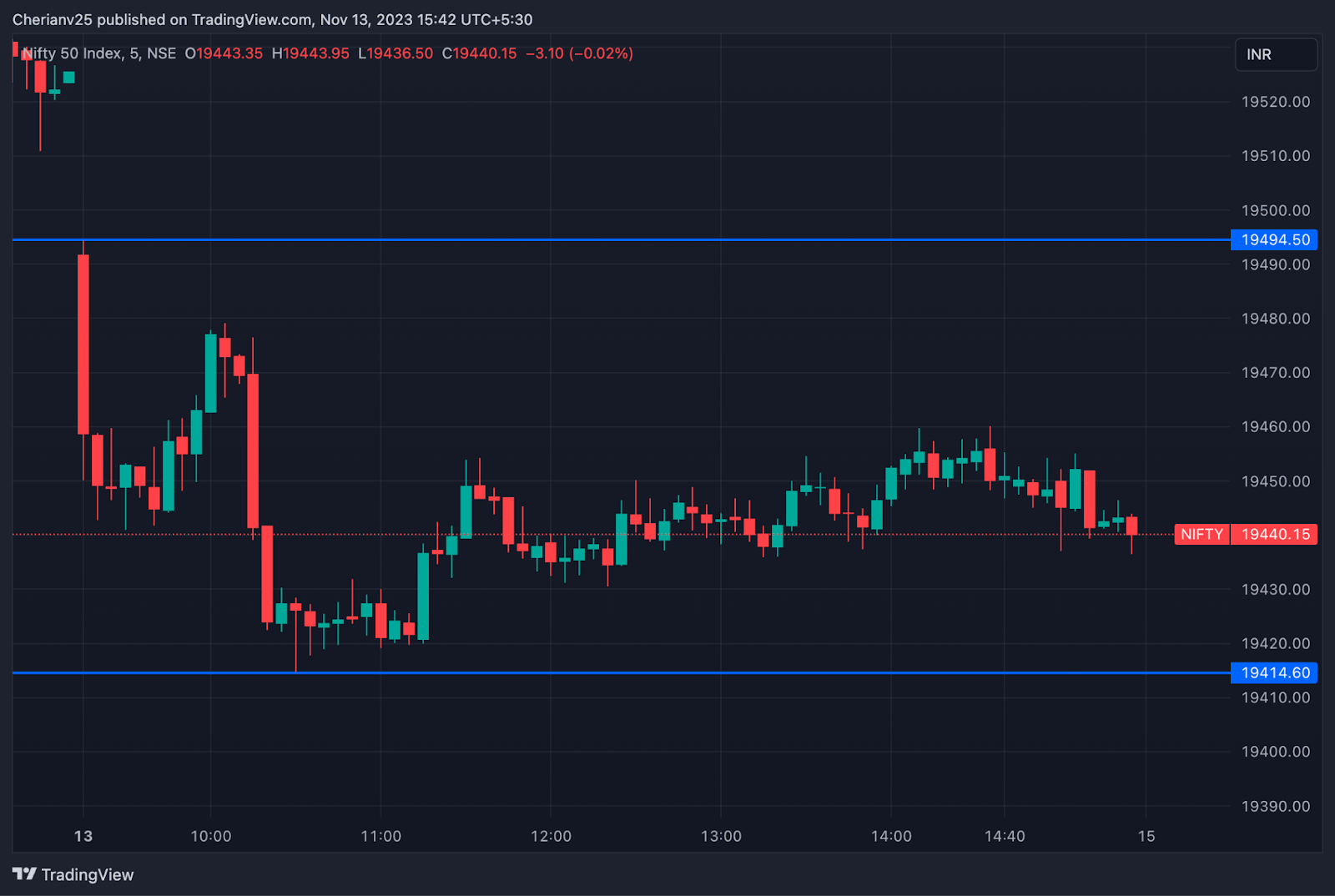
Nifty chart November 13 - post-market analysis | marketfeed

BANK NIFTY (BNF) started the day at 43,915 with a gap-down of 81.5 points. Similar to Nifty, BNF fell more than 200 points with wild moves. Then, the index rebounded 200 points in just 20-25 mins and consolidated for the rest of the day. BNF closed at 43,891, down by 105 points or 0.24%.
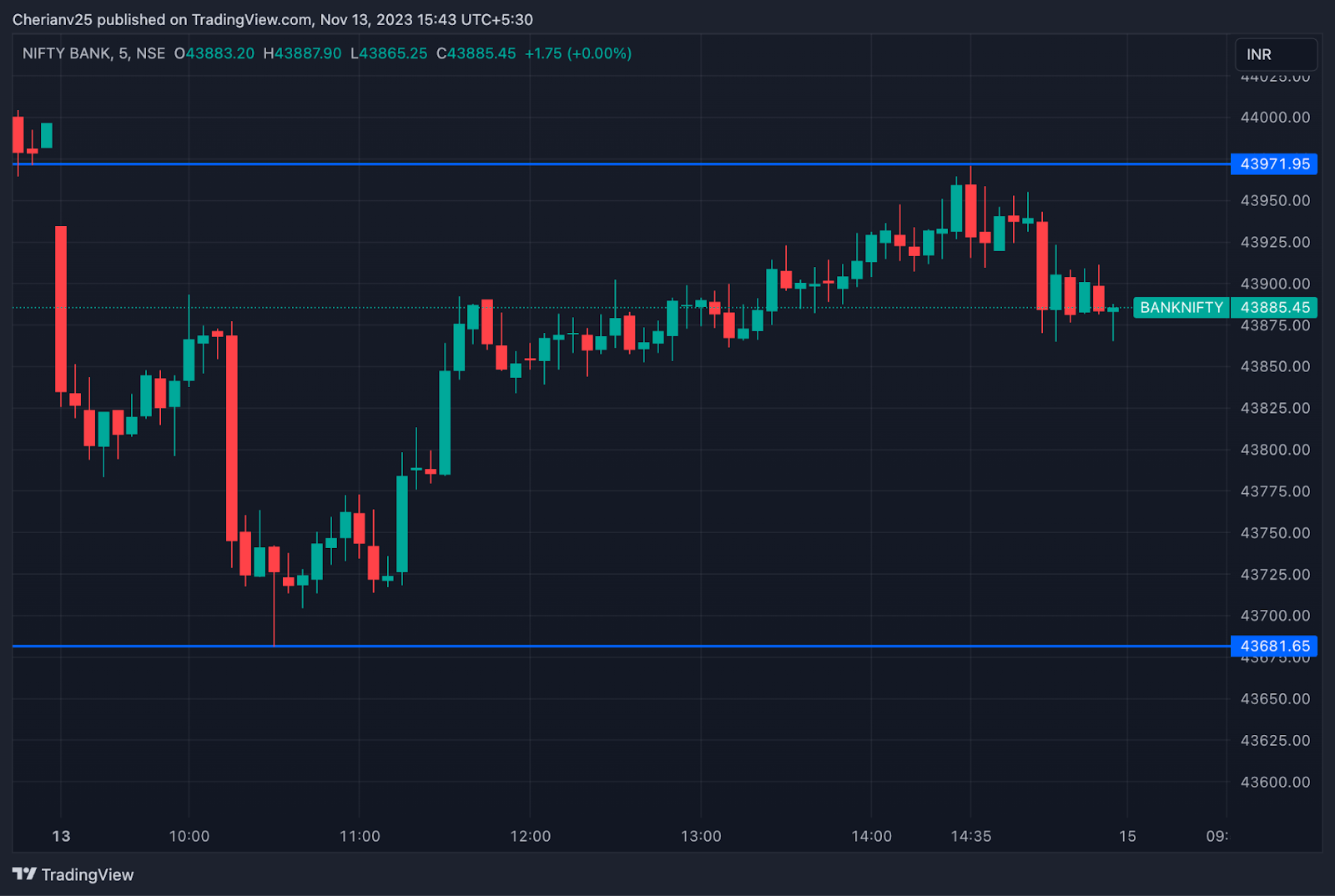
All indices except Nifty PSU Bank (+2.64%) and Nifty Metal (+0.37%) closed in the red.

Major Asian markets closed in the green. Germany’s DAX and UK’s FTSE100 are currently trading in the green, while France’s CAC40 is trading in the red.

Today’s Moves

Coal India (+5.29%) was NIFTY50’s top gainer. Jefferies India and other brokerages have upgraded the stock and raised their target prices on the back of strong Q2 earnings by the state-run miner.

BSE (+9.2%) hit a 52-week high of ₹2,350 after the stock exchange reported a 4x jump in its net profit to ₹118.4 crore in Q2.

Hindustan Copper (+8.07%) surged after the company’s net profit more than doubled in Q2.

SBI Life (-2.2%) was NIFTY50’s top loser. 

Glenmark Pharma (-5.03%) fell sharply after the company posted a loss in Q2 on exceptional legal costs.

Markets Ahead

On the occasion of Muhurat Trading, the Indian markets opened with a gap up (above major resistance levels). However, today’s opening brought the indices back into their original zones, suggesting the presence of selling pressure in the markets.

Nifty: Keep an eye on the resistance levels at 19,460 and 19,500. If there’s a breakout, we might see the index aiming for 19,540 and 19,600. On the other hand, the critical support for Nifty is at 19,400. If it falls below this level, potential targets could be 19,360 and 19,330.

Bank Nifty: The resistance levels to keep an eye on are at 43,900 and 44,000. A breakout might set a target at 44,000 and a larger one at 44,500. On the downside, the key support levels are at 43,800 and 43,700. If there’s a breakdown, potential targets could be 43,500 and 43,300.

Also, watch out for this channel in BNF! 
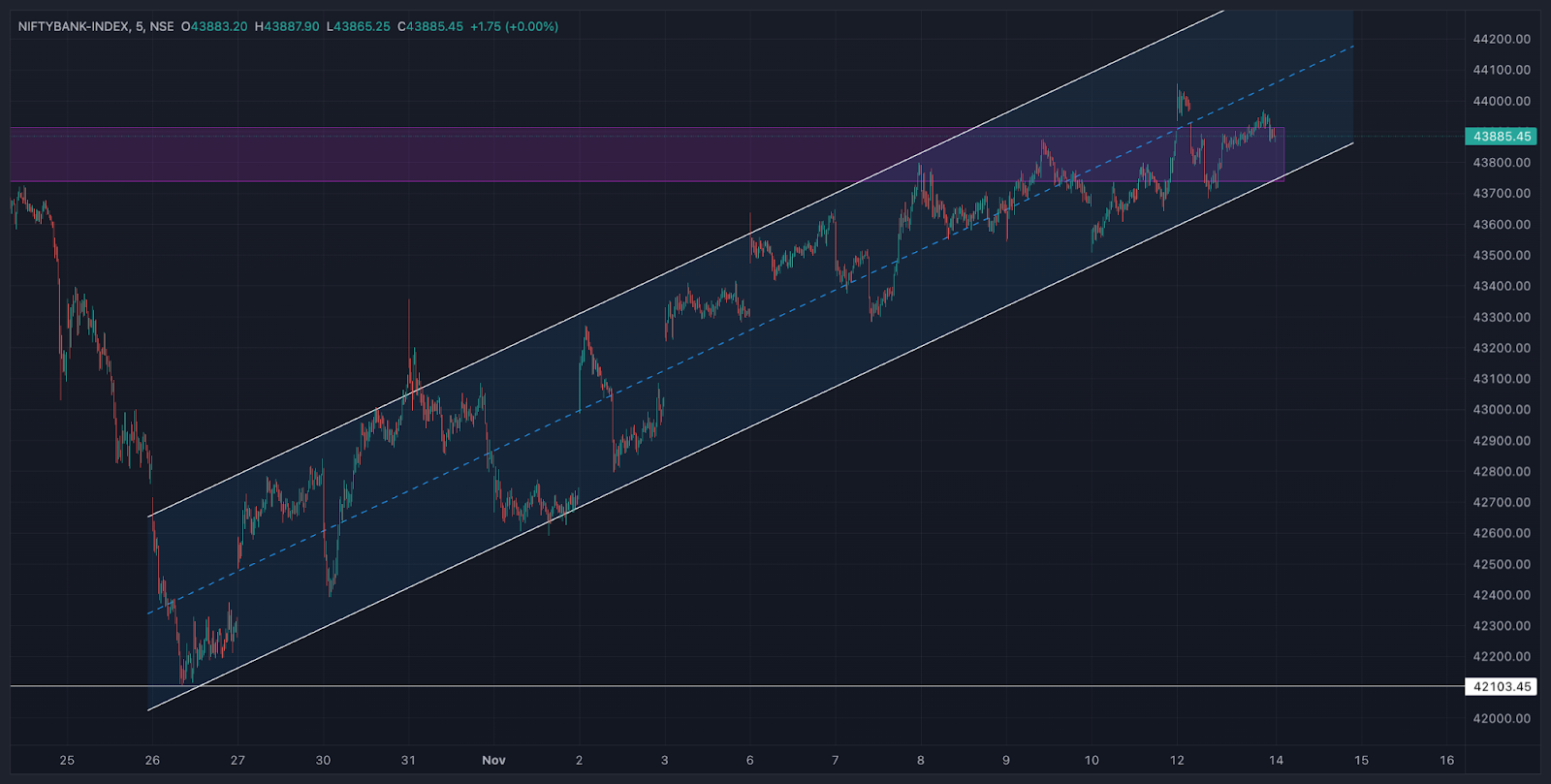
Bank Nifty chart November 13 - post-market analysis | marketfeed

The Indian market continues to consolidate due to various factors: the sudden slowdown in Industrial Production (IIP) growth in Sept 2023, and the declining manufacturing PMI mirror global patterns influenced by rising interest rates and inflation. The weakness in the Indian Rupee has made FIIs adopt a cautious stance. However, the market’s potential decline is limited by robust Q2 earnings, economic stability, and consistent DII investments.

The markets will be closed tomorrow (Nov 14) on account of Diwali-Balipratipada! marketfeed wishes all our readers a Happy Diwali! 🪔

Please join The Stock Market Show at 7 PM on our YouTube channel.

Categories
Editorial

Muhurat Trading 2022: All You Need to Know

Diwali, the Festival of Lights, is widely celebrated all over India. It symbolises the spiritual victory of light over darkness or good over evil. Many traditions are carried out during this auspicious time. One such unique and customary tradition in our stock markets during Diwali is Muhurat Trading. The one-hour special trading session has been carried out every year on Diwali for more than six decades. In this article, learn more about Muhurat Trading and how you can take part in it.

What is Muhurat Trading?

The term ‘Muhurat’ means an auspicious time. According to Hindu customs, Muhurat is a period when planets are aligned favorably to ensure positive results. Muhurat Trading is a one-hour special trading session on the day of Diwali approved by both the NSE and BSE. During the period, investing and trading communities across India pay tribute to the goddess Lakshmi, the deity of wealth and prosperity. It also marks the celebration of ‘Samvat’ or the New Year. 

Thus, according to traditions, it is believed that people who trade during the Muhurat session have a better chance of gaining wealth and prosperity throughout the year. Such a tradition is unique to our Indian stock markets only.

History of Muhurat Trading

When we look at the history of stock markets in India, many stockbrokers started their New Year on the day of Diwali. They would open new settlement accounts for their clients on the Muhurat, or “the auspicious time”.

The concept of Muhurat Trading was officially established in India in 1957 when it was approved by the Bombay Stock Exchange. This tradition can be linked to two prominent business communities: the Gujaratis and the Marwaris. Interestingly, these communities have a century-old tradition of performing pooja of their ledgers and ‘wealth chest’ on Diwali. When the National Stock Exchange was established in 1992, it also permitted trading for one hour on the evening of Diwali day.

Today, Muhurat Trading has become more of a symbolic gesture, and investors even conduct prayers when they purchase shares. Most people buy shares of fundamentally-strong companies that can generate good returns in the long run.

Muhurat Trading Timings for 2022

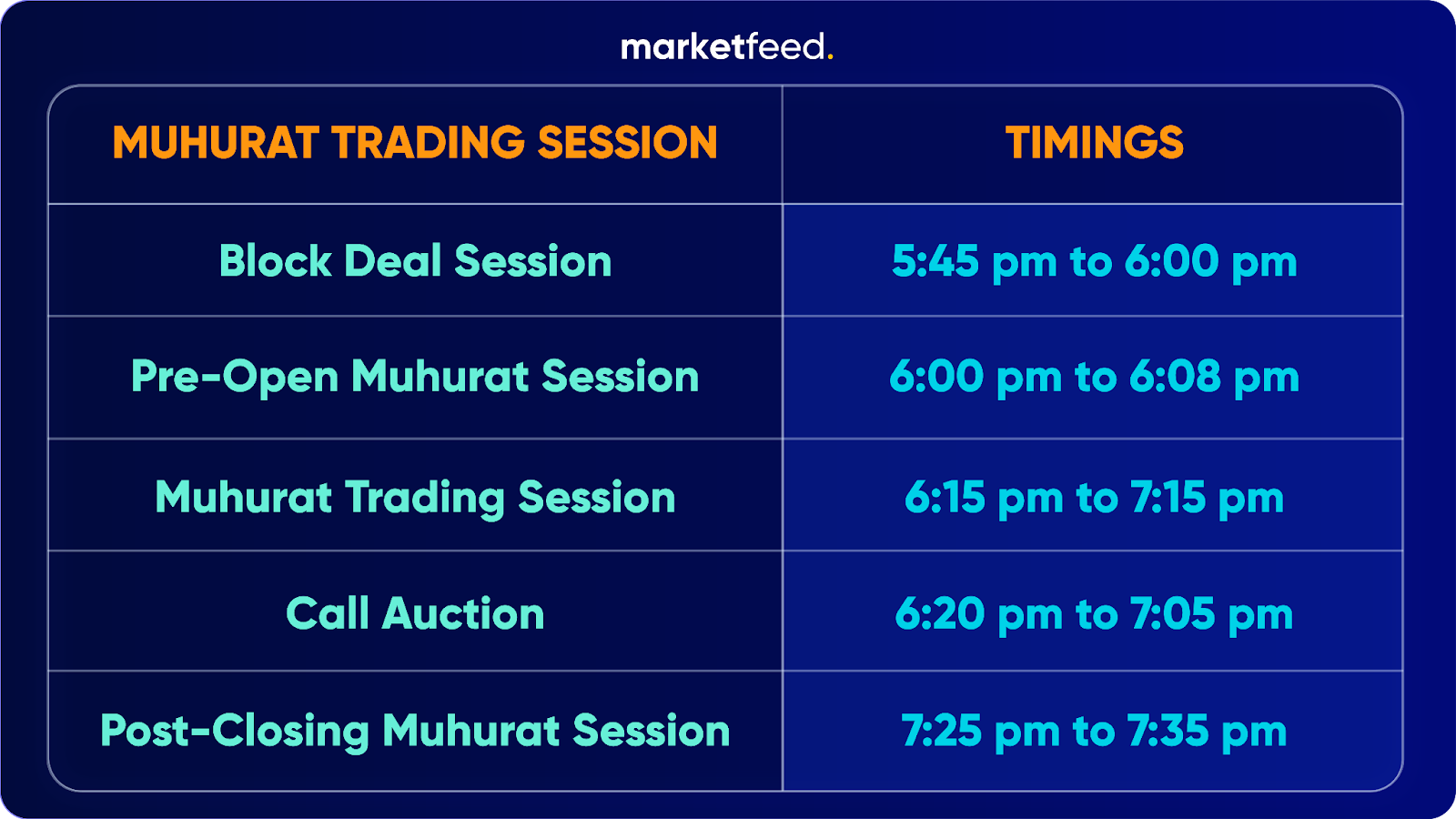
The Muhurat Trading session for this year will be held on October 24, 2022 (Monday). The table given below shows the session timings for Muhurat Trading. The timings are applicable on both NSE and BSE.

1. Block Deal Session – This is when two parties agree to buy/sell a security at a fixed price and inform the stock exchange about it.

2. Pre-Open Session – This is when the stock exchange determines the ideal opening price of a stock for the trading session.

3. Normal Market session – This refers to the one-hour session where the actual trading takes place.

4. Call Auction Session – This is a period when illiquid securities are traded. These are stocks that investors cannot find ready buyers for because of their limited trading. 

5. Closing session – The period when traders can place a market order at a closing price.

Factors to Keep in Mind During Muhurat Trading

When we look at historical records, the Indian stock market has been usually bullish during Muhurat Trading. The BSE Sensex and NIFTY have closed higher in 11 of the last 15 Muhurat sessions.

(Source: NSE Website)

During the session, most investors would prefer to buy stocks that have a potentially higher return on investment (ROI). As always, make sure that the fundamentals of a company are strong before investing in its stock.

Historical records reveal that fast-moving consumer goods (FMCG), textiles, and automobile sectors have a probability to show high growth. This is mainly seen in rural areas, as the festive season is an auspicious time to buy new products. Discount offers and other incentives would also lead to high demand for these goods. Keep a close watch on fundamentally strong companies, and try to add stocks at dips.

At the same time, intraday traders need to be careful as the markets could be volatile in any direction during the Muhurat Trading session. Hence, better trading decisions can be made when the resistance and support levels are given vital importance.

There could also be a lot of fraudulent activities such as free stock tip scams that could be common during this period. marketfeed has prepared a very detailed article on this issue as well. You can read it here. Make sure that you do not fall into any such trap!

As intelligent stock market participants, make sure you watch out for those stocks which could show a potential boom during the festive season. marketfeed wishes all our readers a very Happy and Prosperous Diwali! 🌟

Categories
Editorial

Muhurat Trading 2021: All You Need to know

Diwali, the Festival of Lights, is widely celebrated all over India. It symbolises the spiritual victory of light over darkness or good over evil. It is believed to be an auspicious time and many traditions are followed during this period. One such special tradition in our stock markets during Diwali is Muhurat Trading. It is a very interesting concept that has been followed for nearly six decades. In this article, learn more about Muhurat Trading and how you can make use of it.

What is Muhurat Trading?

The term ‘Muhurat’ means an auspicious time. According to Hindu customs, Muhurat is a time when planets are aligned favorably to ensure positive results. Muhurat Trading is a one-hour special trading session on the day of Diwali approved by both the NSE and BSE. Muhurat is an occasion in which the investing and trading communities pay tribute to the goddess Lakshmi, the deity of wealth and prosperity. It also marks the celebration of ‘Samvat’ or the New Year. 

Thus, according to traditions, it is believed that people who trade during the Muhurat session have a better chance of gaining wealth and prosperity throughout the year. This type of tradition is unique to our Indian stock markets only.

History of Muhurat Trading

When we look at the history of stock markets in India, many stockbrokers started their New Year from the day of Diwali. They would open new settlement accounts for their clients on the Muhurat, or “the auspicious time”.

The concept of Muhurat Trading was officially established in India in 1957 when it was approved by the Bombay Stock Exchange. The main factor for this tradition has been attributed to two prominent business communities— the Gujaratis and the Marwaris. Interestingly, these communities have a century-old tradition of performing pooja of their ledgers and ‘wealth chest’ on the day of Diwali. When the National Stock Exchange was established in 1992, it also permitted trading for one hour on the evening of Diwali day.

Today, Muhurat Trading has become more of a symbolic gesture, and investors even conduct prayers when they purchase shares. It has also been found that during this period, people buy shares of strong companies that can generate good returns in the long run.

Muhurat Trading Timings for 2021

The Muhurat Trading session for this year will be held on November 4, 2021 (Thursday). The table below shows the Session Timings for Muhurat Trading. The timings are applicable on both NSE and BSE.

1. Block Deal Session – This is when two parties agree to buy/sell a security at a fixed price and inform the stock exchange about it.

2. Pre-Open Session – This is when the stock exchange determines the ideal opening price of a stock for the trading session.

3. Normal Market session – This refers to the one-hour session where the actual trading takes place.

4. Call Auction Session – This is a period when illiquid securities are traded. These are stocks that investors cannot find ready buyers for because of their limited trading. 

5. Closing session – The period when traders can place a market order at a closing price.

Factors to Keep in Mind During Muhurat Trading

When we look at past records, the market has been usually bullish during Muhurat Trading. However, investors have to be careful while trading during this period. We must understand that most investors would prefer to buy stocks that have a potentially higher return on investment (ROI). As always, investors need to make sure that the fundamentals of a company are strong before investing in its stock.

Historical records have shown that fast-moving consumer goods (FMCG) companies and two-wheeler segments have a probability to show very high growth. This is mainly seen in rural areas, as the festive season is an auspicious time to buy new products. Offers and other incentives would also encourage a high demand for these goods. Keep a close watch on fundamentally strong companies, and try to add stocks at dips.

At the same time, investors need to keep a close watch on the resistance and support levels of stocks. Historically, it has been noticed that markets could be volatile during Muhurat Trading with no specific direction. Hence, better trading decisions can be made when the resistance and support levels are given high importance.

There could also be a lot of fraudulent activities such as free stock tip scams that could be very common during this period. marketfeed has prepared a very detailed article on this issue as well. You can read it here. Make sure that you do not fall into any such trap!

As intelligent stock market participants, make sure you watch out for those stocks which could show a potential boom during the festive season. marketfeed wishes all our readers a very Happy and Prosperous Diwali!

Categories
Editorial

Muhurat Trading 2020 – All You Need to Know

Diwali, the Festival of Lights, is widely celebrated all over India. The festival symbolises the spiritual victory of light over darkness, or good over evil. It is believed to be an auspicious time and many traditions are followed during this period. One such special tradition in our own stock markets is Muhurat Trading. This is a very interesting concept that has been followed for nearly six decades. Let us understand how this tradition was introduced, and the specific details regarding it.

What is Muhurat Trading?

The term ‘Muhurat’ means ‘an auspicious time’. According to Hindu customs, Muhurat is a time when planets are aligned favorably to ensure positive results. Muhurat Trading is a one-hour special trading session on the day of Diwali, that has been approved by both the NSE and BSE. Muhurat is an occasion in which the investing and trading communities pay tribute to goddess Lakshmi, the deity of wealth and prosperity. It also marks the celebration of ‘Samvat’ or the New Year. 

Thus, according to traditions, people who trade during the Muhurat period have a better chance of earning wealth and gaining prosperity throughout the year. This type of tradition is unique to our Indian stock markets only.

History of Muhurat Trading

When we look at the history of stock markets in India, many stockbrokers started their New Year from the day of Diwali. They would open new settlement accounts for their clients on the Muhurat, or the auspicious time.

The concept of Muhurat Trading was officially established in India in 1957 when it was approved by the Bombay Stock Exchange. The main factor for this has been attributed to two prominent business communities- the Gujaratis and the Marwaris. Interestingly, these communities have a century-old tradition of performing pooja of their ledgers and ‘wealth chest’ on the day of Diwali. Ever since the National Stock Exchange was established in 1992, it has also permitted trading for one hour on every Diwali evening.

Today, we can state that Muhurat Trading has become more of a symbolic gesture, and investors even conduct prayers when they purchase shares. It has also been found that during this period, people buy shares of strong companies that can generate good returns in the long-run.

The Muhurat Trading Timings for 2020

The Muhurat Trading session for this year will be held on 14th November 2020 (Saturday). The table below shows the Muhurat Trading Session Timings. The timings are applicable on both NSE and BSE.

Block Deal Session 5:45 pm to 6:00 pm
Pre-Open Muhurat Session6:00 pm to 6:08 pm
Muhurat Trading Session6.15 pm to 7:15 pm
Call Auction6:20 pm to 7:05 pm
Post-closing Muhurat Session7:25 pm to 7:35 pm

1. Block Deal Session – This is when two parties agree to buy/sell a security at a fixed price and inform the stock exchange about it.

2. Pre-Open Session – This is when the stock exchange determines the ideal opening price of a stock for the trading session.

3. Normal Market session – This refers to the one-hour session where the actual trading takes place.

4. Call Auction Session – This is a period when illiquid securities are traded. These are stocks that investors cannot find ready buyers because of their limited trading. 

5. Closing session – The period when traders can place a market order at a closing price.

Factors to Keep in Mind During Muhurat Trading

When we look at past records, the market has been usually bullish during Muhurat Trading. However, investors have to be careful while trading during this period. We must understand that most investors would prefer to buy stocks that have a potentially high return on investment (ROI). As always, investors need to make sure that the fundamentals of a company are strong, before investing in its stock.

Past records have shown that FMCG (fast-moving consumer goods) firms and two-wheeler segments have a probability to show very high growth. This is mainly seen in rural areas, as the festive season is an auspicious time to buy new products. Offers and other incentives would also encourage a high demand for these goods. 

At the same time, investors need to keep a close watch on resistance and support levels of stocks. Historically, it has been noticed that markets could be volatile during Muhurat Trading with no specific direction. Hence, better trading decisions can be made when the resistance and support levels are given high importance.

There could also be a lot of fraudulent activities such as free stock tip scams, which are very common during this period. Marketfeed has prepared a very detailed article on this issue as well. You can read more about it here. Make sure that you do not fall into any trap!

As intelligent stock market participants, make sure you watch out for those stocks which could show a potential boom during the festive season. Marketfeed wishes all our readers a very Happy and Prosperous Diwali!