Categories
Jargons

What is the Stock Market? How Does it Work?

Have you ever wondered what the stock market is and how it works? If yes, you’re not alone. The stock market can seem confusing and intimidating for people who don’t know how it works. But don’t worry! In this article, we shall learn what the stock market is, how it works, and who market participants are.

Given below are the different participants in the stock market. We’ll understand more about them through a story.
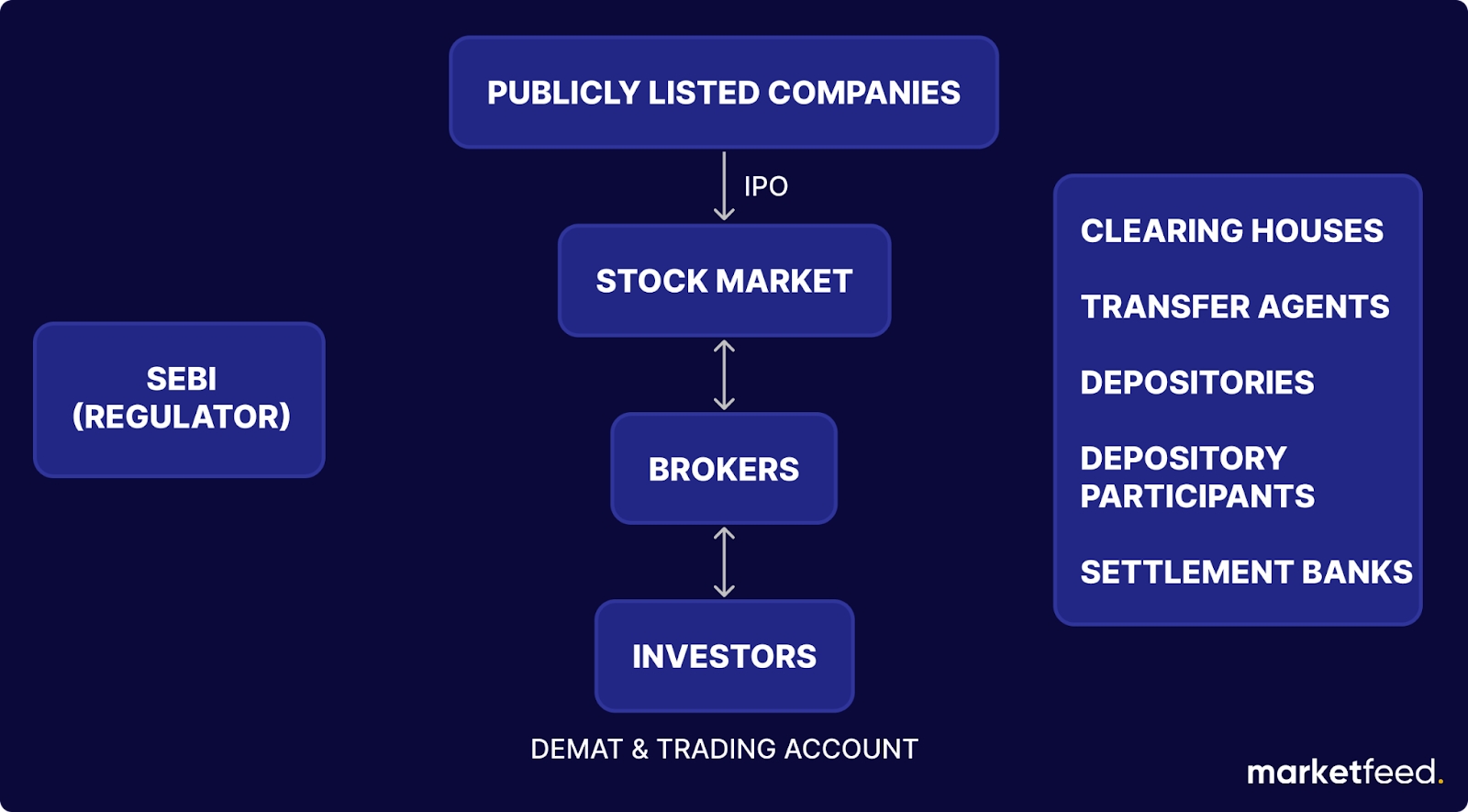
stock market participants | marketfeed

Let’s Look at a Story!

Mr. Jignesh, an owner of a renowned supermarket in Bengaluru, has been successfully running his business for the past ten years. The supermarket has been generating decent revenue and is highly profitable. His business also has goodwill (proprietary or intellectual property and brand recognition). When it comes to business, there are two things you must understand:

  • Ownership of a Business
    Jignesh completely owns and runs the supermarket, and the profit is not shared with anyone else.
  • Valuation of a Business
    Anything and everything has a value attached to it, even a business. The business has been generating income for Jignesh for the past ten years, so it is valuable. The valuation of a business is the economic value of how much a person has to pay to acquire 100% of the business from him. Let’s assume that the supermarket is valued at ₹1 crore.

    Since Jignesh is growing old, he feels he doesn’t want to work as much as he did and is looking for a partner to operate the business in return for 50% of the ownership of his business. He decided to share his business with a partner, Ms. Riya.

What are Shares?

Shares represent units of ownership of a company. A shareholder is entitled to a part of the profit that the company generates. 

The ownership of Jignesh’s supermarket was divided into 1000 equal shares. The value of each share can be mathematically expressed as:

Value of 1 Share = Total Valuation / Total Number of Shares

= 1,00,00,000 / 1000

= ₹10,000 per share.

Riya agreed to acquire 500 shares (50%) of the supermarket in consideration of the value of those shares in Cash.

Valuation = Total Number of Shares x Value of Each Share

Riya paid ₹50,00,000 to Jignesh, and they both became partners in the supermarket business. 

A few years later, the business expanded with several profitable outlets across Bengaluru. Now, Jignesh and Riya want to open 200 more stores nationwide, for which they need a large amount of capital. The easiest way to get funding or capital is by taking out a loan from a bank and using the business’ assets as collateral. However, this carries the risk of falling into a debt trap. If they are unable to repay the loan for some reason, the assets will be seized by the bank to recover the loan. Jignesh and Rita did not want to deal with these issues. 

An alternative would be to find more people who are interested in becoming part-owners of the business across Bengaluru. Even then, they may not be able to find enough people to do so. At this point, Jignesh becomes aware of the stock market. If they convert their company into a Public Limited company, they can raise capital from thousands of investors across India and other countries. The process of issuing shares to the public to raise capital for a business is known as an Initial Public Offering (IPO).

What is the Stock Market?

A stock market is a place where shares of publicly listed companies are traded. It is a physical place or institution where shares are bought and sold.

So Why Do Companies Go Public?

  • To Raise Capital: The company can gather funds for many objectives, such as paying liabilities (loans) and funding its future expansion projects.
  • Reward Founders & Early Investors: The founders and early investors of a company hold a good portion of the shares in their entity. They can sell these shares to the public and the proceeds go directly to them rather than to the company. It can be considered as a reward for all the time and effort they put in to build the company from the ground up. So going public can give them an early exit.

What are Stock Exchanges?

A stock exchange is a financial institution where different participants come together to buy and sell securities (shares). It provides the infrastructure for these activities. The term Stock Market is an umbrella term for a collection of Stock Exchanges.

The two major Stock Exchanges in India are:

  • Bombay Stock Exchange (BSE)
  • National Stock Exchange (NSE)

BSE is older than NSE, which explains why more companies are listed on the BSE than NSE. 

Coming back to the story, Jignesh’s company had a total of 1000 shares, out of which they decided to issue 15% of the shares to the public. Thus, 150 shares are being offered to the public. 

1000 x 15% = 150

How Many Shares Will a Company Have? Who Decides That?

A company’s promoters can decide how many shares it should have. Some firms may have thousands of shares, while others may have lakhs or even crores of shares. 

For example, the valuation of Jignesh’s company was ₹1 crore in the beginning. But the business has grown over the years, and now the valuation stands at ₹2 crores, bringing the value of each share to ₹20,000. 

Why do Investors Exist? What are their Objectives?

The two main objectives of investors are:

1. Capital Appreciation – When a company grows, the price of its shares increases. If investors buy the shares of a company when the prices are low and sell them when the prices increase, they can make good profits via capital appreciation.

2. Earn Dividends – When a company makes profits every year from its operations, it distributes a portion of the profits to shareholders as dividends. However, it is not necessary for them to declare dividends every year. It’s the company’s choice whether to issue dividends or not. The company may fully retain its profits for future capital needs or may give out a part of the profit and retain the rest. 

In short, the objective of a public limited company is to raise capital for its funding needs and the investors’ objective is to grow their money. But the real question is, how does the stock market fit into this?

Why do Stock Markets Exist? 

The stock market provides an avenue for a public company to raise capital from investors in consideration of shares. Investors will be able to grow their savings and wealth through capital appreciation and dividends. The stock market is the facilitator for the two parties. 

What are Primary Market and Secondary Market?

The stock market is divided into two:

1. Primary Markets
It is a market wherein a firm issues securities/shares to investors directly (via an initial public offering or IPO). These sale proceeds go directly to the issuer to finance their capital requirements.

2. Secondary Markets
It is the market where previously issued securities are bought and sold among investors. These sale proceeds go to the person who holds the securities. 

In our story, many people wanted to buy shares of his company after the IPO. However, the company does not issue any more shares as the IPO is already done. So these new investors can only buy the shares from those already holding them. 

When such transactions happen between investors in the secondary markets, the price of the share gets updated. If an existing shareholder sells the stock to another person for ₹20,100, the price of all the shares of the company gets updated to ₹20,100. Consequently, the net worth of the shareholders increases as the price of the shares they hold increases. 

Who Decides the Price of a Stock?

The two reasons which decide the price of a stock are:

  • Company’s Actual Valuation: A company’s value fluctuates as the revenue, profit, and goodwill change. The future prospects of the company also contribute to the valuation. If the revenue and profits go down, the valuation may also decrease, which causes the share price to drop. However, if the revenue and profit increase, the valuation could also rise.
  • Demand & Supply: The market forces of supply and demand also play an important role in deciding the share price. If the demand for the stock increases, then its price also increases since supply is limited. If the demand for the stock decreases, then its price also decreases since the supply is the same. Demand for the stock depends upon market sentiments, which refers to the overall attitude of investors toward the company. If the market sentiment is positive, then the demand for the stock will be high, thus driving the stock price up. Demand for the stock will be less if the market sentiment is negative. 

Why Do Stock Prices Fluctuate Every Second?

The Last Traded Price (LTP) refers to the price at which the previous share transaction took place. The stock market has lakhs of participants, and transactions happen every second. If a person sells a stock for ₹150, then the LTP at the time will be ₹150. The very next second, if a stock is sold for ₹149, then the LTP changes to ₹149. This is the reason why stock prices fluctuate every second.

Who are Brokers?

If you want to buy a stock, you cannot do it directly from the stock market. We have to approach a stockbroker, and the broker will transact on our behalf. A broker is an intermediary that facilitates transactions in the stock market. If you want to buy a stock, your broker will find a seller in the stock market on your instruction and facilitate the transaction between you and the seller. 

Before technology evolved, an investor had to physically visit the broker’s office and instruct them to buy the stock. The broker would then physically go around the stock market, find a seller, and conduct the transaction. But now, technology has evolved, and transactions can be conducted via our phones. Brokers are accessible on computers and smartphones, and investing & trading are as easy as ever. 

It is absolutely necessary to have an account with a broker to participate in the stock market. As intelligent stock market participants, we must have multiple broking accounts for different purposes. We can use one account for our long-term investing activities and another one for trading. Successful traders use multiple broking accounts for different trading strategies. 

How Does a Broker Work?
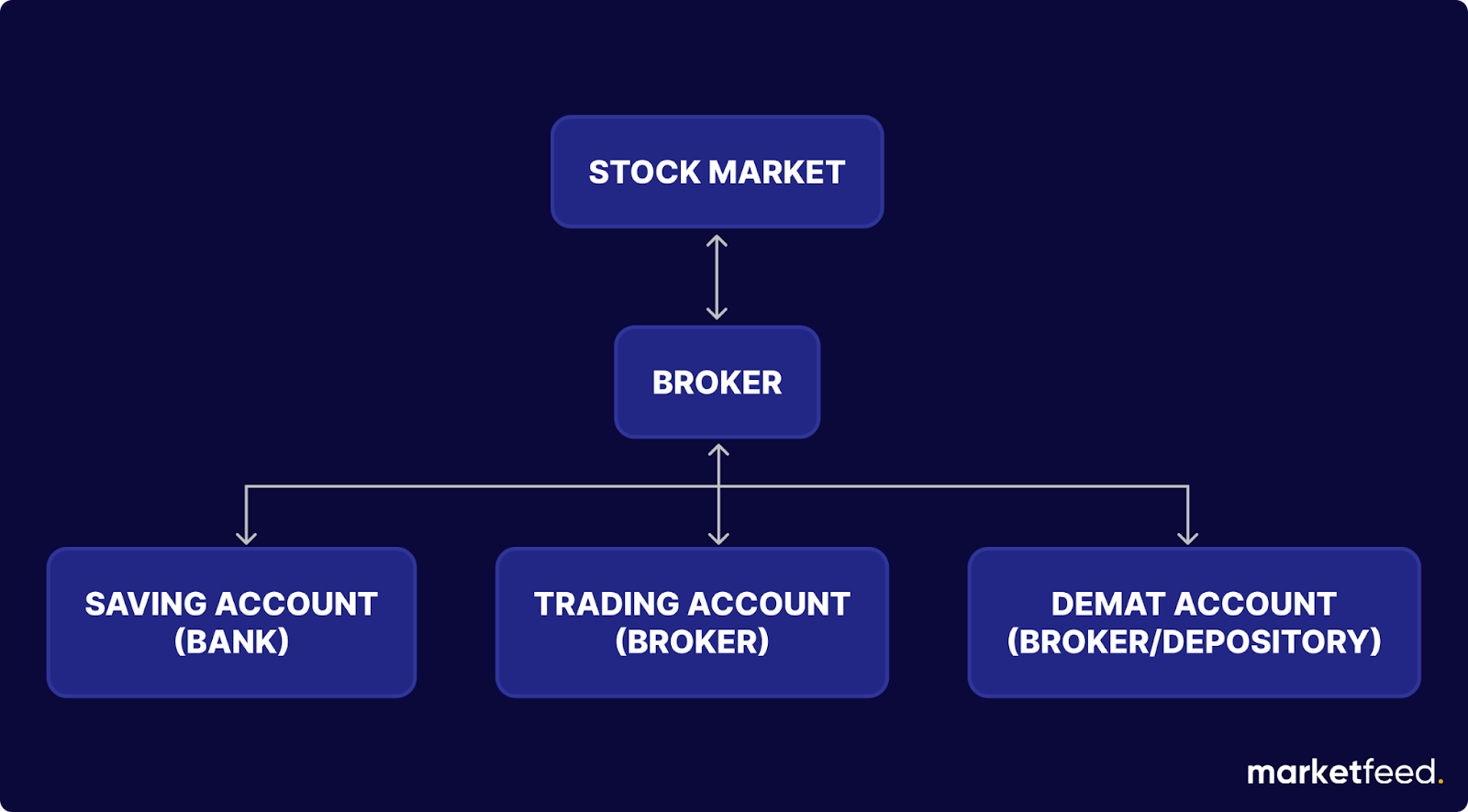
how does a stock market broker work? | marketfeed

There are two accounts that we open with a broker. Even though they are two separate accounts serving different purposes, both of them come in a bundle.

1. Demat Account
A Demat account or dematerialisation account allows you to hold your shares in an electronic format. It converts the physical shares into an electronic form, therefore dematerialising them. Demat accounts are maintained under depositories.

Earlier, the proof of ownership of shares, bonds, or debentures was in the form of physical share certificates. However, this system had many drawbacks, such as the risk of losing the certificate, fire hazards, getting wet, or even a mismatch in the signatures. 

2. Trading Account
A trading account acts as an interface between the investor’s bank savings account and a broker. For the broker to conduct trading activities on our behalf, they need money. We transfer the money we have in our savings account to a trading account with which the broker then conducts trading activities. Money can be transferred using net banking or UPI.

If we want to buy a stock, we instruct the broker to buy the stock, and the broker uses the money we have in our trading account to conduct the transaction. Similarly, when we sell a stock, the proceeds of the sale come directly into the trading account. 

An Illustration to Understand How Demat & Trading Account Works

  • Arun wants to buy a share of Mahindra & Mahindra (M&M) from the stock market. The first step that Arun should take is to open a Demat and trading account. Arun opens a Demat & trading account with a leading broker and deposits money into his trading account by transferring from his bank savings account via UPI. 
  • When the market opened at 9:15 AM, Arun placed an order with his broker to buy 1 quantity of M&M stock. The market price of M&M at the time was ₹1000. His trading account was debited ₹1000 by the broker to finance the transaction. Apart from this, a small amount was deducted as taxes and charges. 
  • Even though the transaction was completed, the stock will only be transferred into his Demat account after T+1 days, which means he will receive the stock in his Demat account on the next working day. 

While selecting brokers, we should choose the brokers that satisfy our various investing and trading needs. YOu can open a Demat and trading account using the links given below: 

Fyers (FREE) – https://bit.ly/3tx3ZJx

Zerodha – https://bit.ly/3AlErmb

Upstox – https://bit.ly/3OUAJnR

(Full disclosure: These are affiliate links. Do use the links if you wish to support us at no extra cost. ❤️)

Click here for step-by-step instructions on how to open a Demat and trading account.

What are Depositories?

If your shares are held by the broker, there is a risk of the broker running away with the shares they have. As a remedy, all Demat accounts are maintained by depositories. A depository is an institution that acts as a custodian of Demat accounts and shares. A Demat account is opened by a depository participant, who acts as an intermediary between the depository and investors. 

There are two depositories in India, which are governed by the Government of India: 

1. CDSL – Central Depository Services Limited
2. NSDL – National Securities Depository Limited

what are depositories | marketfeed

Who are the Other Facilitators?

The other facilitators part from brokers, depositories, and depository participants are: 

  • Clearing Houses – It is an intermediary between buyers and sellers of financial instruments. It is an agency or separate corporation of a futures exchange responsible for settling trading accounts, clearing trades, collecting and maintaining margin monies, regulating delivery, and reporting trading data.
  • Transfer Agents – A transfer agent keeps records of who owns a publicly traded company’s stocks and bonds. They also ensure investors receive dividends on time.
  • Settlement Banks – It refers to a customer’s bank where payments or transactions are finally settled and cleared for customer use.

What is a Market Regulator?

The Indian stock market is a place where transactions worth lakhs of crores of rupees take place. The Securities and Exchange Board of India (SEBI) is a regulatory authority established under the SEBI Act 1992. It’s the principal regulator for stock exchanges in India. SEBI’s primary functions include protecting investor interests and promoting and regulating the Indian securities markets. It is a government organisation. SEBI exists as the watchdog to make sure nothing wrong is happening in such a massive money-involved ecosystem.

Throughout the article, we discussed the various participants in the stock market and how they all work together in the stock market. We’ve also understood the basics of what the stock market is, who its participants are, and how it works!

Categories
Jargons

What are the Best Ways to Make Money From the Stock Market?

The stock market is where shares of public companies are bought and sold. A share represents ownership in a company, and shareholders are entitled to a portion of the company’s profits. People have different perspectives on the stock market. Some consider it a great method to generate wealth, while others perceive it as a risky financial gamble. We firmly believe that the stock market can serve as an incredible opportunity for wealth generation and passive income. You need to gain a deep understanding of how it works to make money from the stock market.

Making money from the stock market is not a walk in the park. While the potential for making money is high, it also has an equally high risk of making losses. In this article, we will take a closer look at a few of the ways by which one can make money from the stock market.

1. Investing in Index Funds or Exchange-Traded Funds (ETFs)

An index fund is a type of mutual fund that tries to replicate the returns made by a stock market index such as Nifty 50 by investing in the constituent stocks of that index. These funds are passively managed. This means that the fund manager invests your money in the same securities that constitute the index and in the same proportion. The portfolio composition will remain unchanged.

An Exchange Traded Fund (ETF) is a type of fund that tracks the performance of a certain basket of assets such as an index and can be traded on the stock exchange. Unlike mutual funds, ETFs have low transaction costs, can easily be traded through any broker, and requires very low minimum investment.

2. Investing in Blue-Chip Stocks or Dividend-Paying Stocks

Blue-chip stocks are stocks of large well-established companies with an impeccable reputation and track record of stable earnings and performance. They are fundamentally strong companies with very high market capitalisations. Investing in these stocks is an easy and low-risk way to make money from the stock market. 

Companies that make a profit may choose to share a portion of those profits with shareholders as dividends. As a shareholder, you will receive dividends based on the number of shares you own. Dividend payments can be quarterly, annually, or semi-annually. Investing in dividend-paying stocks can be a way to earn money from the stock market, as dividends provide returns in the form of cash to your bank account.

3. Investing in International Stocks or Emerging Market Funds

International funds are mutual funds that invest in the stocks of global multinational companies. Meanwhile, an emerging market fund is a fund that provides investors access to countries and regions that are undergoing economic transition. One can invest in such funds like any other mutual fund.

4. Investing in Initial Public Offerings (IPOs)

An Initial Public Offering (IPO) is a method by which a company raises equity capital from the public. Equity represents the ownership of a company. Once a company’s IPO is completed, its shares get listed in a stock exchange, i.e. BSE & NSE. You can invest in IPOs of fundamentally strong companies after thorough research. If the public response is positive, you also stand a chance to make money through listing gains. 

5. Trading in Options & Futures Contracts

Futures and options are derivative contracts that derive their value from an underlying asset. These underlying assets can be indices, equities, currencies, commodities, etc. Although derivative contracts were originally invented to hedge risk, it is popularly used as a speculative instrument these days. With the right knowledge and skill, it can be a great way to make money from the stock market. However, derivatives trading is considerably hard and requires practice and learning. This makes it unappealing for beginners.

6. Day Trading or Swing Trading

Day trading or intraday trading refers to the buying and selling of equities or derivatives in a day. For example, if you buy a stock at 10 AM after the market opens and sell the stock at 2 PM before the market closes, it is intraday trading. The trader exploits the small price movements in the stock to make a profit. Features such as short-selling and leverage help to enhance returns and make profits even in falling markets.

Swing trading is a style of trading in which the trader buys and holds the stock for two or more days to capture the short to medium-term price movements in the stock. The trader takes delivery of the stocks and no leverage will be available. Short selling is also not possible in equity swing trading.

7. Investing in Value Stocks or Growth Stocks Based on Market Trends

Value stocks and growth stocks represent different investment philosophies: value investing and growth investing. In value investing, the focus is on finding stocks with intrinsic values higher than their current market value. In growth investing, the emphasis is on companies with strong growth prospects, regardless of their current valuation. Value investors like Warren Buffet and Rakesh Jhunjhunwala are known for their approach to buying undervalued stocks. Growth investors prioritise companies with good fundamentals and growth potential even if their current market value is higher than their anticipated or calculated value.

8. Investing in Socially Responsible Stocks or Funds that Align with Your Value

Investing in socially responsible stocks or funds that align with your value is a way to make money from the stock market. Here, you support companies that are committed to social, environmental, and governance (ESG) principles, while seeking returns. You can start by defining your values and researching funds or stocks that align with those values. Then you can move to invest in these funds or stocks.

Powerful Investment Hacks:

1. Approach a Financial Advisor to Manage Your Portfolio

Seeking professional advice can be beneficial, especially if you’re new to investing or prefer a hands-off approach. A financial advisor can provide personalized guidance based on your risk tolerance, financial goals, and investment horizon. These professionals can help construct and manage a well-diversified portfolio while ensuring it aligns with your individual circumstances.

2. Avoid Common Mistakes Such as Emotional Investing, Overtrading

Always have a solid investment plan, diversify your portfolio, avoid overtrading and chasing hot stocks, manage your emotions, regularly review and evaluate your portfolio, and seek professional advice if needed. Discipline and mindfulness can increase your chances of achieving long-term investment success.

3. Learn Technical Analysis to Make Trading Decisions

Technical analysis is a technique that uses historical price and volume data to form analysis and forecast the direction of prices that can be used for decision-making. Technical analysis can be applied to securities in any freely traded market around the globe. Utilising technical analysis and charting can be a helpful tool for making trading decisions, especially for short-term traders who rely on technical indicators and price patterns.

4. Start SIPs

Systematic Investment Plans or SIPs are a smart and hassle-free way to invest in stocks. It. involves investing a fixed amount of money at regular intervals (monthly or quarterly) regardless of market conditions. Whether you’re a beginner or a seasoned investor, SIPs provide discipline, convenience, and the potential for long-term wealth creation. 

5. Analyse Financial Statements to Pick Stocks

Analysing financial statements and earnings is fundamental to stock picking. Consider reviewing financial health and performance, assessing profitability and growth prospects, and comparing with peers. Thorough research, considering economic and industry factors, and risk awareness are crucial. Fundamental analysis equips you with the right knowledge for analysing financial statements and company earnings.

In conclusion, making money from the stock market requires thorough research, planning, and risk management. Align your investments with your financial goals, risk tolerance, and time horizon, and regularly review and adjust your strategy. Start with small investments and gradually increase over time, staying informed about the market. A financial advisor can be valuable for beginners to avoid mistakes and make informed decisions.

Disclaimer: This article is only for educational purposes. Please do your own research before investing or trading in the stock market!

Categories
Jargons

What is a Bonus Issue?

Companies often employ various strategies to reward their shareholders and strengthen their market position. Bonus shares are a way in which companies reward their existing shareholders. In this article, we will discuss what a bonus issue is, how it works, and its benefits to the company. We will also examine how it differs from dividends and stock splits.

What is a Bonus Issue?

A bonus issue is a corporate action wherein a company gives additional shares to its existing shareholders at no extra cost. These shares are proportionally allocated to their shareholding as of the record date. [To be eligible for receiving bonus shares, investors must be shareholders of the company before the record date]. The primary object of issuing bonus shares is to capitalise on the company’s retained earnings and reserves while rewarding shareholders.

A bonus issue does not increase a company’s market capitalisation, but the number of shares increases. Thus, the price reduces in the same proportion. The face value (FV) of the stock remains the same after a bonus issue.

How do Bonus Shares Differ From Regular Dividends?

Although both bonus shares and regular dividends are ways to reward shareholders, they are entirely different corporate actions. Dividends involve distributing a portion of the company’s profit in cash directly to the shareholders’ bank accounts. On the other hand, bonus issues do not provide any immediate monetary benefits. Instead, they increase the number of shares owned by each shareholder. The additional shares improve the potential earning capacity of the shareholders.

Why Do Companies Issue Bonus Shares?

Capitalisation of Profits

Accumulated profits, also known as retained earnings, are the cash that remains after a company distributes dividends to its shareholders. Bonus issues allow companies to capitalise their accumulated profits or reserves and convert them into share capital. The company can then use the capital to fund expansion, investments, and other activities.

Enhancing Liquidity

A bonus issue increases the number of outstanding shares in the company. An increase in the number of shares will dilute the share price and improve its liquidity, potentially attracting more investors.

Rewarding Shareholders

Unlike cash dividends, bonus issues are a way to reward shareholders without affecting the company’s cash reserves. It helps maintain investor confidence.

Steps in Bonus Issue

The process of a bonus issue involves the following steps:

1. Board Approval

A company’s board of directors hold a meeting to discusses whether they are in a position to issue bonus shares. If yes, the board approves the bonus issue proposal and puts the decision up for shareholder vote. 

2. Shareholder Approval

Once shareholders approve, the information is made public and communicated with the Securities and Exchange Board of India (SEBI) and other organisations, including stock exchanges (NSE and BSE).

3. Bonus Ratio

A bonus ratio specifies how many bonus shares will be issued for each existing share in the company. For example, a bonus ratio of 2:1 implies that shareholders will receive 2 additional shares for each share they hold, taking the total shares held to 3 (1+2).

How is the Bonus Ratio Determined? The bonus ratio is determined by considering various factors, including the company’s financial performance, capital requirements, and market conditions. The amount of reserve or retained earnings to be capitalised also determines the bonus ratio. 

4. Record Date

A record date is set to identify eligible shareholders who will receive bonus shares. Only shareholders on record on this date are entitled to the bonus. The company collects the names and details of shareholders as on the record date from depositories.

5. Issuance of Bonus Shares

After the record date, bonus shares are allotted to the shareholders in the bonus ratio.

How Do Bonus Issues Impact Shareholders?

A bonus issue affects the shareholders as on the record date as follows:

Increased number of shares

Existing shareholders receive additional shares, which increases the total shares they hold in the company. However, there won’t be any change in shareholding patterns and ownership.

No change in face value

A bonus issue does not reduce the face value of the shares.

Change in market price

The share price of the company adjusts downward after a bonus issue due to the increased supply of shares. However, this adjustment is usually temporary and will stabilise over time.

Example of a Bonus Issue

Berger Paints Ltd had recently declared the issuance of bonus shares in a 1:5 bonus ratio, which means that a shareholder as of the record date will receive one bonus share for every 5 shares held. The record date for the bonus was September 23, 2023.

If you had held 5 shares of Berger Paints Ltd on September 23, 2023, you would have received one bonus share from the company.

what is a bonus issue | marketfeed

On the record date, the stock fell 8.65%. It fell 16.85% till October 4, 2023, when it started to stabilise. However, the fall in the stock price was purely due to the bonus adjustment that we discussed.

Benefits of Bonus Issue

  • Bonus shares are exempt from taxes.
  • It multiplies returns in the long term.
  • Bonus shares are free of cost to the investors.
  • From the company’s point of view, it helps to enhance the company’s value and image in the market. Additionally, the company will have more free-floating shares in the market with the issue of bonus shares.

How is a Bonus Issue Different From a Stock Split?

Although both bonus issues and stock splits result in an increase in the number of shares, they are completely different corporate actions with different purposes. A stock split is a corporate action in which a company divides its existing shares into multiple shares of a smaller price. On the other hand, a bonus issue is a corporate action wherein a company gives additional shares to its existing shareholders at no extra cost.

A bonus issue is a method to reward shareholders whereas a stock split is done to increase share liquidity, reduce share price and make it more affordable for more investors. 

In a bonus issue, the face value of the shares does not change. However, its face value reduces in the same ratio in a stock split.

Regulatory & Compliance Requirements of Bonus Issues 

In India, all corporate actions are governed by the Companies Act of 2013. According to the act, a company can only issue bonus shares to its members out of its:

1. Free reserves

2. Securities premium account

3. Captial redemption reserve account

Given below are some of the mandatory requirements that a company should comply with to issue bonus shares:

  1. The company shall capitalise its profits or reserves for the purposes of issuing fully paid-up bonus shares subject to the following [Section 63(2) and Regulation 293]:
    • Authorisation by the Articles of Association
    • Approval of its Shareholders/Members by passing a special resolution in a duly convened general meeting, basis recommendations of the Board
    • No default in payment of interest or principal in respect of fixed deposits or debt securities so issued
    • No default in payment of statutory dues of the employees, such as, contribution to provident fund, gratuity and bonus
    • Make all the outstanding partly-paid-up shares on the date of allotment as fully paid-up
    • None of its promoters or directors is a fugitive economic offender.
  1. The company shall abstain from withdrawing from the decision of its board recommending a bonus issue if it has been announced. (Rule 14)
  1. The Issuer Company shall implement the bonus issue:
    • Within fifteen days from the date of the board meeting where shareholders’ approval is not required for capitalization of profits or reserves for making the bonus issue
    • Within two months from the date of the board meeting where shareholders’ approval is required for capitalization of profits or reserves for making the bonus issue. (Regulation 295)

You can read more about the regulatory and compliance requirements related to bonus issues here.

Tax Implications of Bonus Issues

In bonus issues, the shareholders receive additional shares at zero cost. However, bonus shares are subject to capital gains tax when sold. The cost of acquisition or purchase price of the bonus shares will be ₹0 as it is free. Bonus shares are subject to capital gains tax.

For example, assume you are holding 100 shares of a company that you had bought at ₹100 per share. After a 1:1 bonus issue, you will receive 100 additional shares, taking the total number of shares held to 200.

No. of shares originally held100
Bonus Ratio1:1
Total number of shares post-bonus200
Purchase price of original shares₹100

Let us assume that you sell 100 shares at ₹150 before 1 year (short-term capital gain). The taxable short-term capital gain would be;

Selling Price (100 x 150)₹15,000
Cost of Acquisition (100 x 100)(₹10,000)
Capital gain on sale of original shares₹5,000

A short-term capital gain tax of ₹750 (i.e. 15% of ₹5,000) is payable.

Now you sell the remaining 100 shares (bonus shares) within the same year at ₹150. The taxable short-term capital gain would be:

Selling price (100 x 150)₹15,000
Cost of Acquisition (100 x 0)(₹0)
Capital gain on sale of bonus shares₹15,000

A short-term capital gain tax of ₹2,250 (i.e. 15% of ₹15,000) is payable.

In conclusion, bonus issues are a popular corporate action used by companies to reward shareholders, enhance share liquidity, and capitalise profits.  It doesn’t change the total value of your investment, but it can affect the share price temporarily. It is also crucial to be aware of the tax implications of bonus issues.