Categories
Editorial

Understanding the Magic Formula: A Value Investing Strategy

Imagine a value investing strategy that claims to have returned investors a 30% Compound Annual Growth Rate (CAGR) over 26 years. If you had invested ₹1 lakh into this strategy, it says you would have turned into over ₹9 crore! Sounds incredible, right? That’s the Magic Formula investment technique. In this article, we will dive deep into this investment strategy, exploring its origin, the nine key rules it follows, backtesting data, and its relevance in both the U.S. and Indian markets.

The Origins of the Magic Formula

Joel Greenblatt, a renowned asset manager since the 1980s, wrote a book titled The Little Book That Beats the Market, where he presented the magic formula for value investing. Greenblatt is a professional investment manager with an impressive $6.3 billion in Assets Under Management (AUM). His magic formula is said to be a simplified version of the value investing strategies used by legends like Warren Buffett and Charlie Munger.

In his book, Greenblatt outlines how investors can generate market-beating returns by following a set of simple rules. His confidence in the strategy led to a follow-up book, The Little Book That Still Beats the Market, further emphasising its relevance. The formula has been consistently applied for over two decades and claims to outperform traditional market benchmarks.

What is the Magic Formula?

The magic formula is a stock-picking strategy based on two financial metrics: earnings yield and return on capital (ROC). The strategy focuses on buying good companies at bargain prices, similar to Warren Buffett’s approach, but Greenblatt simplifies the process into an easy-to-follow method.

The key idea behind the formula is to select companies with a high earnings yield (indicating that the company is undervalued) and a high return on capital (showing that the company is efficiently using its capital to generate profits). These two metrics help identify companies that have strong earning potential and are available at a relatively cheap price.

Why Use the Magic Formula?

Greenblatt wanted to simplify stock picking to make it understandable even to a teenager. The book is written in simple language and provides a clear framework to follow, making value investing more accessible to beginners. As Greenblatt famously said, “Choosing individual stocks without any idea of what you’re looking for is like running through a dynamite factory with a burning match. You may live, but you’re still an idiot.”

In short, the magic formula provides a structured way to invest in the stock market, ensuring that investors are not making random picks but are following a tested and data-driven strategy.

The Nine Rules of the Magic Formula

Now that we have a basic understanding of the magic formula, let’s break down the nine rules that form the foundation of this strategy:

1. Market Cap Greater Than $50 Million

The formula requires that you only assess companies with a market cap greater than $50 million. In the Indian context, this translates to about ₹400 crore. However, we’ll focus on companies with a market cap of over ₹1,000 crore to account for inflation and currency depreciation.

2. Exclude Utility and Financial Stocks

Greenblatt’s strategy excludes utility and financial companies. Although he doesn’t provide a specific reason, it is likely because these industries tend to carry high debt levels, which may misrepresent/skew the financial metrics the formula relies on.

3. Avoid International Companies

The formula excludes international companies. Since there are very few foreign companies listed in our country, this rule is easily applicable in the Indian market.

4. Calculate Earnings Yield

Earnings yield can be calculated as earnings per share divided by the current share price, or using the formula EBITDA divided by enterprise value. The goal is to understand the company’s earnings capacity, essentially evaluating how well it is managing its profits relative to its price.

5. Calculate Return on Capital (ROC)

Return on capital measures the company’s profitability relative to the capital invested in the business. This metric reveals how efficiently the company is using its resources. Think of Coca-Cola, which can generate high profits with relatively low capital due to the brand’s long-standing moat. This rule is designed to simplify Buffett’s approach to analysing a company’s earnings potential.

6. Rank Companies Based on Earnings Yield and ROC

Once you’ve calculated the earnings yield and return on capital for each company, rank them accordingly. Companies with the highest combined earnings yield and ROC should be prioritised.

7. Invest in Top 20-30 Companies

After ranking the companies, invest in the top 20-30 based on their earnings yield and ROC. In the second edition of the book, Greenblatt introduced a small tweak: invest only in companies with a price-to-earnings (P/E) ratio greater than five. This helps to avoid low-quality or overly volatile stocks.

8. Rebalance Your Portfolio Annually

Greenblatt suggests rebalancing your portfolio once a year. He also introduces a useful tax-saving tip: sell loss-making stocks in the 51st week to account for short-term capital losses, which can be offset against other gains. Hold profitable investments for over 52 weeks to benefit from lower long-term capital gains taxes.

9. Stick to the Strategy for 5-10 Years

Finally, the magic formula requires patience. You need to stick to this strategy for at least five to ten years to see the compounding effect and generate significant returns. Short-term fluctuations in the market can cause temporary losses, but the long-term benefits are where the real value lies.

Backtesting the Magic Formula

Backtesting of the magic formula has shown positive results in different markets. Studies have consistently proven that the strategy outperforms the market over time, especially in non-bearish market conditions. Greenblatt’s own backtest of the U.S. market suggests that the formula has outperformed benchmarks like the S&P500 by a significant margin.

A study conducted in India in 2022 by professors from the University of Delhi revealed that the magic formula worked well in the Indian market. Over a period from July 2012 to 2020, the BSE Sensex gave returns of around 99.8%, while Greenblatt’s magic formula returned more than 1% CAGR during the same period.

This shows that the magic formula is not only relevant in the U.S. market but can also be applied successfully in India. With backtested data supporting its credibility, the magic formula stands as a proven, easy-to-implement value investing strategy.

How to Use the Magic Formula Screener in India?

To implement magic formula investing effectively, you can use online tools such as screener.in. This stock screener platform allows you to filter companies based on specific criteria aligned with the Magic Formula’s rules. Here’s how you can set up the screener:

1. Set a market capitalisation filter of greater than ₹1,000 crore.
2. Set a return on invested capital (ROIC) filter of greater than 25%.

After applying these filters, you’ll generate a list of potential quality companies to evaluate. The next step involves exporting this data into an Excel sheet for further analysis.

Once you have your list of companies, the next step is ranking them based on their ROIC and earnings yield. Use Excel’s rank function to assign ranks to each metric. After ranking, add up the ranks to derive a combined score that reflects both the earnings yield and ROIC. The companies with the lowest total rank are your best candidates for investment.

With your ranked list in hand, it’s essential to conduct a thorough analysis of each company. Look for any “shady” companies that might not align with the quality standards outlined in the Magic Formula. For instance, while a company may appear at the top of the list, further investigation might reveal potential red flags.

As emphasised in the rules, it’s crucial to rebalance your portfolio annually. This involves selling off underperforming stocks and maintaining a long-term investing outlook. Adhering to magic formula investing over a 5 to 10-year horizon can help mitigate short-term volatility and potentially yield higher risk-adjusted returns.

Disadvantages of the Magic Formula

While the Magic Formula presents a structured approach to systematic value investing, it’s not without its drawbacks:

  • Return Expectations: The promised 30% CAGR may not be replicable in the current market environment, particularly in India.
  • Complexity of Smaller Companies: Some smaller market cap companies may have less transparent financials, making them harder to analyse.
  • Market Conditions: The formula tends to outperform during bullish markets but may lag in bearish conditions.

Conclusion

Joel Greenblatt’s magic formula is a time-tested value investing strategy that simplifies stock picking for long-term investors. By focusing on high earnings yield and return on capital, the formula helps investors find good companies at reasonable prices. The nine rules of the formula make it easy to implement, even for beginners, and the strategy has been backtested successfully in both the U.S. and Indian markets.

If you’re looking for a simple yet effective stock-picking method, the magic formula could be a great starting point for your investment journey!

Watch: How To Spot Hidden Stock Gems: Easy Value Investing Screener

Disclaimer: We are not SEBI-Registered Investment Advisors. The investment strategy mentioned in this article is purely for educational purposes. Please do your own research before investing!

Categories
Editorial

Understanding Momentum Investing: Riding the Wave for Profitable Returns

Investing in the stock market can be a daunting task, especially with numerous complicated strategies and theories out there. A simple approach that has gained popularity among traders and investors is momentum investing. This strategy involves buying stocks that are on an upward trend and selling them when they reach a higher price. Unlike the traditional “buy low, sell high” mantra, momentum investing focuses on “buying high and selling higher.” In this article, we dive into why this strategy works and how you can implement it in your trading portfolio.

What is Momentum Investing?

Momentum investing, or “riding the wave,” capitalises on the psychological and technical factors that drive stock prices. The idea is simple: instead of trying to swim to the shore against the tide, ride the wave that takes you there. The key to momentum investing is understanding why stocks continue to rise after hitting new highs. It’s a strategy that involves buying stocks that are trending upward and selling them once they reach a higher price. By riding the wave of momentum, investors aim to maximise profits in a shorter timeframe.

Imagine being a surfer riding a wave toward the shore. Instead of struggling against the current, you harness the power of the wave to propel you forward. Similarly, momentum investing allows traders to benefit from the prevailing market direction. The strategy is built on three core principles:

1. Herd Mentality

One of the primary reasons momentum investing works is due to herd mentality. When a stock’s price rises significantly, it often attracts the attention of retail investors. This phenomenon, commonly known as FOMO (Fear of Missing Out), drives more investors to buy into the stock. This further pushes its price upward. Headlines often highlight increased market participation during all-time highs, showcasing the surge of new investors.

2. Technical Factors

Technical analysis plays a crucial role in momentum investing. For instance, if a stock or index breaks through a significant resistance level, such as the Nifty 50 crossing 22,150, it can trigger a short squeeze. Short sellers, who have bet against the stock, may be forced to buy back shares to cover their losses, adding more buying pressure and driving the stock price even higher. This is similar to the infamous GameStop short squeeze, where retail investors caused a massive rally by buying up shares.

3. Insider Activity

Insider trading, though illegal, still occurs and can significantly impact stock prices. Insiders with privileged information may buy shares ahead of a positive announcement, causing the stock price to rise before the news becomes public. This early buying creates momentum, which can attract other investors who follow the price and volume data, unaware of the underlying reason for the price increase.

Research Supporting Momentum Investing

Numerous studies have shown that investing in stocks with positive momentum often yields better returns than buying stocks at 52-week lows. This trend can be attributed to the reasons mentioned above, where the market’s collective behaviour pushes the stock price higher. However, it’s essential to note that momentum investing can work both ways. The same factors that drive a stock up can also accelerate its decline, especially when the market turns bearish.

Practical Examples

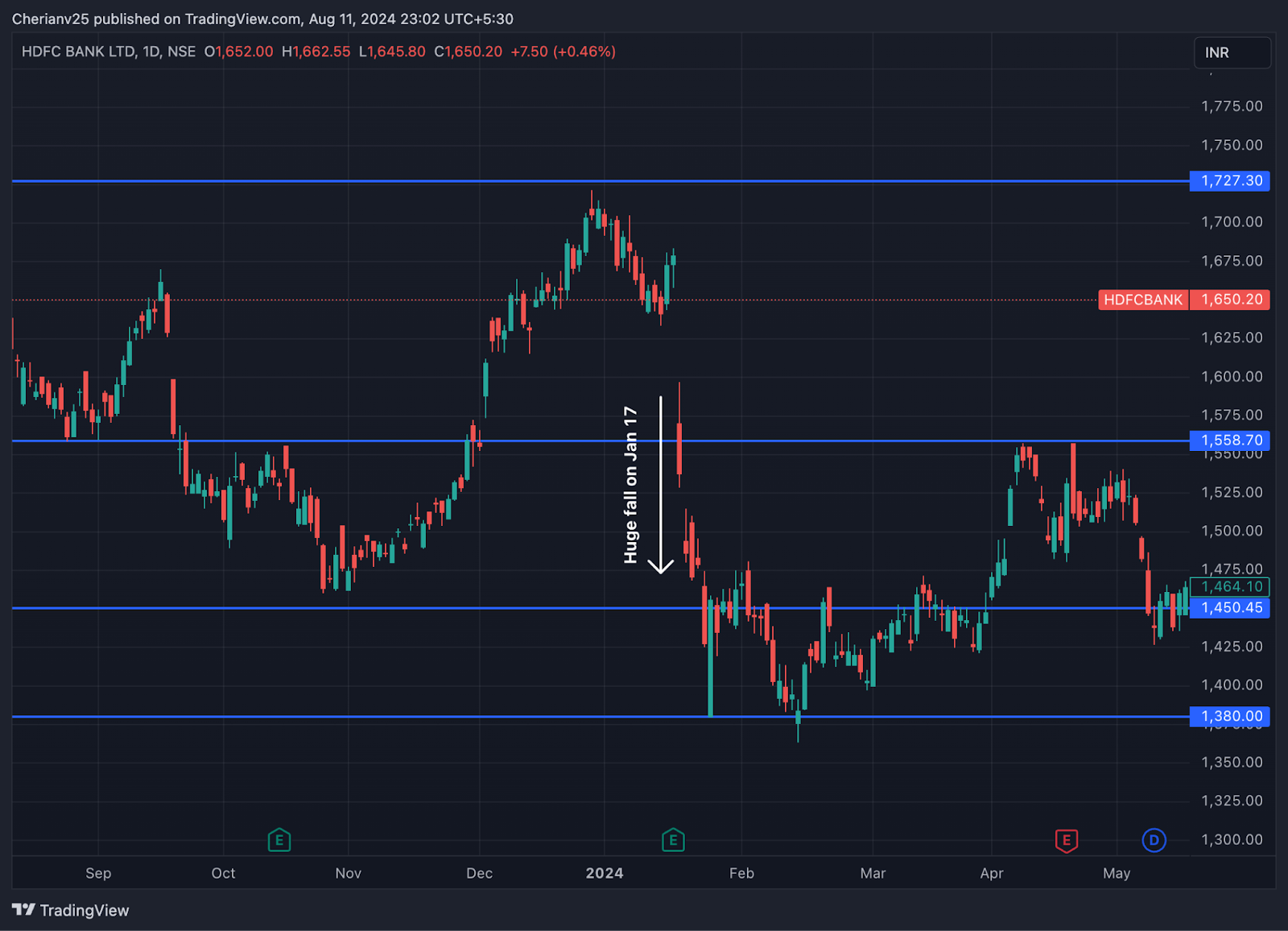
To illustrate the effectiveness of momentum investing, let’s look at two prominent examples: SBI and HDFC Bank.

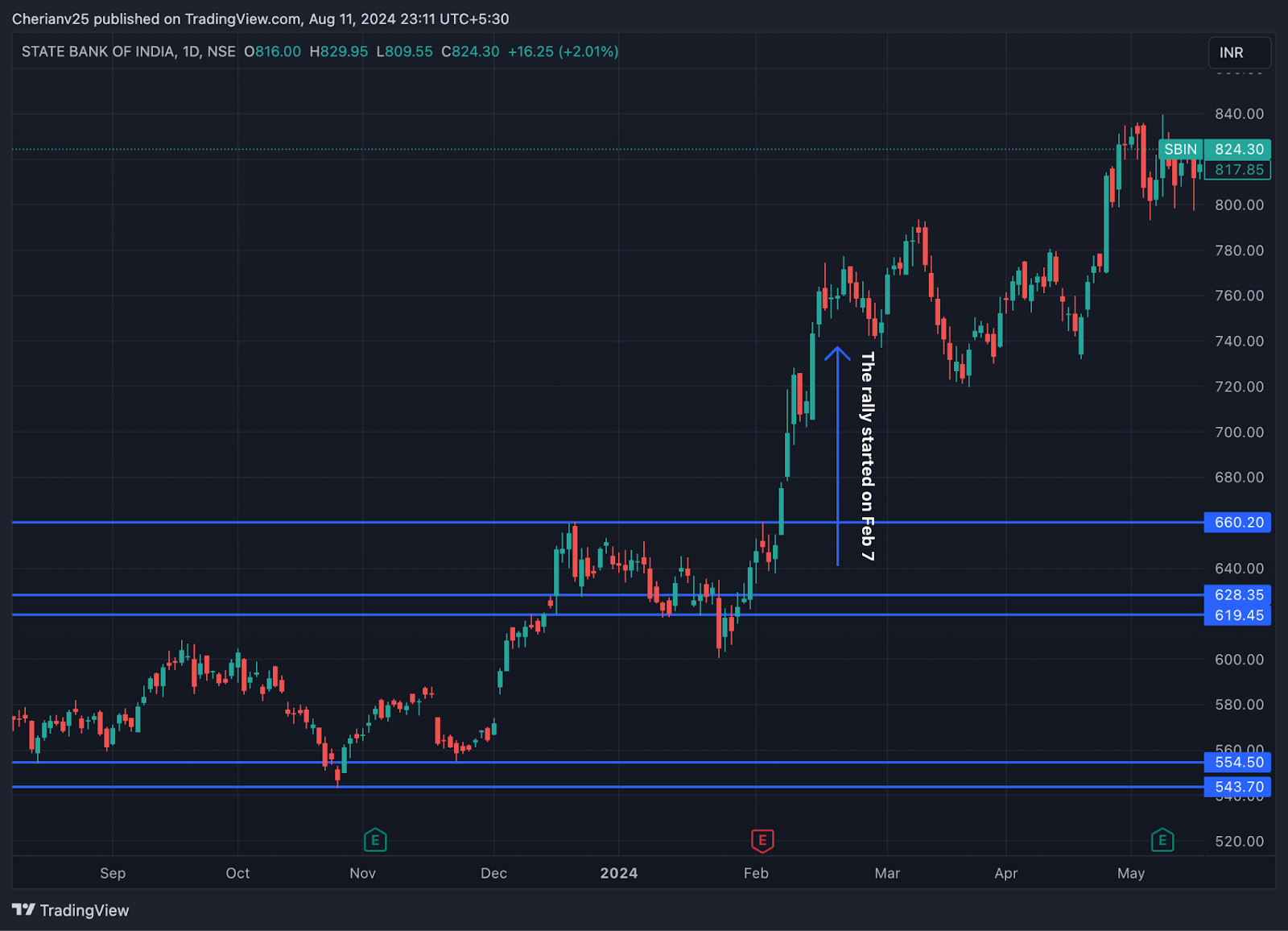
1. SBI: On February 7, 2024, the stock broke its all-time high. Within 7-8 days, it delivered a return of 12.86%. This surge was fueled by the factors discussed earlier, showcasing the power of momentum in a bullish market.

SBI stock chart - momentum investing | marketfeed

2. HDFC Bank: In contrast, HDFC Bank experienced a breakdown, resulting in an 8% decline. This example highlights the risks associated with catching a “falling knife,” where buying into a declining stock can lead to further losses.

HDFC Bank stock chart | marketfeed

Sectoral Rotation and Momentum Investing

Sectoral rotation involves shifting investments across different sectors based on their performance. The market can be divided into four quadrants: leading, weakening, lagging, and improving. Investors often debate whether to invest in leading sectors or chase lagging sectors for potential rebounds. For momentum investors, the focus is generally on stocks in the leading quadrant, as they are more likely to continue their upward trajectory.

sectoral rotation - momentum investing | marketfeed
Sectoral Rotation of Stock Markets – Quadrants

How to Identify High-Momentum Stocks?

To identify stocks with strong momentum, follow these steps:

1. Look for unusually high price changes: Start by identifying stocks with significant price changes, typically 3-5% in a day (focus on Nifty 500 stocks, avoid micro-caps.). This change should not be due to news or result announcements, as these can be temporary.
2. Check for high trading volume: Ensure that the stock has unusually high trading volume, indicating strong investor interest. Compare the volume on the day of the breakout with the average volume over the last several days.
3. Breakout Confirmation: Confirm the breakout by analysing the stock’s chart patterns, such as trend lines or horizontal lines. Be cautious of fake breakouts and set appropriate stop-loss levels to mitigate risks.

Simply add these filters on a stock screening platform (like screener.in) to identify momentum stocks.

Limitations of Momentum Investing

While momentum investing can be highly profitable, it does have its limitations. This strategy tends to work best in trending or bullish markets. In contrast, long-term consolidation phases can lead to false breakouts and increased risk.

Here are some strong measures you can take to mitigate risks while momentum trading:

  • Set stop-loss orders to protect against downturns.
  • Monitor market conditions to identify trends.
  • Use daily candlesticks for short-term trades.
  • Apply weekly or monthly charts for longer-term analysis.
  • Avoid this strategy during periods of long-term consolidation

Conclusion

Momentum investing is a powerful strategy that can yield substantial returns in the short and medium term. Investors can make informed decisions by understanding the psychological and technical factors driving stock prices. Always remember to use screeners and implement robust risk management strategies to enhance the effectiveness of momentum investing!

As you explore momentum investing, remember to stay updated on market trends and be prepared to adapt your strategies as conditions change. With careful analysis and a commitment to continuous learning, you can harness the power of momentum investing in your stock market journey!

Watch: Momentum Investing Strategy using Price and Volume! | marketfeed

Categories
Editorial

How to Invest in US Stocks? A Guide for Indian Investors

Investing in US stocks is become increasingly popular among Indian investors, especially the younger generation. Despite the Indian stock market’s impressive bull run over the past few years, many are drawn to the potential higher returns of prominent US stocks like Amazon, Tesla, and Nvidia. Unfortunately, many investment apps have high fees and complicated terms that can discourage people from using them. In this article, we will explore a low-cost and efficient way to invest in US stocks from India.

Why Invest in US Markets?

Here are four compelling reasons why you can consider investing in US stocks:

1. Diversification

Diversification is a fundamental investment strategy that involves spreading investments across various assets to reduce risk. When one asset class performs poorly, another may perform well, balancing your overall portfolio. For instance, when stock markets decline, commodities like gold often rise. The US and Indian markets have low correlation, meaning their performance is not closely tied. This lack of correlation opens opportunities for true diversification. If the Indian stock market underperforms, your US investments can potentially offset those losses.

2. Currency Depreciation

The performance of the Indian Rupee against the US dollar can significantly impact investment returns. For example, if you bought US dollars when the exchange rate was ₹70 and the rate increased to ₹84, your investment appreciates without any stock market gains. This currency strength can enhance your overall returns.

3. Lower Volatility

The US market is more mature and stable compared to the Indian market. This maturity results in lower daily volatility, making it a less risky investment option. However, do remember that no investment is entirely without risk!

4. Better Valuations

US stocks often have better valuations compared to Indian stocks. Price-to-earnings (P/E) ratios in the US are generally more favourable, providing more value for your investment. For example, many US-listed companies have lower P/E ratios than Indian companies, indicating better value potential.

To learn more about P/E ratio, explore this article: How to Analyse Debt & Valuation of a Company?

How to Start Investing in the US Stock Market from India?

Many investors may wonder how to begin their investment journey in US stocks with minimal capital. Here’s a straightforward approach:

Investing Through Mutual Funds

One of the most effective ways to invest in US tech stocks is through mutual funds, specifically those focused on the NASDAQ index. The NASDAQ is renowned for its tech-heavy listings, including major players like Apple, Amazon, and Nvidia.

Here are two mutual funds that are ideal options for investing in US markets:

1. Motilal Oswal NASDAQ 100 Fund of Fund

The Motilal Oswal NASDAQ 100 Fund of Fund is a popular choice for Indian investors. This fund invests in another mutual fund that directly targets NASDAQ-listed companies. Here are some key points:

  • CAGR Returns: The fund has delivered an impressive Compound Annual Growth Rate (CAGR) of around 25% over the last five years.
  • Expense Ratio: The expense ratio is relatively low, ensuring that you get more out of your investments.
  • Minimum Investment: You can start investing with as little as ₹500.
  • Performance: Over the last year, the fund has provided more than 30% returns, demonstrating the potential of US markets.

2. ICICI Prudential NASDAQ 100 Index Fund

This fund also invests in NASDAQ companies and offers similar benefits:

  • Returns: The fund has delivered a return of 29.21% over the last year.
  • Expense Ratio: The expense ratio is slightly higher at 0.52%, but still reasonable.
  • Portfolio: The fund invests in leading tech companies like Microsoft, Apple, Nvidia, and Amazon, in proportions that mirror the NASDAQ index.

Other Options to Invest in US Stocks

In addition to the NASDAQ-focused funds, you can consider the following options:

  • Motilal Oswal S&P 500 Index Fund: This fund invests in the S&P 500 index, which includes major US companies like Microsoft and Amazon. The investment ratios differ from those in NASDAQ funds, providing additional diversity.
  • Sector-Specific Funds: Explore funds that focus on specific sectors, such as technology or healthcare, to align with your investment strategy.

How Much to Invest?

While investing in US stocks can be beneficial, it’s essential to balance your portfolio. Moderation is key! A recommended strategy is to invest no more than 15-20% of your total portfolio in US stocks. This allocation provides diversification benefits while keeping the majority of your investments within familiar markets.

Investing too heavily in foreign markets can expose you to risks you may not fully understand. While major US tech companies show strong growth potential, diversification is essential to safeguard your investments. Balancing your portfolio with a mix of domestic and international assets can lead to more stable long-term growth.

Conclusion

Investing in US markets offers numerous benefits, from diversification to access to leading technology companies. However, it’s vital to approach this opportunity with caution. Mutual funds provide a transparent and efficient means to invest, minimising risks associated with direct stock purchases.

As you embark on your investment journey, remember to conduct thorough research and consider your risk tolerance. The US market presents a wealth of opportunities, but informed decisions are crucial for success. Share this guide with fellow investors to help them navigate the complexities of investing in US stocks.

Stay informed, stay diversified, and enjoy the journey of investing in the global market!

Categories
Jargons

What is Valuation? What is Discounted Cash Flow?


Ever wondered how to figure out what a company is really worth? That’s where valuation comes in – it’s like a magic trick for understanding a business’s true value. Whether you’re new to investing or a pro, getting the hang of valuation basics is key to making smart money moves. In this article, we dive into the basics of valuation and how a company is valued to help you make better investment decisions.

What is Valuation?

In finance, valuation simply means finding the real worth of a company. Valuation is used to determine the price that market participants are willing to pay or receive while selling a business. Thus, value investing is based on the true value of a business compared to its market value. Let us understand what market value and intrinsic value is.

Market Value vs Intrinsic Value

The market value of a business is the worth that the market assigns to it. You can calculate the market value of any publicly traded company by multiplying the share price by the number of outstanding shares. However, the market value may not be the actual value of the business. Sometimes, the market may overvalue a company for reasons such as high demand for its stocks, future plans, market sentiments for that stock, etc. 

Although the market value is what the market thinks a company is worth, the firm also has an intrinsic value. Intrinsic value is the true and accurate worth of a company. If the market value of a company is higher than its intrinsic value, then the stock is currently overpriced or overvalued. On the other hand, if the intrinsic value of a company is lower than its market value, then the company is undervalued.

How to Find the Intrinsic Value of a Company?

Finding the actual valuation of a company is a very complex, intensive, and lengthy process. Investment banks put together a team and take multiple days to find the true value of a company. Experts use different methods like Dividend Discount Models (DDM), Residual Income Models, Discounted Cash Flow Models, etc. However, for the purpose of our learning series, we will learn a simplified form of Discounted Cash Flow Analysis.

What is Discounted Cash Flow Analysis?

Discounted Cash Flow (DCF) models work on the concept of the time value of money. It is a concept that says that the value of a certain sum of money is worth more in the future than the same amount of money today because of the potential earning capacity of money. If you had the choice to receive ₹100 today or 1 year later, the choice should be today. This is because, if you receive ₹100 today and you invest that amount in an instrument giving you 5% returns per annum, then by the end of the year, you would have ₹105 with you. Having ₹105 over ₹100 is better at the end of the year.

Discounted cash flow analysis finds the present value of expected future cash flows using a discount rate. From the above example, 5% is the discount rate. A discount rate is the expected return over a period. If you think that the company will grow by 10% for the next 5 years, then the discount rate should be 10%. As the discount rate increases, the intrinsic value will decrease. So, we should take reasonable care while assigning a discount rate and make sure that the rate is fair and realistic. 

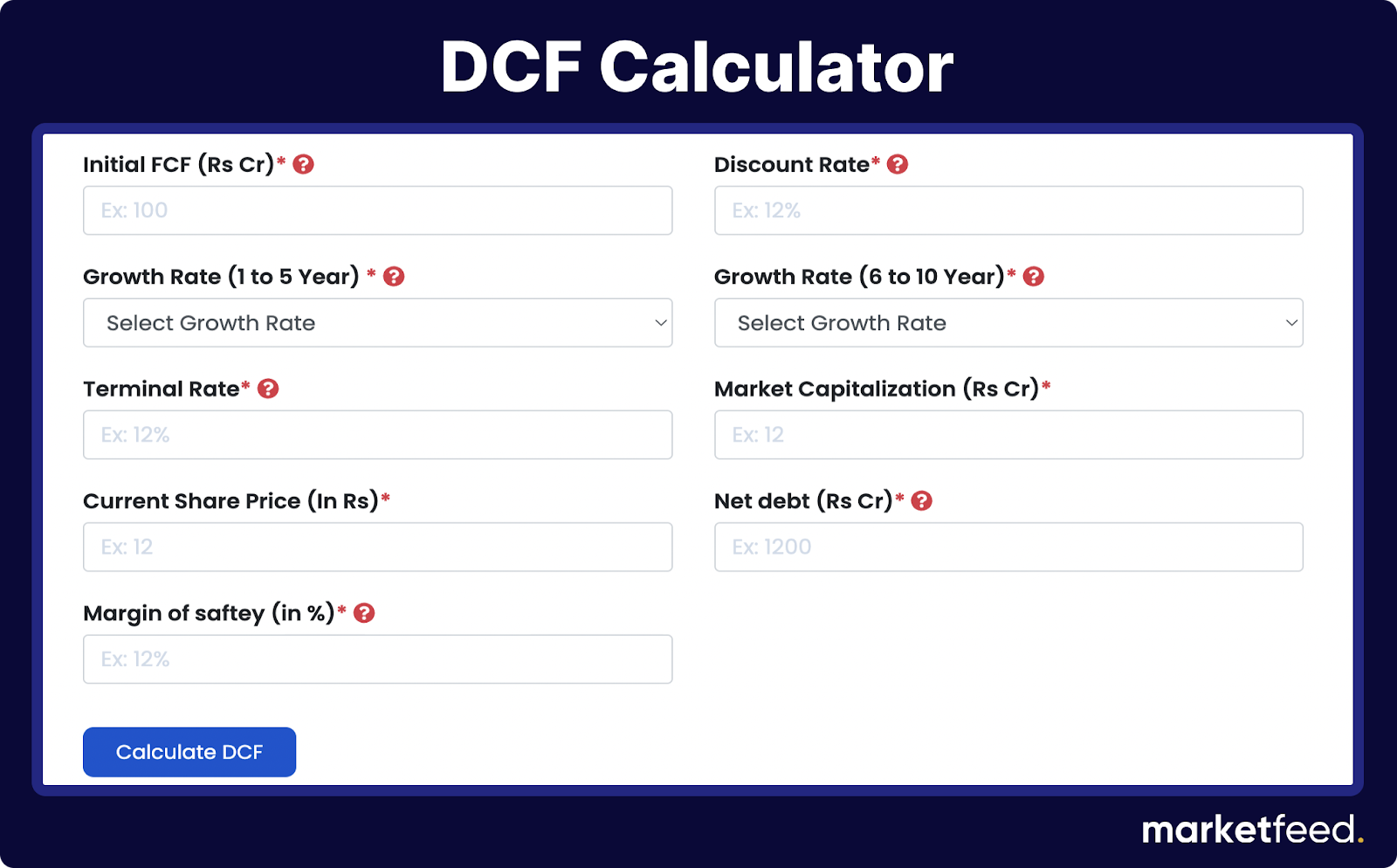
DCF Calculator

To find the intrinsic value of a company, we will be using a Discounted Cash Flow (DCF) calculator. Click here to use the calculator. 

DCF calculator | marketfeed
(Source: Finology)

Steps to Calculate Intrinsic Value

Step 1: Enter the initial FCF

FCF stands for free cash flow. Free cash flow = Net Cash flow from operating activities – Capital expenditure. Enter the three-year average FCF of a company.

Step 2: Enter the Discount Rate

The discount rate refers to the required rate of return. It is the return rate that you are expecting from a similar alternative investment. 

Step 3: Enter Growth Rate (1 to 5 years)

It is the rate at which the company might grow in the next 1 to 5 years. Large and well-established companies will have relatively low growth rates. You can also use the average growth rate of revenue or profit for the past 5 years and use that rate here.

Step 4: Enter Growth Rate (6 to 10 years)

It is the rate at which the company might grow in the next 6-10 years after the initial period.

Step 5: Enter the Terminal Rate

It is the rate at which the company is expected to grow 10 years from now. It is calculated by assuming the constant growth of a company beyond a certain period. 5% and below is a fair terminal rate.

Step 6: Enter the Market capitalization 

The market capitalization can be calculated by multiplying the total number of outstanding shares by its current share price. It can be easily found from screener.in, Tickertape, etc.

Step 7: Enter the Current Stock Price
Step 8: Enter the Net Debt

Net debt can be calculated by deducting cash and cash equivalents from a company’s total debt/liabilities. This data can be calculated from the balance sheet.

Step 9: Enter the Margin of Safety (MoS)

The margin of Safety provides discounts for uncertainties in the business. 

Step 10: Click ‘Calculate’

The calculator gives two values:

  1. DCF value per share shows the estimated intrinsic value.
  2. Fair value shows the intrinsic value per share after deducting the margin of safety.

If the intrinsic value derived is higher than the market price, then the stock is undervalued and if the intrinsic value is lower than the current market price, then the stock is overpriced.

An Illustration

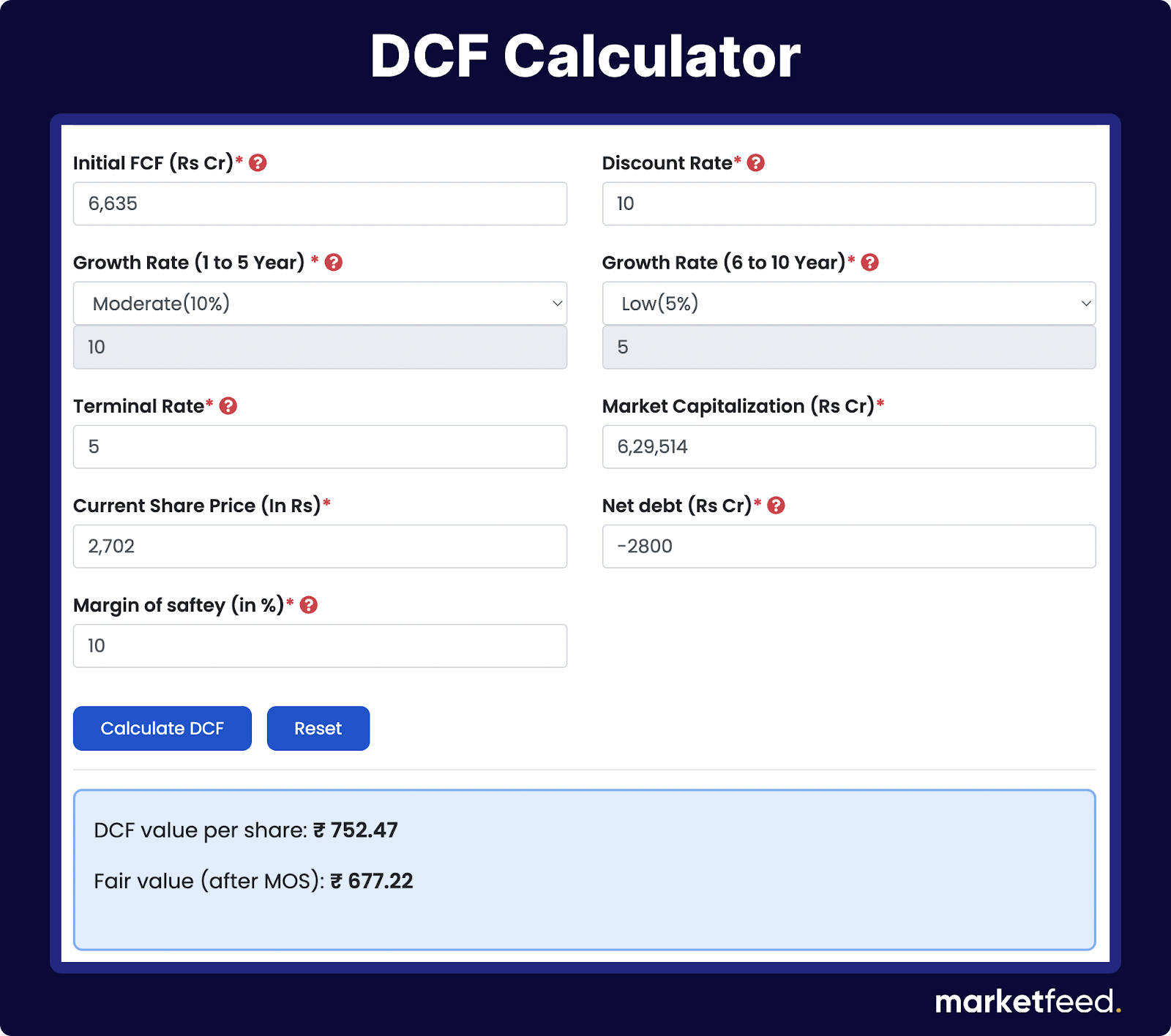
Let us use the calculator to find the intrinsic value of Hindustan Unilever (HUL). The values are entered as per the above instructions:

DCF Calculator - Example | marketfeed
(Source: Finology)

Assuming that the current share price of HUL is ₹2702, the DCF value or intrinsic value per share is ₹752.47. The fair value or intrinsic value after the margin of safety is ₹677.22. The stock price of HUL is 3 times more overpriced than its estimated intrinsic value.

We have learned now how to find the intrinsic value of a company. This value can be used while making decisions when it comes to value investing. However,  we don’t give much importance to intrinsic value in the case of growth investing.

In conclusion, valuation is not just about numbers; it’s about unlocking the potential of a company’s true value. So, as you navigate the world of finance, use these insights to guide your journey and make informed choices!

Also read: 5 Best Steps to Find Quality Stocks in India

Categories
Jargons

What is the Stock Market? How Does it Work?

Have you ever wondered what the stock market is and how it works? If yes, you’re not alone. The stock market can seem confusing and intimidating for people who don’t know how it works. But don’t worry! In this article, we shall learn what the stock market is, how it works, and who market participants are.

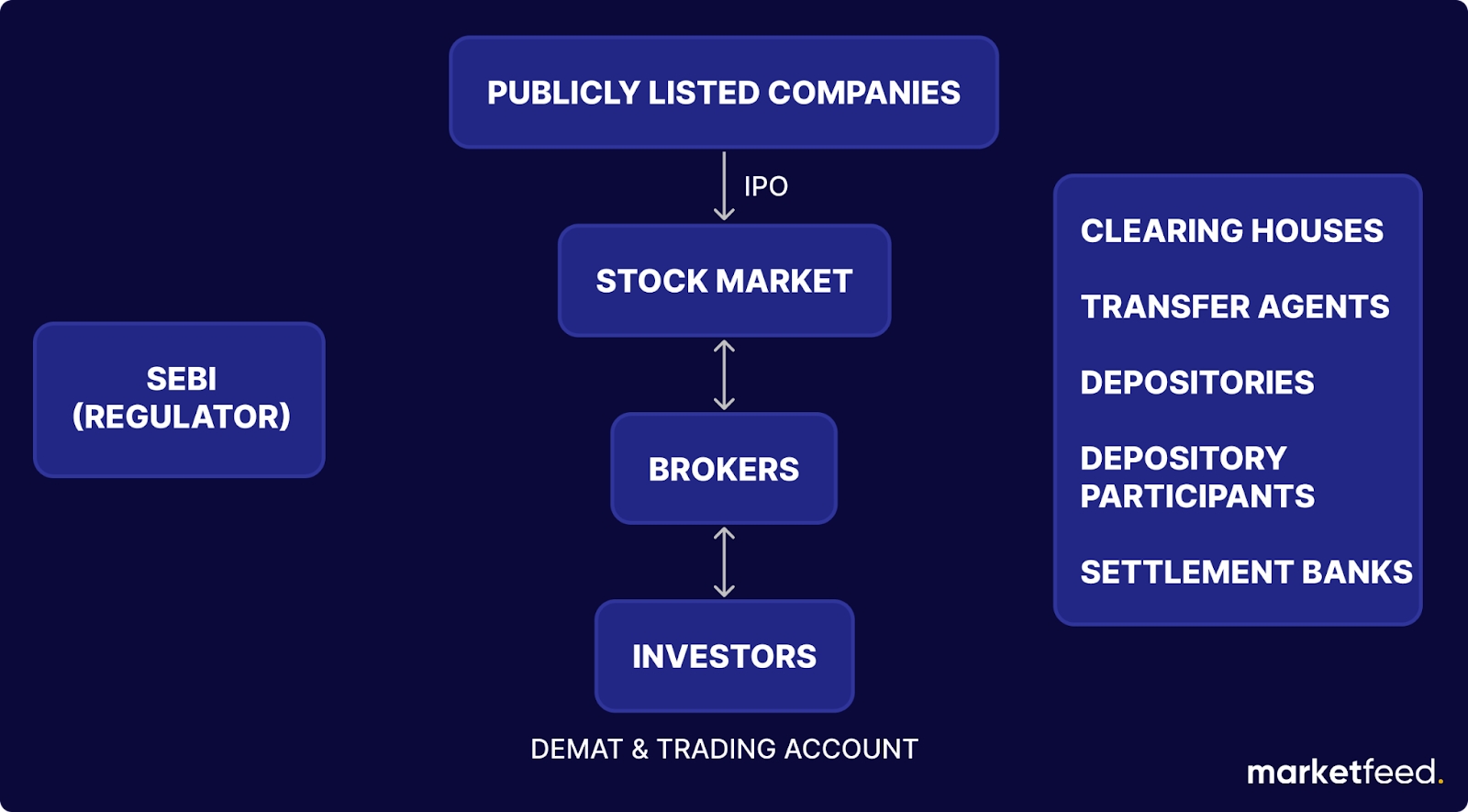
Given below are the different participants in the stock market. We’ll understand more about them through a story.

stock market participants | marketfeed

Let’s Look at a Story!

Mr. Jignesh, an owner of a renowned supermarket in Bengaluru, has been successfully running his business for the past ten years. The supermarket has been generating decent revenue and is highly profitable. His business also has goodwill (proprietary or intellectual property and brand recognition). When it comes to business, there are two things you must understand:

  • Ownership of a Business
    Jignesh completely owns and runs the supermarket, and the profit is not shared with anyone else.
  • Valuation of a Business
    Anything and everything has a value attached to it, even a business. The business has been generating income for Jignesh for the past ten years, so it is valuable. The valuation of a business is the economic value of how much a person has to pay to acquire 100% of the business from him. Let’s assume that the supermarket is valued at ₹1 crore.

    Since Jignesh is growing old, he feels he doesn’t want to work as much as he did and is looking for a partner to operate the business in return for 50% of the ownership of his business. He decided to share his business with a partner, Ms. Riya.

What are Shares?

Shares represent units of ownership of a company. A shareholder is entitled to a part of the profit that the company generates. 

The ownership of Jignesh’s supermarket was divided into 1000 equal shares. The value of each share can be mathematically expressed as:

Value of 1 Share = Total Valuation / Total Number of Shares

= 1,00,00,000 / 1000

= ₹10,000 per share.

Riya agreed to acquire 500 shares (50%) of the supermarket in consideration of the value of those shares in Cash.

Valuation = Total Number of Shares x Value of Each Share

Riya paid ₹50,00,000 to Jignesh, and they both became partners in the supermarket business. 

A few years later, the business expanded with several profitable outlets across Bengaluru. Now, Jignesh and Riya want to open 200 more stores nationwide, for which they need a large amount of capital. The easiest way to get funding or capital is by taking out a loan from a bank and using the business’ assets as collateral. However, this carries the risk of falling into a debt trap. If they are unable to repay the loan for some reason, the assets will be seized by the bank to recover the loan. Jignesh and Rita did not want to deal with these issues. 

An alternative would be to find more people who are interested in becoming part-owners of the business across Bengaluru. Even then, they may not be able to find enough people to do so. At this point, Jignesh becomes aware of the stock market. If they convert their company into a Public Limited company, they can raise capital from thousands of investors across India and other countries. The process of issuing shares to the public to raise capital for a business is known as an Initial Public Offering (IPO).

What is the Stock Market?

A stock market is a place where shares of publicly listed companies are traded. It is a physical place or institution where shares are bought and sold.

So Why Do Companies Go Public?

  • To Raise Capital: The company can gather funds for many objectives, such as paying liabilities (loans) and funding its future expansion projects.
  • Reward Founders & Early Investors: The founders and early investors of a company hold a good portion of the shares in their entity. They can sell these shares to the public and the proceeds go directly to them rather than to the company. It can be considered as a reward for all the time and effort they put in to build the company from the ground up. So going public can give them an early exit.

What are Stock Exchanges?

A stock exchange is a financial institution where different participants come together to buy and sell securities (shares). It provides the infrastructure for these activities. The term Stock Market is an umbrella term for a collection of Stock Exchanges.

The two major Stock Exchanges in India are:

  • Bombay Stock Exchange (BSE)
  • National Stock Exchange (NSE)

BSE is older than NSE, which explains why more companies are listed on the BSE than NSE. 

Coming back to the story, Jignesh’s company had a total of 1000 shares, out of which they decided to issue 15% of the shares to the public. Thus, 150 shares are being offered to the public. 

1000 x 15% = 150

How Many Shares Will a Company Have? Who Decides That?

A company’s promoters can decide how many shares it should have. Some firms may have thousands of shares, while others may have lakhs or even crores of shares. 

For example, the valuation of Jignesh’s company was ₹1 crore in the beginning. But the business has grown over the years, and now the valuation stands at ₹2 crores, bringing the value of each share to ₹20,000. 

Why do Investors Exist? What are their Objectives?

The two main objectives of investors are:

1. Capital Appreciation – When a company grows, the price of its shares increases. If investors buy the shares of a company when the prices are low and sell them when the prices increase, they can make good profits via capital appreciation.

2. Earn Dividends – When a company makes profits every year from its operations, it distributes a portion of the profits to shareholders as dividends. However, it is not necessary for them to declare dividends every year. It’s the company’s choice whether to issue dividends or not. The company may fully retain its profits for future capital needs or may give out a part of the profit and retain the rest. 

In short, the objective of a public limited company is to raise capital for its funding needs and the investors’ objective is to grow their money. But the real question is, how does the stock market fit into this?

Why do Stock Markets Exist? 

The stock market provides an avenue for a public company to raise capital from investors in consideration of shares. Investors will be able to grow their savings and wealth through capital appreciation and dividends. The stock market is the facilitator for the two parties. 

What are Primary Market and Secondary Market?

The stock market is divided into two:

1. Primary Markets
It is a market wherein a firm issues securities/shares to investors directly (via an initial public offering or IPO). These sale proceeds go directly to the issuer to finance their capital requirements.

2. Secondary Markets
It is the market where previously issued securities are bought and sold among investors. These sale proceeds go to the person who holds the securities. 

In our story, many people wanted to buy shares of his company after the IPO. However, the company does not issue any more shares as the IPO is already done. So these new investors can only buy the shares from those already holding them. 

When such transactions happen between investors in the secondary markets, the price of the share gets updated. If an existing shareholder sells the stock to another person for ₹20,100, the price of all the shares of the company gets updated to ₹20,100. Consequently, the net worth of the shareholders increases as the price of the shares they hold increases. 

Who Decides the Price of a Stock?

The two reasons which decide the price of a stock are:

  • Company’s Actual Valuation: A company’s value fluctuates as the revenue, profit, and goodwill change. The future prospects of the company also contribute to the valuation. If the revenue and profits go down, the valuation may also decrease, which causes the share price to drop. However, if the revenue and profit increase, the valuation could also rise.
  • Demand & Supply: The market forces of supply and demand also play an important role in deciding the share price. If the demand for the stock increases, then its price also increases since supply is limited. If the demand for the stock decreases, then its price also decreases since the supply is the same. Demand for the stock depends upon market sentiments, which refers to the overall attitude of investors toward the company. If the market sentiment is positive, then the demand for the stock will be high, thus driving the stock price up. Demand for the stock will be less if the market sentiment is negative. 

Why Do Stock Prices Fluctuate Every Second?

The Last Traded Price (LTP) refers to the price at which the previous share transaction took place. The stock market has lakhs of participants, and transactions happen every second. If a person sells a stock for ₹150, then the LTP at the time will be ₹150. The very next second, if a stock is sold for ₹149, then the LTP changes to ₹149. This is the reason why stock prices fluctuate every second.

Who are Brokers?

If you want to buy a stock, you cannot do it directly from the stock market. We have to approach a stockbroker, and the broker will transact on our behalf. A broker is an intermediary that facilitates transactions in the stock market. If you want to buy a stock, your broker will find a seller in the stock market on your instruction and facilitate the transaction between you and the seller. 

Before technology evolved, an investor had to physically visit the broker’s office and instruct them to buy the stock. The broker would then physically go around the stock market, find a seller, and conduct the transaction. But now, technology has evolved, and transactions can be conducted via our phones. Brokers are accessible on computers and smartphones, and investing & trading are as easy as ever. 

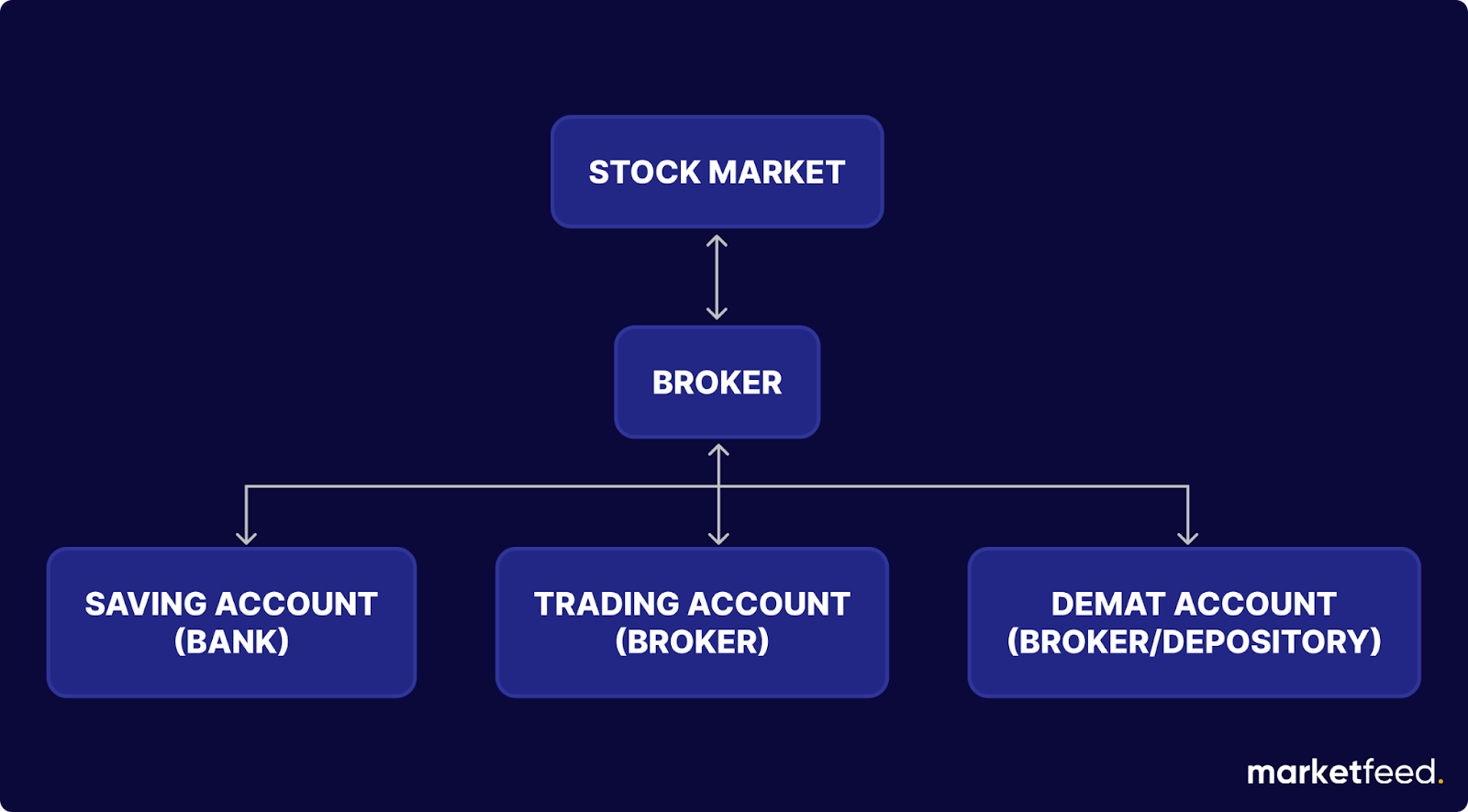
It is absolutely necessary to have an account with a broker to participate in the stock market. As intelligent stock market participants, we must have multiple broking accounts for different purposes. We can use one account for our long-term investing activities and another one for trading. Successful traders use multiple broking accounts for different trading strategies. 

How Does a Broker Work?

how does a stock market broker work? | marketfeed

There are two accounts that we open with a broker. Even though they are two separate accounts serving different purposes, both of them come in a bundle.

1. Demat Account
A Demat account or dematerialisation account allows you to hold your shares in an electronic format. It converts the physical shares into an electronic form, therefore dematerialising them. Demat accounts are maintained under depositories.

Earlier, the proof of ownership of shares, bonds, or debentures was in the form of physical share certificates. However, this system had many drawbacks, such as the risk of losing the certificate, fire hazards, getting wet, or even a mismatch in the signatures. 

2. Trading Account
A trading account acts as an interface between the investor’s bank savings account and a broker. For the broker to conduct trading activities on our behalf, they need money. We transfer the money we have in our savings account to a trading account with which the broker then conducts trading activities. Money can be transferred using net banking or UPI.

If we want to buy a stock, we instruct the broker to buy the stock, and the broker uses the money we have in our trading account to conduct the transaction. Similarly, when we sell a stock, the proceeds of the sale come directly into the trading account. 

An Illustration to Understand How Demat & Trading Account Works

  • Arun wants to buy a share of Mahindra & Mahindra (M&M) from the stock market. The first step that Arun should take is to open a Demat and trading account. Arun opens a Demat & trading account with a leading broker and deposits money into his trading account by transferring from his bank savings account via UPI. 
  • When the market opened at 9:15 AM, Arun placed an order with his broker to buy 1 quantity of M&M stock. The market price of M&M at the time was ₹1000. His trading account was debited ₹1000 by the broker to finance the transaction. Apart from this, a small amount was deducted as taxes and charges. 
  • Even though the transaction was completed, the stock will only be transferred into his Demat account after T+1 days, which means he will receive the stock in his Demat account on the next working day. 

While selecting brokers, we should choose the brokers that satisfy our various investing and trading needs. YOu can open a Demat and trading account using the links given below: 

Fyers (FREE) – https://bit.ly/3tx3ZJx

Zerodha – https://bit.ly/3AlErmb

Upstox – https://bit.ly/3OUAJnR

(Full disclosure: These are affiliate links. Do use the links if you wish to support us at no extra cost. ❤️)

Click here for step-by-step instructions on how to open a Demat and trading account.

What are Depositories?

If your shares are held by the broker, there is a risk of the broker running away with the shares they have. As a remedy, all Demat accounts are maintained by depositories. A depository is an institution that acts as a custodian of Demat accounts and shares. A Demat account is opened by a depository participant, who acts as an intermediary between the depository and investors. 

There are two depositories in India, which are governed by the Government of India: 

1. CDSL – Central Depository Services Limited
2. NSDL – National Securities Depository Limited

what are depositories | marketfeed

Who are the Other Facilitators?

The other facilitators part from brokers, depositories, and depository participants are: 

  • Clearing Houses – It is an intermediary between buyers and sellers of financial instruments. It is an agency or separate corporation of a futures exchange responsible for settling trading accounts, clearing trades, collecting and maintaining margin monies, regulating delivery, and reporting trading data.
  • Transfer Agents – A transfer agent keeps records of who owns a publicly traded company’s stocks and bonds. They also ensure investors receive dividends on time.
  • Settlement Banks – It refers to a customer’s bank where payments or transactions are finally settled and cleared for customer use.

What is a Market Regulator?

The Indian stock market is a place where transactions worth lakhs of crores of rupees take place. The Securities and Exchange Board of India (SEBI) is a regulatory authority established under the SEBI Act 1992. It’s the principal regulator for stock exchanges in India. SEBI’s primary functions include protecting investor interests and promoting and regulating the Indian securities markets. It is a government organisation. SEBI exists as the watchdog to make sure nothing wrong is happening in such a massive money-involved ecosystem.

Throughout the article, we discussed the various participants in the stock market and how they all work together in the stock market. We’ve also understood the basics of what the stock market is, who its participants are, and how it works!

Categories
Jargons

How Much Returns Can You Realistically Make From the Stock Market?

From one of our previous articles, you might’ve understood why you should be interested in the stock market and invest or trade. However, it’s important to have a perspective on how much money (or returns) you should aim to make from the stock market. If you ask beginners, the two most common answers would be as much as possible. Or in absolute terms, maybe ₹5000 or ₹10,000 a day with very little capital. If this is your perspective, then you need to reconsider it as soon as possible!

The answer to the question in the title is: meet industry benchmarks.

What are Industry Benchmarks?

An industry benchmark is a reference point that helps you compare your performance with the leaders in the industry. For example, if the average time the top 10 race drivers take to finish a lap is 1 minute, then the industry benchmark is 1 minute. If a driver finishes the lap in 1 minute, we can consider them successful in that particular industry as they have surpassed the industry benchmark.

We now have clarity on the activities you can do in the stock market: trading and investing. But what are the industry benchmarks in trading and investing?

Industry Benchmark in Trading

If we examine how much Jim Simons (one of the most successful traders in the world) earns, we see that he generates 70% returns on his deployed capital each year. That means that if he had deployed ₹1 crore of capital on trading, he would’ve made around ₹70 lakhs that year. The top traders in India make nearly 40-70% returns on their capital every year. So the industry benchmark of 40-60% returns is what you should aim to generate through trading. 

However, the estimations for industry benchmarks were done with scalability in mind. It is possible to make 100%, 200%, or possibly, even more, returns with small capital, but it may not be scalable. Whatever your capital may be, you should target 40-70% profits per annum. 

Industry Benchmark in Investing

It is common knowledge that Warren Buffet, renowned as the greatest investor of all time, averages CAGR returns of 18% per year. The late Mr. Rakesh Jhunjhunwala, India’s top investor, once said “If you’re able to earn an 18% return on your portfolio, you are no less than a king, and if the return is 21%, you are an emperor.” Even India’s leading portfolio management services generate CAGR returns of 20-30%. From this, we can conclude that 18-20% is the industry benchmark for investing, and this is what you should aim to achieve.

3 Points To Remember

1. Set a Target

Without a target or goal, it is like getting into a car without knowing where to go. To comprehend what is possible, practical, and achievable, you need to be aware of industry benchmarks.

2. Think in Percentage Terms

While discussing profits, we should express them as percentages rather than absolutes. This is because absolute terms do not provide any context for how much capital was used to generate those returns. For example, if someone says they made ₹1 lakh a week and used ₹10 crore capital, that would only be 0.1% returns, which is not great. So we should always think and talk in percentage terms.

3. Making Out of the World Returns is Possible

We discussed how generating massive returns of 200% or more may not be practical because of scalability issues. There are a few exceptional traders who make those kinds of returns, but not everyone can be at that level. It may not be possible or practical if we all aim for high returns from the start. Instead, we should focus on beating the benchmarks and then gradually increasing our targets when needed.

To conclude, you need to set realistic expectations of what you can achieve. People often make the mistake of thinking that they’re going to make a fortune overnight. The reality is that it takes time to make money in the stock market, and you need to be patient. If you’re ready to start investing in the stock market, then make sure that you have the right perspective. Otherwise, you’re setting yourself up for disappointment.

Categories
Jargons

How to Build Wealth Through the Stock Market? Investing vs. Trading

Before you learn about the stock market, it is essential to understand why it should interest you, how you plan to generate income from it, and what kind of activities you should do in the market. There are a lot of different perspectives out there when it comes to the world of the stock market. Some people think it’s a great way to make money, while others think it’s a huge gamble. The core objective of this article is to change mindsets and set a strong perspective.

Why Should You Be Interested in the Stock Market?

To understand why you should become interested in the stock market, we must first understand what everyone is striving for in today’s socio-economic environment. What is the absolute goal of an average person? It’s financial freedom!

What is Financial Freedom?

Financial freedom is a desirable condition of having enough money in your bank account to cover your expenses without having to work, run a business, or rely on others. Many people aspire to achieve it before they retire. Financial freedom allows you to pursue your passions without worrying about expenses, even if your passions do not generate income.

Normally, people save a part of their income and deposit it in their savings account, fixed deposit, or recurring deposit. They invest to generate wealth, which can then be used to take care of any long-term financial goals or expenses after retirement. However, it is impossible to achieve financial freedom by such methods as the annual returns generated by these financial instruments are only 5-7%. They cannot help you generate enough income to beat inflation

Inflation in India stands at ~6%, and if you keep your money in a savings account or deposit it into FDs or RDs, you’re barely beating inflation. You won’t even make enough money to keep aside as savings after accounting for all expenses. So what can you do?

The stock market can be one of the most convenient and easy ways to achieve financial freedom as it offers more returns on your investments.

How to Use the Stock Market to Achieve Financial Freedom?

There are mainly two types of activities in the stock market that a retail participant can take part in:

  • Trading
  • Investing

Trading is the buying and selling of stocks for short periods (intraday or for less than a year) or futures and options to generate income in a short period. There are different types of trading such as intraday trading, swing trading, and positional trading, which we will discuss in later sessions. People trade to generate cash flow instead of generating wealth through long-term investing.

Long-term investing involves buying and holding stocks, bonds, commodities, mutual funds, and exchange-traded funds (ETFs) for extended periods to grow your wealth.

How do Trading and Investing Solve the Problems of an Average Person? 

If you recall, the key issue most people face is the inability to beat inflation. So an average person can beat inflation by investing in the stock market for the long term instead of depositing their savings in a fixed deposit, recurring deposit, or even their bank savings account. Long-term investing can help you amass great wealth by generating higher returns. We should view it as a fundamental duty of every citizen.

The second pressing issue for many people is insufficient income to start investing. With rising expenses, they may not have enough salary or wages to set aside to make investments. To fix this issue, a person can upskill for a higher-paying job, start a business, or trade in the stock markets. You can trade both actively and passively.

Should Everyone Trade?

The only motive for trading is to make money or an extra income. Trading is a choice. If you have the potential to make enough income by increasing your skills in your current job or business, then trading is not necessary.

The stock market is a great way to make money. However, it can also be risky. So it’s important to learn the fundamentals of the stock market before you invest or trade. We hope that you have gained clarity on why you should be interested in the stock market and whether you should engage in trading, investing, or both.

Categories
Jargons

5 Best Steps to Find Quality Stocks in India

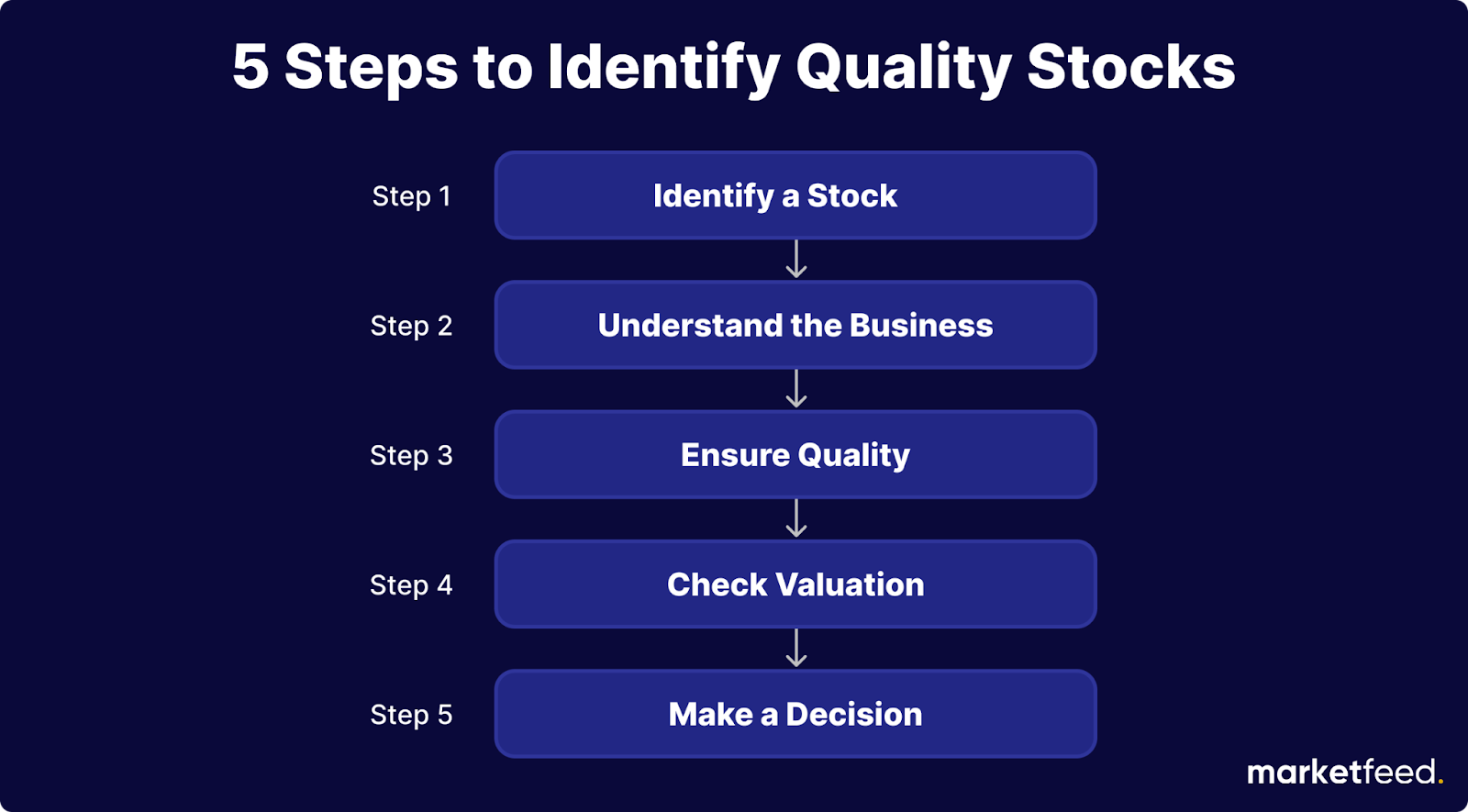
Investing in the stock market can help you create wealth over the long term. However, it requires careful analysis and research to find good stocks. One must know how to effectively apply their knowledge of fundamental analysis to identify high-quality stocks. In this article, we present 5 best steps to find quality stocks to invest in for the long term.

Identify Quality Stocks

Step 1: Identify a Stock

How do we choose high-quality stocks from the thousands of companies listed on the National Stock Exchange (NSE) and Bombay Stock Exchange (BSE)? Here are five ways to identify stocks and find if they are the right ones for us to invest in for the long term:

1. Friends and Social Circles

Take notes from friends and family who invest/talk about stocks and do more research on them. You may also run into online posts or articles about good companies that you can add to your watchlist.

2. General Observation

If you notice a brand or product performing well and gaining popularity, you can verify if that company is listed on the stock exchange. If yes, you can add them to the list. Even when you go to a supermarket, you can see what products have high demand and customer base and note them down for further analysis.

3. Using Stock Screeners

You can also use stock screeners like screener.in and Tickertape, which have good preset screeners to filter or compare companies based on their fundamentals. Apart from the inbuilt filters, such as financial ratios and growth in net profits, you can also create custom filters.

4. New Sectoral Trends and Rule Changes

You can always check which industries benefit from regulatory changes and take note of the listed companies in those sectors. General observation often allows us to identify sectoral trends in many cases.

For example, the electric vehicle (EV) sector is trending because the future is moving towards green mobility. You can identify the companies directly or indirectly linked to the industry benefiting from this trend, such as battery manufacturers, electric vehicle (EV) companies, and other relevant firms.

5. Your Circle of Competence

A circle of competence is the subject area that matches a person’s skills or expertise. If you are working in the IT sector, you can analyse the business models of IT companies and identify the best ones in this sector. On the other hand, if you’re working in the medical field, you can identify good-performing pharmaceutical companies.

Utilizing all the methods above is unnecessary; their sole purpose is to help us identify companies for further study or in-depth analysis.

Step 2: Understand the Business

After identifying various companies or stocks, it’s essential to gain a comprehensive understanding of their businesses.

1. Read annual reports

Annual reports provide a comprehensive overview of a company’s financial performance, strategies, and objectives. They typically include financial statements, management discussions, and analysis. These reports are essential for investors, stakeholders, and analysts to assess the company’s profitability, growth potential, and overall financial health. They serve as a valuable source of information for decision-making and evaluating investment opportunities.

2. Gather data from media reports and interviews

Another method to understand the company’s business is by listening to its founders and management. Watch interviews with the management and founders in which they talk about their company and its business. Read news articles about them.

3. Learn everything you can about the company, business, and competitors

If the company you are analysing has a moat or a unique selling proposition (USP), it’s a bonus. [Moat refers to a business’s ability to maintain competitive advantages over its competitors to protect its long-term profits and market share.]

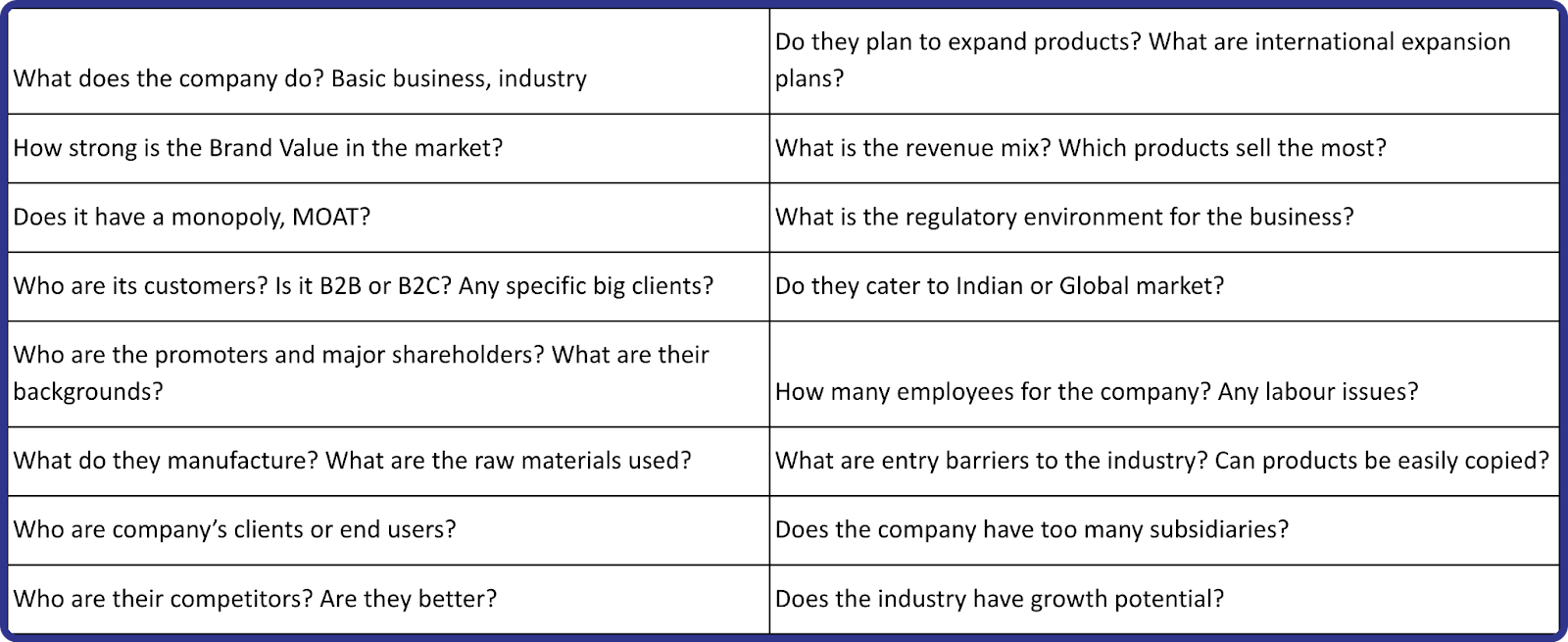
You can also refer to the questions given below to understand more about a business. After getting answers to these questions, you will have enough information about a company to understand its business.

Checklist before investing

If you don’t understand a company’s business even after all this, it’s better that you don’t invest in it.

Step 3: Ensure Quality

1. Read annual reports

Reading the annual report can give you an idea about a company’s quality.

2. Read financial statements

Financial reports like a profit & loss statement and balance sheet help analyse a company’s spending decisions and debt levels.

3. Study financial ratios

Ratio analysis unveils a company’s performance and growth trajectory over time. It would be beneficial to compare a company with others in the same industry or sector. Additionally, comparing a company’s ratios with industry standards provides a better understanding of its position and performance.

You can use the checklist below to analyze quantitative and qualitative factors. The table below is only for reference. You should also consider other checklist points for better analysis.

Financial ratios and metrics

Thus, we should check both quantitative and qualitative factors while ensuring quality.

Step 4: Check Valuation

After completing the steps mentioned above and compiling a list of high-quality stocks, the next crucial step involves evaluating the value of the companies on that list. Valuation is a quantitative process of determining the fair value of an asset, investment, or firm. In this step, we compare the market value and intrinsic value of the company and determine if it is undervalued or overvalued. The market value of a company is what it is currently worth according to the market. It is calculated using the formula below:

Market Capitalisation

The market value is the value the market (retail investors and institutions) gives a company. However, the company also has a true value, which is called its intrinsic value. If the market value of a company exceeds its intrinsic value, the stock is overpriced or overvalued. On the other, if the intrinsic value surpasses the market value, it is undervalued.

After finding the intrinsic value of a company, we have two methods of investing:

1. Growth Investing

Buy a stock if it has a high growth history/potential and fits all your checklists. In growth investing, we ignore the intrinsic value of a company. If a company has been continuously growing for the past few years and still has high growth potential, we can buy its stock despite its overvaluation. For example, Hindustan Unilever has always been overvalued in the past, but it kept on growing despite its overvaluation.

2. Value Investing

Buy a stock if its current market price is lower than its intrinsic value. We choose not to buy overvalued stocks. Veteran investor Warren Buffet and his mentor Sir Benjamin Graham are renowned value investors. 

Growth Investing and Value Investing

Both growth investing and value investing can yield good returns. Growth investing is comparatively easier than value investing. However, if done right, value investing can build you a fortune!

There are many methods to value a company and find its intrinsic value. You can use Dividend Discount Model (DDM), Present Value Methods, etc to value companies.

Step 5: Make a Decision

After completing all these steps, your next action will be to make an informed decision. First, we identified a few stocks, understood their business, ensured the quality, and valued the companies. The final step is to decide whether to add that stock to your portfolio. While building a portfolio, it should be well diversified. So, we should avoid adding multiple stocks from the same industry to our portfolio.

When to Invest?

The two ways in which people invest in stocks are:

1. Lump Sum Investment

When we invest a huge amount into stocks all at once, it is called a lump sum investment. People usually do this when they receive bonuses or a large sum. However, the drawback of this method is that we cannot maintain a better average price. If we make a lumpsum investment and the stock keeps on falling, we cannot take advantage of this price discount as all the money was invested in a single go.

2. Systematic Investment Plan (SIP)

SIP is a method of investing a fixed sum regularly into a portfolio. Most salaried people have a regular income every month. Out of this, they invest a certain percentage as SIP. A better average price can be maintained in this method as the purchase price will be lower and higher sometimes. 

In value investing, we only buy the stock when the intrinsic value is lower than its actual market value. Only a lump sum investment is possible here. On the other hand, with growth investing, we can invest in SIPs. One can perform technical analysis and buy the stock when its price dips or at regular intervals, such as monthly or weekly. 

We should always invest in a portfolio of high-quality stocks while investing for the long term. If we invest in a single stock or sector/industry, there won’t be any diversification. When that particular industry starts performing poorly, our portfolio also dips substantially. Success in long-term investment is not finding or selecting that single multibagger stock. Rather, it is finding out and investing in a well-diversified portfolio.

Disclaimer: The information or any examples mentioned in this article are purely for educational purposes. Please do your own research before investing in stocks for the long term.

Categories
Jargons

What are the Best Ways to Make Money From the Stock Market?

The stock market is where shares of public companies are bought and sold. A share represents ownership in a company, and shareholders are entitled to a portion of the company’s profits. People have different perspectives on the stock market. Some consider it a great method to generate wealth, while others perceive it as a risky financial gamble. We firmly believe that the stock market can serve as an incredible opportunity for wealth generation and passive income. You need to gain a deep understanding of how it works to make money from the stock market.

Making money from the stock market is not a walk in the park. While the potential for making money is high, it also has an equally high risk of making losses. In this article, we will take a closer look at a few of the ways by which one can make money from the stock market.

1. Investing in Index Funds or Exchange-Traded Funds (ETFs)

An index fund is a type of mutual fund that tries to replicate the returns made by a stock market index such as Nifty 50 by investing in the constituent stocks of that index. These funds are passively managed. This means that the fund manager invests your money in the same securities that constitute the index and in the same proportion. The portfolio composition will remain unchanged.

An Exchange Traded Fund (ETF) is a type of fund that tracks the performance of a certain basket of assets such as an index and can be traded on the stock exchange. Unlike mutual funds, ETFs have low transaction costs, can easily be traded through any broker, and requires very low minimum investment.

2. Investing in Blue-Chip Stocks or Dividend-Paying Stocks

Blue-chip stocks are stocks of large well-established companies with an impeccable reputation and track record of stable earnings and performance. They are fundamentally strong companies with very high market capitalisations. Investing in these stocks is an easy and low-risk way to make money from the stock market. 

Companies that make a profit may choose to share a portion of those profits with shareholders as dividends. As a shareholder, you will receive dividends based on the number of shares you own. Dividend payments can be quarterly, annually, or semi-annually. Investing in dividend-paying stocks can be a way to earn money from the stock market, as dividends provide returns in the form of cash to your bank account.

3. Investing in International Stocks or Emerging Market Funds

International funds are mutual funds that invest in the stocks of global multinational companies. Meanwhile, an emerging market fund is a fund that provides investors access to countries and regions that are undergoing economic transition. One can invest in such funds like any other mutual fund.

4. Investing in Initial Public Offerings (IPOs)

An Initial Public Offering (IPO) is a method by which a company raises equity capital from the public. Equity represents the ownership of a company. Once a company’s IPO is completed, its shares get listed in a stock exchange, i.e. BSE & NSE. You can invest in IPOs of fundamentally strong companies after thorough research. If the public response is positive, you also stand a chance to make money through listing gains. 

5. Trading in Options & Futures Contracts

Futures and options are derivative contracts that derive their value from an underlying asset. These underlying assets can be indices, equities, currencies, commodities, etc. Although derivative contracts were originally invented to hedge risk, it is popularly used as a speculative instrument these days. With the right knowledge and skill, it can be a great way to make money from the stock market. However, derivatives trading is considerably hard and requires practice and learning. This makes it unappealing for beginners.

6. Day Trading or Swing Trading

Day trading or intraday trading refers to the buying and selling of equities or derivatives in a day. For example, if you buy a stock at 10 AM after the market opens and sell the stock at 2 PM before the market closes, it is intraday trading. The trader exploits the small price movements in the stock to make a profit. Features such as short-selling and leverage help to enhance returns and make profits even in falling markets.

Swing trading is a style of trading in which the trader buys and holds the stock for two or more days to capture the short to medium-term price movements in the stock. The trader takes delivery of the stocks and no leverage will be available. Short selling is also not possible in equity swing trading.

7. Investing in Value Stocks or Growth Stocks Based on Market Trends

Value stocks and growth stocks represent different investment philosophies: value investing and growth investing. In value investing, the focus is on finding stocks with intrinsic values higher than their current market value. In growth investing, the emphasis is on companies with strong growth prospects, regardless of their current valuation. Value investors like Warren Buffet and Rakesh Jhunjhunwala are known for their approach to buying undervalued stocks. Growth investors prioritise companies with good fundamentals and growth potential even if their current market value is higher than their anticipated or calculated value.

8. Investing in Socially Responsible Stocks or Funds that Align with Your Value

Investing in socially responsible stocks or funds that align with your value is a way to make money from the stock market. Here, you support companies that are committed to social, environmental, and governance (ESG) principles, while seeking returns. You can start by defining your values and researching funds or stocks that align with those values. Then you can move to invest in these funds or stocks.

Powerful Investment Hacks:

1. Approach a Financial Advisor to Manage Your Portfolio

Seeking professional advice can be beneficial, especially if you’re new to investing or prefer a hands-off approach. A financial advisor can provide personalized guidance based on your risk tolerance, financial goals, and investment horizon. These professionals can help construct and manage a well-diversified portfolio while ensuring it aligns with your individual circumstances.

2. Avoid Common Mistakes Such as Emotional Investing, Overtrading

Always have a solid investment plan, diversify your portfolio, avoid overtrading and chasing hot stocks, manage your emotions, regularly review and evaluate your portfolio, and seek professional advice if needed. Discipline and mindfulness can increase your chances of achieving long-term investment success.

3. Learn Technical Analysis to Make Trading Decisions

Technical analysis is a technique that uses historical price and volume data to form analysis and forecast the direction of prices that can be used for decision-making. Technical analysis can be applied to securities in any freely traded market around the globe. Utilising technical analysis and charting can be a helpful tool for making trading decisions, especially for short-term traders who rely on technical indicators and price patterns.

4. Start SIPs

Systematic Investment Plans or SIPs are a smart and hassle-free way to invest in stocks. It. involves investing a fixed amount of money at regular intervals (monthly or quarterly) regardless of market conditions. Whether you’re a beginner or a seasoned investor, SIPs provide discipline, convenience, and the potential for long-term wealth creation. 

5. Analyse Financial Statements to Pick Stocks

Analysing financial statements and earnings is fundamental to stock picking. Consider reviewing financial health and performance, assessing profitability and growth prospects, and comparing with peers. Thorough research, considering economic and industry factors, and risk awareness are crucial. Fundamental analysis equips you with the right knowledge for analysing financial statements and company earnings.

In conclusion, making money from the stock market requires thorough research, planning, and risk management. Align your investments with your financial goals, risk tolerance, and time horizon, and regularly review and adjust your strategy. Start with small investments and gradually increase over time, staying informed about the market. A financial advisor can be valuable for beginners to avoid mistakes and make informed decisions.

Disclaimer: This article is only for educational purposes. Please do your own research before investing or trading in the stock market!

Categories
Jargons

How to Make Side Income From Home?

With rising inflation (essential items getting expensive), having an extra income can make your life easier. Although a full-time job can provide a stable income, it may not always be sufficient to meet your bills. The pandemic has proved how important, useful, and reliable the internet is to make additional money. Many people have started earning a side income online in addition to their primary income. Here are some great ways to earn a side income from home:

1. Investing in Stocks and Real Estate

One can easily make a side income by investing in stocks and other securities. You can buy and hold stocks, bonds, commodities, mutual funds, or exchange-traded funds (ETFs) for extended periods to grow your wealth. High-quality stocks that pay consistent dividends can be a source of passive income. When a company makes a profit, it may choose to distribute a portion of those profits to its shareholders in the form of dividends. As a shareholder, you will receive a portion of those dividends based on the number of shares you own.

Meanwhile, you can invest in real estate through Real Estate Investment Trusts (REITs). A REIT owns, operates, or finances income-generating real estate and pays out the cashflows as dividends. You can invest in stocks and REITs through any broker.

2. Creating a YouTube channel

YouTube channels that meet the eligibility criteria can monetize their videos through Google Adsense. Advertisements will be displayed before, during, or after the video, and you earn a percentage of the revenue those ads generate. Channels with huge viewerships can attract sponsors who’ll pay considerable sums of money to promote their products or services. The amount of revenue you can earn from youtube depends on various factors such as the number of views, engagement levels, and the type of content.

3. Renting Out a Property

Renting out unoccupied properties or homes can generate a decent passive income. You can either rent out properties privately or through platforms like Airbnb. The rental income depends on the type, location, size, and demand of the property. On Airbnb, you can rent out your whole property or just a few rooms. Maintaining the property periodically can generate maximum revenue. Leasing out your property is also a great way to make a side income.

4. Selling Products in Online Marketplaces

E-commerce platforms such as Amazon and Flipkart are great places to sell your products. You can list products on these platforms and sell them by paying a small commission to the e-commerce operator. This is highly economical compared to traditional commerce as the infrastructure needs are minimal.

5. Online Tutoring or Teaching

  • Chegg is an education technology company that helps with homework, digital & physical textbook rentals, textbooks, online tutoring, and other student services. As a Chegg expert, you can solve various questions in Mathematics, Healthcare, Earth science, Business, Engineering, and Science. You can earn up to ₹1 lakh side income from home every month.
  • Course Hero is also a platform like Chegg, but with more subjects like arts, humanities, languages, engineering and technology, Business, maths, science, and social science. You can make up to $1500+ per month.

6. Online Surveys and Microtasks

  • Amazon Mechanical Turk is a crowdsourcing platform for businesses to hire remotely located workers to perform discrete on-demand tasks that computers are currently unable to do. It is owned by Amazon and operates under Amazon Web Services. Employers post jobs known as Human Intelligence Tasks (HITs) such as identifying specific content in an image or video, writing product descriptions, or answering survey questions. You can browse among existing jobs and complete them in exchange for a fee set by the employer. The payment will be in cash or Amazon gift cards.
  • Swagbucks is a platform that pays you for giving your opinion in various surveys. You can select from thousands of surveys. You can choose the length and reward amount of the survey from the available surveys. The surveys can be of any type such as reviewing upcoming super bowl ads, sharing your political beliefs, testing new products, being a mystery shopper, or helping a company decide on a new slogan. The payment will be in SB points, and you can redeem these points for cash or gift cards.

7. Affiliate Marketing

Amazon Associates Program helps content creators, publishers and bloggers monetize their traffic. With millions of products and programs available on Amazon, associates use easy link-building tools to direct their audience to their recommendations and earn from qualifying purchases and programs. Advertising fees for qualifying purchases differ based on the product category.

8. Freelancing

  • Upwork is a marketplace for freelancers in fields like writing, translation, graphic design, web development, finance, and accounting. The platform helps freelancers find projects, communicate with clients, and get paid. To start, create a profile, search for jobs, submit a proposal, make a contract, and complete the work. This way you can easily make a side income from the comfort of your home.
  • Fiverr is also a platform aimed at freelancers. You get paid to design websites, logos, and much more. You can offer any service you wish as long as it’s legal and complies with Fiverr’s terms.

9. Creating and Selling Digital Products

If you have good subject knowledge in any topic, you can plan a curriculum and record classes that can then be sold online on platforms like Udemy from the comfort of your home. You can add assignments, quizzes, and exercises to the course for creating a more rich learning environment. The payout depends on the number of courses sold and learner engagement.

10. Renting Out Your Belongings

Renting out your personal belongings can be a great source of side income. You can rent out your car on days that you do not use it for a daily minimum charge and an additional charge per extra kilometre.

Electronic items such as cameras, projectors, laptops, tablets, gaming consoles, etc, can be easily rented out. 

Renting out personal belongings can be a convenient way to generate extra income, but it’s important to ensure that your belongings are protected and that you have the appropriate insurance coverage in case of damage or theft.

11. Online Transcription Services

Transcribeme is a platform that provides transcription services through machine learning technology and human transcriptionists. It involves the conversion of audio and video clips into texts. To join, you only need a computer and a stable internet connection. Headphones or earphones will enhance the transcription process.

In conclusion, earning a side income from home is always beneficial as it increases your purchasing power. Income diversification, financial security, increased savings, and debt reduction are a few benefits of having a side income. Before you commit your money and resources to such income sources, always perform a proper analysis to understand the risks involved!

Categories
Editorial

Why Basic Stock Market Education Must be Free & Accessible to All

Indian parents have high hopes and expectations for their children’s education and careers. They use all their resources to help their kids excel in academics, get good grades, join a prestigious institution, and get well-paying jobs. Moreover, we Indians have a reputation for being frugal with our money. We’re taught to spend less and save more. All in good intentions, but there’s a lot more to life than just saving money.

Unfortunately, our current education system does not include theory or practical sessions on essential life skills. We’re not trained to handle our hard-earned incomes and make financial decisions. Young professionals find it difficult to understand the basic principles of investing or even filing their taxes. These vital “life subjects” are still not being taught in schools or colleges. Instead, there’s always been a perception among Indians that investing in stocks is risky and you’ll lose all your money.

The Current Scenario

A majority of Indian households prefer to “invest” their hard-earned money in fixed deposits (FDs) even now. Returns from FDs can never beat the rising inflation rate (the general rise in prices of goods). Gold, post-office savings, and real estate are given more priority over stock trading and investment. These are decent options but might not be sufficient in today’s economic climate. 

Thus, future generations will be extremely doubtful and cautious of going the “unconventional route” when it comes to growing their wealth and achieving financial freedom. They’re not getting the proper education or awareness!

According to a Bloomberg Intelligence report in 2021, Indian households invest a meager 7% of their financial assets into stocks compared to an average of 30% in other major emerging markets. More than 55% of adults in the United States invest in the stock market. While saving is the safe way to go, Indian citizens need to understand that the purchasing power of cash in hand or their bank account continuously reduces with time. So, investing in the top-performing firms in the nation can help you become more financially secure

Time to Change Mindsets! 

There is an urgent need for education in financial planning in our country. We need to initiate training sessions around stock investment and trading. The concepts of compounding and portfolio diversification must be ingrained in everyone’s minds so that they become more financially savvy. Having a basic knowledge of personal finance can help an investor make money work for them! Investing in stocks after thorough research will allow your money to outpace inflation and potentially build wealth.

If you’re in your 20s, try to start investing early as it’ll help you make small and calculated risks without the fear of affecting your livelihood and family. In fact, it’ll give you an insight into stock selection and investment risks and allow you to make smart choices in the future. There are plenty of opportunities for you to make money in the stock market. You just need to figure out what works for you!

Still confused about how to start your journey in the stock market? Don’t worry, we’ve got you covered!

marketfeed’s founder, Sharique Samsudheen, has made it his life’s mission to democratize the stock markets and help Indians become financially independent. To that extent, we are proud to launch our Free and Structured Stock Market A-Z Series on YouTube. The series will cover everything from the basics of the stock market to advanced trading strategies. We’ll also teach you proven strategies, tips, and tricks used by our team so you can make consistent profits! marketfeed will help you make informed decisions in the beautiful world of finance!

All you have to do is subscribe to our YouTube channel and turn on notifications! Join the Revolution and be part of the best Stock Market Community that we’re building here at marketfeed!

Categories
Editorial

Want to Invest in CSK and Reliance Retail? Know How!

Investing in the stock markets has become much easier for retail investors (like you and me) through new-age brokers and revolutionary tech platforms. But have you ever thought about how you can invest in private companies like Oyo Rooms, Chennai Super Kings, and Reliance Retail?

We’ve seen ace investor Rakesh Jhunjhunwala making crores from investing in pre-IPO companies. For decades, the private equity markets were accessible only for high net-worth individuals (HNIs) and venture capitalists like him. But things are changing! In this article, learn more about India’s private equity market and how you can invest in firms before they list on the stock markets.

What is Private Equity?

We often come across news of prominent venture capitalists and HNIs investing in privately-owned companies or startups in India. These investments are referred to as private equity (PE) in market terms. It helps firms run their day-to-day operations, work on innovative products or technology, and boost growth. Such private investments are also used to fund expansions, diversifications, or acquisitions. With their deep pockets, institutions get first-hand access to lucrative business models. As companies eventually grow and go public, these early investors and promoters sell their shares at a much higher value.

Over the past few years, private companies and startups based in India have flourished by developing disruptive products and technologies. In 2020, investments in the private market were 2.5 times greater than in the public market. As per an EY report, PE and venture capital investments in Indian firms hit a record high of $77 billion in 2021, an increase of 62% over 2020. E-commerce, fintech, and ed-tech continue to be the fastest-growing sectors in our country. Who wouldn’t want to invest in India Inc.?  

Unfortunately, retail investors have always faced an entry barrier in the private equity markets. Investment rounds and transactions of private firms are made in bulk for millions of dollars and are not at all pocket-friendly for small investors. PE investments are also illiquid and have a strict lock-in period. In most cases, there is a total lack of transparency in these transactions. When companies such as Happiest Minds Tech, Nykaa, and Latent View Analytics floated their IPOs, most of us would’ve wished to invest in them sooner. Besides, buying shares of undervalued companies has always been the essence of investing. 

How Can I Invest in Private Companies?

As retail investors, we often seek new ways to diversify our portfolios and obtain better returns. As such, investing in the equity of private companies allows us to be a part of their growth story. Such investments are now possible through a new platform called Leadoff, which aims to democratise private equity for Indians.

The digital platform essentially breaks the entry barrier and allows you to invest in prominent private companies. It cuts out the middlemen and time-consuming documentation processes to provide a seamless investment platform. You can invest in companies such as Chennai Super Kings, soon-to-be public Oyo Rooms, PharmEasy, and Reliance Retail with a minimum amount of just Rs 10,000! One can make rational investment decisions by going through the financial reports and important documents of these high-growth firms. Investors must always go through these reports thoroughly before investing.

How Does it Work?

Leadoff has established an extensive network of early investors, founders, and other shareholders of privately-owned companies. Thus, they source shares from various entities and transfer them directly to the users on its platform. The share prices are evaluated by the respective companies and their auditing firms. And when you place an order, Leadoff transfers the shares directly to your existing Demat account! 

The platform provides bank-level security and a user-friendly dashboard so that you can keep track of your transactions. Positions/holdings can be exited via company share buybacks or at the time of public listing. Also, all transactions made in private equity shares are legal in India!

From taking the decision to invest to actually getting the shares, you will be able to execute transactions in 3 easy steps:

  • Browse the company you’d like to invest in. Leadoff has handpicked several high-growth firms after a thorough screening process.
  • Research about the company with the help of in-platform reports to make an informed decision. 
  • Make the payment, and the shares will be directly transferred to your existing Demat account in 24-48 hours.

Lately, we have been witnessing most IPOs getting oversubscribed and a few lucky investors enjoying significant listing gains. Just imagine the returns if you could get on the action much earlier! Join the club of active investors who are passionate about the growth of India’s private markets. While Leadoff is still in a ‘waitlist’ mode, marketfeed readers can skip the queue and join the platform here, https://portal.joinleadoff.com/register/marketfeed.

Access to private equity markets has now been unlocked!