Categories
Jargons

How to Make Side Income From Home?

With rising inflation (essential items getting expensive), having an extra income can make your life easier. Although a full-time job can provide a stable income, it may not always be sufficient to meet your bills. The pandemic has proved how important, useful, and reliable the internet is to make additional money. Many people have started earning a side income online in addition to their primary income. Here are some great ways to earn a side income from home:

1. Investing in Stocks and Real Estate

One can easily make a side income by investing in stocks and other securities. You can buy and hold stocks, bonds, commodities, mutual funds, or exchange-traded funds (ETFs) for extended periods to grow your wealth. High-quality stocks that pay consistent dividends can be a source of passive income. When a company makes a profit, it may choose to distribute a portion of those profits to its shareholders in the form of dividends. As a shareholder, you will receive a portion of those dividends based on the number of shares you own.

Meanwhile, you can invest in real estate through Real Estate Investment Trusts (REITs). A REIT owns, operates, or finances income-generating real estate and pays out the cashflows as dividends. You can invest in stocks and REITs through any broker.

2. Creating a YouTube channel

YouTube channels that meet the eligibility criteria can monetize their videos through Google Adsense. Advertisements will be displayed before, during, or after the video, and you earn a percentage of the revenue those ads generate. Channels with huge viewerships can attract sponsors who’ll pay considerable sums of money to promote their products or services. The amount of revenue you can earn from youtube depends on various factors such as the number of views, engagement levels, and the type of content.

3. Renting Out a Property

Renting out unoccupied properties or homes can generate a decent passive income. You can either rent out properties privately or through platforms like Airbnb. The rental income depends on the type, location, size, and demand of the property. On Airbnb, you can rent out your whole property or just a few rooms. Maintaining the property periodically can generate maximum revenue. Leasing out your property is also a great way to make a side income.

4. Selling Products in Online Marketplaces

E-commerce platforms such as Amazon and Flipkart are great places to sell your products. You can list products on these platforms and sell them by paying a small commission to the e-commerce operator. This is highly economical compared to traditional commerce as the infrastructure needs are minimal.

5. Online Tutoring or Teaching

  • Chegg is an education technology company that helps with homework, digital & physical textbook rentals, textbooks, online tutoring, and other student services. As a Chegg expert, you can solve various questions in Mathematics, Healthcare, Earth science, Business, Engineering, and Science. You can earn up to ₹1 lakh side income from home every month.
  • Course Hero is also a platform like Chegg, but with more subjects like arts, humanities, languages, engineering and technology, Business, maths, science, and social science. You can make up to $1500+ per month.

6. Online Surveys and Microtasks

  • Amazon Mechanical Turk is a crowdsourcing platform for businesses to hire remotely located workers to perform discrete on-demand tasks that computers are currently unable to do. It is owned by Amazon and operates under Amazon Web Services. Employers post jobs known as Human Intelligence Tasks (HITs) such as identifying specific content in an image or video, writing product descriptions, or answering survey questions. You can browse among existing jobs and complete them in exchange for a fee set by the employer. The payment will be in cash or Amazon gift cards.
  • Swagbucks is a platform that pays you for giving your opinion in various surveys. You can select from thousands of surveys. You can choose the length and reward amount of the survey from the available surveys. The surveys can be of any type such as reviewing upcoming super bowl ads, sharing your political beliefs, testing new products, being a mystery shopper, or helping a company decide on a new slogan. The payment will be in SB points, and you can redeem these points for cash or gift cards.

7. Affiliate Marketing

Amazon Associates Program helps content creators, publishers and bloggers monetize their traffic. With millions of products and programs available on Amazon, associates use easy link-building tools to direct their audience to their recommendations and earn from qualifying purchases and programs. Advertising fees for qualifying purchases differ based on the product category.

8. Freelancing

  • Upwork is a marketplace for freelancers in fields like writing, translation, graphic design, web development, finance, and accounting. The platform helps freelancers find projects, communicate with clients, and get paid. To start, create a profile, search for jobs, submit a proposal, make a contract, and complete the work. This way you can easily make a side income from the comfort of your home.
  • Fiverr is also a platform aimed at freelancers. You get paid to design websites, logos, and much more. You can offer any service you wish as long as it’s legal and complies with Fiverr’s terms.

9. Creating and Selling Digital Products

If you have good subject knowledge in any topic, you can plan a curriculum and record classes that can then be sold online on platforms like Udemy from the comfort of your home. You can add assignments, quizzes, and exercises to the course for creating a more rich learning environment. The payout depends on the number of courses sold and learner engagement.

10. Renting Out Your Belongings

Renting out your personal belongings can be a great source of side income. You can rent out your car on days that you do not use it for a daily minimum charge and an additional charge per extra kilometre.

Electronic items such as cameras, projectors, laptops, tablets, gaming consoles, etc, can be easily rented out. 

Renting out personal belongings can be a convenient way to generate extra income, but it’s important to ensure that your belongings are protected and that you have the appropriate insurance coverage in case of damage or theft.

11. Online Transcription Services

Transcribeme is a platform that provides transcription services through machine learning technology and human transcriptionists. It involves the conversion of audio and video clips into texts. To join, you only need a computer and a stable internet connection. Headphones or earphones will enhance the transcription process.

In conclusion, earning a side income from home is always beneficial as it increases your purchasing power. Income diversification, financial security, increased savings, and debt reduction are a few benefits of having a side income. Before you commit your money and resources to such income sources, always perform a proper analysis to understand the risks involved!

Categories
Editorial

Best Investment Options for Beginners

As of late, we have noticed that many of our readers are confused about how to start their investment journey. The primary motive behind investing your hard-earned income is to fight inflation or a general rise in the prices of goods. The purchasing power of cash in hand or your bank account continuously reduces with time. In order to beat inflation and achieve future goals, you need to invest your money in a variety of financial products.

Our primary mission here at marketfeed is to show the path for every individual to become financially independent. We help you make informed decisions in the beautiful world of finance. However, it is important that we start from the very basics and slowly work our way up. So, let us have a clear understanding of some of the best investment options that can help you achieve financial freedom.

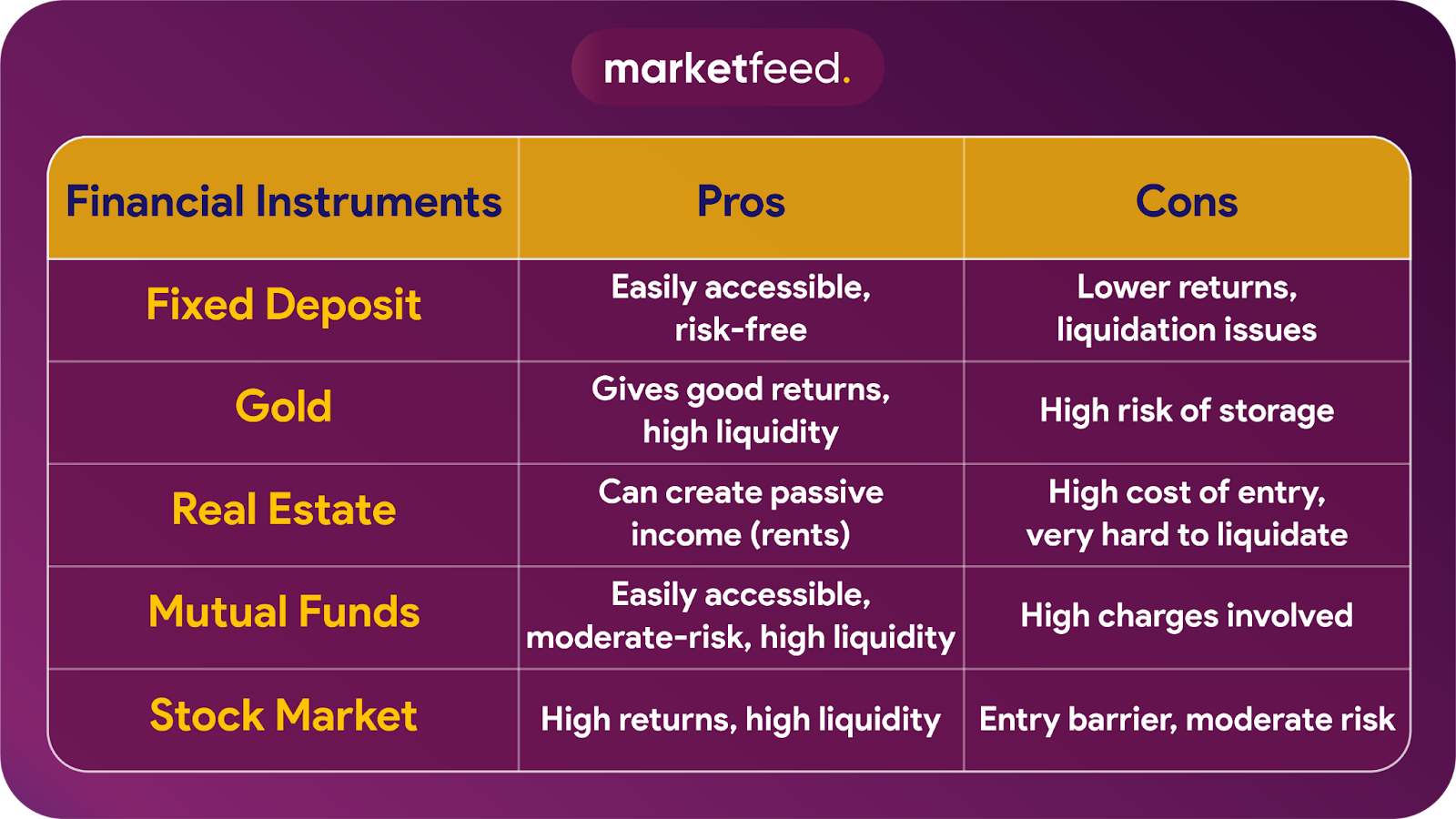
Direct Equity

Direct equity means investing in stocks. When you buy stocks (or shares) of a listed company, you become part-owner of the firm (even though it’s a very tiny fraction). This means that you are directly investing in the company’s development and growth. In the long run, stock markets have always beaten inflation and have delivered higher returns than other asset classes. Thus, stocks are always ideal for long-term investments. To directly invest in shares or equity, you would need to open a Demat account.

However, investing in stocks contains a high level of risk. Stock markets are often very volatile, as a variety of factors (including interest rates, government policies, economic figures, company operations) influence the performance of stocks. You will have to actively manage your investments to limit losses. One needs to have a lot of patience and gain market knowledge to get sufficient returns. With time, you will learn how to pick the right stock and time your entry and exit. Target-oriented and well-researched stock market investments can definitely help you beat inflation.

Mutual Funds

If you are not comfortable with investing directly in stocks due to the risks involved, you can always invest in mutual funds. A mutual fund takes money (investments) from different individual and institutional investors who have a common investment objective. This pooled sum of money is managed by a professional fund manager, who invests in securities and assets to generate returns for investors. 

You can find equity, debt and hybrid mutual funds as a general classification. Equity mutual funds invest in stocks and equity-related instruments, while debt mutual funds invest in bonds and other debt instruments. Hybrid mutual funds invest in a mix of equity and debt instruments. There are various equity mutual funds based on market capitalization, tax-saving funds, sectoral funds, and much more. As per reports, the 5-year and 10-year returns of these equity fund categories were above 10% as of April 2021.

Mutual funds are a very attractive investment option as you do not have to spend much time and effort tracking them. Instead of investing a large sum of money all at once, you could start a Systematic Investment Plan (SIP) and invest small amounts of money periodically (usually every month) in mutual funds. They are very flexible, as you can begin and stop investing according to your convenience. However, one needs to conduct a proper analysis or study before investing in a particular mutual fund. Element of risk is also present as the returns are dependent on market movements.

Bonds

A bond is a fixed-income instrument issued by companies or even government entities to raise funds. Investors can lend their money to organisations in return for fixed yearly interest. At the time of maturity of the bond, you will receive the initial money you had invested and the interest offered on it. Nowadays, bonds offer fixed returns that are at least 2-3% higher than fixed deposits (FDs). Government bonds in India are an ideal investment option as it provides more than 7% guaranteed returns. 

Before investing in bonds, you need to consider and analyse important factors such as coupon rate (fixed interest that the bond pays annually), payment frequency (the number of times the interest is paid to the bondholder), maturity date, and credit rating. A higher-rated bond carries a higher level of safety of investment. AAA-rated bonds are the most secure.

Gold

Gold is one of the best asset classes that can be used to counter inflation. This is because the increase in gold prices and the returns from it have always been able to offset inflation in the past. According to the World Gold Council, for every 1% increase in inflation, there is a 2.6% rise in gold demand. This ultimately leads to an increase in gold prices. However, acquiring and holding gold in the form of jewellery has its own concerns such as safety and high cost.

An alternative way of owning gold is through paper gold or gold ETFs. These are units representing physical gold which may be in paper or dematerialised (electronic) form. One Gold ETF unit is equal to 1 gram of gold and is backed by physical gold of very high purity. The investments made in paper gold are less costly.

What are ETFs?

As the name suggests, an exchange-traded fund (ETF) is a fund that can be traded on the stock exchange. It is a method through which you can buy and sell a basket of assets without having to buy all the components individually. ETFs are managed by finance professionals who own certain underlying assets (such as stocks, bonds, currencies, and commodities). They design a fund to track the performance of these assets and then sell shares of these funds to investors.

ETFs are a great method to diversify your portfolio and manage risks. It is also a cost-effective method of investing and also offers several tax benefits.

Fixed Deposits, Recurring Deposits

Fixed Deposits (FDs) are an investment option offered by banks and financial institutions. It is something that most of us are familiar with. You deposit a lump sum of money for a fixed period and earn a predetermined rate of interest on it. The interest rate of FDs differs from one bank to another. However, the average rate of FDs in India is only 5-6%, which may be insufficient to beat inflation. FDs are favorable for those investors who wish to receive guaranteed, yet conservative returns.

Recurring Deposits (RDs) are a fixed-tenure investment option provided by banks and other institutions that allow individuals to invest a fixed amount every month for a pre-defined time period. The interest rate on RDs is determined by the institution offering them. RDs also offer complete capital protection as well as guaranteed returns.

Government Schemes

Public Provident Fund (PPF) is a long-term investment scheme provided by the Government of India (GoI) that has a lock-in period of 15 years. Currently, the annual rate of interest offered on PPF is 7.10%. The entire amount withdrawn at the end of the 15 years is entirely tax-free for the investor. You can also take loans and make partial withdrawals if certain conditions are met.

Employee Provident Fund (EPF) is a retirement-oriented investment scheme that helps salaried individuals. EPF deductions are a specific percentage of your salary every month, and the same amount is matched by the employer as well. This entire amount is pooled into your EPF corpus or account every month, and you receive interest on it. Currently, the annual rate of interest offered on EPF is 8.50%. At the time of maturity, the entire amount withdrawn from the EPF corpus is entirely tax-free.

The National Pension Scheme (NPS) is another tax-saving investment option offered by the Government of India. Anyone between the age of 18-65 years can make voluntary contributions to this scheme. Investors who subscribe to NPS will mandatorily stay locked in until their retirement and can earn better returns than PPF or EPF. Historically, NPS has delivered ~8-10% returns every year.

Real Estate

Investing in real estate is one of the best ways to diversify your portfolio. Since the value of a real estate property appreciates (or increases) with time, you can earn exponential returns on it. Acquiring a property and renting it out would be an ideal way to earn passive income. However, the location of the property is the most important factor that will determine its value and also the rental income that can be earned from it. In the case of residential properties, investors must always conduct a thorough study of home loan interest rates, offers provided by developers, and government regulations. Another important factor to consider is that real estate is highly illiquid. Properties cannot be sold off and converted into cash quickly.

If you don’t have adequate capital for acquiring real estate properties, you could always invest in a real estate investment trust or REIT. This is very similar to a mutual fund, wherein you can invest small amounts of money on certain income-generating assets and earn a good return from them. A REIT owns and operates several properties such as complexes, infrastructure projects, healthcare units, apartments, and more. The money pooled in from the REIT is used to manage these assets. And, the income derived from these properties or assets is shared among all investors (or unitholders) of the REIT.

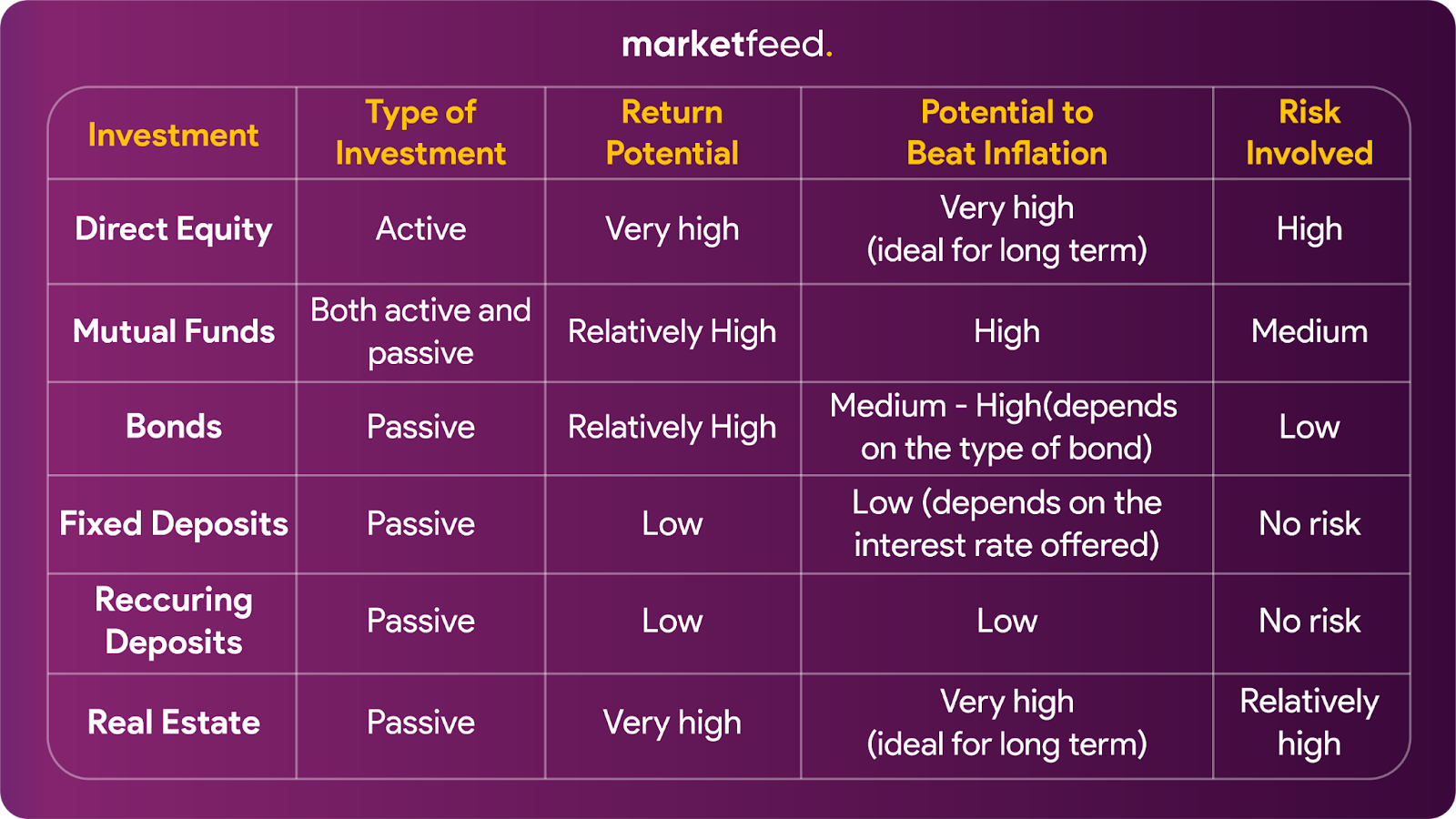
Types of Investments in a Nutshell

Conclusion

Now, you have an idea of how to grow your hard-earned income to beat inflation and lead a better life. However, it is up to you to figure out the right investment that fits your profile and financial goals. Start your investment journey only after carefully going through the risks and costs associated with each of them. Go for those investments that you clearly understand from your own research. At the same time, it is vital that you invest your money in different products and diversify your portfolio. More importantly, make sure you do not fall for scammy schemes that promise high returns in a short period. The sooner you start investing, the longer you will stay invested and earn higher returns.

Open a free Demat account –

Upstox
Zerodha

Happy Investing!

Categories
Editorial

Macrotech Developers IPO: Should You Invest?

Trump Towers(India), World Trace Centre WTC(India), and the tallest tower in India,-World One, have one thing in common. All three mega-structures are built by a company called Macrotech Developers, commonly known as Lodha Group. Formerly known as Lodha Developers, Macrotech is a real-estate company based out of Mumbai. Macrotech Developers has come up with its IPO starting 7th April 2021. It is the first IPO of the financial year 2021-22 or FY22. What does the company do? How does the real estate empire seem like in the Post-COVID scenario? Let us find out.

IPO Opening DateApril 7, 2021
IPO Closing DateApril 9, 2021
Listing DateApril 22, 2021
Issue TypeBook Building
Face ValueRs 10 per equity share
IPO PriceRs 483 to Rs 486 per equity share
Market Lot30 Shares
Min Order Quantity30 Shares
Issue AmountRs 2500 crore
Issue Size51,440,328 equity shares of Rs 10 each

The company plans to use the raised funds to repay debt worth Rs 1,500 crore and acquire land and development rights worth Rs 375 crore. The remaining amount will be used for general purposes. 

The Business 

  • As of December 2020, the company owns or has sole development rights for close to 3,174 acres of land reserves. The company has completed 91 projects with 77.22 million square feet of developable land. It has 36 ongoing projects and 18 planned projects totaling 73.86 million square feet of developable land in the future. 
  • The company has most of its projects lined up in MMR or Mumbai Metropolitan Region and Pune. A city like Mumbai has a high potential for upcoming real estate projects in the near future considering the constantly inflating real estate prices. Apart from this, it has projects around the world in cities like Singapore, Dubai, United Kingdom, and the United States. 
  • The company gains most(60%) from its affordable housing and commercial projects segment followed by mid-income and luxury housing and commercial projects. The weightage of affordable housing and commercial projects has seen an increase over the past few years.
  • Apart from the housing segment, the company also has ongoing and planned logistics (290 acres) and industrial park(540 acres) projects lined up.
  • The company is 100% owned by its promoters and has no secondary or public shareholding. After the IPO, the company will hold 89% shareholding. 

The Finances

FY2017-18FY2018-19FY2019-209M FY2020-21
Sales8129.947162.66 6569.2 3351.3 
Revenue13726.5611978.8 12560.98 3160.48
Profit After Tax1789.391643.77 744.83 (2,643.02) 
Total Borrowings22,59923,36118,41318662
Financial Vitals(In Rs. crore)
  • The company does not reflect a strong financial position. Its sales figure declines from Rs 8129.94 crore in FY2017 to Rs 6569 crore.
  • The company’s revenue has declined from Rs 13726 crore to Rs 12560 crore between FY2017-18 and FY2019-20. The company’s profit after tax almost halved in three years in these three years. Currently, the company has recorded a loss in FY2020-21.
  • The company has managed to cut down on debt a little but still happens to be in deep debt of up to Rs 18,662 crore as of December 31, 2020. 
  • The company’s total borrowing as of December 31, 2020, remains Rs 18,662 crore with secured borrowings of Rs 18,496 crore and unsecured borrowings of Rs 165 crore. The company has to pay or refinance Rs 16,145 crore worth of borrowings within the next year or less

Risk and Reward

  • The company has a strong brand value and market presence. The real estate market is such that its difficult to have new entrants. This is because of various reasons like limited land availability, high capital requirements and regulatory barriers.
  • The company has a strong presence in the MMR region which is a stronghold for real estate in the country. The most expensive properties and constantly rising real estate prices can be found here.
  • The company’s affordable housing segment receives is likely to receive immense support from the government’s housing policy in the form of tax benefits and a lower GST rate.
  • The company has a weak balance sheet. It works on high amounts of debt and has recorded decreasing revenue and profits over the past few years.
  • The company has 12 criminal cases and 271 civil cases against it, totalling an amount of Rs 7,752 crore.
  • The company does not have a diversified geographical presence. It has its strong hold only in the Mumbai Metropolitan Region. Any change in its market can have a significant impact on the company’s balance sheet.

The odds have turned against Macrotech in recent times. Maharashtra, which had reduced the stamp duty for real estate from 5% to 2%, increased it back to 2% almost a week ago. Moreover, a recent close-to-lockdown like restrictions were imposed in Maharashtra, where many non-essential businesses were asked to shut shop for almost a month. This was unprecedented when the company had filed for an IPO. The Rs 2500 crore which the company will raise won’t have a major impact on its debt position. In times like these, it would be risky to invest in a real estate IPO like Macrotech Developers’.