Categories
Jargons

How to Safely Invest in Stocks and Make Money

In today’s fast-paced financial world, investing in stocks has become an attractive option for individuals looking to grow their wealth. However, it’s important to approach stock market investing with caution and a well-thought-out strategy. This article serves as a comprehensive guide on how to safely invest in stocks and make money while minimising risks.

(Before diving into the world of stock market investing, it’s crucial to learn the basics and understand the risks associated with it. Learn concepts like stocks, shares, and equity markets. Stock prices fluctuate based on market conditions, economic factors, and company performance. So be prepared for potential losses and understand the importance of a long-term investment approach).

1. Create a Diversified Portfolio of Stocks and Other Investments

Diversification is the key to managing risk in your investment portfolio. Spread your investments across different sectors, industries, and asset classes. This diversification minimizes the impact of any single investment on your overall portfolio performance. Explore other investment options like bonds, real estate, or commodities to further diversify and balance your risk exposure.

2. Invest in Low-Cost Index Funds or ETFs

Index funds and Exchange-Traded Funds (ETFs) offer a simple and cost-effective way to gain exposure to a broad market index. These funds track the performance of a specific market index such as NIFTY. By investing in index funds or ETFs, you can achieve instant diversification and benefit from the overall growth of the market while minimizing the risk associated with individual stocks.

3. Invest in Blue-Chip Stocks

Blue-chip stocks are shares of well-established companies with a history of stable earnings and dividend payments. These companies have a strong market presence, solid financials, and often operate in mature industries. Investing in blue-chip stocks can provide stability to your portfolio and offer potential long-term growth opportunities. Reliance Industries, Tata Consultancy Services, HDFC Bank, Hindustan Unilever, Infosys, and ITC are examples of some blue chip stocks in the Indian stock market.

4. Invest in Companies with a Strong Economic Moat

Identify companies with a competitive advantage or a strong economic moat. Such companies have unique strengths, such as superior technology, brand recognition, or intellectual property rights, that make it difficult for competitors to replicate their success. Investing in companies with a sustainable competitive advantage can provide long-term growth and a higher margin of safety.

5. Start SIPs

Systematic Investment Plans or SIPs are a smart and hassle-free way to invest in stocks. It. involves investing a fixed amount of money at regular intervals (monthly or quarterly) regardless of market conditions. Whether you’re a beginner or a seasoned investor, SIPs provide discipline, convenience, and the potential for long-term wealth creation. SIPs can help you reduce investment risks over the long term and create wealth with the power of compounding.

6. Conduct Thorough Research and Analysis Before Investing

Performing comprehensive research and analysis is essential before making any investment decision. Evaluate a company’s financial statements, growth prospects, competitive landscape, and industry trends. Look for companies with a strong balance sheet, low debt-to-equity ratio, and consistent cash flow generation. A healthy financial position indicates stability and the ability to survive economic downturns.

Utilize fundamental and technical analysis tools to assess the intrinsic value (the real worth) and growth potential of a stock.

7. Avoid Stocks with High Volatility or Questionable Financial Statements

Volatility can lead to significant price swings and increased risk. Avoid stocks with excessively high volatility unless you have a high-risk tolerance and are actively engaged in short-term trading strategies. High volatility can make it challenging to predict future price movements and increases the potential for losses.

Always exercise caution while dealing with companies that have questionable financial statements. Conduct thorough due diligence and ensure the company’s financials are transparent and reliable. Look for warning signs such as inconsistent earnings, high debt levels, or a history of accounting irregularities. Investing in fundamentally strong and transparent companies reduces the risk of financial fraud or misleading information.

8. Use Risk Management Strategies to Limit Losses

Implementing risk management strategies is crucial for protecting your investment capital. One effective tool is a stop-loss order, which automatically sells your shares if they reach a predetermined price level. This strategy helps limit potential losses during market downturns or if a stock’s price experiences a significant decline. Consider setting a stop-loss order at a level that aligns with your risk tolerance and investment goals.

9. Invest in Dividend-Paying Stocks for Long-Term Income Generation

Dividend-paying stocks provide a reliable source of income and can contribute to long-term wealth creation. Look for companies with a history of consistent dividend payments and a sustainable payout ratio. Dividends not only provide regular cash flow but also indicate a company’s profitability and financial strength. Reinvesting dividends can amplify returns through the power of compounding. Click here to learn more about dividends!

10. Approach a Financial Advisor to Manage Your Portfolio

Seeking professional advice can be beneficial, especially if you’re new to investing or prefer a hands-off approach. A financial advisor can provide personalized guidance based on your risk tolerance, financial goals, and investment horizon. These professionals can help construct and manage a well-diversified portfolio and make sure it aligns with your individual goals and aspirations.

11. Avoid Common Investing Mistakes Such as Emotional Investing or Market Timing

Emotional investing and market timing are common dangers that can erode investment returns. Emotional decision-making driven by fear or greed often leads to impulsive and ill-informed investment choices. Similarly, trying to time the market by predicting short-term price movements is notoriously difficult and can result in missed opportunities and losses. Adopt a disciplined and rational approach to investing, focusing on long-term objectives rather than short-term fluctuations.

12. Staying Up to Date with Market Trends and News

Stay informed about market trends, economic indicators, and industry developments. Regularly review financial news, company announcements, and macroeconomic factors that impact the stock market. Subscribe to reputable financial publications, follow trusted analysts, and leverage online resources to stay updated. This information can help you make informed investment decisions based on a broader understanding of the market environment.

Investing in the stock market can be highly rewarding if you approach it with a focus on safety and long-term wealth creation. By following the strategies outlined in this article, you can mitigate risks and increase the likelihood of achieving your financial goals. Remember, investing in stocks involves inherent risks, and there are no guarantees of returns. It’s essential to conduct thorough research, seek professional advice when needed, and stay committed to a disciplined, long-term investment approach. Consult a qualified financial professional before making any investment decisions.

Happy Investing!

Categories
Editorial

Best Investment Options for Beginners

As of late, we have noticed that many of our readers are confused about how to start their investment journey. The primary motive behind investing your hard-earned income is to fight inflation or a general rise in the prices of goods. The purchasing power of cash in hand or your bank account continuously reduces with time. In order to beat inflation and achieve future goals, you need to invest your money in a variety of financial products.

Our primary mission here at marketfeed is to show the path for every individual to become financially independent. We help you make informed decisions in the beautiful world of finance. However, it is important that we start from the very basics and slowly work our way up. So, let us have a clear understanding of some of the best investment options that can help you achieve financial freedom.

Direct Equity

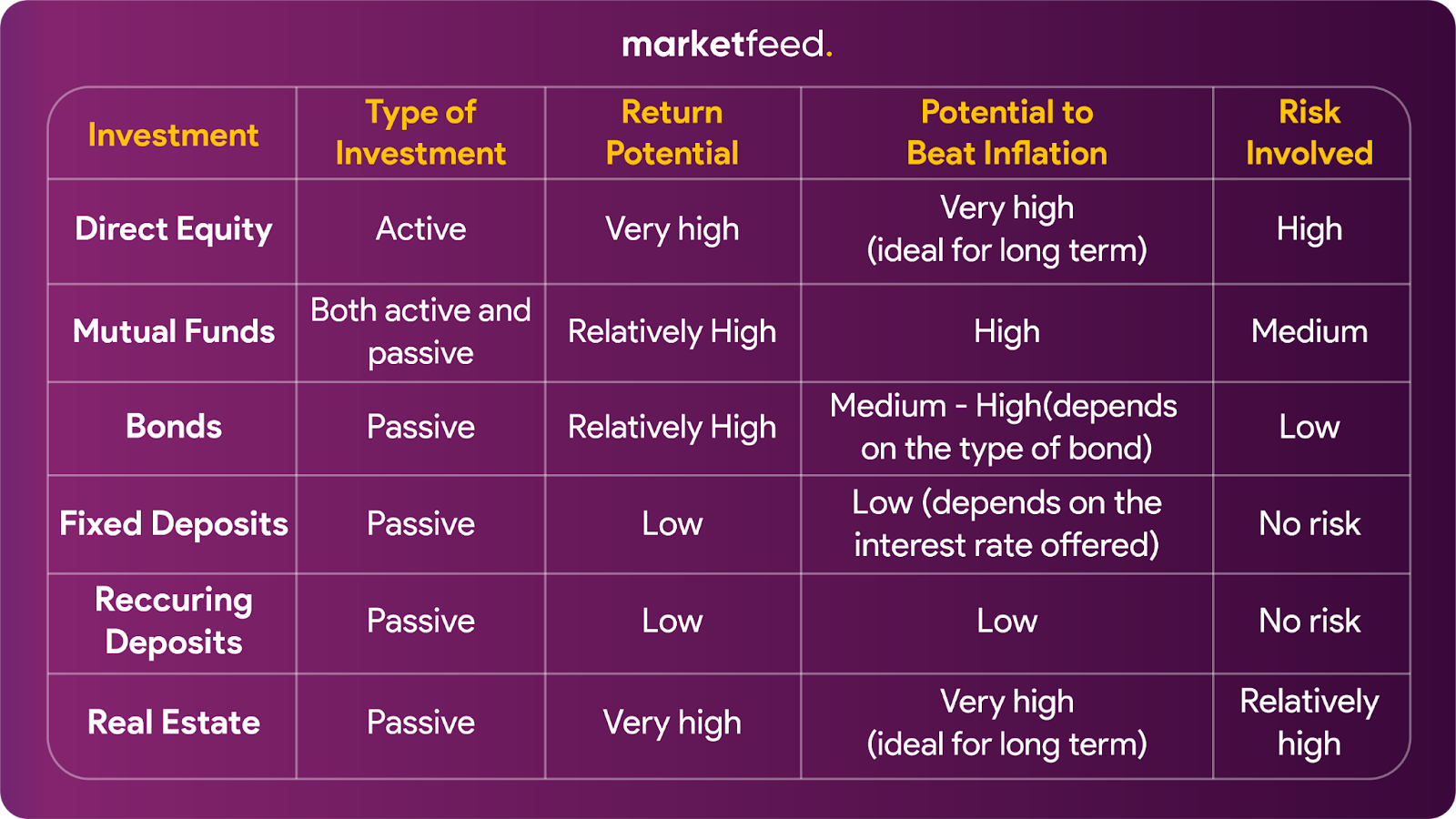
Direct equity means investing in stocks. When you buy stocks (or shares) of a listed company, you become part-owner of the firm (even though it’s a very tiny fraction). This means that you are directly investing in the company’s development and growth. In the long run, stock markets have always beaten inflation and have delivered higher returns than other asset classes. Thus, stocks are always ideal for long-term investments. To directly invest in shares or equity, you would need to open a Demat account.

However, investing in stocks contains a high level of risk. Stock markets are often very volatile, as a variety of factors (including interest rates, government policies, economic figures, company operations) influence the performance of stocks. You will have to actively manage your investments to limit losses. One needs to have a lot of patience and gain market knowledge to get sufficient returns. With time, you will learn how to pick the right stock and time your entry and exit. Target-oriented and well-researched stock market investments can definitely help you beat inflation.

Mutual Funds

If you are not comfortable with investing directly in stocks due to the risks involved, you can always invest in mutual funds. A mutual fund takes money (investments) from different individual and institutional investors who have a common investment objective. This pooled sum of money is managed by a professional fund manager, who invests in securities and assets to generate returns for investors. 

You can find equity, debt and hybrid mutual funds as a general classification. Equity mutual funds invest in stocks and equity-related instruments, while debt mutual funds invest in bonds and other debt instruments. Hybrid mutual funds invest in a mix of equity and debt instruments. There are various equity mutual funds based on market capitalization, tax-saving funds, sectoral funds, and much more. As per reports, the 5-year and 10-year returns of these equity fund categories were above 10% as of April 2021.

Mutual funds are a very attractive investment option as you do not have to spend much time and effort tracking them. Instead of investing a large sum of money all at once, you could start a Systematic Investment Plan (SIP) and invest small amounts of money periodically (usually every month) in mutual funds. They are very flexible, as you can begin and stop investing according to your convenience. However, one needs to conduct a proper analysis or study before investing in a particular mutual fund. Element of risk is also present as the returns are dependent on market movements.

Bonds

A bond is a fixed-income instrument issued by companies or even government entities to raise funds. Investors can lend their money to organisations in return for fixed yearly interest. At the time of maturity of the bond, you will receive the initial money you had invested and the interest offered on it. Nowadays, bonds offer fixed returns that are at least 2-3% higher than fixed deposits (FDs). Government bonds in India are an ideal investment option as it provides more than 7% guaranteed returns. 

Before investing in bonds, you need to consider and analyse important factors such as coupon rate (fixed interest that the bond pays annually), payment frequency (the number of times the interest is paid to the bondholder), maturity date, and credit rating. A higher-rated bond carries a higher level of safety of investment. AAA-rated bonds are the most secure.

Gold

Gold is one of the best asset classes that can be used to counter inflation. This is because the increase in gold prices and the returns from it have always been able to offset inflation in the past. According to the World Gold Council, for every 1% increase in inflation, there is a 2.6% rise in gold demand. This ultimately leads to an increase in gold prices. However, acquiring and holding gold in the form of jewellery has its own concerns such as safety and high cost.

An alternative way of owning gold is through paper gold or gold ETFs. These are units representing physical gold which may be in paper or dematerialised (electronic) form. One Gold ETF unit is equal to 1 gram of gold and is backed by physical gold of very high purity. The investments made in paper gold are less costly.

What are ETFs?

As the name suggests, an exchange-traded fund (ETF) is a fund that can be traded on the stock exchange. It is a method through which you can buy and sell a basket of assets without having to buy all the components individually. ETFs are managed by finance professionals who own certain underlying assets (such as stocks, bonds, currencies, and commodities). They design a fund to track the performance of these assets and then sell shares of these funds to investors.

ETFs are a great method to diversify your portfolio and manage risks. It is also a cost-effective method of investing and also offers several tax benefits.

Fixed Deposits, Recurring Deposits

Fixed Deposits (FDs) are an investment option offered by banks and financial institutions. It is something that most of us are familiar with. You deposit a lump sum of money for a fixed period and earn a predetermined rate of interest on it. The interest rate of FDs differs from one bank to another. However, the average rate of FDs in India is only 5-6%, which may be insufficient to beat inflation. FDs are favorable for those investors who wish to receive guaranteed, yet conservative returns.

Recurring Deposits (RDs) are a fixed-tenure investment option provided by banks and other institutions that allow individuals to invest a fixed amount every month for a pre-defined time period. The interest rate on RDs is determined by the institution offering them. RDs also offer complete capital protection as well as guaranteed returns.

Government Schemes

Public Provident Fund (PPF) is a long-term investment scheme provided by the Government of India (GoI) that has a lock-in period of 15 years. Currently, the annual rate of interest offered on PPF is 7.10%. The entire amount withdrawn at the end of the 15 years is entirely tax-free for the investor. You can also take loans and make partial withdrawals if certain conditions are met.

Employee Provident Fund (EPF) is a retirement-oriented investment scheme that helps salaried individuals. EPF deductions are a specific percentage of your salary every month, and the same amount is matched by the employer as well. This entire amount is pooled into your EPF corpus or account every month, and you receive interest on it. Currently, the annual rate of interest offered on EPF is 8.50%. At the time of maturity, the entire amount withdrawn from the EPF corpus is entirely tax-free.

The National Pension Scheme (NPS) is another tax-saving investment option offered by the Government of India. Anyone between the age of 18-65 years can make voluntary contributions to this scheme. Investors who subscribe to NPS will mandatorily stay locked in until their retirement and can earn better returns than PPF or EPF. Historically, NPS has delivered ~8-10% returns every year.

Real Estate

Investing in real estate is one of the best ways to diversify your portfolio. Since the value of a real estate property appreciates (or increases) with time, you can earn exponential returns on it. Acquiring a property and renting it out would be an ideal way to earn passive income. However, the location of the property is the most important factor that will determine its value and also the rental income that can be earned from it. In the case of residential properties, investors must always conduct a thorough study of home loan interest rates, offers provided by developers, and government regulations. Another important factor to consider is that real estate is highly illiquid. Properties cannot be sold off and converted into cash quickly.

If you don’t have adequate capital for acquiring real estate properties, you could always invest in a real estate investment trust or REIT. This is very similar to a mutual fund, wherein you can invest small amounts of money on certain income-generating assets and earn a good return from them. A REIT owns and operates several properties such as complexes, infrastructure projects, healthcare units, apartments, and more. The money pooled in from the REIT is used to manage these assets. And, the income derived from these properties or assets is shared among all investors (or unitholders) of the REIT.

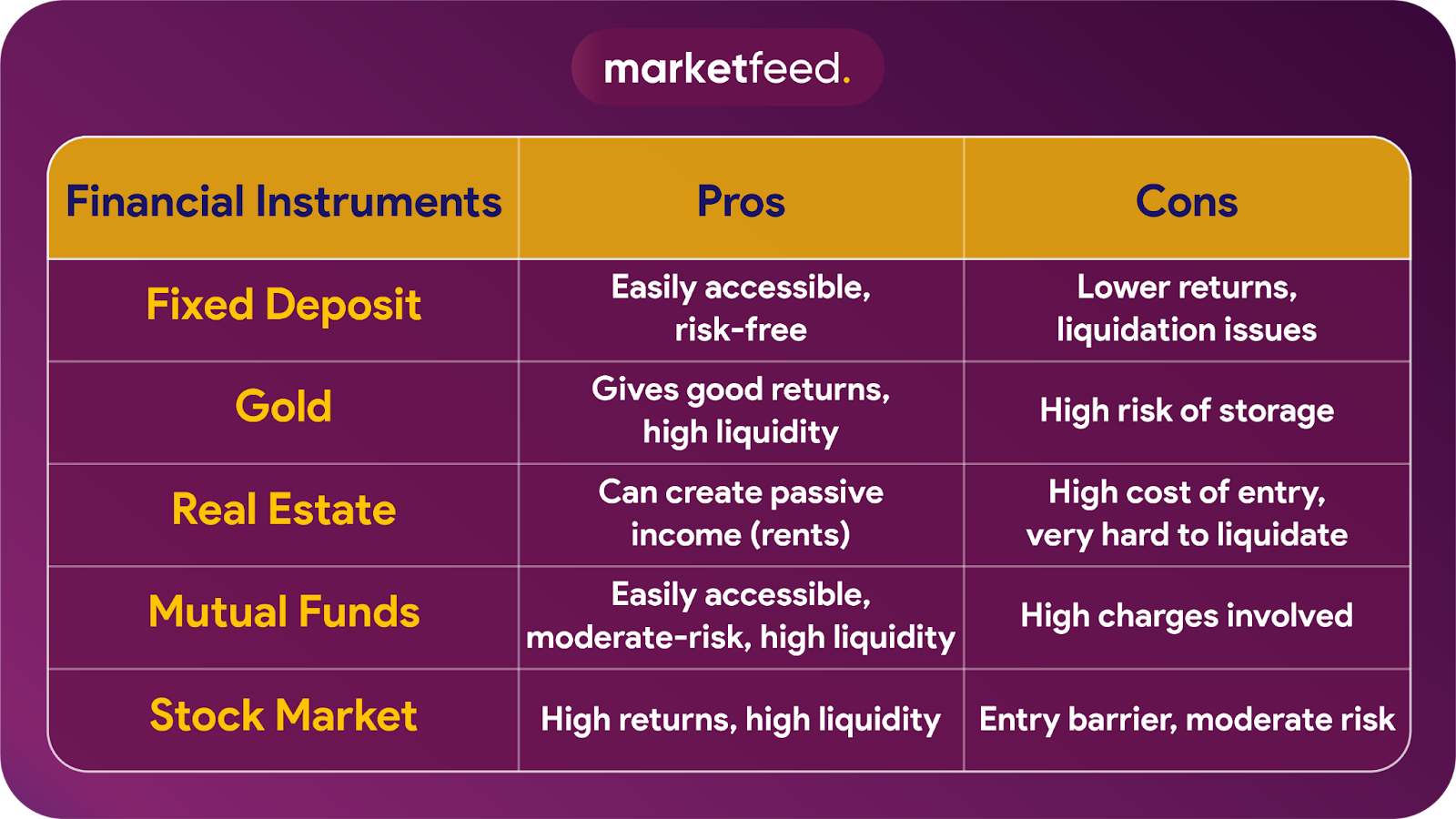
Types of Investments in a Nutshell

Conclusion

Now, you have an idea of how to grow your hard-earned income to beat inflation and lead a better life. However, it is up to you to figure out the right investment that fits your profile and financial goals. Start your investment journey only after carefully going through the risks and costs associated with each of them. Go for those investments that you clearly understand from your own research. At the same time, it is vital that you invest your money in different products and diversify your portfolio. More importantly, make sure you do not fall for scammy schemes that promise high returns in a short period. The sooner you start investing, the longer you will stay invested and earn higher returns.

Open a free Demat account –

Upstox
Zerodha

Happy Investing!

Categories
Jargons

Exchange-Traded Funds: What are they?

Exchange-Traded Funds or ETFs are listed and traded on exchanges like stocks. It is a fund that pools the financial resources of several people and uses it to purchase shares, bonds, derivatives, etc. The trading value of an ETF is based on the net asset value (NAV) of the stocks that are present in the fund. Thus, an Exchange-Traded Fund is said to have qualities of both shares and mutual funds.

One of the main benefits of ETF is diversification. When an investor invests in a stock, he does not have a space to limit his risk. If the company fails to perform, the investor will make losses. Now, an ETF helps you to keep your finances spread over the equities of different companies. If one of the stocks performs poorly, other stocks might act to limit the risk exposure by performing well. If other assets perform exceptionally well, an investor would still be earning profits.

Exchange-Traded Funds vs Mutual Funds

Exchange-Traded FundsMutual Funds
Market orders can be placedMarket orders cannot be placed
Traded intra-day like stocksTraded at the end of the day
Generally, a lower expense ratio than
mutual funds
Generally, a higher expense ratio when
compared to ETFs

Common types of ETFs

Gold ETF – Gold is a commodity. This makes the ETF a commodity ETF. A gold ETF is based on gold prices and it invests in gold bullion. Purchasing shares in this ETF makes you a virtual owner of gold.

Equity ETF – As the names suggest, these ETFs invest in the shares of different companies to earn interest and reduce risk exposure.

Currency ETF – The main objective of a currency ETF is to reduce the exposure to foreign exchange (forex) currencies.

Categories
Market News

Bharat Bond ETF: All you need to know

Bharat Bond ETF (exchange-traded fund) has been in news recently as its second tranche collected ₹10,992 crores. The ETF was launched on July 14 and closed on July 17 with a total size of ₹15,000 crores. Bharat Bond ETF was oversubscribed by three times.

  • In order to understand Bharat Bond ETF, firstly let’s understand what is a bond. A bond is a fixed-income security which allows a lender to lend a predetermined amount of funds and be eligible for interest on those funds. In simpler terms, it means that when we lend a certain amount to a borrower we are eligible for interest on that amount. In the case of government bonds, the borrower is the government and the lender is the person who bought the bond and as government rarely defaults on its loans, so the government bonds are extremely low risk
  • Now let’s understand what an ETF (Exchange-Traded Fund) is. An exchange-traded fund (ETF) is a type of security that involves a collection of securities such as stocks—that often tracks an underlying index. Let’s say there’s an ETF which tracks the Nifty 50 Index and if HDFC Bank comprises of 20% of Nifty Index, then in the fund 20% of the total amount is invested in HDFC Bank.
  • In the case of Bharat Bond ETF, it is a fund which tracks the Nifty Bharat Bond Index and invests in Government Bonds which are rated AAA (highest rating).

Edelweiss Mutual Fund’s Bharat Bond ETF NFO witnessed wide retail participation. It received over 40,000 applications.

The ETF will track Nifty BHARAT Bond IndexApril 2025 or Nifty BHARAT Bond Index – April 2031 depending on the maturity. The indicative yield of Nifty BHARAT Bond Index – April 2025 was 5.60% and Nifty BHARAT Bond Index – April 2031 was 6.75% as on July 06.

Bharat Bond ETF- April 2025 aims to invest in bonds of PSUs like PFC, REC, Power Grid Corporation of India, National Housing Bank, IOC, National Bank for Agriculture & Rural Development, Hindustan Petroleum Corporation, NHPC, Export-Import Bank of India, Indian Railway Finance Corporation, NTPC, Nuclear Power Corporation of India.

Bharat Bond ETF- April 2031 aims to invest in public sector companies like PFC, REC, Power Grid Corporation, National Highways Authority of India, Nuclear Power Corporation of India, Indian Railway Finance Corporation of India, Housing & Urban Development Corporation and NHPC.

Here is the information you need to know about Bharat Bond ETF NFO (New Fund Offering) managed by Edelweiss Mutual Fund:

Q1. What is Bharat Bond ETF?
Ans. Bharat Bond ETF is Exchange Traded Bond Fund which tracks Nifty Bharat Bond Index, which is managed by Edelweiss Asset Management Company. ETF’s invests in a basket of Bonds issued by CPSUs, CPSEs and other government organizations. It offers high security and safety, since all of the bonds are AAA- rated PSU Bonds. The ETF s will be listed on the stock exchange where they can be sold or bought by the investor thereby increasing the liquidity.

Q2. What is their investment strategy?
Ans. It has a Fixed Maturity Period. It follows the Nifty Bharat Bond Index. It holds the bonds till the Maturity and Re-invests the coupons received i.e compounded interest. 95% of the asset is allocated towards AAA-rated PSU Bonds and 5% towards government Securities and REPO Instruments in order to manage the liquidity of the portfolio.

Q3. What are the benefits you avail if you invest in Bharat Bond ETF? Ans.

  1. Stability and predictability of returns at maturity as they invest in AAA-rated Public Sector Undertaking Bonds
  2. Highest Safety: AAA is the highest rating of an instrument and so the invests have an extremely low-risk factor
  3. Transparency: Daily disclosure of portfolio constituents so that the investors are not kept in the dark
  4. No Lock-in: There is no lock-in of capital such as in a PPF, the buyer can buy/sell on the exchange(both BSE & NSE) at any time
  5. Tax Efficient: The investors get the benefit of indexation. Let’s say I invest ₹100 in the market which becomes ₹130 in 3 years, if we assume inflation at 7% then the cost of acquisition is not ₹100 but it is ₹100+7+7+7=₹121. so the 20% tax will not be applied on ₹30 gained but on ₹130-₹121=₹9. In the case of fixed deposits, the total gain is taxable.

Q4. What is the minimum investment amount and cost of management?
Ans. Fund of fund allows to invest a minimum of ₹1,000 and in multiples of Re 1 thereafter. The fund will be managed at a very low cost of maximum Re 1 for ₹2,00,000 worth investment. The fund will charge 0.0005% per annum for assets up to ₹10,000 crores.

In conclusion, it gathered a lot of risk-averse retail investor participation through its attractive minimum investment requirement. So it is for the time that whether Bharat Bond ETF will live up to the hype or not.