Categories
Jargons

The BEST Framework to Create a Diversified Stock Portfolio

Constructing a well-balanced and diversified stock portfolio is an essential strategy for investors seeking long-term success. To ensure optimal returns and reduce risk, it’s important to understand the complexities involving diversifying your investments. In this article, we explore what a portfolio is and how you can diversify your investment portfolio with the best framework

What is a Portfolio?

A portfolio can be defined as a collection or basket of securities. It’s vital we invest in multiple assets from different asset classes and sectors. A portfolio of assets can help you build wealth over the long term. We target a portfolio return of 15-25% CAGR over a long investment horizon, which is more than enough to achieve financial freedom.

Why Should You Diversify?

Apart from not staying invested for the long term, another common mistake that beginners make while starting long-term investing is that they invest in just 2-3 stocks. Beginners follow tips from social media channels that claim multi-bagger returns if they invest in these 2-3 stocks. But what would happen if any 2 out of these 3 stocks start performing poorly? You are going to lose most of your money. Therefore, the first and most important objective of a portfolio is to diversify and provide downside protection.

Portfolio: Not Necessarily Downside Protection

Apart from downside protection, a portfolio can reduce risk by combining securities whose returns do not correlate. Sometimes, an asset class or a sector might go down in value while another sector or asset class goes up in value. Combining assets that have a negative correlation helps to offset each other. 

The Modern Portfolio Theory (MPT) states that investors should not only hold portfolios but should focus on how individual securities in the portfolios are related to one another. Although this theory has many limitations, the principles of this concept continue to be the foundation of knowledge for portfolio managers.

You Only Live Once (YOLO)?

We always preach investing in a portfolio of stocks rather than just 3-4 stocks that could be the next multibagger. But should you do it? It is absolutely possible to invest in just one stock and reap 10x returns. However, we would not recommend this for a consistent long-term wealth-building strategy.

By investing in just 3-4 stocks, you are potentially harming your way to financial freedom. What would happen if your strategy fails? You lose your money, your financial freedom, your mental peace, and a lot more. But by choosing the safer path and investing in a diversified portfolio, you can achieve your retirement goals and financial freedom. 

The win-win solution to this problem is to consistently invest the amount you need to achieve financial freedom by retirement, and any sum of money over that amount, you can use for doing YOLO investments and potentially become the next Rakesh Jhunjhunwala. This way, you can make concentrated investments into potentially multibagger stocks without a trade-off on your financial freedom.

Asset Class Diversification

An asset class is a group of assets or investments that have similar characteristics. There are two types of investments: traditional and alternative. Traditional investments consist of publicly traded investments in stocks, bonds, and cash. Alternative investments are broadly classified into: private capital, real assets, and hedge funds. The alternative investment asset that we will be investing in is gold, which falls under real assets.
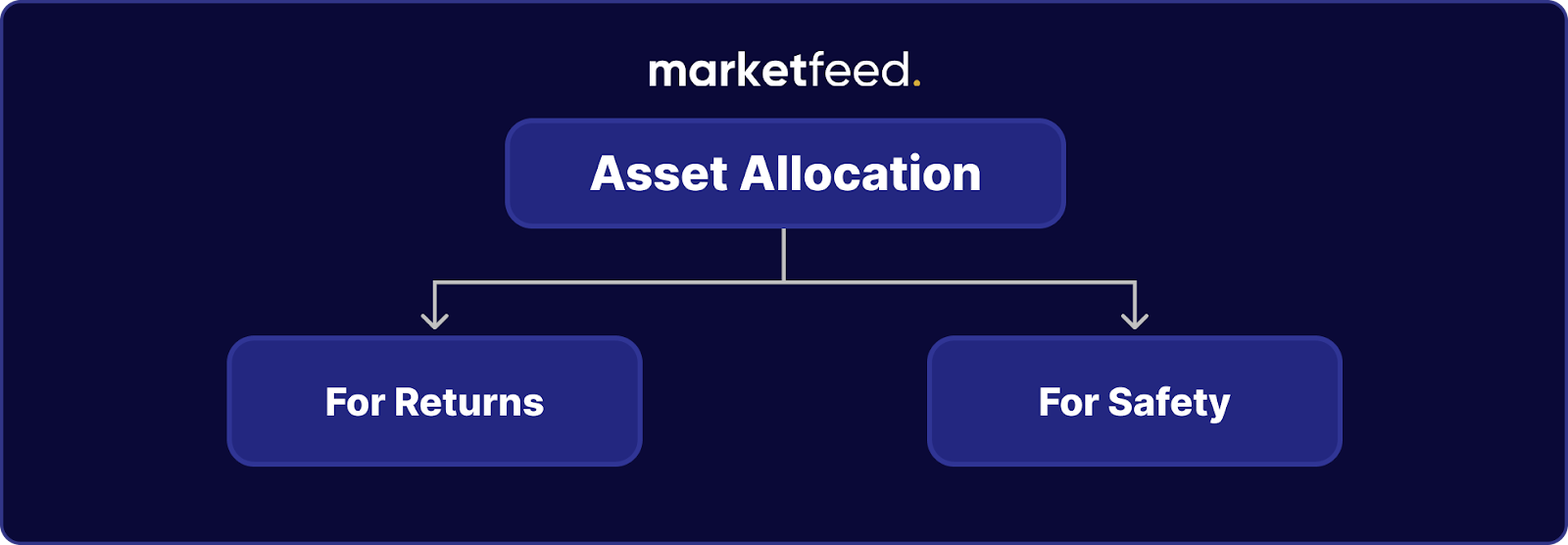
asset allocation | marketfeed

1. Equity will contribute to growth – High ROI but higher risk

You can directly invest in equity directly or indirectly by investing in equity mutual funds.

2. Debt & Gold will contribute to safety – Low ROI but lower risk

  • You can invest in debt mutual funds or liquid bees ETF
  • You can gain exposure to gold by investing in gold ETFs, digital gold, and sovereign gold bonds (SGBs).

3. The minimum recommended equity-debt allocation is 80-20. As your age increases, you can invest more into debt than equity.

Why invest in debt and gold?

Debt instruments give fixed returns as compared to equity. Therefore, even when the market is in bad shape, debt instruments can give you returns. Gold belongs to real assets under alternative investments. Traditional investments and alternative investments have a negative correlation and thus offset the negative returns that the equity in your portfolio might make.

Market Cap Diversification

Market capitalization refers to the total value of all of the company’s issued shares. It’s the valuation of a company. 

Market Cap = Current Share Price x Total Outstanding Shares. 

Market cap diversification refers to the diversification of equity based on the market capitalization of stocks. The three different market cap divisions are:

1. Large-cap – Stocks that have a market cap of more than ₹20,000 crores. The top 100 companies with the highest market capitalization fall under large-cap. These are also known as blue chip stocks.

2. Mid-cap – Stocks that have a market cap of fewer than ₹20,000 crores but higher than ₹5,000 crores.

3. Small-cap and micro-cap – Stocks that have a market cap of fewer than ₹5,000 crores. 

Moderately Aggressive Portfolio

  • Large-cap – 50%
  • Midcap – 30%
  • Smallcap – 10% (first 250 small-caps)
  • Microcap or Bluechips – 10%

You can invest the final 10% of your portfolio into small caps or blue chips depending on your risk appetite.

As a thumb rule, your portfolio should comprise 50-70% large-cap stocks, 20-40% midcap stocks, and 10-20% small-cap stocks.

Sectoral Diversification

A sector refers to a group of companies from the same industry. Given below are  the major sectors in the Indian stock market:

  • Automobile
  • Bank
  • Consumer durables
  • Financial services
  • FMCG
  • Health
  • IT
  • Media
  • Metal
  • Oil and Gas
  • Pharma
  • Realty

Another common mistake beginner investors make is investing in just 1-2 sectors, which is equally disastrous as investing in 2 or 3 stocks. If the industry or sector starts performing poorly, the whole portfolio might go down.

We should give exposure to at least 4-5 sectors and generally align with the market when we invest for the long term. But what does aligning with the market mean? It means that we should take NIFTY’s sectoral diversification as a reference:
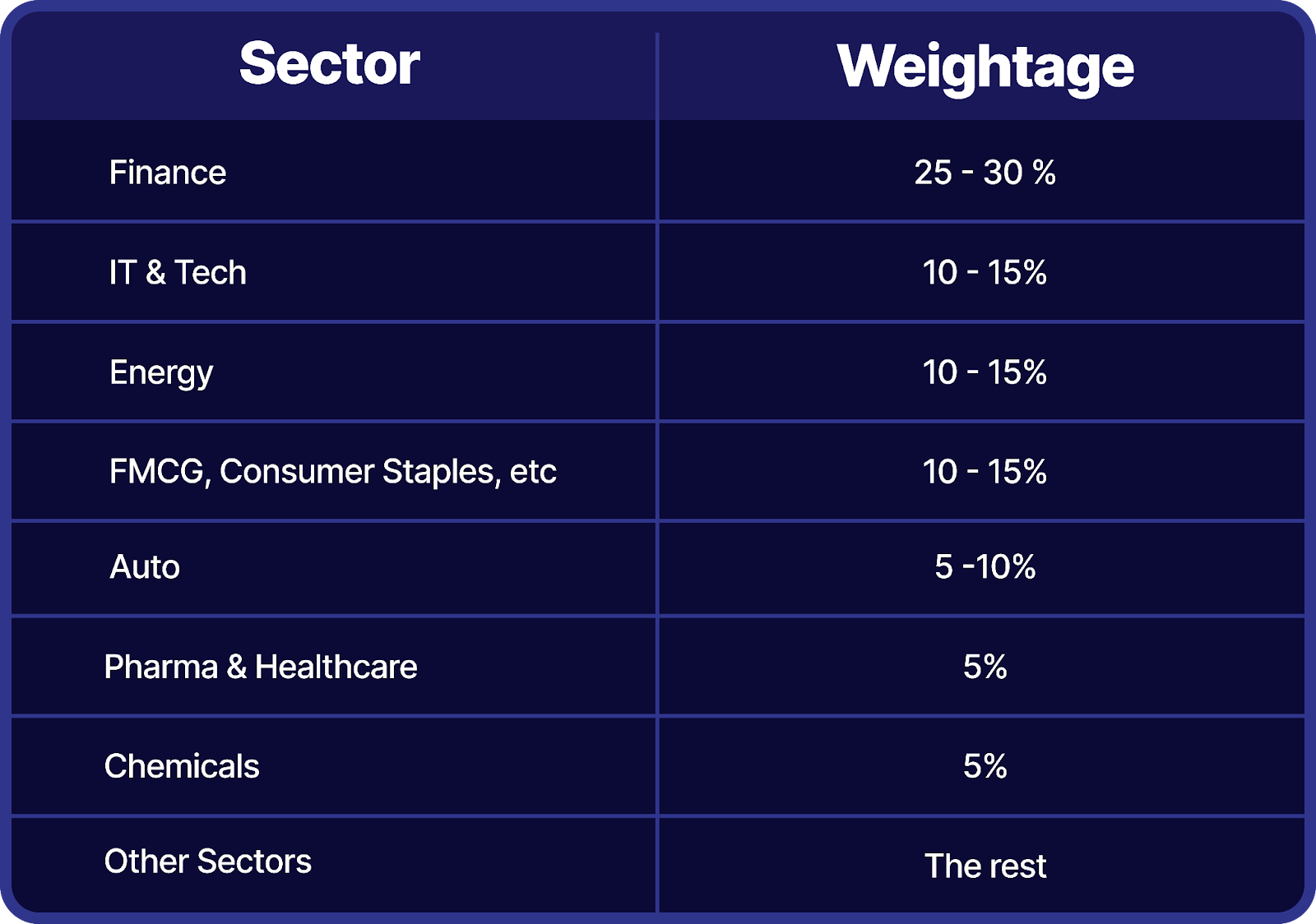
sector diversification

We can follow a similar sectoral diversification while creating a portfolio.

Rules to Follow

1. Do not invest more than 20% of your capital into a single stock.

2. Do not invest more than 40% of your capital into a single industry.

3. Do not invest more than 15% of capital in small caps.

4. Always diversify.

5. Review your exposure frequently.

6. Don’t fall under peer pressure.

7. Always keep some cash available to invest if the market falls. Remember that every fall is an opportunity to invest more.

Model Portfolio

A model portfolio has been created by us for reference in collaboration with industry experts. This portfolio is well diversified and contains 19 stocks across 10 sectors. Even if a few of the stocks start doing badly, the overall portfolio won’t be affected much.
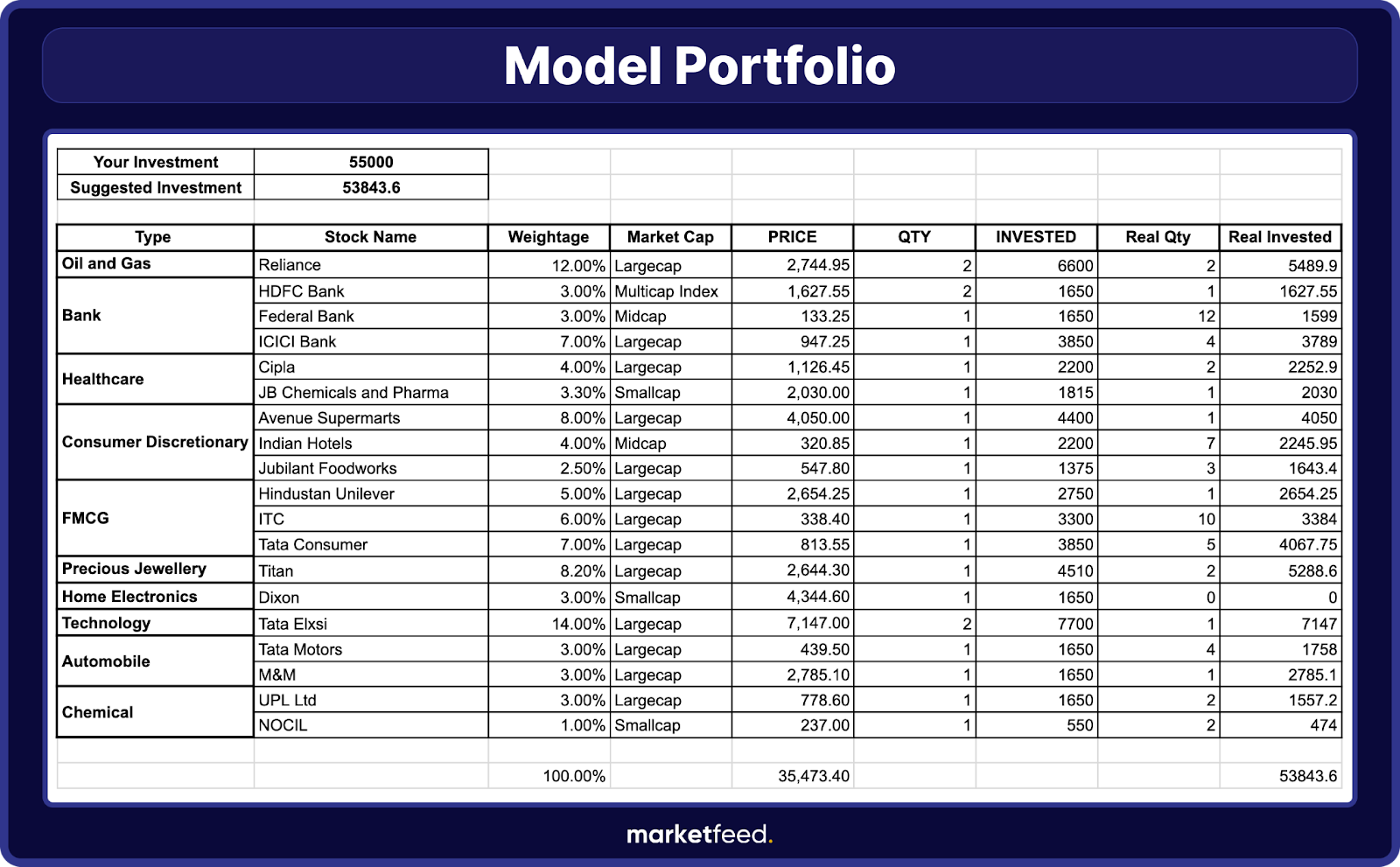
model portfolio - diversification | marketfeed

How to Create a Diversified Portfolio – The Flow

Let’s summarize and structure what we learned: 

1. Find potential quality stocks to invest in 

2. Perform fundamental analysis

  • Read and analyze annual reports
  • Read and analyze financial statements
  • Perform ratio analysis
  • Find valuation
  • Decide on value or growth investment strategy

3. Make a list of stocks that you find investment-worthy and classify them based on market cap and sector.

4. Decide on capital allocation to each sector and market cap.

5. Compile a portfolio of 15-20 stocks

6. Start investing!

Throughout this article, we have learned how to create a well-diversified portfolio for your long-term investment journey! Happy Investing!

Categories
Jargons

Broker’s Terminal and Different Order Types Explained (Zerodha)

Let’s learn how to navigate a broker terminal, explore the various features it offers, learn the different types of orders available, how to fund your account, and finally how to buy & sell a stock. 

For this tutorial, we will be using Zerodha’s mobile app— Kite. We recommend you add some funds to your trading account and follow this tutorial so that you can gain first-hand experience with the broker’s trading terminal.

Understanding the Broker’s Terminal

When you first log in to your account on Zerodha’s Kite app, you will be greeted with the watchlist tab by default. The app has five main tabs. The top left corner of the app displays the name of each tab.

1. Watchlist & Overview

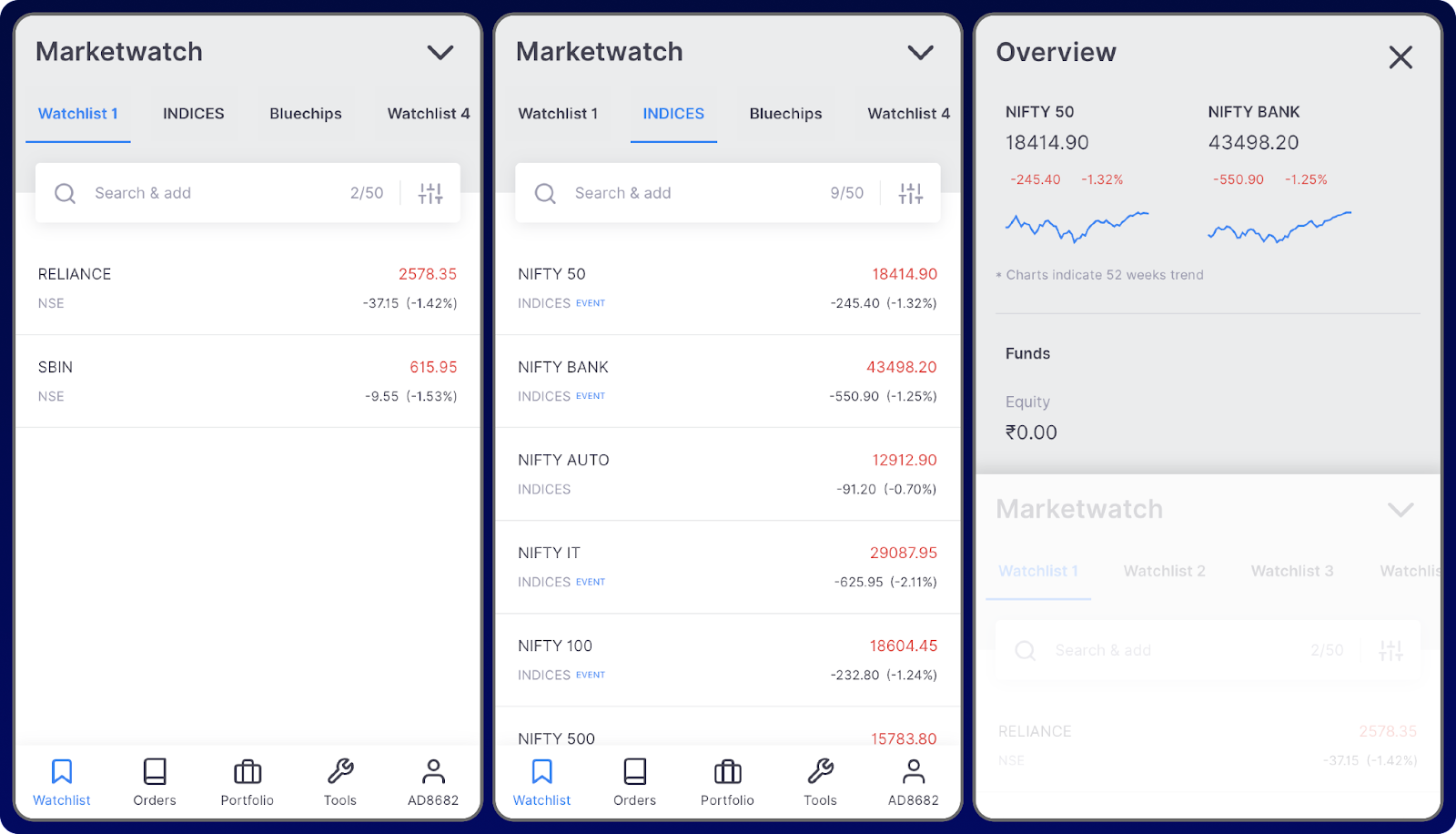
The watchlist tab contains a list of securities to which you can add stocks and other financial instruments and monitor them for potential trading and investing opportunities. You can customize up to seven watchlists based on your needs. The dropdown arrow in the top left of this tab brings down the overview feature, which shows brief data on the prices of NIFTY50 & BankNifty and the funds in your account.

Zerodha Watchlist | marketfeed

How to Add a Stock to Your Watchlist?

1. Select any watchlist from the tab
2. Click on search & add 
3. Type the name of a stock. eg: Reliance 
4. Click on the + icon parallel to the stock name
5. Click on < arrow on the top left
6. The watchlist will display the stock you selected

To add stocks to other watchlists, click on any of the watchlists from the top panel and repeat the steps. You can add up to 50 stocks to a watchlist.

How to Rename a Watchlist?

1. Click and hold on the name of the watchlist you want to change

2. Click on the edit icon 

3. Type the new name

4. Click on save, and your watchlist will be renamed

How to Remove Stocks From the Watchlist?

1. Click and hold on the watchlist name

2. Click on the delete icon parallel to the stock that you want to delete

3. Click on save

How to Reorder Stocks in Your Watchlist?

1. Click and hold on the name of the watchlist

2. Click on the dots to the left of the stock’s name, and drag up or down to change the order

3. Click on save

How to Filter & Sort Your Watchlist?

1. Click on the configure icon to the right of the search bar
2. Under the filter section, select or unselect NSE & BSE to filter your watchlist according to the stock exchange
3. Under the sort section, there are three parameters:

  • A-Z Alphabetically – Sorts the watchlist in alphabetical order
  • % Change – Sorts the watchlist on % change in price
  • LTP – Sorts the watchlist in ascending or descending order of LTP

2. Orders

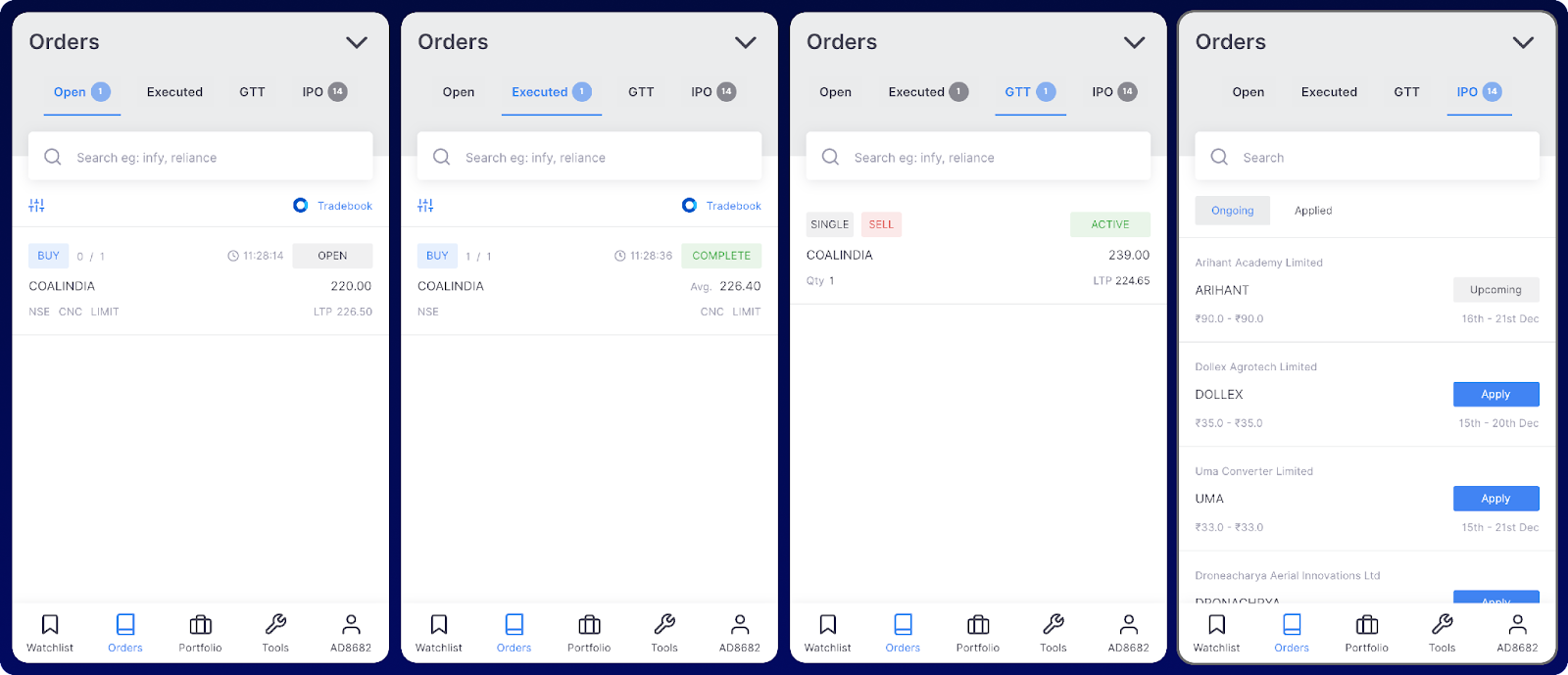
An order is an instruction given to the broker to buy or sell a stock. There are 4 subtabs in the orders tab:

broker order types | marketfeed

1. Open: When you place an order, it will be shown here until the order gets executed

2. Executed: Once the order is executed and the stock is bought, it will be shown in the executed tab.

The details in open and executed tabs are only valid for a day and clear themselves on the next day.

3. GTT: GTT stands for Good Till Triggered. This tab shows all the GTT orders placed with the broker. We will learn about GTT in the coming sections.

4. IPO: This section contains details about ongoing IPOs and applied ones will be shown here.

3. Portfolio

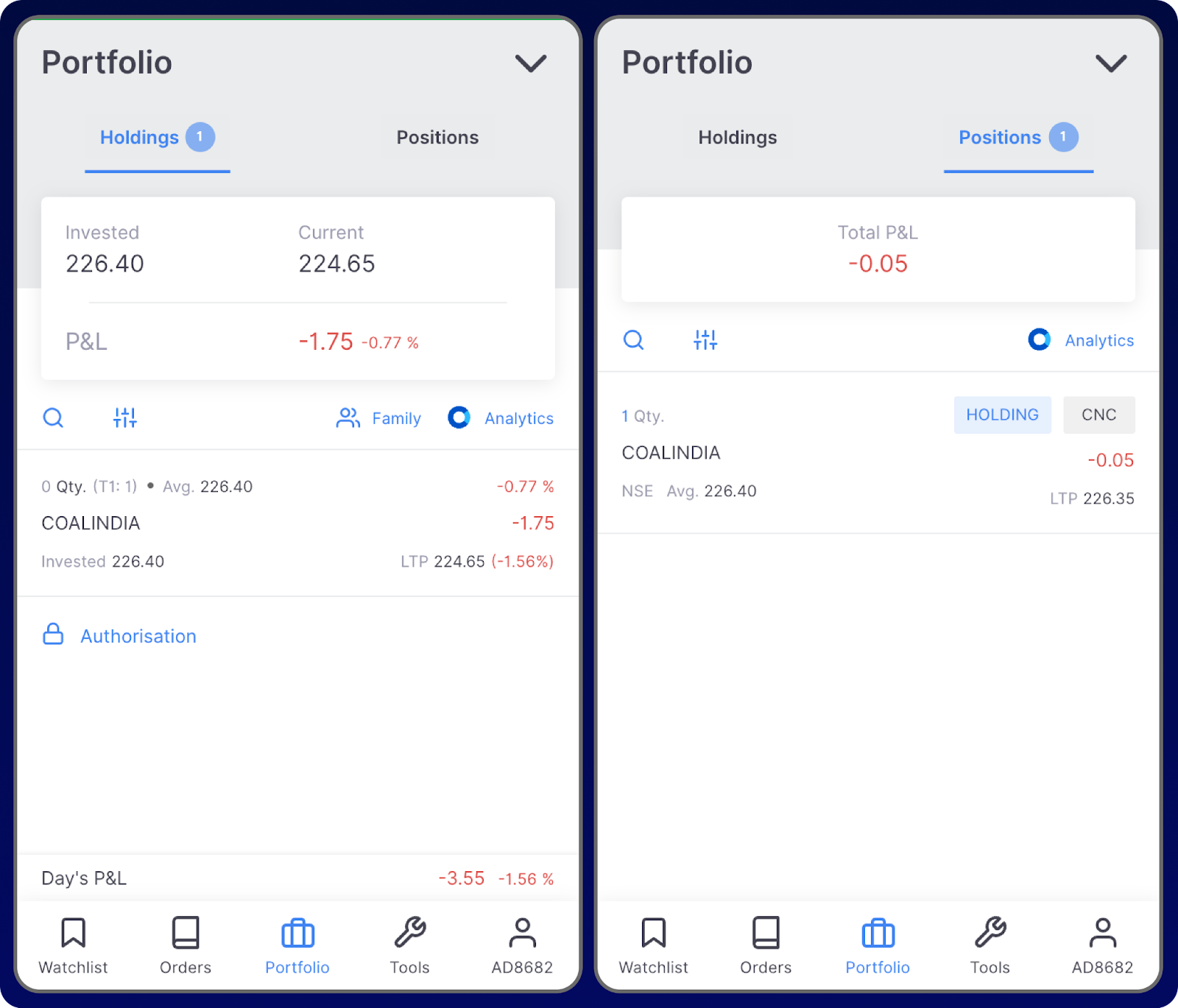
There are two subtabs in the portfolio tab:

Portfolio Zerodha | marketfeed

1. Holdings

This tab displays all the stocks that are in your Demat account. The feature not only presents a summary of the holdings, including the invested amount, current value, and returns generated but also provides details about each individual stock holding.

  • T1 mark near a stock means that it is a T1 holding. T1 will disappear the next day.
  • Day’s P&L shows the changes in the profit or loss of the holdings on any given day.

2. Positions

This tab shows all the trades/investments that you took on that particular day. 

When you buy a stock, it will be shown in the positions tab on that day and will be shown in the holdings tab the next day.

4. Tools

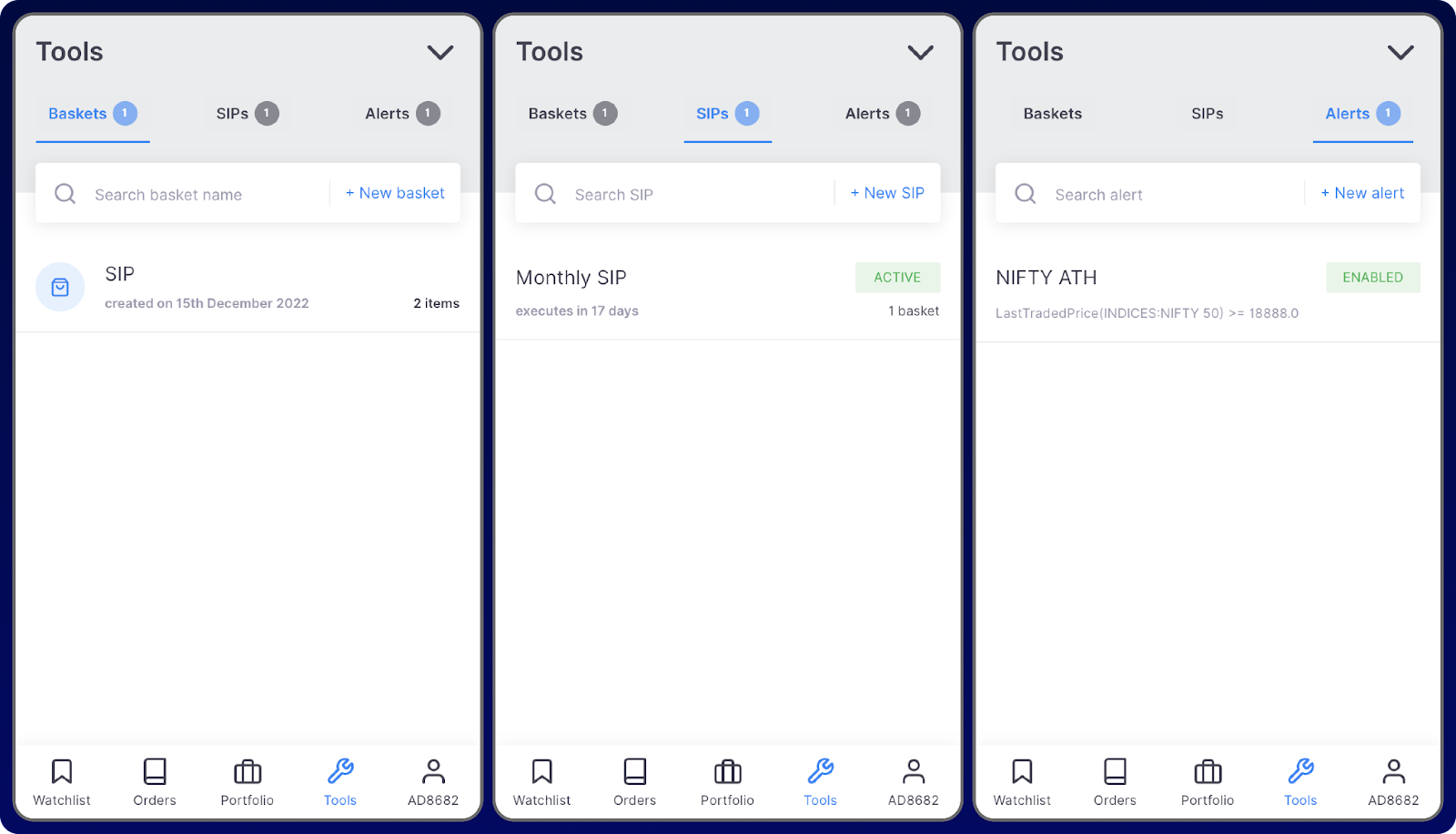
There are 3 subtabs in the tools tab:

Tools Zerodha | marketfeed

1. Baskets

A basket is a feature that allows you to buy a group or portfolio of stocks rather than buying them individually.

2. SIPs

Systematic Investment Plans (SIPs) allow you to invest a certain amount of money into stocks and other securities at regular intervals. Once you create a basket, a SIP can be done on a particular basket.

3. Alerts

This feature allows you to create alerts on stock prices so that you don’t need to monitor them constantly.

5. Profile

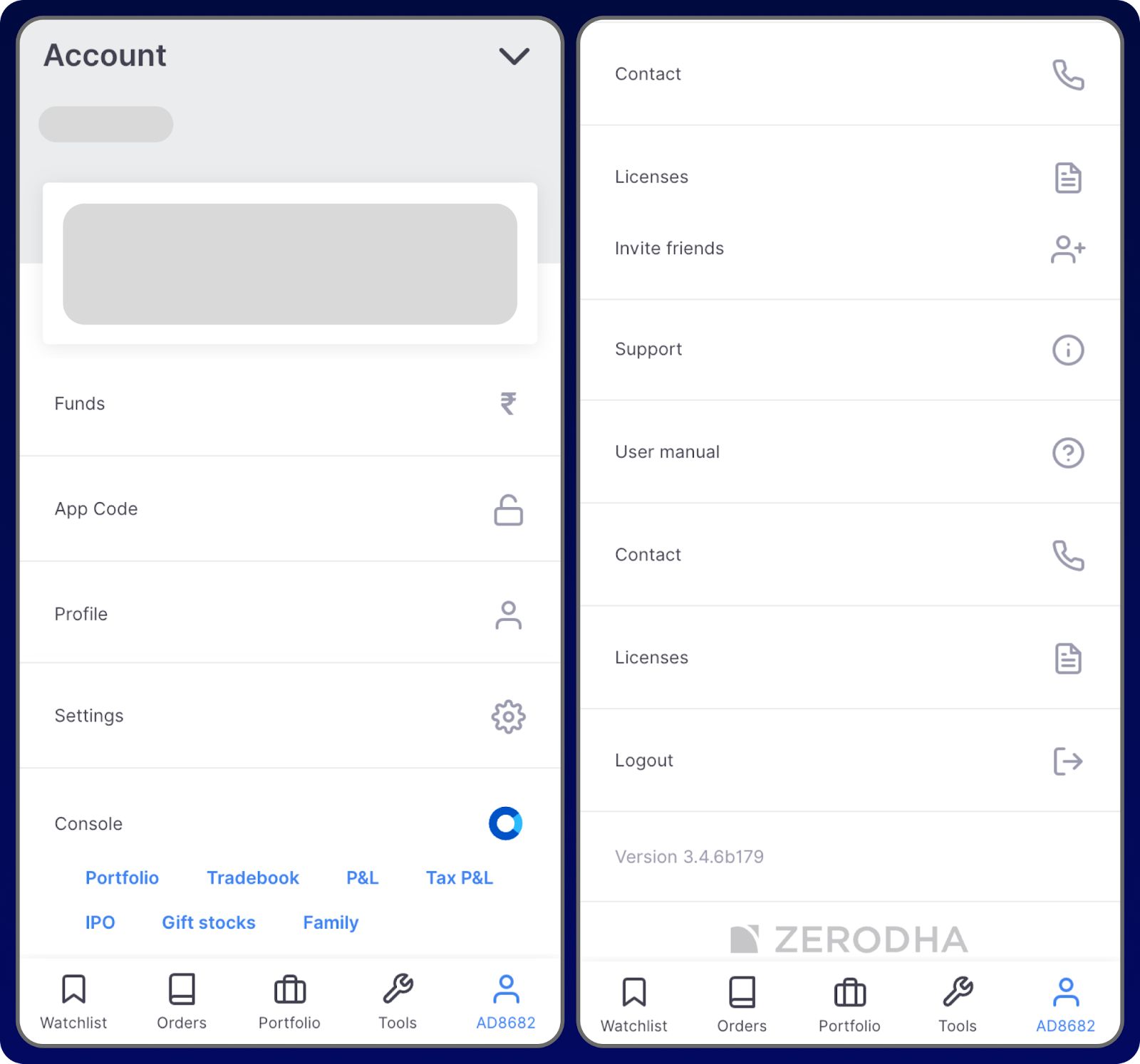
This tab shows all the account settings and profile information: 

Profile | marketfeed
  • Funds – This section is where you deposit and withdraw funds into your trading account.
  • App Code – It displays the code to log in to Kite web.
  • Profile –  Shows all your profile information such as your name, client code, email, phone number, etc
  • Settings – This option allows you to change various settings within the app.
  • Console – Console is the back office of your Zerodha account.
    • Portfolio option shows a detailed view and breakdown of your holdings.
    • Tradebook shows all the trades you have taken on any particular day or range of days.
    • P&L shows the total amount of money you gained or lost in a particular period.
    • Tax P&L displays all the documents required to file tax returns with the Income Tax Department. 
    • IPO displays all the current and upcoming initial public offerings (IPOs). You can also apply for IPOs via Zerodha.
    • Gift Stocks is a feature that allows you to gift stocks to other Zerodha users.
    • Family allows you to add up to 10 family member portfolios (Zerodha accounts) and track the consolidated portfolio through one account. Only viewing and tracking are allowed after explicit authorization from the family member’s account.

Apart from these five tabs, there is an overview section in the app that displays two indices, NIFTY and BANKNIFTY, by default. It also shows the funds available in your account to trade. You can access the overview section from the dropdown pin on the top right corner of the screen and is accessible from any tab in the app.

Features in the Order Placement Window

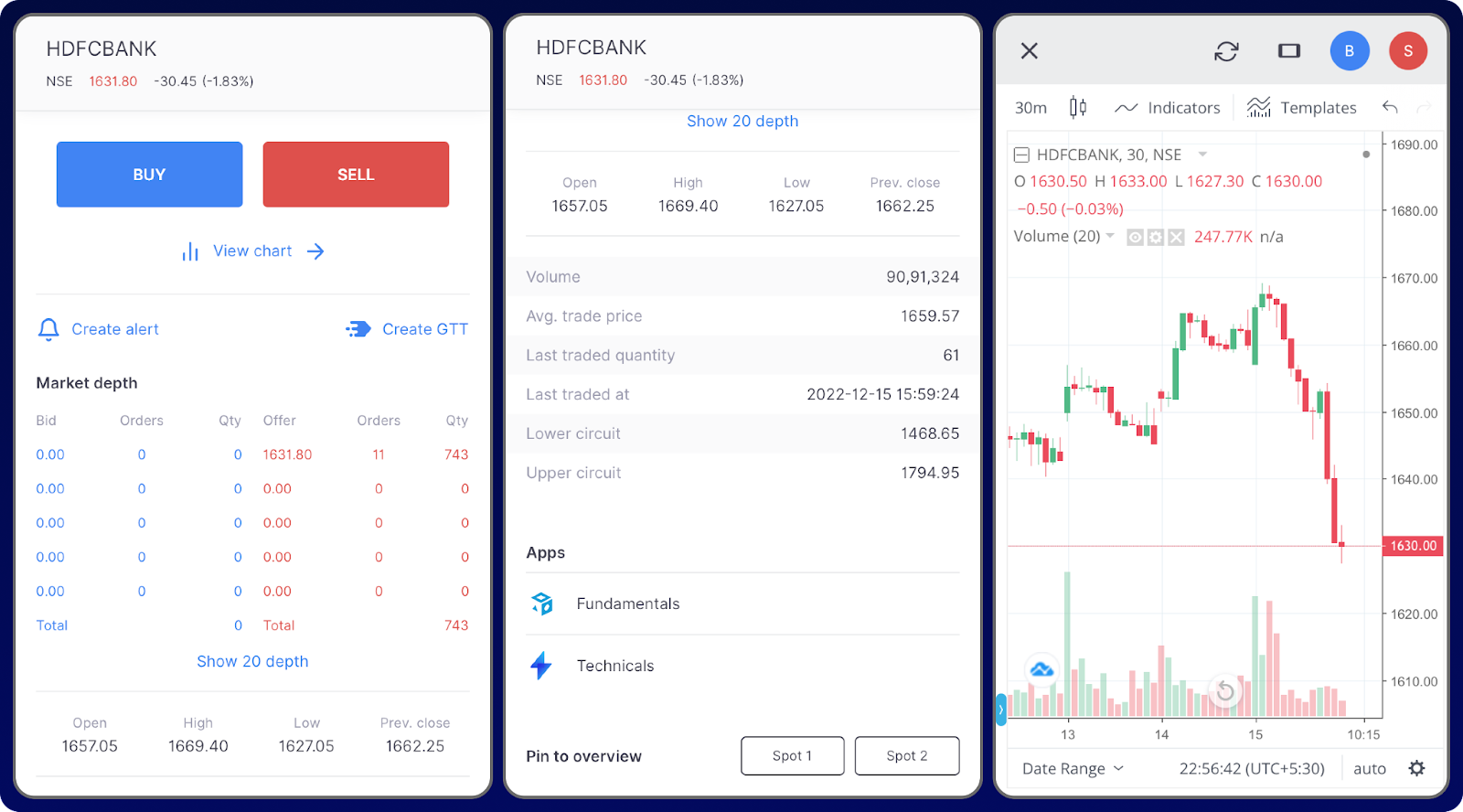
Order Placement Window | marketfeed

Invoke the order placement window by clicking on any scrip and pulling it up.

1. On the top of the window, the details of the scrips such as the name of the listed exchange, LTP, and price change are displayed.

2. A buy and sell button follows, which you can click to place an order.

3. Option to view the price chart of the scrip. We will learn about charts in the upcoming modules.

4. Option to set a price alert on the stock.

5. Option to create a GTT order for the stock.

6. Market depth is a real-time list displaying the bids and offers for the stock. Buyers place orders called bids, and sellers place orders called offers. It displays the top five bids and offers including their quantity, price, and orders. 

7. Shows Open, High, Low, & Previous Close

  • Open represents the price at which the stock opened today.
  • High represents the highest price the stock traded at.
  • Low represents the lowest price the stock traded at.
  • The previous close shows the closing price of the previous day.

8. Various data such as volume, average trade price, last traded quantity, and last traded at are shown along with the lower circuit and upper circuit. We will discuss what upper and lower circuits are in the upcoming modules.

9. The fundamentals and technicals of the stock can also be viewed in detail.

Types of Orders

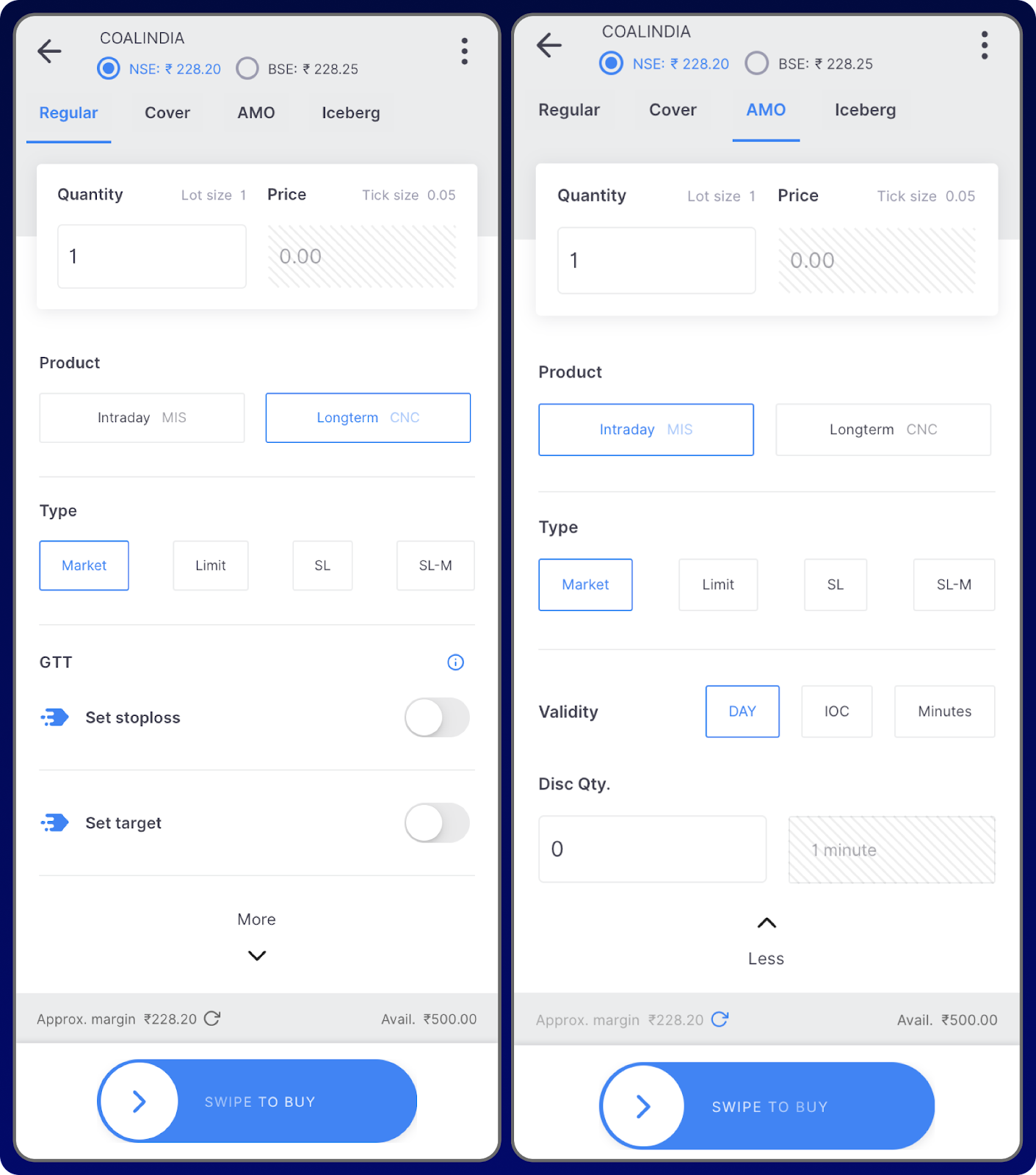
You can either place a buy order or a sell order. A buy order instructs the broker to buy a stock and a sell order instructs the broker to sell a stock. There are Regular orders, Cover orders, AMO orders, and iceberg orders for buy and sell. 

What are Regular, Cover, AMO & Iceberg Orders?

These are different types of buy and sell orders. 

  • Regular orders are normal orders that we place to make trades.
  • A Cover Order (CO) is an order with an in-built risk mitigation mechanism. Simply put, a cover order is a market order or limit order that is placed along with a stop loss order. 
  • An AMO order (After Market Order) allows you to place orders for the next trading day This is especially helpful for people who can’t actively track the markets during the live session – 9:15 am to 3:30 pm. AMO orders are allowed for all product types (CNC/MIS/NRML) except for CO.
  • An Iceberg is an order type that slices orders of larger quantity (or value) into smaller orders, where each small order, or leg, is sent to the exchange only after the previous order is filled. This is only used for orders with huge volumes.

Both buy and sell orders have the following order types, execution, and validity instructions.

Product

  • Intraday – This order is placed for taking intraday trades. This is how we tell our broker upfront that we will be taking an intraday trade and will exit it on the same day before the market closes.
  • Longterm – This order is placed for taking delivery of stocks. We place a long-term (CNC) order when we want to buy and hold stocks for the long term.

Execution Instructions

  • Market Order – To buy a stock at the current market price.
  • Limit Order – To buy a stock at a specific price. If the limit price is below the current market price, it will effectively act as a market order, and the order will be immediately executed.
  • Stop-loss order (SL) – To buy a stock above the current market price. Set the trigger price, the price above which you want to buy the stock. Also, set the limit price, the price at which you want to buy the stock when the price reaches the trigger price.

    Eg: Suppose the current market price of a stock is ₹98 and you want to buy the stock at ₹102 only when the price crosses ₹100. Then place an SL order with a trigger at ₹100 and a limit price of ₹102.
  • Stop-loss Market order (SL-M) – This is a type of SL order in which the stock will be bought at the current market price when the price is triggered. Only a trigger price has to be entered.

Validity Instructions

  • Day Order – The order will be valid till the end of the day if the day order is placed, which means that it will be open until the end of the day.
  • Good-Till-Triggered – A GTT order will be valid for one year. If the order is not executed today, it will be open for 1 year.
  • Immediate or Cancel Orders – The order if not executed right after placing, will be canceled.

How to Add Funds to Your Account?

You can fund your account using various payment methods including UPI and net banking. There will be zero charges if you fund your account via UPI.

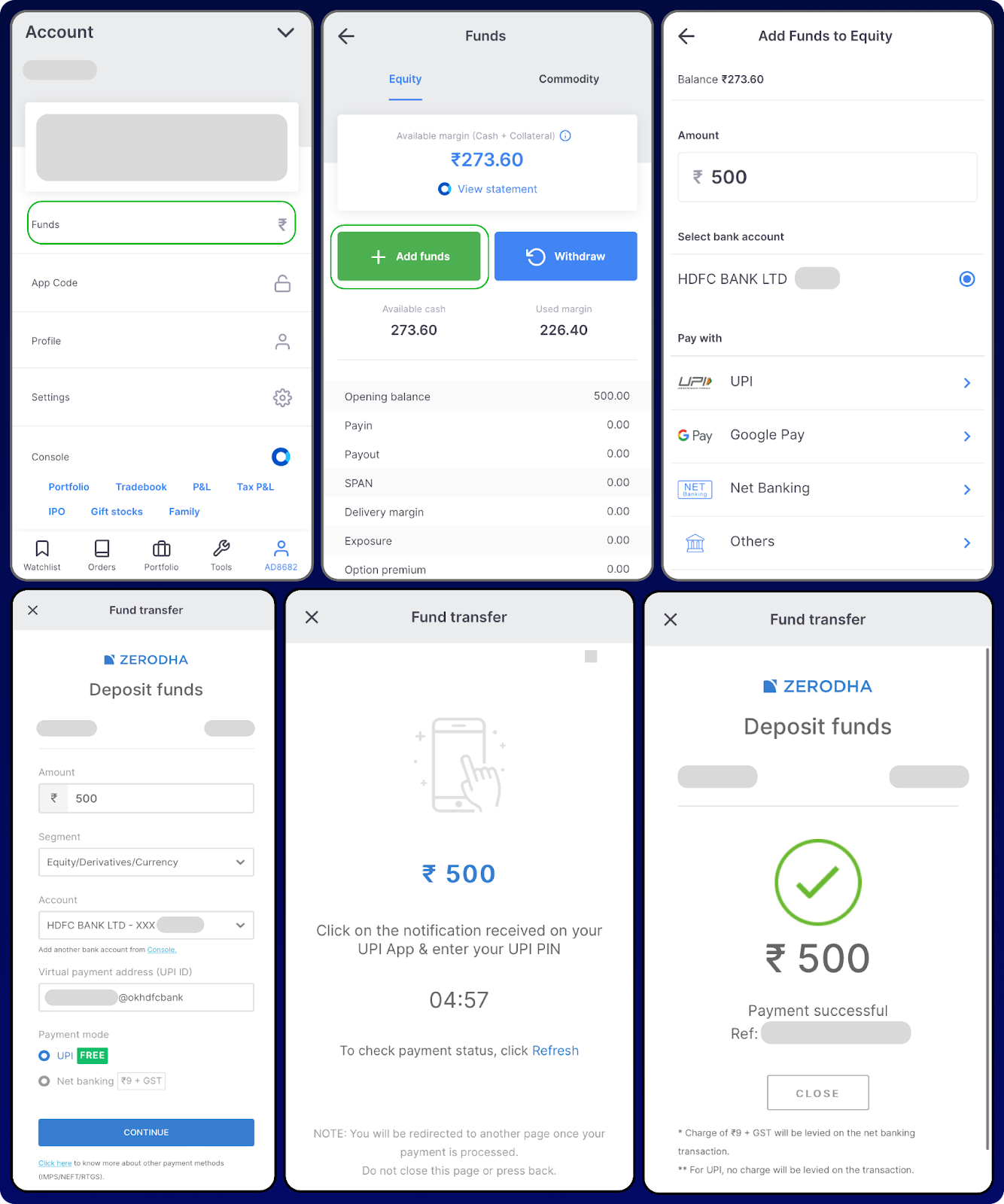
Here are the steps to add funds to your account:

1: Go to Profile and Click on Funds

2: Click on Add funds

3: Enter the amount that you want to deposit

4: Select the payment method

  We will select UPI as the payment method here.

4: Complete the payment

  Voila! You’re done.

You’ve now learnt how to navigate the broker’s app and the different types of orders and their use cases in this chapter. We also discussed the steps to add funds!

Categories
Jargons

How to Safely Invest in Stocks and Make Money

In today’s fast-paced financial world, investing in stocks has become an attractive option for individuals looking to grow their wealth. However, it’s important to approach stock market investing with caution and a well-thought-out strategy. This article serves as a comprehensive guide on how to safely invest in stocks and make money while minimising risks.

(Before diving into the world of stock market investing, it’s crucial to learn the basics and understand the risks associated with it. Learn concepts like stocks, shares, and equity markets. Stock prices fluctuate based on market conditions, economic factors, and company performance. So be prepared for potential losses and understand the importance of a long-term investment approach).

1. Create a Diversified Portfolio of Stocks and Other Investments

Diversification is the key to managing risk in your investment portfolio. Spread your investments across different sectors, industries, and asset classes. This diversification minimizes the impact of any single investment on your overall portfolio performance. Explore other investment options like bonds, real estate, or commodities to further diversify and balance your risk exposure.

2. Invest in Low-Cost Index Funds or ETFs

Index funds and Exchange-Traded Funds (ETFs) offer a simple and cost-effective way to gain exposure to a broad market index. These funds track the performance of a specific market index such as NIFTY. By investing in index funds or ETFs, you can achieve instant diversification and benefit from the overall growth of the market while minimizing the risk associated with individual stocks.

3. Invest in Blue-Chip Stocks

Blue-chip stocks are shares of well-established companies with a history of stable earnings and dividend payments. These companies have a strong market presence, solid financials, and often operate in mature industries. Investing in blue-chip stocks can provide stability to your portfolio and offer potential long-term growth opportunities. Reliance Industries, Tata Consultancy Services, HDFC Bank, Hindustan Unilever, Infosys, and ITC are examples of some blue chip stocks in the Indian stock market.

4. Invest in Companies with a Strong Economic Moat

Identify companies with a competitive advantage or a strong economic moat. Such companies have unique strengths, such as superior technology, brand recognition, or intellectual property rights, that make it difficult for competitors to replicate their success. Investing in companies with a sustainable competitive advantage can provide long-term growth and a higher margin of safety.

5. Start SIPs

Systematic Investment Plans or SIPs are a smart and hassle-free way to invest in stocks. It. involves investing a fixed amount of money at regular intervals (monthly or quarterly) regardless of market conditions. Whether you’re a beginner or a seasoned investor, SIPs provide discipline, convenience, and the potential for long-term wealth creation. SIPs can help you reduce investment risks over the long term and create wealth with the power of compounding.

6. Conduct Thorough Research and Analysis Before Investing

Performing comprehensive research and analysis is essential before making any investment decision. Evaluate a company’s financial statements, growth prospects, competitive landscape, and industry trends. Look for companies with a strong balance sheet, low debt-to-equity ratio, and consistent cash flow generation. A healthy financial position indicates stability and the ability to survive economic downturns.

Utilize fundamental and technical analysis tools to assess the intrinsic value (the real worth) and growth potential of a stock.

7. Avoid Stocks with High Volatility or Questionable Financial Statements

Volatility can lead to significant price swings and increased risk. Avoid stocks with excessively high volatility unless you have a high-risk tolerance and are actively engaged in short-term trading strategies. High volatility can make it challenging to predict future price movements and increases the potential for losses.

Always exercise caution while dealing with companies that have questionable financial statements. Conduct thorough due diligence and ensure the company’s financials are transparent and reliable. Look for warning signs such as inconsistent earnings, high debt levels, or a history of accounting irregularities. Investing in fundamentally strong and transparent companies reduces the risk of financial fraud or misleading information.

8. Use Risk Management Strategies to Limit Losses

Implementing risk management strategies is crucial for protecting your investment capital. One effective tool is a stop-loss order, which automatically sells your shares if they reach a predetermined price level. This strategy helps limit potential losses during market downturns or if a stock’s price experiences a significant decline. Consider setting a stop-loss order at a level that aligns with your risk tolerance and investment goals.

9. Invest in Dividend-Paying Stocks for Long-Term Income Generation

Dividend-paying stocks provide a reliable source of income and can contribute to long-term wealth creation. Look for companies with a history of consistent dividend payments and a sustainable payout ratio. Dividends not only provide regular cash flow but also indicate a company’s profitability and financial strength. Reinvesting dividends can amplify returns through the power of compounding. Click here to learn more about dividends!

10. Approach a Financial Advisor to Manage Your Portfolio

Seeking professional advice can be beneficial, especially if you’re new to investing or prefer a hands-off approach. A financial advisor can provide personalized guidance based on your risk tolerance, financial goals, and investment horizon. These professionals can help construct and manage a well-diversified portfolio and make sure it aligns with your individual goals and aspirations.

11. Avoid Common Investing Mistakes Such as Emotional Investing or Market Timing

Emotional investing and market timing are common dangers that can erode investment returns. Emotional decision-making driven by fear or greed often leads to impulsive and ill-informed investment choices. Similarly, trying to time the market by predicting short-term price movements is notoriously difficult and can result in missed opportunities and losses. Adopt a disciplined and rational approach to investing, focusing on long-term objectives rather than short-term fluctuations.

12. Staying Up to Date with Market Trends and News

Stay informed about market trends, economic indicators, and industry developments. Regularly review financial news, company announcements, and macroeconomic factors that impact the stock market. Subscribe to reputable financial publications, follow trusted analysts, and leverage online resources to stay updated. This information can help you make informed investment decisions based on a broader understanding of the market environment.

Investing in the stock market can be highly rewarding if you approach it with a focus on safety and long-term wealth creation. By following the strategies outlined in this article, you can mitigate risks and increase the likelihood of achieving your financial goals. Remember, investing in stocks involves inherent risks, and there are no guarantees of returns. It’s essential to conduct thorough research, seek professional advice when needed, and stay committed to a disciplined, long-term investment approach. Consult a qualified financial professional before making any investment decisions.

Happy Investing!