Categories
Editorial

How to Build a Profitable Investment Portfolio?

In the world of investing, understanding how to build a profitable investment portfolio is key to achieving long-term financial success. Especially during market cycles like bull runs, investors often get caught up in a state of excitement, only to suffer losses when the market inevitably crashes. In this article, we’ll explore key strategies like diversification, risk management, and portfolio rebalancing to help you protect your investments, ensure steady growth, and reduce volatility.

The Bull Run Trap: How Investors Get Caught

During a bull run, two main things happen:

1. Existing investors pour more money into the market, pushing prices higher.
2. New investors jump into the market at high prices, hoping to ride the wave of profits.

    The result is widespread market euphoria. But this is also the point where market crashes often occur, leaving both seasoned and new investors trapped. Those who bought at higher prices or averaged up their investments during the bull run suffer the most when the market reverses/falls.

    This is why building a well-diversified and balanced portfolio is essential for safeguarding your investments during both bullish and bearish markets.

    Why Diversification Matters?

    Diversification is a term you’ve likely encountered in various financial discussions. But what does it truly mean? In essence, diversification involves spreading your investments across different asset classes to create a balanced portfolio. This strategy aims to shield your investments from the inevitable ups and downs of the market. Let’s break down the concept of diversification with an example:

    If you’re heavily invested in the Nifty50 index and also have investments in small-cap and mid-cap stocks, you may think your portfolio is diversified. However, when the Nifty50 falls, small-cap and mid-cap stocks tend to fall as well. In this case, you’re exposed to a similar risk across different segments of the market, which doesn’t truly represent a diversified portfolio.

    Non-Correlating Assets: The Key to True Diversification

    True diversification means investing in non-correlating assets—assets that don’t move in the same direction as the rest of your portfolio. For instance, pairing Nifty50 stocks with government securities like Gilt funds can create a balanced portfolio.

    When the stock market falls, government bonds, particularly top government security bonds (G-Secs), tend to rise. This inverse relationship between equities and bonds means that even if your equity investments take a hit during a market downturn, the bond portion of your portfolio may provide stability and potentially offset the losses.

    How Much Should You Diversify?

    When considering diversification, a common rule of thumb is to allocate your investments using the 100 minus your age formula. This means if you’re 30 years old, you should invest 70% in equities and the remaining 30% in bonds or other debt instruments.

    While this is a basic approach, there are additional factors to consider when building your portfolio. These include:

    • Your age and life stage
    • Investment goals and time horizon
    • Risk tolerance
    • Number of dependents and financial responsibilities

    The combination of these factors will help you assess how much to allocate to equities, bonds, and other asset classes. Your investment strategy should evolve based on where you are in life. For example, when you’re younger and earning less, you may be willing to take more risks and invest heavily in equities. As you grow older and your income and responsibilities increase, it might make sense to allocate more towards debt and gold to ensure stability in your portfolio.

    One key takeaway here is that investment strategies are not set in stone. They should evolve as your financial situation, goals, and risk tolerance change.

    The 80-20 Portfolio Rule

    An advanced version of the traditional “100 minus your age” formula is the 80-20 rule, which has gained popularity among investors looking for both growth and stability. This rule suggests that you allocate 80% of your investments to equities and 20% to safer assets like government securities and gold.

    This 80-20 allocation allows you to take advantage of the growth potential in equities while keeping a portion of your portfolio in safer assets. In times of market corrections, you can tap into your bond and gold investments and reallocate them into equities when prices are lower.

    Portfolio Rebalancing: Maintaining Stability Over Time

    Over time, your portfolio will shift due to market movements. For instance, during a stock market rally, the equity portion of your portfolio may grow from 80% to 90%, increasing the overall risk. In such cases, rebalancing your portfolio becomes necessary.

    Rebalancing involves selling a portion of your over-performing assets (maybe equities) and reinvesting the proceeds into underperforming assets (bonds or gold) to restore your original allocation. This process helps reduce risk and ensures that your portfolio remains aligned with your investment strategy.

    However, constantly buying and selling assets can trigger tax liabilities and transaction fees. To avoid this, consider increasing your allocation to safer assets (like bonds) during market rallies rather than selling your equities outright. This keeps your portfolio balanced without incurring unnecessary costs.

    The Role of Risk Management in Investing

    Risk management is an essential part of investing. Never invest 100% of your funds in equities, even if your goal is long-term growth. By having a diversified investment portfolio, you’re better prepared for any market condition.

    For example, if you’re saving for retirement and have invested everything in equities, a market crash just before retirement could severely impact your savings. A diversified approach ensures that you have a mix of assets that can withstand market volatility and provide liquidity when needed.

    Final Thoughts

    Building a profitable portfolio requires careful consideration of your investment strategy, risk tolerance, and market conditions. By diversifying across various asset classes and regularly rebalancing your portfolio, you can create a resilient investment strategy that withstands market fluctuations.

    As you embark on your investment journey, remember to adapt your strategy based on your evolving circumstances and financial goals. Whether you’re a seasoned investor or just starting, maintaining a balanced and diversified portfolio is key to long-term financial success.

    Happy investing! 🚀

    Watch the full video on this topic on marketfeed’s YouTube channel: Building a Profitable Portfolio: Tips and Tricks

    Categories
    Jargons

    The BEST Framework to Create a Diversified Stock Portfolio

    Constructing a well-balanced and diversified stock portfolio is an essential strategy for investors seeking long-term success. To ensure optimal returns and reduce risk, it’s important to understand the complexities involving diversifying your investments. In this article, we explore what a portfolio is and how you can diversify your investment portfolio with the best framework

    What is a Portfolio?

    A portfolio can be defined as a collection or basket of securities. It’s vital we invest in multiple assets from different asset classes and sectors. A portfolio of assets can help you build wealth over the long term. We target a portfolio return of 15-25% CAGR over a long investment horizon, which is more than enough to achieve financial freedom.

    Why Should You Diversify?

    Apart from not staying invested for the long term, another common mistake that beginners make while starting long-term investing is that they invest in just 2-3 stocks. Beginners follow tips from social media channels that claim multi-bagger returns if they invest in these 2-3 stocks. But what would happen if any 2 out of these 3 stocks start performing poorly? You are going to lose most of your money. Therefore, the first and most important objective of a portfolio is to diversify and provide downside protection.

    Portfolio: Not Necessarily Downside Protection

    Apart from downside protection, a portfolio can reduce risk by combining securities whose returns do not correlate. Sometimes, an asset class or a sector might go down in value while another sector or asset class goes up in value. Combining assets that have a negative correlation helps to offset each other. 

    The Modern Portfolio Theory (MPT) states that investors should not only hold portfolios but should focus on how individual securities in the portfolios are related to one another. Although this theory has many limitations, the principles of this concept continue to be the foundation of knowledge for portfolio managers.

    You Only Live Once (YOLO)?

    We always preach investing in a portfolio of stocks rather than just 3-4 stocks that could be the next multibagger. But should you do it? It is absolutely possible to invest in just one stock and reap 10x returns. However, we would not recommend this for a consistent long-term wealth-building strategy.

    By investing in just 3-4 stocks, you are potentially harming your way to financial freedom. What would happen if your strategy fails? You lose your money, your financial freedom, your mental peace, and a lot more. But by choosing the safer path and investing in a diversified portfolio, you can achieve your retirement goals and financial freedom. 

    The win-win solution to this problem is to consistently invest the amount you need to achieve financial freedom by retirement, and any sum of money over that amount, you can use for doing YOLO investments and potentially become the next Rakesh Jhunjhunwala. This way, you can make concentrated investments into potentially multibagger stocks without a trade-off on your financial freedom.

    Asset Class Diversification

    An asset class is a group of assets or investments that have similar characteristics. There are two types of investments: traditional and alternative. Traditional investments consist of publicly traded investments in stocks, bonds, and cash. Alternative investments are broadly classified into: private capital, real assets, and hedge funds. The alternative investment asset that we will be investing in is gold, which falls under real assets.

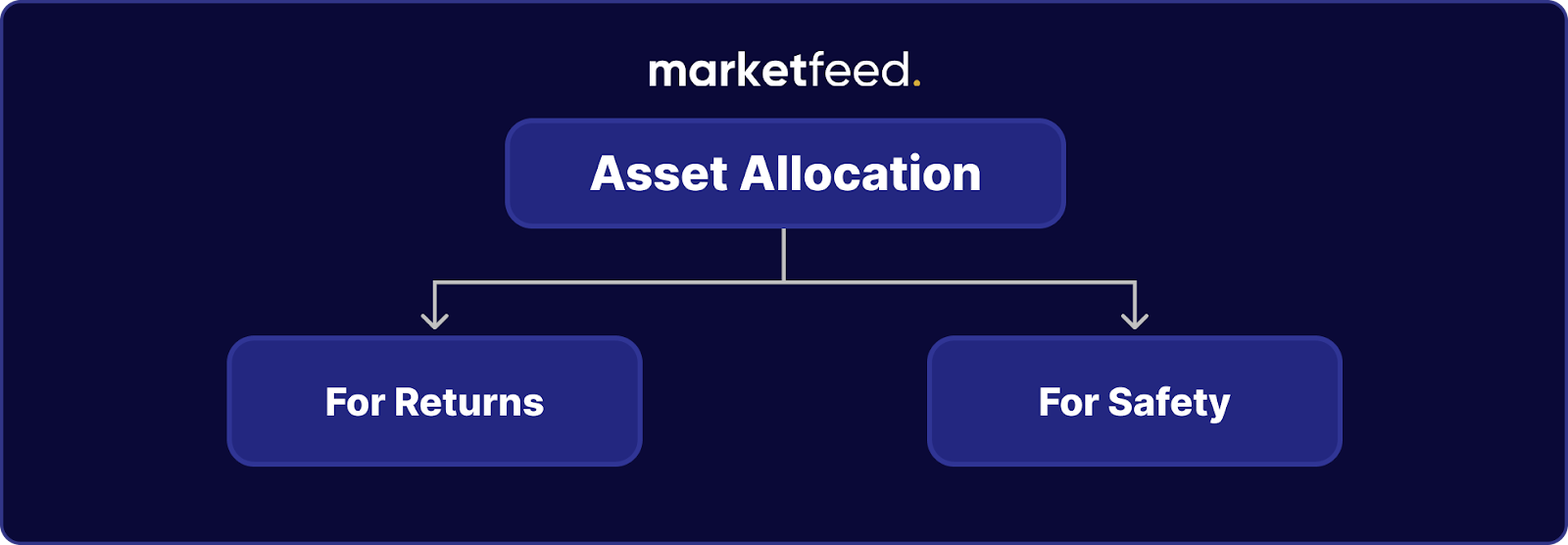
    asset allocation | marketfeed

    1. Equity will contribute to growth – High ROI but higher risk

    You can directly invest in equity directly or indirectly by investing in equity mutual funds.

    2. Debt & Gold will contribute to safety – Low ROI but lower risk

    • You can invest in debt mutual funds or liquid bees ETF
    • You can gain exposure to gold by investing in gold ETFs, digital gold, and sovereign gold bonds (SGBs).

    3. The minimum recommended equity-debt allocation is 80-20. As your age increases, you can invest more into debt than equity.

    Why invest in debt and gold?

    Debt instruments give fixed returns as compared to equity. Therefore, even when the market is in bad shape, debt instruments can give you returns. Gold belongs to real assets under alternative investments. Traditional investments and alternative investments have a negative correlation and thus offset the negative returns that the equity in your portfolio might make.

    Market Cap Diversification

    Market capitalization refers to the total value of all of the company’s issued shares. It’s the valuation of a company. 

    Market Cap = Current Share Price x Total Outstanding Shares. 

    Market cap diversification refers to the diversification of equity based on the market capitalization of stocks. The three different market cap divisions are:

    1. Large-cap – Stocks that have a market cap of more than ₹20,000 crores. The top 100 companies with the highest market capitalization fall under large-cap. These are also known as blue chip stocks.

    2. Mid-cap – Stocks that have a market cap of fewer than ₹20,000 crores but higher than ₹5,000 crores.

    3. Small-cap and micro-cap – Stocks that have a market cap of fewer than ₹5,000 crores. 

    Moderately Aggressive Portfolio

    • Large-cap – 50%
    • Midcap – 30%
    • Smallcap – 10% (first 250 small-caps)
    • Microcap or Bluechips – 10%

    You can invest the final 10% of your portfolio into small caps or blue chips depending on your risk appetite.

    As a thumb rule, your portfolio should comprise 50-70% large-cap stocks, 20-40% midcap stocks, and 10-20% small-cap stocks.

    Sectoral Diversification

    A sector refers to a group of companies from the same industry. Given below are  the major sectors in the Indian stock market:

    • Automobile
    • Bank
    • Consumer durables
    • Financial services
    • FMCG
    • Health
    • IT
    • Media
    • Metal
    • Oil and Gas
    • Pharma
    • Realty

    Another common mistake beginner investors make is investing in just 1-2 sectors, which is equally disastrous as investing in 2 or 3 stocks. If the industry or sector starts performing poorly, the whole portfolio might go down.

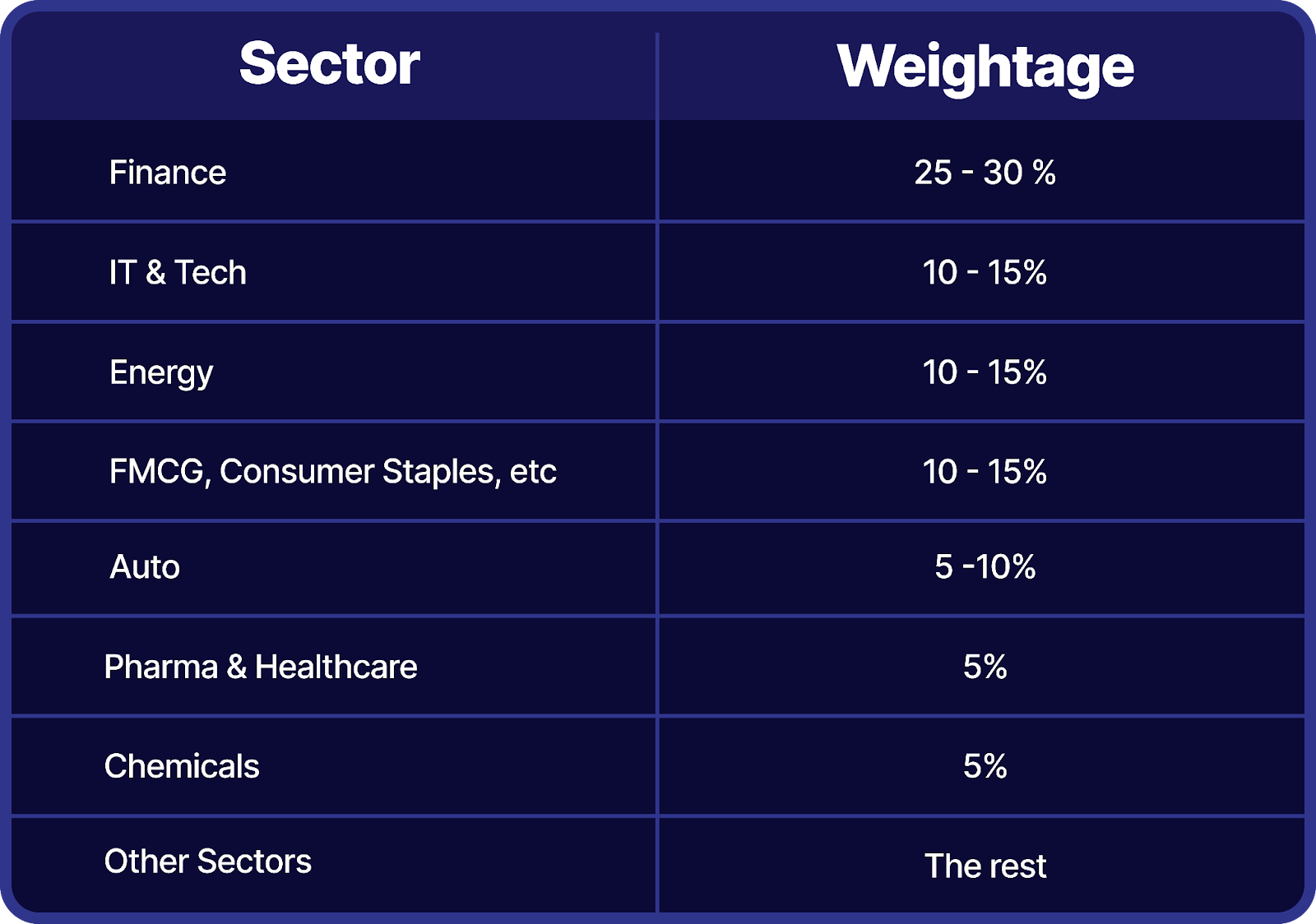
    We should give exposure to at least 4-5 sectors and generally align with the market when we invest for the long term. But what does aligning with the market mean? It means that we should take NIFTY’s sectoral diversification as a reference:

    sector diversification

    We can follow a similar sectoral diversification while creating a portfolio.

    Rules to Follow

    1. Do not invest more than 20% of your capital into a single stock.

    2. Do not invest more than 40% of your capital into a single industry.

    3. Do not invest more than 15% of capital in small caps.

    4. Always diversify.

    5. Review your exposure frequently.

    6. Don’t fall under peer pressure.

    7. Always keep some cash available to invest if the market falls. Remember that every fall is an opportunity to invest more.

    Model Portfolio

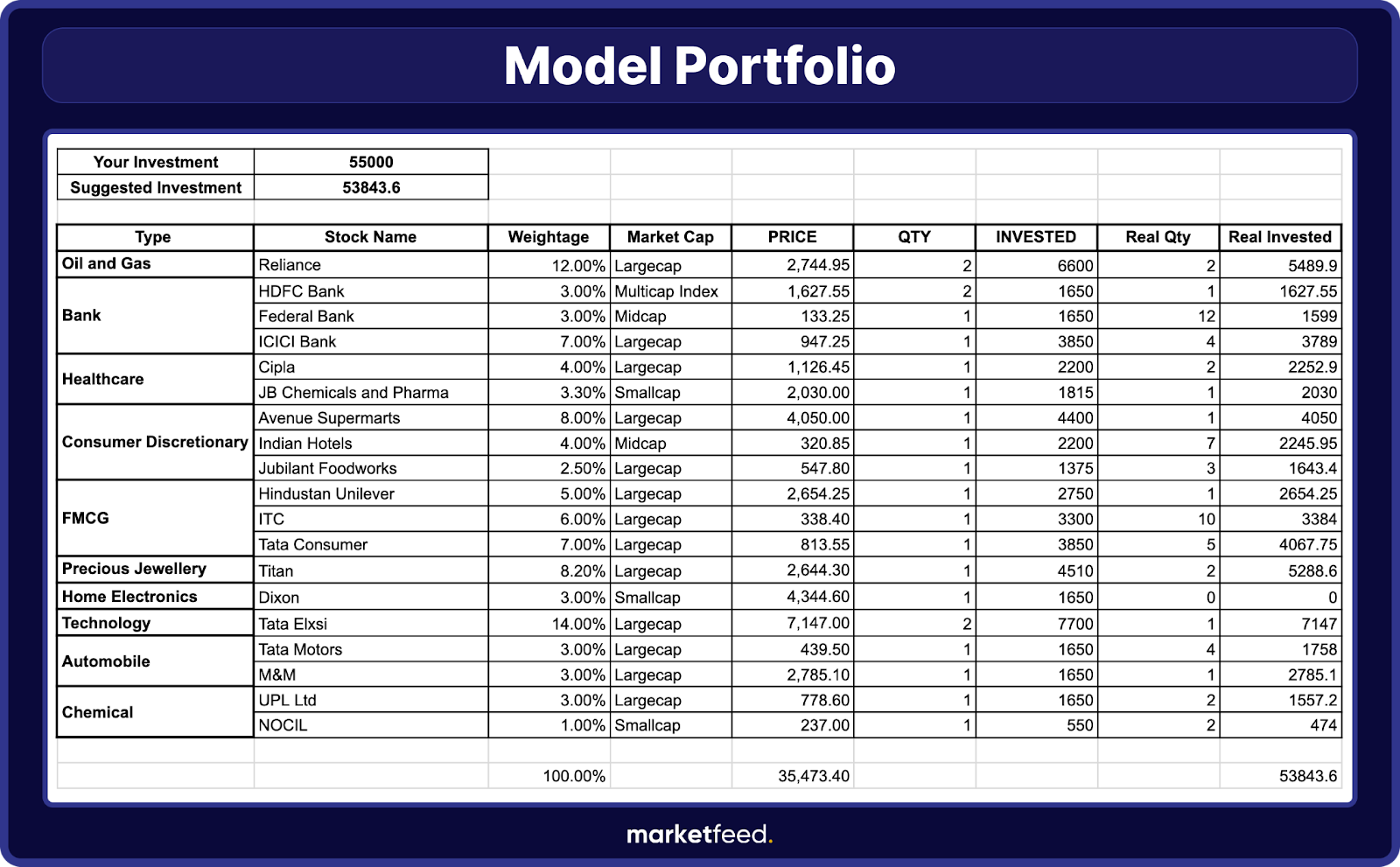
    A model portfolio has been created by us for reference in collaboration with industry experts. This portfolio is well diversified and contains 19 stocks across 10 sectors. Even if a few of the stocks start doing badly, the overall portfolio won’t be affected much.

    model portfolio - diversification | marketfeed

    How to Create a Diversified Portfolio – The Flow

    Let’s summarize and structure what we learned: 

    1. Find potential quality stocks to invest in 

    2. Perform fundamental analysis

    • Read and analyze annual reports
    • Read and analyze financial statements
    • Perform ratio analysis
    • Find valuation
    • Decide on value or growth investment strategy

    3. Make a list of stocks that you find investment-worthy and classify them based on market cap and sector.

    4. Decide on capital allocation to each sector and market cap.

    5. Compile a portfolio of 15-20 stocks

    6. Start investing!

    Throughout this article, we have learned how to create a well-diversified portfolio for your long-term investment journey! Happy Investing!

    Categories
    Jargons

    What are Active Income and Passive Income?

    “If you don’t find a way to make money while you sleep, you will work until you die” – Veteran investor Warren Buffett. But what does he mean when he says, ‘Make money while you sleep’? In this article, we will explore the concepts of passive and active income, their differences, and a few ways to earn a passive income.

    What is Passive Income?

    Passive income is what you earn when you don’t actively work or put forth constant effort on a task/job. It includes regular earnings from a source other than your employer. Simply put, it is an income source that will make you money while you sleep. 

    Examples of Passive Income:

    Returns from stock/mutual fund investments, dividends, rental income, royalties from book sales, and YouTube revenue are the best examples of passive income.

    What is Active Income?

    Income earned by performing a service or work actively is termed active income. All the income sources that require persistent work and effort are active income sources.

    Examples of Active Income:

    The best examples are salaries, wages, and commissions earned from jobs and professions.

    How to Earn Active Income?

    The most traditional and popular method of earning active income is through full-time jobs. The skills, knowledge, and expertise you have in an area get used for the job. A professional job requires a college degree, while a non-professional job does not. You can look for job openings online on platforms such as Linkedin or in newspapers.

    You can also earn an active income by offering freelancing services such as writing, video editing, coding, designing, etc.

    What is the Difference Between Active and Passive Income?

    • Active and passive income are two types of income sources that differ only in terms of effort and time spent to earn them
    • An active income can only be earned by devoting a significant part of your time and effectively applying your skills or expertise. 
    • In contrast, passive income eliminates the need for active involvement after the initial effort. However, periodic maintenance and upkeep are required for some passive income sources.

    Why is Passive Income Important?

    “Passive income” has become one of the most trending topics over the past few years. But why is there so much hype around it? Its rising popularity can be attributed to people’s desire to make extra money without too much effort. A few reasons why you should have a passive income are discussed below:

    1. Beat Inflation

    Inflation is the increase in the general price level of goods and services in the economy. It eats away the purchasing power of money. With a passive income, you earn more money which can be used to meet expenses comfortably during periods of rising inflation.

    2. Financial Freedom

    Financial freedom is a desirable condition of having enough money in your bank account to cover your expenses without having to work, run a business, or rely on others. Having a passive income can improve your chances of financial freedom as the extra income can be invested in the long term.

    3. Reduced Stress

    The inability to pay bills and meet expenses is one of the leading causes of stress and anxiety. By sourcing extra funds through passive income, you will be left with more money that can be used to meet expenses comfortably and on time.

    Passive income can give you more freedom and flexibility to pursue personal interests and goals. Spending quality time with family and friends, travelling, and exploring new hobbies can become a reality as passive income sources can reduce work hours.

    4. Diversification

    Passive income helps you diversify your income streams. Not having a backup source of income will greatly affect you if something happens to your primary income. It will also give you additional income hence increasing your purchasing power.

    5. Early Retirement

    Multiple passive income sources can create higher surplus funds that can be invested for the long term, which can mean early retirement. Reliable passive income sources can also contribute to retirement income.

    Pros and Cons of Active and Passive Income

    ProsCons
    Active IncomeReliable, consistent income, career advancementRequires more time & energy, limited earning potential, lack of flexibility
    Passive IncomeFlexibility, unlimited earning potential, diversification, financial independenceHigh initial investment, inconsistent & unpredictable income.

    Importance of Diversifying Income Streams

    As the saying goes, “Don’t put all your eggs in one basket.” Relying on a single source of income is not financially intelligent. If the single income source is to stop, you might be in big trouble. Multiple passive income sources will cushion you during financial adversities and help maintain financial stability.

    For example, a large number of companies went out of business and many lost their jobs during the pandemic. If they had a source of passive income, the layoff wouldn’t have affected them much.

    This is why diversification of income streams is crucial.

    Myths About Passive Income

    Here are a few myths and misconceptions about passive income sources:

    1. Passive Income is Always Reliable

    Some types of passive income are unreliable. For example, stock dividends might fall during an economic crisis as the companies’ profits might reduce. Rental income may also decline if the property is mismanaged or not maintained properly.

    2. Passive Income Requires Huge Initial Capital

    While a few passive income sources require high investments, plenty of options do not. Buying and renting out a property requires high initial investment and maintenance costs while starting an online blog or course can be done at minimal costs.

    3. Passive Income is a Get-Rich-Quick Scheme

    Passive income is not a get-rich-quick scheme. It requires patience, hard work, and dedication to create a sustainable and reliable source of income.

    4. Passive Income is “Completly Passive”

    Although passive income needs less work than active income sources, it still requires periodic maintenance and review to sustain and grow the income stream.

    Mistakes to Avoid When Pursuing Passive Income

    Below are a few tips that you should follow when pursuing passive income to increase your chances of success:

    1. Perform Due Diligence

    Before committing to any passive income streams, thoroughly research the available options and understand the risks involved. Due diligence can minimize the risks associated with passive income investments and increase your chances of success. It’s important to be patient and take the time to thoroughly evaluate any investment opportunity before committing your funds.

    2. Diversify Income Streams

    Diversification is crucial when it comes to passive income. Investing all your money in a single source can be risky as it increases your exposure to potential losses. So you’ll need to allocate your money across various financial instruments or industries.

    3. Maintain Risk to Reward

    High-reward passive income sources can be attractive, but they often come with the same level of risk. It is essential to balance the risk to reward when selecting passive income streams.

    4. Don’t Underestimate the Effort Involved

    Even passive income streams require some effort and maintenance. Being realistic about the time and effort required to manage your investments and income sources.

    How Much Money Can You Make From Passive Income?

    The major drawback of active income is scalability and earning potential. Even though it has a higher earning potential in the short-term, passive income sources can earn you more in the long term and possibly in the short term too. The amount of money that you can make from passive income sources depends on several factors such as the type of income stream, the amount invested, the scale of operations, and performance level.

    Passive income sources such as trading and real-estate business can generate huge returns if you have sufficient capital and the right strategies.

    Future Trends and Opportunities in Passive Income

    In the era of digitization and technology, there are lots of opportunities for earning a passive income. Web3 and Artificial Intelligence (AI) have opened up earning opportunities like never before. It is clear that the future will be technology intensive. Therefore, future trends and opportunities lie in tech and related areas.

    In conclusion, there are two kinds of income sources: active and passive. While passive income is generated through investments and doesn’t require constant attention or effort, active income involves exchanging time and effort for money. 

    Both types of income have advantages and disadvantages, but passive income offers greater flexibility, scalability, and the potential for more significant long-term returns. However, it requires careful planning, research, and a willingness to accept some level of risk. Ultimately, multiple sources of passive income are what we should strive for. You can achieve a more stable financial future by using your active income to invest in passive income streams!