Categories
Jargons

Introduction to Fundamental Analysis of Stocks

We have discussed the basics of long-term investing in one of our previous articles, which is buying and holding shares for a long period (>1 year). In this article, we will learn how to identify good quality stocks to invest in, when to invest, and how much to invest. Discover how to evaluate a company’s financial health, assess its growth potential, and make wise investment choices!

Long-Term Investing in Stocks vs Fixed Deposits

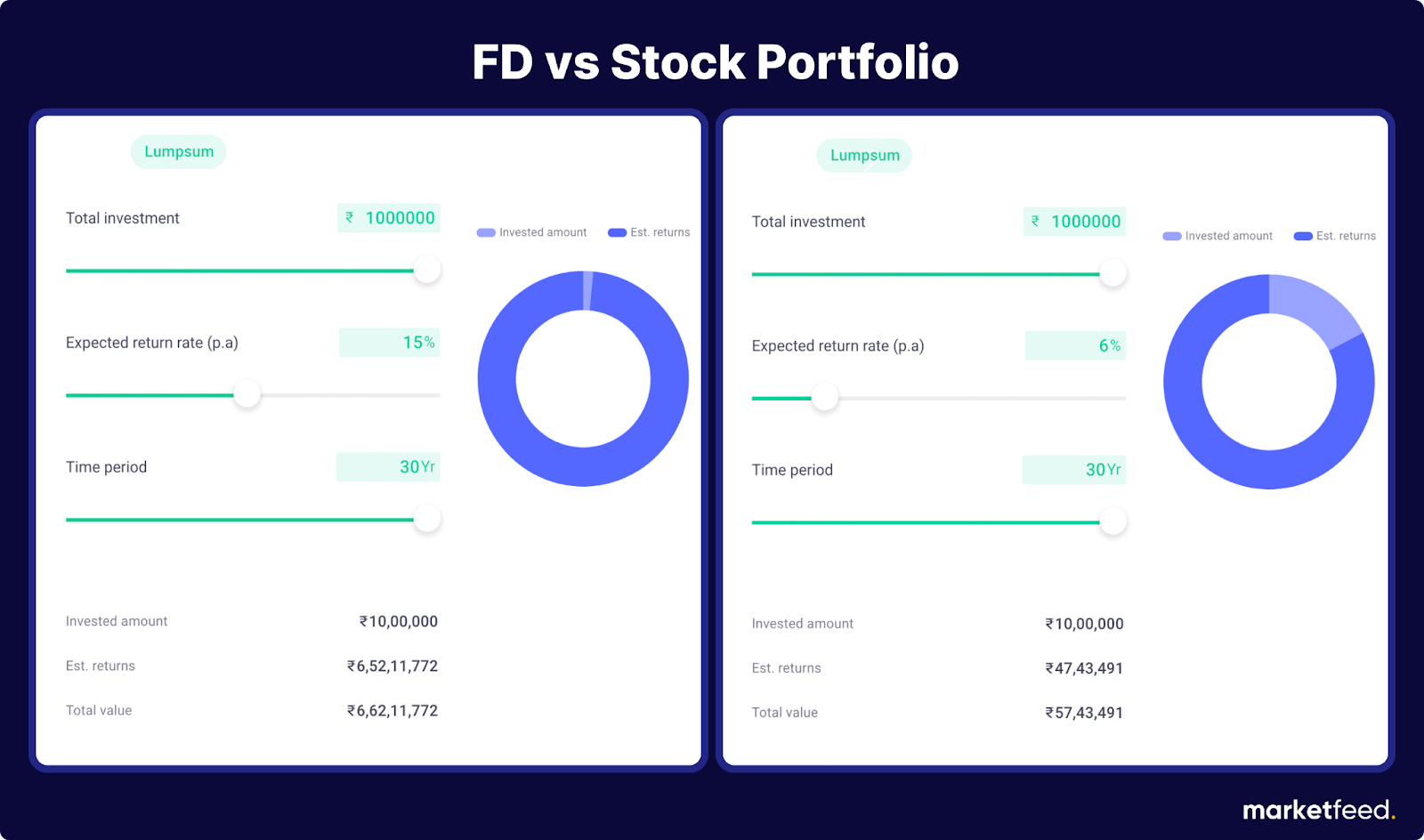
Investing in high-quality stocks will allow your hard-earned money to grow at a fast pace and become a sizable corpus over time. With this money, you can meet your financial goals can be met later in life. In contrast, if you simply deposit your money in a fixed deposit, it will only grow at a rate of 5-6% annually. However, investing in a good portfolio of stocks will grow at a rate of 15-18% or even higher each year. The returns between an FD and a stock portfolio differ wildly:
FD vs Stock Portfolio | marketfeed
(Stock Portfolio on the left side, FD on the right)

The lump sum invested in a stock portfolio giving a 15% CAGR grew to ₹6.62 crores, while the amount invested in a fixed deposit giving a return of 6% every year grew to just ₹57 lakhs. The difference in the corpus is wildly different. This is why you should invest in a stock portfolio instead of traditional methods like fixed deposits or bank savings accounts. 

How to Find Good Quality Stocks to Invest in?

The direct answer to the question is: carefully analyze companies thoroughly. To find high-quality stocks, we should deeply study the overall business and financials of various companies across sectors. We must understand and analyze a company’s business model, its financial performance and position, its market, its competitors, its management, and even the economic factors that could affect the future growth and prospects of the business. This type of study is known as fundamental analysis. Fundamental analysis is a method of determining a stock’s real or “fair market” value. We will learn how to do fundamental analysis in the upcoming modules.

You can do fundamental analysis to understand if a company can be invested in. However, when it comes to picking companies for long-term investments, there are two schools of thought in the market. They are:

1. Value Investing

By doing a fundamental analysis, we will arrive at the intrinsic or true value of a company. In value investing, if the intrinsic value of the company is lower than the current market value, then that company is a buy candidate. We will buy the stock and eventually make a profit when the current value increases to the intrinsic value. Veteran investors like Warren Buffet and the late Rakesh Jhunjhunwala are renowned value investors. 

2. Growth Investing

In growth investing, investors do not give much importance to the true valuation of a company. Suppose the fundamentals of a company are good and its business is growing. In that case, the investor buys the stock even though the current market value is higher than the true value, assuming that the company will keep growing in the future and hence profit from it. 

What to Study in Fundamental Analysis?

While doing fundamental analysis, there are three things we should study:

1. Management

We should study the management of a company. Efficient and effective management is the key to the success of a business. If the management is poor, then the business is on a path to failure. While analyzing the management, we must study the executives who run the business, what their strengths and weaknesses are, their background, their potential, their past, and current performance, etc. We must also see if the management is drawing a high salary even though the business is doing poorly. 

2. Business

We must study the business model of a company and its current & future relevance. Find out if the business excites you as well. 

3. Valuation

While studying a business, we must look into its financials such as revenue, expenses, profits, etc. We can also look into the dividends the company distributes to its shareholders. We can judge a company from a purely financial perspective based on its future prospects and potential. 

The three main areas of study can be called MBV, which stands for Management, Business, and Valuation.

Factors to Consider in Fundamental Analysis

The two factors to be considered when doing fundamental analysis are:

Qualitative Factors

1. Business Model – A business model is an outline of how a company plans to make money. Understanding the business model is an important factor to consider while doing fundamental analysis. You should only consider a company for investments if its business model excites you. 

2. Management Background – A strong idea of who runs the business is an important element of fundamental analysis. We need to analyze if the management is capable of running the business and taking it to new heights. 

3. Ethics – All businesses need to be ethical in all their activities. It also has to be ethical toward all its stakeholders.

4. Corporate Governance – It refers to the corporate structure of a company. The efficiency and productivity of a business depend on its corporate governance. 

5. MOAT – A MOAT is a company’s competitive edge over its competitors. It’s a feature that makes the company highly resistant to competition from other firms. For example, Fevicol (produced by Pidilite Industries) has a moat advantage because it is extremely difficult for another company to reach its level of brand value and sales.

6. Industry – It is also important to analyze the industry in which a company operates. Even if a company is performing well now, it may not be in the future due to a lack of opportunities for the company to grow.

Quantitative Factors

1. Earnings & Growth – We should analyze the earnings or revenue of a company to understand how much money it’s making. An analysis of the trend of revenue over different years should also be considered to understand if a company is growing or not.

2. Expenses – We should be aware of how much money a company is spending and where those expenses are going. Excessive spending is not favourable. However, if the money is allocated toward activities for business expansion and development, it will lay the foundation for future growth.

3. Profit & Margin – The profit that a company makes helps us to understand if its business is growing.

4. Assets & Liabilities – A thorough analysis of the assets and liabilities of a company is a must.

5. Debt – If a company has too much debt burden, it’s unfavourable as there is a high chance of falling into a debt trap. 

Where to Find Qualitative & Quantitative Data of Listed Companies?

The annual report of a company contains all the necessary information from which we can collect quantitative and qualitative data. An annual report is a company’s yearly report to shareholders, documenting its activities and finances of the previous financial year. It is a 300-400 page document containing all vital information about a company. 

  • The qualitative factors of a company can be found in its annual report across various sections. 
  • The quantitative factors of a company can be found in the financial statements section of its annual report.
  • In addition to the annual report, other sources such as videos related to the company, interviews with the founders and management, business magazines, articles, etc., can be used to collect data.

When to Buy Stocks?

The two ways in which people invest in stocks are:

1. Lump Sum Investment

When we invest a large amount into stocks all at once, it is called a lump sum investment. People usually do this when they receive bonuses or any other large sum of money. However, the drawback of this method is that we cannot maintain a better average price. If we do a lumpsum investment and the stock keeps on falling, we cannot take advantage of this price discount as all the money was invested in a single go previously.

2. Systematic Investment Plan (SIP)

SIP is a method of investing a fixed sum regularly into a portfolio. Most salaried people have a regular income every month. Out of this, they invest a certain percentage as SIP. A better average price can be maintained in this method as the purchase price will be lower and higher sometimes. 

When to do SIP?

The two approaches to SIP investments are:

1. Fixed Date/Time

The most common method is to invest on a particular date or time. Some people invest every month, while others invest every week. People buy stocks blindly on a specified date or maybe the first working day of every month.

2. At low prices using technical analysis

Some people also do technical analysis to find if the stock prices are low or high and invest if the prices are low. If technical analysis implies that the stock is overpriced now, the investor waits until the stock price is low. We will discuss Technical analysis in detail in the upcoming module.

The first method, i.e., investing regularly on a fixed date/time is the most convenient. As our aim is to meet the benchmark, it is not necessary to take the extra effort of technical analysis for doing SIPs in the long term. 

How Much to Invest For the Long Term?

The most commonly used method of investing is the 50-30-20 rule, which suggests that 50% of your income should cover your basic needs, 30% should go towards your wants, and the remaining 20% should be invested. However, this method cannot be used by people with low incomes as most of the amount will be used for basic needs. Also, if our income increases, our expenses will more or less be similar so that we will be able to invest. So our aim should be to invest as much as possible. However, it is a very subjective question as needs and financial goals vary from person to person. 

The best way to determine how much you should invest is to calculate how much money you will need during retirement. To reach that number, you should consider your current lifestyle and what your lifestyle will be after retirement, among other things. 

In one of our next articles, we will learn how to calculate the corpus you’ll need when you retire, how much to invest to reach that corpus and plan long-term & short-term financial goals using an Excel calculator. 

Categories
Jargons

Where Exactly to Invest For Financial Freedom?

Suppose you have a current annual expense of ₹16 lakh. You would need approximately ₹1.43 crore every year to meet your expenses when you retire 32 years from now! You’d need a retirement corpus of ₹15 crores to be financially free. 

We also saw investment portfolios that you can invest in to achieve this retirement corpus. But we didn’t discuss where exactly you need to invest to achieve those returns, or rather, where exactly to invest for financial freedom!

Time Horizon-Based Portfolio Selection

You can select portfolios with different returns based on the investment time horizon of your goal. Following are the different investment time horizons:

where to invest - portfolio selection guide | marketfeed

1. Short-term Goals

  • These are goals that are to be achieved in the next 1-3 years.
  • High exposure is to be given to safe asset classes as the goal is relatively closer.
  • A return of 8% CAGR can be targeted for these goals.

2. Medium-term Goals

  • These are the goals that are to be achieved in the next 4-7 years.
  • More exposure is to be given to safe asset classes, while a small exposure can be given to the return-generating asset class, i.e., equity.
  • A return of 10% CAGR can be targeted for these goals.

3. Long-term Goals

  • These are goals that are to be achieved in the next 8 years or later.
  • You should give high exposure to equity as the goal is relatively far away.
  • A reasonable exposure should also be given to safe asset classes to ensure the stability of the portfolio.
  • Returns of 16-20%+ CAGR can be targeted for these goals.
  • We have three different portfolios with conservative, moderately aggressive, and aggressive approaches giving 12%, 15%, and 18% CAGR, respectively.
where to invest | marketfeed

Asset Allocation

We allocate our investments into different asset classes for returns and safety. We will be allocating our investments to three different assets:

asset allocations | marketfeed

1. Equity

  • Equity refers to the shares of companies.
  • Returns from equity investments are very high, and so is the risk.
  • You can expect returns of 12-20% CAGR depending on the stock.

    You can invest in equity in two ways:
  • Direct Stock Investments – buying stocks like Reliance and Tata Motors via a broker (like Zerodha, Groww, and Fyers).
  • Equity Mutual Funds. Learn about mutual funds here.

2. Debt

  • Debt refers to the investment made in bonds.
  • When a company needs capital, it can borrow money from the public in consideration of an interest payment. These payments are fixed.
  • Returns in debt are moderate but the risk is low.
  • You can expect returns of approximately 6-8% CAGR from debt investments.
  • You can invest in debt via debt mutual funds.

3. Gold

  • Gold has given a very good historical performance.
  • You can expect returns of 5-6% CAGR by investing in gold.
  • You can invest in gold via Gold BeES or Sovereign Gold Bonds (SGBs). To learn about Gold BeES and SGBs, click here.

How Much to Invest in Each Asset:

You can click here to access marketfeed’s calculator.

It’s a READ-ONLY VERSION. You have to make a copy of the document to edit it.

Instructions to Use the Calculator

1. The link will take you to the read-only version of our “Where to Invest” Excel Calculator. Click on ‘Make a Copy’ under the File tab to create a copy of the calculator. You could also download the file as .xslx to use the calculator on Microsoft Excel.

2. Edit or enter figures in the yellow cells only. Do not edit any cells other than those in yellow as it will interfere with the preset formulas.

3. The calculator has 8 sheets:

  • 8% Short-Term Goal – To calculate asset allocation for short-term goals with a targeted return of 8% CAGR.
  • 10% Medium-Term Goal – To calculate asset allocation for medium-term goals with a targeted return of 10% CAGR.
  • 12% Conservative Long-Term Goal (No ELSS) – To calculate asset allocation for long-term goals through a conservative approach with a targeted return of 12% CAGR with no allocation to the ELSS category. To learn about Equity Linked Savings Scheme (ELSS), click here.
  • 12% Conservative Long-Term Goal (ELSS) – To calculate asset allocation for long-term goals through a conservative approach with a targeted return of 12% CAGR with allocations to the ELSS category.
  • 15% Moderately Aggressive Long-Term Goal – To calculate asset allocation for long-term goals through a moderately aggressive approach with a targeted return of 15% CAGR with allocations to the ELSS category.
  • 16-20% + Aggressive Long-Term Goal – To calculate asset allocation for long-term goals through an aggressive approach with a targeted return of 16-20%+ CAGR with allocations to the ELSS category.

8% Short-Term Goal

8% short-term goal | marketfeed

Here are the steps to find your allocations:

1. Enter the Goal Name.

2. Input how far away your goal is (in years).

3. Input the SIP amount.

The SIP amount adjacent to the 8% portfolio presented by the goal planning calculator should be entered here.

4. Start your SIP!

The calculator will display to you the recommended fund to invest in, along with its respective category and asset class. Additionally, it will also show you the amount to be invested via SIP in different funds. It also shows the allocation-based return and a pie chart representing the allocation weightage.

Also read: What is a Systematic Investment Plan (SIP)?

10% Medium-Term Goal

where to invest - 10% medium-term goal | marketfeed

Here are the steps to find your allocations:

1. Enter the Goal Name.

2. Input how far away your goal is (in years).

3. Input the SIP amount.

The SIP amount adjacent to the 10% portfolio presented by the goal planning calculator should be typed here.

4. Start your SIP!

The calculator will show which fund to invest in, what category and asset class it belongs to, and the SIP amount to be invested in different funds. It also shows the allocation-based return and a pie chart representing the allocation weightage.

12% Conservative Long-Term Goal (No ELSS)

where to invest - 12% conservative long-term goal | marketfeed

Here are the steps to find your allocations:

1. Enter Goal Name

2. Input how far away your goal is (in years).

3. Input the SIP amount

The SIP amount adjacent to the 12% portfolio presented by the goal planning calculator should be entered here.

4. Start your SIP!

The calculator will mention which fund to invest in, what category and asset class it belongs to, and the SIP amount to be invested in different funds. It also shows the allocation-based return and a pie chart representing the allocation weightage.

12% Conservative Long-Term Goal (ELSS)

ELSS | marketfeed

Here are the steps to find your allocations:

1. Enter Goal Name

2. Input how far away your goal is (in years).

3. Input the SIP amount

The SIP amount adjacent to the 12% portfolio presented by the goal planning calculator should be entered here.

4. Start your SIP!

The calculator will display to you the recommended fund to invest in, along with its respective category and asset class. Additionally, it will also show you the amount to be invested via SIP in different funds. The investment strategy allocates the initial ₹1.5 lakhs of yearly investment to ELSS funds. It also shows the allocation-based return and a pie chart representing the allocation weightage.

15% Moderately Aggressive Long-Term Goal (ELSS)

15% ELSS goal | marketfeed

Here are the steps to find your allocations;

1. Enter Goal Name

2. Input how far away your goal is (in years).

3. Input the SIP amount

The SIP amount adjacent to the 15% portfolio presented by the goal planning calculator should be typed in here.

4. Start your SIP!

The calculator will display to you the recommended fund to invest in, along with its respective category and asset class. Additionally, it will also show you the amount to be invested via SIP in different funds. The investment strategy allocates the initial ₹1.5 lakhs of yearly investment to ELSS funds. It also shows the allocation-based return and a pie chart representing the allocation weightage.

16-20% + Aggressive Long-Term Goal

where to invest - aggressive goal | marketfeed

Here are the steps to find your allocations;

1. Enter Goal Name

2. Input how far away your goal is (in years).

3. Input the SIP amount

The SIP amount adjacent to the 16% portfolio presented by the goal planning calculator should be entered here.

4. Start your SIP!

The calculator will show which fund to invest in, what category and asset class it belongs to, and the SIP amount to be invested in different funds. The investment strategy allocates the initial ₹1.5 lakhs of yearly investment to ELSS funds and allocates a part of the investment to a direct stock portfolio, which will be learned to build in the coming modules. It also shows the allocation-based return and a pie chart representing the allocation weightage.

In conclusion, there is no one-size-fits-all answer to the question of where and how much to invest to achieve financial freedom. The calculators in the previous and current chapters will help you find answers to these questions. In the next module, we will learn how to read and analyze the annual report and financial statements of a company, perform ratio analysis, and build a well-diversified stock portfolio on our own.

Categories
Jargons

5 Best Steps to Find Quality Stocks in India

Investing in the stock market can help you create wealth over the long term. However, it requires careful analysis and research to find good stocks. One must know how to effectively apply their knowledge of fundamental analysis to identify high-quality stocks. In this article, we present 5 best steps to find quality stocks to invest in for the long term.

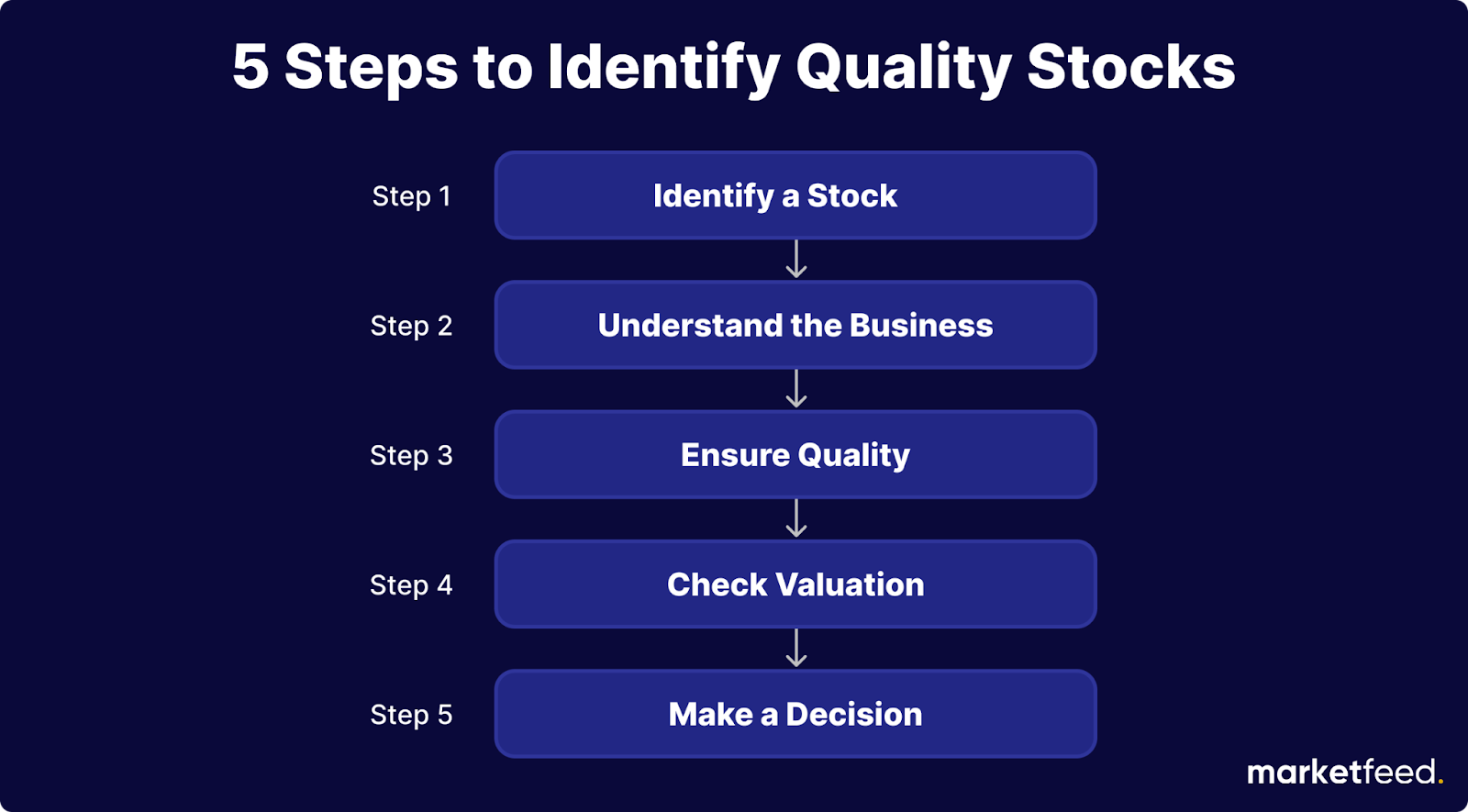
Identify Quality Stocks

Step 1: Identify a Stock

How do we choose high-quality stocks from the thousands of companies listed on the National Stock Exchange (NSE) and Bombay Stock Exchange (BSE)? Here are five ways to identify stocks and find if they are the right ones for us to invest in for the long term:

1. Friends and Social Circles

Take notes from friends and family who invest/talk about stocks and do more research on them. You may also run into online posts or articles about good companies that you can add to your watchlist.

2. General Observation

If you notice a brand or product performing well and gaining popularity, you can verify if that company is listed on the stock exchange. If yes, you can add them to the list. Even when you go to a supermarket, you can see what products have high demand and customer base and note them down for further analysis.

3. Using Stock Screeners

You can also use stock screeners like screener.in and Tickertape, which have good preset screeners to filter or compare companies based on their fundamentals. Apart from the inbuilt filters, such as financial ratios and growth in net profits, you can also create custom filters.

4. New Sectoral Trends and Rule Changes

You can always check which industries benefit from regulatory changes and take note of the listed companies in those sectors. General observation often allows us to identify sectoral trends in many cases.

For example, the electric vehicle (EV) sector is trending because the future is moving towards green mobility. You can identify the companies directly or indirectly linked to the industry benefiting from this trend, such as battery manufacturers, electric vehicle (EV) companies, and other relevant firms.

5. Your Circle of Competence

A circle of competence is the subject area that matches a person’s skills or expertise. If you are working in the IT sector, you can analyse the business models of IT companies and identify the best ones in this sector. On the other hand, if you’re working in the medical field, you can identify good-performing pharmaceutical companies.

Utilizing all the methods above is unnecessary; their sole purpose is to help us identify companies for further study or in-depth analysis.

Step 2: Understand the Business

After identifying various companies or stocks, it’s essential to gain a comprehensive understanding of their businesses.

1. Read annual reports

Annual reports provide a comprehensive overview of a company’s financial performance, strategies, and objectives. They typically include financial statements, management discussions, and analysis. These reports are essential for investors, stakeholders, and analysts to assess the company’s profitability, growth potential, and overall financial health. They serve as a valuable source of information for decision-making and evaluating investment opportunities.

2. Gather data from media reports and interviews

Another method to understand the company’s business is by listening to its founders and management. Watch interviews with the management and founders in which they talk about their company and its business. Read news articles about them.

3. Learn everything you can about the company, business, and competitors

If the company you are analysing has a moat or a unique selling proposition (USP), it’s a bonus. [Moat refers to a business’s ability to maintain competitive advantages over its competitors to protect its long-term profits and market share.]

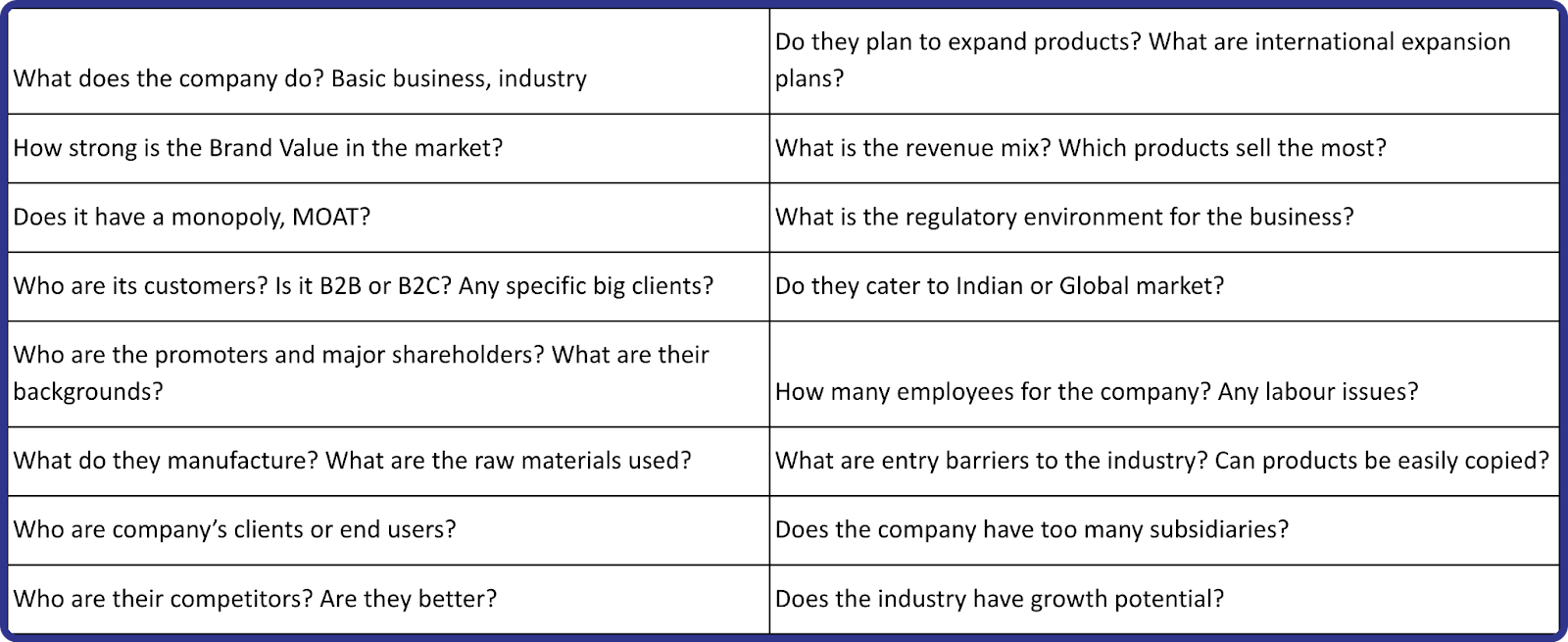
You can also refer to the questions given below to understand more about a business. After getting answers to these questions, you will have enough information about a company to understand its business.

Checklist before investing

If you don’t understand a company’s business even after all this, it’s better that you don’t invest in it.

Step 3: Ensure Quality

1. Read annual reports

Reading the annual report can give you an idea about a company’s quality.

2. Read financial statements

Financial reports like a profit & loss statement and balance sheet help analyse a company’s spending decisions and debt levels.

3. Study financial ratios

Ratio analysis unveils a company’s performance and growth trajectory over time. It would be beneficial to compare a company with others in the same industry or sector. Additionally, comparing a company’s ratios with industry standards provides a better understanding of its position and performance.

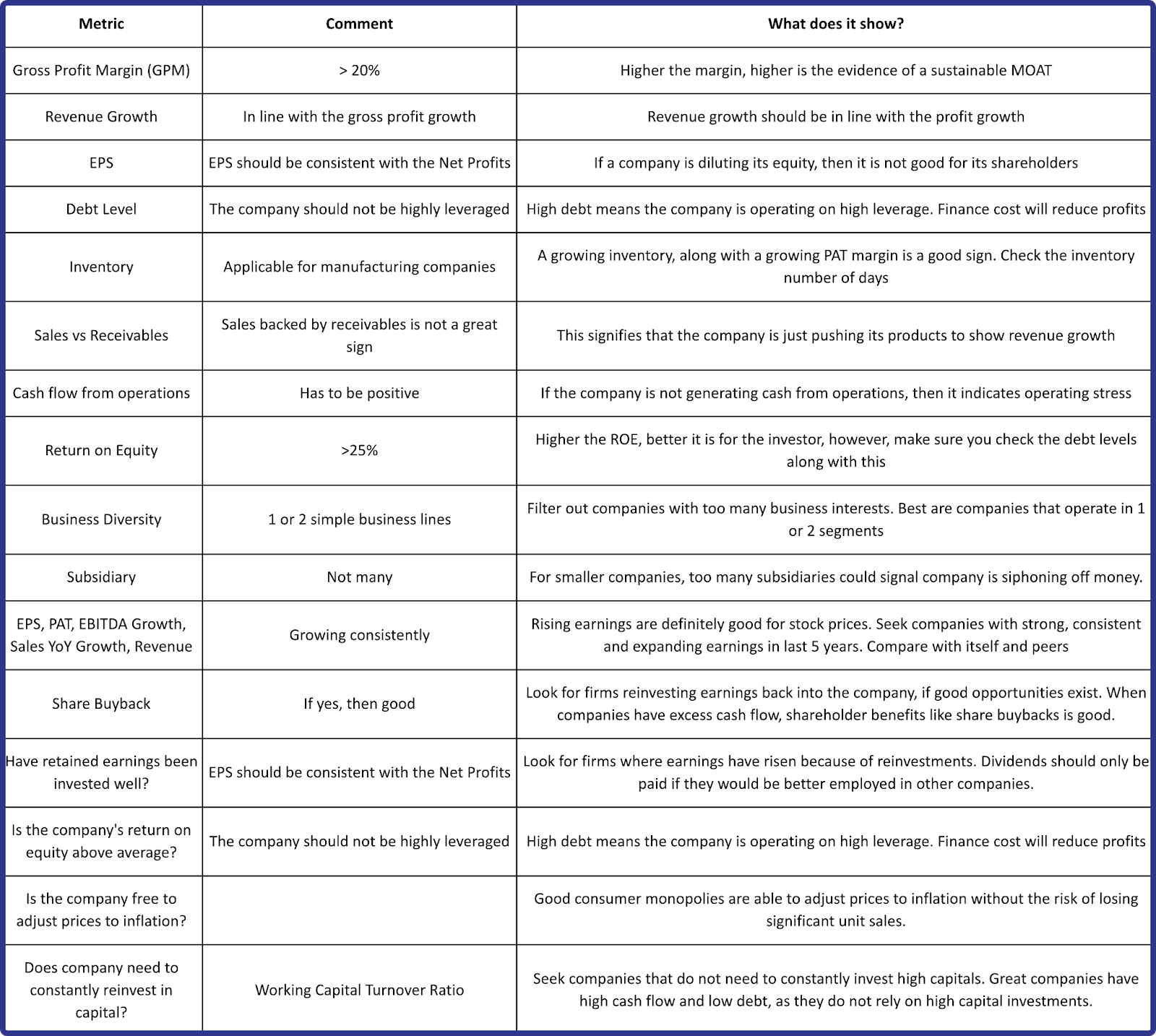
You can use the checklist below to analyze quantitative and qualitative factors. The table below is only for reference. You should also consider other checklist points for better analysis.

Financial ratios and metrics

Thus, we should check both quantitative and qualitative factors while ensuring quality.

Step 4: Check Valuation

After completing the steps mentioned above and compiling a list of high-quality stocks, the next crucial step involves evaluating the value of the companies on that list. Valuation is a quantitative process of determining the fair value of an asset, investment, or firm. In this step, we compare the market value and intrinsic value of the company and determine if it is undervalued or overvalued. The market value of a company is what it is currently worth according to the market. It is calculated using the formula below:

Market Capitalisation

The market value is the value the market (retail investors and institutions) gives a company. However, the company also has a true value, which is called its intrinsic value. If the market value of a company exceeds its intrinsic value, the stock is overpriced or overvalued. On the other, if the intrinsic value surpasses the market value, it is undervalued.

After finding the intrinsic value of a company, we have two methods of investing:

1. Growth Investing

Buy a stock if it has a high growth history/potential and fits all your checklists. In growth investing, we ignore the intrinsic value of a company. If a company has been continuously growing for the past few years and still has high growth potential, we can buy its stock despite its overvaluation. For example, Hindustan Unilever has always been overvalued in the past, but it kept on growing despite its overvaluation.

2. Value Investing

Buy a stock if its current market price is lower than its intrinsic value. We choose not to buy overvalued stocks. Veteran investor Warren Buffet and his mentor Sir Benjamin Graham are renowned value investors. 

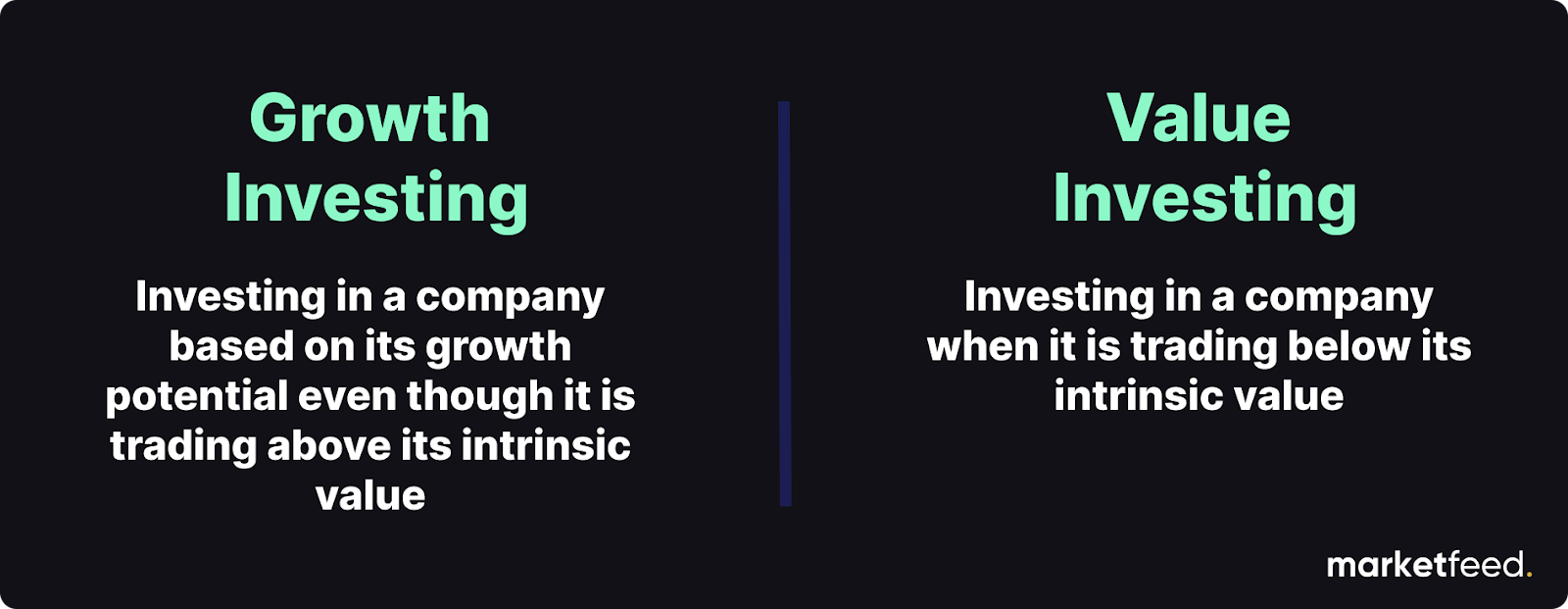
Growth Investing and Value Investing

Both growth investing and value investing can yield good returns. Growth investing is comparatively easier than value investing. However, if done right, value investing can build you a fortune!

There are many methods to value a company and find its intrinsic value. You can use Dividend Discount Model (DDM), Present Value Methods, etc to value companies.

Step 5: Make a Decision

After completing all these steps, your next action will be to make an informed decision. First, we identified a few stocks, understood their business, ensured the quality, and valued the companies. The final step is to decide whether to add that stock to your portfolio. While building a portfolio, it should be well diversified. So, we should avoid adding multiple stocks from the same industry to our portfolio.

When to Invest?

The two ways in which people invest in stocks are:

1. Lump Sum Investment

When we invest a huge amount into stocks all at once, it is called a lump sum investment. People usually do this when they receive bonuses or a large sum. However, the drawback of this method is that we cannot maintain a better average price. If we make a lumpsum investment and the stock keeps on falling, we cannot take advantage of this price discount as all the money was invested in a single go.

2. Systematic Investment Plan (SIP)

SIP is a method of investing a fixed sum regularly into a portfolio. Most salaried people have a regular income every month. Out of this, they invest a certain percentage as SIP. A better average price can be maintained in this method as the purchase price will be lower and higher sometimes. 

In value investing, we only buy the stock when the intrinsic value is lower than its actual market value. Only a lump sum investment is possible here. On the other hand, with growth investing, we can invest in SIPs. One can perform technical analysis and buy the stock when its price dips or at regular intervals, such as monthly or weekly. 

We should always invest in a portfolio of high-quality stocks while investing for the long term. If we invest in a single stock or sector/industry, there won’t be any diversification. When that particular industry starts performing poorly, our portfolio also dips substantially. Success in long-term investment is not finding or selecting that single multibagger stock. Rather, it is finding out and investing in a well-diversified portfolio.

Disclaimer: The information or any examples mentioned in this article are purely for educational purposes. Please do your own research before investing in stocks for the long term.

Categories
Jargons

How to Safely Invest in Stocks and Make Money

In today’s fast-paced financial world, investing in stocks has become an attractive option for individuals looking to grow their wealth. However, it’s important to approach stock market investing with caution and a well-thought-out strategy. This article serves as a comprehensive guide on how to safely invest in stocks and make money while minimising risks.

(Before diving into the world of stock market investing, it’s crucial to learn the basics and understand the risks associated with it. Learn concepts like stocks, shares, and equity markets. Stock prices fluctuate based on market conditions, economic factors, and company performance. So be prepared for potential losses and understand the importance of a long-term investment approach).

1. Create a Diversified Portfolio of Stocks and Other Investments

Diversification is the key to managing risk in your investment portfolio. Spread your investments across different sectors, industries, and asset classes. This diversification minimizes the impact of any single investment on your overall portfolio performance. Explore other investment options like bonds, real estate, or commodities to further diversify and balance your risk exposure.

2. Invest in Low-Cost Index Funds or ETFs

Index funds and Exchange-Traded Funds (ETFs) offer a simple and cost-effective way to gain exposure to a broad market index. These funds track the performance of a specific market index such as NIFTY. By investing in index funds or ETFs, you can achieve instant diversification and benefit from the overall growth of the market while minimizing the risk associated with individual stocks.

3. Invest in Blue-Chip Stocks

Blue-chip stocks are shares of well-established companies with a history of stable earnings and dividend payments. These companies have a strong market presence, solid financials, and often operate in mature industries. Investing in blue-chip stocks can provide stability to your portfolio and offer potential long-term growth opportunities. Reliance Industries, Tata Consultancy Services, HDFC Bank, Hindustan Unilever, Infosys, and ITC are examples of some blue chip stocks in the Indian stock market.

4. Invest in Companies with a Strong Economic Moat

Identify companies with a competitive advantage or a strong economic moat. Such companies have unique strengths, such as superior technology, brand recognition, or intellectual property rights, that make it difficult for competitors to replicate their success. Investing in companies with a sustainable competitive advantage can provide long-term growth and a higher margin of safety.

5. Start SIPs

Systematic Investment Plans or SIPs are a smart and hassle-free way to invest in stocks. It. involves investing a fixed amount of money at regular intervals (monthly or quarterly) regardless of market conditions. Whether you’re a beginner or a seasoned investor, SIPs provide discipline, convenience, and the potential for long-term wealth creation. SIPs can help you reduce investment risks over the long term and create wealth with the power of compounding.

6. Conduct Thorough Research and Analysis Before Investing

Performing comprehensive research and analysis is essential before making any investment decision. Evaluate a company’s financial statements, growth prospects, competitive landscape, and industry trends. Look for companies with a strong balance sheet, low debt-to-equity ratio, and consistent cash flow generation. A healthy financial position indicates stability and the ability to survive economic downturns.

Utilize fundamental and technical analysis tools to assess the intrinsic value (the real worth) and growth potential of a stock.

7. Avoid Stocks with High Volatility or Questionable Financial Statements

Volatility can lead to significant price swings and increased risk. Avoid stocks with excessively high volatility unless you have a high-risk tolerance and are actively engaged in short-term trading strategies. High volatility can make it challenging to predict future price movements and increases the potential for losses.

Always exercise caution while dealing with companies that have questionable financial statements. Conduct thorough due diligence and ensure the company’s financials are transparent and reliable. Look for warning signs such as inconsistent earnings, high debt levels, or a history of accounting irregularities. Investing in fundamentally strong and transparent companies reduces the risk of financial fraud or misleading information.

8. Use Risk Management Strategies to Limit Losses

Implementing risk management strategies is crucial for protecting your investment capital. One effective tool is a stop-loss order, which automatically sells your shares if they reach a predetermined price level. This strategy helps limit potential losses during market downturns or if a stock’s price experiences a significant decline. Consider setting a stop-loss order at a level that aligns with your risk tolerance and investment goals.

9. Invest in Dividend-Paying Stocks for Long-Term Income Generation

Dividend-paying stocks provide a reliable source of income and can contribute to long-term wealth creation. Look for companies with a history of consistent dividend payments and a sustainable payout ratio. Dividends not only provide regular cash flow but also indicate a company’s profitability and financial strength. Reinvesting dividends can amplify returns through the power of compounding. Click here to learn more about dividends!

10. Approach a Financial Advisor to Manage Your Portfolio

Seeking professional advice can be beneficial, especially if you’re new to investing or prefer a hands-off approach. A financial advisor can provide personalized guidance based on your risk tolerance, financial goals, and investment horizon. These professionals can help construct and manage a well-diversified portfolio and make sure it aligns with your individual goals and aspirations.

11. Avoid Common Investing Mistakes Such as Emotional Investing or Market Timing

Emotional investing and market timing are common dangers that can erode investment returns. Emotional decision-making driven by fear or greed often leads to impulsive and ill-informed investment choices. Similarly, trying to time the market by predicting short-term price movements is notoriously difficult and can result in missed opportunities and losses. Adopt a disciplined and rational approach to investing, focusing on long-term objectives rather than short-term fluctuations.

12. Staying Up to Date with Market Trends and News

Stay informed about market trends, economic indicators, and industry developments. Regularly review financial news, company announcements, and macroeconomic factors that impact the stock market. Subscribe to reputable financial publications, follow trusted analysts, and leverage online resources to stay updated. This information can help you make informed investment decisions based on a broader understanding of the market environment.

Investing in the stock market can be highly rewarding if you approach it with a focus on safety and long-term wealth creation. By following the strategies outlined in this article, you can mitigate risks and increase the likelihood of achieving your financial goals. Remember, investing in stocks involves inherent risks, and there are no guarantees of returns. It’s essential to conduct thorough research, seek professional advice when needed, and stay committed to a disciplined, long-term investment approach. Consult a qualified financial professional before making any investment decisions.

Happy Investing!