At the heart of understanding a company’s financial health lies a crucial tool – financial statements. If you’ve ever found yourself wondering about the numbers and terms thrown around in annual reports or business discussions, you’re not alone. In this article, we’ll unravel the mystery behind each financial statement, breaking down their significance, components, and how they serve as invaluable guides for both seasoned and new investors.
What are Financial Statements?
Financial statements are the vital documents through which a company communicates its financial performance and position to its stakeholders. The role of financial statement analysis is to use the information in a company’s financial statements, along with other relevant information, to make investment decisions.
Investors aren’t the sole users of financial statements; a company’s management also relies on them to guide financial decision-making. Creditors use these statements to check if the company will be able to repay the loan along with interest on time. Investors use them to understand the company’s ability to earn profits and generate cash flow in the future.
How are Financial Statements Prepared?
Financial statements are prepared using financial reporting standards. They provide principles for creating financial reports and determine the types & quantity of information that must be provided to those who use them. Institutions such as the International Accounting Standards Board (IASB) and Financial Accounting Standards Board (FASB) create these standards. These organisations are typically private sector and self-regulated. Their board members include experienced accountants, auditors, users of financial statements, and academicians.
Most countries follow the International Financial Reporting Standards (IFRS) developed by IASB. These standards ensure quality in the financial statements. Relevance, faithful representation, comparability, verifiability, timeliness, and understandability are the primary qualities of financial statements.
Regulatory authorities such as SEBI in India and SEC in the US ensure that these financial statements are prepared properly.
What are the Different Financial Statements?
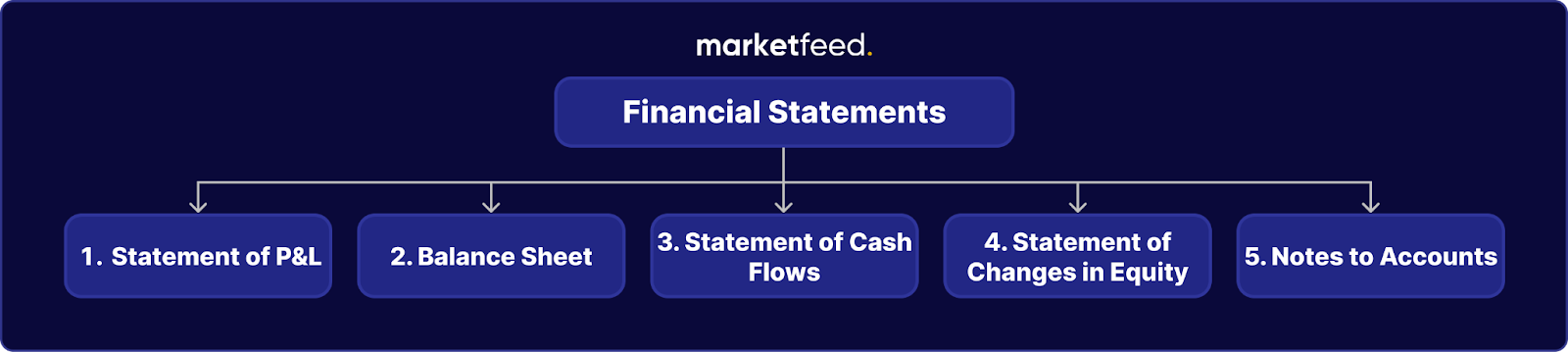
There are five important financial statements for a company. They are:
1. Statement of Profit & Loss
2. Statement of Financial Position (Balance Sheet)
3. Statement of Cash Flows
4. Statement of Changes in Equity
5. Notes to Accounts
Notes to accounts or footnotes are a part of the financial statements which show the details of each item.
Standalone vs Consolidated Financial Statement
Companies with subsidiaries have two sets of financial statements in their annual report: standalone financial statements and consolidated financial statements. Standalone financial statements only include the financials of the company itself and do not include the financials of their subsidiaries. Consolidated financial statements include the financials of the company along with its subsidiaries.
For example, Company B is a subsidiary of Company A. The standalone financial statements of Company A include only the transactions specific to Company A. On the other hand, in consolidated financial statements, the transactions of both Company A and Company B are included.
We always consider the consolidated financial statements because the business transactions of the subsidiary also affect its parent company, as the ownership lies with the company.
In conclusion, financial statements are strategic roadmaps. The numbers might look a bit tricky at first, but once you get the hang of it, you’re in control. Armed with this knowledge, you will be better equipped to navigate the complex landscape of financial decisions. So, as you delve into the world of balance sheets, income statements, and cash flow reports, may your financial wisdom soar, and your decisions stand on solid ground.
Investing in the stock market can help you create wealth over the long term. However, it requires careful analysis and research to find good stocks. One must know how to effectively apply their knowledge of fundamental analysis to identify high-quality stocks. In this article, we present 5 best steps to find quality stocks to invest in for the long term.
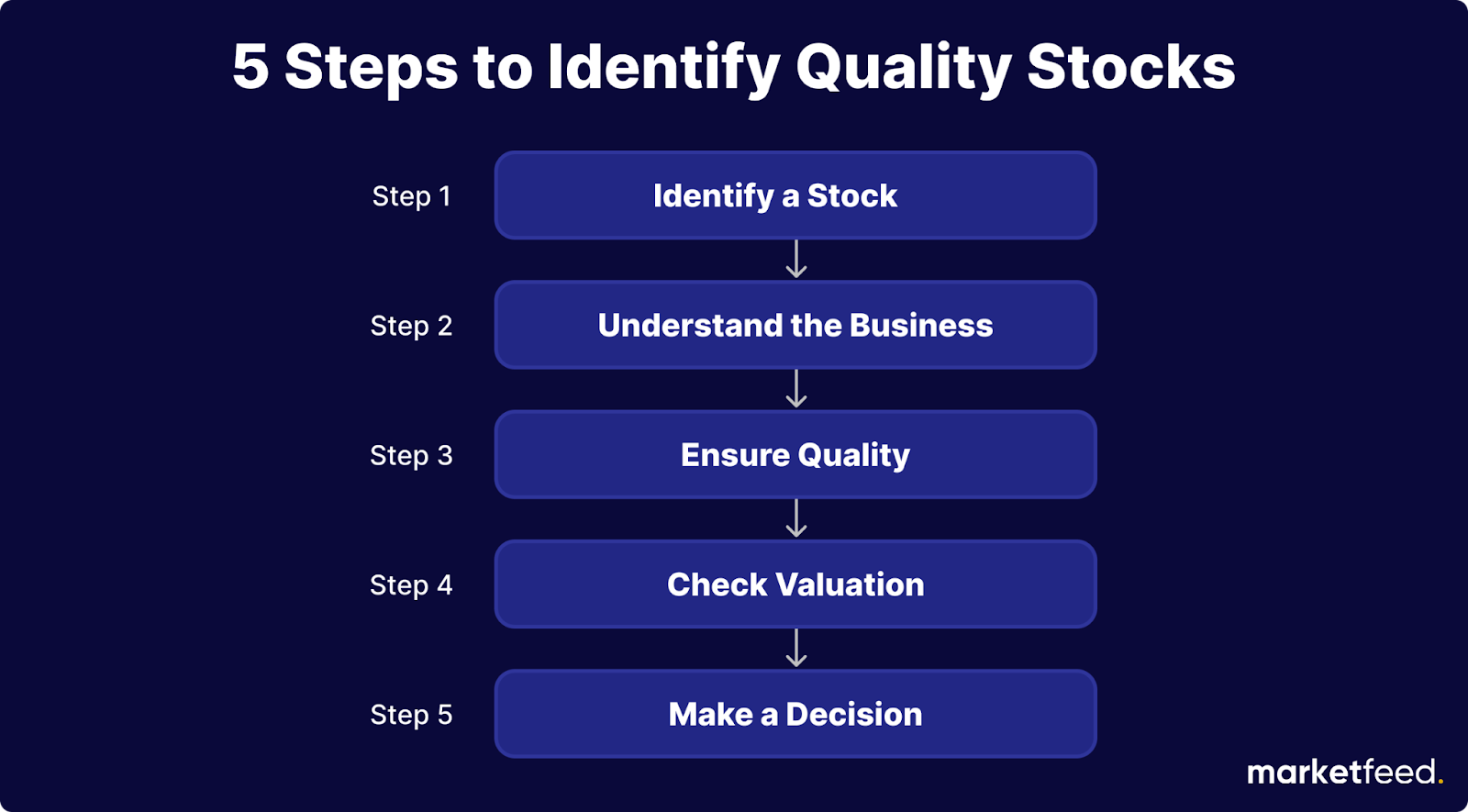
Step 1: Identify a Stock
How do we choose high-quality stocks from the thousands of companies listed on the National Stock Exchange (NSE) and Bombay Stock Exchange (BSE)? Here are five ways to identify stocks and find if they are the right ones for us to invest in for the long term:
1. Friends and Social Circles
Take notes from friends and family who invest/talk about stocks and do more research on them. You may also run into online posts or articles about good companies that you can add to your watchlist.
2. General Observation
If you notice a brand or product performing well and gaining popularity, you can verify if that company is listed on the stock exchange. If yes, you can add them to the list. Even when you go to a supermarket, you can see what products have high demand and customer base and note them down for further analysis.
3. Using Stock Screeners
You can also use stock screeners like screener.in and Tickertape, which have good preset screeners to filter or compare companies based on their fundamentals. Apart from the inbuilt filters, such as financial ratios and growth in net profits, you can also create custom filters.
4. New Sectoral Trends and Rule Changes
You can always check which industries benefit from regulatory changes and take note of the listed companies in those sectors. General observation often allows us to identify sectoral trends in many cases.
For example, the electric vehicle (EV) sector is trending because the future is moving towards green mobility. You can identify the companies directly or indirectly linked to the industry benefiting from this trend, such as battery manufacturers, electric vehicle (EV) companies, and other relevant firms.
5. Your Circle of Competence
A circle of competence is the subject area that matches a person’s skills or expertise. If you are working in the IT sector, you can analyse the business models of IT companies and identify the best ones in this sector. On the other hand, if you’re working in the medical field, you can identify good-performing pharmaceutical companies.
Utilizing all the methods above is unnecessary; their sole purpose is to help us identify companies for further study or in-depth analysis.
Step 2: Understand the Business
After identifying various companies or stocks, it’s essential to gain a comprehensive understanding of their businesses.
1. Read annual reports
Annual reports provide a comprehensive overview of a company’s financial performance, strategies, and objectives. They typically include financial statements, management discussions, and analysis. These reports are essential for investors, stakeholders, and analysts to assess the company’s profitability, growth potential, and overall financial health. They serve as a valuable source of information for decision-making and evaluating investment opportunities.
2. Gather data from media reports and interviews
Another method to understand the company’s business is by listening to its founders and management. Watch interviews with the management and founders in which they talk about their company and its business. Read news articles about them.
3. Learn everything you can about the company, business, and competitors
If the company you are analysing has a moat or a unique selling proposition (USP), it’s a bonus. [Moat refers to a business’s ability to maintain competitive advantages over its competitors to protect its long-term profits and market share.]
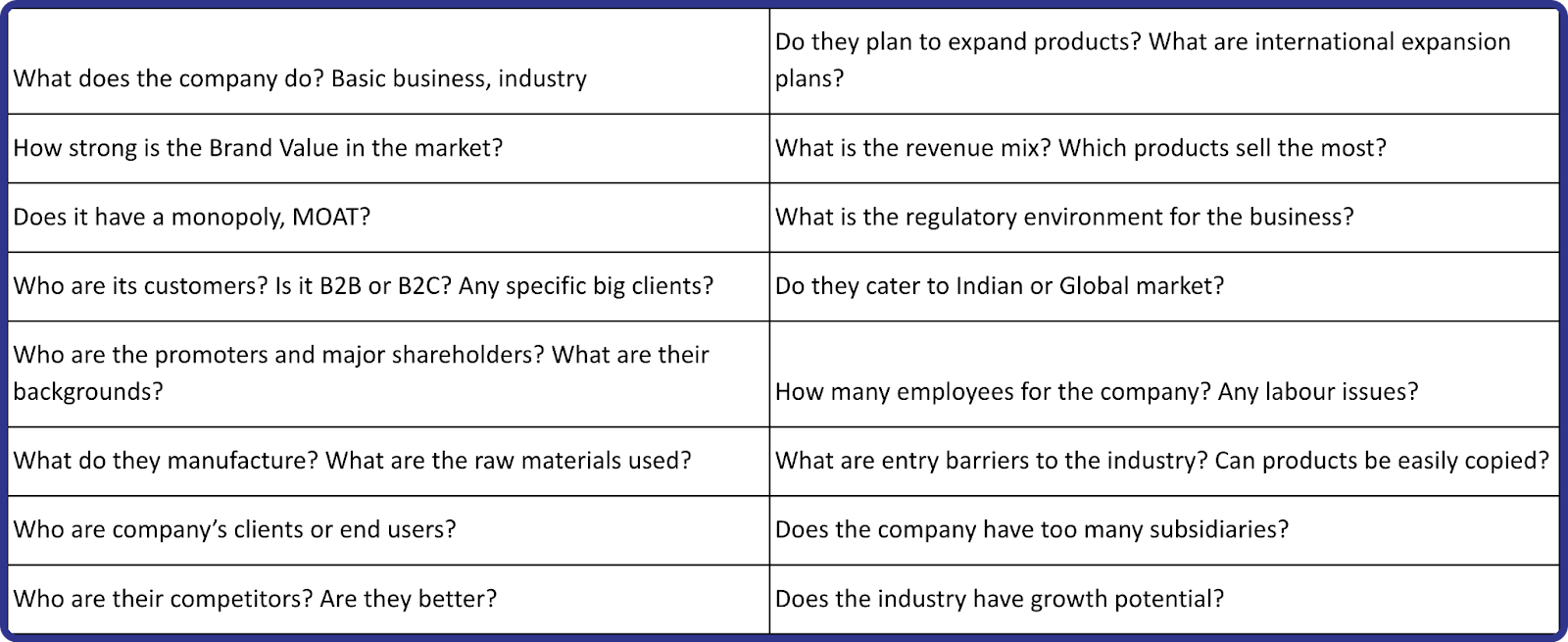
You can also refer to the questions given below to understand more about a business. After getting answers to these questions, you will have enough information about a company to understand its business.
If you don’t understand a company’s business even after all this, it’s better that you don’t invest in it.
Step 3: Ensure Quality
1. Read annual reports
Reading the annual report can give you an idea about a company’s quality.
2. Read financial statements
Financial reports like a profit & loss statement and balance sheet help analyse a company’s spending decisions and debt levels.
3. Study financial ratios
Ratio analysis unveils a company’s performance and growth trajectory over time. It would be beneficial to compare a company with others in the same industry or sector. Additionally, comparing a company’s ratios with industry standards provides a better understanding of its position and performance.
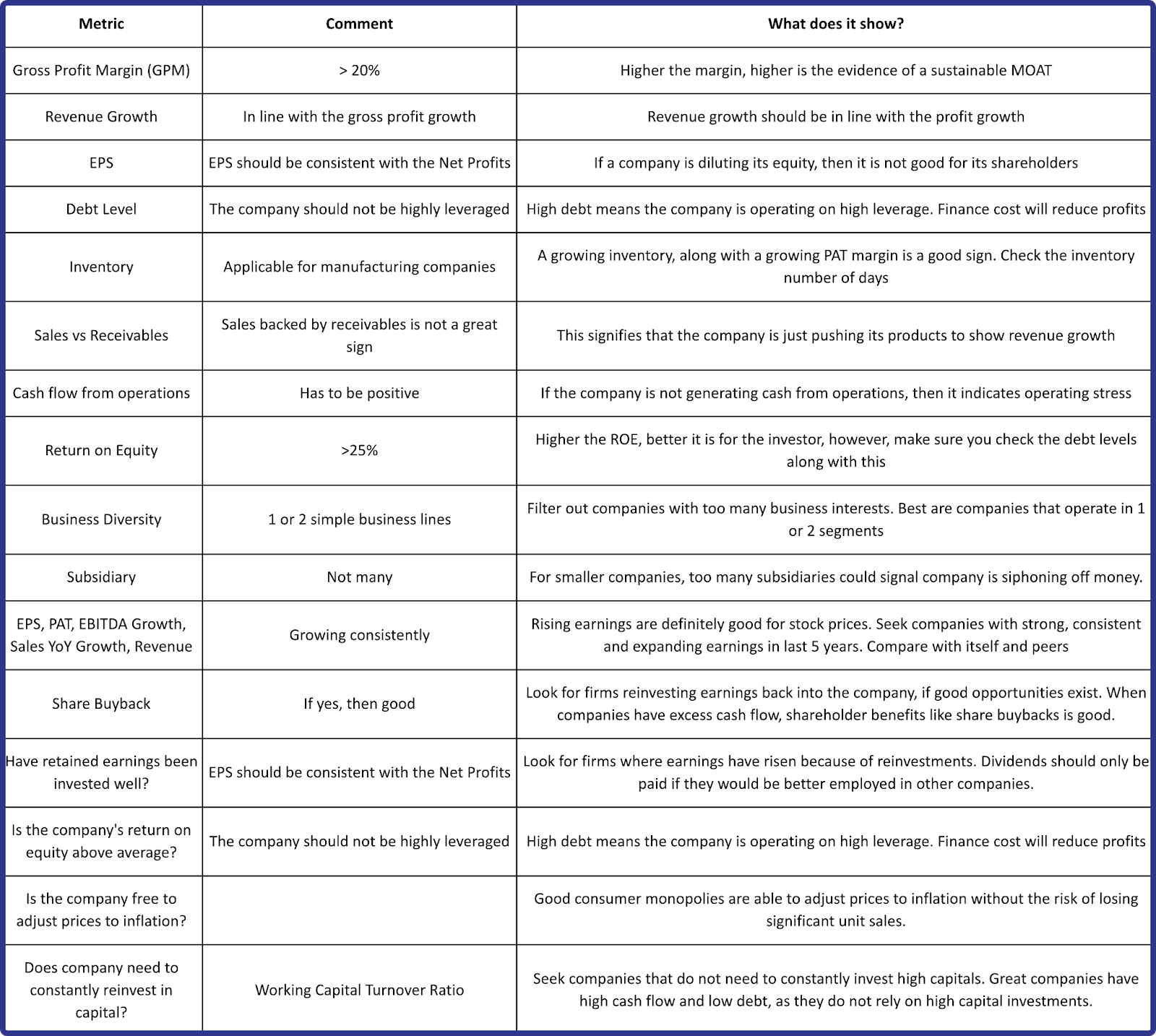
You can use the checklist below to analyze quantitative and qualitative factors. The table below is only for reference. You should also consider other checklist points for better analysis.
Thus, we should check both quantitative and qualitative factors while ensuring quality.
Step 4: Check Valuation
After completing the steps mentioned above and compiling a list of high-quality stocks, the next crucial step involves evaluating the value of the companies on that list. Valuation is a quantitative process of determining the fair value of an asset, investment, or firm. In this step, we compare the market value and intrinsic value of the company and determine if it is undervalued or overvalued. The market value of a company is what it is currently worth according to the market. It is calculated using the formula below:
The market value is the value the market (retail investors and institutions) gives a company. However, the company also has a true value, which is called its intrinsic value. If the market value of a company exceeds its intrinsic value, the stock is overpriced or overvalued. On the other, if the intrinsic value surpasses the market value, it is undervalued.
After finding the intrinsic value of a company, we have two methods of investing:
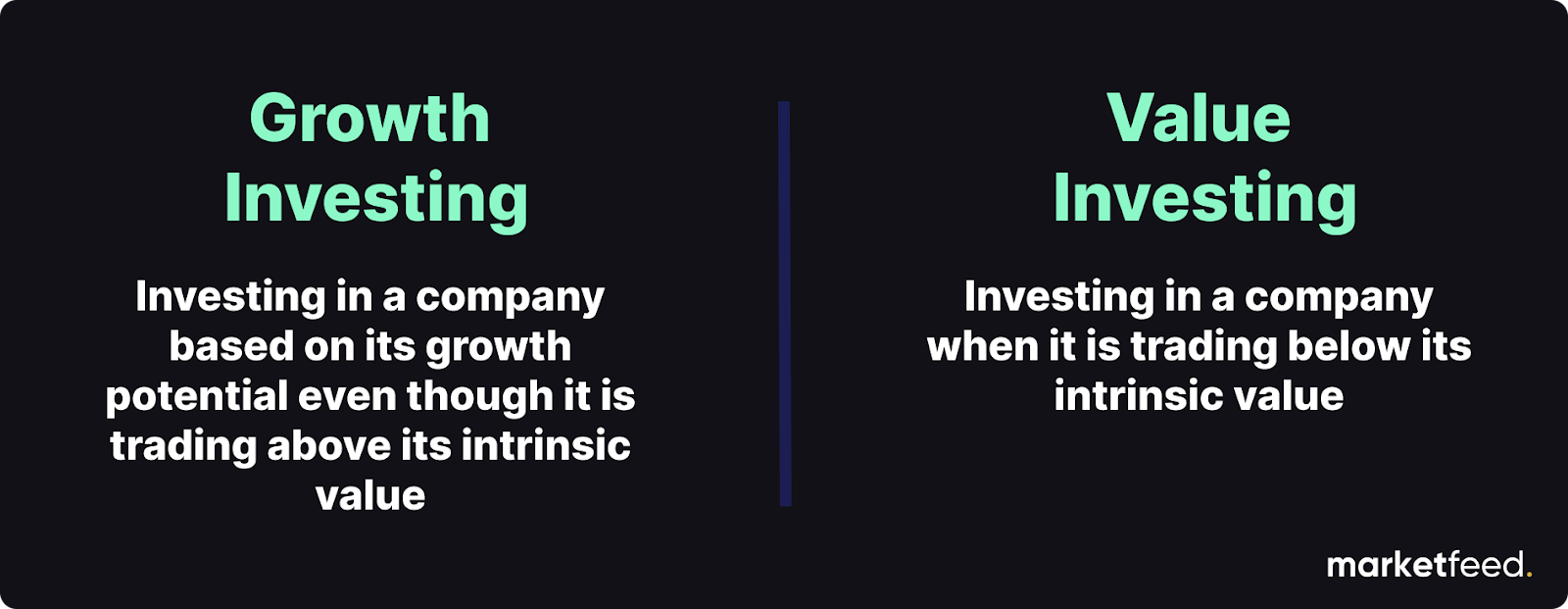
1. Growth Investing
Buy a stock if it has a high growth history/potential and fits all your checklists. In growth investing, we ignore the intrinsic value of a company. If a company has been continuously growing for the past few years and still has high growth potential, we can buy its stock despite its overvaluation. For example, Hindustan Unilever has always been overvalued in the past, but it kept on growing despite its overvaluation.
2. Value Investing
Buy a stock if its current market price is lower than its intrinsic value. We choose not to buy overvalued stocks. Veteran investor Warren Buffet and his mentor Sir Benjamin Graham are renowned value investors.
Both growth investing and value investing can yield good returns. Growth investing is comparatively easier than value investing. However, if done right, value investing can build you a fortune!
There are many methods to value a company and find its intrinsic value. You can use Dividend Discount Model (DDM), Present Value Methods, etc to value companies.
Step 5: Make a Decision
After completing all these steps, your next action will be to make an informed decision. First, we identified a few stocks, understood their business, ensured the quality, and valued the companies. The final step is to decide whether to add that stock to your portfolio. While building a portfolio, it should be well diversified. So, we should avoid adding multiple stocks from the same industry to our portfolio.
When to Invest?
The two ways in which people invest in stocks are:
1. Lump Sum Investment
When we invest a huge amount into stocks all at once, it is called a lump sum investment. People usually do this when they receive bonuses or a large sum. However, the drawback of this method is that we cannot maintain a better average price. If we make a lumpsum investment and the stock keeps on falling, we cannot take advantage of this price discount as all the money was invested in a single go.
2. Systematic Investment Plan (SIP)
SIP is a method of investing a fixed sum regularly into a portfolio. Most salaried people have a regular income every month. Out of this, they invest a certain percentage as SIP. A better average price can be maintained in this method as the purchase price will be lower and higher sometimes.
In value investing, we only buy the stock when the intrinsic value is lower than its actual market value. Only a lump sum investment is possible here. On the other hand, with growth investing, we can invest in SIPs. One can perform technical analysis and buy the stock when its price dips or at regular intervals, such as monthly or weekly.
We should always invest in a portfolio of high-quality stocks while investing for the long term. If we invest in a single stock or sector/industry, there won’t be any diversification. When that particular industry starts performing poorly, our portfolio also dips substantially. Success in long-term investment is not finding or selecting that single multibagger stock. Rather, it is finding out and investing in a well-diversified portfolio.
Disclaimer: The information or any examples mentioned in this article are purely for educational purposes. Please do your own research before investing in stocks for the long term.