Categories
Editorial

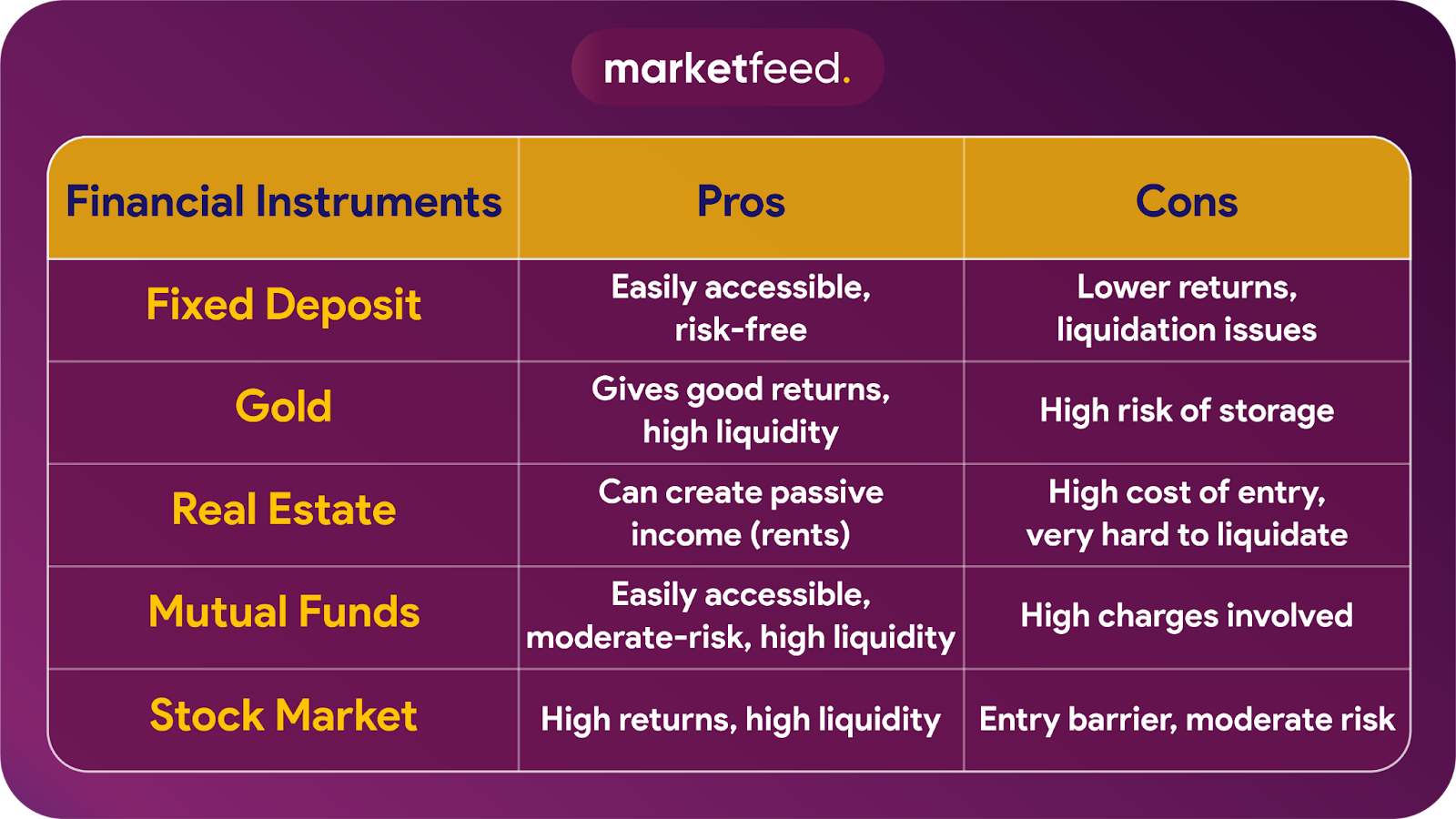
Best Investment Options for Beginners

As of late, we have noticed that many of our readers are confused about how to start their investment journey. The primary motive behind investing your hard-earned income is to fight inflation or a general rise in the prices of goods. The purchasing power of cash in hand or your bank account continuously reduces with time. In order to beat inflation and achieve future goals, you need to invest your money in a variety of financial products.

Our primary mission here at marketfeed is to show the path for every individual to become financially independent. We help you make informed decisions in the beautiful world of finance. However, it is important that we start from the very basics and slowly work our way up. So, let us have a clear understanding of some of the best investment options that can help you achieve financial freedom.

Direct Equity

Direct equity means investing in stocks. When you buy stocks (or shares) of a listed company, you become part-owner of the firm (even though it’s a very tiny fraction). This means that you are directly investing in the company’s development and growth. In the long run, stock markets have always beaten inflation and have delivered higher returns than other asset classes. Thus, stocks are always ideal for long-term investments. To directly invest in shares or equity, you would need to open a Demat account.

However, investing in stocks contains a high level of risk. Stock markets are often very volatile, as a variety of factors (including interest rates, government policies, economic figures, company operations) influence the performance of stocks. You will have to actively manage your investments to limit losses. One needs to have a lot of patience and gain market knowledge to get sufficient returns. With time, you will learn how to pick the right stock and time your entry and exit. Target-oriented and well-researched stock market investments can definitely help you beat inflation.

Mutual Funds

If you are not comfortable with investing directly in stocks due to the risks involved, you can always invest in mutual funds. A mutual fund takes money (investments) from different individual and institutional investors who have a common investment objective. This pooled sum of money is managed by a professional fund manager, who invests in securities and assets to generate returns for investors. 

You can find equity, debt and hybrid mutual funds as a general classification. Equity mutual funds invest in stocks and equity-related instruments, while debt mutual funds invest in bonds and other debt instruments. Hybrid mutual funds invest in a mix of equity and debt instruments. There are various equity mutual funds based on market capitalization, tax-saving funds, sectoral funds, and much more. As per reports, the 5-year and 10-year returns of these equity fund categories were above 10% as of April 2021.

Mutual funds are a very attractive investment option as you do not have to spend much time and effort tracking them. Instead of investing a large sum of money all at once, you could start a Systematic Investment Plan (SIP) and invest small amounts of money periodically (usually every month) in mutual funds. They are very flexible, as you can begin and stop investing according to your convenience. However, one needs to conduct a proper analysis or study before investing in a particular mutual fund. Element of risk is also present as the returns are dependent on market movements.

Bonds

A bond is a fixed-income instrument issued by companies or even government entities to raise funds. Investors can lend their money to organisations in return for fixed yearly interest. At the time of maturity of the bond, you will receive the initial money you had invested and the interest offered on it. Nowadays, bonds offer fixed returns that are at least 2-3% higher than fixed deposits (FDs). Government bonds in India are an ideal investment option as it provides more than 7% guaranteed returns. 

Before investing in bonds, you need to consider and analyse important factors such as coupon rate (fixed interest that the bond pays annually), payment frequency (the number of times the interest is paid to the bondholder), maturity date, and credit rating. A higher-rated bond carries a higher level of safety of investment. AAA-rated bonds are the most secure.

Gold

Gold is one of the best asset classes that can be used to counter inflation. This is because the increase in gold prices and the returns from it have always been able to offset inflation in the past. According to the World Gold Council, for every 1% increase in inflation, there is a 2.6% rise in gold demand. This ultimately leads to an increase in gold prices. However, acquiring and holding gold in the form of jewellery has its own concerns such as safety and high cost.

An alternative way of owning gold is through paper gold or gold ETFs. These are units representing physical gold which may be in paper or dematerialised (electronic) form. One Gold ETF unit is equal to 1 gram of gold and is backed by physical gold of very high purity. The investments made in paper gold are less costly.

What are ETFs?

As the name suggests, an exchange-traded fund (ETF) is a fund that can be traded on the stock exchange. It is a method through which you can buy and sell a basket of assets without having to buy all the components individually. ETFs are managed by finance professionals who own certain underlying assets (such as stocks, bonds, currencies, and commodities). They design a fund to track the performance of these assets and then sell shares of these funds to investors.

ETFs are a great method to diversify your portfolio and manage risks. It is also a cost-effective method of investing and also offers several tax benefits.

Fixed Deposits, Recurring Deposits

Fixed Deposits (FDs) are an investment option offered by banks and financial institutions. It is something that most of us are familiar with. You deposit a lump sum of money for a fixed period and earn a predetermined rate of interest on it. The interest rate of FDs differs from one bank to another. However, the average rate of FDs in India is only 5-6%, which may be insufficient to beat inflation. FDs are favorable for those investors who wish to receive guaranteed, yet conservative returns.

Recurring Deposits (RDs) are a fixed-tenure investment option provided by banks and other institutions that allow individuals to invest a fixed amount every month for a pre-defined time period. The interest rate on RDs is determined by the institution offering them. RDs also offer complete capital protection as well as guaranteed returns.

Government Schemes

Public Provident Fund (PPF) is a long-term investment scheme provided by the Government of India (GoI) that has a lock-in period of 15 years. Currently, the annual rate of interest offered on PPF is 7.10%. The entire amount withdrawn at the end of the 15 years is entirely tax-free for the investor. You can also take loans and make partial withdrawals if certain conditions are met.

Employee Provident Fund (EPF) is a retirement-oriented investment scheme that helps salaried individuals. EPF deductions are a specific percentage of your salary every month, and the same amount is matched by the employer as well. This entire amount is pooled into your EPF corpus or account every month, and you receive interest on it. Currently, the annual rate of interest offered on EPF is 8.50%. At the time of maturity, the entire amount withdrawn from the EPF corpus is entirely tax-free.

The National Pension Scheme (NPS) is another tax-saving investment option offered by the Government of India. Anyone between the age of 18-65 years can make voluntary contributions to this scheme. Investors who subscribe to NPS will mandatorily stay locked in until their retirement and can earn better returns than PPF or EPF. Historically, NPS has delivered ~8-10% returns every year.

Real Estate

Investing in real estate is one of the best ways to diversify your portfolio. Since the value of a real estate property appreciates (or increases) with time, you can earn exponential returns on it. Acquiring a property and renting it out would be an ideal way to earn passive income. However, the location of the property is the most important factor that will determine its value and also the rental income that can be earned from it. In the case of residential properties, investors must always conduct a thorough study of home loan interest rates, offers provided by developers, and government regulations. Another important factor to consider is that real estate is highly illiquid. Properties cannot be sold off and converted into cash quickly.

If you don’t have adequate capital for acquiring real estate properties, you could always invest in a real estate investment trust or REIT. This is very similar to a mutual fund, wherein you can invest small amounts of money on certain income-generating assets and earn a good return from them. A REIT owns and operates several properties such as complexes, infrastructure projects, healthcare units, apartments, and more. The money pooled in from the REIT is used to manage these assets. And, the income derived from these properties or assets is shared among all investors (or unitholders) of the REIT.

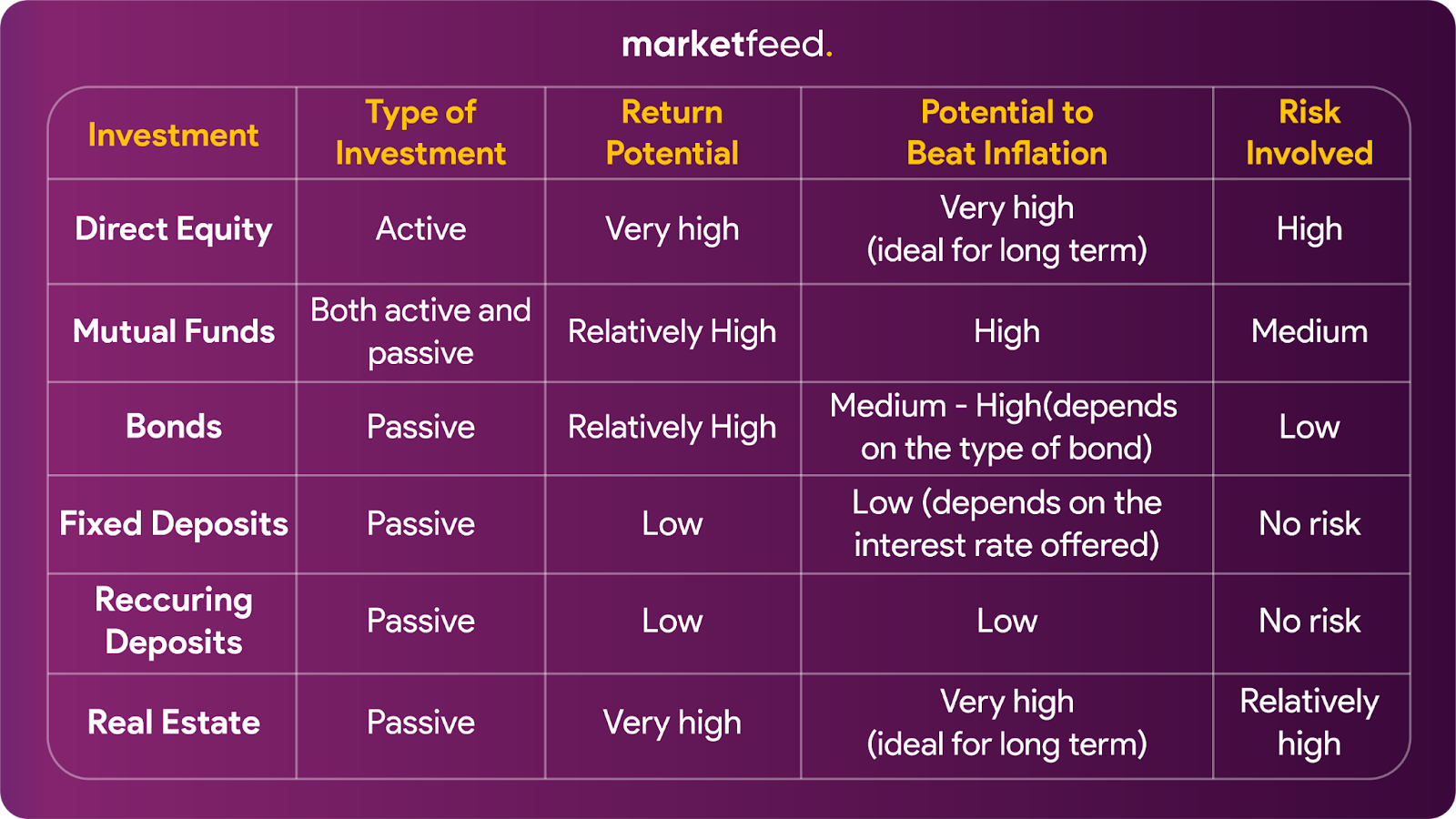
Types of Investments in a Nutshell
Conclusion

Now, you have an idea of how to grow your hard-earned income to beat inflation and lead a better life. However, it is up to you to figure out the right investment that fits your profile and financial goals. Start your investment journey only after carefully going through the risks and costs associated with each of them. Go for those investments that you clearly understand from your own research. At the same time, it is vital that you invest your money in different products and diversify your portfolio. More importantly, make sure you do not fall for scammy schemes that promise high returns in a short period. The sooner you start investing, the longer you will stay invested and earn higher returns.

Open a free Demat account –

Upstox
Zerodha

Happy Investing!

Categories
Editorial

Why Are Gold Prices Falling After Touching A Record High last September?

In September 2020, gold prices touched a record high of Rs 58,000 per 10 gram. In times of crisis and uncertainty, people tend to buy more gold as it is a risk-haven and comparatively less volatile. There were many reasons why gold prices hit record highs in 2020. The US-China Trade War, negative US bond yield, geopolitical tensions, and uncertainty around the COVID-19 pandemic to name a few. 

Fast-forward to a few months later, gold prices have come down significantly to a 10 month low. As of 6th April 2020, gold is trading close to Rs 45,500 per 10-gram level, which is around Rs 13,000 less than the record high of Rs 58,000. The way the gold prices were soaring, a correction was definitely expected but there is much more to it. There are some economic factors, market factors, and other global factors that have come into play. 

Reason 1: Investors Have More Risk Appetite

During the COVID-19 lockdown, businesses were shut, unemployment was high, global economies were down, households did not have money to spend and had to depend on government support for expenses.

Once things were a little better, governments all across the world release stimulus packages. Central banks across the world reduced interest rates to put money into the system. Loans were offered at low-interest rates and moratoriums were given on NPAs. All of a sudden, markets were flooded with liquidity.

Gold, on one hand, is a risk haven. People invest in gold during times of uncertainty, since gold is globally accepted and can be sold during times of crisis.  When there is too much money in people’s hands, they are likely to invest it in more risky assets. The stock market is one of them. The global stock markets managed to touch record highs. NIFTY and SENSEX touched their record highs as well.

Reason 2: Dollar Zooming 

For the past few years, gold and the US Dollar have had an inverse relationship. The current increase in the US dollar with respect to other global currencies has caused gold prices to decrease. This is because if the US dollar becomes stronger, gold will become relatively more expensive in other currencies causing demand to reduce and therefore the price. Conversely, if the US dollar gets weaker, gold becomes relatively cheaper to buy in other currencies, and the demand increases, and therefore the price. However, it must be noted that gold and the US dollar CAN move together in some cases. 

Reason 3: Rising Bond Yield

In August 2020, the US 10-Year bond yield was ~0.52%. The yield has now risen threefold to ~1.6% in March 2020. When bonds return a higher yield, the cost of holding gold becomes higher. Investors will prefer holding stocks and bonds over gold, as these would give a better return than gold. Investors will start diluting their gold holdings and start pouring that money into the bond and stock market. This will cause gold prices to decline.

Reason 4: India cuts custom duty from 12.5% to 7.5%

In the 2021 Budget Session, the import duties on gold were slashed from earlier 12% to 7.5%. An additional 2.5% cess was proposed in the form of Agricultural and Infrastructure Development Cess(AIDC). After the announcement, gold futures on MCX slumped 3% or about ₹1,500 per 10 gram.

The decrease in gold prices has seen a lot of accumulation happening which helped in price recovery. Prices are up by almost Rs 2000-Rs 2500 from the low of Rs. 45,500 per 10 gm. The second wave of COVID-19, rising lockdown measures, uncertainties over vaccines, rising debt, and liquidity are supporting factors of gold price rise. A question remains, should you invest in bonds over gold? The US 10-year bond yield has been at its peak recently, bond prices are low, yields are high. One can either choose to profit from the volatility of the gold market or choose to invest in a rather consistent instrument like bonds. Investors should watch out for inflation numbers, long-term bond yields, US Fed Reserve Rate, and other global factors that might affect the spot price of gold. 

So the next time you see a family member wondering why gold prices are moving like it is, you will know the answer!

Categories
Jargons

What are Municipal Bonds?

Municipal Bonds or Muni Bonds are bonds issued by local government bodies or Municipal Corporations. Bangalore was the first city to issue municipal bonds in India in 1997. Later, Ahmedabad followed by launching its municipal bonds in 1998. The funds raised by these municipal bonds are used for constructing bridges, parks, schools, and other public projects. Are these bonds safe? When should one invest in these bonds? What are the risks associated with these bonds? Let’s find out!

Why Do Local Bodies Need Bonds? 

Urban Local Bodies, like municipal corporations, public townships, etc. have always had a lack of funding and resources. According to a 2018 report by NITI Aayog, “The total revenues of all Urban Local Bodies (ULBs) in India amount to less than Rs 1, 50,000 crores, approximately, 1% of India’s GDP.”  

Most of the municipal corporations rely on grants or budgets allocated by state governments or the central government. Apart from these, they rely on water supply bills, property taxes, octroi, rents from municipal properties, vehicle registration fees, etc. The municipal bodies also had the responsibility of promoting socio-economic development in their areas. However, these are not sufficient to set up new projects or maintain already existing projects. To address this problem, local bodies started issuing municipal bonds. 

How Good Are Municipal Bonds?

  • Tax-Free Income- Municipal bonds are usually tax-free or taxed at a lower rate. It is advisable to check the placement memorandum and necessary paperwork before investing in a bond.
  • Lower Risk – Municipal corporations of big cities set up projects like metro rails, public transport, roads, flyovers, public parking spaces, gardens, redevelopment schemes, and housing schemes. These big municipal corporations are likely to recover the money that they spend. Such development is seen only in Tier-1 and Tier-2 cities and generally gave a credit rating above A- going up to AA+ which is actually good. 

    On the other hand, municipal bonds of smaller towns and cities tend to have fewer development projects in hand and therefore might depend on taxes collected to pay back their bondholders. This means that the returns might get riskier for smaller municipal corporations. These bonds have a credit rating lower than BBB+.
  • Strict SEBI Regulations- SEBI guidelines have assured that only those municipal bodies that are financially stable and have the ability to pay back their bondholders can issue bonds. You can read the official SEBI guidelines for municipal bonds over here.
  • Lower Default Rate – On average, municipal bonds have a default rate of 0.18% as compared to corporate bonds which have an average default rate of 3%. This means that municipal bonds are more likely to pay back an investor’s money.  

How Risky are Municipal Bonds?

  • Long Maturity Period – Most Municipal Bonds are issued for 10 years and generally start paying out after the 4th year from the date of issue. This means that Municipal Bonds may not be the best idea for those wanting to invest short term. 
  • Lower Returns – Municipal bonds offer a lower rate of return than corporate bonds due to various reasons like limited revenue base, tax base and risk factors. 
  • Call Risk – Like how companies ‘buy-back’ shares, bonds are ‘called’ back. Companies do so when the bond yield decreases and they want to increase the yield to attract more investors. When these bonds are ‘called’, they pay the bondholders the face value of the bond and the interest accrued on it.  This can cause the bondholder to lose potential interest or pay more taxes on the amount received. 
  • Dependence on Third Parties – Municipal projects aren’t the cleanest in nature. There is a lot of corruption and third parties (contractors) involved who may try to cut corners on the projects. Whether or not a project is completed depends on the company to whom the project was tendered to. 
Categories
Jargons

What Are Bonds? Types of Bonds, Risks and Jargons

What Are Bonds?

A bond is a fixed-income security that a company or a government uses to raise money for a given period of time. In simple words, an organisation can raise debt/borrow money from investors (Mutual Funds, Foreign Investors, Domestic Investors, etc.). Bonds are low-risk investments that give fixed returns to an investor over a period of time. 

Bonds are less riskier than shares, provide a higher return than bank deposits and certain bonds are even tax-free or are charged less tax than other instruments. Bondholders hold a greater preference than shareholders in a company. This means that in case a company shuts down, the bondholders will get their money before the common shareholders do.

Companies on the other hand prefer issuing bonds than borrowing money from the bank. This is because they may require strong financials, cash flows, and credit profiles, without which banks may not lend money. In bonds, it is completely at the investor’s discretion to invest money in those which abide by certain guidelines issued by SEBI and RBI.

Some Important Jargons

  • Face Value/Par Value- The price or value of a single unit of bond when it is first issued. However, it can be traded at below or above its face value/par value.
  • Premium and Discount- If a bond is traded at a price above its face value, it is said to be at a premium. If a bond is traded at a price below its face value, It is said to be at a discount.
  • The Principal or Par Amount- The total amount invested in a particular bond. 
  • Maturity Date- The expiry date of a bond when the bondholder will get back the principal amount along with interest if any.
  • Coupon Rate- It is the rate of interest payable at a fixed interval till the expiry date (Annually, Semi-Annually, Quarterly).
  • Yield- Coupon Payment or Interest Payment received over one year divided by the face value of the bond. Example: If the face value of a bond is Rs.100 and the interest payment received is Rs.10, then the yield is 10%.
  • Yield To Maturity– Yield To Maturity or YTM is the total expected return for an investor if the bond is held till the maturity date.  

Factors Affecting Bond Prices and Yield

  • Market Interest Rates – When the market interest rates decrease, the price of the bond increases. Let us take an example: If the rest of the market is providing returns at 2% interest and the bond meanwhile is providing 4% returns, then more people would invest in the bond than the rest of the market, and this will increase its demand and its market price simultaneously. When market interest rates increase then the price of the bond decreases. 
  • Inflation – When inflation increases, the buying power of the interest earned also decreases. For example- If a bond pays 4% interest annually, and the inflation increases from 0% to 2% in a year, then the real return earned would be 4% minus 2%, which would be 2%. So the ACTUAL return received would be just 2%.
  • Credit Rating – Based on a company’s performance, its risk, and other factors, Credit Rating Agencies like Flitch and Moody’s rate the bonds according to their risk profile. The riskier the bonds, the lesser is its market price as very few would invest in them.

Types of Bonds

Bonds can be classified into many types based on the requirements of the investor. The bond market is an extremely diverse market with hundreds of different products. Not all bonds have a fixed coupon rate and Not all bonds provide regular coupon payouts. Mainly, Bonds are classified according to their issuer, the coupon rate, purpose, currency, country of origin, and much more. 

Broadly speaking, based on the issue of the bonds, they can be classified as follows:

  • Government Bonds- Bonds issued by the state or central government 
  • Corporate Bonds- Bonds issued by private companies
  • Municipal Bonds- Bonds issued by local governments or municipal corporation
  • PSU Bonds- Bonds issued by Public Sector Undertaking such as SBI, ONGC, etc.

Risks Associated with Fixed Income Securities

Inflation risk – that an increase in inflation might reduce the buying power of the returns received on the security. 

Interest rate risk – that increase in overall interest rates shall occur which in turn will decrease the price of the bonds. 

Currency risk – that exchange rates with other currencies will change during the security’s term, causing loss of buying power in other countries

Default risk – that the issuer will be unable to pay the scheduled interest payments or principal repayment due to financial hardship or otherwise

Example

Let us say, a company, Spanners Pvt. Ltd. manufactures nuts, bolds, and spanners. They wish to set up a new factory in Bangalore, but they do not have the sufficient capital required to set up the new factory. Spanners Pvt Ltd. decided to issue bonds of face value Rs 1000 per unit, with a coupon rate of Rs 100 paid half-yearly for a period of 10 years.

Kumar is a computer programmer with savings of Rs 10000. He wants to invest 50% of his savings (Rs 5000) in less risky investments. He does not want to invest in bank fixed deposits (FD) since he feels that they do not pay much interest and are illiquid. Kumar decides to buy 5 bonds of Spanners Pvt. Ltd for a par value or principal of – Rs.1000 x 5 Bonds – Rs. 5000. 

10 years later, Spanners Pvt. Ltd has become a big company and now it’s time to pay its bondholders. Since Kumar has earned Rs 100 every 6 months as a coupon payout for 10 years, he has earned – Rs 100 x 2 times a year x 10 years – which equals to Rs.2000. Meanwhile, Kumar also gets his principal or par value back which isRs.1000 x 5 Bonds – Rs.5000.

In 10 years’ time, Kumar invested Rs 5000 and got back Rs 7000 making a total profit of Rs 2000. 

Categories
Jargons

What are Fixed Income Securities?

Fixed income securities are a group of debt instruments that provide fixed returns. These can be in the form of regular interest payments or repayments of the principal when the security reaches maturity. They are issued by a government, corporation, or other entity to finance and expand their operations. Investors in fixed-income securities are typically looking for a secure return on their investment.

Types of Fixed Income Securities

  • Bonds – Governments and Corporations(Issuer) issue bonds to the market (general public, mutual funds, etc.) in order to raise money to fund their projects. The issuer promises to pay back the principal amount invested in the bond along with the interest payable at regular intervals.
  • Fixed and Recurring Deposits – You are probably familiar with these terms. Fixed and recurring deposits with a bank give a certain rate of interest. They can help save tax if invested for a long period of time.
  • Company Fixed Deposits Company Fixed Deposits are offered by Financial and Non-Banking financial companies (NBFCs). The deposit is placed by investors with companies for a fixed term carrying a prescribed rate of interest
  • Fixed Maturity Plans or FMPs– FMPs are close-ended debt mutual funds with a pre-determined tenure and rate of return. Their maturity period can be from 1 month to 5 years
  • National Savings Certificate-The National Savings Certificate (NSC) is a fixed-income investment scheme that you can open with any post office. As a government-backed tax-saving scheme, the principal invested in NSC qualifies for tax savings under Section 80C of the Income Tax Act up to Rs 1.5 lakhs annually.
  • National Pension Scheme The National Pension Scheme is a social security initiative by the Central Government. This pension programme is open to employees from the public, private, and even the unorganised sectors except those from the armed forces.
  • Treasury Bills or Government Securities

Risks Associated with Fixed Income Securities

  • Inflation risk – that the buying power of the principal and interest payments will decline during the term of the security
  • Interest rate risk – that overall interest rates will change from the levels available when the security is sold, causing an opportunity cost
  • Currency risk – that exchange rates with other currencies will change during the security’s term, causing a loss of buying power in other countries
  • Default risk – that the issuer will be unable to pay the scheduled interest payments or principal repayment due to financial hardship or otherwise

More On Fixed Income Securities

There are many fixed-income derivatives such as interest derivatives, credit risk derivatives, etc. There are many fixed income products such as Bonds ETF and Debt Mutual Funds. These fixed income instruments are for ones who have a low-risk appetite and want a fixed regular income.

If an investor isn’t able to conveniently able to liquidate or monetise when the need arises, that would make it a bad decision. Fixed Income Investors need to give weightage to their priorities and needs over the rate of return since most fixed income securities have a prolonged maturity period.

One needs to know that fixed-income products aren’t bullet-proof and they have their own risks attached to them. To read more on how Franklin Templeton had to shut its six debt mutual funds, click here.