
Categories
Editorial

Shriram Properties Ltd IPO: All You Need to Know

Shriram Properties Ltd, a real estate developer, launched its three-day initial public offering (IPO) yesterday— Dec 8. In this article, learn more about the company and its IPO.

Company Profile – Shriram Properties Ltd

Shriram Properties Ltd (SPL) is one of the leading residential real estate development companies in South India. It is part of the Shriram Group, a reputed Chennai-based conglomerate with four decades of operating history. SPL primarily focuses on the mid-market and affordable housing segments. The company is also present in the mid-market premium, luxury housing, commercial, and office space categories. It has operations in Bengaluru, Chennai, Coimbatore, and Visakhapatnam.

The realty company completed 29 projects as of September 30, 2021 (Q2 FY22), representing 16.76 million square feet (msf) of saleable area. Out of the total, 24 projects are in Bengaluru and Chennai. Currently, SPL has a total portfolio of 35 ongoing, under development, and forthcoming projects aggregating to 46.72 million sq. ft. of estimated saleable area. Moreover, it has land reserves of approx. 197.47 acres, with a development potential of 21.45 msf of estimated saleable area. They have demonstrated capabilities in project identification and execution.

SPL is now transitioning to a combination of real estate development and real estate services-based business model, with a shift towards an asset-light business strategy. The company will continue to focus on mid-market and affordable housing categories in major cities in South India.

About the IPO

Shriram Properties’ public issue opens on December 8 and closes on December 10. The company has fixed Rs 113-118 per share as the price band for the IPO.

The fresh issue of shares (of the face value of Rs 10 each) aggregates to Rs 250 crore. The IPO also includes an offer for sale (OFS) by promoters and early investors, aggregating to Rs 350 crore. Individual investors can bid for a minimum of 125 equity shares (1 lot) and in multiples of 125 shares thereafter. You will need a minimum of Rs 14,750 (at the cut-off price) to apply for this IPO. The maximum number of shares that can be applied by a retail investor is 1,625 equity shares (13 lots).

SPL will utilise the net proceeds from the IPO for the following purposes:

  • Repayment and/or pre-payment of certain borrowings availed by the company and its subsidiaries Shriprop Structures, Global Entropolis, and Bengal Shriram – Rs 200 crore.
  • General corporate purposes.

The total promoter holding in the company will decline from 31.98% to 27.98% post the IPO.

Financial Performance

Shriram Properties has posted net losses over the past two financial years and in the six months ended September (H1 FY22). Its total income declined sharply from Rs 723.79 crore in FY19 to Rs 501.3 crore in FY21. The fall in revenue can be attributed to a decrease in the number of sale deed registrations and factors related to Covid-19 lockdowns. The company witnessed an increase in customer cancellations. However, EBITDA increased from Rs 79.93 crore in FY19 to Rs 121.05 crore in FY21. Operating margins have also improved during the same period.

SPL’s sales volumes from residential projects fell 7.7% year-on-year (YoY) to 3 million sq. ft in FY21. Its gross collections from the segment declined by 20.56% YoY to Rs 939.36 crore during the same period. There were no sales volumes and gross collections from commercial projects for the financial year ended March 2021.

The company’s total outstanding borrowings stood at Rs 695.1 crore as of Q2 FY22.

Risk Factors

  • SPL’s business and profitability are highly dependent on the performance of the real estate market in South India. Any fluctuations in market conditions could affect the company’s ability to sell projects at expected prices.
  • Shriram Properties has a significant amount of debt. This factor could affect its ability to obtain future financing or pursue growth strategies.
  • Some of the company’s ongoing and forthcoming projects may be delayed due to factors beyond its control. Such delays could adversely affect its reputation and financial condition.
  • The increase in prices, or shortages of, or disruption in the supply of labour and key building materials could severely impact estimated construction costs and timelines.
  • There are outstanding legal proceedings involving SPL, its subsidiaries, directors, and promoters.
  • The company’s business is capital intensive and is highly dependent on the availability of real estate financing in India. Difficult conditions in the global and Indian capital markets may cause SPL to experience limited availability of funds. Such a situation will adversely impact its overall operations.

IPO Details in a Nutshell

The book-running lead managers to the public issue are Axis Capital, ICICI Securities, and Nomura Financial Advisory & Securities (India). Shriram Properties Ltd had filed the Red Herring Prospectus (RHP) for its IPO on December 1. You can read it here. Out of the total offer, 75% is reserved for Qualified Institutional Buyers (QIBs), 15% for Non-Institutional Investors (NIIs), and 10% for retail investors.

Ahead of the IPO, SPL raised Rs 268.65 crore from anchor investors. The marquee investors include Societe Generale, Pioneer Investment Fund, Nomura, Blue Mount Capital, Nippon Life, HDFC Trustee, etc.

Conclusion

The real estate sector is one of the largest contributors to India’s economy. The demand for residential properties has surged as a result of rapid urbanisation and rising household incomes. As we know, real estate developers were forced to halt construction activities amidst the Covid-19 pandemic. They saw a considerable decline in sales volumes last year. Fortunately, with the removal of lockdowns, things are looking positive for this sector. Various realty firms are now witnessing a recovery in demand and have also posted good results. To learn more about the real estate sector in India, click here. One could invest in SPL based on its strong brand image and long-term growth prospects.

India’s real estate development industry is highly competitive and faces massive hurdles. SPL will be directly competing with large developers such as Prestige Estates, Brigade Enterprises, Godrej Properties, Oberoi Realty, Sunteck Realty, and Sobha once it gets listed. 

The company has not received much investor interest in the grey market. SPL’s IPO shares are trading at a premium of just Rs 10-15 in the unofficial market. Many analysts have red-flagged the expensive valuation of SPL when compared to its peers. Before applying to this IPO, wait to see if the portion reserved for institutional investors gets oversubscribed. As always, consider the risks associated with the company and come to your own conclusion.

What are your opinions on this IPO? Will you be applying for it? Let us know in the comments section of the marketfeed app.

Categories
Market News Top 10 News

ICICI Bank Reports 30% YoY Rise in Net Profit in Q2 – Top Indian Market News

ICICI Bank Q2 Results: Net profit rises 30% YoY to Rs 5,511 crore

ICICI Bank reported a 30% YoY increase in net profit to Rs 5,511 crore for the quarter ended September (Q2 FY22). Net profit rose 19% compared to the previous quarter. Its net interest income (NII) rose 25% YoY to Rs 11,690 crore during the same period. [NII is the difference between the interest income a bank receives on loans and the interest paid to depositors]. The bank’s gross non-performing assets (GNPA) ratio stood at 4.82% in Q2, compared to 5.15% in the previous quarter. Provisions declined by 9% YoY to Rs 2,714 crore in the July-Sept quarter of FY22. 

Read more here

Minda Industries to hike stake in Strongsun Renewables to 28.10%

Minda Industries Ltd said the Investment Committee of its Board of Directors has approved the second round of stake purchase in Strongsun Renewables Pvt Ltd. The committee approved the acquisition of 3.07 lakh equity shares (of the face value of Rs 10 each) at Rs 80 per share of Strongsun Renewables, aggregating to Rs 2.46 crore. After completion of the transaction, Minda Industries will hold a 28.10% stake in the special purpose vehicle (SPV).

Read more here.

Tatva Chintan Pharma Q2 Results: Net profit jumps 811% YoY to Rs 32 crore

Tatva Chintan Pharma Chem reported an 811.5% YoY jump in consolidated net profit to Rs 32.41 crore for the quarter ended September (Q2 FY22). Net profit increased by 40% compared to the previous quarter. Its revenue from operations rose 105.8% YoY (or 16% QoQ) to Rs 123.6 crore during the same period. EBITDA stood at Rs 35.8 crore in Q2, up 477% YoY (or 39% QoQ). 

Read more here.

Ami Organics Q2 Results: Net profit rises 14% YoY to Rs 17.5 crore

Ami Organics Ltd reported a 14.78% YoY increase in consolidated net profit to Rs 17.47 crore for the quarter ended September (Q2 FY22). Net profit increased by 27% compared to the previous quarter. Its revenue from operations rose 33.9% YoY (or 8% QoQ) to Rs 122.31 crore during the same period. EBITDA stood at Rs 27.3 crore in Q2, an increase of 27% YoY.  Ami Organics is one of the leading research and development (R&D)-driven manufacturers of specialty chemicals. 

Exxon looks to buy stake in ONGC’s Indian deep sea fields

Global oil major ExxonMobil Corp is looking at buying a stake in some of the local deepwater fields of Oil and Natural Gas Corporation (ONGC), said Oil Secretary Tarun Kapoor. India, the world’s third-largest importer and consumer of oil, imports ~85% of its oil needs from overseas. The government has been scouting for partnerships with global oil companies to quickly monetise its reserves. Exxon would either acquire a stake in the Indian fields or form a joint venture with ONGC to operate them.

Read more here.

Orient Electric Q2 Results: Net profit rises 7% YoY to Rs 34 crore

Orient Electric reported a 7.25% YoY increase in net profit to Rs 34.77 crore for the quarter ended September (Q2 FY22). Net profit jumped 595% compared to the previous quarter. Its revenue from operations rose 37% YoY (or 41% QoQ) to Rs 594.38 crore during the same period. Revenue from its electrical consumer durables segment rose 49.33% YoY to Rs 454.5 crore. The company’s total expenses stood at Rs 549.17 crore in Q2, up 40.38% YoY.

Read more here.

Whistle-blower alleges related party transactions by Asian Paints promoters

A whistle-blower has red-flagged related party transactions (RPTs) carried out by the promoters of Asian Paints Ltd (APL), which allegedly benefited them at the cost of the company’s shareholders. The whistle-blower informed market regulator SEBI that money to buy a company called Paladin Paints and Chemicals (PPC) went from APL. However, APL’s promoters Ashwin Dani and son Malav now control it in their personal capacity. SEBI has sought further details from the whistle-blower.

Read more here.

MCX Q2 Results: Net profit falls 44% YoY to Rs 33 crore

Multi Commodity Exchange of India (MCX) reported a 44% YoY decline in consolidated net profit to Rs 44 crore for the quarter ended September (Q2 FY22). Net profit fell 18% compared to the previous quarter. Its revenue from operations declined by 30% YoY (or 5% QoQ) to Rs 82 crore during the same period. EBITDA stood at Rs 34 crore in Q2, a decline of 49% YoY.

Petrol, diesel prices hiked for fourth consecutive day

The prices of petrol and diesel soared to new record highs across the country after the rates were hiked for the fourth consecutive day on Saturday. State-run oil marketing companies (OMCs) have increased the fuel rates by 35 paise per litre each. Following the latest price revision, petrol is retailing at Rs 107.24 per litre in Delhi. The cost of diesel stands at Rs 95.97 per litre in the national capital.

Read more here.

Real estate sector to touch $1 trillion by 2030: Niti Aayog

The real estate sector plays a multiplier effect in the development of the economy and is expected to reach a market size of $1 trillion by 2030, said Niti Aayog CEO Amitabh Kant. He further said that the sector will account for 18-20% of India’s gross domestic product (GDP). Kant noted that the real estate sector and its stakeholders also play a critical role in supporting the ‘housing for all’ initiative of the government. Real Estate Investment Trusts (REITs) are expected to create opportunities worth Rs 1.25 lakh crore in the coming years.

Read more here.

Categories
Editorial

Macrotech Developers IPO: Should You Invest?

Trump Towers(India), World Trace Centre WTC(India), and the tallest tower in India,-World One, have one thing in common. All three mega-structures are built by a company called Macrotech Developers, commonly known as Lodha Group. Formerly known as Lodha Developers, Macrotech is a real-estate company based out of Mumbai. Macrotech Developers has come up with its IPO starting 7th April 2021. It is the first IPO of the financial year 2021-22 or FY22. What does the company do? How does the real estate empire seem like in the Post-COVID scenario? Let us find out.

IPO Opening DateApril 7, 2021
IPO Closing DateApril 9, 2021
Listing DateApril 22, 2021
Issue TypeBook Building
Face ValueRs 10 per equity share
IPO PriceRs 483 to Rs 486 per equity share
Market Lot30 Shares
Min Order Quantity30 Shares
Issue AmountRs 2500 crore
Issue Size51,440,328 equity shares of Rs 10 each

The company plans to use the raised funds to repay debt worth Rs 1,500 crore and acquire land and development rights worth Rs 375 crore. The remaining amount will be used for general purposes. 

The Business 

  • As of December 2020, the company owns or has sole development rights for close to 3,174 acres of land reserves. The company has completed 91 projects with 77.22 million square feet of developable land. It has 36 ongoing projects and 18 planned projects totaling 73.86 million square feet of developable land in the future. 
  • The company has most of its projects lined up in MMR or Mumbai Metropolitan Region and Pune. A city like Mumbai has a high potential for upcoming real estate projects in the near future considering the constantly inflating real estate prices. Apart from this, it has projects around the world in cities like Singapore, Dubai, United Kingdom, and the United States. 
  • The company gains most(60%) from its affordable housing and commercial projects segment followed by mid-income and luxury housing and commercial projects. The weightage of affordable housing and commercial projects has seen an increase over the past few years.
  • Apart from the housing segment, the company also has ongoing and planned logistics (290 acres) and industrial park(540 acres) projects lined up.
  • The company is 100% owned by its promoters and has no secondary or public shareholding. After the IPO, the company will hold 89% shareholding. 

The Finances

FY2017-18FY2018-19FY2019-209M FY2020-21
Sales8129.947162.66 6569.2 3351.3 
Revenue13726.5611978.8 12560.98 3160.48
Profit After Tax1789.391643.77 744.83 (2,643.02) 
Total Borrowings22,59923,36118,41318662
Financial Vitals(In Rs. crore)
  • The company does not reflect a strong financial position. Its sales figure declines from Rs 8129.94 crore in FY2017 to Rs 6569 crore.
  • The company’s revenue has declined from Rs 13726 crore to Rs 12560 crore between FY2017-18 and FY2019-20. The company’s profit after tax almost halved in three years in these three years. Currently, the company has recorded a loss in FY2020-21.
  • The company has managed to cut down on debt a little but still happens to be in deep debt of up to Rs 18,662 crore as of December 31, 2020. 
  • The company’s total borrowing as of December 31, 2020, remains Rs 18,662 crore with secured borrowings of Rs 18,496 crore and unsecured borrowings of Rs 165 crore. The company has to pay or refinance Rs 16,145 crore worth of borrowings within the next year or less

Risk and Reward

  • The company has a strong brand value and market presence. The real estate market is such that its difficult to have new entrants. This is because of various reasons like limited land availability, high capital requirements and regulatory barriers.
  • The company has a strong presence in the MMR region which is a stronghold for real estate in the country. The most expensive properties and constantly rising real estate prices can be found here.
  • The company’s affordable housing segment receives is likely to receive immense support from the government’s housing policy in the form of tax benefits and a lower GST rate.
  • The company has a weak balance sheet. It works on high amounts of debt and has recorded decreasing revenue and profits over the past few years.
  • The company has 12 criminal cases and 271 civil cases against it, totalling an amount of Rs 7,752 crore.
  • The company does not have a diversified geographical presence. It has its strong hold only in the Mumbai Metropolitan Region. Any change in its market can have a significant impact on the company’s balance sheet.

The odds have turned against Macrotech in recent times. Maharashtra, which had reduced the stamp duty for real estate from 5% to 2%, increased it back to 2% almost a week ago. Moreover, a recent close-to-lockdown like restrictions were imposed in Maharashtra, where many non-essential businesses were asked to shut shop for almost a month. This was unprecedented when the company had filed for an IPO. The Rs 2500 crore which the company will raise won’t have a major impact on its debt position. In times like these, it would be risky to invest in a real estate IPO like Macrotech Developers’. 

Categories
Jargons

What is a Real Estate Investment Trust (REIT)?

Real Estate Investment Trusts or REITs have revolutionised how individuals invest in real estate. REITs provide an avenue for both newcomers and seasoned investors to participate in the world of real estate without the burdens of property management. This article provides a complete overview of Real Estate Investment Trusts (REITs). We will explore what REITs are, how they work, and the advantages & risks of investing in REITs. We will also look at how to invest in REITs.

What is a Real Estate Investment Trust (REIT)?

A real estate investment trust (REIT) is very similar to a mutual fund. In the case of mutual funds, many people invest their money into a fund and fund managers allocate that sum to different asset classes. Similarly, a REIT gives you an opportunity to invest in real estate properties and derive income from them. A REIT owns, operates, or finances income-generating real estate properties. These trusts take money from small and big investors and allocate it to real estate assets. A REIT can possess a number of properties like complexes, infrastructure, healthcare units, apartments, and more.

For example, imagine a shopping complex in one of the popular spots in your city. A REIT could be the owner of that mall. The rent that is collected by the trust is shared with investors like you and me. This means, the more units you own, the higher the income you will derive. In a way, you are a partial owner of that famous shopping complex! How amazing is that, right? Similarly, by investing in REITs, you can own some part of high-priced real estate.

The United States Congress introduced REITs in 1960 to democratize real estate investment in the country. A legislation created a tax-advantaged structure for REITs, mandating them to share a part of their taxable income as dividends with shareholders. This encourages REITs to generate earnings from real estate assets and distribute them to investors.

What are the Types of REITs?

One of the key aspects of REITs is their ability to specialise in specific property types or investment strategies. These different types allow investors to tailor their portfolios to align with their investment preferences and goals. The three types of REITs are:

Equity REITs

Equity REITs own and operate income-generating properties such as residential apartments, office buildings, retail centres, and industrial warehouses. They generate revenue primarily from rental income. Investors in equity REITs participate in the growth and income potential of the underlying real estate assets.

Mortgage REITs

Mortgage REITs focus on providing financing for real estate transactions. They invest in mortgages and mortgage-backed securities (MBS), earning income from interest payments. Mortgage REITs can be more sensitive to interest rate fluctuations than equity REITs. Investors in mortgage REITs primarily benefit from the interest income generated by the mortgage portfolio.

Hybrid REITs

Hybrid REITs are a combination of both equity REITs and mortgage REITs. They own and operate properties, while also engaging in mortgage financing activities. Hybrid REITs offer a diversified investment approach, allowing investors to benefit from rental and interest income.

How do REITs work?

Real Estate Investment Trusts (REITs) operate through a unique structure that allows investors to access the benefits of real estate investing. REITs are typically organised as Trusts.

Asset Acquisition and Management

REITs acquire real estate properties through various means, including direct purchases, development projects, and partnerships. They engage in property management activities such as leasing, maintenance, and tenant relations. Professional management teams handle the day-to-day operations of the properties.

Rental Income and Dividend Distribution

REITs generate revenue from rental income received from tenants. They distribute a significant portion of their taxable income as dividends to shareholders, as required by law. Dividend distributions are a major attraction for income-oriented investors, as they provide regular cash flow.

Taxation and Compliance

REITs enjoy special tax advantages under the Income Tax Act. To qualify as a REIT, the entity must meet certain criteria, such as distributing at least 90% of its taxable income to shareholders, investing a minimum percentage of assets in real estate, and maintaining a diversified portfolio. Meeting these criteria allows REITs to transfer most of their earnings to shareholders without incurring corporate-level taxes.

Qualifications to Become a REIT

  • A minimum of 100 shareholders should be present.
  • It has to give at least 90% of the taxable income as a dividend.
  • Collect a minimum of 75% of total income from mortgage interest, real estate sales and rents.
  • A minimum of 75% of investment assets must be in real estate.
  • Less than five individuals should not have held 50% of its share.

Advantages of Investing in REITs

Investing in Real Estate Investment Trusts (REITs) offers a range of advantages for investors looking to gain exposure to the real estate market.

1. Diversification and Access to Real Estate Market

REITs provide investors with a way to diversify their portfolios by gaining exposure to the real estate market. Investors can access different property types, geographical regions, and market segments through REITs, without the need for large capital investments or property management responsibilities.

2. Regular Income Generation and Dividend Potential

REITs are known for their income-generating potential. They are required to distribute a significant portion of their taxable income as dividends, making them attractive to income-oriented investors seeking regular cash flow. Dividend distributions from REITs can provide a stable and predictable source of income.

3. Professional Management and Hassle-free Ownership

Investing in REITs allows individuals to benefit from professional management expertise. Experienced teams handle property acquisitions, operations, and maintenance. This reduces the burden of direct property ownership and management for individual investors. This makes REITs an attractive option for those seeking a hassle-free real estate investment experience.

4. Liquidity and Tradable Investments

REITs are listed and traded on major stock exchanges, providing investors with liquidity and flexibility. Unlike direct real estate investments, which can be illiquid and challenging to sell, REIT shares can be easily traded, allowing investors to adjust their positions according to market conditions.

5. Potential for Capital Appreciation

In addition to regular dividend income, REIT investments can offer the potential for capital appreciation. If the underlying real estate properties increase in value over time, the value of the REIT units/shares may also appreciate. This combination of income and potential capital gains can enhance overall investment returns.

Risks or Challenges of Investing in REITs

While Real Estate Investment Trusts (REITs) offer compelling advantages, investors need to be aware of the risks and challenges associated with these investments:

1. Interest Rate Risk

REITs can be sensitive to changes in interest rates. Rising interest rates can increase borrowing costs for REITs, impacting their profitability. Additionally, higher interest rates may make other investment options (such as bonds) more attractive relative to REITs.

2. Market Volatility and Economic Conditions

Like any investment, REITs are subject to market volatility. Economic downturns, fluctuations in real estate market conditions, and broader economic factors can impact the performance of REITs. It is crucial to consider these factors when assessing the potential risks associated with REIT investments.

3. Property Market Performance

The performance of REITs is closely tied to the performance of the underlying real estate properties they own. Factors such as occupancy rates, rental rates, and property market trends can influence the income and value of the properties, ultimately impacting the returns generated by the REIT.

4. Regulatory and Legal Risks

REITs operate within a regulatory framework and must comply with specific rules and regulations. Changes in tax laws, regulations related to REIT status, or legal disputes can affect the financial performance and operations of REITs. Investors should be aware of the potential regulatory and legal risks associated with investing in REITs.

5. Management Quality and Governance

The success of a REIT is highly dependent on the quality of its management team. Diligence should be exercised in assessing the expertise, track record, and governance practices of the REIT’s management. Poor management decisions or governance issues can negatively impact the financial performance and long-term prospects of the REIT.

How to Invest in REITs?

You can invest in any publicly listed REITs through your broker. However, you must keep in mind the following points before investing.

1. Research and Due Diligence

Before investing in REITs, it is essential to conduct thorough research and due diligence. Understand the REIT’s investment strategy, property portfolio, financial performance, and management team. Review regulatory filings, financial statements, and analyst reports to gather insights.

2. Assessing REIT Performance and Financials

Analyze the historical performance of the REIT, including its dividend history, earnings growth, and funds from operations (FFO). Assess key financial metrics such as occupancy rates, rental income growth, debt levels, and capital structure to evaluate the financial health and stability of the REIT.

3. Evaluating Property Portfolio and Sector Focus

Understand the types of properties held by the REIT and their locations. Evaluate the growth potential, market conditions, and demand dynamics for the specific property sectors in which the REIT operates. Consider factors such as diversification, tenant quality, and lease terms.

4. Understanding Dividend Policy and Growth Potential

Examine the REIT’s dividend policy, including the frequency and stability of dividend payments. Evaluate the potential for dividend growth over time. Consider factors such as the REIT’s ability to increase rental income, expand the property portfolio, and pursue value-enhancing opportunities.

5. Portfolio Allocation and Risk Management

Consider the role of REITs within your overall investment portfolio. Determine the appropriate allocation based on your investment goals, risk tolerance, and diversification strategy. Monitor and review your REIT holdings regularly, adjusting your portfolio allocation as needed.

In conclusion, Real Estate Investment Trusts (REITs) provide investors with a unique opportunity to gain exposure to the real estate market, while enjoying the benefits of professional management and regular income. Remember to conduct thorough research, assess performance metrics, and consider your own investment objectives and risk tolerance. With careful analysis and proper portfolio allocation, REITs can play a valuable role in diversifying your investment portfolio and potentially enhancing your long-term returns.

Categories
Editorial

The Real Estate Boom in India. Who Will Benefit?

The real estate sector is one of the largest contributors to India’s economy. It is a highly competitive industry that constantly faces massive hurdles. Amidst the Covid-19 pandemic, real estate developers were forced to halt construction activities. They saw a considerable decline in sales volumes. The rental income from malls and office complexes saw a fall. All external conditions led these companies to incur losses. 

Fortunately, with the removal of lockdowns, things are finally looking positive for the sector. Certain realty firms are now witnessing demand recovery and have also posted great Q3 results. However, we must understand an interesting concept that defines the trend of this particular industry. We shall look at how the present conditions prove to be favourable for large real estate companies. Let us dive right in. 

What is the Real Estate Cycle?

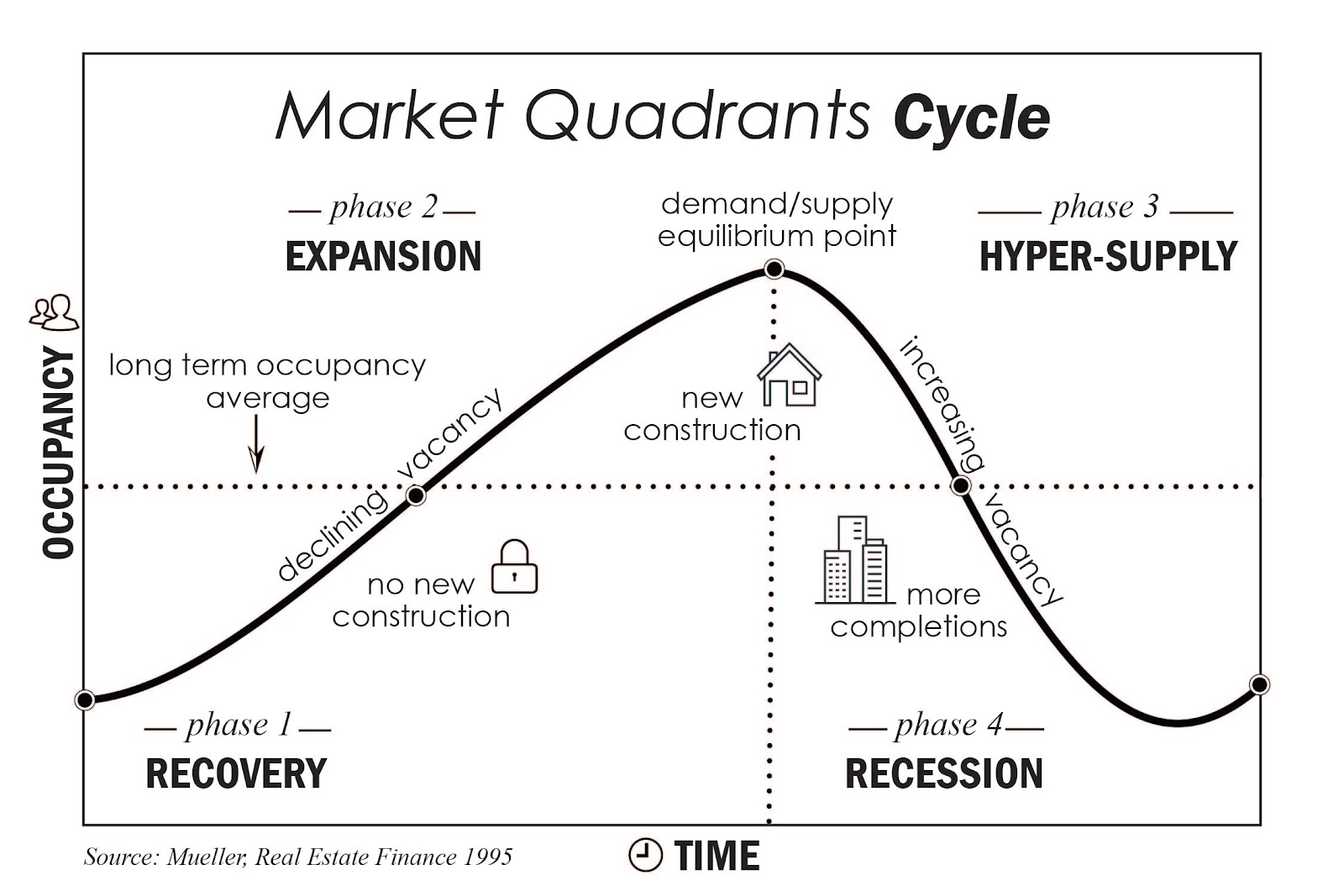
The real estate cycle is a concept that helps predict the income and appreciation performance of a real estate property. It is a sequence of recurrent events based on the economic and emotional factors that affect supply and demand for properties. Historically, it is found that the average real estate cycle spans 15-18 years. However, these cycles are unpredictable and can sometimes last much longer. The population structure, interest rates, overall health of the economy, and government policies (taxation) are some of the major factors that affect this cycle. With interest rates of loans at very low levels, there is no doubt that Indian Real Estate is in a booming cycle now.

Four Phases of the Real Estate Cycle

The real estate cycle consists of four main phases- recovery, expansion, hyper-supply, and recession. This means that there has never been a sustained period of expansion or hyper-supply without a recession- followed by recovery. Let us understand each phase in detail:

1. Recovery: This is a period when rental growth remains stagnant and there are no signs of new construction. Due to financial setbacks, people would be hesitant to buy or construct new properties. It is also a phase when investors buy and hold distressed properties and add value to them. This would allow them to sell or rent out these properties at high rates, right as the economy shifts into the expansion phase.

2. Expansion: This refers to a period when the general economy is improving, with more people being employed. They will regain their confidence in the economy, and thus, the real estate market. Individual renters and homebuyers will be in a better position to move to higher-quality houses/apartments. Real estate developers receive greater demand for their properties. New residential or commercial projects would be launched to meet this growing demand.

3. Hyper Supply: During the expansion phase, there would be a tipping point when supply begins to exceed demand. This could be due to the availability of too many apartments or houses in the market. And, there could be a sudden shift in the economy that leads to a decline in demand. Property owners often start to liquidate their assets out of fear that their properties will go vacant or unsold. 

4. Recession: This is a period when supply exceeds demand by a wide margin, and property owners suffer from high vacancy rates. People would be suffering from the economic downturn, and landlords would be forced to lower their rental rates. At the same time, certain investors use this opportunity to purchase distressed properties at very high discounts. They hold on to these properties, add value to them, and finally sell or rent them out just as the economy begins to recover.

The Current Scenario in India

Major real estate developers in India feel that the real estate cycle has now turned for the better. According to Pirojsha Godrej (Executive Chairman of Godrej Properties), demand is picking up and inventory is getting absorbed steadily. Customers and investors who had stayed away from residential real estate over the last 4-5 years are returning to the sector. This is primarily due to lower interest rates and higher disposable income among individuals. With the removal of all lockdown restrictions, we are witnessing a great recovery in economic activities. Developers have been receiving an influx of demand from home buyers or even investors who wish to buy and hold properties. There is a marginal increase in demand for commercial spaces, as people are now slowly returning to work from offices.

As we know, people were forced to work from home amidst the Covid-19 pandemic. Many felt an urge to shift to better locations or apartments/houses. The geographical markets of Bengaluru, Hyderabad, Pune, and Gurugram have contributed heavily to the overall sales volumes of real estate companies. These firms believe that the real estate sector will continue to perform well over the next 6 months. The Maharashtra Government even reduced all premiums related to this sector by 50% till December 31, 2021. It has been reported that other states would follow suit and introduce cuts on stamp duties and registration fees. The Centre had also introduced a ‘last-mile’ funding mechanism for delayed housing projects. These measures would bring down the financial burden on developers and allow them to offer properties at cheaper rates. 

On the other hand, construction activities have resumed and are now in full swing. To meet the growing demand, developers are focusing on completing existing projects. They have also acquired land in major cities and towns to launch new projects. This ultimately provides a well-needed boost for the cement, steel, paint, and other allied industries. It also generates employment opportunities for lakhs of people in India.

Listed Companies in Focus

As mentioned above, real estate companies in India are now showing an improvement in overall operational performance. Some of the major players in this sector had posted very strong results for the October-December quarter (Q3). Let us look at some of these: 

  • Oberoi Realty Ltd reported a 93% year-on-year (YoY) increase in net profit to Rs 286 crore in Q3, while its revenue rose 57% YoY to Rs 828 crore. There was a sharp surge in demand for higher-end apartments in Mumbai, where the company has a strong foothold.
  • Indiabulls Real Estate Ltd reported a 64% YoY increase in net profit to Rs 80.69 crore in Q3. Its revenue stood at Rs 756.81 crore during the same period. We saw that the share price of the company jumped 12% after it posted these results.
  • Sobha Ltd is yet to post its Q3 financial results. However, the company announced that it had achieved its highest-ever quarterly sales volume in Q3 FY21. It posted a total sales volume of 11.33 lakh square feet of super built-up area, valued at Rs 888 crore. Sales volume and total sales value were up by 27% and 29%, respectively, as compared to Q2 FY21.

It is expected that prominent firms such as DLF, Godrej Properties, Phoenix Mills, Prestige Estate, Embassy Office Parks REIT, and others are very likely to show robust sales growth during Q3. These companies have a positive outlook on India’s real estate sector for the upcoming fiscal year.

Allied Sectors

As construction activities have resumed, the demand for steel and cement are at a record high. At the same time, the prices of both these components have skyrocketed due to alleged cartelisation by large domestic players. China has also been importing and hoarding large quantities of steel, even though they contribute ~51% to global steel production. Now, companies such as SAIL, Tata Steel, JSW Steel, ACC, JK Cements, and Ambuja Cements are benefiting from increased margins

Similarly, we are also witnessing strong sales growth of companies such as Asian Paints, Berger Paints, and Kansai Nerolac Paints. The paint business in India is booming, and we can see conglomerates having a strong desire to enter this segment. For example, Aditya Birla Group’s flagship company- Grasim Industries Ltd announced its plans to enter into the paints business with an initial capital of Rs 5,000 crore. 

Conclusion

After going through a prolonged period of difficulties, things are finally looking positive for the real estate sector. With the anticipation of robust growth and financial performance, we could see an uptrend in the share prices of companies mentioned above. These firms are highly confident about the future prospects of the industry as a whole. This is supported by the present economic conditions, which encourage people to invest or buy new properties. The very low interest rates offered in housing loans, and lower stamp duties and other taxes are making this a perfect time for house-owners.

Developers are in a position to offer incentives or attractive payment schemes. The state and central governments had also introduced mechanisms to decrease the financial burden faced by these companies. The changing patterns of consumer behaviour and the integration of online and offline retail formats have positively influenced the real estate sector. Firms that offer interior-decoration solutions will also obtain a massive boost.

In the upcoming Union Budget 2021, this sector will look forward to additional measures that can support a further recovery in demand and remove supply-side challenges faced by developers. Such policies would help them show increased growth in the prevailing favourable conditions. Exemptions or deductions in tax rates would encourage people to acquire the houses or apartments of their choice. All eyes are focused on how the developers make use of the recovery and expansion phases of the real estate cycle. Will they be able to leverage the current situation and cater to the rising demand? Let us wait and watch.