Categories
Editorial

A Simple Guide to Trading Gold and Silver on MCX

Ever wondered why so many traders are drawn to gold and silver trading? Well, it’s not just about the shine! These precious metals are incredibly popular in the commodity market, thanks to their high liquidity and the big players (like jewellers and institutions) who actively trade them. In this article, we dive into everything you need to know about trading gold, silver, and bullion in the Multi Commodity Exchange of India (MCX).

How to Start Trading Gold and Silver?

One of the advantages of commodity trading is the ability to trade after regular market hours, from 5 PM to 11:30 PM in the Indian market. You can start trading through regulated brokers such as:

  • Zerodha
  • Upstox
  • Fyers
  • IIFL Securities

These established brokers provide reliable platforms for MCX trading and ensure proper regulatory compliance. When selecting contracts through your broker’s terminal, always choose MCX contracts over NSE ones due to higher liquidity in the MCX segment.

Understanding Gold Trading in MCX

Gold trading in MCX is exclusively done through derivatives contracts – either futures or options. There are four different categories of gold contracts available:

1. Gold (Main Contract): Trading unit of 1 kg
2. Gold Mini: Trading unit of 100 grams
3. Gold Guinea: Trading unit of 8 grams
4. Gold Petal: Trading unit of 1 gram

    Each of these categories is tailored for different types of traders based on the trading unit, margin requirements, and liquidity. Let’s explore them in detail.

    Capital Requirements for Gold Trading

    Each category requires different margin amounts:

    • Gold (Main): Approximately ₹8 lakhs per lot
    • Gold Mini: Around ₹79,000 per lot
    • Gold Guinea: About ₹6,436 per lot
    • Gold Petal: Less than ₹800 per lot

    While gold mini and gold futures dominate in terms of liquidity, gold guinea and gold petal contracts often experience low participation. If you’re a beginner, you could focus on gold mini contracts for better price action and stability.

    Understanding Silver Trading in MCX

    Similar to gold, silver trading in MCX is available through derivatives contracts with three categories:

    1. Silver (Main): Trading unit of 30 kg
    2. Silver Mini: Trading unit of 5 kg
    3. Silver Micro: Trading unit of 1 kg

      Capital Requirements for Silver Trading

      The margin requirements vary significantly across categories:

      • Silver Main: Approximately ₹5.27 lakhs
      • Silver Mini: Around ₹87,000
      • Silver Micro: About ₹17,000

      Unlike gold’s smaller contracts, Silver Micro maintains decent liquidity, making it a viable option for traders with smaller capital.

      Understanding Bullion Index

      The MCX Bullion Index (BULLDEX) combines gold and silver futures contracts in a ratio of 63.7% gold to 36.3% silver. While this might seem like an interesting trading instrument, it’s important to note that BULLDEX suffers from extremely low liquidity and is not recommended for active trading.

      Price Impact and PnL Calculations

      Understanding price impact on profit and loss (PnL) is crucial:

      For Gold:

      • Main Contract: ₹100 PnL per ₹1 price movement
      • Gold Mini: ₹10 PnL per ₹1 price movement

      For Silver:

      • Main Contract: ₹30 PnL per ₹1 price movement
      • Silver Mini: ₹5 PnL per ₹1 price movement
      • Silver Micro: ₹1 PnL per ₹1 price movement

      Key Factors Affecting Gold and Silver Prices

      Several factors influence precious metal prices:

      1. Global Economic Conditions: Gold typically performs well during economic uncertainty as a safe-haven asset

      2. Interest Rates and Inflation: Higher inflation often drives increased demand for gold

      3. Currency Fluctuations: USD-INR exchange rates directly impact Indian market prices

      4. Geopolitical Events: Global uncertainty tends to boost gold prices

      5. Supply and Demand Dynamics: Particularly important for silver, given its industrial applications

        The Gold-to-Silver Ratio Trading Strategy

        The gold-to-silver ratio is a valuable tool for positional trading. When the ratio exceeds 80, it suggests gold is overvalued relative to silver, indicating potential outperformance by silver in bullish markets. Conversely, a ratio below 60 suggests silver is overvalued, pointing to potential outperformance by gold.

        Important Trading Considerations

        1. Contract Expiry:

        • Gold and Silver main contracts expire on the 5th of every alternate month
        • Mini and micro contracts typically expire on the last trading day of the month

        2. Risk Management:

        • Always use proper capital allocation
        • Never trade with 100% of available capital
        • Maintain reserves for potential drawdowns

        3. Technical Analysis:

        • Price action and technical analysis work well in precious metals
        • Support and resistance levels are generally well-respected
        • Monitor global gold and silver ETF flows for additional insights

          Trading precious metals can be profitable with proper understanding and risk management. Start with more liquid contracts like Gold Mini or Silver Mini, and always stay informed about global economic conditions affecting these markets.

          Watch: Gold & Silver Trading after 5 PM! | Commodity Series #3 | marketfeed

          Categories
          Editorial

          A Simple Guide to Crude Oil Trading in India

          Crude oil, often referred to as the “mother of all commodities,” plays a significant role in global trade. From powering vehicles to forming the raw material for plastics and pharmaceuticals, crude oil impacts nearly every aspect of our lives. In this article, we explore the fundamentals of crude oil trading in India! We dive into why it’s a compelling market, the capital required, and the critical data points that impact the pricing of crude oil.

          Why Trade Crude Oil?

          One of the most attractive features of crude oil trading is the extended trading hours, making it ideal for individuals who work during regular market hours (9:15 AM to 3:30 PM). With trading sessions running from 5:00 PM to 11:30 PM in India, crude oil offers flexibility for traders constrained by daytime work commitments.

          Crude oil also exhibits high volatility, creating opportunities for directional trades. Its global significance ensures consistent demand and its pricing can act as an indicator for other commodities and even stocks.

          Crude Oil Benchmarks

          Crude oil prices are determined by various benchmarks based on origin and quality. The three major benchmarks are:

          1. West Texas Intermediate (WTI): Sourced primarily from the United States, this is the most widely traded crude oil benchmark.

          2. Brent Crude: Extracted from the North Sea region, this benchmark serves as a reference for European and global markets.

          3. Dubai Crude: Predominantly produced in the GCC (Gulf Cooperation Council) countries, it represents the Middle Eastern oil market.

          The primary difference between these benchmarks lies in their geographical origins and levels of impurities.

          Tracking WTI Crude Oil

          For traders, WTI crude oil’s price movement is a key indicator. On platforms like TradingView, WTI is labelled as “US Oil” and provides valuable insights for market analysis. Observing technical patterns on WTI charts can help traders forecast movements in domestic crude oil contracts listed on the Multi Commodity Exchange (MCX).

          Understanding Crude Oil Trading on MCX

          Indian traders primarily access crude oil through MCX, which offers two types of contracts:

          1. Crude Oil (Standard): Contract size of 100 barrels.

          2. Crude Oil Mini: Contract size of 10 barrels.

          You can trade crude oil in India using any broker that offers access to MCX trading – Zerodha, Angel One, Upstox, etc.

          The crude oil market on MCX is highly active, with daily trading volumes exceeding ₹3,000 crores, equivalent to approximately 8,500 barrels. Both institutional and retail traders participate, with institutions often hedging their exposure in the physical market.

          How Prices Are Determined

          The price of crude oil on MCX is influenced by:

          • WTI Crude Oil Price: The global benchmark.
          • USD to INR Exchange Rate: Currency fluctuations directly impact domestic crude oil pricing.
          • WTI Price: $78.2 per barrel
          • USD/INR Exchange Rate: 86.62
            MCX Crude Oil Price: $78.2 × 86.62 ≈ ₹6,777

          Trading Hours

          WTI crude oil trades globally until 2:00 AM IST, while MCX closes at 11:30 PM (or 11:55 PM during daylight savings). This discrepancy can lead to price gaps and requires traders to account for after-market developments in global markets.

          Capital Requirements for Trading Crude Oil

          • Crude Oil (Standard): Requires a margin of approximately ₹3.32 lakhs for one lot.
          • Crude Oil Mini: Requires a margin of around ₹33,340 for one lot.

          For options traders, the required margin depends on the premium and lot size. Be cautious with options, as lower liquidity in the Indian market can lead to challenges in exiting trades, particularly if contracts are deep in-the-money.

          Key Data Points to Monitor

          Before diving into crude oil trading, closely monitor these factors:

          1. Geopolitical News: Global events like conflicts or OPEC meetings can significantly impact oil prices.

          2. Supply and Demand Data: Regular reports, such as the U.S. Energy Information Administration (EIA) inventories, influence short-term price movements.

          3. Technical Indicators: Utilise tools like moving averages, trendlines, and support/resistance levels to forecast price patterns.

          4. Currency Fluctuations: USD/INR movements can amplify or dampen the effects of international crude oil price changes.

          Trading Strategies for Crude Oil

          1. Futures Trading: Ideal for capturing directional moves in the market. However, ensure you understand margin requirements and risk management.

          2. Options Trading: Provides flexibility but requires caution due to liquidity constraints in the Indian market.

          3. Correlation Trades: Use crude oil trends to influence trades in related stocks or sectors, such as energy or logistics.

          4. Hedging: For advanced traders, crude oil can serve as a hedging instrument against exposure to other assets.

          Practical Tips for Beginners

          • Start Small: Begin with Crude Oil Mini contracts to limit risk.
          • Paper Trade: Use demo accounts to familiarise yourself with the market.
          • Stay Updated: Regularly monitor news and technical analysis platforms like TradingView.
          • Avoid Holding Positions Overnight: Gaps between global and domestic market hours can lead to unexpected losses.
          • Hedge Your Bets: Always consider strategies to minimise risk, especially in volatile markets.

          Conclusion

          Trading crude oil could be rewarding for disciplined and informed traders. Its global significance, high volatility, and accessibility on platforms like MCX make it a preferred choice for many. By understanding benchmarks, monitoring essential data points, and employing sound strategies, you can navigate the complexities of crude oil trading with confidence.

          Embark on your journey into crude oil trading today and harness its potential for growth. Remember, informed decisions and consistent learning are key to success in this dynamic market.

          Also Read: A Beginner’s Guide to Commodity Trading in India

          Disclaimer: Trading in commodities, including crude oil, involves risk and may not be suitable for all investors/traders. The information provided in this guide is for educational purposes only and should not be considered as financial, investment, or trading advice.

          Categories
          Uncategorized

          Nifty Falls 275 Points on Monthly Expiry! IT Stocks Decline – Post-Market Analysis

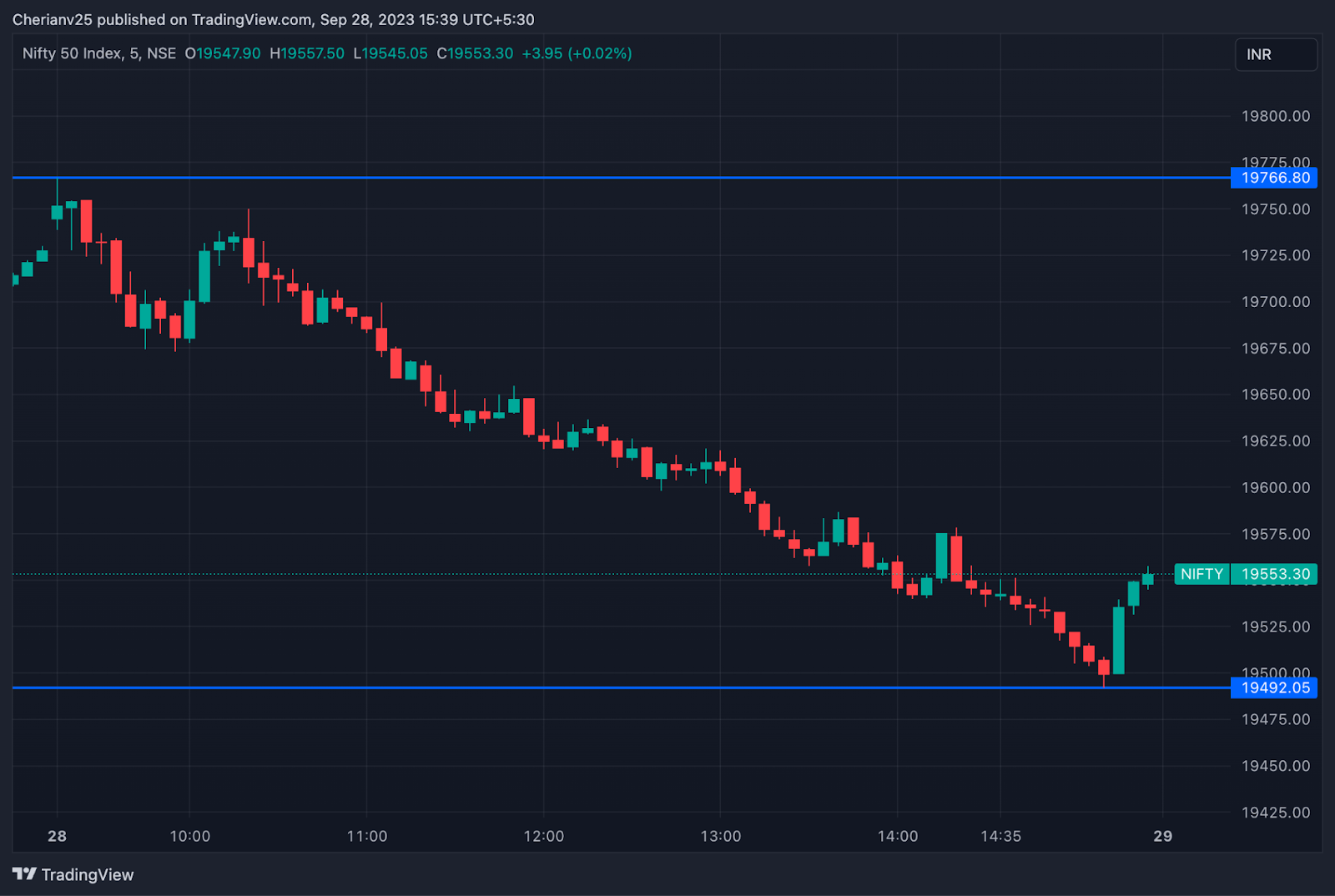
          NIFTY started the day flat at 19,761 with a gap-up of 45 points. Initially, the index fell 90 points to 19,670 levels, made a double-bottom, rose 80 points to 19,750 levels, and took rejection. Then, it gave a sharp fall of nearly 260 points till 19,490. Nifty closed at 19,523, down by 192 points or 0.98%.

          Nifty chart Sept 28 - post-market analysis | marketfeed

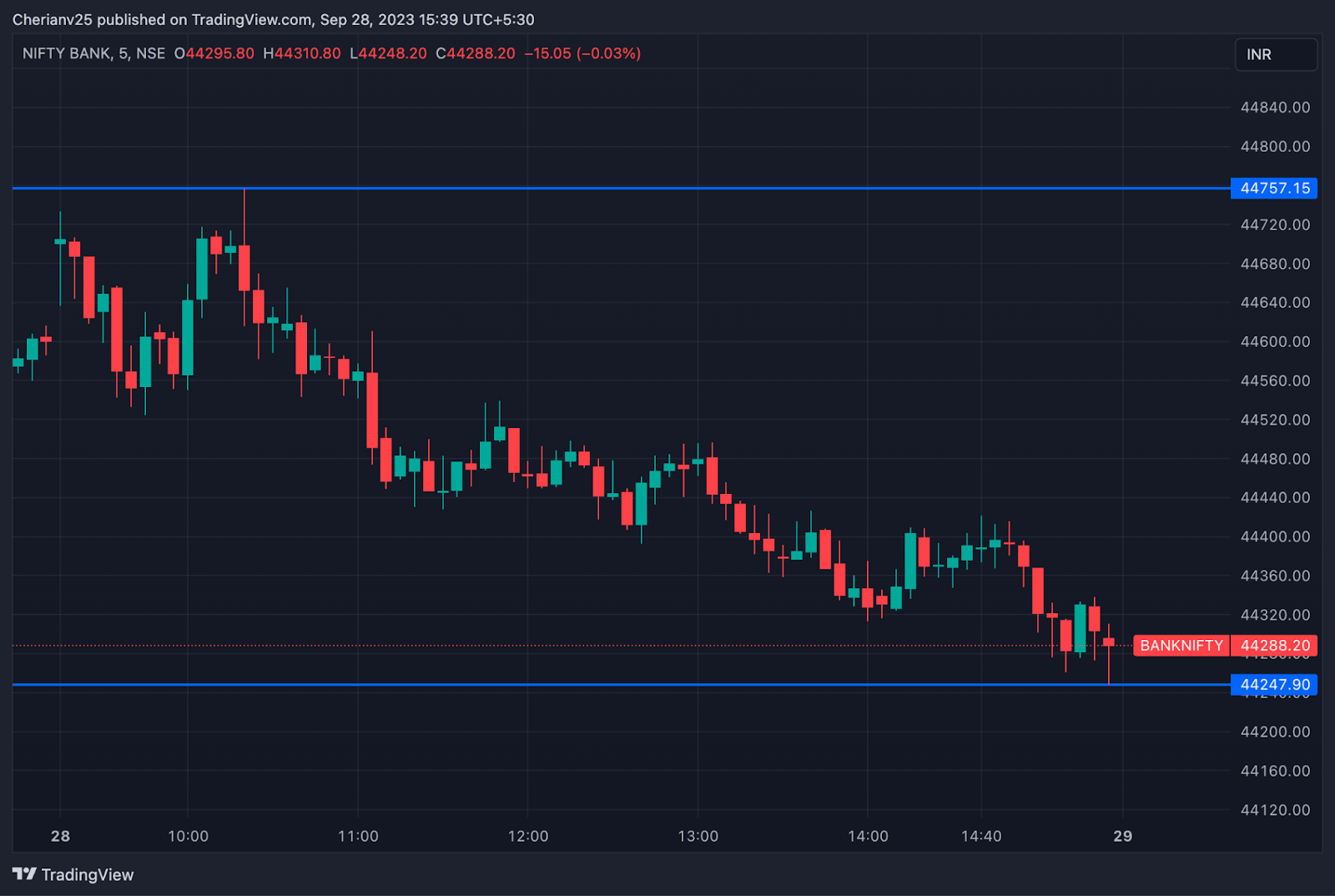
          BANK NIFTY (BNF) started the day at 44,700 with a gap-up of 112 points. Similar to Nifty, BNF gave a sharp fall of 200 points till the round levels of 44,500 initially, made a double-bottom, shot up 200 points till the day’s high, and took resistance. Then, the index fell gradually to 44,250 levels– a fall of 500 points! BNF closed at 44,300, down by 287 points or 0.64%.

          Bank Nifty chart Sept 28 - post-market analysis | marketfeed

          All other indices closed in the red. Nifty IT (-2.19%) and Nifty FMCG (-1.9%) fell the most!

          Major Asian markets closed mixed. European markets are currently trading mixed.

          Today’s Moves

          Larsen & Toubro (+1.52%) was NIFTY50’s top gainer. The stock hit a 52-week high of ₹3,050.5 after brokerage firm UBS increased its price target for L&T from ₹3,040 to ₹3,600 per share.

          MCX (+8.24%) surged after the company confirmed that it will implement a new web-based Commodity Derivatives Platform (CDP) next week.

          CE Info Systems (+7.4%) jumped up to 11% on the back of strong volumes. The stock hit a 52-week high of ₹2,108.95 today.

          Tech Mahindra (-4.59%) was NIFTY50’s top loser.

          IT stocks LTI Mindtree (-3.16%), Wipro (-2.48%), Infosys (-1.88%), TCS (-1.46%), and others fell sharply.

          Shares of HAL have split in the ratio of 1:2. The shares, which had a face value of ₹10 before Sept 28, have halved and are trading at a face value of ₹5 each now.

          Berger Paints (-5.6%) fell after Kotak Institutional Equities downgraded the stock to ‘Sell’, citing weak demand and rising competition.

          Markets Ahead

          Markets are taking rejections from the high levels. As discussed in the post-market report yesterday, the 23% Fibonacci levels acted as good resistance. The indices continued the fall and hit our targets: 19,560 in Nifty and 44,300 in Bank Nifty.

          Both indices are still under a sell-on-rise structure.

          Nifty: The immediate support for Nifty is near the 19,500 round levels. A breakdown from there could take the index down to 19,400 levels. The important resistance to watch out for is the 19,560-600 levels. A breakout from these levels may give us targets of 19,700-740. 

          Bank Nifty: The immediate support for BNF is near 44,200 levels. A breakdown could give us targets of 44,000. The index has an important resistance near 44,500 levels. A breakout from there can give us targets of 44,700-750.

          Every rise is being sold. So wait for vital reversal levels to be crossed for confirmation of a trend reversal and option buying trades.

          As per reports, the increased selling activity by foreign institutional investors (FIIs) is one of the main factors contributing to high volatility in the Indian market. FIIs have sold shares worth nearly ₹12,475 crore in September! The US Federal Reserve’s hawkish stance on interest rates has added to the market’s anxiety.

          How was monthly expiry trading today? Did you trade in Nifty or Bank Nifty (or both)? Let us know in the comments below!

          Don’t forget to tune in to The Stock Market Show at 7 PM on our YouTube channel!

          Categories
          Daily Market Feed Post Market Analysis

          Insane Moves in Nifty Ahead of Monthly Expiry! – Post-Market Analysis

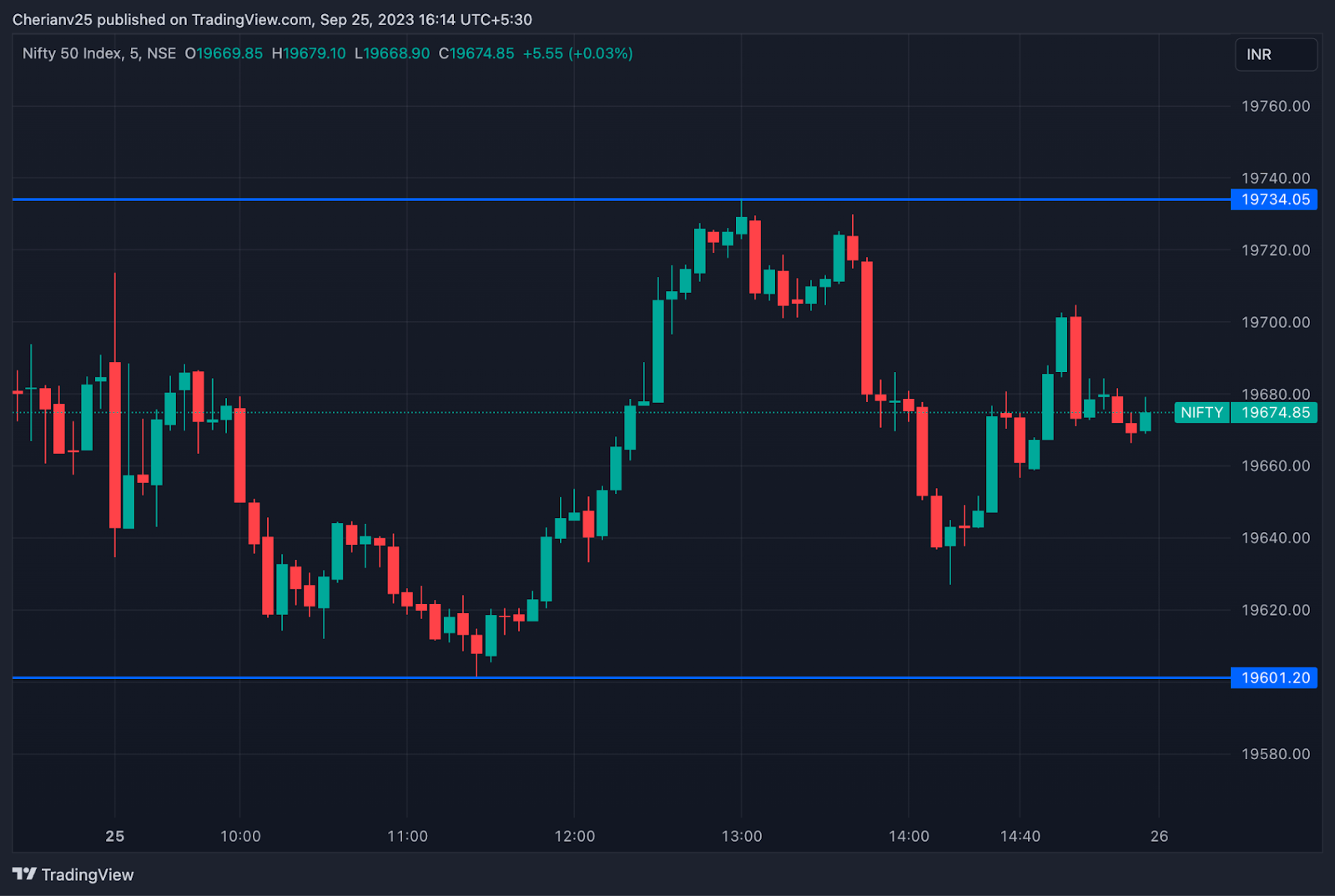
          NIFTY started the day flat at 19,678. After opening, the index fell sharply to 19,600 and took support there. It then moved up by 130 points to 19,730 levels to make a double top. The index fell again by 100 points till 19,630 levels. Nifty closed at 19,674, up by 0.3 points or 0.00%.

          Nifty chart Sept 25 - post-market analysis | marketfeed

          BANK NIFTY (BNF) started the day flat at 44,615. The index gave multiple swings of more than 300 points initially between 44,700 to 44,400, then 44,400 to 44,950, and finally 44,950-44580. BNF closed at 44,766, up by 154 points or 0.35%.

          Bank Nifty chart Sept 25 - post-market analysis | marketfeed

          Nifty Realty (+1.52%) closed well in the green, while Nifty IT (-0.78%) fell the most.

          Major Asian markets closed mixed. European markets are currently trading in the red.

          Today’s Moves

          Bajaj Finance (+4.6%) was NIFTY50’s top gainer. The company is reportedly planning a mega fundraise to the tune of $800 million-$1 billion. 

          Indiabulls Real Estate (+9.32%) surged on the back of strong volumes.

          MCX (+6.6%) rose up to 9% to hit a one-year high of ₹1,952.2 amid reports of the launch of a new trading platform.

          Hindalco Industries (-1.98%) was NIFTY50’s top loser. 

          Delta Corp (-18.59%) crashed to a 33-month low after the company received tax notices totalling ₹16,822 crore from the Directorate General of GST Intelligence on Friday.

          Markets Ahead

          The indices have become extremely volatile ahead of monthly expiry— making wild moves on the upside and downside. The resistance levels were respected, and the indices have come down. This indicates that the selling pressure in the markets could continue.

          Nifty: The immediate resistance to watch out for is near 19,730 levels. A breakout from this level can give us a target of 19,800 on the upside. The immediate support is near today’s low (19,600 levels). A breakdown from there can make the index fall to 19,500.

          Bank Nifty: The immediate support to look out for is near 44,600. A breakdown from this level can give us a target of 44,300. On the other hand, a major resistance for BNF is near 45,000. A breakout from this round level can give us a target of 45,200.

          As per reports, investors are confused as major central banks are sending mixed signals. Last week, the U.S. Federal Reserve said it’s not raising interest rates for now but might do so later this year. Meanwhile, the European Central Bank (ECB) and the Bank of England (BoE) suggested they might not raise rates further.

          If the US Fed keeps rates high for too long, it could harm the US economy’s chances of a soft landing (a gradual, relatively painless economic slowdown). And that could affect economies worldwide.

          Don’t forget to tune in to The Stock Market Show at 7 PM on our YouTube channel!

          Categories
          Market News Top 10 News

          TCS Posts 7% YoY Rise in Net Profit in Q4 – Top Indian Market News

          TCS Q4 Results: Net profit rises 7% YoY to Rs 9,926 crore

          Tata Consultancy Services (TCS) reported a 7% YoY increase in consolidated net profit to Rs 9,926 crore for the quarter ended March (Q4 FY22). Net profit rose 1.6% when compared to the previous quarter. Its revenue from operations grew 16% YoY (or 3.5% QoQ) to Rs 50,591 crore during the same period. The IT company secured new deals worth $11.3 billion in Q4, taking the total order book to $34.6 billion for FY22. TCS’ board has declared a final dividend of Rs 22 per share for Q4 FY22.

          Read more here.

          Tata Motors to ramp up EV production as demand rises

          Tata Motors Ltd will ramp up the production of electric vehicles (EVs) as demand continues to outpace the manufacturing activity by a large margin. The automaker has been receiving an average of 5,500-6,000 bookings in the past two months for its EV range. The company sells three electric products (Nexon EV, Tigor EV, and XPRES-T) in the domestic market. It has also recently unveiled a coupe-style SUV which it plans to launch in the next two years.

          Read more here.

          Godrej Industries launches Godrej Capital

          Godrej Industries Ltd (GIL) announced the launch of Godrej Capital Limited (GCL). GCL will be the holding entity for Godrej Housing Finance and Godrej Finance Ltd (an NBFC). GIL has committed to invest Rs 1,500 crore as capital in the financial services arm. It expects the business to require a total equity investment of Rs 5,000 crore by 2026. With this launch, GIL aims to build a world-class retail financial services business.

          Read more here.

          Glenmark Pharma gets DCGI approval for Phase-1 trial of novel molecule

          Glenmark Specialty S.A. has received approval from the Drugs Controller General of India (DCGI) to conduct a Phase-1 clinical trial of its novel small-molecule, GRC 54276. The molecule has shown the ability to kill tumor cells in pre-clinical studies as a single agent. Glenmark will initiate a Phase-1 clinical trial in India by June 2022. The study will evaluate the safety and tolerability of GRC 54276 as a monotherapy. 

          Read more here

          MCX to partner with Chittagong Stock Exchange to set up derivatives platform

          Multi Commodity Exchange of India (MCX) is planning to collaborate with Chittagong Stock Exchange (CSE) of Bangladesh to provide consultancy services for establishing a commodity derivatives platform in the country. MCX will provide consultation services to CSE in areas of regulations, products, clearing & settlement services, warehousing, etc. CSE is one of the two stock exchanges based in the port city of Chittagong, Bangladesh.

          Read more here.

          Tata Steel infuses Rs 625 crore in Tata Steel Mining

          Tata Steel Ltd has acquired 32.63 crore equity shares of Tata Steel Mining Ltd (TSML) at a premium of Rs 9.15 per share. The aggregate amount paid for acquiring the shares is Rs 625 crore. This equity infusion is for funding TSML’s acquisition of Rohit Ferro Tech under the Corporate Insolvency Resolution Process of the Insolvency and Bankruptcy Code.

          Read more here.

          HAL-L&T consortium emerges lowest bidder for ISRO project

          A consortium of Hindustan Aeronautics Ltd (HAL) and Larsen & Toubro (L&T) has emerged as the lowest (L-1) bidder to make five Polar Space Launch Vehicles (PSLVs) for ISRO. HAL will be the lead partner with L&T, while other vendors will be involved with the consortium in the manufacturing of the launch vehicles. The contract is yet to be formalized.

          Read more here.

          Intellect Design secures digital banking contract from VPBank

          Intellect Global Transaction Banking (iGTB) has signed a transformative deal with Vietnam-based VP Bank to digitize and streamline its transaction banking offerings. This deal marks the tenth key digital banking transformation deal in Vietnam. iGTB is the transaction banking specialist from Intellect Design Arena Ltd.

          Read more here.

          Kesoram Industries Q4 Results: Net loss at Rs 46.6 crore

          Kesoram Industries Ltd reported a consolidated net loss of Rs 46.67 crore for the quarter ended March (Q4 FY22). It had reported a net profit of Rs 112.26 crore in the corresponding quarter last year (Q4 FY21). The company’s revenue rose 19.7% YoY to Rs 1,031.78 crore in Q4 FY22. Kesoram Industries is engaged in the manufacture of cement, tyres, tubes, pipes, paper, and heavy chemicals.

          Read more here.

          Categories
          Market News Top 10 News

          ICICI Bank Reports 30% YoY Rise in Net Profit in Q2 – Top Indian Market News

          ICICI Bank Q2 Results: Net profit rises 30% YoY to Rs 5,511 crore

          ICICI Bank reported a 30% YoY increase in net profit to Rs 5,511 crore for the quarter ended September (Q2 FY22). Net profit rose 19% compared to the previous quarter. Its net interest income (NII) rose 25% YoY to Rs 11,690 crore during the same period. [NII is the difference between the interest income a bank receives on loans and the interest paid to depositors]. The bank’s gross non-performing assets (GNPA) ratio stood at 4.82% in Q2, compared to 5.15% in the previous quarter. Provisions declined by 9% YoY to Rs 2,714 crore in the July-Sept quarter of FY22. 

          Read more here

          Minda Industries to hike stake in Strongsun Renewables to 28.10%

          Minda Industries Ltd said the Investment Committee of its Board of Directors has approved the second round of stake purchase in Strongsun Renewables Pvt Ltd. The committee approved the acquisition of 3.07 lakh equity shares (of the face value of Rs 10 each) at Rs 80 per share of Strongsun Renewables, aggregating to Rs 2.46 crore. After completion of the transaction, Minda Industries will hold a 28.10% stake in the special purpose vehicle (SPV).

          Read more here.

          Tatva Chintan Pharma Q2 Results: Net profit jumps 811% YoY to Rs 32 crore

          Tatva Chintan Pharma Chem reported an 811.5% YoY jump in consolidated net profit to Rs 32.41 crore for the quarter ended September (Q2 FY22). Net profit increased by 40% compared to the previous quarter. Its revenue from operations rose 105.8% YoY (or 16% QoQ) to Rs 123.6 crore during the same period. EBITDA stood at Rs 35.8 crore in Q2, up 477% YoY (or 39% QoQ). 

          Read more here.

          Ami Organics Q2 Results: Net profit rises 14% YoY to Rs 17.5 crore

          Ami Organics Ltd reported a 14.78% YoY increase in consolidated net profit to Rs 17.47 crore for the quarter ended September (Q2 FY22). Net profit increased by 27% compared to the previous quarter. Its revenue from operations rose 33.9% YoY (or 8% QoQ) to Rs 122.31 crore during the same period. EBITDA stood at Rs 27.3 crore in Q2, an increase of 27% YoY.  Ami Organics is one of the leading research and development (R&D)-driven manufacturers of specialty chemicals. 

          Exxon looks to buy stake in ONGC’s Indian deep sea fields

          Global oil major ExxonMobil Corp is looking at buying a stake in some of the local deepwater fields of Oil and Natural Gas Corporation (ONGC), said Oil Secretary Tarun Kapoor. India, the world’s third-largest importer and consumer of oil, imports ~85% of its oil needs from overseas. The government has been scouting for partnerships with global oil companies to quickly monetise its reserves. Exxon would either acquire a stake in the Indian fields or form a joint venture with ONGC to operate them.

          Read more here.

          Orient Electric Q2 Results: Net profit rises 7% YoY to Rs 34 crore

          Orient Electric reported a 7.25% YoY increase in net profit to Rs 34.77 crore for the quarter ended September (Q2 FY22). Net profit jumped 595% compared to the previous quarter. Its revenue from operations rose 37% YoY (or 41% QoQ) to Rs 594.38 crore during the same period. Revenue from its electrical consumer durables segment rose 49.33% YoY to Rs 454.5 crore. The company’s total expenses stood at Rs 549.17 crore in Q2, up 40.38% YoY.

          Read more here.

          Whistle-blower alleges related party transactions by Asian Paints promoters

          A whistle-blower has red-flagged related party transactions (RPTs) carried out by the promoters of Asian Paints Ltd (APL), which allegedly benefited them at the cost of the company’s shareholders. The whistle-blower informed market regulator SEBI that money to buy a company called Paladin Paints and Chemicals (PPC) went from APL. However, APL’s promoters Ashwin Dani and son Malav now control it in their personal capacity. SEBI has sought further details from the whistle-blower.

          Read more here.

          MCX Q2 Results: Net profit falls 44% YoY to Rs 33 crore

          Multi Commodity Exchange of India (MCX) reported a 44% YoY decline in consolidated net profit to Rs 44 crore for the quarter ended September (Q2 FY22). Net profit fell 18% compared to the previous quarter. Its revenue from operations declined by 30% YoY (or 5% QoQ) to Rs 82 crore during the same period. EBITDA stood at Rs 34 crore in Q2, a decline of 49% YoY.

          Petrol, diesel prices hiked for fourth consecutive day

          The prices of petrol and diesel soared to new record highs across the country after the rates were hiked for the fourth consecutive day on Saturday. State-run oil marketing companies (OMCs) have increased the fuel rates by 35 paise per litre each. Following the latest price revision, petrol is retailing at Rs 107.24 per litre in Delhi. The cost of diesel stands at Rs 95.97 per litre in the national capital.

          Read more here.

          Real estate sector to touch $1 trillion by 2030: Niti Aayog

          The real estate sector plays a multiplier effect in the development of the economy and is expected to reach a market size of $1 trillion by 2030, said Niti Aayog CEO Amitabh Kant. He further said that the sector will account for 18-20% of India’s gross domestic product (GDP). Kant noted that the real estate sector and its stakeholders also play a critical role in supporting the ‘housing for all’ initiative of the government. Real Estate Investment Trusts (REITs) are expected to create opportunities worth Rs 1.25 lakh crore in the coming years.

          Read more here.

          Categories
          Editorial

          An Explainer on Commodities Trading and India’s MCX

          Our country is truly blessed with an abundance of natural resources. We have some of the largest reserves of metals in the world. A majority of our population is engaged in agricultural activities, and essential pulses and grains are grown in plenty. Such resources or commodities drive industries and provide a source of livelihood to farmers. 

          At the same time, there are exchanges in India that provide a platform to trade commodities such as gold, copper, crude oil, and even pulses! In this article, we will briefly discuss the concept of commodities trading. More importantly, we shall analyse MCX, the largest commodity derivatives exchange in India.

          What is Commodities Trading?

          A commodity is any basic good that is interchangeable with other goods of the same type. It can be a group of items that are essential for everyday life, such as food, energy, or metals. Simply put, commodities trading is the buying and selling of basic goods such as metals, energy, and agricultural products. Commodity markets/exchanges provide a centralised platform for producers (farmers, power generation companies, etc) to easily sell their commodities to consumers.

          Commodities trading usually takes place through derivative contracts such as commodity futures and options (F&O). These are contracts that derive their value from the underlying commodity itself. An agreement can be formed to buy or sell a predetermined quantity of a commodity at a specific price on a specific date in the future. At the time of maturity, one can either take physical delivery of the commodity or settle in cash, as per the terms of the contract. There are spot markets as well, wherein commodity trading happens instantly and in exchange for cash.

          Commodities traded on an exchange include:

          1. Metals – Gold, Silver, Platinum, and Copper.
          2. Energy – Crude oil, Gasoline, Heating gas, etc.
          3. Agriculture – Wheat, Rice, Cocoa, Ragi, Soy, etc.
          4. Livestock & Meat – Eggs, Cattle, Pork, etc.

            Commodity trading is usually done in lots, such as barrels of oil, bushels of corn, kilograms of wheat, etc.

            Company Profile – Multi Commodity Exchange (MCX)

            Multi Commodity Exchange of India Ltd (MCX) provides a platform to facilitate the online trading of commodity derivatives in our country. It started operations in 2003 and is regulated by the Securities and Exchange Board of India (SEBI). When many entities buy and sell commodity derivatives on an exchange and negotiate on prices, it can lead to better price discovery. It provides a better estimate of the true value of a commodity at a particular point in time.  

            Just like any other exchange, MCX derives its revenues from transaction fees, admission & subscription fees from brokers, and terminal charges. The company’s transaction fees are calculated on the total turnover (or overall value) of the commodity futures and options (F&O) contracts. MCX has a 95.04% share in the Indian commodity derivatives market!

            Other Offerings

            An important feature offered by MCX is its series of India Commodity Indices or iCOMDEX, which provides real-time data of commodity futures price indices. If you visit their website, you can analyse different indices that are based on commodity futures contracts traded on the exchange. It includes iCOMDEX Base Metals, iCOMDEX Bullion, iCOMDEX Crude Oil, and many more. These indices conform to the best global practices set by the International Organisation of Securities Commissions (IOSCO). 

            The company operates a web-based data service known as Commodity Receipts Information System or ComRIS. It maintains an electronic record of all transactions made on commodities from registered warehouses. MCX transmits this recorded data online in real time. Trading volumes, prices, and changes in prices are completely transparent on MCX.

            MCX also provides trade clearing and settlement services and data feed services. Moreover, they have strategic alliances with leading exchanges across the globe. This includes Dalian Commodity Exchange (China), London Metal Exchange, Taiwan Futures Exchange, and Zhengzhou Commodity Exchange (China). These collaborations allow MCX to seamlessly integrate its operations with the global commodities ecosystem.

            Main Commodities Traded on MCX:

            • Bullion – Gold, Gold Guinea, Gold Petal, Gold Petal (in New Delhi), Gold Global, Silver.
            • Agriculture Commodities – Cardamom, Cotton, Crude Palm Oil, Kapas, Mentha Oil, Castor seed, RBD Palmolien, Black Pepper.
            • Energy – Crude Oil, Natural Gas, Brent Crude Oil 
            • Metal – Aluminium, Copper, Lead, Nickel, Zinc, Brass

            Financial Overview of MCX

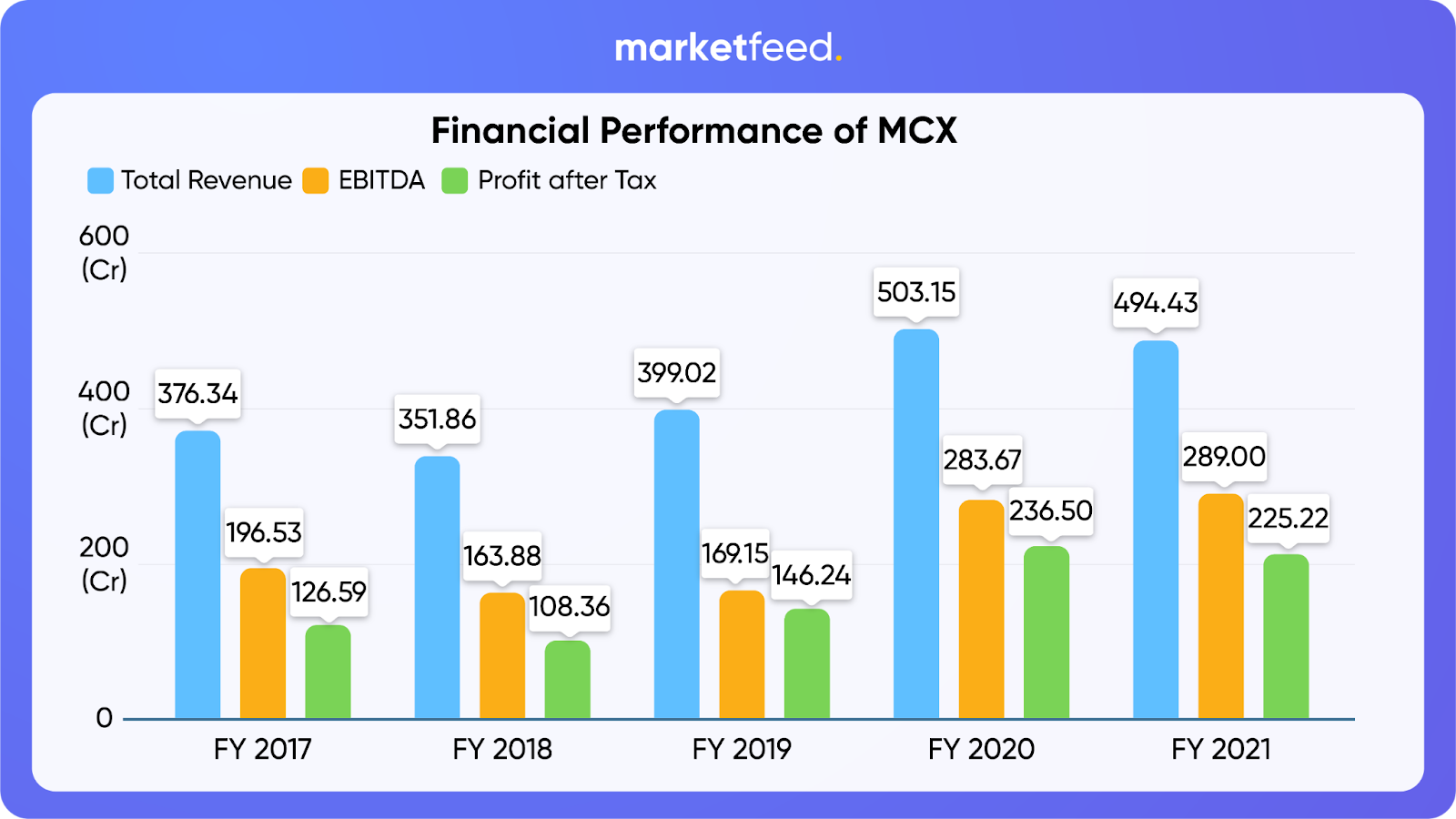
            The company’s revenue and profit growth has been quite inconsistent. MCX reported a 41.3% year-on-year (YoY) decline in consolidated net profit to Rs 38.44 crore for the quarter ended March 2021 (Q4 FY21). Its total income declined by 19.6% YoY to Rs 108.46 crore during the same period. The average daily turnover in commodity futures on MCX declined by 13% YoY to Rs 31,823 crore in Q4 FY21. 

            Net profit for the financial year 2020-21 (FY21) declined by 4.77% YoY to Rs 225.22 crore. The company’s Earnings Per Share (EPS) fell 4.8% YoY to Rs 44.25 in FY21. Based on certain assessments, MCX said the Covid-19 pandemic had a very minimal impact on its operations.

            Let us take a look at some of the positive financial cues. Over the past five years, the company’s profits have grown at a good CAGR of 20.31%. MCX is almost debt-free. The company is also well-known for declaring huge dividends. It has maintained a healthy dividend payout of 65.72%. [Dividend Payout Ratio refers to the percentage of net earnings that is distributed to shareholders in the form of dividends].

            Conclusion

            Trading in commodities can be a great way to diversify your portfolio. A large number of investors use commodities to limit their risks on other financial instruments (also known as hedging). It also provides great liquidity. However, there are a large number of factors that can influence commodity markets. As we know, weather conditions influence the production of agricultural commodities, and thereby its prices. The economic and political conditions of a country can have a significant impact on commodity prices. You should have a broad understanding of the different cycles (trends) of commodity prices.

            You can easily trade in commodities through brokers such as Zerodha, Upstox, Angel Broking, etc.

            On the other hand, MCX as a company/stock is favoured by many investors due to its future growth potential. Ace investor Rakesh Jhunjhunwala recently increased his stake in the commodity trading platform from 3.92% to 4.90%. MCX has announced plans to introduce futures contracts on more commodities across different categories.

            Have you invested in MCX stock? Let us know your views on commodities trading in the comments section of the marketfeed app. 

            Categories
            Market News Top 10 News

            Services PMI Falls to 41.2 in June – Top Indian Market News

            India’s services PMI falls to lowest level in 11 months in June

            India’s services sector activities fell to their lowest level in 11 months as new businesses and output declined. The IHS Markit India Services Purchasing Managers’ Index (PMI) stood at 41.2 in June, compared to 46.4 in May. PMI is a month-on-month calculation and a value below 50 represents contraction when compared to the previous month. International demand for Indian services continued to deteriorate in June, with new export orders falling for the 16th consecutive month.

            Read more here.

            Govt to sell up to 7.49% stake in NMDC via OFS on Tuesday

            The government will sell up to a 7.49% stake in National Mineral Development Corp (NMDC) through an offer for sale (OFS) on Tuesday (July 6). The Centre will sell its 4% stake (or 11.72 crore equity shares) in NMDC at a floor price of Rs 165 per share. The floor price is set at a nearly 6% discount to Monday’s closing price. The OFS also includes a greenshoe option to sell an additional 3.49% stake (or 10.22 crore shares) of NMDC. After the completion of the OFS, the government’s shareholding in NMDC will reduce to 60.8%.

            Read more here.

            MCX signs pact with Europe’s EEX to share expertise on electricity derivative products

            Multi Commodity Exchange of India (MCX) has signed a Memorandum of Understanding (MoU) with European Energy Exchange AG (EEX) to share knowledge and expertise on electricity derivative products. The MoU will facilitate cooperation between the two exchanges in areas such as education & training and organising events in the domain of electricity derivatives. EEX is a leading energy exchange in Europe that develops, operates, and connects secure and transparent markets for power and other energy products.

            Read more here.

            ITD Cementation secures orders worth Rs 585 crore

            ITD Cementation India Ltd has secured two orders worth approximately Rs 585 crore. The first order consists of the development and construction of ‘Dream City Depot’, including electrical and mechanical works, in connection with Phase-1 of the Surat Metro Rail Project. The second order has been received from Military Engineer Services for the construction of an Aero Space Museum at Air Force Station in Palam, Delhi. It also includes the installation of mechanical and electrical systems, a rainwater harvesting system, etc. 

            Read more here.

            Tata Communications introduces Virtual Video Assisted Referee solution

            Tata Communications Ltd announced the launch of a Virtual Video Assisted Referee (V-VAR) solution. It enables an unlimited number of referees, judges to connect remotely from anywhere across the globe and assess/analyse sporting events. SailGP (a global sailing championship) will be the first sports event to deploy the company’s V-VAR solution. 

            Read more here.

            Sales volume in IEX real-time power market jumps 3-fold in June

            The sales volume of the real-time power market (RTM) jumped over three-fold year-on-year (YoY) to 1,726 million units (MU) in June 2021 at the Indian Energy Exchange (IEX). RTM allows consumers to buy power just one hour below delivery. IEX traded 7,093 MU of electricity volume in June, registering a 48% YoY growth. The term-ahead market (comprising intraday, contingency, daily & weekly contracts) traded 641 MU last month, recording a 539% YoY growth.

            Read more here.

            Heranba Industries gets environmental clearance for Rs 110 crore expansion

            Heranba Industries Ltd has received environmental clearance from the Ministry of Environment, Forest, and Climate Change for the expansion of manufacturing capacity at its facility in Gujarat. The expansion plan consists of setting up an additional manufacturing capacity of 24,900 tonnes per annum (TPA) for producing insecticides, fungicides, and pesticide intermediates. The estimated cost for the project is Rs 110 crore.

            Read more here.

            Godrej Consumer expects double-digit sales growth in Q1 

            Godrej Consumer Products Ltd (GCPL) said it expects strong double-digit growth in sales at the consolidated level for the quarter ended June (Q1 FY22). The demand trends in various categories remained steady across all countries the company operates in. GCPL’s home care segment saw strong sales growth in Q1, led by household insecticides. There was high demand for personal care and hygiene products as well.

            Read more here.

            Religare’s shareholders approve Rs 570 crore preferential issue

            The shareholders of Religare Enterprises Limited (REL) have approved the preferential issue of fresh equity shares worth Rs 570 crore. The company will allot 5.41 crore equity shares at Rs 105.25 per share to existing shareholders, including Burman Family, Ares SSG Capital, and select marquee investors. Noida-based Religare Enterprises provides broking services for equities, currencies, and commodities. It also offers financial services for small and medium enterprises (SMEs).

            Read more here.

            HDFC Bank reports 14% YoY loan growth in Q1

            HDFC Bank reported a 14% YoY growth in its loan book to Rs 11.47 lakh crore for the quarter ended June 30 (Q1 FY22). Loan advances grew 1.3% when compared to the previous quarter. The bank’s deposits grew over 13% YoY (or 0.8% QoQ) to Rs 13.4 lakh crore in Q1. Total retail disbursements at the end of Q1 stood at Rs 43,600 crore, a growth of 202% YoY. During the same period, HDFC Bank purchased loans aggregating to Rs 5,489 crore through a direct assignment route under a home loan arrangement with HDFC Limited.  

            Read more here

            SEBI announces new rules to make MIIs pay for technical glitches

            Market regulator SEBI has issued a detailed framework for penalising market infrastructure institutions (MIIs) for technical glitches. MIIs include stock exchanges, clearing corporations, and depositories. Under the new framework, MIIs will have to pay Rs 1 lakh per day in case of delay in submission or incomplete submission of root cause analysis (RCA). A comprehensive RCA report needs to be submitted within 21 days of an incident. The failure to timely address a technical glitch will attract Rs 2 lakh per day for the first 15 days.

            Read more here.

            Categories
            Market News Top 10 News

            India’s Manufacturing PMI Falls Marginally in February – Top Indian Market News

            India’s manufacturing PMI falls marginally in February

            India’s factory activity expanded for the seventh straight month in February, driven by strong demand and increased output. The IHS Markit Purchasing Managers’ Index (PMI) for India’s manufacturing sector eased slightly to 57.5 in February from 57.7 in January. Last month, firms responded to rising production needs by boosting their purchasing activities. PMI is a month-on-month calculation, and a value of more than 50 represents an expansion when compared to the previous month.

            Read more here.

            Automobile companies register strong sales growth in February

            Major automobile companies reported healthy sales growth during February 2021. Tata Motors posted a 51.1% YoY jump in total sales to 61,365 units, as passenger vehicle (PV) sales surged two-fold to 27,225 units. Maruti Suzuki reported an 11.8% YoY increase in overall sales to 1.64 lakh units in February. Bajaj Auto posted a 6% YoY rise in total sales to 3.75 lakh units during the same period. Farm equipment manufacturer Escorts reported a 30.6% YoY increase in tractor sales to 11,230 units in February.

            Read more here.  

            BPCL approves sale of its 61.65% stake in Numaligarh refinery for Rs 9,875 crore

            Bharat Petroleum Corporation Ltd’s (BPCL) board has approved the sale of its 61.65% stake in Numaligarh Refinery Ltd (NRL) for Rs 9,875 crore. The consortium of Oil India Ltd (OIL) and Engineers India Ltd will acquire 49% stake. The remaining 13.65% will be sold to the Government of Assam. The sale of NRL is considered to be the first step towards the disinvestment of BPCL.

            Read more here.

            Sterlite Tech secures orders worth $100 million in Middle East, Africa 

            Sterlite Technologies Ltd (STL) has secured orders worth $100 million (~Rs 734 crore) in the Middle East and Africa for setting up the network and infrastructure for 5G wireless services. The multi-year deals range from providing optical connectivity solutions to network solutions. With these new deals, the STL’s order book stands at a record Rs 11,300 crore. 

            Read more here.

            Godrej Properties acquires land parcels worth Rs 166 crore for residential project in Navi Mumbai

            Godrej Properties Ltd has emerged as the highest bidder for two adjacent land parcels in Navi Mumbai for a total bid value of Rs 166 crore. The e-auction was conducted by Maharashtra’s City and Industrial Development Corporation (CIDCO). The company will develop a residential project on the 1.5-acre land located in Sanpada, Navi Mumbai. The project is expected to have a development potential of around 4 lakh sq ft.

            Read more here.

            IndiGo, BOC Aviation signs purchase-leaseback agreement for eight A320neo planes

            Singapore-based aircraft leasing firm BOC Aviation has signed a purchase-and-leaseback agreement with InterGlobe Aviation (IndiGo) for eight new Airbus A320 neo planes. The aircraft are scheduled to be delivered in the second half of 2021. As of December 31, 2020, IndiGo had 287 aircraft in its fleet. Out of this, 272 were on operating lease, while the remaining 15 were owned/finance lease. 

            Read more here.

            Siemens acquires 99.2% stake in C&S Electric for Rs 2,100 crore

            Siemens Limited has completed the acquisition of a 99.22% equity share in C&S Electric Ltd for Rs 2,100 crore. The Competition Commission of India (CCI) had given its approval for the deal on August 20, 2020. The acquisition will enable Siemens to address the competitive infrastructure low-voltage market in India while creating a manufacturing hub to source low-voltage products for export to competitive markets globally.

            Read more here.

            Bharat Dynamics secures order worth Rs 373 crore

            Bharat Dynamics Limited said it has received an order worth Rs 372.98 crore for supplying MRSAM Missile Rear Sections for the Indian Air Force. The order is said to be executed on or before November 30, 2023. Hyderabad-based Bharat Dynamics is a leading manufacturer of defense equipment such as ammunitions and missile systems.  

            Read more here.

            MCX signs MoU with NSE, India INX, NSDL, and CDSL to set up new entity at GIFT City

            Multi Commodity Exchange of India Ltd (MCX) has signed a Memorandum of Understanding (MoU) with National Stock Exchange (NSE), India International Exchange IFSC Ltd (India INX), National Securities Depository Limited (NSDL), and Central Depository Services (India) Ltd (CDSL) for setting up Market Infrastructure Institutions comprising of International Bullion Exchange, Clearing Corporation and Depository at Gujarat International Financial Trade (GIFT) City.

            [Bullion refers to physical gold and silver of high purity that is often kept in the form of bars, ingots, or coins]

            Biocon Biologics, Viatris Inc. gets CHMP approval for Abevmy

            Biocon Biologics, a subsidiary of Biocon Ltd, announced that the European Medicines Agency’s Committee for Medicinal Products for Human Use (CHMP) has recommended the approval of its biosimilar- Bevacizumab- to be marketed as Abevmy. The product was co-developed with US-based Viatris Inc. Abemby is indicated for the treatment of metastatic breast cancer, non-small-cell lung carcinoma, as well as ovarian, cervical, and renal cancer.

            Read more here.