Categories
Editorial

Natural Gas Trading: A Beginner’s Guide

Welcome, traders! Today, we dive into one of the most exciting and dynamic commodities in the market: natural gas. It’s one of the most popular commodities among traders due to its high liquidity and volatility. Whether you’re a seasoned trader or just starting out, this guide will walk you through everything you need to know about trading natural gas effectively.

Why Trade Natural Gas?

Natural gas is a preferred asset for traders because of two key reasons:

1. High Liquidity – Liquidity refers to how easily an asset can be bought or sold in the market without affecting its price. High liquidity in natural gas means that traders can enter and exit positions quickly, which is crucial for intraday trading strategies. Both its major and mini contracts attract a large number of traders, ensuring ease of entry and exit.

2. High Volatility – The price of natural gas fluctuates significantly, providing opportunities for profitable trades.

    Moreover, commodity trading allows flexibility as the market remains open from 5:00 PM to 11:30 PM, making it ideal for traders who have day jobs or other commitments. You could use this window to maximise your trading potential.

    How to Trade Natural Gas?

    Unlike gold or silver, natural gas trading is exclusively conducted through derivatives, specifically futures and options (F&O). It’s strictly limited to MCX derivative contracts. This means understanding the basics of these financial instruments is essential for anyone looking to trade natural gas.

    Types of Natural Gas Contracts

    • Natural Gas Major Contract – Designed for institutional traders with larger capital and high margin requirements.
    • Natural Gas Mini Contract – Suitable for retail traders who wish to take smaller positions with lower margin requirements.

    The major contract has a trading unit of 1,250 Metric Million British Thermal Units (mmBTU), while the mini contract has a trading unit of 1/5th the major contract size.

    Each contract has a specific expiry date that traders must be aware of to avoid delivery complexities. For instance, if the current contract expires in a few days, it’s advisable to trade the next month’s contract instead.

    Capital Requirements for Natural Gas Trading

    The margin required to trade one lot of natural gas major contract is approximately ₹1.65 lakh. It’s about ₹32,584 for the mini contract— making it appealing to retail traders.

    How to Do Natural Gas Trading on a Broker Terminal?

    1. Search for Natural Gas Futures: Type in “Natural Gas” in your broker’s search bar and select MCX contracts.

    2. Choose the Right Contract: Select the contract with an expiration date that provides enough time for smooth trading. As mentioned earlier, the mini contract is ideal for retail traders.

    3. Analyze Price Trends: Use technical analysis to inform your trading decisions. This includes analyzing price charts, identifying trends, and applying indicators to predict future price movements. Price action strategies work particularly well in the natural gas market due to its volatility. [You can use the MCX Energy Index to track natural gas price movements].

    4. Consider Capital Requirements: Ensure you have the necessary margin before placing trades.

    5. Use Limit Orders: Given the low liquidity in some natural gas options, it’s advisable to place limit orders rather than market orders. This approach helps avoid significant slippage and protects your capital.

    Important Pointers:

    For options trading in natural gas contracts:

    • At-the-money contracts are recommended due to better liquidity.
    • Out-of-the-money contracts often suffer from low liquidity and high slippage.
    • Option buyers need less capital (based on premium x lot size), but liquidity is a concern.

      Factors Affecting Natural Gas Prices

      1. Supply and Demand Dynamics: High inventory levels of natural gas can lead to lower prices, while increased demand (especially during cold winters) can drive prices up. Monitoring inventory reports and production data is crucial for anticipating price movements.

      2. Weather Conditions: In colder climates, natural gas is used for heating, leading to increased consumption during winter months. Keeping an eye on weather forecasts in major markets like the U.S. and Europe can provide insights into potential price fluctuations.

      3. The Crude Oil Connection: As an energy commodity, natural gas prices are also tied to crude oil prices. Movements in crude oil can directly impact natural gas, so it’s essential to track crude oil market trends (including OPEC decisions) as part of your trading strategy.

      4. Geopolitical Factors: Events such as conflicts or trade disputes can disrupt supply chains and affect prices. For instance, the Russia-Ukraine conflict has had significant implications for European natural gas supplies, leading to increased volatility in the market.

      Who Should Go For Natural Gas Trading?

      Natural gas trading is ideal for:

      • Traders comfortable with volatility – Price fluctuations can be both an opportunity and a risk.
      • Those with sufficient capital – It’s important to have a proper risk management strategy.
      • Experienced traders in derivatives – Beginners should first learn futures and options trading before venturing into commodities.

      Conclusion

      Natural gas trading offers excellent opportunities due to its volatility and liquidity, but it also requires sound market knowledge and strategy. Before you start, ensure you understand futures and options, choose the right contract, manage risks effectively, and stay updated with market trends.

      By understanding the fundamentals of trading contracts, monitoring market conditions, and employing effective strategies, you can position yourself for success in this market.

      Are you ready to trade natural gas? Start with thorough research and practice before deploying your hard-earned money!

      Watch: Intraday Favourite! Natural Gas Trading after 5 PM! | marketfeed

      Categories
      Editorial

      A Guide to Commodity Trading in India

      Commodity trading is an exciting segment of financial markets that many traders in India are unaware of. While Indian equity markets operate from 9:15 a.m. to 3:30 p.m., the commodity market offers extended trading hours from 9:00 a.m. to 11:30 p.m., divided into two sessions. This is especially beneficial for working professionals who can trade after office hours. However, entering this market requires a clear understanding of its dynamics, benefits, and risks. In this article, we dive into everything you need to know about commodity trading in India.

      What is Commodity Trading?

      Commodity trading involves buying and selling commodities, such as natural resources or agricultural products, on exchanges. This can include energy sources like crude oil and natural gas, metals such as gold and silver, and agricultural products like wheat and cotton. The primary goal in commodity trading is to profit from fluctuations in the price of these commodities.

      Why Does Commodity Trading Exist?

      Unlike equity markets that exist for companies to raise funds, the commodity market primarily serves to allow businesses to hedge against price fluctuations. For example, consider a gold shop owner named Charlie. He holds 10 kg of gold, hoping to profit from making jewellery. If the price of gold falls significantly from ₹80,000 per 10g to ₹60,000, Charlie may incur losses that outweigh his profits from jewellery sales. But if the price of gold goes way up (say ₹1 lakh per 10g), he might earn more, but it will also cost him more to restock. Thus, commodity trading allows Charlie to hedge his risk by using futures contracts to balance potential losses or gains.

      [A futures contract is an agreement to buy or sell something (like gold, oil, or stocks) at a fixed price on a future date. It helps buyers and sellers protect themselves from price changes—buyers lock in lower prices if they expect a rise, while sellers secure higher prices if they expect a drop.]

      How to Get Started in Commodity Trading in India?

      To begin trading commodities, you need to understand the basics, including the types of commodities available, how trading works, and the exchanges involved.

      In India, there are two primary exchanges for commodity trading:

      • National Commodity & Derivatives Exchange Ltd (NCDEX): This platform primarily deals with agro-based commodities like wheat, spices, and cotton.
      • Multi Commodity Exchange (MCX): This is where non-agro commodities like gold, silver, zinc, and crude oil are traded.

      Both exchanges are regulated and provide a safe environment for trading. It is crucial to avoid unregulated platforms or apps that do not adhere to SEBI guidelines!

      All major brokers in India like Zerodha, Upstox, Fyers, etc. support commodities trading. You should activate the commodities segment separately in your broker/trading account.

      Types of Contracts

      Commodity trading mainly involves derivatives, specifically futures and options:

      • Futures Contracts: Agreements to buy or sell a commodity at a future date at a predetermined price.
      • Options Contracts: Rights to buy or sell a commodity at a specific price before a set date.

      Unlike stocks, commodities can’t be held forever. Every futures or options contract has an expiry (settlement) date. As a thumb rule, never let your commodity trades enter into a settlement phase. It’s better to square off your positions at least 2-3 days before the settlement date.

      Some of the most actively traded commodities include:

      • Gold: Available in various contract sizes, including 1 kg, 100 g, and 8 g.
      • Silver: Typically traded in contracts of 30 kg or smaller sizes.
      • Crude Oil: A significant commodity often influenced by global market conditions.
      • Natural Gas: Another volatile commodity that attracts traders.

      The capital needed to trade commodities depends on the type of commodity and the broker’s policies. Brokers often have specific margin requirements for commodities.

      Commodity trading offers high leverage. For example, a gold mini contract worth ₹7.2 lakh may only require ₹72,000 as margin. Leverage amplifies both profits and losses, so it’s essential to have proper risk management strategies in place!

      Commodity Indices in India

      Similar to equity indices like Nifty50, commodity markets also offer indices for trading:

      1. Bullion Index: Tracks gold and silver prices.
      2. Metal Index: Tracks aluminium, copper, lead, zinc, and nickel prices.
      3. Energy Index: Tracks crude oil and natural gas prices.

      These indices allow traders to speculate on overall market movements rather than individual commodities.

      Advantages of Commodity Trading

      Commodity trading offers several benefits that can attract both individual and institutional traders:

      • High Liquidity: Many commodities, especially gold and crude oil, have high trading volumes. These markets tend to follow price action well.
      • People who are unable to trade during the daytime (office-goers) can use the opportunity to make potential extra income!
      • Less Price Manipulation: Commodities are traded globally, reducing the chances of price manipulation compared to more localised markets.
      • Hedging Opportunities: Businesses can hedge against price fluctuations to stabilise costs and revenues.

      Disadvantages of Commodity Trading

      While there are many advantages, there are also significant risks and drawbacks to consider:

      • High Price Volatility: Commodity prices can change rapidly due to geopolitical factors or supply and demand shifts, which may result in substantial losses for unprepared traders.
      • Leverage Risks: Trading with leverage can amplify losses. Commodity traders must understand how to manage leverage effectively.
      • Liquidity Issues: Not all contracts have the same level of liquidity, which can complicate trades and lead to slippage.
      • Geopolitical Sensitivity: Commodity markets are often the first to react to global events, requiring traders to stay informed about international affairs.

      Conclusion

      Commodity trading presents a unique opportunity for investors looking to diversify their portfolios and take advantage of market fluctuations. Also, profits from commodity trading are treated as business income (same as F&O). You’ll have to pay tax based on your tax slab.

      Approach the commodities market only after a thorough understanding of the risks involved, the mechanics of trading, and the specific commodities you wish to trade. Always start small, educate yourself continuously, and consider consulting with financial advisors to navigate the commodities market effectively.

      As you venture into commodity trading, remember to keep your capital allocation conservative, especially if you’re new to the field. With the right strategies and knowledge, you can successfully navigate the volatile waters of commodity trading and potentially achieve significant returns. Happy trading!

      Categories
      Editorial

      An Explainer on Commodities Trading and India’s MCX

      Our country is truly blessed with an abundance of natural resources. We have some of the largest reserves of metals in the world. A majority of our population is engaged in agricultural activities, and essential pulses and grains are grown in plenty. Such resources or commodities drive industries and provide a source of livelihood to farmers. 

      At the same time, there are exchanges in India that provide a platform to trade commodities such as gold, copper, crude oil, and even pulses! In this article, we will briefly discuss the concept of commodities trading. More importantly, we shall analyse MCX, the largest commodity derivatives exchange in India.

      What is Commodities Trading?

      A commodity is any basic good that is interchangeable with other goods of the same type. It can be a group of items that are essential for everyday life, such as food, energy, or metals. Simply put, commodities trading is the buying and selling of basic goods such as metals, energy, and agricultural products. Commodity markets/exchanges provide a centralised platform for producers (farmers, power generation companies, etc) to easily sell their commodities to consumers.

      Commodities trading usually takes place through derivative contracts such as commodity futures and options (F&O). These are contracts that derive their value from the underlying commodity itself. An agreement can be formed to buy or sell a predetermined quantity of a commodity at a specific price on a specific date in the future. At the time of maturity, one can either take physical delivery of the commodity or settle in cash, as per the terms of the contract. There are spot markets as well, wherein commodity trading happens instantly and in exchange for cash.

      Commodities traded on an exchange include:

      1. Metals – Gold, Silver, Platinum, and Copper.
      2. Energy – Crude oil, Gasoline, Heating gas, etc.
      3. Agriculture – Wheat, Rice, Cocoa, Ragi, Soy, etc.
      4. Livestock & Meat – Eggs, Cattle, Pork, etc.

        Commodity trading is usually done in lots, such as barrels of oil, bushels of corn, kilograms of wheat, etc.

        Company Profile – Multi Commodity Exchange (MCX)

        Multi Commodity Exchange of India Ltd (MCX) provides a platform to facilitate the online trading of commodity derivatives in our country. It started operations in 2003 and is regulated by the Securities and Exchange Board of India (SEBI). When many entities buy and sell commodity derivatives on an exchange and negotiate on prices, it can lead to better price discovery. It provides a better estimate of the true value of a commodity at a particular point in time.  

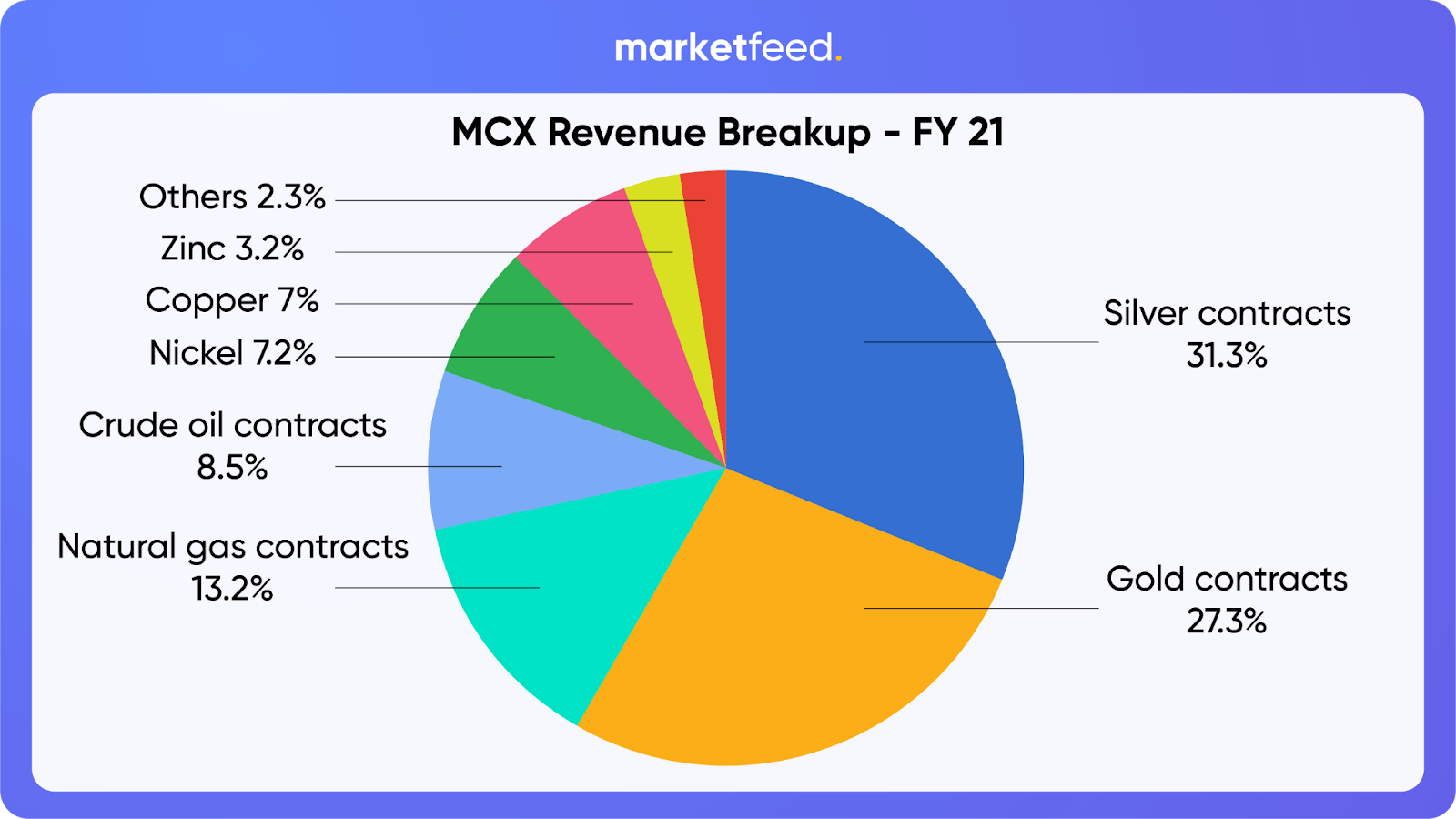
        Just like any other exchange, MCX derives its revenues from transaction fees, admission & subscription fees from brokers, and terminal charges. The company’s transaction fees are calculated on the total turnover (or overall value) of the commodity futures and options (F&O) contracts. MCX has a 95.04% share in the Indian commodity derivatives market!

        Other Offerings

        An important feature offered by MCX is its series of India Commodity Indices or iCOMDEX, which provides real-time data of commodity futures price indices. If you visit their website, you can analyse different indices that are based on commodity futures contracts traded on the exchange. It includes iCOMDEX Base Metals, iCOMDEX Bullion, iCOMDEX Crude Oil, and many more. These indices conform to the best global practices set by the International Organisation of Securities Commissions (IOSCO). 

        The company operates a web-based data service known as Commodity Receipts Information System or ComRIS. It maintains an electronic record of all transactions made on commodities from registered warehouses. MCX transmits this recorded data online in real time. Trading volumes, prices, and changes in prices are completely transparent on MCX.

        MCX also provides trade clearing and settlement services and data feed services. Moreover, they have strategic alliances with leading exchanges across the globe. This includes Dalian Commodity Exchange (China), London Metal Exchange, Taiwan Futures Exchange, and Zhengzhou Commodity Exchange (China). These collaborations allow MCX to seamlessly integrate its operations with the global commodities ecosystem.

        Main Commodities Traded on MCX:

        • Bullion – Gold, Gold Guinea, Gold Petal, Gold Petal (in New Delhi), Gold Global, Silver.
        • Agriculture Commodities – Cardamom, Cotton, Crude Palm Oil, Kapas, Mentha Oil, Castor seed, RBD Palmolien, Black Pepper.
        • Energy – Crude Oil, Natural Gas, Brent Crude Oil 
        • Metal – Aluminium, Copper, Lead, Nickel, Zinc, Brass

        Financial Overview of MCX

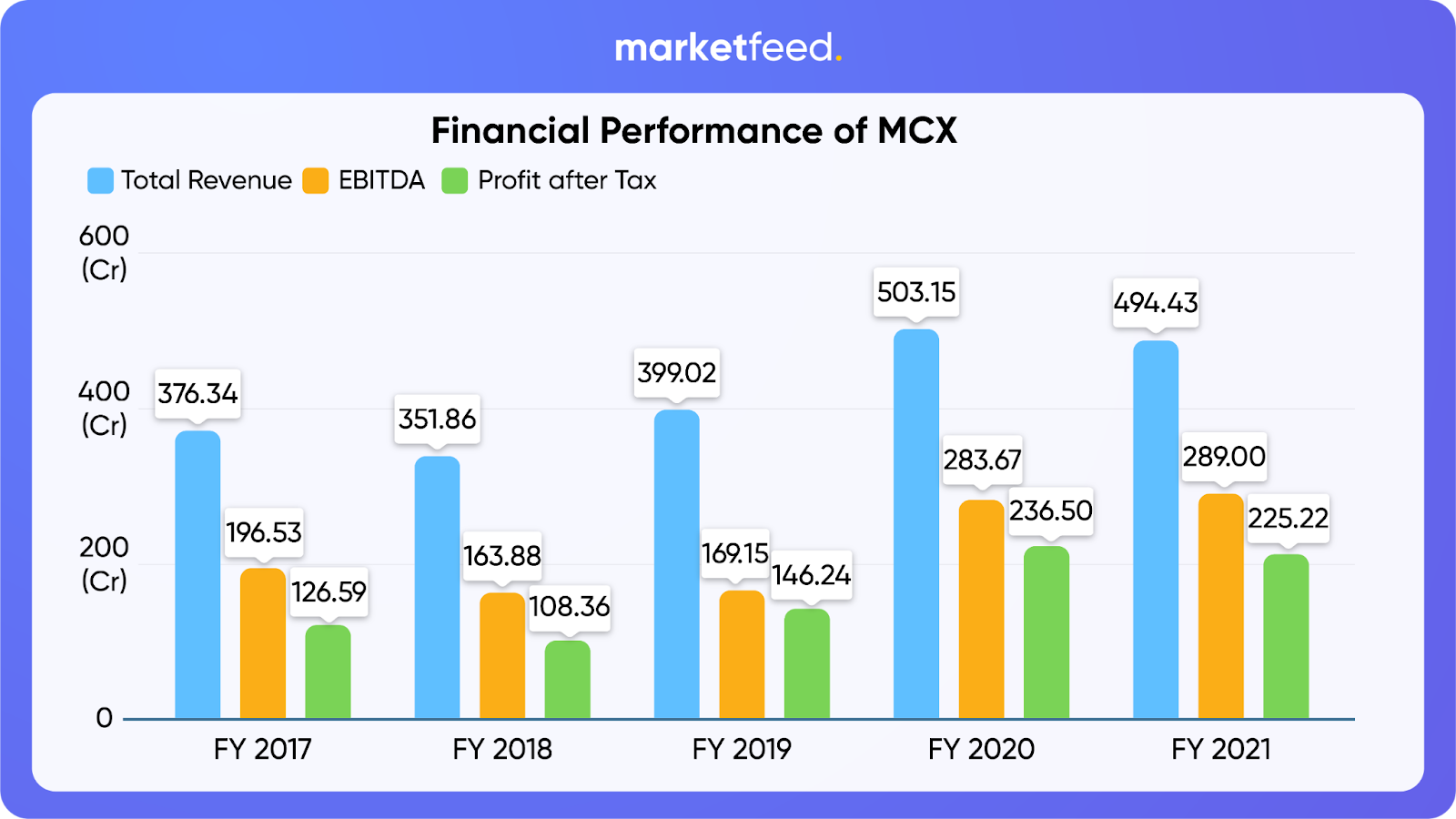
        The company’s revenue and profit growth has been quite inconsistent. MCX reported a 41.3% year-on-year (YoY) decline in consolidated net profit to Rs 38.44 crore for the quarter ended March 2021 (Q4 FY21). Its total income declined by 19.6% YoY to Rs 108.46 crore during the same period. The average daily turnover in commodity futures on MCX declined by 13% YoY to Rs 31,823 crore in Q4 FY21. 

        Net profit for the financial year 2020-21 (FY21) declined by 4.77% YoY to Rs 225.22 crore. The company’s Earnings Per Share (EPS) fell 4.8% YoY to Rs 44.25 in FY21. Based on certain assessments, MCX said the Covid-19 pandemic had a very minimal impact on its operations.

        Let us take a look at some of the positive financial cues. Over the past five years, the company’s profits have grown at a good CAGR of 20.31%. MCX is almost debt-free. The company is also well-known for declaring huge dividends. It has maintained a healthy dividend payout of 65.72%. [Dividend Payout Ratio refers to the percentage of net earnings that is distributed to shareholders in the form of dividends].

        Conclusion

        Trading in commodities can be a great way to diversify your portfolio. A large number of investors use commodities to limit their risks on other financial instruments (also known as hedging). It also provides great liquidity. However, there are a large number of factors that can influence commodity markets. As we know, weather conditions influence the production of agricultural commodities, and thereby its prices. The economic and political conditions of a country can have a significant impact on commodity prices. You should have a broad understanding of the different cycles (trends) of commodity prices.

        You can easily trade in commodities through brokers such as Zerodha, Upstox, Angel Broking, etc.

        On the other hand, MCX as a company/stock is favoured by many investors due to its future growth potential. Ace investor Rakesh Jhunjhunwala recently increased his stake in the commodity trading platform from 3.92% to 4.90%. MCX has announced plans to introduce futures contracts on more commodities across different categories.

        Have you invested in MCX stock? Let us know your views on commodities trading in the comments section of the marketfeed app.