Categories
Editorial

A Guide to Commodity Trading in India

Commodity trading is an exciting segment of financial markets that many traders in India are unaware of. While Indian equity markets operate from 9:15 a.m. to 3:30 p.m., the commodity market offers extended trading hours from 9:00 a.m. to 11:30 p.m., divided into two sessions. This is especially beneficial for working professionals who can trade after office hours. However, entering this market requires a clear understanding of its dynamics, benefits, and risks. In this article, we dive into everything you need to know about commodity trading in India.

What is Commodity Trading?

Commodity trading involves buying and selling commodities, such as natural resources or agricultural products, on exchanges. This can include energy sources like crude oil and natural gas, metals such as gold and silver, and agricultural products like wheat and cotton. The primary goal in commodity trading is to profit from fluctuations in the price of these commodities.

Why Does Commodity Trading Exist?

Unlike equity markets that exist for companies to raise funds, the commodity market primarily serves to allow businesses to hedge against price fluctuations. For example, consider a gold shop owner named Charlie. He holds 10 kg of gold, hoping to profit from making jewellery. If the price of gold falls significantly from ₹80,000 per 10g to ₹60,000, Charlie may incur losses that outweigh his profits from jewellery sales. But if the price of gold goes way up (say ₹1 lakh per 10g), he might earn more, but it will also cost him more to restock. Thus, commodity trading allows Charlie to hedge his risk by using futures contracts to balance potential losses or gains.

[A futures contract is an agreement to buy or sell something (like gold, oil, or stocks) at a fixed price on a future date. It helps buyers and sellers protect themselves from price changes—buyers lock in lower prices if they expect a rise, while sellers secure higher prices if they expect a drop.]

How to Get Started in Commodity Trading in India?

To begin trading commodities, you need to understand the basics, including the types of commodities available, how trading works, and the exchanges involved.

In India, there are two primary exchanges for commodity trading:

  • National Commodity & Derivatives Exchange Ltd (NCDEX): This platform primarily deals with agro-based commodities like wheat, spices, and cotton.
  • Multi Commodity Exchange (MCX): This is where non-agro commodities like gold, silver, zinc, and crude oil are traded.

Both exchanges are regulated and provide a safe environment for trading. It is crucial to avoid unregulated platforms or apps that do not adhere to SEBI guidelines!

All major brokers in India like Zerodha, Upstox, Fyers, etc. support commodities trading. You should activate the commodities segment separately in your broker/trading account.

Types of Contracts

Commodity trading mainly involves derivatives, specifically futures and options:

  • Futures Contracts: Agreements to buy or sell a commodity at a future date at a predetermined price.
  • Options Contracts: Rights to buy or sell a commodity at a specific price before a set date.

Unlike stocks, commodities can’t be held forever. Every futures or options contract has an expiry (settlement) date. As a thumb rule, never let your commodity trades enter into a settlement phase. It’s better to square off your positions at least 2-3 days before the settlement date.

Some of the most actively traded commodities include:

  • Gold: Available in various contract sizes, including 1 kg, 100 g, and 8 g.
  • Silver: Typically traded in contracts of 30 kg or smaller sizes.
  • Crude Oil: A significant commodity often influenced by global market conditions.
  • Natural Gas: Another volatile commodity that attracts traders.

The capital needed to trade commodities depends on the type of commodity and the broker’s policies. Brokers often have specific margin requirements for commodities.

Commodity trading offers high leverage. For example, a gold mini contract worth ₹7.2 lakh may only require ₹72,000 as margin. Leverage amplifies both profits and losses, so it’s essential to have proper risk management strategies in place!

Commodity Indices in India

Similar to equity indices like Nifty50, commodity markets also offer indices for trading:

  1. Bullion Index: Tracks gold and silver prices.
  2. Metal Index: Tracks aluminium, copper, lead, zinc, and nickel prices.
  3. Energy Index: Tracks crude oil and natural gas prices.

These indices allow traders to speculate on overall market movements rather than individual commodities.

Advantages of Commodity Trading

Commodity trading offers several benefits that can attract both individual and institutional traders:

  • High Liquidity: Many commodities, especially gold and crude oil, have high trading volumes. These markets tend to follow price action well.
  • People who are unable to trade during the daytime (office-goers) can use the opportunity to make potential extra income!
  • Less Price Manipulation: Commodities are traded globally, reducing the chances of price manipulation compared to more localised markets.
  • Hedging Opportunities: Businesses can hedge against price fluctuations to stabilise costs and revenues.

Disadvantages of Commodity Trading

While there are many advantages, there are also significant risks and drawbacks to consider:

  • High Price Volatility: Commodity prices can change rapidly due to geopolitical factors or supply and demand shifts, which may result in substantial losses for unprepared traders.
  • Leverage Risks: Trading with leverage can amplify losses. Commodity traders must understand how to manage leverage effectively.
  • Liquidity Issues: Not all contracts have the same level of liquidity, which can complicate trades and lead to slippage.
  • Geopolitical Sensitivity: Commodity markets are often the first to react to global events, requiring traders to stay informed about international affairs.

Conclusion

Commodity trading presents a unique opportunity for investors looking to diversify their portfolios and take advantage of market fluctuations. Also, profits from commodity trading are treated as business income (same as F&O). You’ll have to pay tax based on your tax slab.

Approach the commodities market only after a thorough understanding of the risks involved, the mechanics of trading, and the specific commodities you wish to trade. Always start small, educate yourself continuously, and consider consulting with financial advisors to navigate the commodities market effectively.

As you venture into commodity trading, remember to keep your capital allocation conservative, especially if you’re new to the field. With the right strategies and knowledge, you can successfully navigate the volatile waters of commodity trading and potentially achieve significant returns. Happy trading!

Categories
Editorial

An Explainer on Commodities Trading and India’s MCX

Our country is truly blessed with an abundance of natural resources. We have some of the largest reserves of metals in the world. A majority of our population is engaged in agricultural activities, and essential pulses and grains are grown in plenty. Such resources or commodities drive industries and provide a source of livelihood to farmers. 

At the same time, there are exchanges in India that provide a platform to trade commodities such as gold, copper, crude oil, and even pulses! In this article, we will briefly discuss the concept of commodities trading. More importantly, we shall analyse MCX, the largest commodity derivatives exchange in India.

What is Commodities Trading?

A commodity is any basic good that is interchangeable with other goods of the same type. It can be a group of items that are essential for everyday life, such as food, energy, or metals. Simply put, commodities trading is the buying and selling of basic goods such as metals, energy, and agricultural products. Commodity markets/exchanges provide a centralised platform for producers (farmers, power generation companies, etc) to easily sell their commodities to consumers.

Commodities trading usually takes place through derivative contracts such as commodity futures and options (F&O). These are contracts that derive their value from the underlying commodity itself. An agreement can be formed to buy or sell a predetermined quantity of a commodity at a specific price on a specific date in the future. At the time of maturity, one can either take physical delivery of the commodity or settle in cash, as per the terms of the contract. There are spot markets as well, wherein commodity trading happens instantly and in exchange for cash.

Commodities traded on an exchange include:

1. Metals – Gold, Silver, Platinum, and Copper.
2. Energy – Crude oil, Gasoline, Heating gas, etc.
3. Agriculture – Wheat, Rice, Cocoa, Ragi, Soy, etc.
4. Livestock & Meat – Eggs, Cattle, Pork, etc.

    Commodity trading is usually done in lots, such as barrels of oil, bushels of corn, kilograms of wheat, etc.

    Company Profile – Multi Commodity Exchange (MCX)

    Multi Commodity Exchange of India Ltd (MCX) provides a platform to facilitate the online trading of commodity derivatives in our country. It started operations in 2003 and is regulated by the Securities and Exchange Board of India (SEBI). When many entities buy and sell commodity derivatives on an exchange and negotiate on prices, it can lead to better price discovery. It provides a better estimate of the true value of a commodity at a particular point in time.  

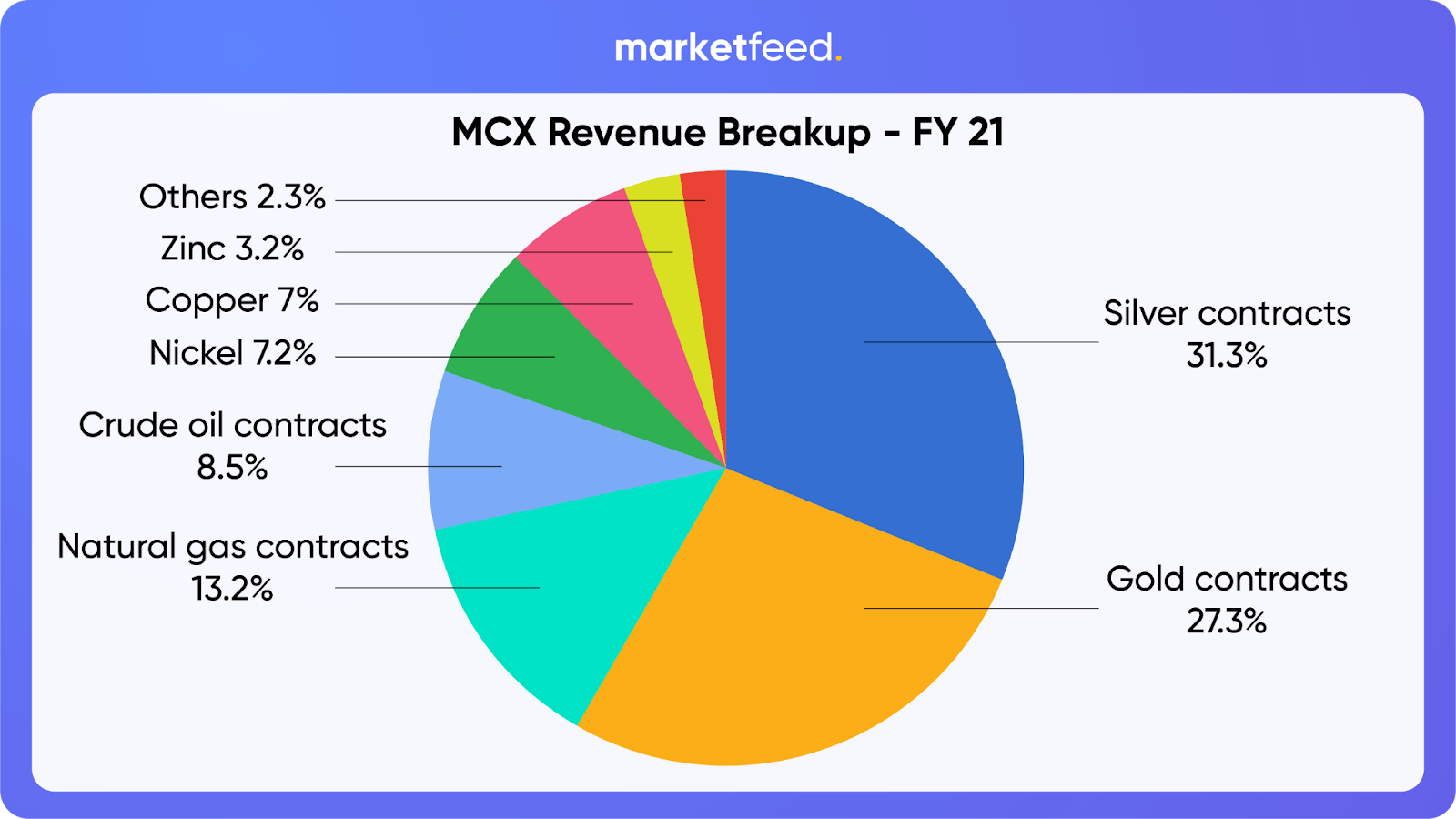
    Just like any other exchange, MCX derives its revenues from transaction fees, admission & subscription fees from brokers, and terminal charges. The company’s transaction fees are calculated on the total turnover (or overall value) of the commodity futures and options (F&O) contracts. MCX has a 95.04% share in the Indian commodity derivatives market!

    Other Offerings

    An important feature offered by MCX is its series of India Commodity Indices or iCOMDEX, which provides real-time data of commodity futures price indices. If you visit their website, you can analyse different indices that are based on commodity futures contracts traded on the exchange. It includes iCOMDEX Base Metals, iCOMDEX Bullion, iCOMDEX Crude Oil, and many more. These indices conform to the best global practices set by the International Organisation of Securities Commissions (IOSCO). 

    The company operates a web-based data service known as Commodity Receipts Information System or ComRIS. It maintains an electronic record of all transactions made on commodities from registered warehouses. MCX transmits this recorded data online in real time. Trading volumes, prices, and changes in prices are completely transparent on MCX.

    MCX also provides trade clearing and settlement services and data feed services. Moreover, they have strategic alliances with leading exchanges across the globe. This includes Dalian Commodity Exchange (China), London Metal Exchange, Taiwan Futures Exchange, and Zhengzhou Commodity Exchange (China). These collaborations allow MCX to seamlessly integrate its operations with the global commodities ecosystem.

    Main Commodities Traded on MCX:

    • Bullion – Gold, Gold Guinea, Gold Petal, Gold Petal (in New Delhi), Gold Global, Silver.
    • Agriculture Commodities – Cardamom, Cotton, Crude Palm Oil, Kapas, Mentha Oil, Castor seed, RBD Palmolien, Black Pepper.
    • Energy – Crude Oil, Natural Gas, Brent Crude Oil 
    • Metal – Aluminium, Copper, Lead, Nickel, Zinc, Brass

    Financial Overview of MCX

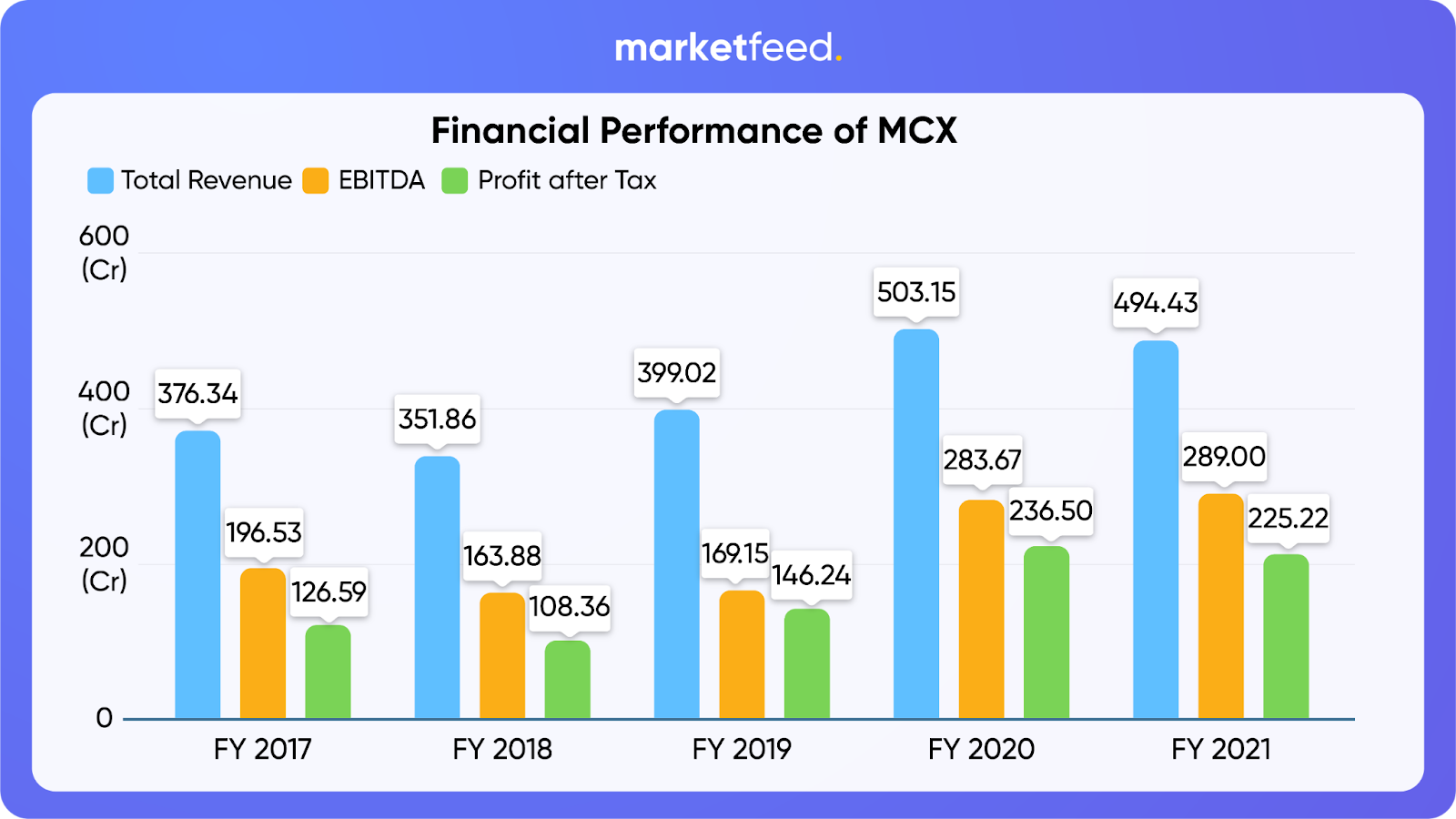
    The company’s revenue and profit growth has been quite inconsistent. MCX reported a 41.3% year-on-year (YoY) decline in consolidated net profit to Rs 38.44 crore for the quarter ended March 2021 (Q4 FY21). Its total income declined by 19.6% YoY to Rs 108.46 crore during the same period. The average daily turnover in commodity futures on MCX declined by 13% YoY to Rs 31,823 crore in Q4 FY21. 

    Net profit for the financial year 2020-21 (FY21) declined by 4.77% YoY to Rs 225.22 crore. The company’s Earnings Per Share (EPS) fell 4.8% YoY to Rs 44.25 in FY21. Based on certain assessments, MCX said the Covid-19 pandemic had a very minimal impact on its operations.

    Let us take a look at some of the positive financial cues. Over the past five years, the company’s profits have grown at a good CAGR of 20.31%. MCX is almost debt-free. The company is also well-known for declaring huge dividends. It has maintained a healthy dividend payout of 65.72%. [Dividend Payout Ratio refers to the percentage of net earnings that is distributed to shareholders in the form of dividends].

    Conclusion

    Trading in commodities can be a great way to diversify your portfolio. A large number of investors use commodities to limit their risks on other financial instruments (also known as hedging). It also provides great liquidity. However, there are a large number of factors that can influence commodity markets. As we know, weather conditions influence the production of agricultural commodities, and thereby its prices. The economic and political conditions of a country can have a significant impact on commodity prices. You should have a broad understanding of the different cycles (trends) of commodity prices.

    You can easily trade in commodities through brokers such as Zerodha, Upstox, Angel Broking, etc.

    On the other hand, MCX as a company/stock is favoured by many investors due to its future growth potential. Ace investor Rakesh Jhunjhunwala recently increased his stake in the commodity trading platform from 3.92% to 4.90%. MCX has announced plans to introduce futures contracts on more commodities across different categories.

    Have you invested in MCX stock? Let us know your views on commodities trading in the comments section of the marketfeed app. 

    Categories
    Editorial Uncategorized

    Tea, Coffee and India Inc.

    Tea and Coffee are two of the most common beverages in the world. They have been regarded as a holy potion. It is has a high medicinal value. In fact, Chinese immigrants to the USA who helped build the First Transcontinental Railroad in the 19th Century survived on Black Tea, which helped stave off dysentery and other waterborne illnesses. Out-of-home consumption itself is 40% of the total consumption of tea.

    The cultivation of Coffee started with the sowing of 7 Coffee beans smuggled from Yemen by an Indian Saint. Thereafter, the seeds were sown in the present-day district of Chikkamagaluru. It is estimated that India now consumes 120,000 tons of coffee per year.

    Tea and Coffee Key Data.

    Annual Tea and Coffee Statistics(FY-19)
    • The market consumption for Tea is expected to grow at a CAGR of 4% in the forecast period of 2020-2025. It is expected to attain 1.40 million tons of production by 2025.
    • As of 2019, India was the second-largest tea producer in the world with production of 1,339.70 million kgs. Furthermore, during Jan-Feb 2020, the estimated production of tea stood at 30.54 million kgs.
    • Revenue in the Coffee segment amounts to US$808m in 2020 in India. The market is expected to grow annually by 8.9% (CAGR 2020-2025).
    India’s % Export Country WIse
    • According to CoffeeBi, The urban consumption dominates with about 73 per cent of total volumes. The remaining 27 per cent it is speculated to account for rural consumption, especially in South India. Moreover, Coffee is consumed more in South India than in North India.
    • Among the South Indian States, Tamil Nadu accounts for 60 per cent of consumption, while Karnataka, Andhra Pradesh, and Kerala account for 25%, 10%, and 5% respectively.
    • Nearly 30% of Coffee produced in India is Arabica and 70% produced is Robusta.

    Tea, Coffee and the Tickers; and of course COVID-19.

    Tea and Coffee stocks have shown excellent performance this quarter. According to Trendlyne, 10 out of the 12 Tea and Coffee stocks have shown a positive profit growth this quarter and share prices of Tea and Coffee stocks zoomed substantially. However, Production and Consumption figures speak the opposite, What is the paradox we are looking at? Let’s find out.

    Tea

    • After the COVID-19 pandemic, there was a 40% reduction in production in Tea due to disrupted supply chain and loss of lively hood. Moreover, Assam, which is the highest producer of tea faced devastating floods. The production of the state fell from 44 Million Kilograms (M. Kgs) on April 19′ to just about 14 M.Kgs on April 20′.
    • The price of tea skyrocketed from a meagre Rs. 121.34 per Kg in March to Rs. 188.77 per Kg in July, according to Auction Price Data from Tea Board. The average monthly domestic consumption is 90 million kg. Of this, out-of-home consumption accounts for 36 million kg. In April and May, there was a loss of around 72 million kg of tea consumption.
    • As tea prices soar in India due to lower output this year, tea players and tea traders are considering importing teas from Kenya and Vietnam, where tea prices have crashed due to overproduction.
    • If the government approves, India may have to import tea for the first time. India has been importing teas only for re-export and that too at a small volume of 9-10 million kg annually.

    Coffee

    • India’s coffee exporters are amidst deep financial crisis with the state and Central governments announcing a lockdown to contain the spread of Covid-19 across the country. Restriction of coffee exports from India to Europe has had an unprecedented impact on the Indian Coffee Industry.
    • As a result, around 21,000 metric tonnes of coffee valued at over Rs 400 crore is stuck at coffee curing centres and various ports for non-availability of permissions to export.
    • Likewise, India’s coffee export declined by 17.2% per cent to 168,435 tonnes for the period from January 1 to July 23, 2020, compared with the same period in the previous year. The plunge has been severe in the case of robusta variety beans at 26 per cent.
    • Coffee prices have been on the rise due to high demand and low supply, is a trend that is likely to continue.

    The Tickers

    The Top Gainers in the Tea and Coffee Industry for the month of July 20′ are as follows:

    Top Gainers(July 20′) on NSE
    Rossell India Ltd. 43.67%
    Tata Coffee Ltd. 40.41%
    Goodricke Group Ltd. 36.80%
    Tata Consumer Products. 33.57%
    B&A Ltd. 30.24%

    Average Revenue Growth of Tea and Coffee companies was 27.74%. EBIT Growth for Tea and Coffee companies was 72.4%. Operating Profit growth for the companies was 68%. All of this over a year. The tea market just luke other companies initially slumped which was followed by a spikey/volatile recovery as the companies started posting excellent results.

    How was is it that reduced production still resulted in tea and coffee companies making a profit?

    • India is the largest consumer of tea in the world. The production slowed down, but the demand never went down very much. After the lockdown was imposed the demand for out-of-home Tea slumped, but demand for Tea inside households covered up for it to some extent. The demand for Tea overall can never die down in a country like India.
    • According to data from the Indian Tea Board, there is a reserve inventory or a buffer stock for at least 145-165 Days when the lock-down was imposed. The Tea picking season had just ended in March when the lockdown was imposed. It is THIS Tea that met with the consumption demand and added to the profits of Tea companies
    • Why the panic in the newsroom then? The demand for three months of Tea was met, but the non-availability of labour and resources during the lockdown is what caused panic in the market. There was an uncertainty about when the production of Tea would resume. This made it difficult for companies to plan prospects or orders of Tea causing prices to skyrocket. This was a supply constraint.
    • June-July 2020 data from Indian Board show that India’s Tea production has started closing up to pre-COVID levels. It will be clearer through August-September data whether India will be able to supply the consumption and export demand or not.
    • On the other hand, Coffee conglomerates like Tata Consumer Products and Tata Coffee managed to perform well because of its international presence with the likes of Eight O’Clock Coffee and Tata Coffee Vietnam Company (TCVCL).
    • Medium and small farmers were already having difficulty covering operating costs. The decrease in prices in recent years has made their livelihood increasingly difficult. Therefore, the main risk is the possible shortage of manpower due to the spread of the virus and the measures of lockdown.

    What drives Tea and Coffee Prices?

    1. The concentration of production: Brazil and Vietnam happen to be the top two producers of coffee, This concentrated output means that supply disruptions in one or both of these countries can have a significant impact on the price of coffee.
    2. Substitution to cheaper beans or leaves: In the Tea and Coffee business, there are cheap beans/leaves and expensive finer beans/leaves. If it so happens that the price spread between the cheap and expensive one’s increases then companies will start substituting the cheaper ones into their blend. This is a positive signal for India in terms of coffee This is because 70% of India’s produce is Robusta.
    3. The price of substitute products: Tea and Coffee are substitute goods, one should analyse the trend in either side to be able to speculate which good will be more in demand and where? Other substitutes for caffeine include energy drinks and supplements.
    4. The weather: Coffee in India mostly depends on monsoon and humidity. A poor monsoon or irrigation facility means that coffee production will be hampered. If climatic conditions are unfavourable for tea plantations owing to less or heavy rainfall that also poses severe problems affecting the production of tea and lives of tea industry labourers.
    5. Yield: There is a fair possibility that the Tea bush or coffee plant might rot or be rendered unsuitable due to conditions like pest, disease or climatic conditions. It is necessary to check the yield provided by Tea and Coffee plantations. The data for which is available on India Tea Board or Indian Coffee Board.
    6. Supply Chain and Logistics: The customs duties exposed on the import and export of coffee has a huge impact on the price and demand of the coffee. One should look out for trade and policy changes between countries.

    What’s the Future Like?

    During the period of the lockdown Tea and Coffee, production was impacted. However, June-July numbers of production show some sign of positivity in terms of production as it returns to normalcy. Tea has a huge potential export value as the international market shifts towards a more healthy lifestyle and the adoption of Tea increases as a substitute for widely preferred coffee.

    On the other hand, the Chai drinking nation of India sees greater potential in rising demand for premium coffee as people’s disposable incomes rise and so does their taste for good tasting coffee. Moreover, the North Indian Market isn’t as penetrated as the South Indian market in terms of coffee consumption.

    Tea and Coffee are two products that stimulate the human mind, so much so that many around the world have made it a part of their daily routine. The possible reason why the Tea and Coffee market in India suffered in COIVD is the disruption of Logistics, Supply Chain and Labor along with the uncertainty of things getting back to normal. Huge potential lies in the future ahead for the two to prosper.