Categories
Jargons

What are Candlestick Charts & How to Read Them?

A candlestick chart graphically represents a share/stock’s price and volume data. They help us visualise the price movement, making it easier to understand and analyse. In the past, traders had to constantly monitor the screen for hours and try to memorise significant price levels, which was practically impossible. Thankfully, the introduction of candlestick charts revolutionised how we interpret market data.

In this article, we will learn how to read candlestick charts, the types of candlesticks, and a few candlestick patterns.

What is a Candlestick Chart?

A candlestick chart is a type of price chart that displays four prices per data point. It shows the opening and closing prices and the high and low prices during a period. These price points are known as the OHLC data in short, which stands for Open, High, Low, and Close, respectively. Furthermore, a candlestick chart also portrays the emotions of the investors and traders.
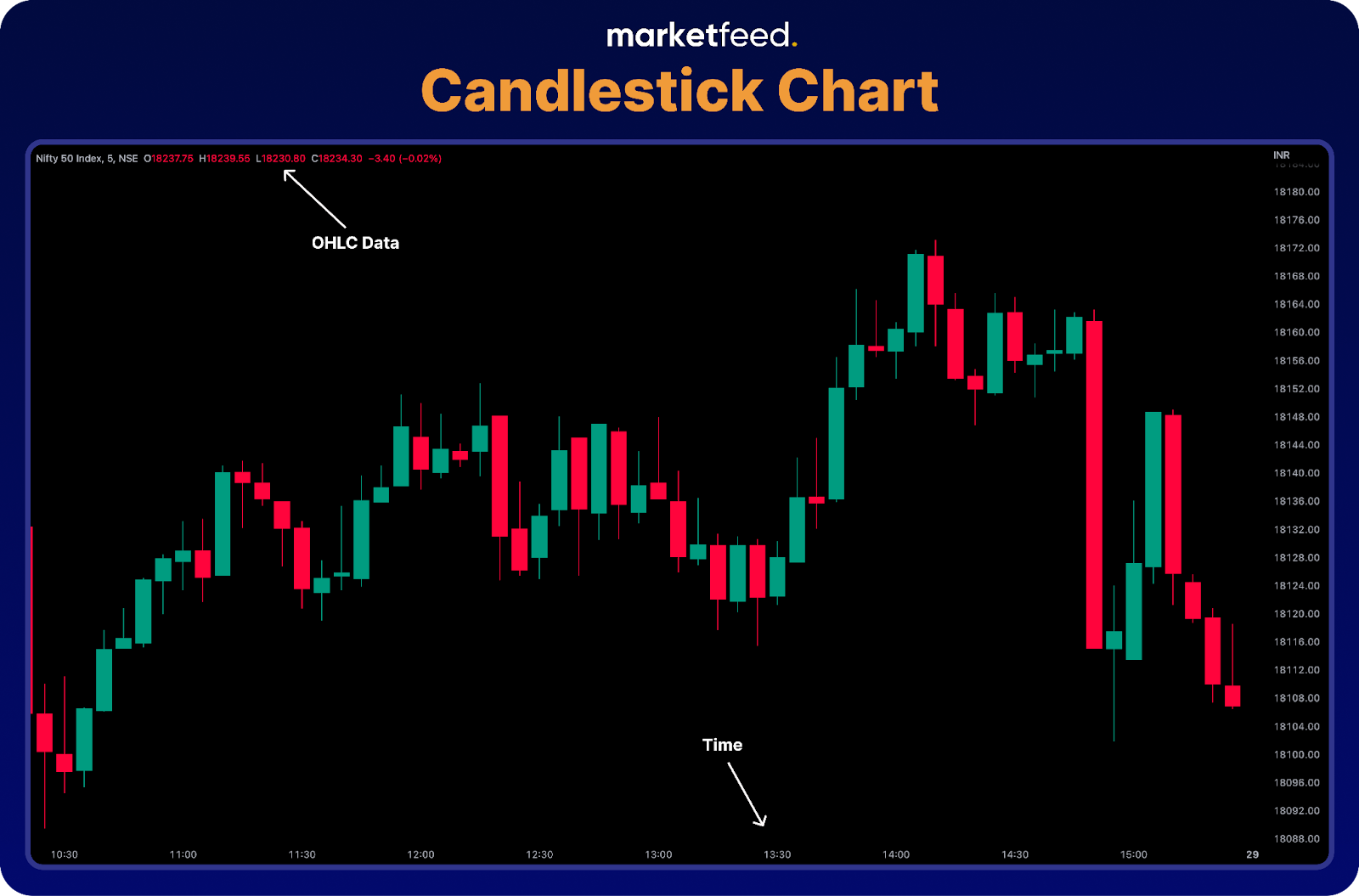
Candlestick Chart

Candlestick charts originated in Japan, where technical analysis has been in use for centuries. A Japanese rice trader, Homma Munehisa, developed a system of charting price movements using candlestick patterns and observations of market psychology. His work laid the foundation for candlestick charting methods.

Structure of Candlesticks

A candlestick chart is a collection of candlesticks. There are two types of candlesticks based on whether the price increases or decreases. They are bullish (green) and bearish (red) candles. A candlestick has three parts that depict four prices:

  • The central real body – It is a rectangular shape that connects the opening and closing prices.
  • Upper shadow – Indicates the high
  • Lower shadow – Indicates the low

The four price points are:

  • Open – The price at which the asset started trading in the timeframe.
  • High – The highest price at which the asset got traded.
  • Low – The lowest price at which the asset got traded.
  • Close – The price at which the asset got traded at the end of the time frame. The Last Traded Price (LTP) of the timeframe will be the closing price.

Both bullish and bearish candles have OHLC price points. However, the position of opening and closing prices in both are different.

Candlestick Structure

If the closing price is higher than the opening price, it is known as a Bullish or green candle. On the other hand, If the closing price is lower than the opening price, it is known as a Bearish or red candle. A green or bullish candle symbolises buying, while a red or bearish candle symbolises selling. Next, let’s look at some basic candlestick charts!

Basic Candlestick Patterns

1. Bullish and Bearish Engulfing Patterns
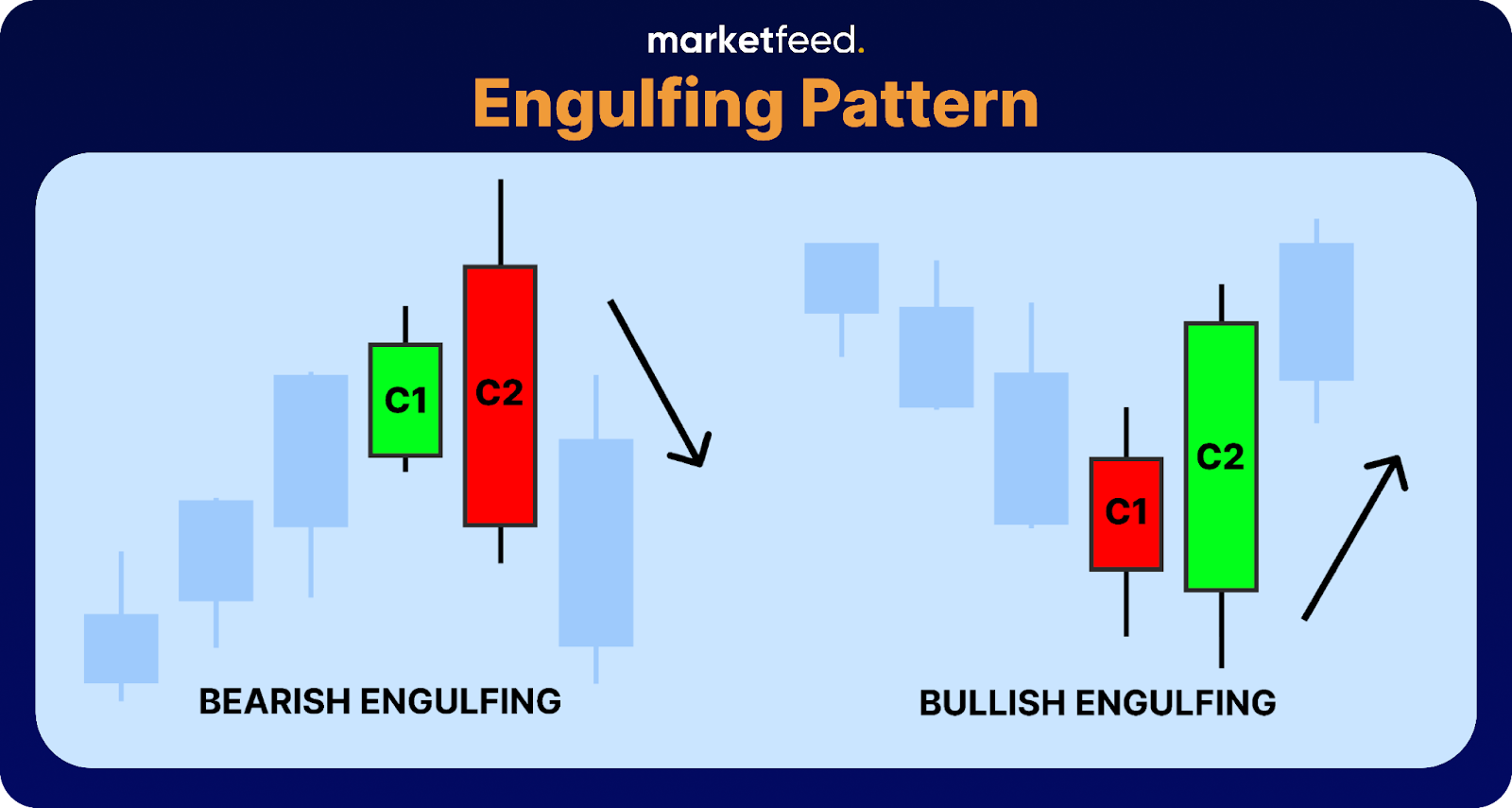
Candlestick Patterns: Engulfing Pattern

A bearish engulfing candlestick pattern occurs during an uptrend and consists of two candles. The first candle is a bullish (green) candle, followed by a larger bearish (red) candle that completely engulfs or covers the previous candle’s range. This pattern suggests that selling pressure has increased, overpowering the previous buying momentum, and indicates a potential shift toward a downward trend. Traders often interpret a bearish engulfing pattern as a bearish signal.

On the other hand, a bullish engulfing pattern occurs during a downtrend. It also consists of two candles, but in the opposite configuration. The first candle is a bearish (downward) candle, followed by a larger bullish (upward) candle that completely engulfs the previous candle’s range. This pattern suggests that buying pressure has increased, overpowering the previous selling momentum, and indicates a potential shift toward an upward trend. Traders often interpret a bullish engulfing pattern as a bullish signal.

2. Bullish and Bearish Harami Patterns
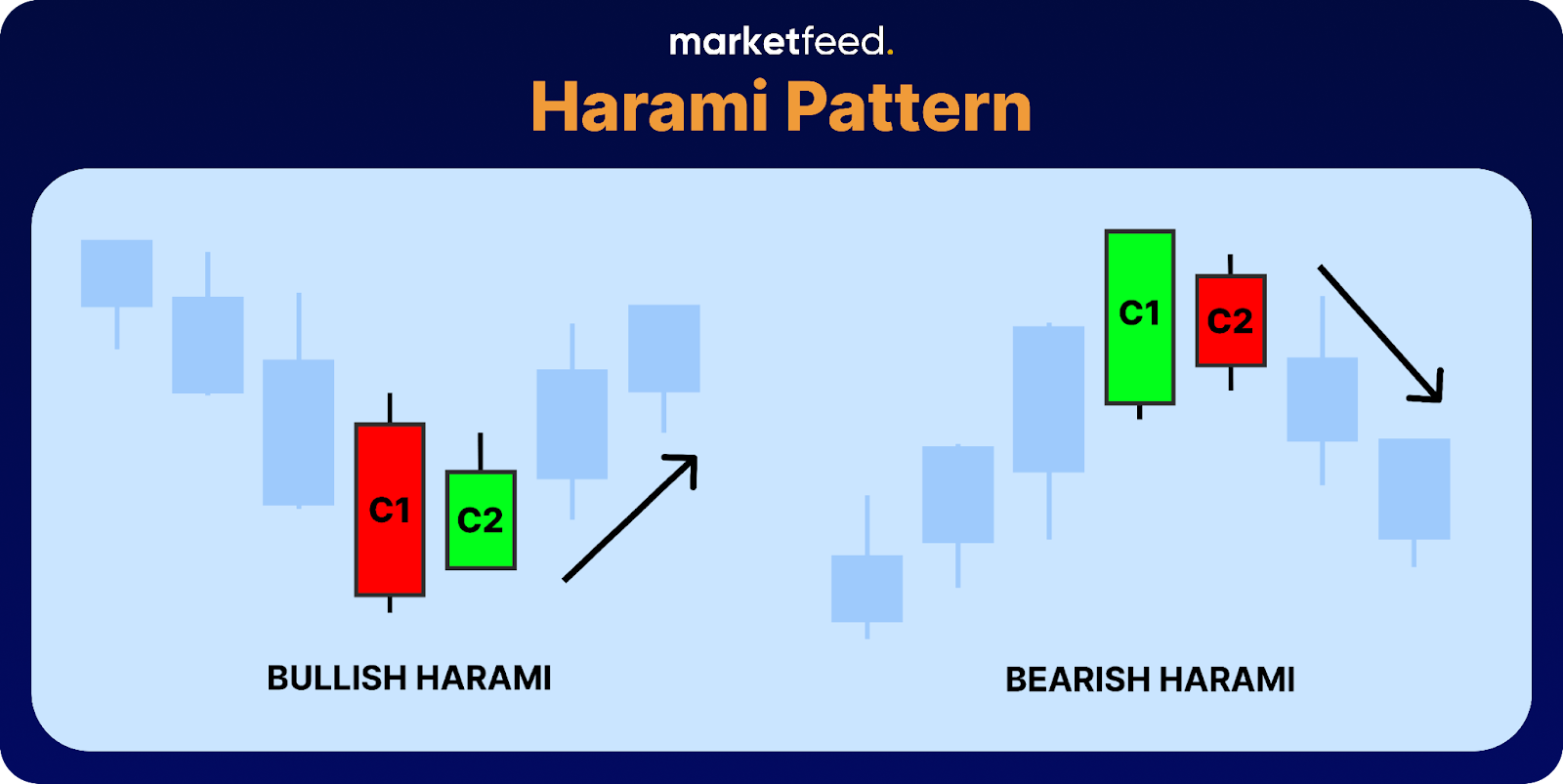
Candlestick Patterns: Harami Pattern

A bullish harami pattern consists of two candles. The first candle is a large bearish (red) one, indicating a prevailing downtrend. The second candle is a smaller bullish (green) candle that is completely engulfed or covered by the body of the first candle. This pattern suggests that selling pressure may be weakening, and a potential trend reversal towards an upward move could occur. Traders often interpret the bullish harami as a bullish signal.

On the other hand, a bearish harami pattern also consists of two candles. The first candle is a large bullish (green) candle, indicating a prevailing uptrend. The second candle is a smaller bearish (red) candle that is completely engulfed by the body of the first candle. This pattern suggests that buying pressure may be diminishing, and a potential trend reversal toward a downward move could occur. Traders often interpret the bearish harami as a bearish signal.

3. Morning & Evening Star Patterns
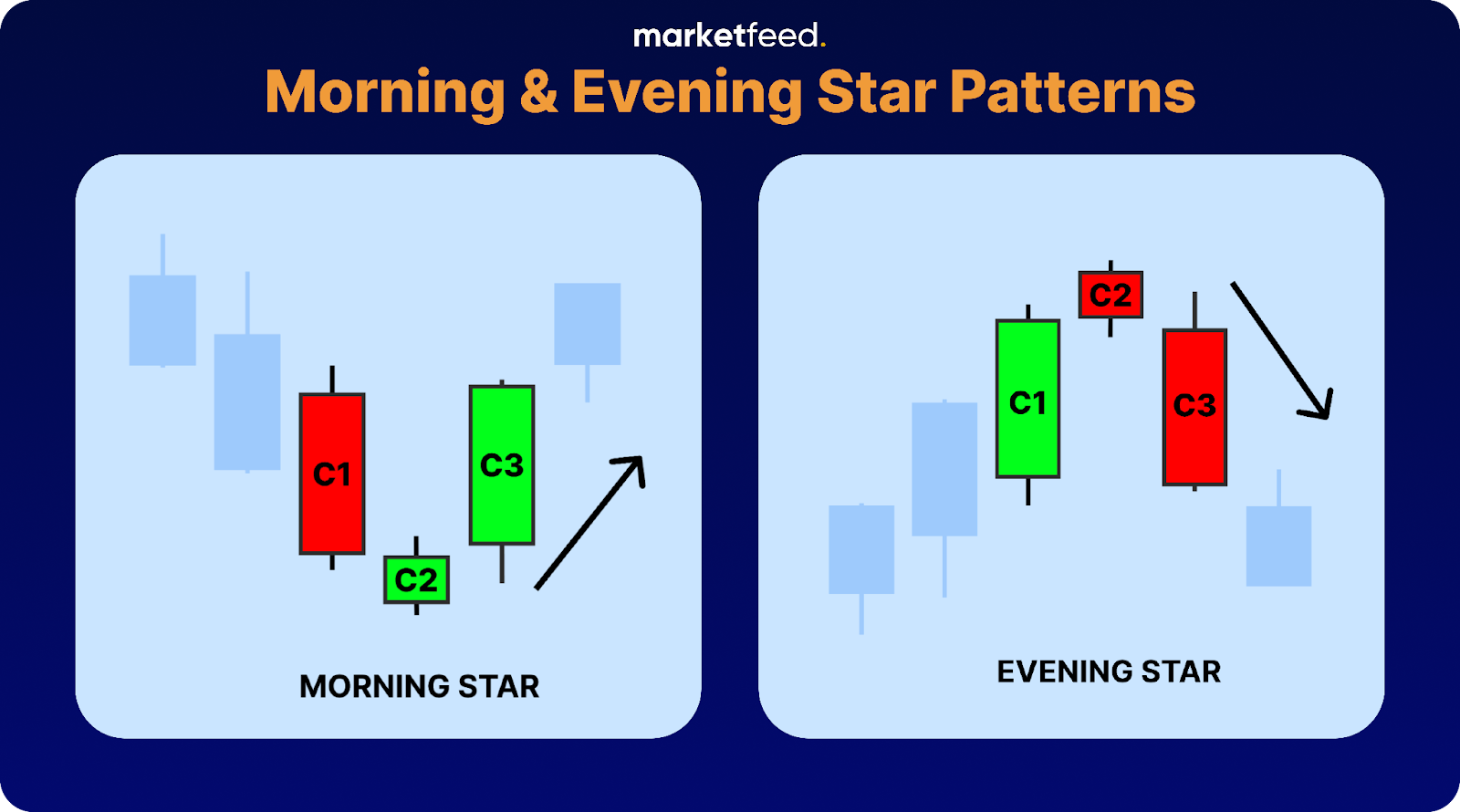
Morning and Evening Star Patterns

A morning star pattern appears during a downtrend and consists of three candles. The first candle is a large bearish (red) candle, indicating the prevailing downtrend. The second candle is a smaller candle with a small body that may be bullish or bearish. This candle represents indecision in the market. The third candle is a large bullish (green) candle that closes near or above the midpoint of the first candle. This pattern suggests that the selling pressure is diminishing, and a potential trend reversal toward an upward move could occur. Traders interpret the morning star pattern as a bullish signal.

On the other hand, an evening star pattern appears during an uptrend and also consists of three candles. The first candle is a large bullish (green) candle, indicating the prevailing uptrend. The second candle is a smaller candle with a small body that may be bullish or bearish. This candle represents indecision in the market. The third candle is a large bearish (red) candle that closes near or below the midpoint of the first candle. This pattern suggests that the buying pressure is diminishing, and a potential trend reversal toward a downward move could occur. Traders interpret the evening star pattern as a bearish signal.

In conclusion, reading candlestick charts is not just about understanding the price and volume data. These candles provide insights into the underlying psychology and market sentiments. Identifying patterns and taking the right action at the right time can only get better with time and practice. Make sure to practice identifying patterns on historic charts to get your game on for actual trading.

Categories
Jargons

What are The Best Ways to Generate Passive Income?

Passive income is what you earn when you don’t actively work or put forth constant effort on a task/job. It includes regular earnings from a source other than your employer. Simply put, it is an income source that will make you money while you sleep. In this article, we will explore a few reliable ways to generate passive income, ranging from investing in real estate to creating digital products. So, let’s dive in and explore some of the best ways to generate passive income:

1. Investing in Dividend-Paying Stocks

High-quality stocks that pay consistent dividends can be a source of passive income. When a company makes a profit, it may choose to distribute a portion of those profits to its shareholders in the form of dividends. As a shareholder, you will receive those dividends based on the number of shares you own. Some companies pay dividends quarterly, while others may pay them annually or semi-annually. More importantly, you can generate good passive income over the long term by investing in shares of top Indian companies.

Dividend yield mutual funds and dividend smallcases are a great way to invest in dividend-paying stocks!

2. Creating a YouTube channel

YouTube channels that meet the platform’s eligibility criteria can monetize their videos through Google AdSense. Advertisements will be displayed before, during, or after the video, and you earn a percentage of the revenue those ads generate. Channels with huge viewerships can attract sponsors who’ll pay considerable sums of money to promote their products or services. The amount of revenue you can earn from YouTube depends on various factors such as the number of views, engagement levels, type of content, etc.

3. Renting Out Properties

Renting out unoccupied properties or homes can help you generate passive income. You can either rent out properties privately or through platforms like Airbnb. The rental income depends on the type, location, size, and demand of the property. On Airbnb, you can rent out your whole property or just a few rooms. Maintaining the property periodically can generate maximum revenue.

4. Creating and Selling Online Courses

If you have good subject knowledge in any topic, you can plan a curriculum and record classes that can then be sold online on platforms like Udemy. You can add assignments, quizzes, and exercises to the course for a rich learning environment. The payout depends on the number of courses sold and learner engagement.

5. Starting a Blog

A blog is an informational website published on the internet, consisting of discrete, often informal diary-style text entries. Posts are typically displayed in reverse chronological order so that the most recent post appears first, at the top of the web page. You can run ads and affiliate links on your website that creates revenue. Sponsored posts are also another great way to generate income from blogs.

6. Affiliate Marketing

It is a performance-based marketing strategy that pays the affiliates for the visitors or customers brought by them to the business. Affiliate links are placed often on banners on the website or in the form of affiliate links. When a reader clicks on the affiliate link and purchases a product or service, the affiliate earns a commission from the business. The amount of commission varies depending on the agreement between them. Affiliate marketing can be done through various mediums such as websites, social media platforms, emails, podcasts, etc.

7. Selling on Amazon and Other Marketplaces

E-commerce platforms such as Amazon and Flipkart are great places to sell your products. You list your products on these platforms and sell them by paying a small commission to the e-commerce operator (Amazon, Flipkart, etc). This is highly economical compared to traditional commerce as the infrastructure needs are minimal.

8. Investing in REITS

A Real Estate Investment Trust or REIT allows you to invest in real estate companies and earn income. A REIT owns, operates, or finances income-generating real estate. These trusts take money from small and big investors and put it into real estate companies. A REIT can possess several properties like complexes, infrastructure, healthcare units, apartments, and more.

REITs can be a reliable source of passive income as they are legally required to pay out a minimum of 90% of their income to shareholders. Brokers such as Zerodha and Groww allow you to buy and sell REITs like shares.

9. P2P Lending

Peer to Peer or P2P lending is a form of lending directly between individuals without a bank. The banks charge a high-interest rate from borrowers and return a low-interest rate to depositors. The absence of banks results in a higher yield to depositors. Most P2P facilitators diversify the deposits and lend to multiple borrowers to mitigate default risk.

You could look into platforms like Lendbox, a Reserve Bank of India-certified P2P-lending NBFC. One can earn up to 11% returns per year with daily or monthly interest credits.

10. ATM Franchise

Like starting a Mcdonalds’ or KFC franchise, you can start an SBI ATM franchise. The Reserve Bank of India (RBI) has allowed companies to set up ATMs on behalf of the bank through a franchise model with the mission to provide ATM facilities to all corners of India. Tata Indicash is the most popular of the four companies authorized to give franchises. 

For the installation, you need at least an 80-sq.ft ground floor commercial space with a minimum of 100 footfalls a day. A refundable security deposit of ₹2 lakhs and an additional ₹3 lakhs of working capital should be maintained. The revenue generated depends on the transactions. A monthly revenue of ₹45,000 to ₹50,000 can be expected if there are 300 transactions per day. SBI pays ₹8 per cash transaction and ₹2 per noncash transaction. You can apply for the ATM franchise from the Indicash website. 

11. Royalty from Books, Music, and Podcasts

Royalty refers to the payment by one party to another for the ongoing right to use an intellectual asset. 

Authors can earn royalties from the sale of books that they write. It can either be based on the number of books sold or the number of books printed. 

Artists can earn royalties by publishing music on various platforms like Apple Music and Spotify. The royalty will be based on the platform’s average pay per stream.

You can stream podcasts on platforms such as YouTube and Spotify. Content with high engagement and popularity can attract sponsorships and paid advertisements, which can be an additional revenue stream. The number of listeners and engagement affects the pay scale.

We have mentioned a few methods by which you can generate passive income. You can earn an extra income without putting in continuous effort! However, it’s crucial to approach such opportunities with caution and ensure that they are legitimate and trustworthy. Explore platforms that leverage your skills, expertise, or hobbies so that you can enjoy the process while earning!

Disclaimer: This article is only for educational purposes.

Categories
Editorial

Why Basic Stock Market Education Must be Free & Accessible to All

Indian parents have high hopes and expectations for their children’s education and careers. They use all their resources to help their kids excel in academics, get good grades, join a prestigious institution, and get well-paying jobs. Moreover, we Indians have a reputation for being frugal with our money. We’re taught to spend less and save more. All in good intentions, but there’s a lot more to life than just saving money.

Unfortunately, our current education system does not include theory or practical sessions on essential life skills. We’re not trained to handle our hard-earned incomes and make financial decisions. Young professionals find it difficult to understand the basic principles of investing or even filing their taxes. These vital “life subjects” are still not being taught in schools or colleges. Instead, there’s always been a perception among Indians that investing in stocks is risky and you’ll lose all your money.

The Current Scenario

A majority of Indian households prefer to “invest” their hard-earned money in fixed deposits (FDs) even now. Returns from FDs can never beat the rising inflation rate (the general rise in prices of goods). Gold, post-office savings, and real estate are given more priority over stock trading and investment. These are decent options but might not be sufficient in today’s economic climate. 

Thus, future generations will be extremely doubtful and cautious of going the “unconventional route” when it comes to growing their wealth and achieving financial freedom. They’re not getting the proper education or awareness!

According to a Bloomberg Intelligence report in 2021, Indian households invest a meager 7% of their financial assets into stocks compared to an average of 30% in other major emerging markets. More than 55% of adults in the United States invest in the stock market. While saving is the safe way to go, Indian citizens need to understand that the purchasing power of cash in hand or their bank account continuously reduces with time. So, investing in the top-performing firms in the nation can help you become more financially secure

Time to Change Mindsets! 

There is an urgent need for education in financial planning in our country. We need to initiate training sessions around stock investment and trading. The concepts of compounding and portfolio diversification must be ingrained in everyone’s minds so that they become more financially savvy. Having a basic knowledge of personal finance can help an investor make money work for them! Investing in stocks after thorough research will allow your money to outpace inflation and potentially build wealth.

If you’re in your 20s, try to start investing early as it’ll help you make small and calculated risks without the fear of affecting your livelihood and family. In fact, it’ll give you an insight into stock selection and investment risks and allow you to make smart choices in the future. There are plenty of opportunities for you to make money in the stock market. You just need to figure out what works for you!

Still confused about how to start your journey in the stock market? Don’t worry, we’ve got you covered!

marketfeed’s founder, Sharique Samsudheen, has made it his life’s mission to democratize the stock markets and help Indians become financially independent. To that extent, we are proud to launch our Free and Structured Stock Market A-Z Series on YouTube. The series will cover everything from the basics of the stock market to advanced trading strategies. We’ll also teach you proven strategies, tips, and tricks used by our team so you can make consistent profits! marketfeed will help you make informed decisions in the beautiful world of finance!

All you have to do is subscribe to our YouTube channel and turn on notifications! Join the Revolution and be part of the best Stock Market Community that we’re building here at marketfeed!

Categories
Editorial

Union Budget 2022-23: Stocks Likely to Benefit

Finance Minister Smt. Nirmala Sitharaman presented the Union Budget 2022-23 in Parliament on February 1, 2022. The budget has included a set of important schemes that target different sectors of our economy. Let us take a look at some of the key highlights from the Budget presentation and the stocks that could benefit in the long term.

Boost for Infrastructure Sector

The Budget has given utmost importance to the development of core infrastructure across the country. Under PM Gati Shakti, the National Highway network will be expanded by 25,000 km in 2022-23. The PM Gati Shakti— National Master Plan for Multi-modal Connectivity is a digital platform that brings 16 Ministries (including Railways and Roadways) together for integrated planning and implementation of infrastructure connectivity projects. It aims to pull forward the economy and lead to more job creation.

As part of the project, 400 new-generation Vande Bharat trains will be manufactured in the next three years. Also, 100 cargo terminals will be established within the same period. The “One Station-One Product” concept will be popularised to help local businesses and supply chains.

Under PM Awas Yojana, 80 lakh affordable houses will be completed in 2022-23. An amount of Rs 48,000 crore will be allocated for this scheme. This initiative will give a significant boost to the steel, cement, paints, and other allied sectors.

The FM has announced an allocation of Rs 60,000 crore under the Har Ghar, Nal Se Jal project. It aims to provide clean drinking water to over 3.8 crore households in FY23.

Stocks That May Benefit:

Prominent highway-infra construction firms such as Larsen & Toubro (L&T), KNR Construction, Ashoka Buildcon, GR Infra are likely to benefit. IRCTC and the Indian Railway Finance Corp (IRFC) may benefit from the developments in the Indian Railways. Other stocks to be watched in this space include Tata Steel, SAIL, DLF, Godrej Properties, UltraTech Cement, etc. You can read marketfeed’s analysis of the paint and real estate industries. 

Stocks related to pipe manufacturing and water treatment can be watched. This includes Astral Ltd, Prince Pipes & Fittings Ltd, Supreme Industries, Finolex Industries, Va Tech Wabag, etc.

Boost for Energy Transition

The Indian government aims to facilitate domestic manufacturing of 280 gigawatts (GW) of installed solar capacity by 2030. The Finance Minister has announced an additional allocation of Rs 19,500 crore towards a Production Linked Incentive (PLI) scheme for manufacturing high-efficiency solar modules.

The govt’s EV30@30 campaign aims to speed up deployment and achieve 30% sales share for electric vehicles (EVs) by 2030. It will also help reduce the import of expensive crude oil. The Centre will introduce an extensive battery swapping policy to promote the sale of EVs. Moreover, special mobility zones for EVs will be established in urban areas.

Sovereign Green Bonds (SGBs) will be issued to mobilize resources for green infrastructure. The proceeds from the issue of these bonds will be deployed in public sector projects that will help reduce carbon emissions in the economy. It will also support the wider adoption of solar and other renewable energy sources across India. SGBs will be part of the government’s borrowing program in FY23.

Stocks That May Benefit:

Stocks in the EV and green energy space will benefit the most from these policies. Tata Motors, Tata Power, Adani Green Energy, Borosil Renewables, Tata Chemicals, Motherson Sumi, etc can be watched. Battery manufacturers such as Exide Industries and Amara Raja Batteries could also benefit.

You can also go through our detailed analysis of power distribution and transmission companies here

Boost for Telecom Sector

Telecom spectrum auction will be conducted in 2022 for the rollout of 5G mobile services by private telecom providers. The Centre will also launch a PLI scheme for design-led manufacturing for the 5G ecosystem to enable affordable broadband and mobile communication in rural and remote areas. 

The govt will offer contracts for laying optical fibre cables in villages under the BharatNet project under the public-private partnership (PPP) model in FY23. The project aims to bring rural access to e-services, communication facilities, and digital resources.

Bharti Airtel, HFCL, RailTel Corporation of India, Tejas Networks, Dixon Technologies, GTL Infra, Sterlite Technologies are likely to benefit.

Boost for the Defence Sector

  • The Finance Minister has stated that ~25% of the total defense R&D budget will be earmarked for opening up defence research & development (R&D) for private industry, startups, and academia. 
  • Private industries will be encouraged to take up the design and development of military platforms and equipment. They can now collaborate with DRDO and other organizations through special purpose vehicle (SPV) model. 
  • 68% of the capital procurement budget in defence will be allocated for domestic industry in 2022-23. This will give a boost to the Make in India initiative.

Stocks related to the defence sector include Hindustan Aeronautics Ltd, Bharat Dynamics, Zen Technologies, Bharat Electronics, and Paras Defence & Space.

Boost for Banking and NBFC Sectors

As per reports, HDFC Bank, ICICI Bank, and State Bank of India could be the biggest beneficiaries of the government’s push to convert more than 1.5 lakh post offices into banking outlets. These lenders could tap into nearly Rs 15 lakh crores of savings in the post offices to sell other financial products like mutual funds and insurance. 

The extension of the Emergency Credit Line Guarantee Scheme (ECLGS) to March 2023 will be beneficial for banks and non-banking financial companies (NBFCS) that focus on micro, small, and medium enterprises (MSMEs).

The Way Ahead

The Indian government continues to focus on getting the economy back on track and speeding up growth. The Budget will provide a boost to the ‘Make-in-India’ initiative by focusing on infrastructure, housing, power, railways, and agriculture. The Centre’s extended focus on digitisation through new-age technologies and electric vehicles is highly commendable. Let us look forward to seeing how these strategic plans are implemented. 

Disclaimer: The stocks mentioned in the article are solely for educational purposes. Please do your own research before investing.

Categories
Editorial

NSE VS BSE | How NSE Beat BSE to Become India’s Top Stock Exchange

Stock exchanges are the powerful platforms or marketplaces that allow us to invest or trade in securities. Most beginners in the stock market have a doubt regarding the exchange they should transact in— whether it should be BSE or NSE. In this article, we dive into the two prominent stock exchanges of India. We shall also analyse the factors that helped NSE become our country’s largest stock market exchange.

A Brief Profile on NSE and BSE

The Bombay Stock Exchange (BSE) was established way back in 1875. Located in Dalal Street, Mumbai, it is the oldest stock exchange in Asia. There are more than 5,400 companies listed on the BSE. Its benchmark index, the S&P BSE Sensex, is widely tracked by investors across the globe. The Sensex (Sensitive Index) tracks the performance of 30 of the largest and most actively traded stocks on the BSE. As of 2020, BSE is the 10th largest exchange in the world in terms of the cumulative market capitalisation of all companies listed on its platform.

The National Stock Exchange (NSE) was incorporated in 1992. It is also located in Mumbai. NSE is ranked the third-largest stock exchange globally in terms of the total number of trades in equity shares. There are more than 1,600 companies listed on the NSE. It is the first bourse in India to implement electronic or screen-based trading. The Nifty 50 is NSE’s benchmark index that represents the weighted average of 50 of the largest companies listed on its platform.

Both NSE and BSE provide a platform for companies to raise funds efficiently. The exchanges allow investors to trade in equities, currencies, debt instruments, derivatives (F&O), and mutual funds. Moreover, they provide services such as risk management, clearing and settlement, and investor education. The exchanges operate under the strict guidelines of the Securities and Exchange Board of India (SEBI).

Factors That Led to the Rise of NSE

For more than a century, BSE had complete dominance over stock trading in India. To break this monopoly and improve transparency in the capital market, our government decided to create the NSE. It was India’s first computer-driven stock exchange and was promoted by some of the leading financial institutions at that time. NSE was given the right to set up trading terminals across the country, while BSE was not allowed to do so. [Trading terminals are intermediary software that allows investors and traders to place buy/sell orders without having to call their brokers]. Meanwhile, it took a few years for BSE to receive permission for the same.

Thus, NSE was able to capture a significant portion of share trading across India. They used state-of-the-art technologies to ramp up the performance of trading systems. NSE was the pioneer of automated and paperless trading in the Indian market. It set up the first depository— the National Securities Depository Ltd (NSDL), which initiated the demat revolution in the country. NSE was also the first stock exchange to establish a clearing corporation (NSE Clearing Limited), which helps reduce trading and settlement risks in the market. 

With the arrival of NSE, investing and trading in stock markets became highly transparent, efficient, and less costly.

High Liquidity

Ever since NSE was established in 1992, there has been fierce competition between the two bourses for attracting more trading volumes. Higher volumes would ultimately allow exchanges to obtain more revenue. More importantly, it would lead to better liquidity, an aspect that is vital while trading in shares and derivatives. Higher liquidity allows traders to quickly and easily buy or sell shares at the exact price specified by them. 

As a result of its revolutionary offerings, NSE has the highest average daily turnover for equity shares than any other stock market in India. The turnover for an exchange refers to the overall value of shares traded during a certain period. 

Let’s look at an example. On July 12, 2021, around 15.76 lakh shares of Reliance Industries were traded on the BSE. At the same time, ~39.6 lakh shares of RIL were traded on the NSE— more than double! Since NSE has high trading volumes, the price a buyer offers per share (bid price) and the price the seller is willing to accept (ask price) will be fairly close to each other. This helps intraday and swing traders enter and exit a trade at the exact price specified by them and realise their targets.

Trading in Derivatives

For those who are not aware of what derivatives trading really is, here’s a quick explanation:

A derivative is an instrument whose value is derived from an underlying asset. The underlying can be a stock, commodity, index, etc. Derivatives are used by large institutions or traders to hedge risk and to speculate on price changes in the underlying asset. Futures and options (F&O) are the most common types of derivatives trading.  An agreement (or contract) can be formed between a buyer and seller to buy/sell a predetermined quantity of the underlying asset at a specified price on a specified date. You can learn more about basic options terms here.

Coming back to the point, NSE has always been the most liquid exchange for derivatives. It is the undisputed leader when it comes to futures and options (F&O) trading. This is clear when you compare the volumes (options chain) of F&O activated stocks on NSE and BSE. In most instances, there are zero contracts formed in BSE. On the other hand, NSE’s Nifty 50 and Bank Nifty are traded heavily in the stock market.

Conclusion

Despite its exceptional growth, NSE lags behind BSE on one aspect: the brand. Sensex is still widely used across the world to measure the health of the Indian markets and the economy. 

To summarise, NSE is the preferred exchange for intraday, swing, and derivatives trading due to high liquidity. If you are a long-term investor, it does not really matter where you buy/sell shares. However, BSE gives access to more than 5,000 stocks across various sectors. There could be a minor/insignificant difference in the prices of scrips in NSE and BSE. The costs related to investing and trading are similar for both exchanges.

Over the past few years, stock exchanges have come under the scanner due to frequent technical glitches. You may recall the four-hour-long halt in NSE’s trading system that occurred in February 2021. The exchange informed that the instability of telecom links from two of its service providers had affected the functioning of its risk management system. Unfortunately, it resulted in heavy losses for investors. There was a complete lack of accountability from NSE.

Recently, SEBI came out with a standard operating procedure (SOP) to curb technical glitches in stock market operations. NSE and BSE could face a penalty of up to Rs 2 crore or more if they fail to respond to technical disruptions within 30 minutes and restore operations within 45 minutes. Stock exchanges and other market infrastructure institutions (MIIs) will have to submit a root cause analysis report within 21 days of an accident.

Let us hope such events do not occur in the future!

Categories
Trending

Yes Bank and 4 more stocks to be converted from Mid Cap to Large Cap

By 5th Jan 2021, AMFI (Association of Mutual Funds in India) is expected to release a fresh list for categorization of stocks into large caps, midcaps, and small caps. Large-cap refers to a company with a market capitalization of more than Rs 20,000 crores. Mid-cap is denoted to companies with a market capitalization between Rs 5,000 crores and Rs 20,000 crores. Small-cap is a term used to classify companies with a market capitalization of less than Rs 5,000 crores. 

Here is the list of stocks according to ICICI Securities that have the potential to switch from mid-cap to large-cap:

  1. Yes Bank (NSE: YESBANK, Mkt Cap: Rs 38,459 crore)
  2. Adani Enterprises (NSE: ADANIENT, Mkt Cap: Rs 49,046 crore)
  3. PI Industries (NSE: PIIND, Mkt Cap: Rs 35,923 crore)
  4. Hindustan Aeronautics Ltd (NSE: HAL, Mkt Cap: Rs 28,177 crore)
  5. Jubilant Food (NSE: JUBLFOOD, Mkt Cap: Rs 33,747 crore)

Here is the list of stocks according to ICICI Securities which are to be moved from large-cap to mid-cap:

  1. MRF (NSE: MRF, Mkt Cap: Rs 33,377 crore)
  2. NMDC (NSE: NMDC, Mkt Cap: Rs 32,715 crore)
  3. United Breweries (NSE: UBL, Mkt Cap: Rs 32,715 crore)
  4. Container Corporation of India (NSE: CONCOR, Mkt Cap: Rs 25,142 crore)
  5. General Insurance Corporation of India (NSE: GICRE, Mkt Cap: Rs 24,465 crore)
  6. Bank of Baroda (NSE: BANKBARODA, Mkt Cap: Rs 27,284 crore)

This change in classifaction may result in funds flowing in and out of the stocks, as mutual funds re-arrange their portfolios. Do keep watch of it.