Categories
Jargons

What is the Stock Market? How Does it Work?

Have you ever wondered what the stock market is and how it works? If yes, you’re not alone. The stock market can seem confusing and intimidating for people who don’t know how it works. But don’t worry! In this article, we shall learn what the stock market is, how it works, and who market participants are.

Given below are the different participants in the stock market. We’ll understand more about them through a story.
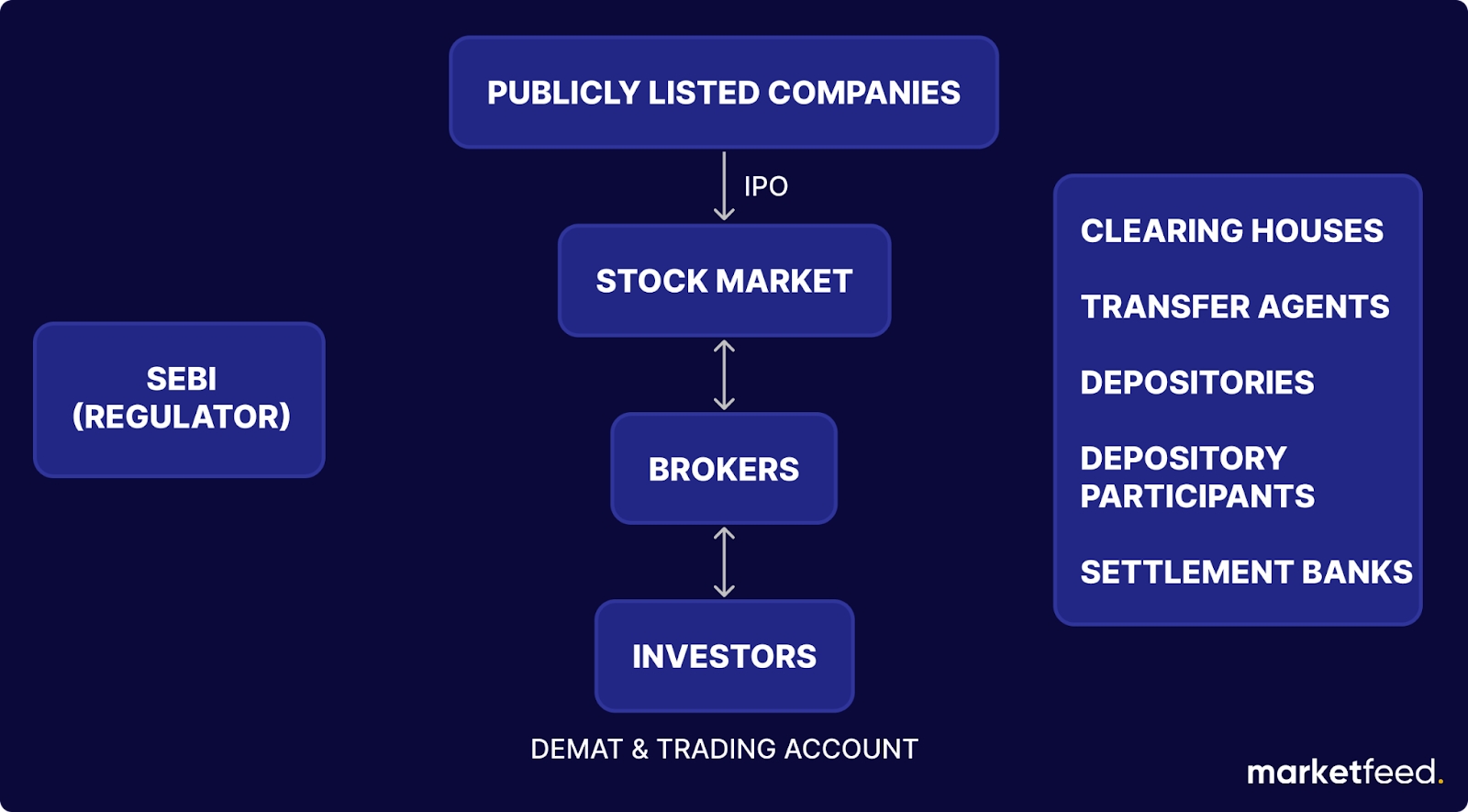
stock market participants | marketfeed

Let’s Look at a Story!

Mr. Jignesh, an owner of a renowned supermarket in Bengaluru, has been successfully running his business for the past ten years. The supermarket has been generating decent revenue and is highly profitable. His business also has goodwill (proprietary or intellectual property and brand recognition). When it comes to business, there are two things you must understand:

  • Ownership of a Business
    Jignesh completely owns and runs the supermarket, and the profit is not shared with anyone else.
  • Valuation of a Business
    Anything and everything has a value attached to it, even a business. The business has been generating income for Jignesh for the past ten years, so it is valuable. The valuation of a business is the economic value of how much a person has to pay to acquire 100% of the business from him. Let’s assume that the supermarket is valued at ₹1 crore.

    Since Jignesh is growing old, he feels he doesn’t want to work as much as he did and is looking for a partner to operate the business in return for 50% of the ownership of his business. He decided to share his business with a partner, Ms. Riya.

What are Shares?

Shares represent units of ownership of a company. A shareholder is entitled to a part of the profit that the company generates. 

The ownership of Jignesh’s supermarket was divided into 1000 equal shares. The value of each share can be mathematically expressed as:

Value of 1 Share = Total Valuation / Total Number of Shares

= 1,00,00,000 / 1000

= ₹10,000 per share.

Riya agreed to acquire 500 shares (50%) of the supermarket in consideration of the value of those shares in Cash.

Valuation = Total Number of Shares x Value of Each Share

Riya paid ₹50,00,000 to Jignesh, and they both became partners in the supermarket business. 

A few years later, the business expanded with several profitable outlets across Bengaluru. Now, Jignesh and Riya want to open 200 more stores nationwide, for which they need a large amount of capital. The easiest way to get funding or capital is by taking out a loan from a bank and using the business’ assets as collateral. However, this carries the risk of falling into a debt trap. If they are unable to repay the loan for some reason, the assets will be seized by the bank to recover the loan. Jignesh and Rita did not want to deal with these issues. 

An alternative would be to find more people who are interested in becoming part-owners of the business across Bengaluru. Even then, they may not be able to find enough people to do so. At this point, Jignesh becomes aware of the stock market. If they convert their company into a Public Limited company, they can raise capital from thousands of investors across India and other countries. The process of issuing shares to the public to raise capital for a business is known as an Initial Public Offering (IPO).

What is the Stock Market?

A stock market is a place where shares of publicly listed companies are traded. It is a physical place or institution where shares are bought and sold.

So Why Do Companies Go Public?

  • To Raise Capital: The company can gather funds for many objectives, such as paying liabilities (loans) and funding its future expansion projects.
  • Reward Founders & Early Investors: The founders and early investors of a company hold a good portion of the shares in their entity. They can sell these shares to the public and the proceeds go directly to them rather than to the company. It can be considered as a reward for all the time and effort they put in to build the company from the ground up. So going public can give them an early exit.

What are Stock Exchanges?

A stock exchange is a financial institution where different participants come together to buy and sell securities (shares). It provides the infrastructure for these activities. The term Stock Market is an umbrella term for a collection of Stock Exchanges.

The two major Stock Exchanges in India are:

  • Bombay Stock Exchange (BSE)
  • National Stock Exchange (NSE)

BSE is older than NSE, which explains why more companies are listed on the BSE than NSE. 

Coming back to the story, Jignesh’s company had a total of 1000 shares, out of which they decided to issue 15% of the shares to the public. Thus, 150 shares are being offered to the public. 

1000 x 15% = 150

How Many Shares Will a Company Have? Who Decides That?

A company’s promoters can decide how many shares it should have. Some firms may have thousands of shares, while others may have lakhs or even crores of shares. 

For example, the valuation of Jignesh’s company was ₹1 crore in the beginning. But the business has grown over the years, and now the valuation stands at ₹2 crores, bringing the value of each share to ₹20,000. 

Why do Investors Exist? What are their Objectives?

The two main objectives of investors are:

1. Capital Appreciation – When a company grows, the price of its shares increases. If investors buy the shares of a company when the prices are low and sell them when the prices increase, they can make good profits via capital appreciation.

2. Earn Dividends – When a company makes profits every year from its operations, it distributes a portion of the profits to shareholders as dividends. However, it is not necessary for them to declare dividends every year. It’s the company’s choice whether to issue dividends or not. The company may fully retain its profits for future capital needs or may give out a part of the profit and retain the rest. 

In short, the objective of a public limited company is to raise capital for its funding needs and the investors’ objective is to grow their money. But the real question is, how does the stock market fit into this?

Why do Stock Markets Exist? 

The stock market provides an avenue for a public company to raise capital from investors in consideration of shares. Investors will be able to grow their savings and wealth through capital appreciation and dividends. The stock market is the facilitator for the two parties. 

What are Primary Market and Secondary Market?

The stock market is divided into two:

1. Primary Markets
It is a market wherein a firm issues securities/shares to investors directly (via an initial public offering or IPO). These sale proceeds go directly to the issuer to finance their capital requirements.

2. Secondary Markets
It is the market where previously issued securities are bought and sold among investors. These sale proceeds go to the person who holds the securities. 

In our story, many people wanted to buy shares of his company after the IPO. However, the company does not issue any more shares as the IPO is already done. So these new investors can only buy the shares from those already holding them. 

When such transactions happen between investors in the secondary markets, the price of the share gets updated. If an existing shareholder sells the stock to another person for ₹20,100, the price of all the shares of the company gets updated to ₹20,100. Consequently, the net worth of the shareholders increases as the price of the shares they hold increases. 

Who Decides the Price of a Stock?

The two reasons which decide the price of a stock are:

  • Company’s Actual Valuation: A company’s value fluctuates as the revenue, profit, and goodwill change. The future prospects of the company also contribute to the valuation. If the revenue and profits go down, the valuation may also decrease, which causes the share price to drop. However, if the revenue and profit increase, the valuation could also rise.
  • Demand & Supply: The market forces of supply and demand also play an important role in deciding the share price. If the demand for the stock increases, then its price also increases since supply is limited. If the demand for the stock decreases, then its price also decreases since the supply is the same. Demand for the stock depends upon market sentiments, which refers to the overall attitude of investors toward the company. If the market sentiment is positive, then the demand for the stock will be high, thus driving the stock price up. Demand for the stock will be less if the market sentiment is negative. 

Why Do Stock Prices Fluctuate Every Second?

The Last Traded Price (LTP) refers to the price at which the previous share transaction took place. The stock market has lakhs of participants, and transactions happen every second. If a person sells a stock for ₹150, then the LTP at the time will be ₹150. The very next second, if a stock is sold for ₹149, then the LTP changes to ₹149. This is the reason why stock prices fluctuate every second.

Who are Brokers?

If you want to buy a stock, you cannot do it directly from the stock market. We have to approach a stockbroker, and the broker will transact on our behalf. A broker is an intermediary that facilitates transactions in the stock market. If you want to buy a stock, your broker will find a seller in the stock market on your instruction and facilitate the transaction between you and the seller. 

Before technology evolved, an investor had to physically visit the broker’s office and instruct them to buy the stock. The broker would then physically go around the stock market, find a seller, and conduct the transaction. But now, technology has evolved, and transactions can be conducted via our phones. Brokers are accessible on computers and smartphones, and investing & trading are as easy as ever. 

It is absolutely necessary to have an account with a broker to participate in the stock market. As intelligent stock market participants, we must have multiple broking accounts for different purposes. We can use one account for our long-term investing activities and another one for trading. Successful traders use multiple broking accounts for different trading strategies. 

How Does a Broker Work?
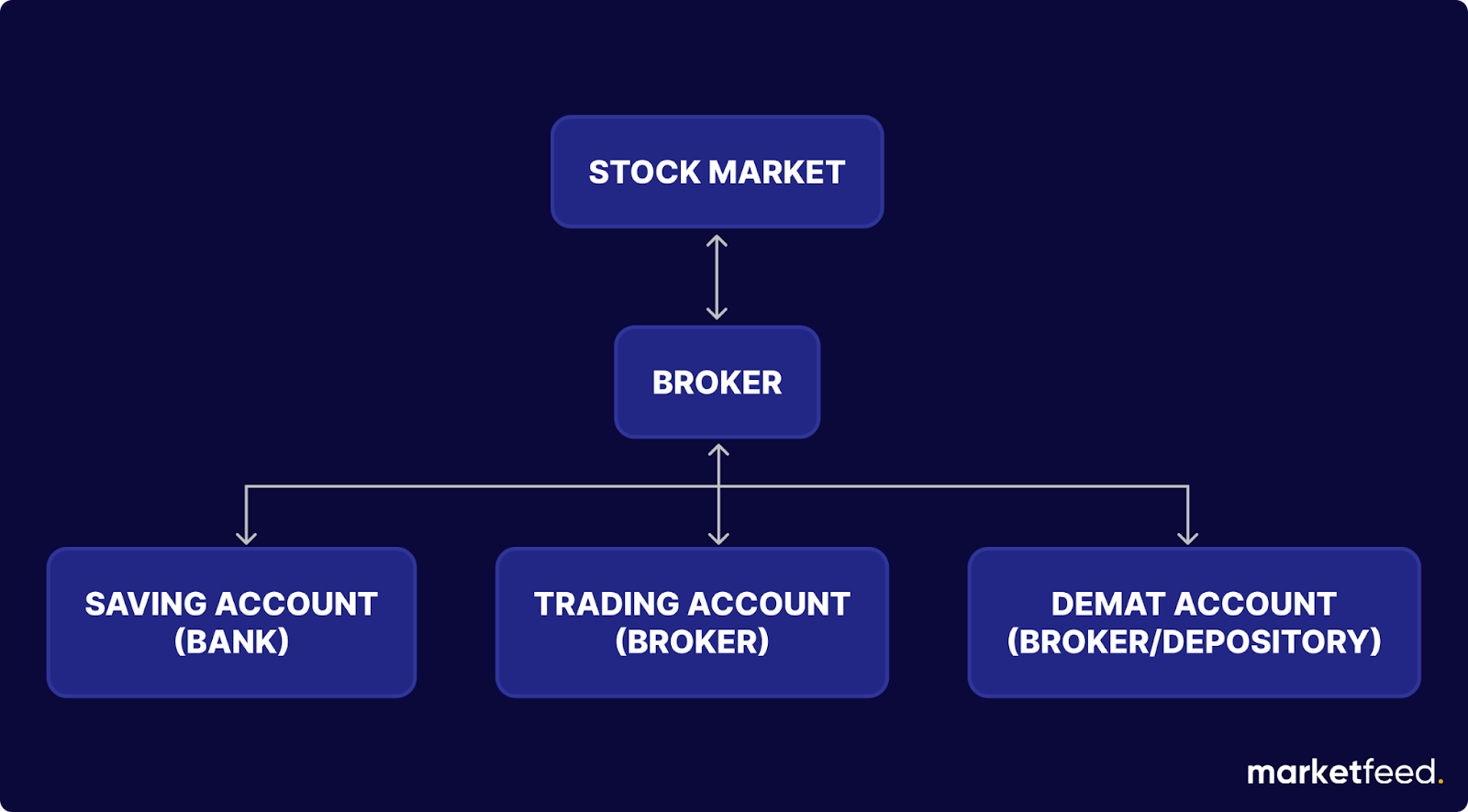
how does a stock market broker work? | marketfeed

There are two accounts that we open with a broker. Even though they are two separate accounts serving different purposes, both of them come in a bundle.

1. Demat Account
A Demat account or dematerialisation account allows you to hold your shares in an electronic format. It converts the physical shares into an electronic form, therefore dematerialising them. Demat accounts are maintained under depositories.

Earlier, the proof of ownership of shares, bonds, or debentures was in the form of physical share certificates. However, this system had many drawbacks, such as the risk of losing the certificate, fire hazards, getting wet, or even a mismatch in the signatures. 

2. Trading Account
A trading account acts as an interface between the investor’s bank savings account and a broker. For the broker to conduct trading activities on our behalf, they need money. We transfer the money we have in our savings account to a trading account with which the broker then conducts trading activities. Money can be transferred using net banking or UPI.

If we want to buy a stock, we instruct the broker to buy the stock, and the broker uses the money we have in our trading account to conduct the transaction. Similarly, when we sell a stock, the proceeds of the sale come directly into the trading account. 

An Illustration to Understand How Demat & Trading Account Works

  • Arun wants to buy a share of Mahindra & Mahindra (M&M) from the stock market. The first step that Arun should take is to open a Demat and trading account. Arun opens a Demat & trading account with a leading broker and deposits money into his trading account by transferring from his bank savings account via UPI. 
  • When the market opened at 9:15 AM, Arun placed an order with his broker to buy 1 quantity of M&M stock. The market price of M&M at the time was ₹1000. His trading account was debited ₹1000 by the broker to finance the transaction. Apart from this, a small amount was deducted as taxes and charges. 
  • Even though the transaction was completed, the stock will only be transferred into his Demat account after T+1 days, which means he will receive the stock in his Demat account on the next working day. 

While selecting brokers, we should choose the brokers that satisfy our various investing and trading needs. YOu can open a Demat and trading account using the links given below: 

Fyers (FREE) – https://bit.ly/3tx3ZJx

Zerodha – https://bit.ly/3AlErmb

Upstox – https://bit.ly/3OUAJnR

(Full disclosure: These are affiliate links. Do use the links if you wish to support us at no extra cost. ❤️)

Click here for step-by-step instructions on how to open a Demat and trading account.

What are Depositories?

If your shares are held by the broker, there is a risk of the broker running away with the shares they have. As a remedy, all Demat accounts are maintained by depositories. A depository is an institution that acts as a custodian of Demat accounts and shares. A Demat account is opened by a depository participant, who acts as an intermediary between the depository and investors. 

There are two depositories in India, which are governed by the Government of India: 

1. CDSL – Central Depository Services Limited
2. NSDL – National Securities Depository Limited

what are depositories | marketfeed

Who are the Other Facilitators?

The other facilitators part from brokers, depositories, and depository participants are: 

  • Clearing Houses – It is an intermediary between buyers and sellers of financial instruments. It is an agency or separate corporation of a futures exchange responsible for settling trading accounts, clearing trades, collecting and maintaining margin monies, regulating delivery, and reporting trading data.
  • Transfer Agents – A transfer agent keeps records of who owns a publicly traded company’s stocks and bonds. They also ensure investors receive dividends on time.
  • Settlement Banks – It refers to a customer’s bank where payments or transactions are finally settled and cleared for customer use.

What is a Market Regulator?

The Indian stock market is a place where transactions worth lakhs of crores of rupees take place. The Securities and Exchange Board of India (SEBI) is a regulatory authority established under the SEBI Act 1992. It’s the principal regulator for stock exchanges in India. SEBI’s primary functions include protecting investor interests and promoting and regulating the Indian securities markets. It is a government organisation. SEBI exists as the watchdog to make sure nothing wrong is happening in such a massive money-involved ecosystem.

Throughout the article, we discussed the various participants in the stock market and how they all work together in the stock market. We’ve also understood the basics of what the stock market is, who its participants are, and how it works!

Categories
Market News Top 10 News

RBI Stops Bank of Baroda From Adding Users to Mobile App – Top Indian Market Updates

Here are some of the major updates that could move the markets tomorrow:

RBI stops Bank of Baroda from adding customers to its mobile app

The Reserve Bank of India (RBI) has directed Bank of Baroda to stop adding customers to its mobile application, bob World. The ban is based on certain material supervisory concerns observed in the manner of onboarding of their customers onto this mobile application. In July, Al Jazeera reported that Bank of Baroda officials had linked bank accounts to unrelated mobile numbers to achieve stiff targets to get customers to join the app.

Read more here.

Tata Power partners with Bridgestone to install EV chargers

Bridgestone India has partnered with Tata Power to install electric vehicle (EV) chargers for four-wheelers at its dealerships across India. Tata Power will install 25/30 kilowatt-hour (Kwh) capacity DC fast chargers. The chargers are capable of charging a four-wheeler within one hour and will allow 20-24 vehicles to be charged in a day. It will be operational 24×7.

Read more here.

Adani Group’s $3.5 billion Ambuja loan moves ahead

A consortium of banks that had engaged in discussions to provide Adani Group with a $3.5 billion loan for refinancing the debt taken to acquire Ambuja Cements Ltd has now obtained internal approval for this loan. The banks will provide approximately $250 million each toward the syndicated loan. Barclays Plc, Deutsche Bank AG and Standard Chartered Plc are part of a larger consortium of banks.

Read more here.

India’s crude steel output grows to 70 MT in April-Sept

India’s crude steel production rose 14.7% YoY from 61.06 million tonnes (MT) to 69.65 MT during the April-September period of FY24. The increase in production was mainly due to improved capacity utilisation rates and the ramping up of capacities by key Indian steel players. The domestic consumption of finished steel also rose 14.77 YoY to 63.99 MT from 55.75 MT in FY24.

Read more here.

Godrej Properties to sell 14 acres of land in Gurugram

Godrej Properties is in advanced talks with Hero Realty to sell a 14-acre land parcel in Gurugram for around ₹730 crore. The real estate developer bought the land in Sector 89 around two years ago from a local land-aggregating company. The deal is said to be at an advanced stage and both parties have agreed on the transaction.

Read more here.

NSDL to acquire office space in BKC from IDFC Bank

National Securities Depository Ltd (NSDL) has acquired a 68,000 sqft office space from IDFC First Bank in Mumbai’s Bandra-Kurla Complex (BKC) for approx. ₹198 crore. The property will serve as NSDL’s new headquarters and is expected to be ready by January-February 2024. The decision is part of the consolidation of the bank’s operations near its corporate office at IDFC FIRST Bank Tower in Mumbai.

Read more here.

SpiceJet and Celestial Aviation in advanced stages of settlement

SpiceJet Ltd and aircraft lessor Celestial Aviation Services Ltd are in advanced stages of settlement over a default of $29.9 million for nine aircraft. The National Company Law Tribunal (NCLT) has deferred the matter to November 7. SpiceJet is facing insolvency proceedings from two other aircraft lessors and an engine lessor. The airline has argued against the maintainability of these petitions.

Read more here.

L&T Construction secures significant order from Rajasthan govt

Larsen and Toubro Ltd’s (L&T) construction arm has secured an order (worth ~₹1000-2500 crore) from the Rajasthan Government’s public health and engineering department. The engineering, procurement and construction order is to build a water supply project in the Chittorgarh district of Rajasthan for 648 villages from the Chambal River. This order marks L&T’s fourth order in this month so far.

Read more here.

Sterlite Technologies’s subsidiary launches generative AI platform

Sterlite Technologies’ subsidiary, STL Digital, has launched a generative AI platform, Alnnov. The generative AI services, frameworks, methodologies and solutions are designed for enterprises to accelerate Generative AI-led innovation and adoption. The platform will accelerate the generative AI-led adoption as well as innovation for modern enterprises.

Read more here.

Mazagon Dock signs Letter of Intent for 10 multi-purpose hybrid power vessels

Mazagon Dock Shipbuilders Ltd (MDL) has signed a Letter of Intent (LoI) with a European client. The LoI is to construct six firm units and four optional units of 7,500 DWT multi-purpose hybrid power vessels. The prices of these vessels will be finalised at the time of signing the official contract.

Read more here.

Dr Reddy’s subsidiary faces antitrust lawsuit in US over Revlimid patents

Dr Reddy’s Laboratories Ltd’s wholly-owned subsidiary, Dr Reddy’s Laboratories Inc., has been named as a defendant in a recently filed lawsuit in the US. The complaint, filed by Mayo Clinic and Lifepoint Corporate Services, asserts claims under federal & state antitrust laws and other state laws alleging that the defendants improperly restrained competition and maintained a shared monopoly in the sale of brand and generic Revlimid through their respective settlements of patent litigation.

Read more here.

Puravankara’s sale bookings rises 102% YoY in Q2

Puravankara Ltd’s sale bookings rose 102% YoY to ₹1,600 crore in Q2 FY24 from ₹791 crore in Q1. The company’s sale bookings in value terms rose 89% YoY to 2.01 million square feet in Q2. It stood at 1.07 million in Q2 FY23. Average sales realisation also increased 7% to ₹7,947 per sq ft from ₹7,396 per sq ft last year.


Read more here.

Categories
Market News Top 10 News

Demat Accounts in India Cross 10 Crore Mark – Top Indian Market Updates

Here are some of the major updates that could move the markets tomorrow:

Demat accounts cross 10 crore mark in August

The total number of Demat accounts in India crossed the 10 crore mark in August 2022. In August alone, over 7 crore active Demat accounts were registered. CDSL operated 7.16 crore Demat accounts with total assets under custody (AUC) of ₹38.5 lakh crore as of August, while NSDL had 2.89 crore accounts with AUC of ₹320 lakh crore. The culture of equity investing is slowly and steadily picking up in India, especially in Tier-2 and Tier-3 cities.

Read more here.

Blue Star secures two orders worth ₹390 crore from BMRCL

Blue Star Ltd has secured two orders from Bangalore Metro Rail Corporation Ltd (BMRCL) for the upcoming Pink Line of Bangalore Metro Rail Project Phase-II. The first order, worth ₹203 crore, is a turnkey project including maintenance works for Tunnel Ventilation System (TVS) and Environmental Control System (ECS) for six underground stations and associated tunnel sections.

The second order, worth ₹187 crore, is a turnkey project for Electrical & Mechanical (E&M) works for five underground stations and five elevated stations.

Read more here.

Suzlon secures 180.6 MW wind energy project from Sembcorp’s arm

Suzlon Energy Ltd has secured an order to set up a 180.6 megawatts (MW) wind energy project from Singapore-based Sembcorp’s arm Green Infra Wind Energy Ltd. The company will install 86 Wind Turbine Generators (WTGs) with a Hybrid Lattice Tubular (HLT) tower and a rated capacity of 2.1 MW each. The project is located at Bagalkot, Karnataka, and is expected to be commissioned in 2024.

Read more here.

Saregama launches feature phone with pre-loaded Hindi songs

Saregama India Ltd has launched Carvaan Mobile, a keypad feature phone with 1500 preloaded Hindi songs and two screen sizes, priced at ₹2490 and ₹1990, respectively. This is the first feature phone from the music brand. The mobile is available across retail markets and e-commerce platforms such as Amazon, Flipkart, and saregama.com. Saregama also sells Carvaan, a digital audio player with preloaded songs.

Read more here.

Kalpataru Power wins orders worth ₹1,345 crore

Kalpataru Power Transmission Ltd (KPTL) and its international units have secured orders worth ₹1,345 crore. The company has won orders in India and overseas markets in the transmission and distribution (T&D) business. It has also received orders for pipeline laying and metro rail electrification works in India.

Read more here.

Quiklyz to expand presence in the electric mobility leasing space

Quiklyz has announced its expansion plans in the electric mobility leasing space. The company will now offer customized leasing and subscription solutions for electric three-wheelers (3W) and four-wheelers (4W) to its partners. It has financed over 1000 electric vehicles over the past 12 months, including passenger vehicles and 3Ws. Quiklyz is the new-age vehicle leasing and subscription business of Mahindra & Mahindra Financial Services Ltd.

Read more here.

Paytm reports 72% YoY growth in merchant payment volume

Digital payments platform Paytm reported a 72% YoY growth in gross merchandise value (GMV) to ₹2.10 lakh crore for the two months ended August 2022. [GMV is the value of total payments made to merchants through app transactions or payment solutions.] The company distributed 6 million loans during the same period. The average monthly transacting users (MTU) grew 40% YoY to 7.88 crore during July-August 2022. 

Read more here.

Blue Jet Health files papers for ₹1,800-crore IPO

Specialty pharmaceutical and healthcare ingredient company Blue Jet Healthcare filed its Draft Red Herring Prospectus (DRHP) with market regulator SEBI for an initial public offer (IPO). The public issue is entirely an offer-for-sale (OFS) of up to 21.7 million shares by the promoters and other shareholders, aggregating to ₹1,800 crore.

Meanwhile, SEBI has given approval to Concord Enviro Systems (an environmental engineering solutions firm) to raise funds via an IPO.

Read more here.

Canara Bank hikes benchmark lending rate by up to 0.15%

Canara Bank has raised its benchmark Marginal Cost of Funds Based Landing Rate (MCLR) by up to 0.15%, a move that will make loans costlier. The one-year MCLR will be 7.75% from Wednesday onwards, compared to the existing rate of 7.65%. This rate is used to fix most consumer loans such as auto, personal, and home loans. [MCLR is the lowest interest rate that a bank can offer.] 

Read more here.

RIL to acquire 79.4% stake in SenseHawk for $32 million

Reliance Industries Ltd (RIL) has entered into definitive agreements with US-based SenseHawk Inc. to acquire a 79.4% stake in the company for $32 million (~₹255.5 crore). SenseHawk is an early-stage developer of software-based management tools for the solar energy generation industry. It helps accelerate solar projects from planning to production by helping companies streamline processes and use automation.

Read more here.

Categories
Market News Top 10 News

DHFL Promoters Booked in Rs 34,615 crore Bank Fraud Case – Top Indian Market Updates

Here are some of the major updates that could move the markets tomorrow:

DHFL promoters booked in Rs 34,615 crore bank fraud case

The Central Bureau of Investigation (CBI) has registered a fresh case against DHFL promoters Kapil and Dheeraj Wadhawan for defrauding a consortium of banks led by Union Bank of India for Rs 34,615 crore. It is the biggest bank fraud case registered by CBI. The agency is carrying out searches at 12 locations in Mumbai at the premises of the accused.

Read more here.

Delhivery to expand infra in Mumbai, Bengaluru

Delhivery Ltd has announced plans to expand its infrastructure in Bhiwandi (Greater Mumbai) and Bengaluru to enhance its processing capacity to cater to demand from the southern and western regions of India. The company will collaborate with Welspun on a 7 lakh sq. ft. mega-gateway facility in Mumbai. It is also partnering with GMR Group for an over 1-million sq. ft. facility in Bengaluru.

Read more here.

NSDL looking to raise Rs 4,500 crore via IPO

National Securities Depository Ltd (NSDL) is eyeing to raise Rs 4,500 crore through an initial public offering (IPO). It is India’s first and biggest depository services company. As of May 31, 2022, NSDL managed more than 2.76 crore investor accounts with a Demat custody value of Rs 297.55 lakh crore. The company has more than 89% market share in terms of Demat asset value. 

To learn more about depositories, click here.

Read more here.

Kalpataru Power secures orders worth Rs 2,290 crore

Kalpataru Power Transmission Ltd and its subsidiaries have secured new orders worth Rs 2,290 crore. These include orders from international markets in the power transmission business of Rs 1,416 crore. The company has also won orders for the construction of an elevated viaduct and five elevated stations of the Kanpur Metro Rail Project, civil works for a data centre, and buildings & factories projects across India totaling Rs 874 crore.

Read more here.

GAIL to venture into gas liquefaction retail sales

GAIL (India) Ltd plans to liquefy natural gas for easy transportation and sale in areas that are not connected with pipeline grids. It has placed orders for two small-scale liquefaction skids capable of producing LNG on a pilot basis. These plants will help in the distribution of natural gas through liquefaction in new city gas distribution areas and liquefaction of gas at isolated fields. It will also support the establishment of LNG fueling stations.

Read more here.

Macrotech Developers to provide warehousing space to Skechers near Mumbai

Realty firm Macrotech Developers Ltd will provide 1.1 million square feet of warehousing space to Skechers at Palava near Mumbai. Skechers is a global athletic footwear and apparel brand. The first phase of Skechers’ national distribution centre (NDC) will be delivered in mid-2023. It will be the second-largest NDC for Skechers in Asia and is likely to be one of the tallest warehouse structures in India.

Read more here.

Vodafone Idea to raise Rs 436 crore from Vodafone Group

Vodafone Idea Ltd’s board has approved a proposal to raise Rs 436.21 crore through the preferential issue of equity shares or warrants to its UK-based parent firm, Vodafone Group. In case the funds are raised via allotment of equity shares, the issue price will be Rs 10.20 per share. In the case of warrants, the issue price will be Rs 10.20, and 100% of the issue price will be paid upfront at the time of subscription of warrants.

Read more here.

Jio-bp to power EV charging stations at Nexus malls across 13 cities

Nexus Malls has partnered with Jio-bp for the rollout of EV charging stations and battery swapping stations across 17 malls in 13 cities. Jio-bp is a fuel and mobility joint venture between Reliance Industries Ltd and UK-based bp. As part of this partnership, Jio-bp will install 24×7 charging infrastructure for two and four-wheeler EVs at Nexus malls.

Read more here.

Carlyle acquires 24% stake in Bharti Airtel’s Nxtra for Rs 1,788 crore

CA Cloud Investments, an affiliate of US-based Carlyle Group, has completed the acquisition of a 24.04% stake in Bharti Airtel’s subsidiary Nxtra Data. The Indian teleco will continue to hold the remaining stake in the data centre company. Nxtra Data provides data centre colocation services through its 10 data centres across India.

Read more here.

Categories
Jargons

What are Depositories?

Have you ever wondered where the the shares you own/bought are stored? Just like a bank holds your funds, an institution called a depository keeps shares and other securities safe. In this article, we will understand what a depository is, its different types, functions, and its role in the financial markets. Additionally, we will understand a few concepts and topics related to depositories.

What are Depositories?

Depositories are institutions that hold your shares and other securities in an electronic or dematerialised (Demat) form. Brokers are privately owned companies, and entrusting them with your equity shares and other assets is risky. There exists a possibility of brokers engaging in unethical activities using your securities. Depositories exist to prevent such a risk.

A depository acts as a custodian of Demat accounts and shares. Depository participants open Demat accounts, serving as intermediaries between investors and the depository. One can store shares, exchange traded funds (ETFs,) bonds, debentures, certificates of deposits, Government Securities (GSecs), and much more in a depository.

What is Dematerialisation?

Dematerialisation is the process of converting physical paper securities (such as share certificates, bonds, and other financial instruments) into electronic or digital form. In other words, it involves the transformation of tangible paper-based assets into electronic records.

Depositories in India

In India, there are two depositories:

1. National Securities Depositories Ltd (NSDL)

NSDL is the oldest and largest depository in India. It came into existence through the Depositories Act of 1996 and commenced operations in 1996. It was the first depository to provide trading services in electronic format. According to the Securities & Exchange Board of India (SEBI), NSDL has around 2.4 crore active investors, with more than 36,123 depository participant service centres across 2,000 cities. 

2. Central Depository Services Ltd (CDSL)

Established in 1999 in Mumbai, CDSL is the second-largest depository in our country after NSDL. It provides services like holding financial securities in the electronic format and facilitating trade and settlement of orders. This depository holds all types of stocks and securities. According to SEBI, CDSL has more than 5.2 crore active customer accounts with around 21,434 depository participant service centres.

In India, every broker must register with at least one of the two depositories. Brokers like Zerodha and Upstox are registered with CDSL, while Sharekhan and Kotak Securities are registered with both NSDL and CDSL. Each broker has a unique ‘DP number’ from the depository they are registered with. Some brokers are DPs at both NSDL and CDSL.

Functions of Depositories

1. Custodian

Depositories act as a custodian for your securities. It securely holds and safeguards securities, including stocks, bonds, mutual funds, and other financial instruments, on behalf of investors. This eliminates the need for physical possession of paper certificates and reduces the risk of loss, theft, or damage.

2. Dematerialisation

Dematerialisation is the process of converting financial securities in physical form into electronic format or demat form. Depositories perform dematerialisation. This conversion simplifies the process of transferring ownership and eliminates the need for physical delivery.

3. Immobilisation

Depositories immobilize physical securities, making them no longer transferable through physical means. Instead, ownership is electronically transferred, improving both security and efficiency.

4. Book-Entry System

Depositories maintain electronic records of securities ownership. They act as intermediaries in the transfer of securities between buyers and sellers. Depositories update their records to reflect changes in ownership after each transaction. This enables the seamless transfer of ownership between buyers and sellers. This book-entry system eliminates the need for physical record-keeping and reduces paperwork.

5. Settlement Services

Depositories facilitate the settlement of securities transactions by ensuring that securities are transferred from sellers to buyers and that payment is made to the sellers. This reduces settlement risks and delays.

6. Ownership Transfer Facilitation

Depositories have facilities for transferring securities from one account to another. This is especially important in the case of unlisted securities. Since unlisted securities are not publicly traded, they cannot be sold in the open market like public securities.

CDSL provides Easi/Easiest Portal to transfer securities manually.

7. Corporate action processing

Depositories process corporate actions such as dividends, stock splits, mergers, and rights issues. They ensure that shareholders receive the benefits or instructions associated with these actions.

8. Facilitation of Trading

Depositories make it easier for investors to buy and sell securities. When investors trade on stock exchanges or in over-the-counter (OTC) markets, depositories handle the transfer of ownership behind the scenes, ensuring a smooth transaction process.

9. Reduction in Settlement Risks

By providing a centralised system for settlement and record-keeping, depositories reduce the risk of settlement failures, errors, and discrepancies.

10. Proxy Voting

Some depositories offer proxy voting services. Proxy voting refers to the vote cast by one person or firm on behalf of another.

What is a Book Entry System?

Book entry is a method of electronically tracking ownership of securities, eliminating the need for physical certificates to be issued to investors. This allows investors to trade or transfer securities without having to present a paper certificate as proof of ownership. When an investor purchases a security, they receive a receipt and the information is stored electronically.

Depository vs Clearinghouse

A Depository is a facility that holds and maintains records of securities in demat form. A Clearing House is responsible for validating, clearing, and settling trades executed on a stock exchange or other trading platform.

Who are Depository Participants (DPs)?

Although Depositories are the custodian of securities, investors cannot directly interact with them. It can only be done through a depository participant (DP). The DP acts as an intermediary between the depository and investors. It’s a depository participant who opens a Demat account with a depository.

In India, most of the brokers themselves are the Depository Participants

What are Depository Receipts (DRs)?

A Depository Receipt (DR) represents ownership in a foreign company. It’s a security that trades like an ordinary share on a local exchange. This means that publicly listed shares of a foreign company can be traded on an exchange outside its home market. To create a depository receipt, the equity shares of the foreign company are deposited in a bank (which serves as the depository) in the country where the shares will be traded. Subsequently, the depository issues receipts that represent the deposited shares.

Global Depository Receipts (GDRs)

Companies issue global depository receipts (GDRs) outside their home country and beyond the United States. The depository bank that issues GDRs is generally located (or has branches) in the countries on whose exchanges the shares are traded. A key advantage of GDRs is their exemption from foreign ownership and capital flow restrictions that the issuing company’s home country might impose since they are sold beyond its borders.

American Depository Receipts (ADRs)

An American depository receipt (ADR) is a US dollar-denominated security that trades like a common share on US exchanges. They enable foreign companies to raise capital from US investors. Note: An ADR is one form of a GDR. However, not all GDRs are ADRs because GDRs cannot be publicly traded in the United States. 

Role of Depositories in Capital Markets

Depositories play a crucial role in capital markets and investment infrastructure. They provide essential services that facilitate the efficient and secure functioning of the financial markets. Their role includes various aspects of the financial system, including securities trading, settlement, and investor protection. Depositories streamline the process of holding and trading securities, enhance transparency, reduce risks, and provide valuable services to investors, issuers, and other market participants. Their role is essential in promoting market integrity and investor confidence.

Categories
Editorial

Rally May Not be Done Yet: CDSL Stock Analysis

CDSL or Central Depository Services Ltd is one of the two central depository services in India. You may have received several emails from them as you opened your Trading & Demat accounts. It was established in 1999 with the Bombay Stock Exchange (BSE) as its promoter. The depository became the first to hit 3 crore active users in India. 

The company has given a staggering ~272% return on investment over the past year. Before this, the share price was moving pretty much in a consolidated manner. There is definitely something that has triggered retail investors across the market since such returns were not seen in the past even when CDSL had healthy financials. 

From an investor’s perspective, CDSL is a ‘unique’ company. The company has a sustainable business model and stable financial growth over the years. In this piece, we discuss CDSL’s business model, financial stability, and growth prospects for the future.  

CDSL’s Business Model

The profits and stock returns of CDSL have increased after the COVID-19 lockdown was imposed last year in March 2020. India has managed to add the highest-ever number of 49 lakh Demat accounts in FY 2020. The company has 589 registered Depository Participants(DPs) across India and 290 lakh investors across the country.

Speaking of Demat accounts, CDSL earns close to 60% of its revenue directly or indirectly from Demat accounts. If you look closely at the revenue breakup, CDSL earns most of its revenue from Transaction Charges and Annual Issuer Charges. 

Transaction Charges

Every time a transaction takes place CDSL levies charges on it. A transaction can be buying, selling, or transfer of securities. The number of transactions has increased considerably over the past year and so has the income from the ‘Transaction Charges’ segment. 

Annual Issuer Charges

Coming to the Annual Issuer Charges segment. This is the cash cow of CDSL. According to SEBI regulations all listed companies need to establish a connection with both NSDL and CDSL. Listed companies pay ‘Annual Issuer Charges’ to both NSDL and CDSL. The ‘Issuer’ over here is the company whose shares would be traded. SEBI regulates ‘Annual Issuer Charges’ and renews them every five years. This is a fee that the depository charges to listed companies for being a custodian of their shares. Remember that even though shares are ‘traded’ on stock exchanges, they are ‘stored’ in depositories, which requires complex data warehouses that need maintenance. 

Largest KYC Registry

The Online Data Charges segment refers to KYC services offered by the company. ‘KYC’ or Know Your Customer is a very familiar term today. Opening a bank or Demat account or even investing in a mutual fund requires a KYC. It is a security verification process used by banks and companies to avoid financial fraud and money laundering activities. CDSL is the LARGEST KRA(KYC Registration Agency) in India holding 60% of the market share in the KYC of the capital market.

Other Income

The company offers services involving the transfer of securities during an IPO. It provides other services like hosting e-Annual General Meetings(e-AGMs) and e-voting for a nominal charge. The company also charges Electronic Consolidated Account Statements(e-CAS) that investors and traders receive every month. It also offers services for storing insurance claims and the commodities market receipts for commodities trading offered on platforms like Multi Commodity Exchange of India (MCX).  

Subsidiaries

In all, the company owns three subsidiaries:

CDSL Ventures Limited (CVL)

CDSL Ventures Limited (CVL) manages the KYC (Know Your Customer) business. The company is also a vendor for GST Suvidha centres. CVL held over 216 investor records, as of March 31, 2021. The company also maintains a claim registry for life insurance companies that offer Pradhan Mantri Jeevan Jyoti Bima Yojana (PMJJBY).

CDSL Insurance Repository Limited (CIRL)

CIRL is regulated by the Insurance Regulatory and Development Authority of India (IRDAI) and is in the business of enabling policyholders to hold life policies, motor policies, health policies, and all other types of general (non-life) policies

CDSL Commodity Repository Limited (CCRL)

Just like share trading involves storing ‘share certificates’ in an electronic form. The commodities markets involve storing electronic warehouse receipts(e-NWR) for goods bought or sold.  CCRL is regulated by the Warehousing Development and Regulatory Authority (WDRA) and is in the business of holding and transacting in electronic negotiable warehouse receipts (e-NWR).

Supportive Financials

  • The company’s revenue and net profit have grown consistently since September 2018 as shown in the chart above. The company has grown at a CAGR of close to ~16% over the past 3 years. In the most recent quarterly results for Q4FY21, the company’s revenue grew by ~51% YoY. The Net Profit grew by ~89% YoY.
  • CDSL has an Asset-Light Model. The company does not have to invest in heavy machinery, land, or other fixed assets. This meant that the company does not have many fixed costs associated. 
  • CDSL’s main costs are Employee Wages and Benefits, Computer Technology Related Expenses which are largely fixed in nature. Any increase in revenue will naturally reflect on net profits. 
  • The company operates on zero debt.
  • The share price of the company has increased by ~272% over the past year and ~240% over three years. This could mean your investment in the stock would have multiplied more than 3.5x had you invested in the stock. 
CDSL Price and Volume Chart(Source: TradingView)
  • The company’s charts suggest that the stock picked up most of its activity in 2020. Trading volumes were relatively insignificant before that. The stock price is supported by strong volumes. FII or Foreign Institutional Investor’s shareholding in the company has increased by a staggering 7% in FY 2020-21.  

Conclusion

Let me tell you about the risks associated with CDSL. CDSL’s profit numbers are cyclical, just like the stock market. The more people invest, the more money it makes. Any reduction in trading or delivery volumes could impact profits. For the long term, the company needs to tackle regulation by SEBI, at the same time improving its technology. The company’s expenditure on employees’ salaries has increased over the years. 

The rally that CDSL saw in FY2020-21 filled many pockets. At this point, there are two possibilities, there could be profit booking which could mean that the share prices would eventually fall. The second possibility could be that the stock breaks the glass ceiling and the price would increase further. The only thing that is crystal clear is the monopoly that CDSL has in their domain, and this is likely to push long-term growth.

One can only speculate for the short term. What do you think about the stock? You may let us know in the comments section below!