Categories
Editorial

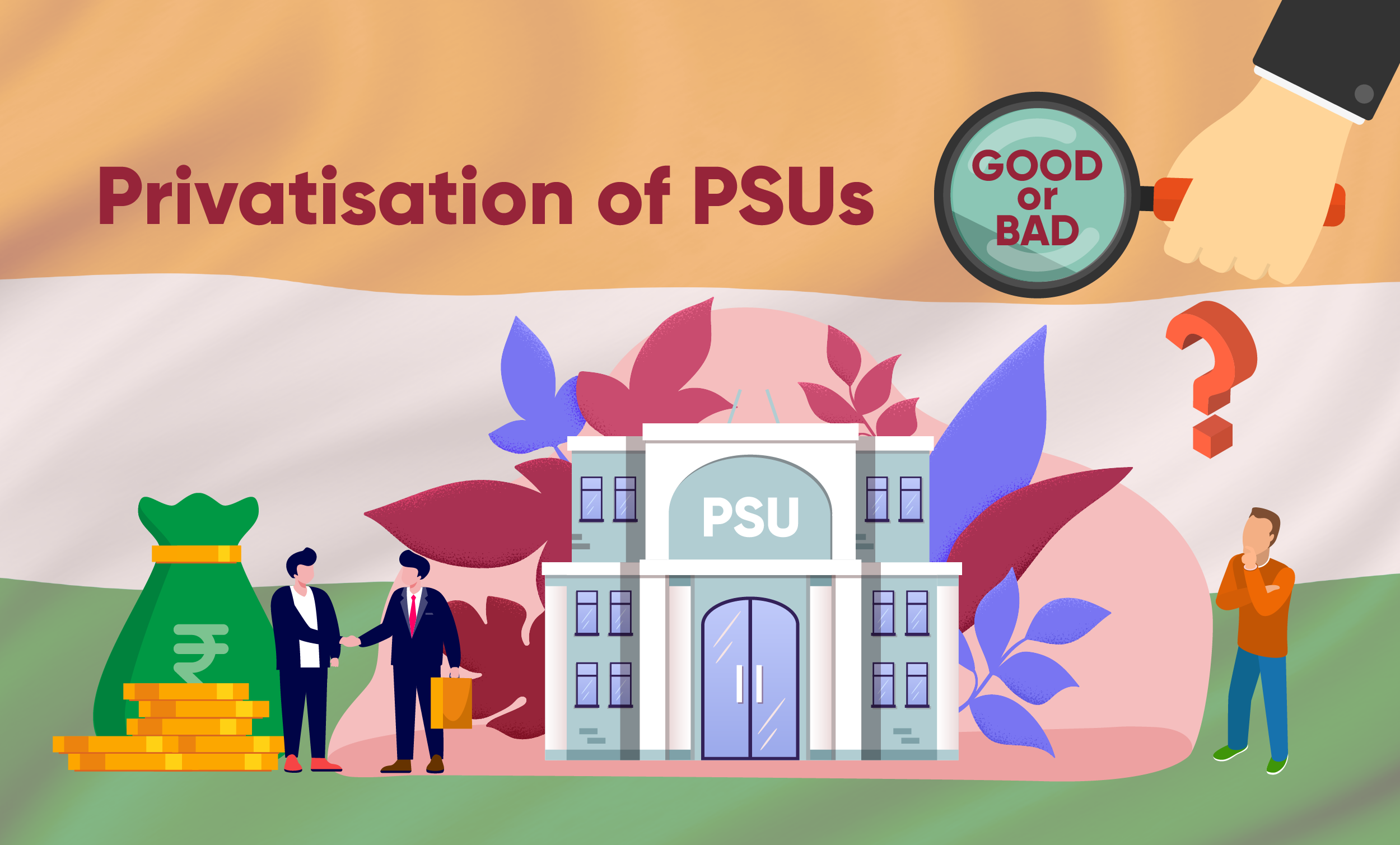
Is Privatisation of PSUs Worth It?

Privatisation in India began with some major policy changes in 1991 by the P. V. Narasimha Rao-led government and its LPG(Liberalization, Privatisation, and Globalisation) policy. India witnessed a trajectory in growth after that. Fast forward to 2020, there is a need for further privatisation in certain sectors. In a webinar organized by DIPAM or the Department of Investment and Public Asset Management (DIPAM), Prime Minister Narendra Modi pitched saying “Government has no business to be in business, and businesses have no business to be in the Government.” He went on batting for the privatisation of strategically important public sector companies.

Essentially the government will be selling stakes or divesting from certain companies it feels are inefficiently managed or an added burden to the central government ledger. Privatisation as of now is in its infancy. There were reports that a total of 300 PSUs could shrink to around two-dozen after privatisation and divestment. Why does the centre feel that privatisation is necessary? What can be the consequences of privatisation? Let’s get right into it. 

Why Are PSUs Privatised?

Governments might privatise certain companies to:

  • To generate revenue. 
  • Desire a higher level of service.
  • Get necessary expertise which otherwise might not be available.
  • Allow flexibility in the functioning of the company.
  • Increase competition in a certain sector and invite other private players into it.
  • Reduce debt burden in distressed companies like the national carrier Air India.

In the private sector, employees have incentives to perform better and therefore have their skin in the game. Otherwise, the government employees get a fixed salary irrespective of performance. Due to administrative inefficiencies, public enterprises might not be able to import the necessary technology needed for their functioning. Private players on the other hand will have a lobby to ensure that the right technology is availed. They will also ensure that political interference does not impact business performance. 

Private companies also have the interests of multiple individuals at stake. This interest or stake in the company ensures that any mishappening in the company is corrected. In the public sector, this lack of interest fails to mitigate any mismanagement. In the past, it was seen that public sector banks like SBI or PNB were more exposed to financial fraud and high levels of NPAs. On the other hand, private sector banks have high expertise in credit-management, risk-management, and a more efficient loan recovery system.

DIPAM, and How Privatisation Works

The Department of Disinvestment was renamed as the Department of Investment and Public Asset Management (DIPAM) on 14th April 2016. It is a department under the Ministry of Finance. 

Department of Investment and Public Asset Management (DIPAM) deals with all matters relating to the management of Central Government investments in equity including disinvestment of equity in Central Public Sector Undertakings. DIPAM works in these four areas: 

  • Strategic Disinvestment 
  • Minority Stake Sales 
  • Asset Monetisation
  • Capital Restructuring. 

It also deals with all matters relating to the sale of Central Government equity through an offer for sale or private placement or any other model in the erstwhile Central Public Sector Undertakings. DIPAM and NITI AAYOG together will decide a number of companies to be privatised.

The Impact

PM Modi in his speech said that the government holds underutilized assets worth Rs 2.5 crores. Privatisation might help use these assets efficiently. The Modi government has been emphasizing the privatisation of government entities ever since it came to power for the first time in 2014. 

MALCO, Modern Foods, Hindustan Zinc, Bharat Aluminium, Maruti, Jessop and Co, CMC Ltd are some of the popular companies that were owned by the Government of India and were later privatised. 

Hindustan Zinc was one such company whose majority stake was sold to Vedanta Limited. The company went on in becoming the world’s second-largest Zinc-mining company and one of the top 10 silver producers of silver.

For some period of time, Maruti Suzuki was a government-owned company. It faced a lot of political conflicts, violent workers union protest, political intervention, quality issues, production issues, and much more. Eventually, the company ended up getting privatised and Suzuki later became the majority stakeholder in the company. 

Bharat Aluminium Company is also another such privatised company. Before privatisation, only 50% of the revenue came from profits, the rest came from interest earned over fixed deposits. It was a wholly government-owned company till 2001 when it was sold to Vedanta. What followed was huge protests between supporters and opposers of privatisation. Yet, the company’s revenue rose from Rs 898 crore in FY2001 to Rs 90,000 crores in FY2018. The company made alloys for “Intermediate-Range Ballistic Missile” – Agni and “Surface Missile” – Prithvi.

Future of Privatisation

It’s clear, only a few companies have been privatised so far, but most of them have shown good results. However, the financial and structural condition of some of the state-owned companies like Air India is so bad that private companies refuse to bid for them. The government has been showing quite an inclination towards privatisation. In a historic move, coal mines are going to be privatised, which will transform India’s trajectory in a HUGE way. 

The current Policy For Strategic Divestment states that all sectors in the public domain will be privatised except for 4 strategic sectors. These include Railways, Department of Posts, Airports Authority of India and some major port trusts. Privatisation will definitely have its own devilish impacts. It will give control of public companies in the hands of private players who would forward their own personal interests rather than that of the public.

 There will be lots of restructuring that these public sector companies would require in order to function efficiently, there will be layoffs, wages will be incentivized, benefits will be cut. All in all, theoretically it will be for a greater public good. Let us see if the country can make this theory practical.

Categories
Editorial Editorial of the Day

How Kotak Bank made a Profit Jump of 26.3% for Q2 FY21 Result

Private sector lender Kotak Mahindra Bank Ltd, on Tuesday (26th October), came out with their results which defeated all the street estimates. They declared a 26.3% year-on-year (YoY) rise in standalone net profit for the September quarter 2021. Their Net Interest Income (NII) also gained 17% YoY for this quarter.

These are spectacular numbers. The previous week, HDFC Bank came out with 18% year-on-year (YoY) rise in net profits which gave birth to a lot of positive sentiments in the market. But, Kotak has left the number one bank behind and reported even better performance this quarter. Let’s have a closer look at their quarterly performance.

Robust Revenue Generation

NII is the difference between the interest income a bank earns from its lending activities and the interest it pays to depositors. Higher the spread between the two interest rates, more profitable it is for the banks.

In the same quarter previous year, Kotak declared a net interest income of Rs 3,350 crore. This quarter, it increased by 17% to Rs 3,913 crore. This 17% increase is constant for the bank since the previous three quarters. NII for the bank has increased by 18%, 17% and 17% in the previous three quarters. This shows that even amidst the pandemic, the bank has done really well to maintain its revenue growth.

Digitally Advanced

We have discussed several times how being digital is pivotal for any company in any industry, let alone the banks. Kotak has put consistent efforts to digitally transform itself. They have stressed on a paperless transaction for Home Loans and Loans Against Property (LAP) for some time now. And now this has given the bank good business, as paperless transactions became a necessity during the times of Covid-19.

Other than this, tractor, retail commercial vehicle/infrastructure loans were also available on Kotak Mobile App. As we know, tractor sales have been booming over the last few months. They have one of the most user-friendly mobile applications in the industry. Transaction volume and value of mobile banking went 81% and 56% above annually during the quarter. Also, Kotak became the 1st Bank in the country to launch Video KYC for Account Opening.

85% of the total Fixed Deposits were booked through Digital channels in Q2. 86% of all Credit Cards and 30% of the total personal loans were again carried with the help of digital channels in this quarter. All of this cumulated to 73% (YoY) growth in Digital Payments volumes.

So this digital push by Kotak Bank helped them maintain good business when most customers were staying at home.

A glance at their Asset Quality

Kotak Bank’s gross non-performing asset ratio (GNPA) fell to 2.55% this quarter. This ratio was reported as 2.7% in the preceding quarter. Also, their Net NPA ratio fell to 0.64% from 0.84% during the same period.

Due to the interim order of the Supreme Court, they didn’t recognise any NPAs since August 31, 2020. This could have given a false image of non-performing assets. But the bank was quick to discard this concern. Even if they had not considered the Supreme Court’s decision, the gross NPA would have been 2.70% and NNPA 0.74%. This is only a marginal increase from the reported values. Thus, one can conclude that Kotak has a very stable asset quality.

Market Reaction

The market sentiments were negative on the day Kotak Bank was due to announce the results. Nifty 50 and Bank Nifty closed 1.36% and 1.65% down. Yet, Kotak Bank emerged as one of the top gainers to close at Rs 1410.90, up by 2.01%. The day after the results were announced, the share price of Kotak Bank rocketed up even in the presence of the bearish global sentiments. It closed 11.70% higher at Rs 1582.70 to become the top gainer of the day. There were also reports that America’s Morgan Stanley was going to pump in funds to the stock, as covered here.

The Way Forward

The banking sector has been in the news ever since the lockdown. The 6-month moratorium on repayment of loans ended on 31st August. On 3rd October, the government of India announced that interest-on-interest for loans up to Rs 2 crore will be waived off for the borrowers. At the same time, to prevent banks from facing huge losses, the amount waived off will be paid to the banks by the government. This news was welcomed by the market as there is huge pressure on banks to maintain their asset quality. To read more on the interest waiver scheme, click here

The Q2 results of the banks have been great so far! Especially big banks like HDFC Bank and Kotak Mahindra Bank which operate all over India. Will this trend continue? Will all the banks come out with positive results? Where are the high NPA rates predicted by The Reserve Bank? Will Public-Sector Banks be the worst affected? Let’s wait and watch.

The upcoming quarter will be very important for the banks. This will be the quarter in which the government will implement its strategies to aid banks. The moratorium was lifted less than 30 days before the September quarter-end. The loans being defaulted and turning into sub-standard assets will be only seen in the October-December financial results. Thus, a more clear picture of NPAs will be seen in the third quarterly reports of banks and NBFCs. Keep tracking all the updates with marketfeed to follow more of this story.

Categories
Editorial

The Government Interest Waiver – All You Need to Know

In normal circumstances, when an individual or a business takes a loan from a bank, they would have to repay the loan amount with interest. More importantly, there would be a specific time period by which they have to make the required payments. What happens to these entities when they fail to repay the banks or other financial institutions? Their credit scores go down, thus, making it difficult for such entities to get essential loans in the future. Or, the property which was used as collateral for the loan would be taken over by the bank and sold off. These are important facts that we already know.

So let us look at the problems faced by different entities in these challenging times of Covid-19. Then we will jump into what this interest waiver means, and how it will affect different parties including consumers like us by understanding what every guideline means.

Problems faced by Businesses:

We need to establish the fact that there is nothing ‘normal’ about this year. The Covid-19 pandemic has definitely caused a huge impact on individuals and businesses all around the world. Small or large businesses would have taken loans to improve production. In order to scale up, the loan amount could have also been used to increase investments in infrastructure. With the lockdown being imposed in late March in India, most businesses had very few customers. Supply chain (network between a firm and its suppliers) disruptions due to the closing of borders had made it very difficult for many businesses to keep their shops open. 

Problems faced by Banks:

An important factor that we must consider is the view of the commercial banks in our country. One of the main sources of income for banks is the interest they receive on loans. In such cases when customers are not in a position to repay the loan interest amount, financial institutions would have a very tough time conducting its normal activities. It could affect the financial result or position of the banks. (There could be exceptions to this. For eg, HDFC Bank reported a high-profit growth of 18% YoY for Q2). Banks and financial institutions are the backbones of any modern economy. To make sure that they do not fail, there should also be a system in place so that all stressed loans do not get classified as bad loans when borrowers fail to repay.

With almost all economic activities being hit, the Government of India had to step in and provide maximum support to its citizens, while maintaining the welfare of banks. The Reserve Bank of India (RBI) had announced a moratorium on repayment of loans (debt) for three months, beginning from March 1, 2020. What this meant was that businesses and individuals would not have to make payments on their loans during this period. The moratorium period was further extended from May 31st for another 3 months. This was mainly because the number of coronavirus cases in India kept on increasing rapidly, and lockdown rules became more strict. 

The Compound Interest Waiver

Even though the RBI had offered a moratorium, the banks continued to build up the compound interest on these loans over the six month period. Interest-on-interest(or compound interest) is the interest on a loan, calculated based on both the initial amount and the piled-up interest from previous periods. On October 3rd, the Government announced that interest-on-interest for loans up to Rs 2 crores during the six-month moratorium period, would be waived off. This would provide relief to many micro, small, and medium enterprises, and individuals. However, do bear in mind that the banks which had provided loans to these enterprises would be largely affected. It had been estimated that the cost of the compound interest waiver could be around Rs 5,000 – 6,000 crores. This loss would be compensated by the Government. 

On 15th October, the Supreme Court asked the Government to speed up the process for implementing the waiver of interest-on-interest. The Court instructed the Centre to implement the waiver by 2nd November. This is to make sure that individuals or businesses would not suffer more financial losses. 

Guidelines for Implementing The Waiver

On 23rd October, the Indian Government issued the important operational guidelines to banks. The guidelines specified how the implementation of the compound interest waiver would go about. Let us look at some of the important aspects of the guidelines:

  1. The interest waiver scheme would be applicable to loans below Rs 2 crores
  1. The amount of relief should be calculated as the difference between simple interest and compound interest. What this means is that compound interest on loans would be covered or paid by the government. The simple interest amount has to be paid by the borrowers themselves. The relief amount will be credited to the customer’s account.
  1. The relief payment would be calculated on loan repayments in the period between March 1, 2020, to August 31, 2020.
  1. The rate of interest while calculating the relief amount would be the same as the rate in the loan agreement. This is to ensure that there is no confusion, in case the interest rate has been increased or decreased by banks during the moratorium period.
  1. The government has identified eight categories of loans under this scheme. The categories include micro, small, and medium enterprises (MSME) loans, educational loans, housing loans, consumer durable loans, credit card dues, auto loans, personal loans to professionals, and consumption loans. People who have taken loans based on any of these 8 categories would be eligible for getting relief. Check with your bank to see if you can avail the scheme.
  1. In the case of credit card dues, the rate of interest will be the weighted average lending rate that is charged by the card company. The scheme will also be applicable only for transactions financed on an EMI basis between March and August. The weighted average is a method of calculating the average, in which some elements carry more importance than others.
  1. In the case of loans that were given as cash, normal interest will be calculated on a daily basis at the rate as of February 29, 2020. The compound interest will be calculated on a monthly basis. The amount that comes as the difference between both these rates will be credited to the customer’s account.
  1. The compound interest waiver applies to all lending institutions such as banks, non-bank finance companies (NBFCs), and housing finance companies.
  1. The scheme can also apply to those who had not utilized the RBI moratorium plan, and had continued with the repayment of loans.

The entire cost of the compound interest waiver would be borne by the government. It has been estimated that the scheme would cost Rs 6,500 crores. The banks (or lenders) have to submit all claims for reimbursement by 15th December 2020. The State Bank of India (SBI) will provide the necessary support to the government for receiving and settling all claims.

Conclusion

During these tough times, it is of very high importance that individuals and businesses get support or relief. The effects of non-repayment of loans can have a huge impact on their future activities. On the other hand, it is also essential that compensation is provided for lenders such as banks and other financial institutions. The new scheme would certainly help to balance the present economic conditions in India.  Let us hope that these guidelines will be implemented accurately, and every entity gets what they deserve. 

Categories
Editorial

Everything about Restructuring of loans

Why this concerns you?

Many borrowers like you and me are facing deep economic stress due to the pandemic. Some of the people have lost their jobs and some are working with significant pay cuts. This has caused people to default on their loan repayments. RBI has to come to their aid since the start of the pandemic by issuing out a loan moratorium from March 2020.

This moratorium period ended on 31st August 2020. Till then, borrowers were allowed to defer from their repayments. Now RBI has advised the banks to restructure the loans of stressed assets so that the banks do not have to count them into NPAs. But the central bank is still very sceptical about this step.

What is Loan Moratorium?

When a borrower takes a loan, he is obligated to pay his monthly instalments to the banks. Loan Moratorium is a period during which the borrower is relieved from the obligation to pay fixed instalments. Once the loan moratorium period is over, he is again bound to pay the fixed instalments at fixed regular intervals.

Restructuring of loans

RBI has allowed banks to restructure loans of borrowers who are struggling to repay because of the pandemic. The last date for banks to restructure the loans is December 31, 2020. But what does this restructuring of loans means? The borrowers have to make a fixed payment against the loans issued to them. The restructuring of loans’ plans will help them on a few of these criteria:

  • Reschedule their loan payment
  • Lower interest rates on their existing loans
  • A limited loan repayment holiday
  • Possible loan moratorium to a maximum of 6 months

All banks and non-banks including small finance banks, Local Area Banks, NBFCs, housing finance companies and all the other Indian financial institutions can help their borrowers by restructuring their loans.

The eligibility criteria

Those borrowers who were making repayments for their loan in less than the 30 days after the repayment deadline as of 1st March 2020 are eligible for the benefit. Financial services providers and MSME borrowers who have total loans outstanding of less than Rs 25 crore are not eligible.

For corporate borrowers, banks have to come out with a restructuring plan before the start of 2021. They will have a 6-month time period, till June 30, 2021, to implement it. When it comes to personal loans, the banks have the same duration to invoke a new plan but will have only 90 days to implement it. If the banks fail to implement the resolution plan in the specified duration then no restructuring will be approved and the banks will be forced to set aside higher provisions.

Impact on Banks

Banks are the central figure of this resolution plan. The restructuring plan will help in keeping things static but what implications will it have on medium and long-term in still to be seen. With this in mind, RBI has asked banks to maintain additional 10% provisions against post-resolution debt.

As loan moratorium is not extended for the first time since March, banks will get a better picture of how much their NPAs has risen. With this new move, banks do not have to count every default as an NPA. Thus, saving themselves from a lower bottom line in their Profit and Loss statement. During the revival window, if the borrower can get his business running, he will be paying the loan accrued back. Hence, benefitting all parties.

Is everyone better off?

Restructuring of loan is a win-win situation for both banks and the borrowers but not so much for the economy as a whole. By not naming defaulters, banks do not have to keep higher provisions. When the banks are forced to keep high provisions due to NPAs, their losses mounts. This loss leads to negative emotions among the investors in the stock market which further drives down the bank’s market value. As borrowers are not termed as defaulters, their credit score is not impacted and they can avail loan from other banks. For the general public, their deposits are at risk as banks are giving out its depositor’s money to people who may not pay under the it back under the name of moratorium.