Categories
Jargons

How to Open Demat & Trading Account? Step-by-Step Tutorial in Zerodha

If you’re considering starting your trading journey and joining the investing world, having a trading and Demat account is essential. Zerodha, India’s leading discount brokerage firm, provides a seamless and user-friendly platform for investors to trade in the stock market. Opening a trading and Demat account with Zerodha is a straightforward process that can be done online. This article provides a clear, step-by-step guide on how to open a trading and Demat account with Zerodha.

How Many Demat & Trading Accounts Should You Have?

Having multiple Demat and Trading Accounts is common among successful traders and investors. You can effectively implement different strategies without confusion or mix-up if you have multiple accounts. You can also use different accounts for alternate investment portfolios. One account could be used for trading and another for investing. It’s entirely up to you.

Documents Required for Opening a Demat Account:

Following are the documents required to open a Demat and trading account. Make sure you keep all these documents ready to make the account opening process smoother.

1. Self-attested copy of PAN with the signature under the applicant signature column.

2. Aadhar

3. An Aadhar-linked mobile number (mandatory to receive an OTP and ensign the account opening form)

4. Proof of bank account in your name (account statement with personal details)

5. A scanned copy of your signature (The signature must be with ballpoint or ink pens. Markers or sketch pens are not allowed)

6. Income proof

Click on the links to open a Demat and trading account with Zerodha, Upstox, and Fyers.

The link will take you to the account opening page.

Step-by-Step Tutorial to Open Demat & Trading Account in Zerodha

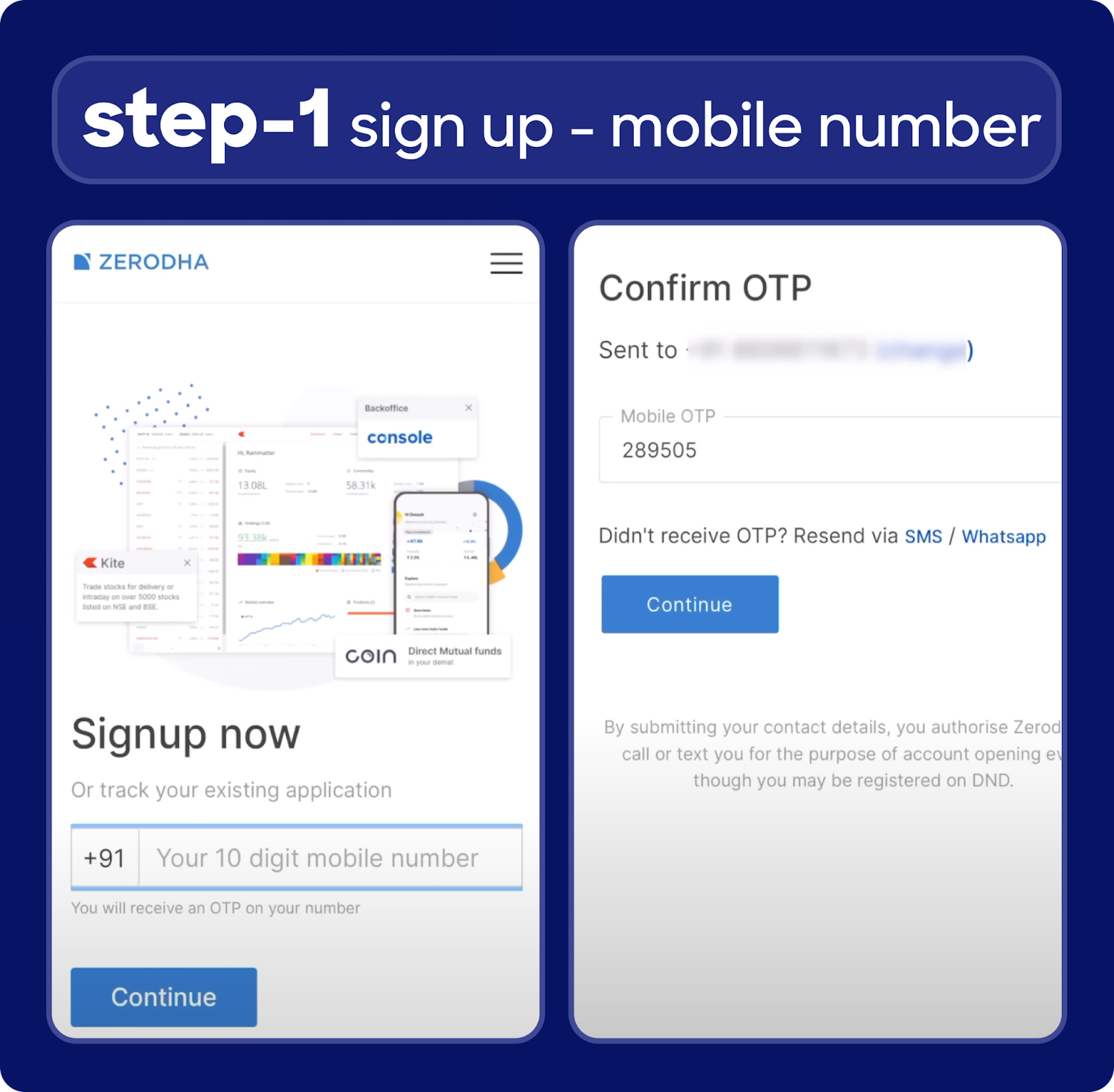
Step 1: Sign Up – Mobile Number

Enter the mobile number linked with your Aadhar and verify with OTP
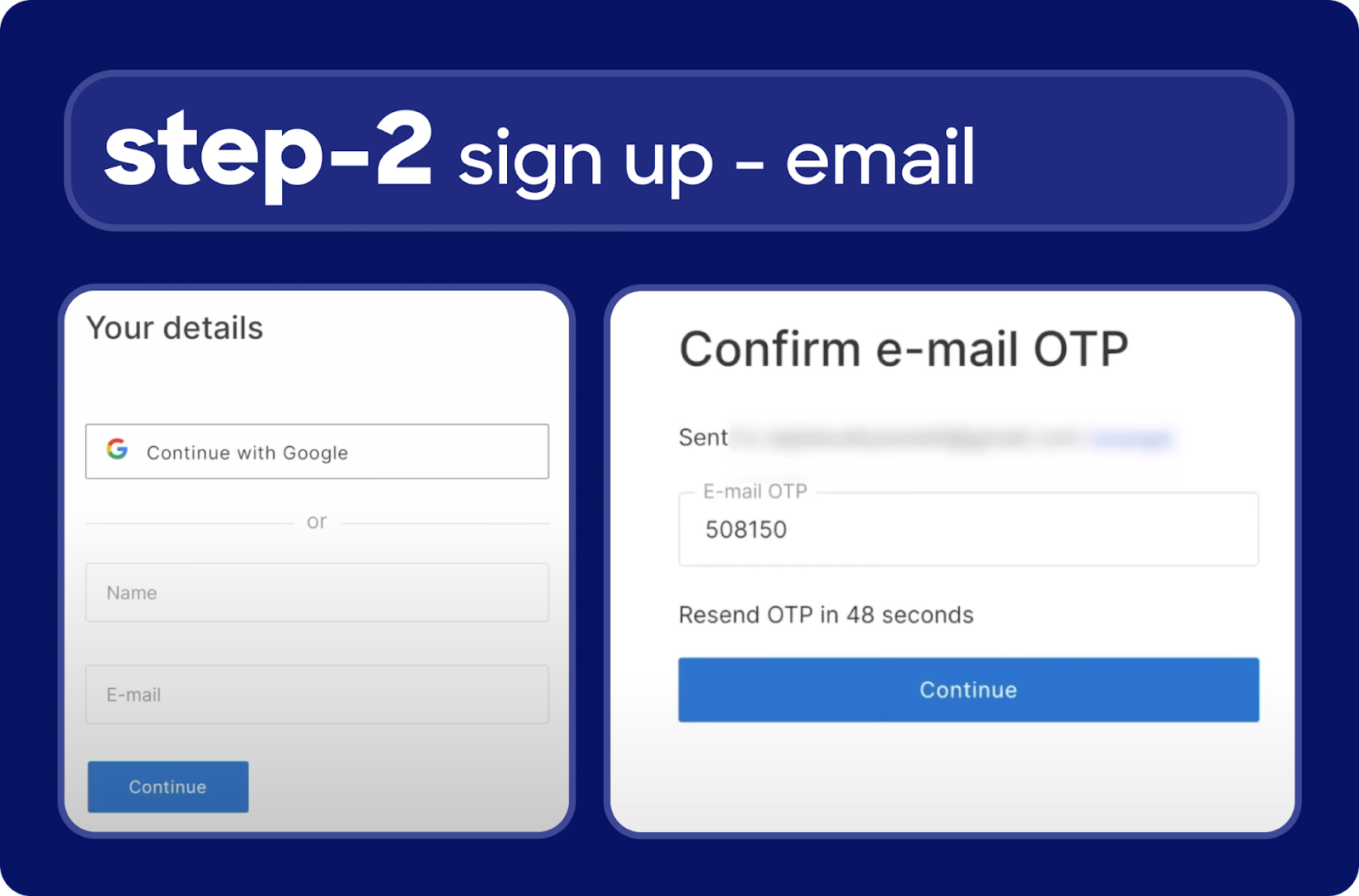
Step 2: Sign up – Email

Enter your email address and verify with e-mail OTP.
Step 3: PAN Card & Date of Birth

Enter your Permanent Account Number (PAN) and Date of Birth (DoB), and click Continue.

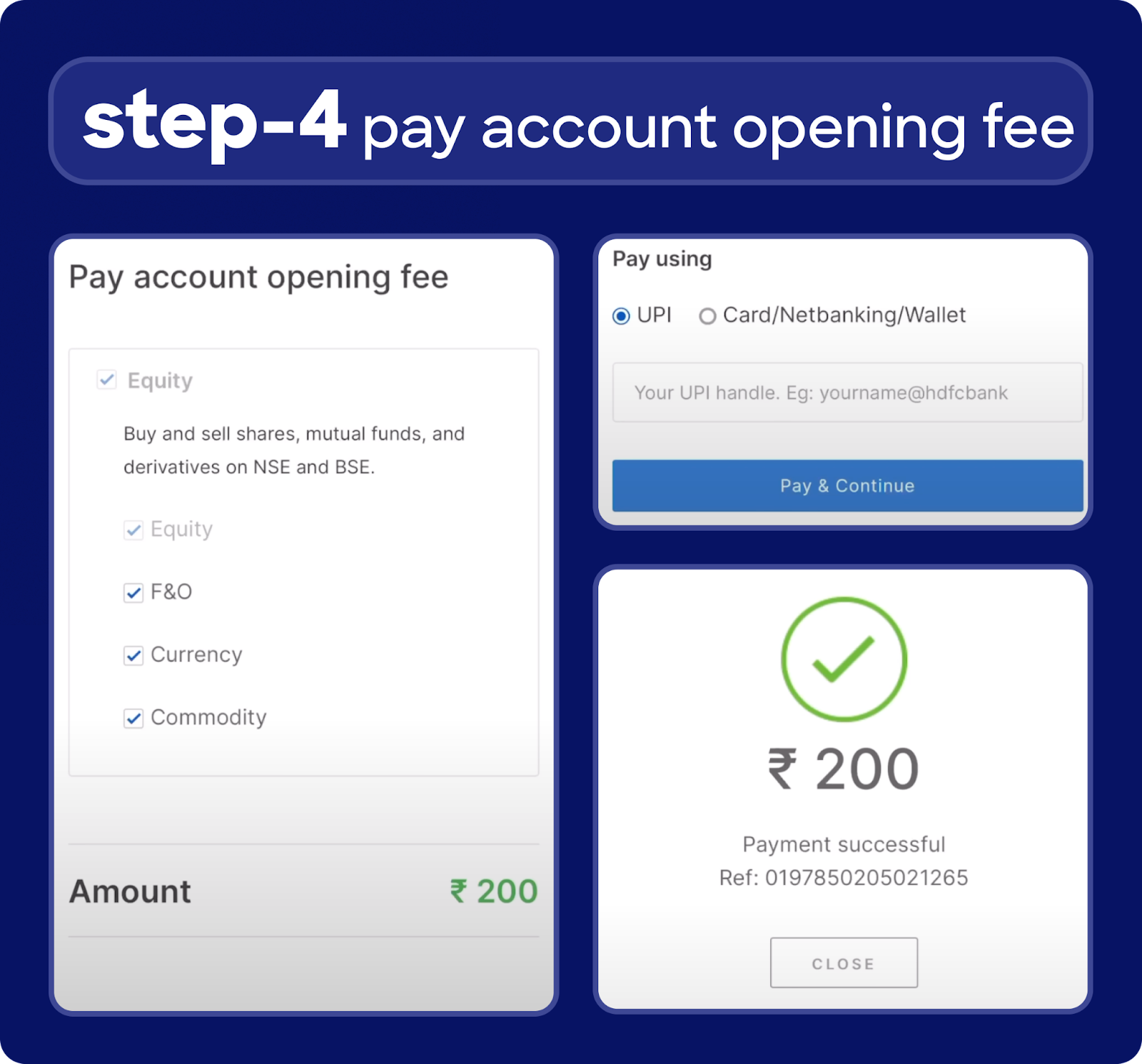
Step 4: Pay the Account Opening Fee

Enable the segments that you want to trade in. We suggest you enable all the segments and open a full-fledged account with Zerodha.

Pay the account opening fee using UPI or other methods.
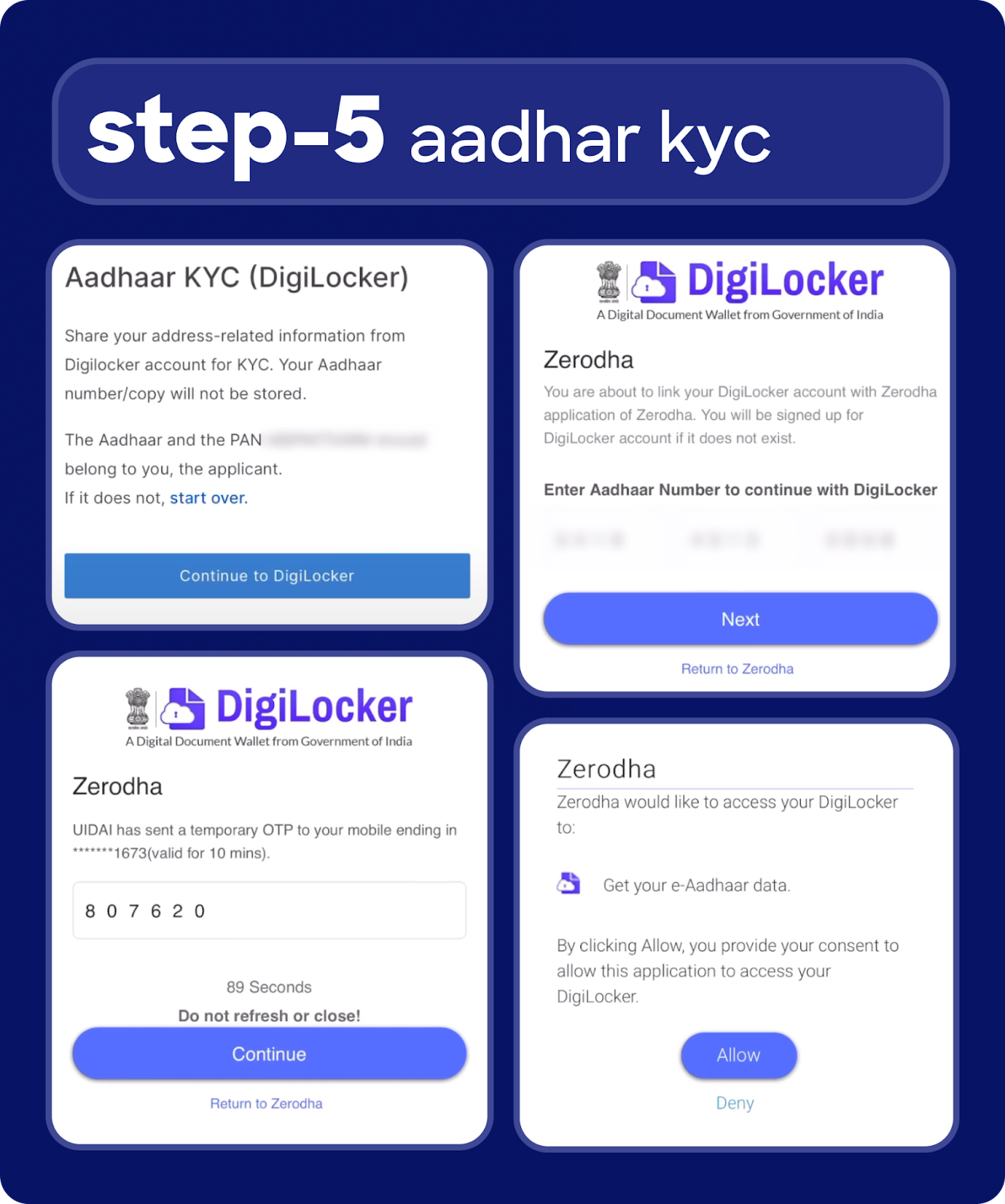
Step 5: Aadhar KYC

Complete Aadhar KYC by providing Zerodha access with your Aadhar details from Digilocker. Zerodha uses this to complete KYC and will not get access to your personal data. Enter your Aadhar number, verify with OTP, and click on Allow to complete the KYC process.
Step 6: Personal Details

Enter your personal details and complete your profile data. Set funds and securities settlement preference as ‘Once every calendar quarter’ and trading experience as relevant.
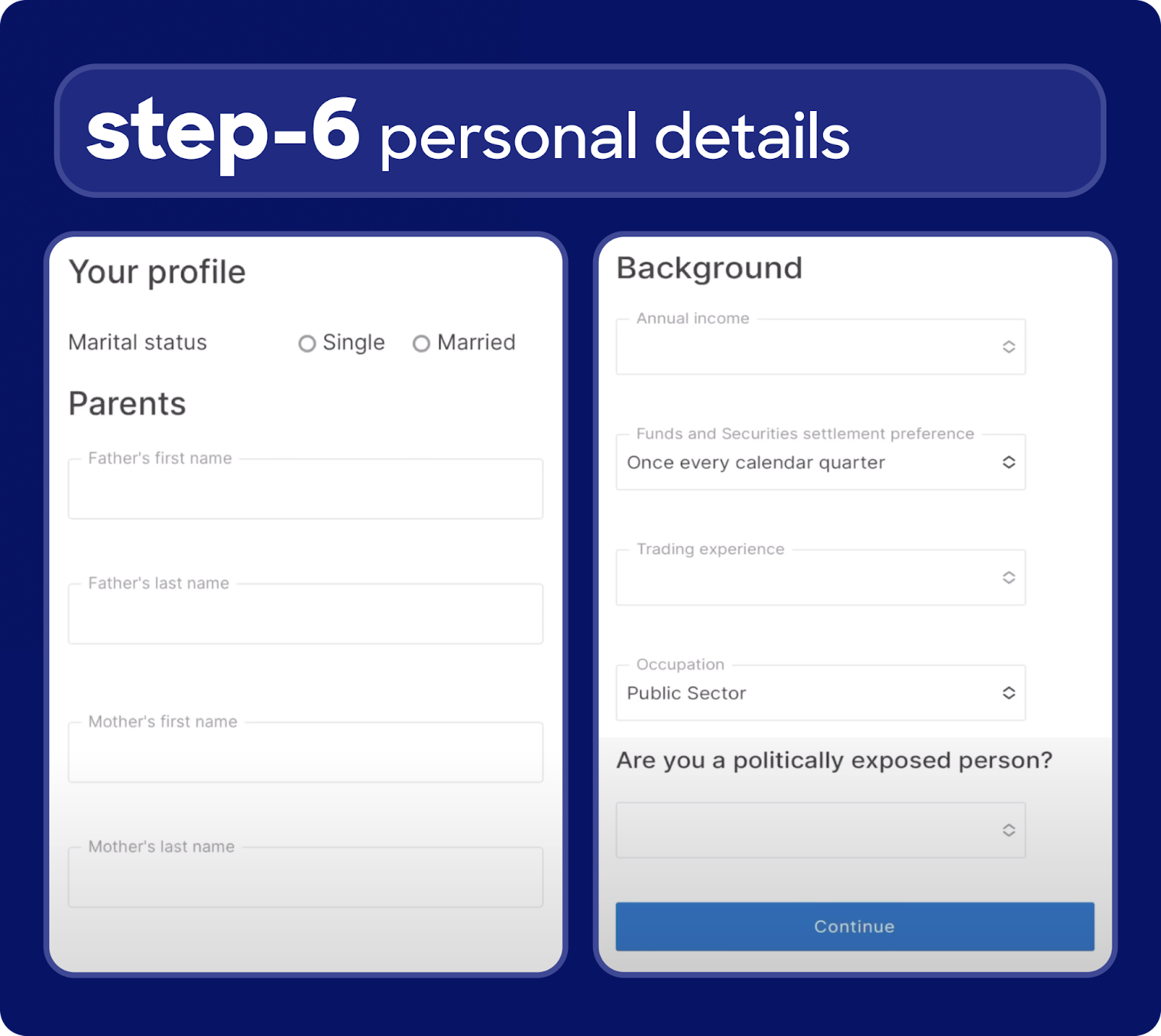
Step 7: Link Bank Account

Link your bank account to your Demat & Trading account using IFSC and account details. Alternatively, you can UPI-ID to link your bank account. Agree to all the terms and conditions and click continue.
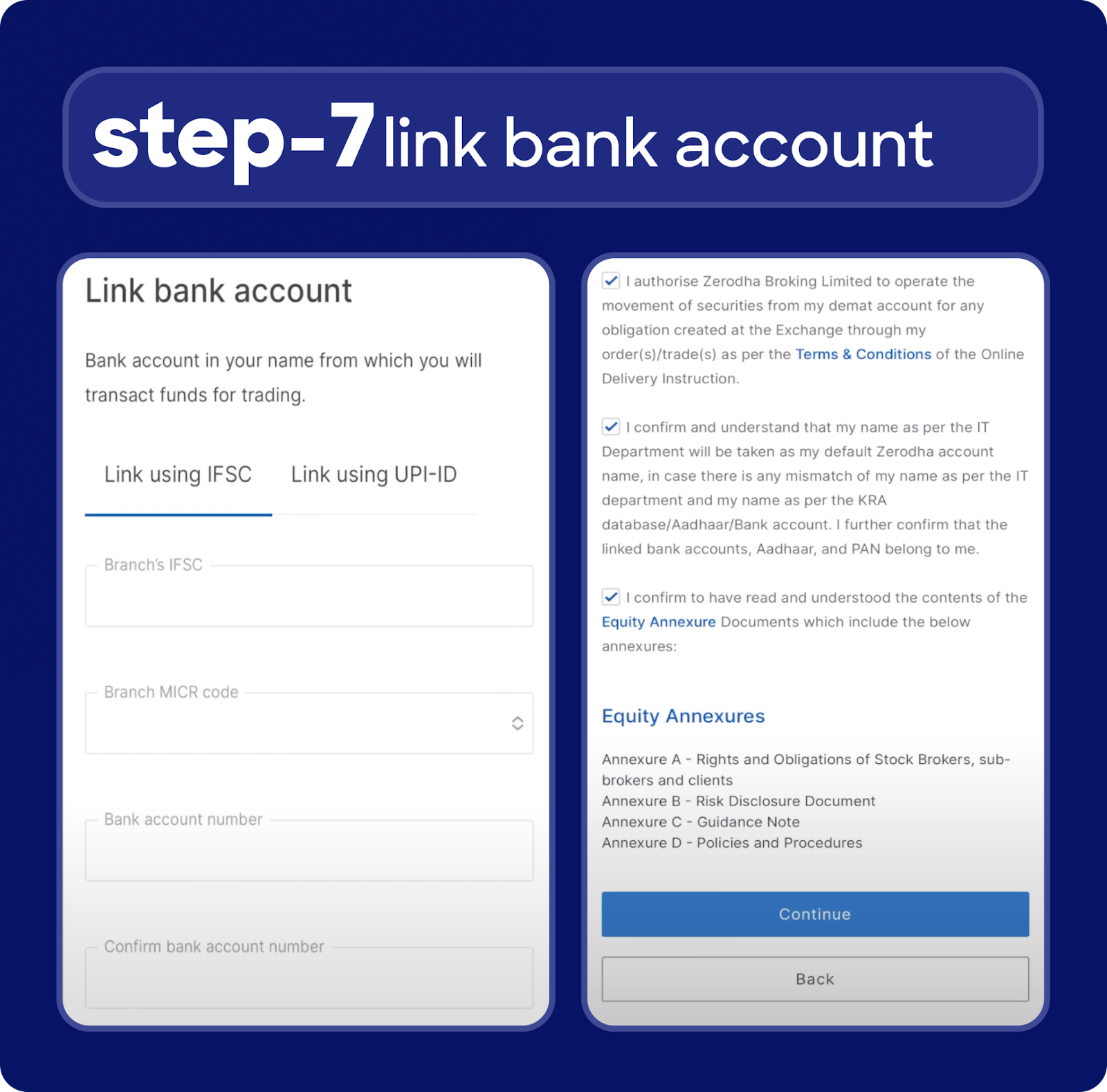
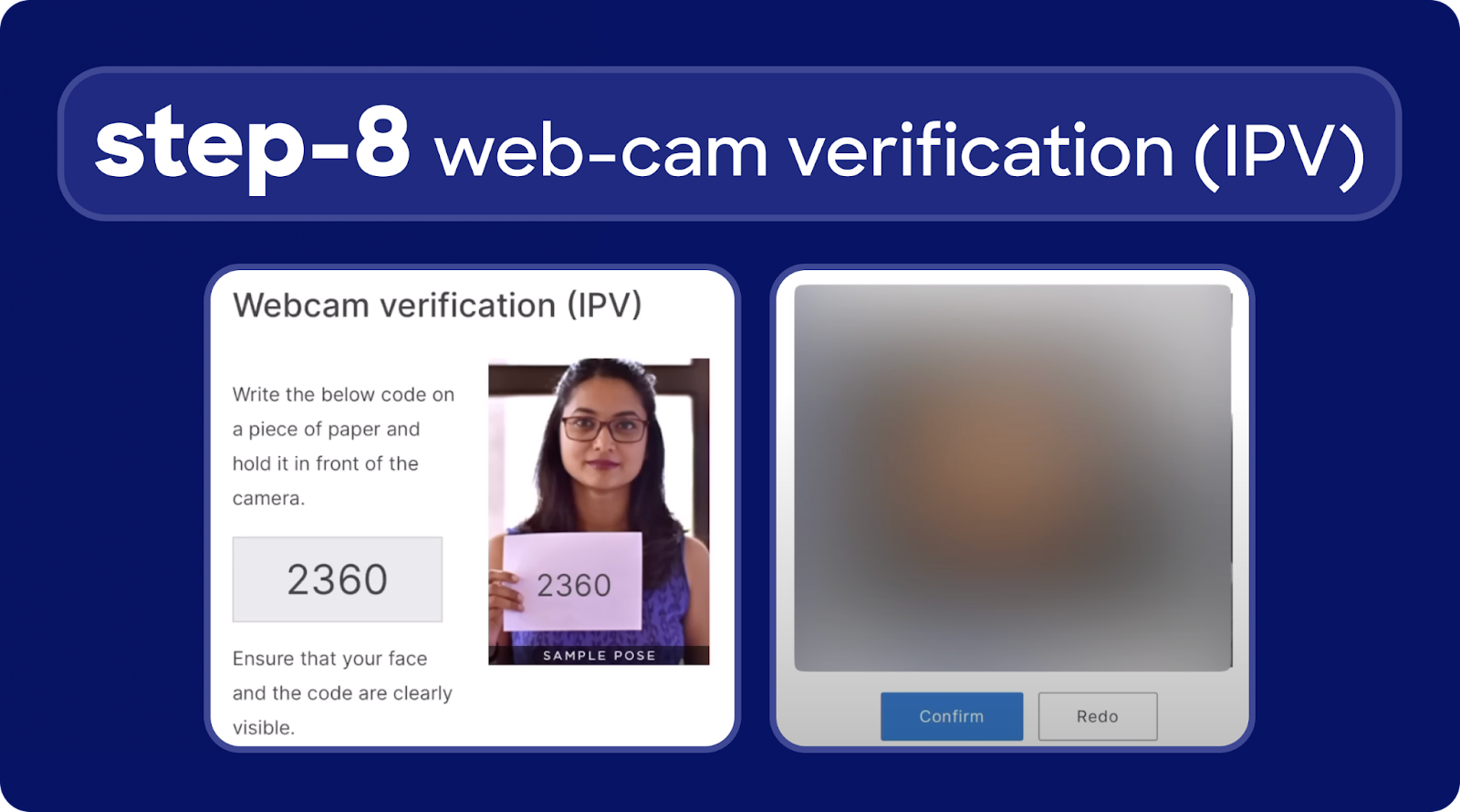
Step 8: Webcam Verification (IPV)

Zerodha performs this process for user verification. Write the number displayed on the screen on clean white paper. Then hold it in front of you as shown in the image while facing the webcam. Once you finish this process, the verification will be complete.
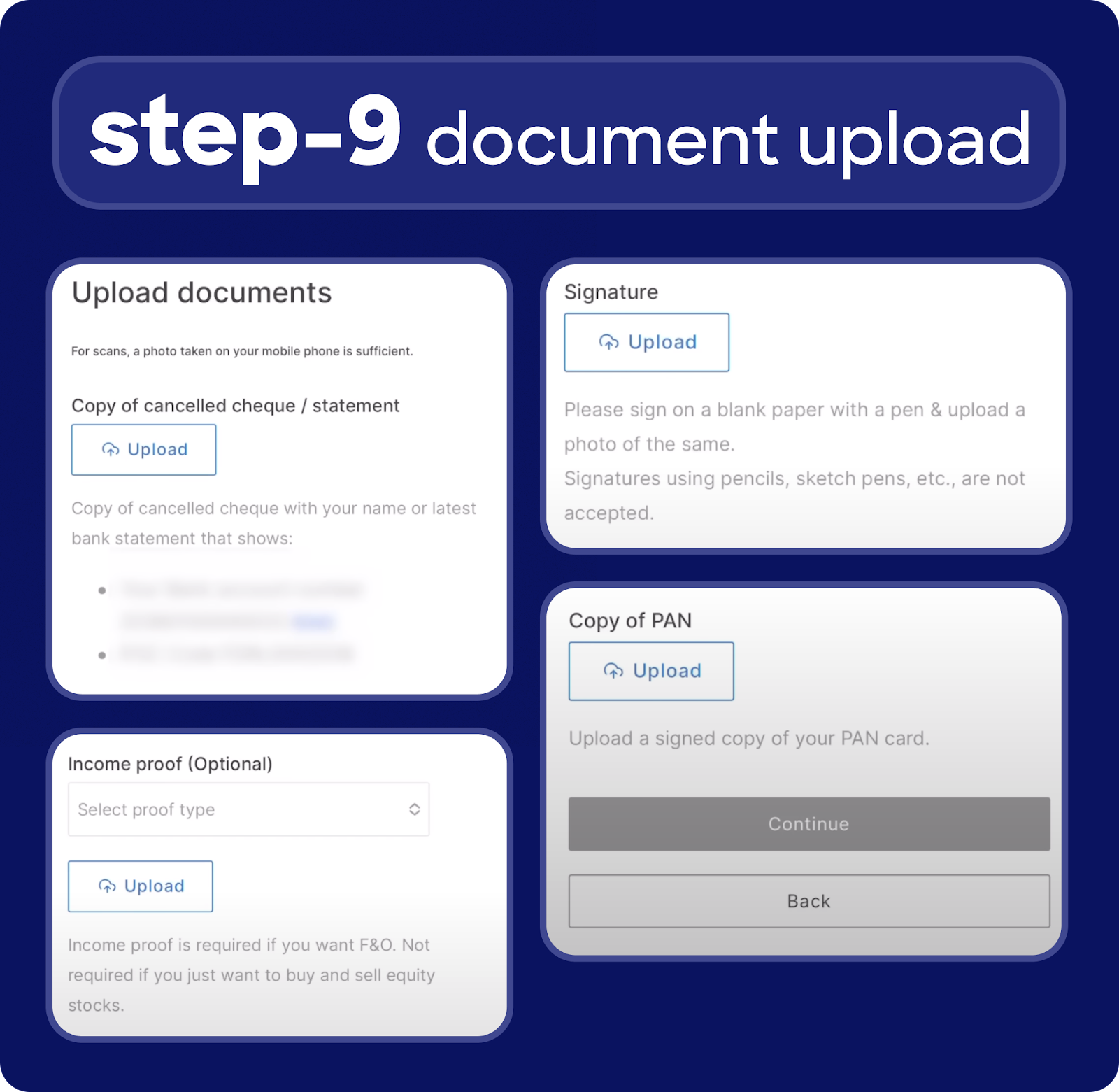
Step 9: Upload Documents

Upload the requested documents (income statement, signature, etc.) and click continue.
Step 10: E-sign the Application Form

The application process will be complete upon signing the application. Click on the e-sign button, enter Aadhar details, and verify. Review the application for errors and click on ‘Sign Now.’ It will redirect you to another page, which will be automatically closed upon completion. Click on Finish, and voila, you’re all set!
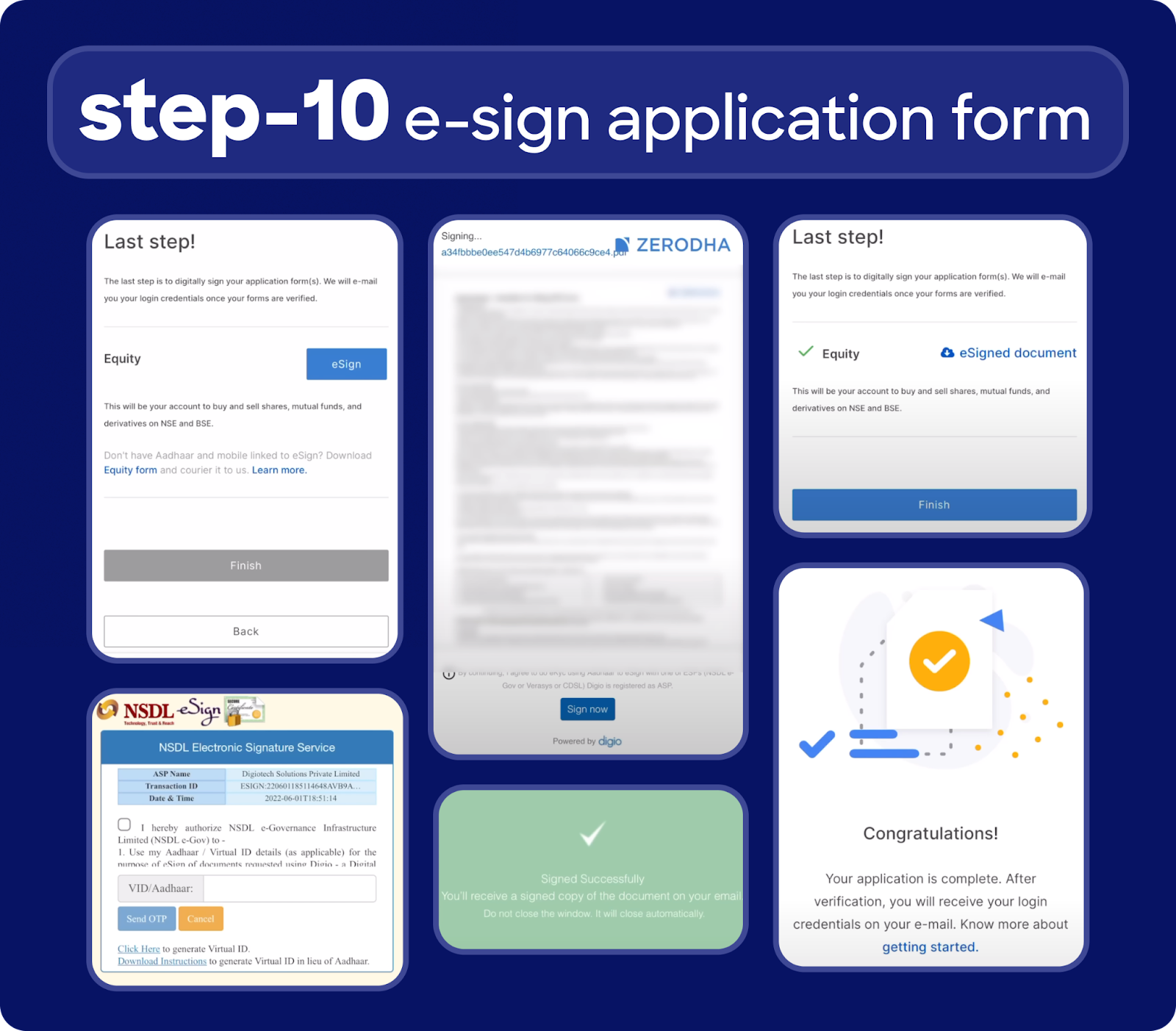
It may take up to 72 hours for the application to be verified. After verification, you will receive your login credentials via e-mail.

Kite is Zerodha’s trading platform. You can access it via a web browser or mobile app, available for download on both the App Store and Play Store.

How to Open an Account with Other Brokers?

The procedure for opening a Demat and trading account with other stock brokers in India is very similar to that mentioned above.

Categories
Editorial

What is the Karvy Stock Scandal all about? Explained.

On 22nd November 2019, SEBI announced that it had prohibited Karvy Stock Broking Limited (KSBL) to add any more clients after NSE found some irregularities. This order meant, no new trader can open his/her account with Karvy Stock Broking.

After a year-long investigation, on 23rd November 2020, National Stock Exchange (NSE) declared Karvy stock broking limited as a defaulter. They also expelled the broking firm from its membership. NSE also stated that it has settled the claims of more than 2 lakh investors whose funds worth Rs 2,300 crore. Bombay Stock Exchange (BSE) followed NSE’s path and expelled Karvy stock broking limited from its membership. They asked the investors to file for their outstanding claims against Karvy before 22nd February 2021. These claims will be considered for compensation of up to Rs 15 lakh. KSBL in the response have decided to accept their wrongdoings and do not wish to present their case. 

What exactly happened with this very successful brokerage firm? Let’s find the whole story here.

The Process of Karvy Scam

To take loans from banks, people are required to submit some type of collateral. Higher the amount of loan demanded, more valuable the collateral required by the banks. This collateral can be the portfolio of stocks you hold as an investor or a trader. Just like an individual has a Demat account, the broker has a pool account. This pool account is nothing but the broker’s Demat account.

Whenever you buy or sell a share, that share comes from the opposite seller or buyer. It first goes into the broker’s pool account and from there it comes to your Demat account. Now, suppose that you want to get a loan against your shares. Then, those shares are transferred into the broker’s pool account, who gives it to the banks. Banks issue loans to the broker against the shares submitted to them as collateral. The broker increases the interest rate and passes the money borrowed to the individual whose stocks are submitted. The difference between the two interest rates is the brokers’ profit. 

How Karvy Scam Worked

There would be a doubt in your mind that how the stocks owned by the investors can suddenly be pledged by the broker. Here comes the entry of POA or Power Of Attorney. This Power of Attorney gives the authority to the brokers to take shares out of the individual’s Demat account. Shares are stored with NSDL and CDSL, who are the only two depositories in India. Their work is to keep the shares safe in an electronic form in the customer’s Demat account. Both NSDL and CDSL give weekly or monthly reports to the account holders about all the transactions done. Thus, brokerage companies have to be honest in their practices because any variation can be caught by the account holders. 

But, Karvy found a loophole here. They identify those accounts in which the holder is not very active. For example, some of the investors do not trade very often. Some of them buy shares and keep them in their account for 1-2 years doing no further activity. Karvy transferred some of the shares to their pool account from these dormant accounts with the help of PoA. They approached different banks and took loans against these loans. Imagine you are taking a loan by giving someone’s house as collateral just because they don’t live there for the previous 2-3 years. Is that legal? NO. To whom these loans were issued? No one, Karvy kept it with themselves.

Misuse of funds by Karvy

The loans taken from the banks were transferred to one of their subsidiaries, Karvy’s Realty private limited. This subsidiary is engaged in real estate and property services. They offer investments, financing and advisory services to the customers related to the realty sector. So the loans were taken against the shares of the individuals without their consent. Then, the sums acquired were transferred to their own business in another sector. When this scam came into notice for the first time in 2019, it was rumoured that Rs 1,100 crore has been transferred till then. This is when SEBI banned Karvy Stock Broking company to add any more clients. Later, the amount misused in the scam was calculated to be much more than Rs 2,000 crore.

What Now for Karvy?

A major chunk of the clients has received their funds back as they were not the one who defaulted. But that does not cover the system failure which happened just a year back. There are still plenty of unanswered questions.

How did NSDL/ CDSL fail to find an anomaly in the Demat accounts if Karvy was putting these stocks in their pool account? How did NSE, who keeps an eye on all the brokerage firms, not find any wrongdoings for four years? Did they do any checks? How did banks not do any background checks before taking the shares of a third-party as collateral? Shouldn’t they have cross-checked with the owner of those shares? For now, it is difficult to answer any of these questions. As an investor, your responsibility is to maintain regular checks of your Demat account. If there is something odd happening in your account, you should straightaway call your brokerage firm and ask for a reason. Until, next time.