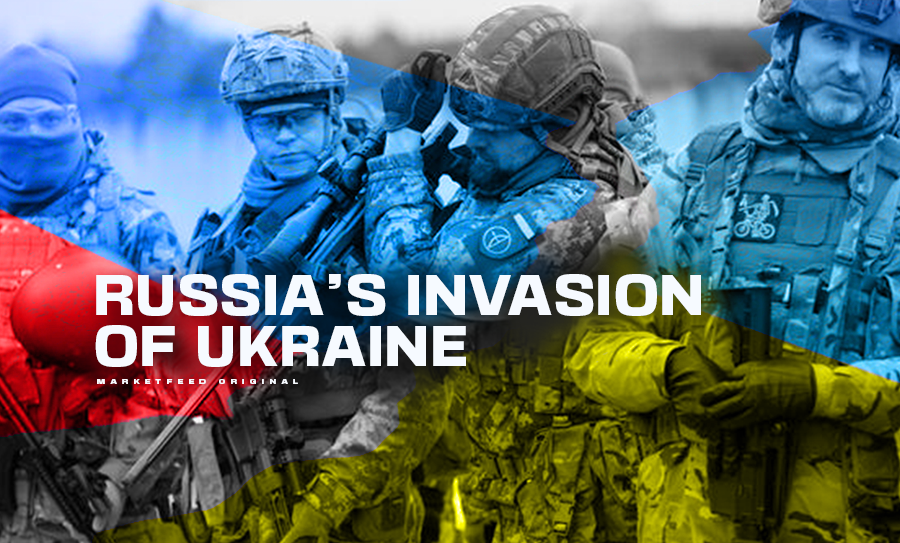
As the rest of the world watches helplessly, Russia continues its brutal invasion of Ukraine. Global tensions have been rising ever since President Vladimir Putin began a full-scale military operation against his neighbouring country on February 24. He sent troops by land, water, and sea, surrounding Ukraine from three fronts. Russian forces are using missiles and tanks to attack key cities of Kyiv and Kharkiv, killing many innocent citizens. The war has displaced over 7 million people. Several pro-Russian separatist forces in Ukraine are fighting from the inside.
As the situation escalates and negotiations fail, there seems to be no end in sight. In this article, we analyze some of the recent developments of the crisis and its impact.
A Timeline of the Russia-Ukraine Crisis
- Ever since the collapse of the Soviet Union in 1988-1991, the Russian Federation has been looking to bring it back and expand its territory. Ukraine, an independent nation since 1991, aligned itself with several western countries to prevent such an uprising.
- In 2014, Russia illegally annexed Ukraine’s Crimea region under the pretext of protecting Russians and Russian-speaking citizens from abuse or ill-treatment. This action led to major geo-political tensions between Russia, Ukraine, and many western nations that condemned the attack.
- In January 2021, Ukraine’s President Volodymyr Zelenskyy urged US President Joe Biden to allow his country to be a part of the North Atlantic Treaty Organisation (NATO). [NATO is an inter-governmental alliance between American and European countries that ensures the security and freedom of its members using military and diplomatic means.]
- Putin disliked the fact that NATO was extending its reach into Eastern Europe. He wanted the alliance to stop offering memberships to former Soviet Union countries. Moreover, Putin demanded that NATO pull back its military deployments in Central and Eastern Europe. Russia claimed that NATO promised it wouldn’t expand to the east in the 1990s and had cheated them. Diplomatic talks did not yield positive results.
- As Ukraine showed interest to join NATO, the Russian President started to send hundreds of thousands of military troops to Ukraine’s borders in the name of training exercises. At the end of 2021, many countries and international organizations raised concerns about a war-like situation between Russia and Ukraine. Meanwhile, Putin had assured that his country would not attack Ukraine.
Latest Developments
- On Feb 21, 2022, Putin recognised the independence of Donetsk and Luhansk in Ukraine as independent states. He sent troops into these areas to “keep the peace”. These territories had been broken away from Ukraine by alleged Russian-backed separatist forces in 2014.
- Three days later, Putin launched a full-scale invasion of Ukraine. His actions were condemned across the world, and even within Russia. There were multiple reports of missile strikes and bombings in the capital city of Kyiv and Kharkiv. The Russians took control over several regions. Gas pipelines & terminals, power stations, and airports were attacked and destroyed. Nearly 137 were confirmed dead on the first day of the Russian siege.
- President Zelenskyy ordered a full mobilization of the Ukrainian military for 90 days. The armed forces fought bravely against Russian troops and stopped their advance deep into the country. They also shot down Russian Air Force planes. Meanwhile, many Ukrainian citizens stayed back and learned how to handle guns and ammunition. Various allies of Ukraine have shown their support by providing military and humanitarian aid.
- On Feb 27, Zelenskyy agreed to send delegations for ceasefire negotiations with Russia on the Belarusian border. Unfortunately, the peace talks ended with no resolution. The Russians continue to fire missiles in key cities. Putin has even threatened to execute a nuclear attack. He has kept Russia’s nuclear arsenal on high alert. Meanwhile, innocent citizens who had no role in geopolitical issues are dying every day.
The Economic Impact
Following the ruthless attack on Ukraine, the US, UK, the European Union, Japan, and other allies have imposed a series of sanctions against Russia. They have primarily targeted Russia’s banks, oil refineries, and military exports. The international community aims to freeze the assets of President Putin and his foreign minister, Sergei Lavrov. Russian banks will be removed from the SWIFT international payments system to harm their ability to operate globally. The US has cut off Russia’s largest banks and their subsidiaries from its system. Such measures will disconnect Russia from the international financial system. The Russian Ruble has crashed and is now worth less than 1 US cent!
Crude oil prices have surged to $109-110 per barrel as the war triggered supply fears. Prices of metals, natural gas, and other essential commodities are shooting up across the globe. Flights continue to be cancelled or rerouted, putting pressure on cargo capacity and shipping costs. Inflation will become a key concern. You can learn more about the devastating economic effects of the war on India’s economy here.
The unfortunate events that unfolded in Ukraine led stock markets to fall significantly. There will be uncertainty in the market as long as the war continues. In the event of a nuclear attack, we could see a major correction. However, if the Russian President sees reason and stops the attack (which is highly unlikely), there could be a good recovery in the markets. Let us hope for successful diplomatic/peace talks between world leaders to bring an end to the bloodshed.
Let us look forward to seeing how this situation unfolds in the days to come. Our thoughts go out to Ukraine, its people, and all those who have been affected by the tragic attacks.

