Categories
Market News Top 10 News

Cabinet Approves Rs 19,744Cr for National Green Hydrogen Mission – Top Indian Market Updates

Here are some of the major updates that could move the markets tomorrow:

Cabinet approves ₹19,744 crore for National Green Hydrogen Mission

The Union Cabinet has approved provisions of the National Green Hydrogen Mission. It has sanctioned ₹19,744 crore for implementation of the project. The mission aims to provide direct incentives for manufacturing green hydrogen and generating hydrogen from green power sources. Incentives will also be given for manufacturing electrolysers in India for five years.

Read more here.

Adani plans to focus on digital expansion in 2023: Report

According to a Times of India report, Adani Group’s chairman Gautam Adani has been planning to roll out enterprise 5G services and consumer apps this year. He will be focusing on building AI-ML (artificial intelligence & machine learning) & industrial cloud capabilities and expanding data centres. Rolling out its 5G services and business-to-consumer (B2C) apps to digitally onboard millions of customers will be the company’s priority in 2023.

Read more here.

Switch Mobility, JBM Auto, PMI Electro Mobility win e-bus contracts from Centre

Ashok Leyland’s Switch Mobility, JBM Auto, and PMI Electro Mobility have emerged as the lowest bidders for a $362.24 million (~₹3,000 crore) tender floated by state-run Convergence Energy Services Ltd (CESL). Switch Mobility will supply 2,600 electric buses in three states, JBM Auto 1,781 e-buses in three states, and PMI Electro quoted the lowest for the supply of 2,080 electric buses in two states.

Read more here.

Housing demand across India rises 19% in Q3

The Magicbricks’ PropIndex report for the quarter ended Dec (Q3 FY22) said the aggregate residential demand (indicated by searches) increased 19% YoY led by major cities such as Mumbai with a 52.1% rise, Noida 35.8%, Gurgaon 34.5%, Delhi 14.8% and Bengaluru with 33% growth. The average property rates increased 13.9% YoY, and the cumulative supply (indicated by listings) grew 2.7% YoY.

Read more here.

Vedanta’s aluminium production falls 2% in Q3

Vedanta Ltd’s total aluminum production declined by 2% YoY to 5.66 lakh tonne in the three months ended December 2022. Alumina production at Lanjigarh refinery in Odisha FELL 6% YoY and 2% from the previous quarter to 4.43 lakh tonne due to maintenance activities in calciners. Total production of finished steel was at 3.06 lakh tonne in Q3, down by 13% YoY.

Read more here.

RailTel to monetise Wi-Fi footfalls in rail stations, eyes ₹250 crore revenue in 5 years

RailTel Corporation of India Ltd has initiated a Wi-Fi monetisation project covering more than 6,100 railway stations across India where a public Wi-Fi network has already been made available by the company. The company has signed a five-year agreement with three partners— 3i Infotech Ltd, Forensics Intelligence Surveillance & Security Technologies Private Ltd, and Yellow Inc for the project. 

Read more here.

RBI lifts restrictions imposed on Mahindra Finance

Reserve Bank of India has lifted restrictions on Mahindra & Mahindra Financial Services Limited on loan recovery via third-party services. On September 22, 2022, RBI directed the company to immediately cease carrying out any recovery or repossession activity through outsourcing arrangements, till further orders. The company was allowed to carry out recovery or repossession activities through its own employees.

Read more here.

NTPC’s power generation jumps 11% to 254 BU in April-December 2022

NTPC Ltd has reported an 11.6% year-on-year (YoY) growth in power generation during the April-December period in FY23. The state-owned company generated 295.4 billion (BU) of power during the period. The coal-based thermal power plants of the company utilised 73.7 percent of their capacity, a jump from 68.5 percent utilisation in the year-ago period. NTPC also commissioned India’s first green hydrogen blending project on Tuesday.

Read more here.

Categories
Editorial

An Analysis of India’s Green Hydrogen Industry

India has announced plans to de-carbonize within the next 30 years. The government has taken strategic decisions to reduce the reliance on fossil fuels and cut down costly imports. Our country’s target of achieving 175 gigawatts (GW) of renewable energy capacity by 2022 has received a significant boost through new policies. As part of these efforts, India is now focusing on the development and production of green hydrogen as an energy source.

In this article, we shall analyse an industry that is gradually evolving and essential for India’s growing economy— the green hydrogen energy industry! We shall also find out who the top players in this field are.

What Exactly is Green Hydrogen?

Hydrogen is the most common element in the universe. However, it only exists in the form of combinations with other elements. Hydrogen is commonly extracted from compounds such as water, and the process can be quite energy-intensive. Based on the sources and processes by which hydrogen is derived, it can be categorized into three: 

  • Grey hydrogen: Produced from fossil fuels (primarily natural gas).
  • Blue hydrogen: Generated from fossil fuels with carbon capture and storage options. 
  • And finally, green hydrogen: Generated from renewable power sources such as solar, wind, and geothermal energy.

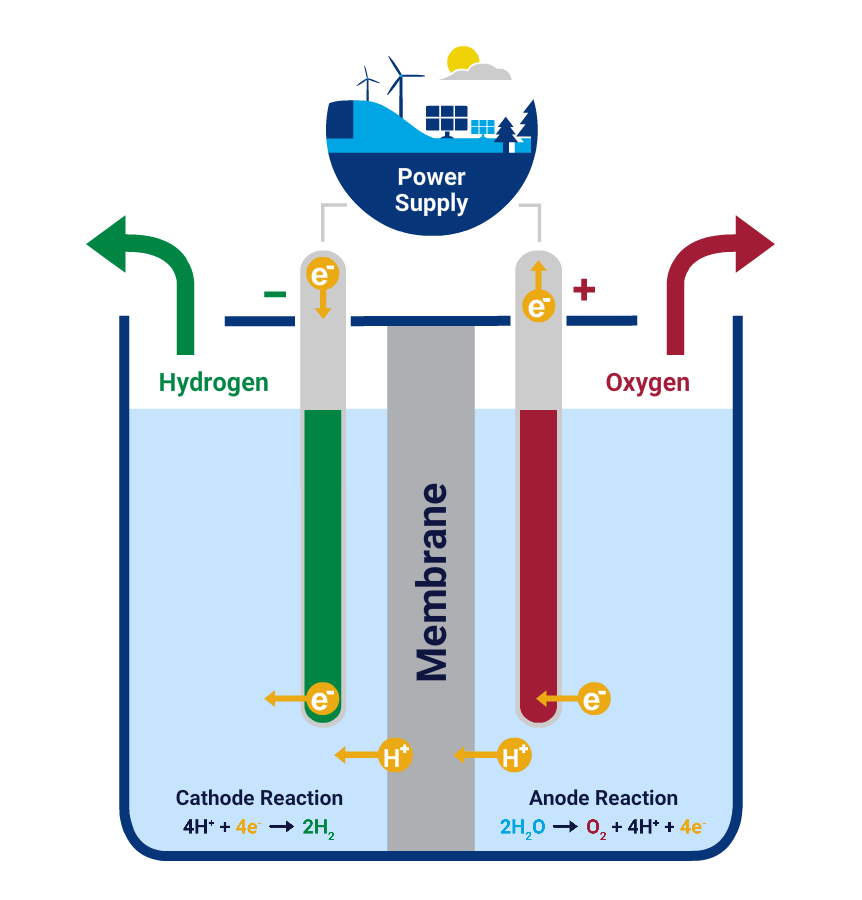
Green hydrogen is produced by splitting water into hydrogen and oxygen using renewable electricity. This chemical process is known as electrolysis. The main advantage of green hydrogen is that it is a clean-burning molecule. It can help reduce carbon emissions in the iron and steel, chemicals, and transportation sectors. A truly revolutionary concept, indeed!

The Green Hydrogen Industry in India

Since green hydrogen is one of the cleanest forms of energy, it is now considered the best solution to achieve net-zero emissions. Many countries are now investing billions of dollars into the development of green hydrogen infrastructure. Meanwhile, India has also taken various steps to support green initiatives. 

  • In August 2021, Prime Minister Narendra Modi launched the National Hydrogen Energy Mission (NHEM) and announced his decision to transform India into a global hub for green hydrogen production and export. Between 2021 and 2024, the government will invest Rs 800 crore in research & development projects that aim to cut down the cost of green hydrogen production.
  • India’s current energy import bill is over Rs 12 lakh crore a year. The dependence on coal and oil is likely to surge by 2-3 times in the near future. Thus, NHEM will help to stop our reliance on expensive oil imports. Green hydrogen will become a necessity to meet energy consumption requirements in the long term. 
  • In February 2022, the Indian government introduced the Green Hydrogen Policy. It targets the production of 5 million metric tonnes per annum (MTPA) of green hydrogen by 2030. Under this policy, a renewable energy plant set up to supply power for green hydrogen production before July 2025 will get 25 years of free power transmission! This policy will bring a sense of competitiveness amongst players in the green hydrogen sector. 
  • Many entities are working on the development of hydrogen fuel cell technology to power automobiles. We will soon be able to see many hydrogen-powered vehicles plying on Indian roads!

Now, let’s look at the top 5 companies leading the green hydrogen revolution in India.

Reliance Industries Ltd

  • Reliance Industries Ltd (RIL) has entered the green energy sector with highly ambitious plans. 
  • Chairman Mukesh Ambani had revealed a roadmap to invest $10 billion (or Rs 75,400 crore) in solar, green hydrogen, batteries, and fuel cells over the next three years.
  • RIL has also started developing the Dhirubhai Ambani Green Energy Giga Complex in Jamnagar, Gujarat. This Rs 60,000 crore project will be an integrated facility that manufactures components such as solar cells & modules, batteries, fuel cells, and an electrolyzer plant to produce green hydrogen.
  • RIL has partnered with Danish company Stiesdal A/S through its subsidiary Reliance New Energy Solar Ltd to develop and manufacture hydrogen electrolyzers.
  • Reliance has vowed to produce green hydrogen at $1 per kilogram by 2030.

GAIL (India) Ltd

  • GAIL is currently working on building the largest green hydrogen plant in our country as it looks to supplement its natural gas business with carbon-free fuel.
  • It had recently floated a global tender to procure an electrolyzer that can produce 4.5 tonnes of hydrogen per day.
  • The company has also started mixing hydrogen in natural gas systems of key cities as part of a pilot project. 

NTPC

  • State-owned NTPC plans to produce green hydrogen on a commercial scale. 
  • NTPC will establish a 4,750 MW renewable energy park in Rann of Kutch.
  • The company is running a pilot project at one of its units in Uttar Pradesh, where the cost of hydrogen is currently around $2.8-3/kg. 
  • NTPC  also plans to set up its first green hydrogen fuelling station in Leh, Ladakh.
  • The PSU aims to achieve 60 gigawatts (GW) of renewable capacity by 2032. 

Indian Oil Corporation (IOC)

  • IOC plans to build a green hydrogen plant at its Mathura refinery in Uttar Pradesh. The unit is likely to have a capacity of nearly 1.6 lakh barrels per day.
  • The company has set a target of converting at least 10% of its hydrogen consumption at refineries to green hydrogen in the upcoming years.
  • IOC also aims to establish a standalone green hydrogen manufacturing unit in Kochi, Kerala. This unit will draw energy from the solar power facility of Cochin International Airport Ltd. 

Larsen & Toubro

  • Larsen & Toubro signed a major pact with Norway-based HydrogenPro AS to establish an alkaline water electrolysis unit in India.
  • They also plan to set up green hydrogen plants at their manufacturing units.
  • L&T recently announced the formation of a joint venture with Indian Oil Corporation and Nasdaq-listed ReNew Power to develop a green hydrogen business in India.
  • L&T has set a target to become a net-zero company by 2040. The company aims to invest Rs 1,000-5,000 crore on green initiatives in the coming years.

Conclusion

India’s green hydrogen market is at an infant stage. Producing hydrogen fuel is an expensive task, with the biggest cost being the electrolyser. It is also quite expensive to move/transport hydrogen. Manufacturing at a greater scale could reduce such costs. However, production capacities are low due to limited demand. 

Despite these challenges, our government has taken the initial steps toward encouraging research & development of green hydrogen. In 2017, the Indian hydrogen market was valued at $50 million. This market is expected to grow to $81 million by 2025! No wonder a lot of companies are entering this highly-promising sector! They have already started tapping into the potential of hydrogen as an energy source. Many are examining methods to bring down the cost of production and find alternate use-cases. As citizens, we can build awareness of the technology behind green hydrogen and its benefit to the environment.

What are your views on the evolving green hydrogen industry in India? Let us know in the comments section of the marketfeed app!