Categories
Market News Top 10 News

SBI’s Net Profit Jumps 83% YoY to Rs 16,695cr in Q4 – Top Indian Market Updates

Here are some of the major updates that could move the markets tomorrow:

SBI Q4 Results: Net profit rises 83% YoY to Rs 16,695 crore

State Bank of India (SBI) reported an 83% YoY increase in standalone net profit to Rs 16,695 crore for the quarter ended March (Q4 FY23). Net Interest Income (NII) stood at Rs 40,393 crore, up 29% YoY. The gross non-performing assets (NPA) ratio fell from 3.14% in Q4 FY22 to 2.78% in Q4 FY23. The bank’s board has declared a dividend of Rs 11.3 per equity share.

Read more here.

India’s coal production up 8.5% to 73 MT in April

According to the Ministry of Coal, India’s coal production increased by 8.5% to 73.14 million tonnes (MT) in April 2023, compared to 67.20 MT in April 2022. This accounted for 94.89% of the production target set for April 2023. Coal India and its subsidiaries contributed 57.57 MT to the overall production, marking a 7.67% growth from April 2022.

Read more here.

ITC Q4 Results: Net profit rises 23% YoY to Rs 5,175 crore

ITC reported a 23% YoY increase in consolidated net profit to Rs 5,175 crore in Q4 FY23. Its operating revenue rose 7% YoY to Rs 19,058 crore during the same quarter. EBITDA stood at Rs 6,209 crore, up 18.9% YoY in Q4 FY23. The company’s board has recommended a final dividend of Rs 6.75 and a special dividend of Rs 2.75 per equity share.

Read more here.

Zydus Lifesciences Q4 Results: Net profit falls 25% YoY to Rs 297 crore

Zydus Lifesciences reported a 25% YoY decline in consolidated net profit to Rs 296.6 crore in Q4 FY23. However, its consolidated total revenue rose 32% YoY to Rs 5,011 crore during the same quarter. EBITDA stood at Rs 1,257 crore, up 75% YoY. The company’s board has recommended a final dividend of Rs 6 per equity share.

Read more here.

Vedanta to free up cash and raise funds as it nears $500 million bond maturity

According to a Bloomberg report, Vedanta Group seeks to raise funds and generate cash as its $500 million bond matures. The board of Vedanta Ltd. is considering a dividend payout, while the conglomerate is in talks with banks for a potential $500 million raise. Vedanta Resources Ltd. relies on funds from its subsidiaries to reduce debt after a failed zinc mining unit sale.

Read more here.

Ramco Cements Q4 Results: Net profit rises 23% YoY to Rs 152 crore

Ramco Cements reported a 22.6% YoY increase in net profit to Rs 152 crore in Q4 FY23. Its revenue increased by 50.2% YoY to Rs 2,568 crore during the same quarter. EBITDA stood at Rs 412 crore, up 39.5% YoY in Q4. 

Read more here.

Paytm partners with NPCI to launch Paytm SBI Card on the RuPay network

One97 Communications Ltd’s Paytm has collaborated with NPCI and SBI Card to launch the Paytm SBI Card on the RuPay network. Customers who join will receive privileges worth up to Rs 75,000, including a complimentary Paytm First Membership with OTT platform access and flight ticket discounts through the Paytm app. Cardholders also get other cashback offers on various transactions.

Read more here.

Godrej Agrovet and SBI launch finance offering for oil palm farmers

Godrej Agrovet’s Oil Palm Business has collaborated with SBI to launch a finance offering for oil palm farmers. The product aims to support farmers by providing loans for setting up micro-irrigation facilities, implementing fencing arrangements for protection against cattle grazing, and improving tube wells on their oil palm farms. This initiative aims to enhance Fresh Fruit Bunches (FFB) productivity, acting as a catalyst for oil palm growth.

Read more here.

GAIL shuts Ratnagiri LNG terminal till September, cuts imports

GAIL (India) Ltd has temporarily halted LNG imports at its Ratnagiri plant in Maharashtra since mid-May. The facility is shut down annually during the monsoon season due to operational challenges caused by rain and high tides. A breakwater is currently under construction and is expected to be completed next year, eliminating the need for seasonal shutdowns. GAIL’s last LNG cargo was received on May 11 at the Dabhol port.

Read more here.

Oriana Power commissions 2.7 MW solar project at IOCL refinery in Haryana

Oriana Power has successfully commissioned a 2.7 MW solar project at the Indian Oil Corporation Ltd (IOCL) refinery in Panipat, Haryana. The project was completed within a record time of three months and is specifically for Indian Synthetic Rubber Private Ltd (ISRPL), a joint venture between IOCL and Trimurti Holding Corporation. This marks the successful establishment of a single rooftop solar power plant at the IOCL refinery.

Read more here.

Pfizer suspends sale of some popular products due to technical issues

Pfizer Ltd has halted the sale and use of its bacterial infection products in India due to technical issues at a contract manufacturing site. The company has requested a temporary suspension of Magzex, Zosyn, Magnamycin injections, and Magnex forte supplies. Stockists and distributors have been instructed to refrain from selling, distributing, or using the products until further notice from Pfizer.

Read more here.

Categories
Editorial

Paytm Shares Are Up 32% From 52-Week Low. What Next?

Shares of One97 Communications Ltd, the parent company of digital payments platform Paytm, have recovered ~32% from its 52-week low. Unfortunately, the stock is still down by Rs 1,280 or 65% compared to its IPO listing price of Rs 1,955! In today’s article, we analyze the recent developments surrounding Paytm and its financial performance.

What Led to the Recent Rally in Paytm’s Shares?

Market analysts have primarily attributed the stock’s rally to a triangular pattern breakout above Rs 640-650, supported by large volumes. Let’s look at the chart to understand this:

Source: TradingView

Reports of a share buyback by Paytm’s promoters have also boosted the morale/sentiments of investors. CEO Vijay Shekhar Sharma had purchased 1.72 lakh shares of One97 Communications worth Rs 11 crore. A share buyback is a process wherein a company or its promoters buy back its own shares from shareholders at fair market value.

Fundamentals Remain Weak

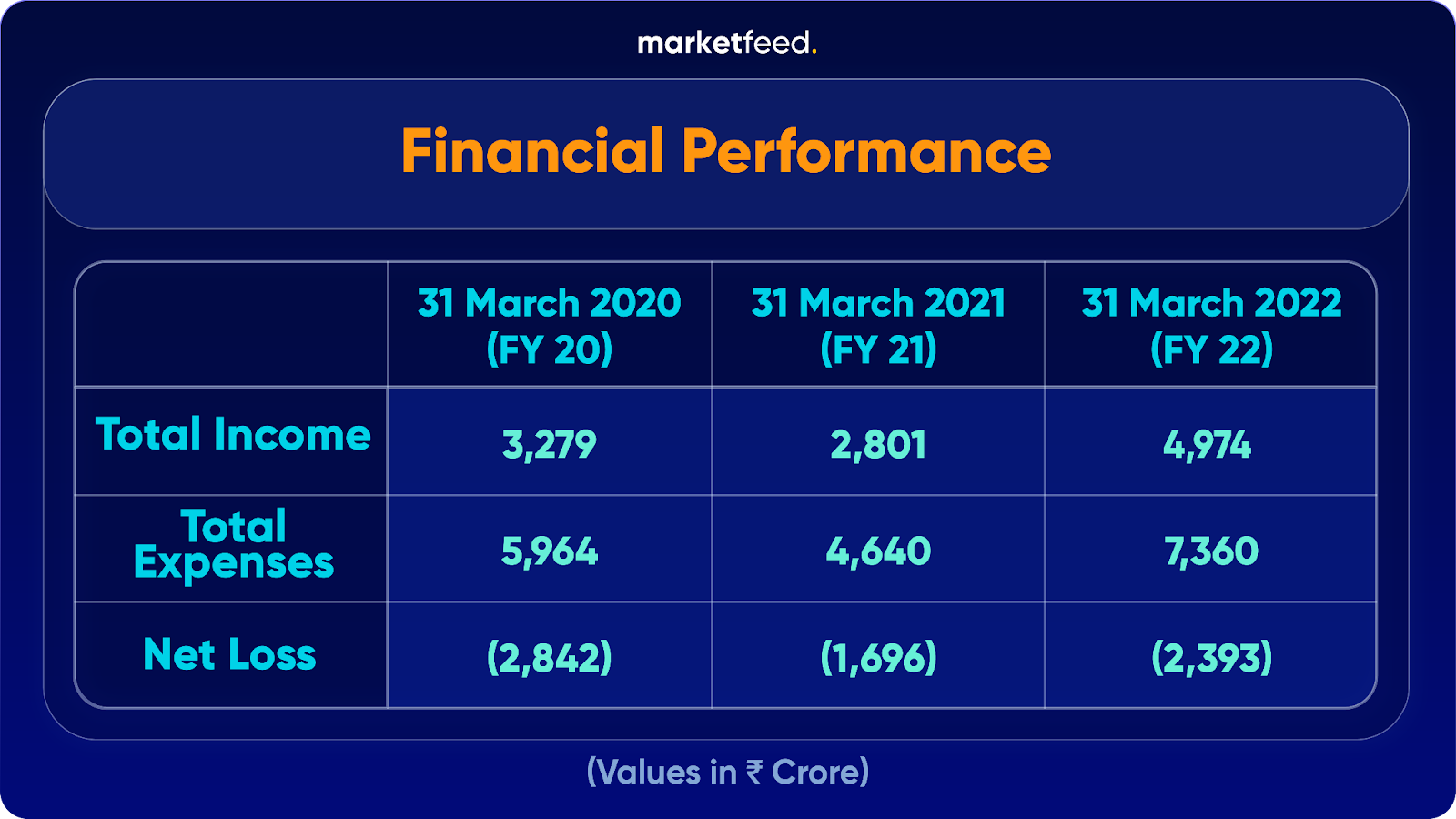
One97 Communications reported a 41% year-on-year (YoY) increase in its consolidated net loss to Rs 2,392.9 crore for the financial year 2021-22 (FY22). However, the startup’s revenue from operations grew 77% YoY to Rs 4,974.2 crore in FY22. They saw a healthy increase in consumer and merchant payments & loan disbursements through its partners on Paytm. Average monthly transacting users (MTU) rose 35% YoY to 6.08 crore during the same period.

Time and again, high expenses have been blocking the company’s road to profitability. Paytm made huge investments in marketing expenses to grow its monthly transacting users (MTU) in FY22. Its employee costs rose due to investments to scale up its device deployment from 8 lakh per quarter to 10 lakh per quarter. [Paytm offers smart point-of-sale (POS) hardware devices for merchants.]

(Values in Rs crore)

In the last quarter of FY22 (Q4), Paytm’s net loss rose 72% YoY to Rs 762.5 crore, while revenue from operations grew 89% YoY to Rs 1,541 crore. Earnings before interest, tax, depreciation, and amortisation (EBITDA) remained negative during the quarter. However, it narrowed from Rs 420 crore in Q4 FY21 to Rs 368 crore in Q4 FY22. The startup declared it is on track to break even at the EBITDA level by the July-Sept quarter of FY23.

The Way Ahead

One97 Communications’ shares have been on a free fall since it got listed in November 2021. It crashed over 70% from the IPO price of Rs 2,150. The company was highly overvalued, especially when the path to profitability was unclear. Many find Paytm’s business model problematic as it generates very low revenue for every dollar spent on marketing. In a major blow, the Reserve Bank of India (RBI) directed Paytm Payments Bank (PPB) to stop onboarding new customers due to supervisory concerns in March 2022.

Paytm often dabbles in numerous business lines, and it has become difficult for them to work out a solid business model. A high level of competition in the fintech space is also weighing down on their operations. As a result, many global and domestic analysts had advised against buying the company’s shares and slashed their target prices on the stock.

However, CEO Vijay Shekhar Sharma expects his company to achieve operational profitability by Q2 FY23. They are focusing on increasing consumer engagement and merchant base to achieve higher revenue from payment services. Paytm is also scaling up its loan disbursement business, where it offers Paytm Postpaid (Buy Now, Pay Later), personal loans, and merchant loans. Moreover, the proposal of linking credit cards to UPI is expected to benefit the full-stack payments and financial solutions provider.

Let us wait patiently and see how One97 Communications performs in the upcoming quarters. Have you invested in the company? Let us know in the comments section of the marketfeed app.

Categories
Editorial

Why Was The PayTM IPO a Flop Show?

India’s largest IPO in a decade has turned a flop show! One97 Communications Ltd, the parent company of digital payments app PayTM, lost 27% of its share price on the day of its listing. Domestic retail investors had high hopes on the Rs 18,300 crore IPO. Nevertheless, investors were left surprised when the shares were listed at a discount on the stock exchanges. In this piece, we explore the possible causes that led to the failure, and whether the stock has any future investment prospects. 

Offloading By Promoters and Hedge Funds

The company planned to raise a total of Rs 18,300 crore through its IPO, Rs 8300 through a fresh issue (which goes to the company), and Rs 10,000 through an Offer For Sale (which goes to the promoters). The signs of an IPO debacle were pretty much evident at the beginning of the month. The highest number of shares were offloaded by Jack Ma’s Antfin (Netherlands) Holding B.V, Alibaba Group, and SoftBank Group. Other offloaders included some promoters and hedge funds. Hedge funds and Investment funds have an appetite for risk. They generally avoid playing on smooth grounds. Seemingly, the investment, venture capital, and hedge funds tried to take some money home by offloading stakes in the company. This wouldn’t have been the case if the companies saw a greater opportunity in the IPO.

Retail Investor Hype!

On November 3, 2021, the US Fed announced its plans to begin tapering quantitative easing by reducing interest rates and selling government bonds. While the announcement did not trigger a sudden reaction, investors knew it was time to slowly get their hands off high-risk assets, but obviously not the retail investors. Retail investors are individuals like me and you. The IPO was subscribed only 18% on Day 1. The retail segment was subscribed 78%, while the Qualified Institutional Buyers (QIB) and Non-Institutional Investor (NII) segments were subscribed only 2% and 5% respectively. By Day 3, India’s ‘largest’ IPO was subscribed 1.89 times, a small number for the hype around the company. In the end, the Foreign Institutional Investors and Retails investors managed to see the IPO through an oversubscription. 

Bad Timing

Timing is the most crucial element in an IPO. PayTM’s IPO is one of the last few IPOs of this season. The IPO bull run was powered by a rush of liquidity globally through quantitative easing and expansionary fiscal policies by various governments. This sudden rush of liquidity made its way to shares, IPOs, and other high-risk venues. The NIFTY and SENSEX are at an all-time high, and all the available liquidity has already been invested in the markets or IPOs. Almost all of PayTMs peers, despite high valuations, sailed through smoothly and gave investors a bang for the buck. This makes us ask, why did PayTM IPO fail while the IPO of its tech peers like Nykaa and Zomato sailed through smoothly?

We at marketfeed, in our article titledNykaa IPO: All You Need To Know’, pointed out the following:The IPOs are coming out all at once with extremely high valuations and buzz in the market. It might leave the market out of liquidity. Nykaa is the first IPO going up in November and might therefore have a first-mover advantage. The company has grown significantly in a very small period, much faster than its other tech-commerce peers.”

The Future

Analysts had already signalled overvaluation for the company. An overvalued IPO can only sustain in a bull run. When the bears kick in, the fall can be bloody. The market has correctly valued the company through the discounted listing, dragging it towards the median valuation. As they say, the market decides its best value. Macquarie (a research firm) has assigned its lowest rating ‘underperform’ to the company. 

Despite being a loss-making company, Paytm has managed to trim its losses and expenses. While the company remains in net loss, its financial growth and stability have been healthy recently. The company does not have one specific listed competitor. It has a competitor in just about every domain it operates. This over-diversification can stunt the growth of the company in parent segments. The Macquarie report has mentioned that the company has ‘too many fingers in too many pies’. 

We are at the peak of the market cycle The flopped PayTM IPO is a red flag for over-valuation. While the company’s promoters made quite some money because of overvaluation, the retail investors suffered. Certain news reports suggest that analysts have advised to ‘sell and book loss’ to those who have received an allotment. It is advised that retail investors perform thorough research and take due caution before making a move.

Categories
Editorial

PayTM IPO Analysis: The Biggest Indian IPO is Here!

India’s largest IPO in a decade is near! One 97 Communications Limited, the parent company of PayTM, is expected to raise Rs 18,300 crore through its IPO next week. This piece covers the company’s financial position and business model.

About PayTM

PayTM is an Indian multinational company that specializes in digital payment systems, e-commerce, and finance. Founded in 2010 in Noida by Vijay Shekhar Sharma with an initial investment of $2 million, the company now holds a valuation of $16 billion or Rs 1.2 lakh crore. The company is backed by investors like Jack Ma’s Ant Group, SoftBank, and even Warren Buffet’s Berkshire Hathaway, to name a few.

Paytm is coming up with what could be known as the biggest IPO in a decade. It plans to raise nearly Rs 18,300 through its public issue. According to the RHP, the company would raise Rs 8,300 through a Fresh Issue and the balance Rs 10,000 through Offer For Sale (OFS). The draft papers had stated that the company had plans to raise Rs 2,000 crore in a pre-IPO placement. However, the plan was later scrapped since Paytm faced disagreements with investors over its valuation. 

Business Model

The company has a payments-led super-app, through which it offers innovative and intuitive digital products and services. It offers consumers a wide selection of payment options on the Paytm app, which include (i) Paytm Payment Instruments, which allow them to use digital wallets, sub-wallets, bank accounts, buy-now-pay-later and wealth management accounts, and (ii) major third-party instruments, such as debit/credit cards and net banking.

Merchants can use in-store and online payment solutions to accept payments through Paytm Payment Instruments as well as major third-party payment methods. To help them acquire and retain customers, and create demand, PayTM offers them services like selling tickets to customers, advertising, mini-app listings, channel, and loyalty solutions.

Paytm offers services to nearly 33.3 crore customers with 2.1 crore merchants on its network, as of March 2021. The company’s Gross Merchandise Value (GMV) stands at Rs 4 lakh crore. GMV refers to the rupee value of total payments made to merchants through transactions through Paytm Payment Instruments or its payment solutions, over a period.

According to a Redseer Report, Paytm has an overall payments transaction volume market share of approximately 40%, and wallet payments transaction market share of 65-70% in India as of FY 2021.

Paytm provides mobile banking services through Paytm Payments Bank, in which it owns a 49% equity stake. It offers a comprehensive suite of digital banking products for individuals, small and medium enterprises, and large corporates including current account, savings account, salary accounts, fixed deposits, and debit cards. As of March 31, 2021, Paytm Payments Banks had 64 million savings accounts, the largest UPI beneficiary bank with a market share of 17.1%.

Paytm also offers wealth management services through the Paytm app and the Paytm Money app. Paytm Payments Bank has launched fixed deposits on the Paytm app in partnership with commercial banks. It also launched Paytm Gold, which allows consumers to purchase gold for as low as Rs 1. Paytm Money offers mutual funds, equity, and derivatives trading through a registered investment advisor (RIA) license and equity broking license from SEBI.

Source:PayTM RHP

Financial Performance

Paytm has three revenue segments— Payment and Financial Services, Commerce and Cloud Services, and Other Income. The maximum revenue contribution is made by the Payments and Financial Services segment. This segment includes wallet payments, Paytm Payments Bank, Paytm Money, Paytm Postpaid, and other financial services. 

Between FY19 and FY21, the contribution of the Commerce and Cloud Services segment has reduced by ~54%. This was mainly due to the disruption caused by the COVID-19 pandemic, which affected the travel, e-commerce, and entertainment business of Paytm. Paytm is a loss-making company. Between FY19 and FY21, the company has managed to limit its losses by ~59%. 

Paytm has also managed to trim down its expenses by ~38%. Most of the company’s expenditure is made on payment processing charges due to high volumes of transactions taking place on the app. In FY21, close to 40% of the total expenses were payment processing charges. Another major expense was ‘Marketing and Promotional Expenses’. Between FY19 and FY21, the company managed to reduce Marketing and Promotional expenses by 84% from Rs 3,408 crore in FY19 to Rs 532 crore

Paytm holds a short-term debt of Rs 544.9 crores. 

About the IPO

Paytm plans to use the Rs 8,300 crore that it raises from the IPO as follows:

Growing and strengthening its ecosystem, including through acquisition and retention of consumers and merchants and providing them with greater access to technology and financial services.Rs 4,300 crore
Investing in new business initiatives, acquisitions, and strategic partnerships.Rs 2,000 crore

Paytm hasn’t specified where it will be using the remaining Rs 2,000 crore. 

Chinese mogul Jack Ma’s Antfin (Netherlands) Holding B.V. owns close to 29.6% equity stake in Paytm, the highest in the company. According to SEBI regulatory requirements, no shareholder can hold more than 25% in a ‘professionally managed company’. Since Paytm has decided to list as a professionally managed company, it cannot have a promoter. Antfin will be the largest seller in the IPO. It will be selling shares worth Rs 4,704 crore out of the total OFS of Rs 10,000 crore. Jack Ma’s Alibaba too holds a 7.2% stake in Paytm separately. Other shareholders include Berkshire Hathaway, Elevation Capital, SoftBank, and CEO Vijay Shekhar Sharma. 

According to SEBI regulations, the company needs to offer not less than 75% of the net offer to Qualified Institutional Buyers (QIBs). This will bring down the retail quota from 35% to 10% as is the requirement laid down by SEBI. Therefore, retail investors like you and me have a lesser chance of getting an allotment due to supply-side restraint. 

Despite being a loss-making company, Paytm has managed to trim its losses and expenses. It has diversified its revenue stream, which ensures that impact on one vertical does not affect the other. While the company remains in net loss, its financial growth and stability are healthy. The company does not have one specific listed competitor. It has a competitor in just about every domain it operates. 

What are your views on this IPO? Will you be applying for it? Let us know in the comments section of the marketfeed app.