Categories
Market News Top 10 News

HDFC Bank’s Net Profit Rises 30% YoY to Rs 11,952Cr in Q1- Top Indian Market Updates

Here are some of the major updates that could move the markets tomorrow:

HDFC Bank Q1 Results: Net profit jumps 30% YoY to Rs 11,952 crore

HDFC Bank reported a 30% YoY jump in net profit to ₹11,952 crore for the quarter ended June (Q1 FY24); meeting street estimates. The total income for the quarter increased 39% YoY to ₹57,817 crore. The net interest income (NII) rose 21% YoY to ₹23,599 crore during the same period. The bank’s gross non-performing asset (NPA) declined to 1.17% against 1.28% in Q1 FY23. This is the first earnings of the bank following its merger with HDFC. 

Read more here.

Ashok Leyland wins defence orders worth Rs 800 crore

Ashok Leyland has secured significant orders in the defence sector. The orders are collectively valued at ₹800 crore. The contracts awarded also include the procurement of the Field Artillery Tractor (FAT 4×4) and the Gun Towing Vehicle (GTV 6×6). The FAT 4×4 and GTV 6×6 are specialised vehicles employed by the Indian Artillery for towing light and medium guns, respectively.

Read more here.

LTIMindtree Q1 Results: Net profit jumps 4% YoY to Rs 1,151 crore

LTIMindtree reported a 4% YoY increase in consolidated net profit to ₹1,151 crore in Q1 FY24. Its revenue from operations rose 14% YoY to ₹8,702 crore. EBITDA rose 9% YoY to ₹1,635 crore during Q1. The company has added 19 clients in the quarter, taking the total number of active clients to 723. The deal wins for the first quarter stood at $1.41 billion.

Read more here.

Reliance Brands to buy kidswear range for ₹300 crore: Report

According to an Economic Times report, Reliance Brands is planning to buy Ed-a-Mamma, a kidswear brand promoted by actress Alia Bhatt. Talks between Reliance and Ed-a-Mamma are in the final stages and an agreement is likely in the next 7-10 days. The brand has been selling largely through online platforms like FirstCry, AJIO, Myntra, Amazon, and Tata CLIQ, apart from its own webstore. Reliance Brands is part of Reliance Retail Ventures Ltd (RRVL).

Read more here.

Tata Elxsi Q1 Results: Net Profit up 2% YoY to Rs 189 cr

Tata Elxsi reported a 2% YoY increase in net profit to ₹189 crore in Q1 FY24. Its operating revenue stood at ₹850 crore, up 17% YoY in Q1. The company’s EBITDA also rose 4.15 YoY to ₹230 crore. Its financial performance was also altered due to the increase in the Effective Tax Rate (ETR). The increment was on account of lower tax exemption due to the completion of 5 years for 2 of its Special Economic Zone (SEZ) units.

Read more here.

GQG acquires 5.96% stake in Patanjali Foods via OFS

GQG Partners bought a 5.96% (2.15 crore shares) stake in Patanjali Foods on July 14. The stocks were bought through the stock exchange settlement process via an offer for sale (OFS). Last week, Patanjali Foods concluded a 7% stake sale, with the promoter group stake falling to 73.82% from 80.82% earlier, meeting the minimum shareholding norms.

Read more here.

L&T’s construction unit bags ‘large’ orders from UP Water and Sanitation Mission

Larsen and Toubro’s subsidiary L&T Construction has secured orders for water supply-related works. The orders are from the Uttar Pradesh government and NTPC, with an approximate value of ₹2,500-5000 crore. The order is for constructing a water supply scheme in Ballia and Firozabad districts in Uttar Pradesh. The projects are aimed at providing safe and potable drinking water to 50.85 lakh rural citizens in the two districts.

Read more here.

USFDA recommends no regulatory action for Aurobindo Pharma’s Andhra Pradesh unit

Aurobindo Pharma Ltd received an Establishment Inspection Report (EIR) from the United States Food and Drug Administration (USFDA). The company’s Andhra Pradesh unit received the EIR with a ‘Voluntary Action Indicated’ status. The VAI inspection classification indicates that investigators found and documented objectionable conditions during the inspection. However, no regulatory or enforcement action is recommended.

Read more here.

Sheela Foam to pick 94.66% in Kurlon for Rs 2,150 cr

Sheela Foam is set to acquire a 94.66% stake in Kurlon Enterprise. The company will acquire Kurlon at a valuation of ₹2,150 crore. Additionally, Sheela Foam has purchased a controlling stake in the furniture rental company Furlenco. The company would infuse a primary fund of ₹300 crore to buy a 35% stake in Furlenco at a valuation of ₹857 crore. 

Sheela Foam will fund the acquisition through a mix of equity, internal accruals, and debt. 

Read more here.

PNGRB rejects Adani’s application for Noida city gas licence

The Petroleum and Natural Gas Regulatory Board (PNGRB) has rejected Adani Total Gas Ltd’s application for a licence to retail CNG to automobiles. The application to retail piped gas to household kitchens in Noida and on the outskirts of New Delhi has also been rejected. The rejection comes as the company does not meet the criteria. Adani has been eyeing a city gas distribution (CGD) licence for cities adjoining the national capital for nearly two decades now.

Read more here.

Indian Oil signs long-term LNG import deals with ADNOC LNG, TotalEnergies

Indian Oil Corp has signed long-term liquefied natural gas (LNG) import deals with United Arab Emirates’ s Abu Dhabi Gas Liquefaction Co Ltd (ADNOC LNG) and France’s TotalEnergies. The company signed both deals during Prime Minister Narendra Modi’s Visit to France and UAE last week. ADNOC LNG would supply up to 1.2 million metric tonnes per year of LNG to IOC for 14 years.

Read more here.

Categories
Market News Top 10 News

Adani Ports’ Net Profit Rises 5% YoY to Rs 1,159Cr in Q4 – Top Indian Market Updates

Here are some of the major updates that could move the markets tomorrow:

Adani Ports Q4 Results: Net profit rises 5% YoY to Rs 1,159 crore

Adani Ports reported a 5% YoY increase in consolidated net profit to Rs 1,159 crore for the quarter ended March (Q4 FY23). Its consolidated revenue rose 40% YoY to Rs 5,797 crore during Q4 FY23. EBITDA stood at Rs 3,270.7 crore, up 59% YoY. The company’s board has recommended a dividend of Rs 5 per equity share.

Read more here.

Inox Wind receives 150 MW order from NTPC Renewable Energy

Inox Wind secures a 150 MW wind power project order from NTPC Renewable Energy. The project will be located in Gujarat and Inox Wind will supply and install Wind Turbine Generators, as well as handle operation and maintenance services. This brings Inox Wind’s total orders from NTPC to 550 MW. The addition will expand Inox Wind’s O&M fleet and contribute to overall profitability.

Read more here.

India’s growth momentum likely to be sustained in FY24: RBI

India’s growth momentum is likely to be sustained in 2023-24 in an atmosphere of easing inflationary pressures, the Reserve Bank of India (RBI) said in its Annual Report 2022-23. The central bank added that the economy will be supported by sound macroeconomic policies, softer commodity prices, a robust financial sector, continued fiscal policy thrust on quality of government expenditure, and new growth opportunities stemming from global realignment of supply chains.

Read more here.

Jubilant Pharmova’s Canada unit gets OAI status

Jubilant Pharmova’s Canadian unit gets Official Action Indicated (OAI) status from the US Food & Drug Administration (USFDA). The USFDA might not approve applications or supplements for Jubilant Pharmova’s Montreal facility. The regulator inspected the facility in February 2023 and found objectionable conditions. Jubilant HollisterStier, a subsidiary of Jubilant Pharmova, is working with the USFDA to address the observations within the given timeframe.

Read more here.

Mankind Pharma Q4 Results: Net profit jumps 50% YoY to Rs 285 crore

Mankind Pharma reported a 50% YoY increase in consolidated net profit to Rs 285 crore for the quarter ended March (Q4 FY23). Its operating revenue rose 19% YoY to Rs 2,053 crore during Q4 FY23. For FY23, the company reported an 11% fall in consolidated net profit to Rs 1,282 crore, despite a 12.4% growth in revenue to Rs 8,749 crore.

Read more here.

Triveni to expand capacity of its existing plants

Triveni Engineering & Industries will invest Rs 85 crore in expanding its sugar business. The company plans to increase the capacity of its sugar unit in Uttar Pradesh by 2,000 tonnes of cane per day, raising it from 7,000 Tonnes of Cane per Day (TCD) to 9,000 TCD. This expansion will bring the company’s total crushing capacity to 63,000 TCD according to the company.

Read more here.

Sun Pharma signs pact with Philogen to commercialise skin cancer drug

Sun Pharma has partnered with Philogen SpA to commercialize an under-development skin cancer drug called Nidlegy in Europe, Australia, and New Zealand. Nidlegy, currently in Phase III clinical trials, is being developed by Philogen for the treatment of melanoma and non-melanoma skin cancers. Sun Pharma will hold exclusive rights to commercialize the product and will share post-commercialization economics with Philogen in a 50:50 ratio.

Read more here.

Apollo Hospitals Q4 Results: Net profit jumps 50% YoY to Rs 146 crore

Apollo Hospitals reported a 50% YoY increase in net profit to Rs 146 crore for the quarter ended March (Q4 FY23). Its operating revenue rose 21% YoY to Rs 4,303 crore during Q4 FY23. EBITDA stood at Rs 488 crore, up 5% YoY. The company’s board has recommended a dividend of Rs 9 per equity share.

Read more here.

Prestige Estates acquires DB Group’s balance stake in 2 Mumbai projects for Rs 1,176 crore

Prestige Estates Projects has acquired the remaining stake in two projects located in Mumbai’s Bandra-Kurla Complex (BKC) and Mahalaxmi locality from DB Group. The total cost of the acquisitions amounts to over Rs 1,176 crore. The projects are expected to be completed within the next 3-4 years. These strategic acquisitions will allow Prestige Estates Projects to strengthen its ownership in these prime assets and significantly enhance the value of its annuity rental portfolio.

Read more here.

V-Guard Q4 Results: Net profit falls 41% YoY to Rs 53 crore

V-Guard Industries reported a 41% YoY fall in consolidated net profit to Rs 52.73 crore in Q4 FY23. However, its operating revenue rose 7% YoY to Rs 1,140 crore during Q4 FY23. EBITDA stood at Rs 99 crore, down 12% YoY. The company’s board has announced a dividend of Rs 1.3 per equity share.

Read more here.

Shriram Properties reports highest-ever sales volumes of in FY23

Shriram Properties Ltd (SPL) has reported the highest-ever sales volumes of 4.02 million sq. ft (msf) in FY23 with sales value reaching a new high of Rs 1,846 crore, up 25% YoY, supported by higher volumes, better realisation, change in product mix and the impact of seven launches. Gross collections stood firm at Rs 1,200 crore. SPL completed seven projects with an aggregate development area of 3.8 msf during the year.

Read more here.

Patanjali Foods Q4 Results: Net profit rises 13% YoY to Rs 264 crore

Patanjali Foods Ltd reported a 13% YoY rise in standalone net profit to Rs 264 crore in Q4 FY23. The profit stood at Rs 234 crore in the same period last year. Its operating revenue also rose 18% YoY to Rs 7,873 crore during Q4 FY23. The company’s board has recommended a dividend of Rs 6 per equity share.

Read more here.

Categories
Editorial

How Patanjali Bought Ruchi Soya For Free

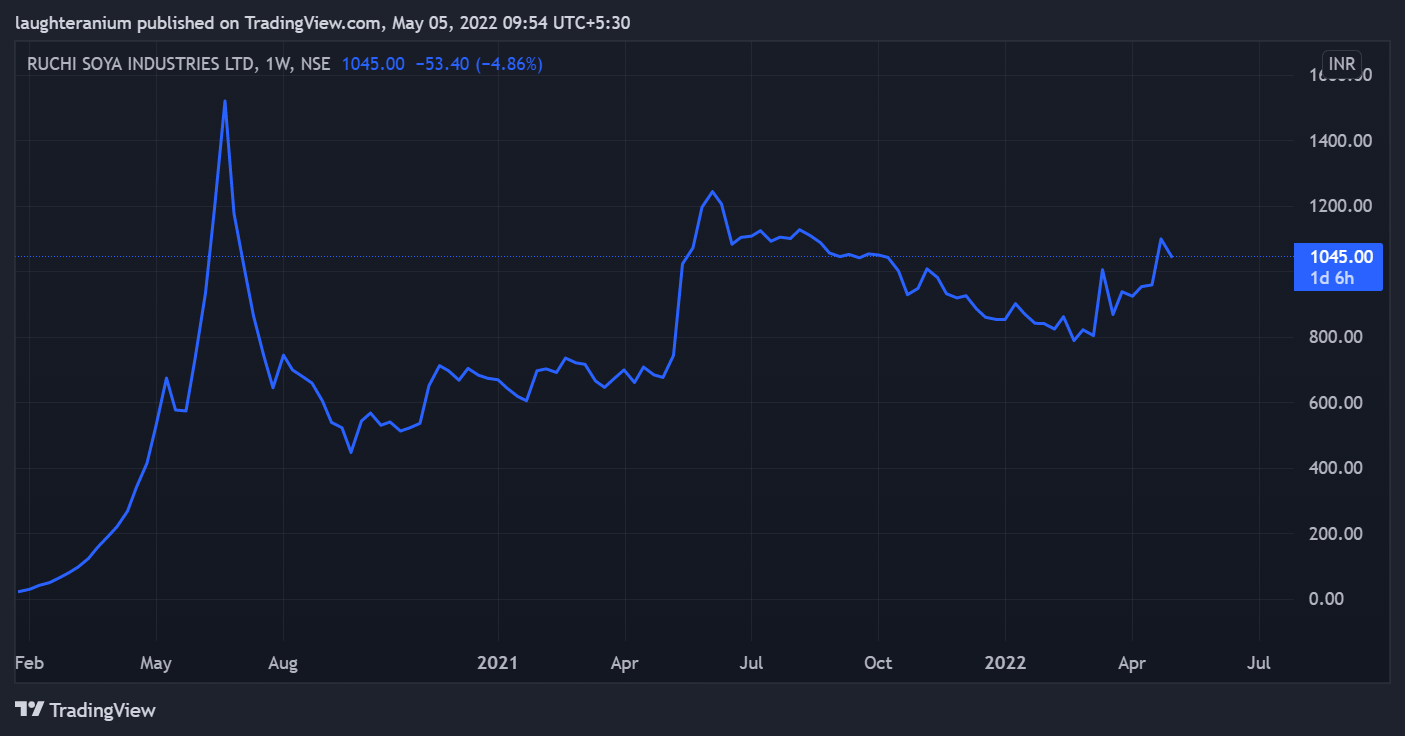
Ruchi Soya Industries is a company that was technically valued at zero for a while but was soon valued at thousands of crores. The company faced extreme financial doldrums and was dragged to insolvency court by its creditors. Two companies placed bids to buy Ruchi Soya— Patanjali and Adani Wilmar. Patanjali won the bid and virtually bought the company for free. After the turbulent takeover, the company’s share price soared at unimaginable rates, filling the pockets of all investors. It is pretty rare to see such a comeback in the Indian business world. The story of the takeover is controversial and is a test case for SEBI. 

In this article, we discuss the story behind Ruchi Soya and why it has been in the news lately. 

Ruchi Soya and its Controversial Takeover By Patanjali

Ruchi Soya Industries manufactures oils, vanaspati, bakery fats, and soya. The company’s oil business faced problems because of cheaper imports from foreign countries and competition from other local players. There are dozens of reasons as to why Ruchi Soya faced a financial crunch. 

Moving on, Ruchi Soya’s lenders (the banks) dragged Ruchi Soya to bankruptcy court and was taken off the stock exchanges. The banks were unsure if Ruchi Soya would be able to pay back its dues. Therefore, they wanted to liquidate the company to clear the pending dues. Two companies were frontrunners in the bidding process— Adani Wilmar and Baba Ramdev’s Patanjali. Patanjali won the bid, acquiring Ruchi Soya for ~Rs 4,350 crore. 

Here’s the twist: out of the ~Rs 4,350 crore, around Rs 3,200 crore were lent to Patanjali by the very same banks that lent money to Ruchi Soya initially. Around Rs 1,200 crore from SBI, Rs 700 crore from Punjab National Bank, Rs 600 crore from Union Bank of India, Rs 400 crore from Syndicate Bank, and Rs 300 crore from Allahabad Bank.

Shares Rally 8,000%!

After Patanjali’s takeover, the company relisted on the exchanges and its shares rallied by nearly ~8,000%! One of the reasons for such strong inflation in price is because only ~1% of the total shareholding is public, the rest being with Patanjali and other promoters. A small group of traders could have pumped the price of Ruchi Soya. Many investors questioned the sudden rally and accused Patanjali of foul play and manipulation. They demanded a SEBI probe. 

Now, Patanjali has a debt that it has to repay for having borrowed money to acquire Ruchi Soya. Ruchi Soya’s business continues as usual, but the company’s valuation has skyrocketed. This is when Patanjali decides to dilute its shareholding through a follow-on public offer (FPO) at a discount of around 30%. Patanjali decided to reduce its shareholding to around ~80% through the FPO, offloading around 18-19% stake for Rs 4,300 crore. This is practically the same amount it bought Ruchi Soya for. 

Crackdown by SEBI

Around the time of the FPO, suspicious emails and texts started circulating, nudging Patanjali consumers to invest in the FPO. In one of his speeches, Baba Ramdev stated that the secret to being a ‘crorepati’ was to invest in Ruchi Soya’s FPO. This didn’t go down well with SEBI. The market regulator stalled the FPO, allowing investors a window of three days to withdraw their bids from the FPO. They also asked Patanjali to put out advertisements in national newspapers, discrediting the SMS and e-mails. Nearly 97 lakh bids were withdrawn from the FPO in the meantime. 

In the end, Ruchi Soya managed to go debt-free and profitable from a once bankrupt company. Retail investors, who might have lost hope during the insolvency proceedings, earned humongous returns from the share. Patanjali managed to buy Ruchi Soya at virtually little to no cost, and creditors went back home with their respective money. Seemed like all in a day’s work!

Categories
Editorial

What is Happening Between SEBI and Ruchi Soya?

The share price of Ruchi Soya Industries Ltd has been highly volatile lately. The Patanjali-owned company’s Follow on Public Offer (FPO) has come under the scanner of India’s stock market regulator. In this article, we discuss the recent developments surrounding Ruchi Soya’s FPO and why SEBI has taken strict action against the FMCG firm.

Ruchi Soya Industries – A Brief Profile

Ruchi Soya Industries Ltd (RSIL) is a fast-moving consumer goods (FMCG) company that has evolved as an integrated player in India’s edible oil sector. It also produces and markets textured soya protein, honey, atta, biscuits, noodles, and wellness products. The company owns and operates numerous palm plantations across our country.

Over a decade ago, Ruchi Soya started facing massive hurdles due to high input costs and low margins. The company was competing with cheap imports, and its seed extraction business was failing. Moreover, they used to offer generous credit terms to customers, which they ultimately could not retrieve. RSIL faced an unfortunate debt crisis to the tune of Rs 9,000 crore! 

In 2017, a consortium of banks dragged RSIL to the bankruptcy court. The lenders agreed to resolve the bankruptcy proceedings by selling Ruchi Soya to another FMCG firm. This is when Baba Ramdev’s Patanjali Ayurved Group stepped in. They acquired a ~99% stake in RSIL and settled ~Rs 4,000 crore in dues.

The FPO

As per SEBI’s current shareholding norms, Patanjali has to bring down its stake in Ruchi Soya to 75%. Earlier this month, Ruchi Soya announced the launch of a Follow on Public Offer (FPO) to raise Rs 4,300 crore and bring down Patanjali’s (promoter) stake to 81%. The company fixed Rs 615-650 as the price band for the FPO. Through this offer, RSIL will introduce new shares to the public and dilute its current shareholding pattern. 

The offer opened on March 24 and received an overall subscription of 3.59 times as of March 28. During this period, SEBI noticed that unsolicited SMSes were being circulated amongst Patanjali’s customers:

The market regulator said the content of the SMS appeared to be misleading and fraudulent. It directed Patanjali and the lead managers of the FPO to issue a notice to all investors in the form of advertisements to caution them about the circulation of such messages. Ruchi Soya claimed the messages were not issued by them or by any of their directors, promoters, or group companies.

Special Window to Withdraw Bids

To highlight their non-tolerance policy on such affairs, SEBI instructed RSIL to offer investors a special window to cancel their bids in the FPO! A notice was sent to all applicants that submitted bids, informing them about a window till March 30 to withdraw their bids. As per reports, foreign portfolio investors (FPIs) have cancelled 97% of bids during the two-day withdrawal period. However, demand from high net-worth individuals (HNIs) and small retail investors saw only a minor pullback. Many would have come under pressure and felt subscribing to the FPO would now be a risky bet. 

The overall subscription of the FPO declined from 3.6 times to 3.4 times on March 30. The finalisation of the basis for allocation of new shares will be declared on April 5. Will those who have been allotted new shares lose money? Or will the news surrounding RSIL and its FPO simply die down? Let us look forward to seeing how the situation unfolds in the days to come. 

Have you invested in Ruchi Soya Industries or applied for its FPO? Let us know in the comments section of the marketfeed app.

Categories
Editorial

The Honey Scam – All You Need to Know

The Covid-19 pandemic has created a necessity to improve our immunity. Many people started taking vitamin tablets, while others turned to a more natural alternative. This is when we saw an increase in the consumption of honey all over the world. It is one of the best remedies for a sore throat, due to its antibacterial properties. Indian brands used this as an opportunity to ramp up their honey production. They even came up with interesting marketing campaigns to improve sales. 

However, a shocking report from CSE was released last week, which claims that major Indian brands are involved in adulteration of honey! How pure is the honey that we have been consuming all this while? Have the companies been selling a cheap alternative? Let us understand the details surrounding these latest revelations.

The CSE Investigation

The Centre for Science and Environment (CSE) is a not-for-profit public interest research and advocacy organization based in New Delhi, India. They had earlier exposed a large number of illegal practices such as pesticides in colas and packaged water, antibiotics in honey, and excess salts and trans fats in junk foods. 

Earlier this year, CSE received many tip-offs from Indian beekeepers. They informed the organization about the presence of widespread contamination of honey by domestic manufacturers. The beekeepers pointed out that major brands were sourcing sugar syrup from China. The brands opted to buy sugar syrup, as it is available for half the price of raw honey. This had led to many beekeepers going out of business. The CSE took up the mission to find out the truth behind these claims.

Key Findings

Now, let us specifically look at the details regarding CSE’s recent study on the adulteration of honey:

  • Between August-November 2020, the CSE collected 22 samples of honey from 13 Indian brands. Eight of these brands sell processed honey, while the others sell raw honey.
  • They initially sent the samples for testing at the Centre for Analysis and Learning in Livestock and Food (CALF), in Gujarat. The testing was conducted as per the parameters set by the Food Safety and Standards Authority of India (FSSAI). All the major brands passed this particular test, whereas smaller brands failed to meet the Indian standards. 
  • However, CSE was not convinced with the results from the initial test conducted by CALF. They believed that these samples had to go through a world-class purity test. Thus, they sent all the samples to a renowned food testing laboratory in Germany. This lab has a more advanced testing technology that helps detect adulteration and also the origin of honey. These specific tests are called Nuclear Magnetic Resonance Spectroscopy (NMR Test) and Trace Marker for Rice Syrup (TMR Test).
  • The German lab sent a very detailed analysis of their findings on December 2. This was exactly when things became very serious. It was found that 10 out of the 13 honey brands had failed the purity test. Out of a total of 22 samples, only 5 passed all the tests.
  • More importantly, the investigation revealed that Indian companies were importing synthetic sugar syrups from China for adulteration of honey. 
  • CSE stated that honey is also mixed with syrup acquired from rice, corn, beetroot, and sugarcane and is sold as ‘pure honey’ by these brands. This syrup is factory-made and produced in bulk (mainly from China) and was cheap. The Indian brands used large quantities of these cheap syrups in their honey. This is clearly a health hazard.
  • At least 77% of Indian honey brands including Dabur, Patanjali, Zandu, Baidyanath, Hitkari have failed the NMR test. Saffola Honey (a product of Marico Ltd), Markfed Sohna, and Nature’s Nectre were the only brands that passed all the tests.

Recent Developments

After CSE released these shocking revelations, the companies such as Dabur Ltd., Patanjali Ayurved, and Emami Group (Zandu Honey) have denied all claims. They stated that their respective honey brands adhere to all protocols and quality standards as per the Indian Government and the FSSAI. The companies have also stated that CSE’s claims seem to be motivated and aimed at defaming them. They have also insisted that honey sold by them are collected from Indian sources and packed with no added sugar or other adulterants.

Over the last few days, some of you may have seen the advertisements of Dabur Honey popping out on all types of media. It states that their honey passes all key tests of the Indian food regulators and is 100% pure with no added sugar. At the same time, Marico Ltd has also posted newspaper ads that mention that their brand- Saffola Honey- has passed the international standards test. Interestingly, both Dabur and Marico have decided to move the Advertising Standards Council of India (ASCI), accusing each other of making false purity claims of their ads!

On December 4, CSE forwarded all details regarding their investigation to the FSSAI. This contains step-by-step developments that brought the fraud to light. This would help the agency to understand the loopholes in its purity and quality testing standards. 

Conclusion

We had increased the consumption of honey to boost our immunity. Unfortunately, we were actually ingesting sugar instead of natural honey. Widely consumed honey brands in India have been misleading or deceiving us with their promise of purity. Such an important food item, that has immense health benefits, is completely filled with sugar syrup. The CSE has provided us with concrete evidence that brands have used demand opportunities arising from the Covid-19 pandemic as an excuse to sell adulterated items. The business of adulteration has constantly evolved over the years to beat laboratory tests as well. Consuming such items could cause severe health issues in individuals.

Also, do bear in mind that India imports these adulterants in bulk orders from China. The Chinese companies had openly claimed that its syrups will not be detected in adulteration checks. As India has now stopped all imports of Chinese items, the major domestic companies have even moved on to local entities for their supply of sugar syrup. The Indian beekeepers have been losing their business, as brands are using fewer quantities of raw honey in their products.

Let us hope that the government, and its agencies such as the FSSAI, introduce new and better standards for the testing of honey. The agencies need to step up surveillance, sampling, and inspection to check the misuse of such activities. It needs to be completely stopped at all costs. The health of all Indians needs to be given utmost importance, especially at a time when we are facing a global pandemic.

Categories
Editorial

Who is Murari Lal Jalan, the Mystery Man in Jet Airways Revival Plan?

On 17th October, the partnership consisting of Kalrock Capital and Murari Lal Jalan won the bid to revive Jet Airways. The troubled airline will finally be able to fly the skies again after more than a year, by initially kickstarting domestic flights. However, this will have to wait, as all the required formalities have to be completed. That aside, we believe that the name Murari Lal Jalan is one that none of us have heard before. Let us understand what this random stranger does, and why he plans to enter the airline industry.

The Mystery Man

According to many in the business world, Murari Lal Jalan is a very mysterious man. There is not much information about how he was able to create all his wealth. He has always kept a very low profile, and is not popular among the business communities in India or abroad. Totally inexperienced in the field, he has confused a lot of people as to how he was able to enter into the airline industry. Let us look at some of the facts which we know are for certain: 

In the 1980s, Murari Lal Jalan began his career by entering into the paper industry. He started working at his family’s paper trading business in Kolkata. He also worked as a trader for JK Paper and Ballarpur Industries, which were once big paper manufacturing companies. In 2003, he wanted to expand his paper business, and thus, acquired Kolkata-based Kanoi Paper and Industries. He renamed the company to Agio Paper, and currently has a manufacturing facility in Bilaspur (Chattisgarh). However, In 2010, the paper company faced a lawsuit from government agencies, for pollution-related issues. The production activities of Agio Paper have been suspended since then. So almost his whole career, his focus was on the paper industry and even that did not end well either.

After his paper company received backlash, Jalan began plans to enter the real estate and healthcare sector. In 2015, he approached Dr. Naresh Trehan and Associates Health Services. He went on to acquire a stake in the company for Rs 75 crore, through a secondary share sale transaction. A secondary sale means that Jalan bought-out the shares from an existing stockholder. Around the same time as the acquisition, Dr. Trehan’s Medanta Hospital had plans to establish a hospital in Dubai, with the help of Jalan. Unfortunately, this plan was not implemented.

Jalan kept going and began to secure his vision of entering into more businesses. Once he moved his base to the UAE, he quickly expanded to sectors such as real estate, mining, fast-moving consumer goods, and construction. He was chairman of the Agio Image group, which sold and distributed photographic and consumer products of well-known companies such as Sony, Panasonic, and Konica.

He established the real estate development company, MJ Developers. The firm has its headquarters in Dubai, but its main businesses span over countries such as Russia, Brazil, and India. MJ Developers is currently engaged in developing residential and commercial properties in Uzbekistan. Jalan is also contributing to the development of the city of Namangan (in Uzbekistan), which has been termed as a land of investment opportunity in pharmaceuticals, the health sector, automobile, and information technology. Various reports state that he was able to improve his business position through these projects in Uzbekistan. In fact, if you search his name on Google, many shady self-praising articles from Uzbekistan will show up.

It is also interesting to know that Jalan had partnered with his own family relatives to set up Patanjali India Distribution Ltd. Certain documents from the Indian Ministry of Corporate Affairs state that this company would be involved in trading, export, distribution, and marketing of milk products and health foods. The list of products also included herbal medicines and ayurvedic cosmetic items. Regardless of these claims, the company never opened, and the founders never looked back on it. We do know that Patanjali Ayurved is owned by the yoga guru, Baba Ramdev. However, it is not clear whether the two companies are linked in some way.

Entry into Airline Industry

At a time when most airline companies are going through huge losses due to the Covid-19 pandemic, we see that Kalrock Group and Murari Lal Jalan have plans to revive a very troubled airline- Jet Airways. You can read more about why the airline company failed here. Some may question as to why there was a sudden need for Jalan to enter into this field. Many have suspicions whether this deal would really help the airline to bring back its former glory.

Through the bid to revive Jet Airways, it would be the first time that Jalan starts his venture into the airline industry.  “Jet Airways is a renowned Indian aviation company with a strong legacy. The aviation sector underwent substantial correction on account of Covid-19 and created an opportune time to enter the sector. Our vision for Jet Airways is to operate the carrier as a full-service airline, both domestic and international”, he declared in a statement. The point to be noted here is that Jalan has no expertise in this particular sector. However, the management team of Kalrock does have the essential experience from cargo and logistics management through past deals. They have big plans to take Jet Airways to new heights.

Now, we know that Murari Lal Jalan has always been interested in entering into multiple business sectors. His latest entry into the aviation or airline industry can be analysed as part of his plan to speed up the expansion of his empire. The proverb ‘don’t put all your eggs in one basket’  can clearly be attributed to him. 

But now, a major doubt remains to be answered – how was Jalan able to create all this wealth and expand his business to such a large magnitude? We have seen that his initial business in the paper manufacturing industry had failed. Also, when Jalan moved to the UAE, he was not able to contribute effectively towards the implementation of projects in the healthcare sector. He created a company in India that was never launched. Moreover, the fact that most business people don’t know about him, makes everything all the more suspicious. All these facts make us feel very unsure and doubtful about his new deal with Jet Airways. Let us wait and watch for the results of this revival plan.