Categories
Market News Top 10 News

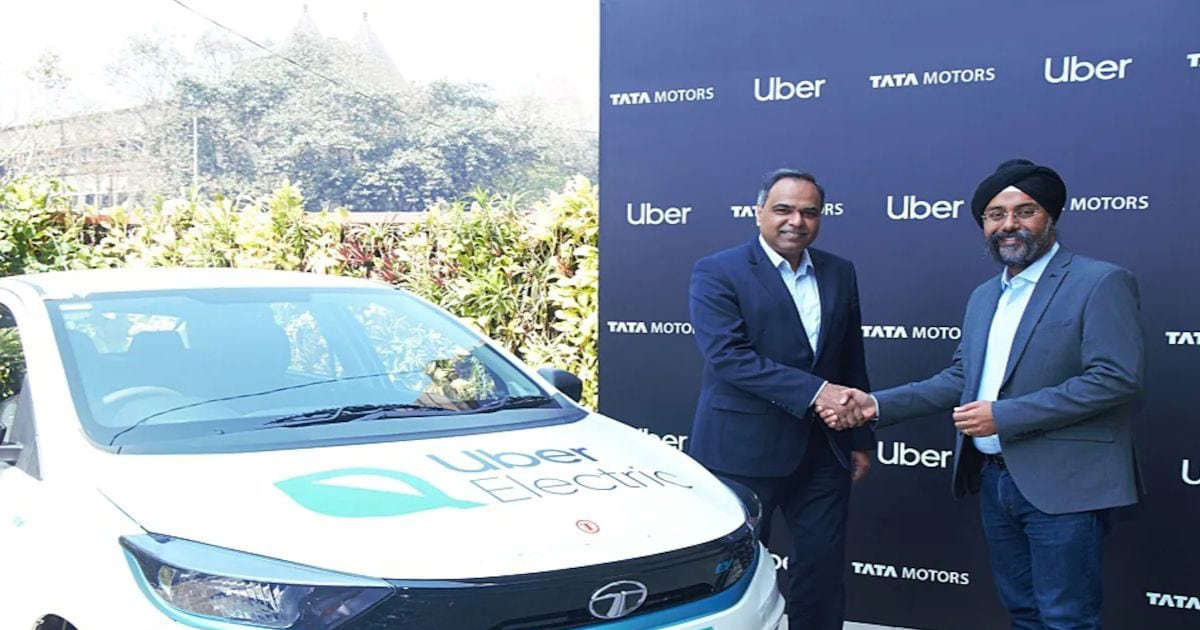
Tata Motors to Supply 25,000 Electric Sedans to Uber – Top Indian Market Updates

Here are some of the major updates that could move the markets tomorrow:

Tata Motors to supply 25,000 XPRES-T electric sedans to Uber

Tata Motors said it would supply 25,000 XPRES-T electric vehicle units to Uber in one of the largest deals in the green mobility space to date. As per a memorandum of understanding (MoU) between the companies, Uber will utilise electric sedans in its premium category service. The electric fleet would be operational across Delhi NCR, Mumbai, Kolkata, Chennai, Hyderabad, Bengaluru, and Ahmedabad

Read more here.

Adani Ports to prepay $121 million short-term debt due in March

Adani Ports & Special Economic Zone Ltd. will prepay the debt raised through commercial paper after it repaid 15 billion rupees of similar debt due on Monday as scheduled, the company’s spokesperson said. India’s largest-private-sector ports operator used its cash balance and funds generated from business operations to pay its short-term debt due on Monday.

Read more here.

Maruti Suzuki to focus on local manufacturing and reducing carbon footprint

Maruti Suzuki India said it will continue to work on all kinds of technologies in order to reduce its carbon footprint. The auto major will also focus on local manufacturing to achieve its green goals. It also noted that Maruti Suzuki has the least amount of fleet carbon emission among all car manufacturers in India.

Read more here.

Bank of Baroda CEO says willing to keep lending to Adani Group

Bank of Baroda CEO says that it is willing to consider lending additional money to the Adani Group, including for a project to remodel a slum that is among the world’s largest. The bank will extend loans to the conglomerate if it meets the lender’s underwriting standards. He also added that he’s not concerned about the market volatility around Adani stocks.

Read more here.

Adani said to decide against a bid for stake in power trader PTC

Gautam Adani has decided against bidding for a stake in state-backed electricity trader PTC India Ltd as the company looks to preserve cash amidst the Hindenburg issue. In January, Adani was among the possible bidders reviewing preliminary information on the Mumbai-listed company, Bloomberg News reported. The company will not proceed with any offer for the energy trading firm, said the people, who asked not to be identified as the information is private.

Read more here.

Gland Pharma to invest Rs 400 crore to expand its Telangana plant

Gland Pharma will invest Rs 400 crore to create additional capabilities in its existing facility at Genome Valley in Hyderabad to manufacture biologicals, biosimilars, antibodies, and recombinant Insulin. The expanded site is envisaged to meet the national and international regulations to be followed in the manufacturing of biological products as applicable, and shall be built under the GMP guidelines applicable for the respective product lines, it said.

Read more here.

Domestic aviation traffic continues growth, Jan records 1.25 cr passengers with 95.72% rise

Domestic aviation traffic has continued to witness massive growth. Passengers carried by domestic airlines during January 2023 were 1.25 crore, registering an annual growth of 95.72% and monthly growth of 95.72%. According to data released by the Directorate General of Civil Aviation (DGCA), the passenger load factor or occupancy of the airlines remained on the higher side in the range of 80 to 90%.

Read more here.

Centre opposes Hindustan Zinc’s $2.98 billion deal for Vedanta zinc assets

The Central government has opposed Hindustan Zinc’s proposed $2.98 billion acquisition of zinc assets from Vedanta Ltd. The govt will oppose any further resolutions on the deal and explore all legal avenues available to it. The Centre holds nearly 30% stake in Hindustan Zinc, while Vedanta is the company’s largest shareholder.

Read more here.

Categories
Editorial

Can BluSmart EV Cabs be a Threat to Ola, Uber?

An electric vehicle (EV) ride-hailing platform has made a grand entrance at a time when Ola and Uber (who have largely enjoyed a duopoly) are facing the rage of customers over numerous concerns, particularly with how surge pricing is determined. 

In this article, we discuss the challenges faced by online cab service providers and how BluSmart, the newest entrant in the ride-hailing segment, seems to be checking off all the right boxes. 

Transformation of the Indian Taxi Industry 

We have all witnessed a major transition in the Indian taxi industry. Around 2010, we experienced a shift from radio cabs or conventional taxis to online cab services from OLA and Uber.

Before the OLAs and Ubers took over the Indian market, there was a scarcity of good cab services. There was a time when getting a taxi in places like Mumbai and Delhi required a 40-minute wait. Owing to high demand and betterment in the quality of cabs, the organised taxi market grew. The online players were responsible for changing the customer perception of taxi services in India.

“Customer is god”. We all know that, but these online players also strived to keep their driver-partners content. Bonuses, incentives, free training, and health check-ups were provided. These companies knew that if they kept their drivers satisfied, then the riding experience would improve, and that would translate into higher brand value

Challenges Faced by Online Cab Service Providers

With rising fuel prices over the years, driver incentives were eliminated and the earlier no-cancellation policy was now a major curse.

  • App-based taxi aggregator companies had promised their drivers high monetary incentives. However, incentives were drastically cut, resulting in increased driver dissatisfaction.
  • The average wait time for the cab was 2-4 minutes, which has now been increased to 12-15 minutes. 
  • Fare prices have also increased, which is driving customers away.
  • Users have been complaining about the high rates of cancellations and the drivers’ insistence on cash payments.
  • The drivers work 14-16 hours shifts a day to make ends meet.

BluSmart: Disrupting the Disruptors

These shortcomings are exactly what Gurugram-based BluSmart is attempting to address and eradicate!

BluSmart is an electric shared smart mobility platform that offers intelligent, economical, sustainable, and efficient transportation. It was established in 2019 with sustainability being the core foundation of its operations. They have the vision to bring positive environmental changes to Indian cities by establishing a holistic and comprehensive electric on-demand mobility platform. 

As of July 2022, the company announced it had saved 4300+ tonnes of CO2 over 1.8 million rides in Delhi NCR and received Verra accreditation (a standard for certifying carbon emissions reductions) on carbon emissions.  

BluSmart’s drivers don’t have a cancel button in their app! It has also onboarded women drivers. In that sense, it seems to be checking off all the right boxes— spanning higher service levels, environmental awareness, and women empowerment. 

Challenges in Growth

BluSmart’s expansion faces several hindrances. It accepts reservations/bookings for its automobiles and works in accordance with the availability of slots. Since the rider already has a set itinerary, this will not pose a problem. However, it may lose out on rides where spontaneous travel decisions are made. On the same right, BluSmart users have reported that their vehicle usually arrives at the pickup location well before the allotted time frame. 

Also, their vehicles are not driver-owned assets, unlike Ola or Uber. BluSmart possesses ownership of all its vehicles. Its entire fleet is electric and consists of Tata Tigor EVs. This also implies that these vehicles require a location to recharge their batteries. The lack of charging infrastructure in India poses a significant hurdle to the company’s expansion. However, BluSmart has partnered with Jio-BP to set up charging infrastructure across India. 

The Way Ahead 

BluSmart is dedicated to expanding its substantial and competitive presence throughout all of the nation’s megacities. After being Delhi NCR-focused, it has started operations in certain areas in Bengaluru, including Indiranagar, Koramangala, Wilson Garden, Domlur, HSR Layout, Bellandur, and a few more. 

The ride-sharing company also aims to grow its fleet size from 2,200 cars to more than 5,000 by the end of this year. It plans to operate 30,000 EV cabs by the end of 2023!

BluSmart is creating inclusive and equitable economic opportunities for driver-partners who can drive and earn without the hassles of asset ownership. The startup’s goal is to provide economical and environmentally friendly transportation options for metropolitan India.

Will BluSmart outsmart Ola and Uber, or will it face the heat and pressure of the veterans? Let us know your views in the comments section of the marketfeed app!