Categories
Market News Top 10 News Top Global News

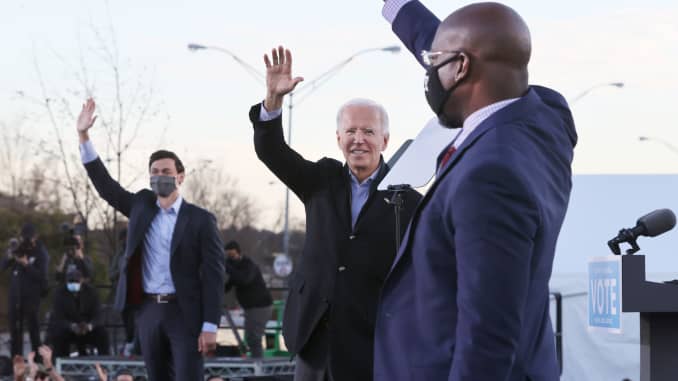
Democrats win Senate; Biden gets Full Govt. Support – Top 10 Global News

1. Stocks Climb Toward Record With Stimulus in Focus

Stocks rose toward a record a day after violence rocked the U.S. Capitol, with investors firmly focused on the prospect for more economic stimulus and the likelihood that calm will prevail as Joe Biden takes the presidency. The S&P 500 extended gains into a third day, led by financial companies. Treasury yields held above 1%, while the dollar advanced. Democrats are set to take control of the U.S. Senate, House and presidency, paving the way for Biden to bring his legislative agenda to life and reshape the American economy. He was recognized by Congress as the next president early Thursday.

The S&P 500 rose 0.7% as of early morning New York time.

The Stoxx Europe 600 Index gained 0.4%.

The MSCI Asia Pacific Index climbed 0.8%.

2. Biden Reaps Best Georgia Prize: Democrats Get Senate

Joe Biden won a huge boost with Democrats securing control of the Senate by the narrowest of margins, giving the president-elect a smoother path for advancing his nominees and legislative agenda. But the wins in two Georgia runoff elections came on a day when rioters backing President Donald Trump stormed the U.S. Capitol during the joint session of Congress that certified Biden’s Electoral College win. Lawmakers sheltered under their desks as security officers drew weapons and barricaded the members in the chamber with whatever furniture they could find.

3. Global Food Prices at Six-Year High and Climbing

Global food prices reached a six-year high in December and are likely to keep rising into 2021, adding to pressure on household budgets while hunger surges around the world. Food prices has jumped 18% since May, as adverse weather, government measures to safeguard supplies and robust demand helped fuel rallies across agricultural commodities. Prices will likely climb further, the UN’s Food & Agriculture Organization said. The spike threatens to push up broader inflation, making it harder for central banks to provide more stimulus to shore up economies. It’s bad news for consumers whose incomes have been hurt by the Covid-19 crisis and adds to concerns about global food security that’s being affected by conflicts and weather shocks.

4. U.S. Vaccine Rollout Hindered by Faulty Coordination, Messaging

As the U.S. grapples with record hospitalizations and deaths from the Covid-19 pandemic, a crucial vaccination rollout campaign is being impeded by inconsistent messaging and myriad state strategies as a new variant of the virus drive up infection rates, according to public health experts. The missteps have put the number of vaccinations well behind targets set by the Trump administration’s U.S. Operation Warp Speed effort. Only 5.46 million doses have been administered in the U.S. since mid-December against a goal of 20 million by the end of 2020. Vaccination rates have ranged significantly across states, with South Dakota using 69% of the doses sent to it and Georgia just 22%.

5. U.S. Trade Gap Widened to Second-Biggest Record in November

The U.S. trade deficit widened to the second-largest on record in November as merchandise imports reached a more than one-year high in the midst of the holiday shopping season, causing the shortfall in goods to climb to the highest yet. The gap in the trade of goods and services expanded to $68.1 billion in November from $63.1 billion in October. Total imports increased 2.9% to $252.3 billion, with inward-bound shipments of goods climbing to $214.1 billion, the highest value since May 2019. The merchandise-trade deficit increased 6.2% to $86.4 billion, the biggest on record, while the nation’s surplus in services to $18.2 billion, the lowest since August 2012.

6. Tokyo in State of Emergency; China Locks Down City: Virus Update

Japan’s Prime Minister Yoshihide Suga declared a state of emergency for Tokyo and the surrounding areas, trying to stem infections that hit a daily record in the capital. China banned all vehicles and people from leaving the city of Shijiazhuang to the south of Beijing after confirming almost 200 coronavirus infections. More than 10 million people will now be tested for the virus. Accelerating caseloads across Europe prompted a call from the World Health Organization for stricter measures across the continent. The U.S. reported a record 3,844 deaths from Covid-19, while confirmed cases globally climbed by an all-time high of 776,435 to more than 87 million.

7. Alibaba, Tencent Shares Drop as U.S. Weighs Investment Ban

Alibaba and Tencent led a technology stocks selloff as the Trump administration considers barring investments in China’s two most valuable companies. Alibaba fell 3.9% and Tencent dropped 4.7% in Hong Kong trading on Thursday, tracking losses in their New York-listed securities. Imposing a ban on the two companies would mark the most dramatic escalation yet by President Donald Trump’s administration, given the sheer size of the two firms and the difficulty unwinding positions. At $1.3 trillion, the combined market value of their primary listings together accounts for about 11% of the weighting for MSCI emerging markets benchmark.

8. Abu Dhabi’s Mubadala Wants to Take Crack at Top 10 Sovereign Wealth Funds

Abu Dhabi’s Mubadala Investment is overhauling its structure and deploying capital to double in size to nearly half a trillion dollars in the next decade, a plan that will vault it into the top ranks of the world’s sovereign wealth funds. With stakes in businesses from Reliance Industries Ltd.’s retail unit to private equity firm Silver Lake, Mubadala was among a few sovereign investors that last year seized on opportunities from a dislocation in markets caused by the coronavirus pandemic. The focus will be on technology, infrastructure, life sciences and other “future-oriented asset classes,” alongside continued investment in renewables and other clean technologies.

9. India’s GDP Set to Drop 7.7%, Biggest Contraction Since 1952

India’s economy is set for its biggest annual contraction in records going back to 1952 as the rapid spread of coronavirus cases and measures to contain them hurt businesses and households. The gross domestic product will shrink 7.7% in the financial year ending March 2021, the statistics ministry said in its first advance estimate published on Thursday. That’s steeper than a 7.5% drop forecast by the Reserve Bank of India. The estimates may undergo sharp revisions due to disruptions caused by steps to contain the pandemic, said the statistics office, which had suspended data collection coinciding with a nationwide lockdown.

10. U.S. Initial Jobless Claims Remain Elevated Heading Into 2021

Applications for U.S. state unemployment benefits were little changed at elevated levels in the final week of 2020, indicating the labour market remains battered with the pandemic dragging on. Initial jobless claims in regular state programs fell by 3,000 to 787,000 in the week ended Jan. 2, Labor Department data showed Thursday. Continuing claims for state programs — a rough approximation of the number of people receiving those benefits — declined by 126,000 to 5.07 million in the week ended Dec. 26. While initial claims dropped for a third consecutive week, the figures underscore a labour-market rebound that remains fragile, with Friday’s jobs report forecast to show a sharp slowdown in December hiring. The surge in Covid-19 cases sparked a wave of renewed restrictions on businesses and activity, spurring businesses to cut jobs.

Categories
Market News Top 10 News Top Global News

Democrats Hopeful of Senate Control – Top 10 Global News

1. Treasury Yields Reach 1%; Nasdaq Futures Tumble

Benchmark Treasury yields touched 1% for the first time since March while investors rotated out of technology and into cyclical stocks on speculation Democrats are on the cusp of taking control of U.S. Congress. Democrat Raphael Warnock ousted Republican Kelly Loeffler in a runoff race, leaving control of the Senate hinging on the state’s other election, which remains too close to call. Cyclical assets posted strong gains on Wednesday. Energy stocks and banks lifted equity benchmarks in Europe. In contrast, technology companies suffered and fell more than 2% in U.S. pre-market trading. 

Futures on the S&P 500 Index fell 0.2% as of afternoon London time.

The Stoxx Europe 600 Index climbed 0.9%.

The MSCI Asia Pacific Index was little changed.

The MSCI Emerging Market Index gained 0.2%.

2. Democrats’ Senate Bid Hangs in Balance After First Georgia Win

Democrats’ hopes of taking control of the U.S. Senate received a huge boost early Wednesday after the party captured one seat in the Georgia runoff elections and waited on the outcome of another race that remained too close to call. To secure a narrow majority, Democrats need to win both Senate seats, which would split the chamber 50-50 between Republicans and the Democratic caucus, with Vice President-elect Kamala Harris casting tie-breaking votes. Senate control, paired with the Democrats’ narrow majority in the House, would give Democratic President-elect Joe Biden full control of the U.S. government and allow him to implement major pieces of his agenda.

3. Saudis Take Charge of Oil Market With Surprise Output Cut

Saudi Arabia surprised the market with a large cut in crude production, an assertion of primacy over the global oil industry that came directly from the kingdom’s de-facto ruler. The move papered over cracks in the OPEC+ coalition and was a U-turn from some recent Saudi oil-policy priorities, but those things paled in comparison next to the global impact of the decision. Crude prices jumped to a 10-month high and shares of energy giants in London and shale drillers in Texas surged. 

4. U.K. Steps Up Biggest Vaccine Drive, With 1 in 50 Now Infected

More than 1 million people in England now have coronavirus, the British government said, as medics raced to vaccinate the most vulnerable against the rapidly spreading disease. Rocketing case rates from the new virus strain mean one person in every 50 in England now has Covid-19, while in London one in 30 is infected. Prime Minister Boris Johnson unveiled the statistics as he vowed to speed up the government’s vaccination program, in order eventually to lift the latest lockdown. He said 23% of all over-80s in England have now been given a dose of a Covid-19 vaccine, meaning some of those at the greatest risk are starting to get the protection they need.

5. Hong Kong Arrests U.S. Citizen, Dozens More Under Security Law

Hong Kong arrested dozens of opposition figures under a controversial national security law, an unprecedented crackdown that included an American lawyer, as authorities work to quash any dissent that remains in the former British colony. Police said they had swept up 53 people in the Wednesday operation and that around 1,000 officers had been dispatched to carry out the detentions. Those arrested included several prominent former lawmakers, with allegations centred on an informal July primary to choose candidates for legislative elections subsequently postponed by the government.

6. Faang Stocks Step Back as Democrats Advance in Senate

The Faang mega-cap stocks fell premarket Wednesday after Democrats won one of two seats in Georgia that they need to take control of the U.S. Senate. The other race remains too close to call. A blue sweep of Georgia that puts the Senate in Democratic control would be a “clear negative” for big tech, raising the potential for greater antitrust regulations in the sector. Facebook Inc. shares dropped 2.4% premarket, while Amazon.com Inc., Apple Inc., Netflix Inc., Alphabet Inc. and Microsoft Corp. fell less than 2%. Nasdaq 100 futures fell 1.4% while S&P 500 futures were trading lower by 0.3%.

7. Moderna’s Covid Vaccine Wins Backing of EU Drugs Regulator

Moderna Inc.’s Covid-19 vaccine won the backing of the European Union drugs regulator, clearing the way for a second weapon in the bloc’s fight to stem the pandemic. The recommendation was announced by the European Medicines Agency on Wednesday. The European Commission is working “at full speed” on the final clearance step, President Ursula Von Der Leyen said in a tweet. EU leaders are facing growing pressure to speed up clearance and deployment of vaccines to tame a virus resurgence across the continent. The 27-nation bloc began immunizations last week with the vaccine developed by Pfizer Inc. and BioNTech SE, but the pace of the rollout has been uneven, prompting unfavourable comparisons with the U.K. and U.S.

8. China’s Bottled Water King Is Now Richer Than Warren Buffett

The chairman of Nongfu Spring Co., a bottled-water company that’s ubiquitous in China, is now richer than Warren Buffett as his fortune surged $13.5 billion since the start of the year to $91.7 billion on Tuesday. Zhong, 66, is now the sixth-wealthiest person on the planet. Nongfu shares jumped 18% in the first two trading days of 2021, taking the advance since their September listing to more than 200%. It’s only the second time a Chinese national has broken into the world’s Top 10 — property tycoon Wang Jianlin hit No. 8 in 2015 — and no one from the mainland has ever ranked this high. Nicknamed locally as the “Lone Wolf” for avoiding involvement in clubby business groups or politics, Zhong also took vaccine maker Beijing Wantai Biological Pharmacy Enterprise Co. public in April. The stock has soared more than 2,800%.

9. World’s Super-Rich Families Want More Hedge Funds

More than a third of 185 investment firms for wealthy clans plan to boost allocations amid the economic upheaval caused by the Covid-19 pandemic, according to a survey released Wednesday by BlackRock Inc. and Juniper Place, a London-based firm that helps asset managers raise capital. Family offices and other investors soured on hedge funds in recent years, bemoaning high fees and lacklustre returns. But the health crisis has given some of those managers a boost, particularly stock-pickers who benefited from aggressive bets on technology stocks and copious economic stimulus that drove equities to new heights.

10. Gulf Arabs Agree to Restore Qatar Ties But No Word on OPEC Role

Saudi Arabia and three other Arab states agreed to fully restore ties with neighbouring Qatar on Tuesday after a sustained U.S. push for the countries to unite against Iran. The breakthrough ending a dispute among some of the world’s top oil and gas producers that erupted in 2017 came just two weeks before President-elect Joe Biden takes office after pledging a new start with Tehran. Saudi Arabia, Bahrain, the United Arab Emirates and Egypt signed an accord with Qatar in a mirrored concert hall in the northwestern Saudi town of Al Ula during a summit of Gulf Cooperation Council leaders, bringing the regional split to an end — at least on paper. The same day, Saudi Arabia asserted its primacy over the global oil industry by surprising the market with a large crude production cut that secured its leadership among global producers and sent crude prices soaring. The Gulf leaders made no mention of whether Qatar would rejoin the Organization of Petroleum Exporting Countries. The nation, which pumps around 650,000 barrels a day of crude in addition to gas, decided to leave the cartel at the start of 2019, in one of the most visible consequences of the fallout.

Categories
Market News Top 10 News Top Global News

Saudi – Qatar Normalize Relations – Top 10 Global News

1. Stocks Fluctuate Amid Key Georgia Senate Runoffs

Stocks wavered amid key elections in Georgia that will decide which party controls the U.S. Senate for the next two years, setting the scope of President-elect Joe Biden’s agenda. The S&P 500 swung between gains and losses after posting its worst start to a year since 2016. There’s a perception among several traders that if Democrats prevail in Tuesday’s runoff, Congress will deliver a more generous stimulus package, potentially leading to upward pressure on inflation and interest rates as well as higher taxes to pay for fiscal aid.
The S&P 500 was little changed as of early morning New York time.

The Stoxx Europe 600 Index decreased 0.5%.

The MSCI Asia Pacific Index climbed 0.6%.

2. Saudi, Qatar Borders Reopen Before Gulf Summit

Qatar’s ruler landed in Saudi Arabia on Tuesday to a warm embrace from host Crown Prince Mohammed bin Salman, hours after their nations re-established travel ties and eased a regional dispute. Qatari Emir Sheikh Tamim bin Hamad Al Thani is attending the Gulf Cooperation Council summit for the first time since a 2017 row that cut trade, travel and diplomatic ties with Saudi Arabia, the United Arab Emirates, Bahrain and Egypt. Saudi Arabia reopened its air, land and sea borders with Qatar on Monday, a leap toward easing the crisis that had complicated U.S. efforts to isolate Iran amid heightened tensions.

3. Oil Rises Above $48 With OPEC+ Talks Set to Start Second Day

Oil gained ahead of a resumption of OPEC+ talks that were unexpectedly suspended due to a disagreement over whether to raise output in February. Futures in New York rose above $48 a barrel after dropping the most in two weeks on Monday. Discussions will restart on Tuesday after a majority of members, including Saudi Arabia, opposed Russia’s proposal for another supply hike. The talks are happening against a shaky short-term demand backdrop. England was ordered into a third lockdown until mid-February, Germany is set to extend its curbs and Japan is considering another state of emergency for the Tokyo area. Several Asian refiners won’t be getting into long-term supply contracts for fuel sales this year, a sign the region’s energy consumption recovery is far from certain.

4. China Stock Index Tops 2015’s Peak, Closes at 13-Year High

China’s stock benchmark has ended above its 2015 bubble high, marking a recovery from one of the country’s worst equity crashes. The CSI 300 Index rose 1.9% at the close on Tuesday, surpassing the peak from June 8, 2015. That is its highest since 2008. That advance helped push the value of China’s domestic equities to a record $11 trillion. China’s stock benchmark outpaced MSCI Inc.’s global benchmark by the most in six years in 2020, with savers funnelling cash into thousands of new stock funds after some popular wealth products suffered their first-ever losses. The bullishness was reinforced by a strong currency, as well as data showing China’s economy was rebounding faster than other major economies from the virus pandemic.

5. JPMorgan Says Bitcoin Could Surge to $146,000 in Long Term

Bitcoin has the potential to reach $146,000 in the long term as it competes with gold as an asset class, according to JPMorgan Chase & Co. Bitcoin’s market capitalization of around $575 billion would have to rise by 4.6 times — for a theoretical price of $146,000 — to match the total private sector investment in gold via exchange-traded funds or bars and coins. But that outlook depends on the volatility of Bitcoin converging with that of gold to encourage more institutional investment, a process that will take some time, they said.

6. NYSE Abruptly Reverses Plan to Delist Chinese Companies

The New York Stock Exchange has abruptly reversed plans to delist three major Chinese telecommunications companies after consulting regulators about an investment ban ordered by President Donald Trump. Coming days before the companies were to be delisted — and just over two weeks before Trump is to leave the White House — the U-turn avoids a step that threatened to heighten U.S.-China tensions further. The Big Board gave no reason for its decision in a statement released during Asian hours, saying only that it had consulted “relevant regulatory authorities” about Trump’s executive order, signed in November as part of his administration’s push to check China’s growing economic power.

7. Saudi, UAE Business Conditions Improve, but Employment Falls

Business activity in the Arab world’s two largest economies improved at the end of last year, with Saudi Arabia seeing its strongest expansion in 13 months. After 2020 setbacks caused by the spread of Covid-19 and lower crude prices, non-oil private sector economies in the United Arab Emirates and neighbouring Saudi Arabia still faced job losses as firms adjusted to the challenges of the global pandemic. Purchasing Managers’ Index surveys in December for the two Gulf nations rose above the threshold of 50 that separates growth from contraction. In Saudi Arabia, the gauge rose to the highest since November 2019, driven by an increase in output and new business.

8. Danes Get 20-Year 0% Mortgages

Denmark stands out in a global context as the country to have lived with negative central bank rates longer than any other. Back in 2012, policymakers drove their main rate below zero to defend the krone’s peg to the euro. Since then, Danish homeowners have enjoyed continuous slides in borrowing costs. The once unthinkable notion of borrowing for two decades without paying interest comes as central bankers across the globe shy away from rate hikes. No major western central bank is likely to raise rates this year. As rates have continued to sink, banks in Denmark — home to the world’s biggest mortgage-backed covered-bond market — to offer 20-year loans at 0%.

9. Airlines Start to Scrap U.K. Flights Following New Lockdown

Airlines kicked off 2021 by shrinking their already meagre U.K. schedules, prompted by a new coronavirus lockdown and the prospect of further restrictions on travel abroad. The fast-spreading virus strain that’s driven up U.K. case counts has also dashed airline-industry hopes of relief from 2020’s unrelenting downturn. Prime Minister Boris Johnson late Monday announced a new coronavirus lockdown that will keep most people at home until mid-February when vaccines being rolled out are able to stem the worst infection rates since the start of the outbreak.

10. Merkel Pushes for Strict Curbs With Vaccine Strategy Under Fire

Chancellor Angela Merkel is seeking tighter lockdown restrictions to contain the coronavirus as criticism over Germany’s vaccine rollout sparks feuding in her cabinet. The chancellery is proposing a limit on how far people can travel from their homes in areas with high infection rates. The plan has run into opposition from state leaders, who are joining a video conference with Merkel on Tuesday to decide the next steps in fighting the disease. The political tensions threaten to escalate amid a rising tide of criticism that the government bungled the rollout of a Covid-19 vaccine.