Categories
Market News Top 10 News Top Global News

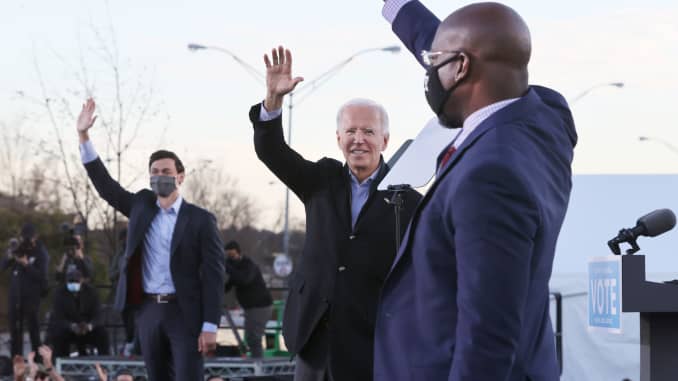
Democrats win Senate; Biden gets Full Govt. Support – Top 10 Global News

1. Stocks Climb Toward Record With Stimulus in Focus

Stocks rose toward a record a day after violence rocked the U.S. Capitol, with investors firmly focused on the prospect for more economic stimulus and the likelihood that calm will prevail as Joe Biden takes the presidency. The S&P 500 extended gains into a third day, led by financial companies. Treasury yields held above 1%, while the dollar advanced. Democrats are set to take control of the U.S. Senate, House and presidency, paving the way for Biden to bring his legislative agenda to life and reshape the American economy. He was recognized by Congress as the next president early Thursday.

The S&P 500 rose 0.7% as of early morning New York time.

The Stoxx Europe 600 Index gained 0.4%.

The MSCI Asia Pacific Index climbed 0.8%.

2. Biden Reaps Best Georgia Prize: Democrats Get Senate

Joe Biden won a huge boost with Democrats securing control of the Senate by the narrowest of margins, giving the president-elect a smoother path for advancing his nominees and legislative agenda. But the wins in two Georgia runoff elections came on a day when rioters backing President Donald Trump stormed the U.S. Capitol during the joint session of Congress that certified Biden’s Electoral College win. Lawmakers sheltered under their desks as security officers drew weapons and barricaded the members in the chamber with whatever furniture they could find.

3. Global Food Prices at Six-Year High and Climbing

Global food prices reached a six-year high in December and are likely to keep rising into 2021, adding to pressure on household budgets while hunger surges around the world. Food prices has jumped 18% since May, as adverse weather, government measures to safeguard supplies and robust demand helped fuel rallies across agricultural commodities. Prices will likely climb further, the UN’s Food & Agriculture Organization said. The spike threatens to push up broader inflation, making it harder for central banks to provide more stimulus to shore up economies. It’s bad news for consumers whose incomes have been hurt by the Covid-19 crisis and adds to concerns about global food security that’s being affected by conflicts and weather shocks.

4. U.S. Vaccine Rollout Hindered by Faulty Coordination, Messaging

As the U.S. grapples with record hospitalizations and deaths from the Covid-19 pandemic, a crucial vaccination rollout campaign is being impeded by inconsistent messaging and myriad state strategies as a new variant of the virus drive up infection rates, according to public health experts. The missteps have put the number of vaccinations well behind targets set by the Trump administration’s U.S. Operation Warp Speed effort. Only 5.46 million doses have been administered in the U.S. since mid-December against a goal of 20 million by the end of 2020. Vaccination rates have ranged significantly across states, with South Dakota using 69% of the doses sent to it and Georgia just 22%.

5. U.S. Trade Gap Widened to Second-Biggest Record in November

The U.S. trade deficit widened to the second-largest on record in November as merchandise imports reached a more than one-year high in the midst of the holiday shopping season, causing the shortfall in goods to climb to the highest yet. The gap in the trade of goods and services expanded to $68.1 billion in November from $63.1 billion in October. Total imports increased 2.9% to $252.3 billion, with inward-bound shipments of goods climbing to $214.1 billion, the highest value since May 2019. The merchandise-trade deficit increased 6.2% to $86.4 billion, the biggest on record, while the nation’s surplus in services to $18.2 billion, the lowest since August 2012.

6. Tokyo in State of Emergency; China Locks Down City: Virus Update

Japan’s Prime Minister Yoshihide Suga declared a state of emergency for Tokyo and the surrounding areas, trying to stem infections that hit a daily record in the capital. China banned all vehicles and people from leaving the city of Shijiazhuang to the south of Beijing after confirming almost 200 coronavirus infections. More than 10 million people will now be tested for the virus. Accelerating caseloads across Europe prompted a call from the World Health Organization for stricter measures across the continent. The U.S. reported a record 3,844 deaths from Covid-19, while confirmed cases globally climbed by an all-time high of 776,435 to more than 87 million.

7. Alibaba, Tencent Shares Drop as U.S. Weighs Investment Ban

Alibaba and Tencent led a technology stocks selloff as the Trump administration considers barring investments in China’s two most valuable companies. Alibaba fell 3.9% and Tencent dropped 4.7% in Hong Kong trading on Thursday, tracking losses in their New York-listed securities. Imposing a ban on the two companies would mark the most dramatic escalation yet by President Donald Trump’s administration, given the sheer size of the two firms and the difficulty unwinding positions. At $1.3 trillion, the combined market value of their primary listings together accounts for about 11% of the weighting for MSCI emerging markets benchmark.

8. Abu Dhabi’s Mubadala Wants to Take Crack at Top 10 Sovereign Wealth Funds

Abu Dhabi’s Mubadala Investment is overhauling its structure and deploying capital to double in size to nearly half a trillion dollars in the next decade, a plan that will vault it into the top ranks of the world’s sovereign wealth funds. With stakes in businesses from Reliance Industries Ltd.’s retail unit to private equity firm Silver Lake, Mubadala was among a few sovereign investors that last year seized on opportunities from a dislocation in markets caused by the coronavirus pandemic. The focus will be on technology, infrastructure, life sciences and other “future-oriented asset classes,” alongside continued investment in renewables and other clean technologies.

9. India’s GDP Set to Drop 7.7%, Biggest Contraction Since 1952

India’s economy is set for its biggest annual contraction in records going back to 1952 as the rapid spread of coronavirus cases and measures to contain them hurt businesses and households. The gross domestic product will shrink 7.7% in the financial year ending March 2021, the statistics ministry said in its first advance estimate published on Thursday. That’s steeper than a 7.5% drop forecast by the Reserve Bank of India. The estimates may undergo sharp revisions due to disruptions caused by steps to contain the pandemic, said the statistics office, which had suspended data collection coinciding with a nationwide lockdown.

10. U.S. Initial Jobless Claims Remain Elevated Heading Into 2021

Applications for U.S. state unemployment benefits were little changed at elevated levels in the final week of 2020, indicating the labour market remains battered with the pandemic dragging on. Initial jobless claims in regular state programs fell by 3,000 to 787,000 in the week ended Jan. 2, Labor Department data showed Thursday. Continuing claims for state programs — a rough approximation of the number of people receiving those benefits — declined by 126,000 to 5.07 million in the week ended Dec. 26. While initial claims dropped for a third consecutive week, the figures underscore a labour-market rebound that remains fragile, with Friday’s jobs report forecast to show a sharp slowdown in December hiring. The surge in Covid-19 cases sparked a wave of renewed restrictions on businesses and activity, spurring businesses to cut jobs.

Categories
Market News Top 10 News Top Global News

New Covid Strain Shakes Global Markets – Top 10 Global News

1. Stocks, Futures Slump on Virus Curbs; Bonds Rally

Stocks and futures were a sea of red on Monday as a new variant of the coronavirus in the U.K. caused chaos ahead of the Christmas holiday, with regional neighbours suspending travel. Energy and travel shares dragged the Stoxx 600 Index down 2.5% as Italy, the Netherlands, Belgium and France closed their borders to the U.K. The dollar gained the most since June. In the U.S., equity futures pointed to sharp declines at the open even after Congressional leaders reached a deal on spending to support the economy. Losses were concentrated in energy producers and stocks that would benefit from a return to more normal economic activity.  The pound slumped by the most since March as an official said “significant differences” remain in Britain’s trade talks with the European Union. Crude oil fell by more than 3%.

Futures on the S&P 500 Index sank 1.8% as of early morning New York time.

The Stoxx Europe 600 Index sank 2.6%.

The MSCI Asia Pacific Index dipped 0.6%.

The MSCI Emerging Market Index dipped 1.1%.

2. Congress Poised for Vote on $900 Billion Pandemic Relief Plan

The House and Senate are set to vote Monday on a roughly $900 billion pandemic relief bill that would be the second-biggest economic rescue measure in the nation’s history. The aid package will be attached to a $1.4 trillion measure to fund government operations through the end of the fiscal year, and congressional leaders said they expect the legislation to easily pass both chambers. The White House said President Donald Trump would sign it. The deal followed more than a week of furious negotiations sparked by a group of Democratic and Republican senators who drew up their own compromise proposal and urged their leaders to act.

3. Tesla Slides in First Day of Trading on the S&P 500 Index

Tesla’s shares fell as much as 6.4% in premarket trading on its first day after being added to the S&P 500 Index, as the broader market slid and the stock retraced gains from Friday when tens of millions of shares were purchased by index-fund managers. Futures contracts on the S&P 500 plunged 2.5%, following European stocks lower after several major countries moved to suspend travel from the U.K. amid concerns about a new strain of Covid-19. Tesla has catapulted 731% this year in anticipation of the historic inclusion, making it the biggest company ever to be added to the benchmark.

4. Biden Will Inherit a Strong Hand Against Xi, Thanks to Trump

Joe Biden will be sworn in as president after Trump’s administration spent years ramping up pressure on China, including levying tariffs on $370 billion in imports, getting Canada to place a Chinese executive for Huawei Technologies Co. under house arrest, threatening access to U.S. capital markets and blaming the Communist Party for the scale of the Covid-19 outbreak. President Trump’s pressure campaign continued last week, as the administration blacklisted more than 60 Chinese companies, limiting their ability to get U.S. technology, in order “to protect national security”.

5. JPMorgan Says Flows to Into Major Crypto Fund Are Key to Bitcoin’s Outlook

The odds of a Bitcoin correction would increase if the flows into the world’s largest traded cryptocurrency fund slow significantly, according to strategists at JPMorgan Chase & Co. The Grayscale Bitcoin Trust’s assets under management have climbed to $13.1 billion from $2 billion at the start of December last year, amid a tripling in the digital currency’s price so far in 2020. Inflows into the fund are running at about $1 billion per month, the strategists wrote in a note Friday. Bitcoin reached an all-time high of $24,291.38 on Sunday. The cryptocurrency’s backers argue it’s gaining ground among longer-term investors as a hedge against dollar weakness and risks such as higher inflation. Others claim an unsustainable speculative fervour, exacerbated by trend-following quant funds, lies behind much of the rally in Bitcoin and other digital assets.

6. Hong Kong May Consider Unprecedented Virus Curbs, Including Curfews

Unprecedented virus control measures including curfews and shutdowns of non-essential businesses may be considered in Hong Kong, according to a government health adviser, as the city continues to see a high number of locally-transmitted cases and the holiday season looms. Limiting the number of people per household allowed to shop for groceries, shuttering all businesses deemed non-essential and shortening mall operating hours are among the curbs that may have to be imposed to prevent another Covid-19 wave.

7. France Halts U.K. Freight Over Virus Alarm, Rocking Supplies

Britain’s biggest port stopped all traffic heading to Europe, triggering delays to food supplies after the discovery of a new variant of the virus prompted a wave of countries to ban travel from the U.K. The escalating crisis prompted Boris Johnson to convene a meeting of the government’s emergency committee on Monday in a bid to keep goods flowing. The concern is focused on links with France, which suspended inbound travel from the U.K., including freight, for 48 hours starting midnight Sunday. The disruption comes at a critical time for Johnson’s government, which is still negotiating the terms of post-Brexit trade with the European Union. It’s also battling a surge in coronavirus infections which forced ministers to put London and much of southeast England into lockdown over the weekend, heaping more misery on businesses in the critical pre-Christmas period.

8. Pound Plummets as Virus Threatens U.K.’s Supply Chains With EU

The pound had its worst day since the coronavirus roiled global markets in March, as a new strain of the pathogen disrupted the U.K.’s supply chains with Europe. Sterling tumbled 2.5% to as low as $1.3188 as Britain’s biggest port in Dover stopped all traffic heading to the continent, and after another Brexit deadline went past without results. The currency’s one-week implied volatility is the highest for a Christmas period in more than a decade. Expectations of monetary easing by the Bank of England mounted, with money markets bringing forward bets for a 10-basis-point interest-rate cut to September, compared with March 2022 on Friday. Ten-year bonds rallied, with yields slipping as much as nine basis points, and the FTSE 100 share index fell as much as 3.3%. 

9. Saudi Arabia, Oman Suspend Foreign Travel Over Mutant Virus

Saudi Arabia and Oman halted international flights and closed their borders for a week over fears about the fast-spreading new strain of the coronavirus. State-run Saudi Press Agency said the kingdom may extend the suspension for another week depending on the nature of the virus spread. Oman halted passenger traffic through its air, land and seaports for a week starting Tuesday, but freight services are exempt from the ban. The U.K. has warned that the new virus strain is “out of control,” prompting countries including France and Germany to suspend travel from Britain. 

10. Dubai Stocks Fall Most in Seven Months on Travel Worries

Stocks in Dubai slumped the most since May on fears of further travel restrictions after a new variant of the coronavirus was found in the U.K. A travel corridor between Britain and Dubai was expected to help air traffic on the route to climb by a third this month. Any anticipated boost to the city’s struggling tourism sector could also be threatened by several countries including neighbouring Saudi Arabia imposing fresh curbs.

Categories
Market News Top 10 News Top Global News

Countries Rush to Secure Vaccines. – Top 10 Global News

1. Global Stocks Advance, Dollar Weakens

Global stocks rallied, with confidence among investors building on the back of stronger German factory data, the vaccine rollout and the prospect for more U.S. stimulus. Markets were green across the board. The Stoxx 600 Index rose 0.9%, notching a third day of gains, and the DAX Index outperformed. In the U.S., S&P 500 futures were higher and the dollar weakened as investors waited for details from the Federal Reserve’s recent meeting. Economists say the Fed may deliver fresh guidance on its asset purchases and progress in meeting its goals of full employment and 2% inflation.

Futures on the S&P 500 Index increased 0.3% as of early morning London time.

The Stoxx Europe 600 Index jumped 0.8%.

The MSCI Asia Pacific Index increased 0.8%.

The MSCI Emerging Market Index gained 0.8%.

2. Fishing Rights Are Now Major Last Hurdle, EU Says: Brexit Update

European Commission President Ursula von der Leyen said fishing rights are now the last major hurdle to a post-Brexit trade deal, as Prime Minister Boris Johnson warned the U.K. has a “natural right” to control its own waters. With negotiations continuing in Brussels, von der Leyen told the European Parliament that a deal is possible but difficult. “As things stand, I can’t tell you if there will be a deal or not,” she said. Optimism has grown after the two sides agreed to continue discussions past their self-imposed Sunday deadline and the EU’s chief negotiator Michel Barnier said he saw a “narrow path” to a deal this week if differences can be bridged.

3. China Secures 100 Million Doses of BioNTech Vaccine

A Chinese drugmaker has secured 100 million doses of the coronavirus vaccine co-developed by Pfizer and BioNTech, as the country seeks overseas shots in addition to home-made ones to ensure immunization for the world’s most populous nation. Shanghai Fosun Pharmaceutical Group Co., which in March made an agreement with BioNTech to develop and market the mRNA shot in China, will make an advance payment of $300 million for an initial 50 million doses. The German vaccine maker will supply no fewer than 100 million doses for China by the end of 2021, Fosun said in a statement filed with the Hong Kong Stock Exchange.

4. New York Is on a Path Toward a Second Full Shutdown

New York is headed toward a second full shutdown if Covid-19 cases and hospitalizations continue at their current pace, Governor Andrew Cuomo said. “If we do not change the trajectory, we could very well be headed to shut down” all non-essential businesses, Cuomo said Monday at a virus briefing. The state reported 5,712 hospitalizations, an increase of more than 1,000 in the past week. If that pace continues, it will be at 11,000 in a month, and some regions may be overwhelmed, Cuomo said. The increase is of particular concern in dense regions like New York City, the governor said. Cuomo shut down the city’s indoor dining on Monday, even as he cited statistics showing that three-fourths of new cases come from private gatherings.

5. Cathay Still Mired in Covid Trouble With Traffic Down 99%

Cathay Pacific Airways carried just 37,815 passengers in November, down 98.6% from a year earlier, and warned that its second-half losses will be significantly worse than the $1.3 billion haemorrhages in the first six months. Average passenger capacity in the second half is only likely to be 8.4% of pre-pandemic levels, compared with 34.3% in the first half, the Hong Kong-based carrier said Wednesday. Restructuring and impairment costs will add to the pressure on earnings as demand remains elusive. Cathay’s passenger traffic has been down around 99% every month since April as Covid-19 and related travel restrictions decimated demand. November revenue passenger kilometres fell 97.9% from a year earlier, while passenger load factor was just 18.5%.

6. Hong Kong’s Lalamove Seeks Funds at $8 Billion Valuation

Hong Kong’s on-demand logistics and delivery firm Lalamove is seeking new funding round at an $8 billion valuation. The company, also known as Huolala in China, is looking to raise at least $500 million. The startup could raise more depending on investor demand. Founded in 2013 by Stanford graduate and former professional poker player Chow Shing-yuk, Lalamove provides van-hailing and courier services on demand. It operates in 24 markets across Asia, Latin America and the U.S. with a pool of more than 700,000 driver-partners. Lalamove’s business is anchored in China. Transportation and logistics companies have seen a surge in demand globally amid a boom in e-commerce, one of the beneficiaries of coronavirus-driven lockdowns this year.

7. FDA Clears First At-Home, Over-the-Counter Covid-19 Test

The first Covid-19 test that can be performed entirely at home was cleared by U.S. regulators on Tuesday, and it can be acquired without a prescription. While availability will be limited initially, the new test and others in development could make virus screenings as accessible as over-the-counter pregnancy tests in the U.S. for the first time. The advance follows months of criticism that the Food and Drug Administration has been too slow to approve rapid home tests for the virus. Manufactured by East Brisbane, Australia-based Ellume, the self-administered, single-use nasal swab test is small enough to fit in the palm of a person’s hand. It detects proteins on the virus’s surface in 15 minutes and delivers results to an app.

8. Boris Johnson Urges ‘Extreme Caution’ in U.K. Over Christmas

U.K. Prime Minister Boris Johnson urged people to exercise “extreme caution” over Christmas, despite pressing ahead with plans to ease coronavirus restrictions over the holidays. “We can celebrate it sensibly, but we have to be extremely cautious in the way we behave,” Johnson told lawmakers in the House of Commons on Wednesday. As many as three households will be able to gather together for five days between Dec. 23 and 27 in England. Ministers have faced growing demands to rethink the approach after a surge in Covid-19 infections in recent days.

9. German Virus Deaths at Record: Virus Updates

Germany recorded the biggest increase in Covid-19 deaths since the pandemic began as Chancellor Angela Merkel hinted that a hard shutdown that takes effect Wednesday will remain in force beyond January. Tokyo cases rose to an all-time high, while South Korea also reported record infections. China secured 100 million doses of the vaccine developed by Pfizer Inc. and BioNTech SE. In the U.K., almost 140,000 people have been vaccinated against Covid-19. Across the U.S., cases are surging. New York City’s mayor told residents to prepare for a shutdown of all but essential businesses soon after Christmas. California is stockpiling body bags, recruiting medical workers and considering whether to request a U.S. Navy hospital ship.

10. Saudis Stop Disclosing Oil Revenue Following Aramco’s Listing

Saudi Arabia has stopped disclosing projected revenue from oil following the listing of Aramco, as doing so could give clues about the state energy giant’s dividend plans. The kingdom is relying on payouts from Aramco, the world’s biggest oil company, to help plug its budget deficit and bolster an economy that’s been hammered this year by coronavirus lockdowns and the crash in crude prices. The Dhahran-based firm sold shares for the first time in December 2019, though the government still owns around 98% of them.

Categories
Market News Top 10 News Top Global News

Tech Giants may face 10% fine in EU – Top 10 Global News

1. Stocks, Futures Set Bullish Tone as Pound Rises

Stocks started off the week in a sea of green as investors took comfort from further stimulus bill negotiations and the impending deployment of the first vaccine in the U.S. S&P 500 futures gained about 0.7%, with the first deliveries of the Pfizer-BioNTech vaccine in the U.S. due to arrive Monday morning. A bipartisan group of lawmakers is set to unveil a $908 billion pandemic relief bill, although there is “no guarantee” Congress will pass it. European shares got a boost after the EU’s chief Brexit negotiator told a private meeting of ambassadors that a trade deal with the U.K. could come as soon as this week. The pound jumped by the most in almost two months.

Futures on the S&P 500 Index rose 0.7% as of early morning New York time.

The Stoxx Europe 600 Index jumped 0.8%.

The MSCI Asia Pacific Index increased 0.2%.

The MSCI Emerging Market Index decreased 0.1%.

2. Tech Firms Risk EU Fines Up to 10% of Sales in Bid to Curb Power

Tech giants deemed to be gatekeepers could face fines as high as 10% of annual revenue if they don’t comply with new European Union rules on data usage to be unveiled Tuesday. Companies that could include Google, Amazon.com and Apple will be banned from using any data from business users to compete with them or from treating their own services more favourably in rankings, among other obligations. A company that “systemically infringes” the obligations could face orders by the European Commission to make behavioural and structural changes, such as divesting businesses. Companies will be considered to be in systematic non-compliance if the EU has issued at least three fines within a period of five years.

3. Google Services Including Gmail, YouTube Suffer Major Outage

Services from Alphabet Inc.’s Google experienced widespread outages around the world, preventing people from accessing Gmail, YouTube and other products. Errors ranged from “something went wrong” on YouTube, to “there was an error. Please try again later,” when attempting to log into the company’s mail product from about 6:30 a.m. in New York. Google tools were failing to load for users in the U.S., the U.K. and across Europe, but began functioning again for many people after about an hour. Google confirmed there was an outage for the majority of its services according to a Workspace Status Dashboard, which monitors the health of its products. Later, it said functionality was restored to the “vast majority” of users.

4. Europe Hit With Tougher Virus Curbs Ahead of Vaccine Rollout

Europe is sharpening curbs on people and businesses to slow the rapid spread of the coronavirus, risking another knock to battered economies even with the rollout of a vaccine tantalizingly close. With months of pandemic fighting ahead, authorities are tightening measures without resorting to the strict curbs that triggered a collapse in business activity in the spring. Following record daily cases and deaths on Friday, Germany is urging, but not requiring, employers to close workplaces as it starts a hard lockdown on Wednesday. Italy and the Netherlands are among the countries expected to sharpen restrictions as well.

5. China Fines Alibaba, Tencent Unit Under Anti-Monopoly Laws

China’s antitrust watchdog fined Alibaba Group Holding and a Tencent Holdings unit over a pair of years-old acquisitions and said it’s reviewing an impending Tencent-led merger, signalling Beijing’s intention to tighten oversight of internet sector deals. The State Administration for Market Regulation said Monday it’s reviewing the combination of DouYu International Holdings Ltd. with Huya Inc., which could create a Chinese game streaming leader akin to Amazon’s Twitch. It fined Alibaba 500,000 yuan ($76,500) for failing to seek approval before increasing its stake in department store chain Intime Retail Group Co. to 73.79% in 2017, while China Literature Ltd., the e-books business spun off by Tencent, was also censured over a previous deal, according to a statement.

6. U.S. Government Agencies Hit by Suspected Russian Hackers

In one of the most audacious hacks in recent memory, U.S. government agencies were attacked as part of a global campaign that exploited a flaw in the software updates of a U.S. company. The hackers are suspected to be part of a notorious hacking group tied to the Russian government. The attack included breaches in the U.S. Treasury and Commerce departments and those of other government agencies in an attack that started months ago. The same hacking group is also believed to be behind the recent attack on the cyber-security firm FireEye Inc.

7. Barnier Tells EU Envoys Deal Could Come This Week: Brexit Update

The European Union’s chief negotiator, Michel Barnier, told a private meeting of ambassadors that a trade deal with the U.K. could be completed as soon as this week, but there are still significant differences to be bridged. The U.K. has made concessions on the level playing field and is now pushing the bloc to soften its demands on fisheries, Barnier told envoys from the EU’s 27 member states on Monday, according to two diplomats with knowledge of the meeting. A compromise on the latter subject could unlock the accord, Barnier said.

8. Rapid China Inflows Spur Call for Strongest Yuan Since 1993

The unrelenting pace of inflows heading for China’s bonds and stocks has one yuan bull predicting the currency could strengthen to a level not seen in nearly three decades. A “flood” of foreign cash will chase yuan-denominated assets in 2021 because they’ll offer far better yield than the rest of the world. He predicts the currency could rally 10% or even more by the end of next year. The yuan hasn’t been that strong since late 1993, just before China’s unification of official and market exchange rates triggered a plunge in the currency.

9. Dubai Business Conditions Worsen as Pandemic Weighs on Demand

Business activity in Dubai dropped for a second month in November as the coronavirus pandemic continued to weigh on demand. The non-oil private sector economy in the Middle East’s business hub deteriorated last month to the lowest since May. Its Purchasing Managers’ Index dipped to 49 from 49.9 in October, falling further below the 50 mark that separates growth from contraction. Employment figures continued to stabilize after having dipped to the lowest on record earlier this year and the pace of job losses was the mildest seen in nine months, though a possible lapse in demand could lead to another setback for employment in the short-term, the report said.

10. Adidas Plans to Sell Reebok by Early March 2021

Adidas has begun a review of whether to sell its Reebok brand, part of the development of the German sports company’s new five-year strategy. Adidas will announce a decision on March 10, when it presents its new plan, the company said Monday. The company acquired Reebok for $3.8 billion in 2006 and in recent years returned the division to profitability and growth. Adidas was exploring a sale and might start a strategic review in October. Private-equity firms Permira and Triton have looked at acquiring Reebok, though any plans are at an exploratory stage and may not ripen into an offer. Other interested parties include VF Corp., which owns the Timberland and North Face brands, as well as China’s Anta International Group Holdings.

Categories
Market News Top 10 News Top Global News

Facebook-Instagram-Whatsapp to be Broken Up – Top 10 Global News

1. U.S. Futures Drop After Tech Slide; Pound Slumps

U.S. stock futures turned lower with European equities as investors assessed a dimmer outlook for fiscal stimulus and for any tech-stock rebound after Wednesday’s tumble. Nasdaq 100 contracts signalled the gauge may fall further after its biggest drop in a month on news that Facebook was being sued by U.S. antitrust officials. In Europe, German bonds dropped and the euro turned higher after the European Central Bank boosted its emergency bond-buying program by 500 billion euros ($605 billion). The pound sank further after a report that talks between the EU and the U.K. are on course to end without a trade deal, barring a dramatic last-minute intervention.

The Stoxx Europe 600 Index dropped 0.2%

Nasdaq 100 Index futures sank 0.5%.

Futures on the S&P 500 Index sank 0.2%.

The MSCI Asia Pacific Index gained 0.6%.

2. Facebook Breakup Would Demolish Zuckerberg’s Social Media Empire

The U.S. Federal Trade Commission took a major step toward the possible breakup of Facebook by formally filing an antitrust lawsuit against the technology giant, accusing it of abusing its monopoly powers in social networking to stifle competition. Whatsapp and Instagram acquisitions were meant to erase competition. Now, the FTC wants Facebook to divest the two businesses — an idea that poses an existential threat to the empire built by CEO Mark Zuckerberg. Because much of the company’s revenue growth is already coming from Instagram, and WhatsApp is central to Facebook’s bet on digital commerce, losing the two platforms would threaten to erase much of Facebook’s long-term value.

3. EU Leaders to Unlock Budget & Stimulus Deal at Major Summit

European Union leaders gathering in Brussels are expected to sign off on the bloc’s landmark $2.2 trillion stimulus package after a compromise struck with Poland and Hungary was set to unblock the flow of rescue funds to the continent’s battered economies. The governments in Warsaw and Budapest vehemently opposed making funding conditioned on rule-of-law standards and threatened to torpedo the EU’s 750 billion-euro pandemic aid fund and the 2021-2027 budget. But after long negotiations with Germany, which holds the bloc’s rotating presidency, they agreed on a statement clarifying the way the link would work.

4. Airbnb Reaches $47 Billion Value in Above-Range IPO

Airbnb priced its long-awaited initial public offering above a marketed range to raise about $3.5 billion, seizing on investor demand for a home-rental business roaring back from a pandemic-fueled slump. The company’s IPO came just hours after DoorDash almost doubled from its listing price in its debut trading session, adding to a flurry of consumer-facing web-based companies going public this month. Airbnb and its investors sold about 52 million shares Wednesday for $68 each after marketing them for $56 to $60 apiece. At that price, Airbnb has a fully diluted value of about $47 billion, which includes employee stock options and restricted stock units.

5. Morgan Stanley to Shift About $120 Billion of Assets to Germany

Morgan Stanley plans to move about 100 billion euros ($120 billion) of assets to Frankfurt, the latest Wall Street bank to shift business away from the U.K. The U.S. lender expects to transfer the bulk of the assets in the first quarter of next year when the transition period for Britain’s exit from the European Union will likely have elapsed. They will sit in the Frankfurt-based subsidiary Morgan Stanley Europe SE. The move is in line with efforts by several other U.S. banks such as JPMorgan Chase & Co. and Goldman Sachs Group Inc. to beef up their EU operations amid Brexit. 

6. Fidelity Digital to Hold Bitcoin as Collateral for Cash Loans

Fidelity Digital Assets will allow its institutional customers to pledge Bitcoin as collateral against cash loans in a partnership with blockchain startup BlockFi. The unit of Boston-based asset manager Fidelity Investments will hold the digital asset and not make loans itself. The target is Bitcoin investors who want to turn their digital stash into cash without selling, and potential customers include hedge funds, crypto miners and over-the-counter trading desks. The new service from Fidelity comes after Bitcoin beat its 2017 highest price earlier this month before retreating in recent days. The world’s most valuable digital asset has risen 164% this year, hitting a high of $19,462 on Dec. 3. Other cryptocurrencies like Ether and Litecoin have also seen gains.

7. World’s Second-Largest Cigarette Market Raises Levy by 12.5%

Indonesia will raise the excise duty on cigarette products by an average of 12.5% as the country seeks higher earnings from the industry. The world’s second-largest cigarette market, after China, boosted the levy as it seeks to earn $12 billion in state revenue from tobacco products in 2021, a 5% increase from this year’s target. The industry accounts for a majority of the government’s excise revenue. The higher levies are effective Feb. 1, 2021. While Indonesia seeks to reduce the number of smokers, it’s also mindful of workers who rely on the tobacco industry, which is why it isn’t raising the levy for hand-rolled cigarettes.

8. U.K.-Singapore Sign Free Trade Agreement to Replace EU Deal

The U.K. and Singapore signed a free trade agreement on Thursday, under which companies from both countries will continue to enjoy the same benefits on about $23 billion worth of goods and services they receive under an existing EU-Singapore deal. The signing sustains the two nations’ trade relationship beyond the U.K. departure from the European single market. Under the agreement, duties will remain eliminated on 84% of tariff lines for Singapore’s exports to the U.K.

9. China to Sanction U.S. Officials, Curb Some Diplomat Travel

China said it will sanction more U.S. officials and place new travel restrictions on American diplomats in retaliation for measures taken by the Trump administration over Hong Kong. Chinese Foreign Ministry spokeswoman Hua Chunying didn’t provide specific names of those sanctioned but said they included people in the executive and legislative branches and their immediate families, as well as non-government organizations. China would also revoke visa-free entry to Hong Kong and Macau for U.S. diplomatic passport holders.

10. JPMorgan Says Gold Will Suffer for Years Because of Bitcoin

The rise of cryptocurrencies in mainstream finance is coming at the expense of gold, says JPMorgan Chase & Co. Money has poured into Bitcoin funds and out of gold since October, a trend that’s only going to continue in the long run as more institutional investors take a position in cryptocurrencies, according to the bank’s quantitative strategists. JPMorgan is one of the few Wall Street banks that’s predicting a major shift in gold and crypto markets as digital currencies become increasingly popular as an asset class. The trend poses a problem for bulls in precious metals markets over the coming years if investors move, even a small slice, of their allocations away from gold and into crypto.

Categories
Market News Top 10 News Top Global News

U.S. Revisits Economic Stimulus Package – Top 10 Global News

1. Stocks Rise, Bonds Dip Amid Hope for Stimulus Deal

Global stocks approached another record high as hopes for a U.S. stimulus deal countered fears about resurgent coronavirus cases. Benchmark Treasuries and the dollar slipped for the first time this week. Health-care and banking shares led gains in Europe after equities rose across much of the Asia Pacific. Global equities were energized by the White House’s surprise re-entry into pandemic-relief talks with a $916 billion proposal that opened a potential new path to a year-end deal. S&P 500 futures edged up. Nasdaq 100 contracts slipped following the gauge’s 10th straight gain.

The Stoxx Europe 600 Index climbed 0.7% as of early morning New York time.

Nasdaq 100 Index futures sank 0.1%.

Futures on the S&P 500 Index climbed 0.2%.

The MSCI Asia Pacific Index gained 0.8%.

2. White House Return to Stimulus Talks Boosts Chance of a Deal

Treasury Secretary Steven Mnuchin made a surprise re-entry into talks on a 2020 pandemic-relief package with a $916 billion proposal that opened a potential new path to a year-end deal despite objections from Democrats over elements of the plan. After largely leaving the task to Senate Majority Leader Mitch McConnell since Election Day, Mnuchin pitched a $916 billion stimulus plan to House Speaker Nancy Pelosi in a Tuesday afternoon telephone call. The Mnuchin plan differs in important ways from the alternative that Pelosi and Schumer endorsed as a basis for fresh talks. It includes $600 stimulus payments to individuals, which could win support from both Republicans and Democrats.

3. China State-Backed Covid Vaccine Has 86% Efficacy

China’s state-backed coronavirus vaccine protected 86% of people against Covid-19 in trials conducted in the United Arab Emirates, giving credence to the quickly developed shot that Beijing intends to distribute around the developing world. The data was from trials that included 31,000 volunteers in the UAE, which found the vaccine was highly effective in preventing moderate and severe cases of Covid-19 and had no serious safety concerns. That’s expected to pave the way for full public use of the vaccine and a re-opening of the Gulf nation’s economy. In an early sign of how the vaccine could be a gamechanger to “resume all activities within two weeks” including economic, tourism and cultural operations.

4. DoorDash Set for Trading Debut After IPO Raises $3.37 Billion

DoorDash is making its trading debut Wednesday after raising $3.37 billion in an initial public offering with Airbnb’s IPO set to follow within hours. San Francisco-based DoorDash sold 33 million shares Tuesday for $102 each after marketing them for $90 to $95 each. The company has a fully diluted value of about $38 billion, which includes employee stock options and restricted stock units as detailed in its filings. DoorDash’s IPO is the third-largest U.S. listing this year. The food delivery company is part of a cadre of consumer-facing, web-based businesses that have successfully navigated the coronavirus pandemic and are expected to go public this month.

5. Tesla Shares Are Dramatically Overvalued : JPMorgan

Tesla’s shares are now “dramatically” overvalued and investors thinking of raising their holdings in the company ahead of its impending addition to the S&P 500 Index should not, JPMorgan analyst Ryan Brinkman wrote in a note on Wednesday. The analyst pointed out that in the past two years Tesla shares have risen over 800%. Analysts have raised their price targets by about 450%, and also simultaneously lowered their earnings estimates for the company for the years 2020 through 2024. This data is “strongly suggestive of the idea that something apart from the fundamentals (speculative fervour?) is driving the shares higher,” Brinkman added.

6. Ray Dalio Sees ‘Flood of Money’ With Soaring Asset Prices

Ray Dalio stressed the importance of diversification in a Reddit Ask Me Anything event on Tuesday where he said that a “flood of money and credit” was unlikely to recede. “Assets will not decline when measured in the depreciating value of money,” the billionaire investor told users of the discussion network who asked for his perspective on where financial markets are headed. “I believe that with the enormous amount of debt and money that has been created and will be created in the future, the most important thing to pay attention to is the value of debt and money relative to the value of assets and other currencies.” Dalio added that he saw no reason that stocks couldn’t trade at 50 times earnings and recommended “smart diversification” among asset classes, currencies and countries.

7. Johnson Says No U.K. Leader Could Accept EU Terms: Brexit Update

Boris Johnson said no British prime minister could accept the European Union’s Brexit demands as he prepared to head to Brussels for a showdown with the European Commission’s Ursula von der Leyen on Wednesday. The premier’s team hopes the face-to-face conversation with the Commission president will inject political impetus into the deadlocked process. If the dinner goes well, negotiators could be back in a room hammering out the details within hours. If it goes badly, officials on both sides fear the chances of an agreement being ready before the end of December — when the Brexit transition period expires — will fade away.

8. JPMorgan Says Equities to Get a $1.1 Trillion Boost Next Year

Those with a bullish outlook for stocks in 2021 are set to get another uplift: more demand and less supply to the tune of $1.1 trillion. That’s the conclusion of global market strategists at JPMorgan Chase & Co. as they expect a rise in equity demand of about $600 billion relative to this year. Meanwhile, supply will drop by $500 billion, returning to the very low levels of 2016 to 2018. “This is similar to the equivalent equity demand/supply improvement in 2019 relative to 2018 which at the time had seen global equities rising by around 25%,” JPMorgan said.

9. China’s Yuan Rapidly Falls at Close After Hitting Strongest Level in 2 Years

China’s yuan weakened minutes before Wednesday’s official close, reversing an earlier gain that had pushed the currency to its strongest level in more than two years. The onshore yuan fell as much as 0.26%, touching its session low. The rapid move came after the offshore yuan had earlier strengthened past 6.5 per dollar for the first time since 2018, expanding the gap between the two rates to one of the widest seen this year. A few large Chinese banks were seen buying dollars in a large volume around market close.

10. U.K.’s Vaccine Warning; Merkel Urges Sacrifice: Virus Update

The U.K.’s vaccination campaign hit a snag on its second day as two people with allergies experienced reactions to the shot, and France and Germany battled worsening virus numbers despite weeks of curbs. Chancellor Angela Merkel urged Germans to make an additional sacrifice over the Christmas holidays to contain the coronavirus as the country’s soft shutdown fails to slow its spread. People with a significant history of allergies should not get the vaccine from Pfizer Inc. and BioNTech SE, the U.K.’s National Health Service said after two people experienced reactions. U.S. regulators indicated they may grant the shot emergency-use authorization.

Categories
Market News Top 10 News Top Global News

Now Trade Water Futures to hedge scarcity – Top 10 Global News

1. Futures Mixed Amid Stimulus Talks, Brexit Deadlock

Stock futures were mixed as traders await more details on a new stimulus package, with coronavirus infections sweeping across U.S. states. The pound fell on concern that Brexit talks could collapse. S&P 500 contracts signalled the equity benchmark would drop from an all-time high, while Nasdaq-100 futures rose. Intel, the world’s largest chipmaker, slid in premarket trading on news that Apple is planning a series of new Mac processors for introduction as early as 2021. 

Futures on the S&P 500 fell 0.2% as of early morning New York time.

The Stoxx Europe 600 Index slid 0.4%.

The MSCI Asia Pacific Index dropped 0.1%.

2. Water Futures to Start Trading Amid Growing Fears of Scarcity

Water is joining gold, oil and other commodities traded on Wall Street, highlighting worries that the life-sustaining natural resource may become scarce across more of the world. Farmers, hedge funds and municipalities alike will be able to hedge against — or bet on — potential water scarcity starting this week when CME Group launches contracts linked to the $1.1 billion California spot water market. According to Chicago-based CME, the futures will help water users manage risk and better align supply and demand. The contracts, a first of their kind in the U.S., were announced in September as heat and wildfires ravaged the U.S. West Coast. They are meant to serve both as a hedge for California’s biggest water consumers against skyrocketing prices and a scarcity gauge for investors worldwide.

3. $908 Billion U.S. Pandemic Relief Plan Set for Release

Bipartisan negotiators on a $908 billion pandemic relief package are planning to unveil more details of their proposal on Monday, aiming to settle on language that can satisfy enough Republicans and Democrats to secure passage of one final tranche of Covid-19 aid before Congress breaks for the year. The outline of the plan spurred a flurry of optimism last week when it won the endorsement of House Speaker Nancy Pelosi, Senate Minority leader Chuck Schumer and a number of Republican senators as a basis for fresh talks after a half-year of stalemate.

4. Europe, U.S. Economic Activity Slows Further on Virus Resurgence

The economic activity in several of the world’s largest advanced economies slid at the beginning of December, reflecting a surge in the rate of Covid-19 infections and stricter containment measures. After a temporary period of stability in Europe in November, activity slowed further in Germany, Italy and Spain, according to Bloomberg Economics metrics that integrate data such as mobility, energy consumption and public transport usage. France saw some pickup recently, likely reflecting gains from starkly retrenching infections, while activity in the U.S. decelerated.

5. Germany Eyes Tighter Curbs as Infection Rates Remain High

Germany is looking to impose tougher restrictions on movement after a nationwide partial shutdown failed to bring contagion rates down to manageable levels. Germany shut restaurants, gyms and cinemas, but allowed schools and most of the economy to keep running as it tried a softer approach than other European countries. The measures — in place since the beginning of November — have made little impact on the spread of the disease, even as the government spends more than 15 billion euros ($18 billion) a month to compensate affected businesses.

6. China’s Exports Surge in Year-End Rush as Pandemic Fuels Demand

China’s exports jumped in November by the most since early 2018, pushing its trade surplus to a monthly record high and underlining how global demand for pandemic-related goods is supporting a growth rebound in the world’s second-largest economy. Chinese companies shipped $268 billion in goods in November, the most for any single month and more than 21% higher than the same month last year. Import growth eased to 4.5%, leaving a trade surplus of $75.4 billion — the largest on record in data going back to 1990.

7. Airbnb, DoorDash Boost Price Ranges Ahead of Mega Week for IPOs

December is set to be the busiest year-end on record for initial public offerings in the U.S., with DoorDash Inc. and Airbnb Inc. ready to start trading this week in long-awaited listings. The two startups, which are aiming to raise a combined $6.2 billion at the top-end of their price ranges, will propel the month’s IPO volume to an all-time high. IPOs on U.S. exchanges have already raised a record $156 billion this year. Private companies that sat out the market chaos in the early days of the Covid-19 pandemic — and were awaiting a final outcome in the U.S. election — are now rushing to go public. Airbnb and DoorDash will quickly be followed by three other mega-listings that could add billions of dollars to the IPO tally.

8. Japan Set to Unveil $706 Billion Stimulus Package

Yoshihide Suga is set to unveil his first stimulus package as Japan’s prime minister on Tuesday amid an increase in virus cases and a dip in support for his cabinet that is an early test of his leadership. The measures put together by Suga’s government will have an overall value of 73.6 trillion yen ($707 billion). The package will include around 40 trillion yen in fiscal measures, such as loans, investment and direct expenditure. The spending will be partly financed by 19.2 trillion yen from a third extra budget.

9. Dubai’s Largest Developer Halts New Projects as Glut Hits Values

Dubai’s largest developer is temporarily halting new projects amid a property glut that, combined with the coronavirus pandemic, has shaved nearly a third off house prices in the past six years. “We don’t build anymore,” Emaar Properties PJSC Chairman Mohamed Alabbar said at a conference in Dubai on Monday. “The government entities decided to stop new developments almost a year back, but Covid definitely put the brakes on.” The comments marked a rare admission from Emaar, which for years has resisted calls to stop construction even as new properties flooded the market and drove down values.

10. Israeli Tech Funding Jumps 23% to $9.5 Billion on Virus Demand

Israeli technology companies raised $9.5 billion so far this year, a 23% increase over 2019, as the coronavirus outbreak spurred demand for innovative solutions to overcome challenges posed by the pandemic. Funding rounds ballooned in Israel along with the rest of the world, as the global economy relied more on technology to solve the disruptions caused by restrictions on the movement of goods and people. The biggest rounds this year include the $350 million raised by insurance tech company Hippo Insurance Services, $267 million garnered by cyber-security outfit SentinelOne, $200 million by customer analytics firm Gong.io Ltd., and a $150 million deal by the fintech startup Tipalti Solutions Inc.

Categories
Market News Top 10 News Top Global News

OPEC+ Clinches Oil Deal with Compromises – Top 10 Global News

1. Futures Rise as Jobs Miss Boosts Stimulus Bets

American equity-index futures gained and Treasury yields rose after a report showing U.S. employment gains slowed in November bolstered expectations for more federal stimulus. S&P 500 futures gained along with those on the Nasdaq 100 and Dow Jones. The dollar headed for its biggest weekly decline in five days. U.S. Labor Department figures showed non-farm payrolls increased by a less-than-forecast 245,000 from the prior month, as the unemployment rate dipped 0.2% to 6.7%. Energy companies led the Stoxx Europe 600 index higher, with U.K. equities outperforming as negotiators edged closer to a Brexit trade agreement. The euro strengthened for the fourth day after data signalled the German economy’s resilience to the coronavirus pandemic.

Futures on the S&P 500 Index increased 0.3% early morning New York time, the highest ever.

The Stoxx Europe 600 Index climbed 0.3%, the highest in a week.

The MSCI All-Country World Index rose 0.2%, the highest on record.

2. OPEC+ Finds Its Way to an Exhausting Compromise on Oil Cuts

After five days of difficult talks that exposed new rifts between core members, OPEC+ agreed to gently ease output cuts next year. The deal appeared to satisfy the oil market and most of the cartel’s members, but strained the group’s unity and set up testing times ahead. After a split emerged between Saudi Arabia and the United Arab Emirates, the cartel couldn’t agree on what had been widely expected before this week: a full three-month delay to the scheduled January output increase. Instead, ministers resolved to add 500,000 barrels a day of production to the market next month, then hold monthly meetings to decide on subsequent moves. The maximum change in any month will be 500,000 barrels a day in either direction.

3. U.S. Hiring Rebound Markedly Slows Amid Virus Surge

The U.S. labour-market rebound markedly slowed in November, indicating the surge in Covid-19 cases is hitting workers and curbing the broader economic recovery. Nonfarm payrolls increased by 245,000 from the prior month, as the unemployment rate dipped 0.2 percentage point to 6.7%, according to a Labor Department report Friday. The labour-force participation rate and employment-population ratio both declined, in negative signs for the economy. The data raise the chances that President-elect Joe Biden will inherit an even weaker labour market next year, with the recovery at risk of stalling during the wait for widespread vaccine distribution. With millions still enduring long-term joblessness, the report may also help push Congress to pass new fiscal aid and could make Federal Reserve officials more inclined to provide new stimulus when they meet Dec. 15-16.

4. Ant, Grab Win Singapore Digital Bank Licenses Along With Sea

Ant Group and a venture led by Grab Holdings won licenses to run digital banks in Singapore, paving the way for the technology giants to expand their financial services in the Southeast Asian hub. Sea Ltd. is also among the four winners announced Friday by the Monetary Authority of Singapore after almost a year of deliberation. A consortium involving China’s Greenland Financial Holdings Group is the other successful candidate. Singapore joins the U.K. and Hong Kong in opening up its banking system to purely digital entrants, as it seeks to inject innovation and competition into a market dominated by traditional lenders. The permits are coveted given the city’s status as a rapidly growing wealth management centre and a gateway to Southeast Asia, where the digital lending market is expected to quadruple in five years.

5. India’s Gold Imports Slump as Festival Fails to Light Up Demand

Gold imports by India tumbled last month as the festival of lights failed to revive demand in the world’s second-biggest consumer. Overseas purchases fell 41% in November from a year earlier to 33.1 tons. Still, imports showed an improvement from the 29 tons in October. Jewellers in India may be staring at one of their worst years for sales in 2020 as the coronavirus pandemic, high prices and a weak economy slam the ability of buyers to purchase gold. Demand during Diwali, the biggest occasion for the country’s more than 90 crore Hindus to purchase jewellery, was only about 70% of last year’s levels. India’s imports in the January to November period are down 63% from a year earlier to 220.2 tons.

6. Glaxo-Backed Vaccine Shows Strong Immune Response in Early Trial

A Covid-19 vaccine project supported by GlaxoSmithKline is headed for advanced trials after showing a strong immune response in early studies. Sichuan Clover Biopharmaceuticals Inc. of China said its shot induced neutralizing antibodies and proved to be safe in a study of 150 adults and elderly volunteers. The vaccine uses adjuvants — agents that boost a vaccine’s response — from both Glaxo and Dynavax Technologies Corp. Advanced-stage trials using Glaxo’s adjuvant are planned to begin this month, while studies using the Dynavax system will start in the first half of 2021, according to a statement Friday. The Clover vaccine showed long-term stability at refrigerator temperature. That would allow it to be used widely, including in developing nations.

7. U.K. Grants Five Passports a Minute to Hongkongers as China Tightens Grip

The U.K. is granting the most special travel documents to Hong Kong residents since the 1997 handover, bolstering predictions of a mass exodus as China tightens its grip over the former British colony. Some 216,398 Hong Kong residents received British National (Overseas) passports during the first 10 months of the year, higher than any annual figure stretching back to 1997. In October alone, the office issued 59,798 Hongkongers with BNOs, or 52% higher than in the same period last year, and the highest monthly figure since the Passport Office began readily compiling them in 2015. That translates to more than five every minute, based on an average eight-hour working day.

8. Europe Vaccination Plans; U.S. Sees Record Cases: Virus Update

European nations are rushing to draw up large-scale coronavirus vaccination programs, with the U.K. hoping to inoculate millions of Britons before the year is out. Sweden expects to get enough doses in the first quarter to immunize a fifth of the population and Norway sees its program starting in early 2021. Spain is aiming at vaccinating up to 20 million people by June. The U.S. posted another day of record Covid-19 infections and deaths, as overburdened hospitals around the nation brace for a surge in cases after Thanksgiving. In Asia, Japan’s Osaka prefecture raised its virus alert to the highest level following a rise in serious cases. South Korea’s number of newly confirmed cases climbed to the highest since early March.

9. BlackRock, Storebrand Pressure Indian Bank Over Coal Mining Loan

Shareholders of India’s largest bank are raising concerns about a proposed loan to Adani Enterprises Ltd. to help fund the opening of the controversial Carmichael coal mine in northern Australia. Officials from New York-based BlackRock Inc. and Norway’s Storebrand ASA have contacted the State Bank of India, which is majority-owned by the Indian government, about the loan. The loan’s value is expected to be as much as 5000 cr rupees ($678 million). The Carmichael mine has been the focus of environmental protestors since it was proposed in 2010, with demonstrations most recently at a Nov. 27 cricket match in Sydney between Australia and India. Adani changed its trading name in Australia to Bravus Mining and Resources last month, possibly to help dampen controversy about the mine, which is located in Galilee Basin in the northeastern Queensland province. The project has become a target of anger from climate-change activists in the country, which saw record temperatures and widespread wildfires this year.

10. Angry India Farmers Are ‘Ready to Die’ in Showdown With Modi

As India’s virus numbers swell and the economy stumbles, Prime Minister Narendra Modi has another crisis to deal with: Tens of thousands of angry farmers vowing to camp outside the capital for months. The farmers — mostly from Punjab, often called India’s bread-basket — want him to repeal three laws passed in September that allow them to sell crops directly to private firms instead of licensed middlemen at state-controlled markets. While Modi has said the laws will help them earn more cash, farmers fear those companies won’t give them minimum prices set by the government.

Categories
Market News Top 10 News Top Global News

Global Stocks Overbought; Risks Correction – Top 10 Global News

1. Global Stocks Pause at Record Highs; Dollar Slips

Global stocks paused near all-time highs and bonds steadied on Thursday amid mounting concern about fragile economic recoveries and the debate over fiscal support. S&P 500 futures stalled after the underlying gauge closed at another record high. European shares edged lower, pulled down by energy companies, while markets edged up in Asia. Sterling recouped Wednesday’s drop as traders took in stride France’s threat to veto a Brexit deal. And the dollar added to its slump this week that has sent the euro, Australian dollar and the Korean won to their highest levels versus the greenback in more than two years, and the Swiss franc to its strongest since 2015.

Futures on the S&P 500 Index were little changed at early morning New York time.

The Stoxx Europe 600 Index dipped 0.1%.

The MSCI Asia Pacific Index gained 0.6%.

The MSCI Emerging Market Index advanced 0.6%.

2. Morgan Stanley Says Stocks Overbought, Risk Correction

U.S. equities are overbought and at risk of a correction after their recent surge, according to Morgan Stanley’s Mike Wilson. One key risk that most people are overlooking is that Treasury yields continue to march higher, which could create jitters that send stocks lower, said the firm’s chief investment officer. Surging Treasury yields this week amid renewed optimism about a U.S. stimulus program and positive vaccine news are leaving some investors nervous that a higher discount rate may eventually require an adjustment lower in equity valuations with stocks at all-time highs. The S&P 500 Index is coming off a record monthly gain and is trading at valuations last seen at the bursting of the dotcom bubble.

3. Global Oil Benchmark Brent Could Soon Incorporate American Crude

S&P Global Platts is considering adding a key U.S. crude grade to its North Sea benchmark, a move that could transform the way oil prices are set in many parts of the world. The pricing agency has opened consultations on adding West Texas Intermediate Midland crude to the Dated Brent benchmark and is inviting feedback on the proposal until Feb. 5. Dated Brent is used to set more than two-thirds of the world’s physical oil prices and ultimately helps shape the price of Brent oil futures. The move reflects the growing importance of U.S. crude internationally. 

4. Covid Drug Prices Need U.S. Controls to Prevent Gouging

The U.S. government should set prices for coronavirus vaccines and therapies to prevent gouging, a coalition of companies and other employers said. Medicare, the health program serving older Americans, should determine fair prices for Covid-19 drugs and inoculations that would also be paid by companies, organizations and individuals, Employers’ Prescription for Affordable Drugs said in a statement. The group cited Gilead’s remdesivir antiviral as an example of an overpriced therapy. Employers are growing increasingly uneasy about their share of the treatment costs for rising numbers of patients with Covid-19, more than 90,000 of whom are now hospitalized in the U.S. alone. Remdesivir, one of the few coronavirus treatments, costs private health plans more than $3,000 per treatment course, the group said.

5. Germany Extends Lockdown; Iran’s 1 Million Cases

The number of coronavirus cases reported in Iran surpassed 1 million on Thursday, the Middle East’s worst outbreak. German Chancellor Angela Merkel extended the nation’s partial lockdown for three more weeks, with the daily death toll at its highest since April. Los Angeles (USA) ordered residents to stay home and businesses that require in-person work to cease operations. The U.S. had its deadliest day ever, with Covid-19 fatalities topping 2,700, according to Johns Hopkins University. Hospitalizations in the country surpassed 100,000 for the first time. Thailand will intensify patrolling at its borders after about a dozen people, who illegally entered the country from neighbouring Myanmar, tested positive for coronavirus.

6. China faces Ticking Debt Bomb in China’s $15 Trillion Bond Market

While defaults were once considered a rare occurrence in China’s bond market. After years of debt-fueled spending, Chinese companies are under increasing pressure. They are trying to cope with unsustainable levels of debt against a backdrop of substantially slower economic growth compared with earlier decades. With Beijing pulling back some of its supportive measures introduced to offset the impact of the pandemic, signs of credit stress are returning. A series of failures among state-linked companies sent shockwaves through the market, throwing doubt on the credit risks of a group of borrowers historically considered to enjoy the implicit guarantee of the state or local governments.

7. France Floats Veto Threat on Brexit Deal as EU Feels Strain

France warned it could veto a trade deal between the U.K. and the European Union if it doesn’t like the terms, piling pressure on the EU negotiating team not to make further concessions as talks build to a climax. At a meeting of the bloc’s 27 ambassadors on Wednesday, the French envoy warned chief Brexit negotiator Michel Barnier of how bad it would look if he brokered a deal only to see it vetoed by EU leaders. Once any deal is done, EU leaders must approve it unanimously if it is to take effect, meaning Barnier has to keep all member states on board.

8. China to Allow Australian Coal Cargo Ashore Despite Ban

China is set to allow a shipment of Australian coal into the country, despite a ban on such imports remaining in place as tensions between Beijing and Canberra escalate. A cargo of 135,000 tons of Australian thermal coal on the vessel Alpha Era, which has been waiting since late May to unload at the southern Chinese port of Fangchenggang, is expected to clear customs and is bound for a local user. It isn’t clear why the cargo is expected to clear customs. The ban on Australian coal, except on the Alpha Era cargo, remained unchanged. The person with knowledge of the Alpha Era said customs didn’t explain why they were processing the cargo.

9. Pandemic Pushed 32 Million People Into Extreme Poverty: UN

The coronavirus pandemic has had a devastating impact on the world’s poorest countries, pushing millions into extreme poverty, according to a United Nations report. More than 32 million additional people in the poorest countries in the world now live on less than INR 150 a day – a direct result of the outbreak, the UN Conference on Trade and Development said Thursday. The economic impact in the Least Developed Countries (LDC) has been far more devastating than the health crisis, it said, with growth prospects cut from 5% to -0.4% this year. That would be the worst economic performance of the 47 LDCs since the third-world debt crisis of the 1980s, the UN said. The abrupt halt in world trade and tourism, and the impact of lockdowns on international migration and remittances, dealt a “ruinous” blow.

10. Saudi Arabia, Qatar Near U.S.-Brokered Deal to End Lengthy Rift

Saudi Arabia and Qatar are nearing a preliminary deal to end a rift that’s dragged on for more than three years, prodded by a Trump administration seeking foreign policy wins during its waning days in the White House. The tentative agreement does not involve the three other Arab countries that also severed diplomatic and trade ties with Qatar in June 2017 — the United Arab Emirates, Bahrain and Egypt. A broader realignment remained a long way off as the underlying issues, such as Doha’s relations with Tehran, remained unresolved. The potential breakthrough follows months of intense diplomacy mediated by Kuwait, which reached fruition with a final push from President Donald Trump’s son-in-law and Middle East envoy Jared Kushner, who visited the Gulf this week. The rapprochement is likely to include reopening air space and land borders, an end to the information war Qatar and Saudi Arabia have waged and other confidence-building steps as part of a detailed plan to gradually rebuild relations.

Categories
Market News Top 10 News Top Global News

U.K. approves Pfizer Vaccine – Top 10 Global News

1. U.S. Futures Dip; Pound Slides on Brexit Angst

Futures on U.S. equity indexes slipped a day after closing at record highs and European shares edged lower as investors struggled to find fresh catalysts to add more risk. Pro-cyclical sectors including auto and travel shares dragged the Stoxx Europe 600 Index modestly lower. Britain’s pound slumped after the European Union’s chief Brexit negotiator Michel Barnier reportedly told envoys the outcome of any deal is still too close to call. Salesforce.com fell more than 4% in pre-market trading after agreeing to buy software maker Slack. for $27.7 billion. Pfizer climbed after its Covid-19 shot was cleared for deployment in the U.K. as soon as next week.

Futures on the S&P 500 Index decreased 0.2% as of early morning New York time.

Nasdaq 100 Index futures declined 0.2%.

The Stoxx Europe 600 Index fell 0.2%.

The MSCI Asia Pacific Index increased 0.2%.

2. The U.K. Approves Pfizer’s Vaccine, Roll-out Next Week

Now that Britain has become the first western country to approve a Covid-19 shot, the spotlight shifts to the high-stakes rollout. Vaccinating the country’s roughly 6.7 crore people won’t happen overnight. The U.K. has ordered enough doses of the two-shot Pfizer-BioNTech vaccine to immunize 2 crore people. The government plans to prioritize as it begins to deploy the vaccine, starting with residents and staff in care homes, then moving to people over 80 years old and health-care workers. Britain will immunize people throughout the wider population next, based on age and risk. The shot is expected to be available from next week.

3. Barnier Voices Caution as Brexit Negotiators Race to a Deal

British and European Union officials are racing to strike a post-Brexit trade deal before the start of next week, with EU chief negotiator Michel Barnier telling envoys the outcome is still too close to call. While intensive, round-the-clock talks in London are making progress, genuine disagreement remains on the two biggest obstacles, meaning it’s impossible to predict an outcome with any certainty. A third issue — how the deal would be enforced — can only be overcome at the end. However, two officials said the general mood on both sides is one of optimism. 

4. OPEC+ Works Silently to Repair Crack at Oil Coalition’s Core

After failed talks exposed a dangerous fissure at the alliance’s core, OPEC and its partners are quietly working to repair the damage. Key players in the 23-nation alliance are making diplomatic efforts to resolve a dispute — centred around Saudi Arabia and the United Arab Emirates — over how much crude to pump in the new year. On Monday, differences between the Saudis and the UAE prevented the cartel from reaching a clear agreement on whether to delay a planned production increase. Traditionally stalwart allies, a fissure has emerged between the two Persian Gulf exporters as Abu Dhabi pursues a more independent oil policy.

5. Global Bank Job Cuts Reach Five-Year High

Banks around the world have announced the most job cuts in five years as the pandemic adds further pressure to business models upended by the digital revolution. ABN Amro Bank and Banco de Sabadell disclosed plans to eliminate as many 4,600 positions between them this week, taking the total to 85,540 globally, according to data compiled by Bloomberg. That’s the most since 2015, when deep overhauls of several major lenders called for a combined 91,448 positions to be axed. These moves are a reminder that Europe is at the epicenter of the industry’s job cuts, with its lenders facing record-low and even negative interest rates.

6. Grab, Gojek Close In on Terms for Merger

Grab and Gojek have made substantial progress in working out a deal to combine their businesses in what would be the biggest internet merger in Southeast Asia. The region’s two most valuable startups have narrowed their differences of opinion, though some parts of the agreement still need to be negotiated. The final details are being worked out among the most senior leaders of each company with the participation of SoftBank Group’s Masayoshi Son, a major Grab investor.

7. SoftBank Is Winding Down Options Bets After Investor Fallout

SoftBank Group is quietly winding down its controversial derivatives strategy after a sustained backlash from investors. The Japanese conglomerate is letting its options expire, instead of maintaining its positions. About 90% of the contracts will close out by the end of December because they are short-term. SoftBank will hold on to its underlying portfolio of big tech stocks, which included Amazon and Facebook. SoftBank shareholders balked after SoftBank’s foray into derivatives trading was first disclosed in September, cutting the company’s market value by as much as $17 billion. Investors have questioned the rationale of a company known for its years-long bets on technology startups dabbling in public securities, especially derivatives. They have also criticized founder Masayoshi Son for taking a personal stake in the trading.

8. HSBC’s Loyal Hong Kong Investors Find Redemption in 51% Rally

Europe’s biggest lender is up 51% in Hong Kong since touching its 25-year low in September and is the best-performing stock on the Hang Seng Index this quarter. Just two months ago, investors were fretting over how mounting regulatory and economic pressures would squeeze the firm’s key businesses in Asia. But a lot has changed since then. British regulators have signalled they would consider softening their stance on a dividend ban imposed on banks in March at the height of the pandemic. Also, HSBC recorded better-than-expected third-quarter results on cost savings while investors have piled into financial stocks as part of a sector rotation.

9. After Aramco, Plenty More IPOs rain in Saudi Arabia

One year on from oil giant Saudi Aramco’s record-busting initial public offering in Riyadh, the exchange has continued to enjoy a steady stream of listings. Deals are already lining up for 2021. For years, the twists and turns leading up to Aramco’s listing dominated Saudi Arabia’s IPO market. The decision to float on Riyadh’s Tadawul exchange and to largely forgo international investors sparked concerns that the $29 billion deal would soak up all the available local liquidity for years. That fear has turned out to be unfounded. This year, four companies have gone public on the Saudi exchange, raising a combined $1.5 billion. That’s more than the $1.3 billion worth of IPOs in Germany, though far behind the Aramco year of 2019.

10. Australia’s economy bounced back in the third quarter

Australia’s economy rebounded sharply in the third quarter from a coronavirus-induced recession as consumer spending surged, though the country’s top central banker signalled monetary policy will stay supportive of growth for a while. The latest data show that the 2-trillion Australian dollar ($1.5 trillion) economy expanded at a faster-than-expected rate of 3.3% in the September quarter, following a 7% contraction in June, as the country largely brought COVID-19 under control. The rebound was led by household spending, which rose 7.9%, driven by aggressive fiscal and monetary stimulus programmes since March.

Categories
Market News Top 10 News Top Global News

Giant U.K. Retailers go Bankrupt – Top 10 Global News

1. Stocks Bounce Back With U.S. Futures; Dollar Slips

Global stocks and U.S. futures are starting December on a bullish note with a rebound from Monday’s retreat. Cyclical shares led the Stoxx Europe 600 Index higher as banks, miners and energy firms climbed. U.K. stocks were up almost 2% after Goldman Sachs strategists called them a buy ahead of a Brexit trade deal. The risk-on mood carried across other markets. Bitcoin is approaching $20,000 and futures on the Russell 2000 Index of small-cap stocks outperformed the tech-heavy Nasdaq 100 Index. The dollar weakened against most of its major peers.

Futures on the S&P 500 Index increased 0.8% as of morning London time.

The Stoxx Europe 600 Index gained 0.9%.

The MSCI Asia Pacific Index rose 1%.

The MSCI Emerging Market Index rose 1.2%.

2. Pfizer, BioNTech Seek EU Clearance for Covid-19 Vaccine

Pfizer and BioNTech sought regulatory clearance for their Covid-19 vaccine in the European Union, putting the shot on track for potential approval there before the end of the year. The European Medicines Agency said it could issue an opinion within weeks, with a meeting on the assessment scheduled for Dec. 29 at the latest. Submitted on Monday, the formal application caps a rolling review process that started on Oct. 6 and allowed Europe’s drugs regulator to examine data on the vaccine as it emerged. Governments around the world are eager to start vaccinating their populations to curb the pandemic. Rival Moderna requested clearance in the U.S. and Europe on Monday. The U.K. invoked a special rule to allow its regulator to bypass its EU counterpart and maybe the first to sign off on the Pfizer-BioNTech product. The U.S. isn’t far behind, with a Food and Drug Administration panel set to meet on Dec. 10 to discuss the vaccine.

3. Exxon Faces Historic Writedown After Energy Markets Implode

Exxon Mobil is about to incur the biggest writedown in its modern history as the giant U.S. oil and gas producer reels from this year’s collapse in energy prices. Exxon — traditionally far more reluctant to cut the book value of its business than other oil majors — on Monday disclosed it will write down North and South American natural gas fields by $17 billion to $20 billion. That could make it the industry’s steepest impairment since BP’s 2010 Gulf of Mexico oil spill that killed 11 workers and fouled the sea for months. Meanwhile, capital spending will be drastically reduced through 2025. The announcement comes in the waning days of a gruelling year for Chief Executive Officer Darren Woods, who’s resorted to laying off thousands of employees, curtailing retirement benefits and cancelling ambitious growth projects. 

4. Two U.K. Retail Collapses Threaten 25,000 Jobs in 24 Hours

The U.K. retail industry suffered one of the harshest blows yet after two of the country’s best-known retailers collapsed, putting 25,000 jobs at risk in less than 24 hours. Debenhams said Tuesday morning it’s preparing to close its doors for good after failing to find a buyer. Late Monday, Philip Green’s Arcadia Group, which owns brands including Topshop and Dorothy Perkins, began insolvency proceedings. Both retailers have anchored malls and main streets across Britain for decades and operate about 600 stores combined. U.K. retailers have suffered a double whammy: the pandemic hit as many were struggling to adjust to online competition. The industry is set to lose 235,000 retail jobs this year, according to the Centre for Retail Research.

5. European Central Bank Warns Against Hopes for Blockbuster Stimulus

The European Central Bank should focus on keeping financial conditions at current levels through the crisis rather than announcing a blockbuster stimulus package that beats market expectations, according to Executive Board member Isabel Schnabel. Just over a week before the ECB Governing Council’s policy decision, Schnabel confirmed that more support is likely because the pandemic will be more protracted than expected. But she also noted that borrowing costs have dropped to record lows because of monetary and fiscal aid, and what is most important is sustaining that state of affairs until the crisis is past.

6. Pound Rises as Traders Bet on Brexit Breakthrough Within Days

The pound advanced to the highest level in three months as anticipation grew that the U.K. and European Union may strike a trade deal soon. Pound sterling rose as much as 0.6%, sending the currency above September-highs. Irish Prime Minister Micheal Martin told the Irish Times he’s hopeful for a Brexit deal by the end of the week, echoing similar comments by French European Affairs Minister Clement Beaune. With time running short to ratify any agreement before the transition period ends on Dec. 31, momentum is building for a pact. It was spurred by relief the U.K. and EU seemed willing to negotiate a deal and on optimism over the developments of several Covid-19 vaccinations.

7. Xiaomi Seeks Up to $4 Billion in Shares, Convertible Bonds

China’s No. 2 smartphone maker Xiaomi Corp. is seeking to raise as much as $4 billion from a combined share placement and sale of convertible bonds, adding to a war chest aimed at expanding its market share from competitor Huawei. Xiaomi is selling 100 crore shares in a top-up placement to raise as much as $3.2 billion. Xiaomi is also seeking $855 million through a seven-year, zero-coupon convertible bond. Xiaomi shares had been on a rally this year, rising 146% from a year ago. However, its stock slipped after it disclosed that its internet services revenue had grown at its slowest pace in three years in the September quarter. It grabbed market share from Huawei when American sanctions deepened particularly in overseas markets from Europe to India.

8. OPEC+ Talks Delayed as Split Deepens Between Key Gulf Allies

OPEC+ talks were delayed for two days to give ministers more time to reach a deal, after a long and tense meeting on oil production broke down without an agreement. The move was the most dramatic sign yet of the deep division inside the cartel after hours of talks on Monday yielded no result. Oil prices, which have rallied on vaccine hopes as well as expectations that OPEC will maintain its current output curbs, slipped on the news. OPEC ministers met on Monday and had been scheduled to talk to their non-OPEC partners on Tuesday. At one point, there had appeared to be a consensus building between ministers yesterday, but the meeting then became unusually fraught. The run-up to the meeting saw new cracks emerge in the relationship between the United Arab Emirates — a core part of the group — and other members. The UAE’s national long-term strategy to crank up production is clashing with the cartel’s current restrictions.

9. Oyo Has $1 Billion to Fund Operations Until IPO, CEO Tells Employees

Ritesh Agarwal, founder and CEO of Oyo Hotels, told employees the Indian startup is making progress in recovering from the coronavirus fallout and has about $1 billion (INR 7500 cr) to fund operations until an IPO. The 27-year-old entrepreneur made the comments in a fireside chat with Oyo board member Troy Alstead, after the once high-flying company endured months of layoffs and losses as Covid-19 hammered its business. Oyo is one of the largest startups in the portfolio of SoftBank Group, reaching a valuation of $10 billion (INR 75,000 cr) before the downturn. Agarwal said the company’s focus is on getting revenue per available room to 60% to 80% of pre-pandemic levels across all markets. India, China, Japan and Southeast Asia are making progress in reaching that range, he added.

10. Wendy’s to Open 250 Cloud Kitchens in India as Virus Hits

Wendy’s has struck a deal with India’s Rebel Foods to open about 250 cloud kitchens across the country, one of the most ambitious efforts yet to serve customers through delivery rather than the traditional fast-food stores as the industry adapts to the coronavirus pandemic. The U.S. company is experimenting with a new format as the Covid-19 outbreak makes many consumers unwilling or unable to visit traditional stores. Cloud kitchens, which derive their name from cloud computing, are remote facilities without seating or cashiers that prepare food exclusively for delivery. Wendy’s, with nine brick-and-mortar outlets in India, said it believes its cloud kitchen alliance is the largest yet in the industry. Rebel Foods, backed by Sequoia Capital and Goldman Sachs Group is the world’s largest cloud-kitchen operator with more than 300 locations.

Categories
Market News Top 10 News Top Global News

London to lose Finance Capital Crown – Top 10 Global News

1. Stocks Slip After Record Rally; Oil Retreats

U.S. futures slipped and European stocks steadied on the last day of the month after a record-breaking rally in global equity markets. Oil extended a retreat on signs of discord among OPEC+ ministers. The rotation that sent stocks to all-time highs showed signs of a slight reversal, with technology companies holding firm, while small-caps, banks and energy producers were broadly lower. The MSCI Asia Pacific Index sank 1.6%, the biggest loss in a month. Investors have become cautious after big gains in the last few weeks that were driven by the vaccine news.

Futures on the S&P 500 Index declined 0.5% as of early morning London time.

The Stoxx Europe 600 Index was little changed.

The MSCI Asia Pacific Index declined 1.6%.

The MSCI Emerging Market Index fell 1.3%.

2. OPEC+ Heads Into Crucial Talks Still Split Over Output Plans

OPEC and its allies headed into a two-day meeting with ministers still split on plans to delay a production boost, after failing to reach consensus in talks on Sunday night. The 23-nation coalition led by Saudi Arabia and Russia is debating whether to maintain the output cuts at current levels, deferring the increase scheduled for January. Some members are concerned that global markets remain too fragile to absorb additional barrels, while others are keen to sell more crude.

3. London in Deep Trouble as Brexit Finance Deal Unlikely

The golden age of the City of London began with a big bang. It’s ending with a whimper. Fears that the finance powerhouse that emerged from Margaret Thatcher’s 1986 deregulation — known as the Big Bang – will gradually be dismantled have deepened with a recent flurry of announcements about some business heading to the European Union as Britain enters the last month of the Brexit transition period without a financial-services deal in sight. The latest shift comes Monday at 8 a.m. when London Stock Exchange’s stock trading platform Turquoise Europe goes live in Amsterdam. It joins other trading venues like Cboe Europe and Aquis Exchange setting up shop on the continent as part of their no-deal Brexit plans.

4. China Says Its Grain Imports Not to Blame for Global Price Surge

A Chinese government official rebuffed the idea that the nation’s massive corn and wheat imports are to blame for the jump in international prices, saying the coronavirus pandemic and uncertainty in global food trade drove “panic” in the industry. Grain prices have risen because of export restrictions by major suppliers and the stockpiling of food reserves by some countries. China’s grain imports only account for a 10th of global trade, with the majority being soybeans, and have a limited impact on international food prices. Crop prices have been on a rise as China’s buying gained pace in recent months amid tighter-than-expected world grain and oilseed supplies. The second-biggest economy surpassed for the first time ever an annual corn-import quota set by the World Trade Organization as purchases in October hit a record high.

5. Iran Pledges Payback at ‘Right’ Time Over Scientist Killing

President Hassan Rouhani said Iran will respond to the killing of its top nuclear scientist “when the time is right,” and accused Israel of an “act of terrorism” in a significant escalation of tensions in the Persian Gulf. Mohsen Fakhrizadeh, a senior nuclear scientist working for the Ministry of Defense, was assassinated Friday in a shootout and car bombing on the outskirts of Tehran. Promising “severe revenge,” officials also pointed the finger at the U.S., potentially complicating President-elect Joe Biden’s bid to revive the Iranian nuclear deal.

6. U.K. Mortgage Approvals Unexpectedly Jump to 13-Year High

U.K. mortgage approvals jumped to the highest since before the financial crisis in October as buyers rushed to take advantage of tax incentives. Lenders approved 97,532 loans in October, the most since 2007, the Bank of England said Monday. Net consumer credit fell by 590 million pounds (INR 5800 cr) as households paid down debt, mostly on credit cards. The housing market is defying a broader economic downturn because of pent-up demand from the Covid lockdowns and a temporary tax break on home purchases. The BOE expects the unemployment rate to climb higher than 7% next year from the current 4.8%. Economic output won’t recover to pre-pandemic levels until 2022, the central bank’s latest forecasts show.

7. ABN Amro to Cut About 2,800 Jobs as Investment Bank Shrinks

ABN Amro Bank plans to cut about 2,800 jobs over four years as the Dutch lender retreats from large parts of its investment bank and digitization allows it to operate with a smaller staff. The company plans to reduce costs by about $840 million (INR 6200 cr) by 2024. The workforce will shrink by about 15%, with most reductions to start in 2022, Chief Executive Officer Robert Swaak said in an investor update on Monday. In August, Swaak announced plans to cut a third of the lender’s business with corporate clients, dropping company finance outside of Europe and exiting trade and commodity financing altogether. 

8. Cyber Monday Projected to Hit Pandemic-Fueled $12.7 Billion in Sales

Online shoppers in the U.S. are expected to drop a record-busting $12.7 billion (INR 94,000 cr)  on Cyber Monday — the busiest e-commerce day of the year — presenting a valuable opportunity for retailers whose websites, customer service departments and delivery operations can withstand the period of crushing traffic. Amazon.com, Walmart, Target, Best Buy and others have been preparing for the 2020 holiday season for months. This week will be the ultimate test for their new investments in ramping up delivery capacity and adding features like parking lot pickup for digital orders. The Covid-19 surge kept crowd-averse shoppers away from physical malls on Black Friday, reinforcing predictions that online shopping will soar this year. Adobe Analytics predicts that Cyber Monday spending for 2020 will climb by 35% – more than double the growth rate in the years prior to the pandemic. That also means that any service interruptions on Cyber Monday — slow websites, payment processing problems, shopping carts that vanish before checkout – could be painful for companies.

9. China Oil Giant CNOOC Targeted by U.S. After Years of South China Sea Tension

China’s third-biggest oil company faces a U.S. blacklist, which could spur major outflows from its Hong Kong-listed unit, after years of involvement in offshore drilling in disputed South China Sea waters. China National Offshore Oil Corp., the nation’s main deepwater explorer, is among four companies to be added to a list of firms owned or controlled by the Chinese military. The move comes as the Trump administration plans several new hard-line moves against Beijing in the final weeks of its term. CNOOC hasn’t yet received any official notice or decision from any relevant U.S. government agency, the firm’s listed unit said in an exchange filing in Hong Kong.

10. China’s factories crank up output, but jobs, debt remain concerns

China’s factory activity expanded at the fastest pace in more than three years in November, while growth in the services sector also hit a multi-year high, as the country’s economic recovery from the coronavirus pandemic stepped up. Upbeat data released on Monday suggest the world’s second-largest economy is on track to become the first to completely shake off the drag from widespread industry shutdowns, with recent production data showing manufacturing now at pre-pandemic levels. But companies are still not expanding their payrolls, the figures show, and some analysts point to rising debt levels among state-owned firms as another possible headwind for the economy.