Categories
Editorial

Vaccine Wars: Can India Come Out on Top?

The world is now searching all over for COVID-19 vaccines. Vaccines have become a diplomatic tool for countries to expand their domain and improve ties with other countries. Countries like India, China, Russia, UK have been ahead in the race for vaccine production and have now started using their vaccines as a tool for diplomacy. The European Union(EU) and the UK have locked horns with each other, India and China are competing fiercely in what is being termed as a ‘Vaccine War.’ What is the whole ‘Vaccine War’ all about? Let’s find out. 

EU vs Britain: Bad Blood on Brexit Still On?

The UK and European Union haven’t been on good terms since they parted ways, and the UK stopped being a part of the European Union. In the COVID-19 situation, European Union and the UK depend on the same source for their vaccine, the British-Swedish Pharma company AstraZeneca. AstraZeneca is manufactured in the UK and the Netherlands. The UK, apart from domestic production, also ‘imports’ vaccines from Europe. AstraZeneca had earlier promised 12 crore vaccines to the European Union. It could not meet its commitment to Europe and reduced the pledge to 3 crore vaccines in the first quarter.

European Union says that the UK had imported vaccines from Europe and had reciprocated by exporting them. This had led to a shortage of vaccines in Europe. So much so that some countries like Hungary inoculated Russia’s Sputnik-V vaccine, even when the European Union had stated that it had no intention of doing so.

The EU has said that if the vaccine shortage continues and the UK does not reciprocate by exporting vaccines, there might be a ban on the export of vaccines from the EU. The UK is leading the way in Europe in terms of the number of people vaccinated. Likewise, countries in the European Union are way behind in the race. 

India and China’s Vaccine Wars

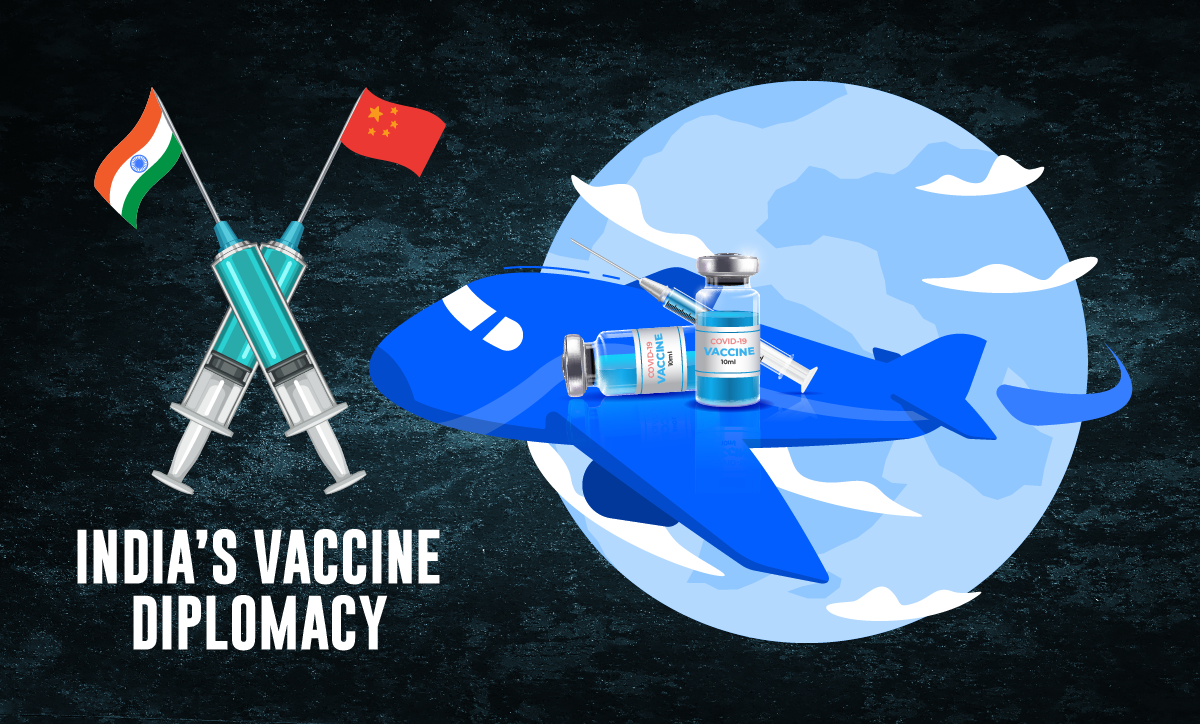
India has come up with two vaccines so far – COVAXIN by Bharat Biotech, COVISHIELD manufactured by Serum Institute of India. On the other hand, China has three vaccines – CoronaVac, CanSino, and BBIBP-CorV. India has the upper hand in vaccine production since, even before the COVID-19 pandemic, India manufacture 60% of all vaccines across the world. India is using this as a tool for diplomacy. Seeing this, Chinese Manufacturers like Sinopharm, Sinovac, and many other vaccine producers have started ‘ramping up’ their annual production capacity. 

India has so far donated eight crore vaccines to developing countries. Developing countries do not have that kind of money to buy these vaccines and vaccinate their citizens extensively. India and China are trying to win the goodwill of these very countries. China has donated vaccines to more than 52 countries globally, mostly middle and low-income in the Asia-Pacific and Carreibian Region.

Both China and India are trying to generate popularity through vaccines. India is doing so through its Vaccine MAITRI program, wherein it donates vaccines to friendly developing nations.

While some countries awaited vaccines from China, India had already delivered the vaccines to them. Sri Lanka was awaiting Chinese vaccines in January when it put the Chinese vaccines on hold and got its first lot of vaccines from India as a part of the Vaccine MAITRI program. At the same time, India has also bagged orders for exporting several million vaccines on a commercial basis.

A question remains, is India compromising on its citizens while making an applaudable humanitarian and political move? While India is facing a surge in COVID-19 cases, it has already exported a few crore vaccines in the form of grants. Delhi High Court has questioned this move. 

“We are not utilizing it fully. We are either donating or selling it to foreign countries and are not vaccinating our own people. So there has to be that sense of responsibility and urgency,” a bench led by Justices Vipin Sanghi and Rekha Palli said.

While developed countries like the USA have managed to vaccinate close to 16% of their population, countries like India and China that have the upper hand in vaccine production barely managed to vaccinate even 2% of their citizens. China has only recently started vaccinating its citizens above the age of 60; before that, the vaccine was available to only critical COVID-19 frontline workers. 

India’s Advantage In Vaccine Diplomacy

India has managed to earn goodwill among countries that could not rely on US or UK-based vaccines, which might be expensive. India’s ‘Neighbourhood First Policy’ has ensured that it provides its neighbours like Bangladesh, Bhutan, Sri Lanka, Seychelles, and Mauritius with the vaccine before delivering it to other countries. Such a move will strengthen India’s geopolitical position with the neighbouring countries. 

India will have an advantage over China in terms of diplomacy. China did offer vaccines to India’s neighbouring countries, but India’s efficiency in producing these vaccines ensured that its vaccine reached them first. 

While the west is dealing with its own political and economic problems, India’s vaccines act as a support system for countries that cannot afford expensive vaccines. India’s Pharmaceutical sector will see a boost.

Since India produces 60% of the world’s vaccines, with increasing demand for the COVID-19 vaccine, even western countries will start importing vaccines from India. India’s vaccines do not have a good brand value in highly developed countries. However, this reputation is changing in the global markets gradually.  If India becomes the global production and supply centre, India’s GDP will benefit from vaccine production.

Categories
Market News Top 10 News Top Global News

New Covid Strain Shakes Global Markets – Top 10 Global News

1. Stocks, Futures Slump on Virus Curbs; Bonds Rally

Stocks and futures were a sea of red on Monday as a new variant of the coronavirus in the U.K. caused chaos ahead of the Christmas holiday, with regional neighbours suspending travel. Energy and travel shares dragged the Stoxx 600 Index down 2.5% as Italy, the Netherlands, Belgium and France closed their borders to the U.K. The dollar gained the most since June. In the U.S., equity futures pointed to sharp declines at the open even after Congressional leaders reached a deal on spending to support the economy. Losses were concentrated in energy producers and stocks that would benefit from a return to more normal economic activity.  The pound slumped by the most since March as an official said “significant differences” remain in Britain’s trade talks with the European Union. Crude oil fell by more than 3%.

Futures on the S&P 500 Index sank 1.8% as of early morning New York time.

The Stoxx Europe 600 Index sank 2.6%.

The MSCI Asia Pacific Index dipped 0.6%.

The MSCI Emerging Market Index dipped 1.1%.

2. Congress Poised for Vote on $900 Billion Pandemic Relief Plan

The House and Senate are set to vote Monday on a roughly $900 billion pandemic relief bill that would be the second-biggest economic rescue measure in the nation’s history. The aid package will be attached to a $1.4 trillion measure to fund government operations through the end of the fiscal year, and congressional leaders said they expect the legislation to easily pass both chambers. The White House said President Donald Trump would sign it. The deal followed more than a week of furious negotiations sparked by a group of Democratic and Republican senators who drew up their own compromise proposal and urged their leaders to act.

3. Tesla Slides in First Day of Trading on the S&P 500 Index

Tesla’s shares fell as much as 6.4% in premarket trading on its first day after being added to the S&P 500 Index, as the broader market slid and the stock retraced gains from Friday when tens of millions of shares were purchased by index-fund managers. Futures contracts on the S&P 500 plunged 2.5%, following European stocks lower after several major countries moved to suspend travel from the U.K. amid concerns about a new strain of Covid-19. Tesla has catapulted 731% this year in anticipation of the historic inclusion, making it the biggest company ever to be added to the benchmark.

4. Biden Will Inherit a Strong Hand Against Xi, Thanks to Trump

Joe Biden will be sworn in as president after Trump’s administration spent years ramping up pressure on China, including levying tariffs on $370 billion in imports, getting Canada to place a Chinese executive for Huawei Technologies Co. under house arrest, threatening access to U.S. capital markets and blaming the Communist Party for the scale of the Covid-19 outbreak. President Trump’s pressure campaign continued last week, as the administration blacklisted more than 60 Chinese companies, limiting their ability to get U.S. technology, in order “to protect national security”.

5. JPMorgan Says Flows to Into Major Crypto Fund Are Key to Bitcoin’s Outlook

The odds of a Bitcoin correction would increase if the flows into the world’s largest traded cryptocurrency fund slow significantly, according to strategists at JPMorgan Chase & Co. The Grayscale Bitcoin Trust’s assets under management have climbed to $13.1 billion from $2 billion at the start of December last year, amid a tripling in the digital currency’s price so far in 2020. Inflows into the fund are running at about $1 billion per month, the strategists wrote in a note Friday. Bitcoin reached an all-time high of $24,291.38 on Sunday. The cryptocurrency’s backers argue it’s gaining ground among longer-term investors as a hedge against dollar weakness and risks such as higher inflation. Others claim an unsustainable speculative fervour, exacerbated by trend-following quant funds, lies behind much of the rally in Bitcoin and other digital assets.

6. Hong Kong May Consider Unprecedented Virus Curbs, Including Curfews

Unprecedented virus control measures including curfews and shutdowns of non-essential businesses may be considered in Hong Kong, according to a government health adviser, as the city continues to see a high number of locally-transmitted cases and the holiday season looms. Limiting the number of people per household allowed to shop for groceries, shuttering all businesses deemed non-essential and shortening mall operating hours are among the curbs that may have to be imposed to prevent another Covid-19 wave.

7. France Halts U.K. Freight Over Virus Alarm, Rocking Supplies

Britain’s biggest port stopped all traffic heading to Europe, triggering delays to food supplies after the discovery of a new variant of the virus prompted a wave of countries to ban travel from the U.K. The escalating crisis prompted Boris Johnson to convene a meeting of the government’s emergency committee on Monday in a bid to keep goods flowing. The concern is focused on links with France, which suspended inbound travel from the U.K., including freight, for 48 hours starting midnight Sunday. The disruption comes at a critical time for Johnson’s government, which is still negotiating the terms of post-Brexit trade with the European Union. It’s also battling a surge in coronavirus infections which forced ministers to put London and much of southeast England into lockdown over the weekend, heaping more misery on businesses in the critical pre-Christmas period.

8. Pound Plummets as Virus Threatens U.K.’s Supply Chains With EU

The pound had its worst day since the coronavirus roiled global markets in March, as a new strain of the pathogen disrupted the U.K.’s supply chains with Europe. Sterling tumbled 2.5% to as low as $1.3188 as Britain’s biggest port in Dover stopped all traffic heading to the continent, and after another Brexit deadline went past without results. The currency’s one-week implied volatility is the highest for a Christmas period in more than a decade. Expectations of monetary easing by the Bank of England mounted, with money markets bringing forward bets for a 10-basis-point interest-rate cut to September, compared with March 2022 on Friday. Ten-year bonds rallied, with yields slipping as much as nine basis points, and the FTSE 100 share index fell as much as 3.3%. 

9. Saudi Arabia, Oman Suspend Foreign Travel Over Mutant Virus

Saudi Arabia and Oman halted international flights and closed their borders for a week over fears about the fast-spreading new strain of the coronavirus. State-run Saudi Press Agency said the kingdom may extend the suspension for another week depending on the nature of the virus spread. Oman halted passenger traffic through its air, land and seaports for a week starting Tuesday, but freight services are exempt from the ban. The U.K. has warned that the new virus strain is “out of control,” prompting countries including France and Germany to suspend travel from Britain. 

10. Dubai Stocks Fall Most in Seven Months on Travel Worries

Stocks in Dubai slumped the most since May on fears of further travel restrictions after a new variant of the coronavirus was found in the U.K. A travel corridor between Britain and Dubai was expected to help air traffic on the route to climb by a third this month. Any anticipated boost to the city’s struggling tourism sector could also be threatened by several countries including neighbouring Saudi Arabia imposing fresh curbs.