Categories
Editorial

Vaccine Wars: Can India Come Out on Top?

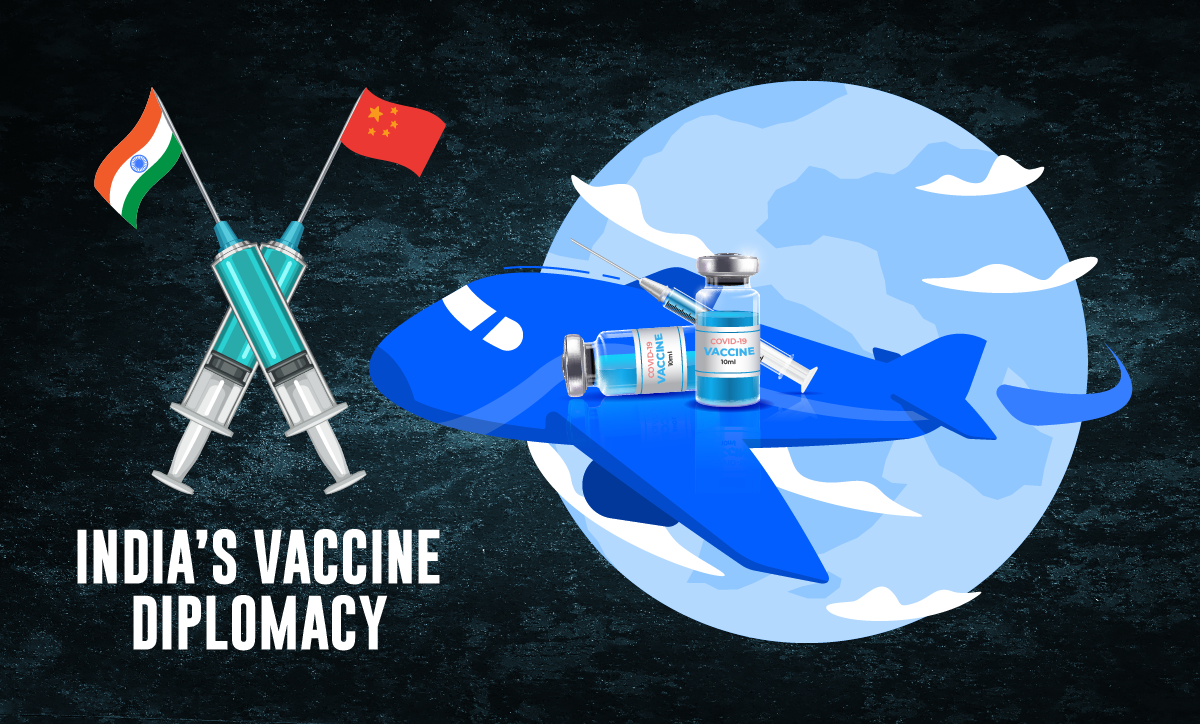
The world is now searching all over for COVID-19 vaccines. Vaccines have become a diplomatic tool for countries to expand their domain and improve ties with other countries. Countries like India, China, Russia, UK have been ahead in the race for vaccine production and have now started using their vaccines as a tool for diplomacy. The European Union(EU) and the UK have locked horns with each other, India and China are competing fiercely in what is being termed as a ‘Vaccine War.’ What is the whole ‘Vaccine War’ all about? Let’s find out. 

EU vs Britain: Bad Blood on Brexit Still On?

The UK and European Union haven’t been on good terms since they parted ways, and the UK stopped being a part of the European Union. In the COVID-19 situation, European Union and the UK depend on the same source for their vaccine, the British-Swedish Pharma company AstraZeneca. AstraZeneca is manufactured in the UK and the Netherlands. The UK, apart from domestic production, also ‘imports’ vaccines from Europe. AstraZeneca had earlier promised 12 crore vaccines to the European Union. It could not meet its commitment to Europe and reduced the pledge to 3 crore vaccines in the first quarter.

European Union says that the UK had imported vaccines from Europe and had reciprocated by exporting them. This had led to a shortage of vaccines in Europe. So much so that some countries like Hungary inoculated Russia’s Sputnik-V vaccine, even when the European Union had stated that it had no intention of doing so.

The EU has said that if the vaccine shortage continues and the UK does not reciprocate by exporting vaccines, there might be a ban on the export of vaccines from the EU. The UK is leading the way in Europe in terms of the number of people vaccinated. Likewise, countries in the European Union are way behind in the race. 

India and China’s Vaccine Wars

India has come up with two vaccines so far – COVAXIN by Bharat Biotech, COVISHIELD manufactured by Serum Institute of India. On the other hand, China has three vaccines – CoronaVac, CanSino, and BBIBP-CorV. India has the upper hand in vaccine production since, even before the COVID-19 pandemic, India manufacture 60% of all vaccines across the world. India is using this as a tool for diplomacy. Seeing this, Chinese Manufacturers like Sinopharm, Sinovac, and many other vaccine producers have started ‘ramping up’ their annual production capacity. 

India has so far donated eight crore vaccines to developing countries. Developing countries do not have that kind of money to buy these vaccines and vaccinate their citizens extensively. India and China are trying to win the goodwill of these very countries. China has donated vaccines to more than 52 countries globally, mostly middle and low-income in the Asia-Pacific and Carreibian Region.

Both China and India are trying to generate popularity through vaccines. India is doing so through its Vaccine MAITRI program, wherein it donates vaccines to friendly developing nations.

While some countries awaited vaccines from China, India had already delivered the vaccines to them. Sri Lanka was awaiting Chinese vaccines in January when it put the Chinese vaccines on hold and got its first lot of vaccines from India as a part of the Vaccine MAITRI program. At the same time, India has also bagged orders for exporting several million vaccines on a commercial basis.

A question remains, is India compromising on its citizens while making an applaudable humanitarian and political move? While India is facing a surge in COVID-19 cases, it has already exported a few crore vaccines in the form of grants. Delhi High Court has questioned this move. 

“We are not utilizing it fully. We are either donating or selling it to foreign countries and are not vaccinating our own people. So there has to be that sense of responsibility and urgency,” a bench led by Justices Vipin Sanghi and Rekha Palli said.

While developed countries like the USA have managed to vaccinate close to 16% of their population, countries like India and China that have the upper hand in vaccine production barely managed to vaccinate even 2% of their citizens. China has only recently started vaccinating its citizens above the age of 60; before that, the vaccine was available to only critical COVID-19 frontline workers. 

India’s Advantage In Vaccine Diplomacy

India has managed to earn goodwill among countries that could not rely on US or UK-based vaccines, which might be expensive. India’s ‘Neighbourhood First Policy’ has ensured that it provides its neighbours like Bangladesh, Bhutan, Sri Lanka, Seychelles, and Mauritius with the vaccine before delivering it to other countries. Such a move will strengthen India’s geopolitical position with the neighbouring countries. 

India will have an advantage over China in terms of diplomacy. China did offer vaccines to India’s neighbouring countries, but India’s efficiency in producing these vaccines ensured that its vaccine reached them first. 

While the west is dealing with its own political and economic problems, India’s vaccines act as a support system for countries that cannot afford expensive vaccines. India’s Pharmaceutical sector will see a boost.

Since India produces 60% of the world’s vaccines, with increasing demand for the COVID-19 vaccine, even western countries will start importing vaccines from India. India’s vaccines do not have a good brand value in highly developed countries. However, this reputation is changing in the global markets gradually.  If India becomes the global production and supply centre, India’s GDP will benefit from vaccine production.

Categories
Editorial

Is India prepared for Covid-19 Vaccination? Storage, Transportation and Mock Drills

The new year started with a glorious update. DGCA has approved restricted emergency use of Oxford-AstraZeneca and Bharat Biotech shots. Both the vaccines will soon hit the market. The first in line to receive the vaccines is our health workers who have been working tirelessly since last one year. Other people who come under the priority list are those above 50 years of age and those below it having comorbidities.

https://twitter.com/adarpoonawalla/status/1345605880381784067

The main concern in 2020 was till when we can expect a vaccine? Now, in 2021, our concern is how the developed vaccine will be distributed? When it comes to India, the concern grows even further. How can the government vaccinate a country of more 1.3 billion people? Is it necessary to vaccinate everyone? How long will it take to manufacture enough vaccines for the population? How will this fragile vaccine be distributed? This all sums up to one question: How prepared India is for the Covid-19 vaccination process? Let’s find out some of the recent developments as we step in the new phase of the war against Coronavirus. 

The cold storage & training issues

The vaccines approved needs a minimum temperature every time to be effective. This temperature may vary from 2 degrees to 8 degrees. Thus, the Indian government had to put special attention to cold storage and transportation. Last month, the government notified that 29000 cold chain points, 240 walk-in coolers, 70 walk-in freezers, 45000 ice-lined refrigerators, 41000 deep freezers and 300 solar refrigerators will be utilized in the vaccination process. Many of these units have already been transferred to the states so that the vaccination drive does not get delayed. Glass vials and syringes need to be stocked in huge numbers.

Godrej is one of the leading private companies which is looking to build products which can help the government in this vaccination process. They have already announced that it will commission 11,856 units of vaccine refrigerators and deep freezers within the next 6 months. This comes after they won a tender under the Universal Immunization Programme of the union health ministry. 

Our airports have to play a pivotal role in the speedy transportation of vaccines. India’s largest airport which is in Delhi has already geared itself with cold storage facilities since last month. It has developed cold chambers which can store at least 27 lakh vials at a given point. Also, they have the capability to transport 80 lakh vials per day. This is great news for the people of Delhi who have already seen three peaks of virus till now.

It is clear that logistics is a problem, but so is the human resource. Special training modules have been designed for every rank of personnel. Medical officers, vaccinator officers, data managers, ASHA coordinators, people in transport & storage, all are being trained to deal with this special and limited vaccine. More than 1,14,000 vaccinators have already been trained so far for the world’s largest immunisation exercise.

Mock Drill 

Any nation-wide vaccination programme imposes a huge challenge in front of the government. Any lapse during the distribution can lead to fatal consequences. A more cautious approach is required and this is what the Indian government has put their focus on. 

Recently, they have conducted mock vaccine drills in four states of the country to test the smoothness of the operations. These four states were Andhra Pradesh, Gujarat, Punjab and Assam. Now, the national government has announced a dry run of vaccination will be rolled out in each state. The mock drill took place at 286 session sites across 125 districts.

This process will help the government to take note of the glitches in the system if any. The focus is to keep a check on the functionality of Co-WIN application, cold storage & transportation, and the human resource preparation which will be required when the vaccine actually comes out. 

During these dry runs, dummy vaccines are being transported from the central storage facility to cold chain points. Volunteers were sent SMSes with a date, place and time to get vaccinated. Every person who is vaccinated will be monitored for the next 30 minutes to see if there’s any ill-reaction happening to the individual. The whole process gives a rough idea about the time required and logistics that will be involved every day.

Conclusion

The world’s largest immunisation exercise won’t be easy at all. More than 75 lakh beneficiaries have already been registered on Co-WIN software. This number will only increase from here. The CM of Uttar Pradesh, Yogi Adityanath, has already stated that he expects vaccination to start around mid-January. Does it mean that within a fortnight, we will be seeing our health workers getting vaccinated? How successfully can India achieve this challenge? Can Narendra Modi and his government live up to the strong image it has worldwide? All of these questions will be answered in the next few weeks. Here, we hope that this immunisation drive works out well and we return to the pre-covid life as soon as possible.

Studies actually suggest it would be well over 2022 June before we can vaccinate all of India. The vaccines are said to be safe by experts, and the vaccination process is starting very soon. What are your opinions on this largest vaccination process in the world? Let us know in the comment section!