Categories
Editorial

Vaccine Wars: Can India Come Out on Top?

The world is now searching all over for COVID-19 vaccines. Vaccines have become a diplomatic tool for countries to expand their domain and improve ties with other countries. Countries like India, China, Russia, UK have been ahead in the race for vaccine production and have now started using their vaccines as a tool for diplomacy. The European Union(EU) and the UK have locked horns with each other, India and China are competing fiercely in what is being termed as a ‘Vaccine War.’ What is the whole ‘Vaccine War’ all about? Let’s find out. 

EU vs Britain: Bad Blood on Brexit Still On?

The UK and European Union haven’t been on good terms since they parted ways, and the UK stopped being a part of the European Union. In the COVID-19 situation, European Union and the UK depend on the same source for their vaccine, the British-Swedish Pharma company AstraZeneca. AstraZeneca is manufactured in the UK and the Netherlands. The UK, apart from domestic production, also ‘imports’ vaccines from Europe. AstraZeneca had earlier promised 12 crore vaccines to the European Union. It could not meet its commitment to Europe and reduced the pledge to 3 crore vaccines in the first quarter.

European Union says that the UK had imported vaccines from Europe and had reciprocated by exporting them. This had led to a shortage of vaccines in Europe. So much so that some countries like Hungary inoculated Russia’s Sputnik-V vaccine, even when the European Union had stated that it had no intention of doing so.

The EU has said that if the vaccine shortage continues and the UK does not reciprocate by exporting vaccines, there might be a ban on the export of vaccines from the EU. The UK is leading the way in Europe in terms of the number of people vaccinated. Likewise, countries in the European Union are way behind in the race. 

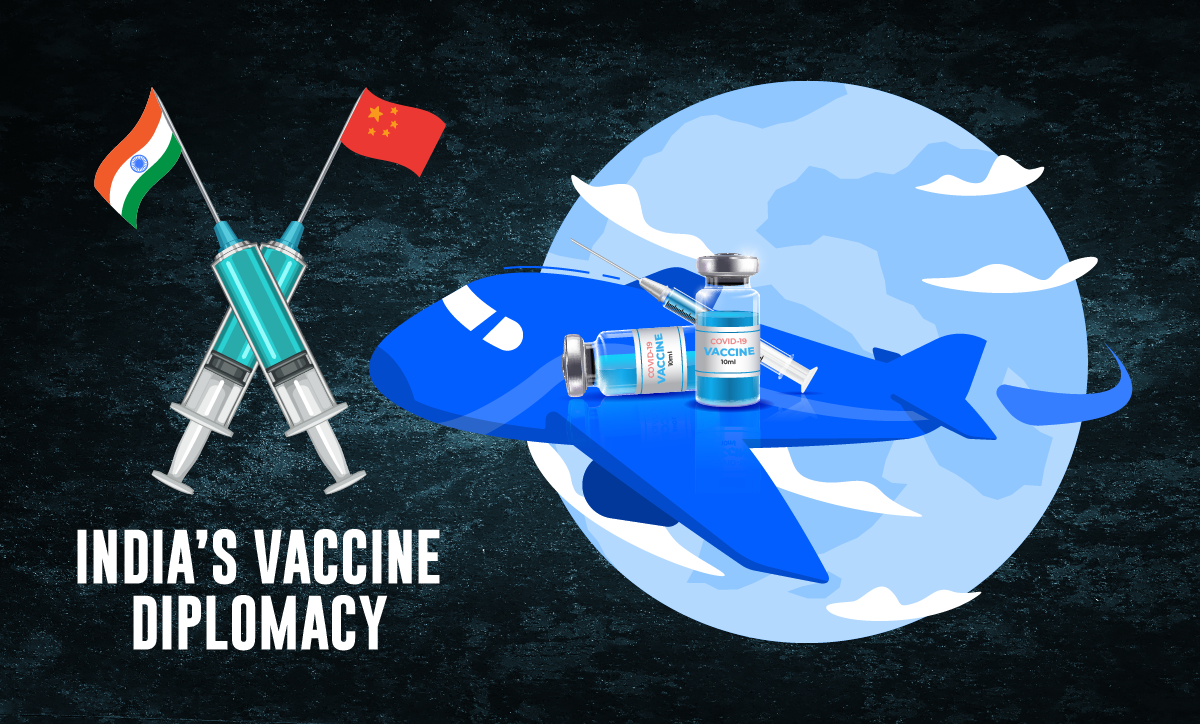
India and China’s Vaccine Wars

India has come up with two vaccines so far – COVAXIN by Bharat Biotech, COVISHIELD manufactured by Serum Institute of India. On the other hand, China has three vaccines – CoronaVac, CanSino, and BBIBP-CorV. India has the upper hand in vaccine production since, even before the COVID-19 pandemic, India manufacture 60% of all vaccines across the world. India is using this as a tool for diplomacy. Seeing this, Chinese Manufacturers like Sinopharm, Sinovac, and many other vaccine producers have started ‘ramping up’ their annual production capacity. 

India has so far donated eight crore vaccines to developing countries. Developing countries do not have that kind of money to buy these vaccines and vaccinate their citizens extensively. India and China are trying to win the goodwill of these very countries. China has donated vaccines to more than 52 countries globally, mostly middle and low-income in the Asia-Pacific and Carreibian Region.

Both China and India are trying to generate popularity through vaccines. India is doing so through its Vaccine MAITRI program, wherein it donates vaccines to friendly developing nations.

While some countries awaited vaccines from China, India had already delivered the vaccines to them. Sri Lanka was awaiting Chinese vaccines in January when it put the Chinese vaccines on hold and got its first lot of vaccines from India as a part of the Vaccine MAITRI program. At the same time, India has also bagged orders for exporting several million vaccines on a commercial basis.

A question remains, is India compromising on its citizens while making an applaudable humanitarian and political move? While India is facing a surge in COVID-19 cases, it has already exported a few crore vaccines in the form of grants. Delhi High Court has questioned this move. 

“We are not utilizing it fully. We are either donating or selling it to foreign countries and are not vaccinating our own people. So there has to be that sense of responsibility and urgency,” a bench led by Justices Vipin Sanghi and Rekha Palli said.

While developed countries like the USA have managed to vaccinate close to 16% of their population, countries like India and China that have the upper hand in vaccine production barely managed to vaccinate even 2% of their citizens. China has only recently started vaccinating its citizens above the age of 60; before that, the vaccine was available to only critical COVID-19 frontline workers. 

India’s Advantage In Vaccine Diplomacy

India has managed to earn goodwill among countries that could not rely on US or UK-based vaccines, which might be expensive. India’s ‘Neighbourhood First Policy’ has ensured that it provides its neighbours like Bangladesh, Bhutan, Sri Lanka, Seychelles, and Mauritius with the vaccine before delivering it to other countries. Such a move will strengthen India’s geopolitical position with the neighbouring countries. 

India will have an advantage over China in terms of diplomacy. China did offer vaccines to India’s neighbouring countries, but India’s efficiency in producing these vaccines ensured that its vaccine reached them first. 

While the west is dealing with its own political and economic problems, India’s vaccines act as a support system for countries that cannot afford expensive vaccines. India’s Pharmaceutical sector will see a boost.

Since India produces 60% of the world’s vaccines, with increasing demand for the COVID-19 vaccine, even western countries will start importing vaccines from India. India’s vaccines do not have a good brand value in highly developed countries. However, this reputation is changing in the global markets gradually.  If India becomes the global production and supply centre, India’s GDP will benefit from vaccine production.

Categories
Market News Top 10 News

Bharat Biotech’s Covaxin Gets Approval for Emergency Use – Top Indian Market News

Bharat Biotech’s Covaxin gets approval for restricted emergency use: Report

The Subject Expert Committee of the Central Drugs Standard Control Organisation (CDSCO) on Saturday gave its approval for the restricted emergency use of Covaxin in India. Covaxin is jointly developed by Bharat Biotech and the Indian Council of Medical Research (ICMR). This is the second Covid-19 vaccine that has been recommended for emergency use approval to DCGI, after Serum Institute’s locally produced Oxford-AstraZeneca vaccine ‘Covishield’. The Drug Controller General of India (DCGI) will give the final approval to both the vaccine candidates. [This has been reported by news agencies PTI and ANI, citing government sources]

Read more here.

SEBI fines RIL, Mukesh Ambani for manipulative trades in RPL

The Securities and Exchange Board of India (SEBI) has imposed a fine of Rs 25 crore on Reliance Industries Ltd (RIL) and Rs 15 crore on its chairman, Mukesh Ambani, for their alleged role in manipulative trades in Reliance Petroleum Ltd (RPL) in 2007. The penalties imposed pertain to the trading of RPL shares in the cash and futures segments in November 2007. SEBI believes illegal profits were made by RIL and other parties through manipulation of RPL’s share prices. This followed RIL’s decision in March 2007 to sell a 4.1% stake in RPL, a listed subsidiary that was later merged with RIL in 2009.

Read more here.

Tata Steel transfers stake in processing arms to TSDPL

Tata Steel Ltd has transferred the 51% stake it holds in Jamshedpur Continuous Annealing & Processing Company Private Ltd (JCAPCPL) and 50% stake it holds in Tata BlueScope Steel Private Ltd (TBSPL) to Tata Steel Downstream Products Ltd (TSDPL). The company stated that this step was taken to reorganise the company’s India footprint into four clusters to drive scale, synergies, and create value for all stakeholders. The transfer will help consolidate its downstream steel processing services.

Read more here.

EID Parry to close sugar unit in Tamil Nadu

EID Parry India Ltd has decided to close down one of its non-operating sugar units in Tamil Nadu. The company stated that the expectation of revival of cane cultivation in the area is low due to a variety of factors. The company’s sugar mill at Pettavaithalai in Tamil Nadu had not been operational due to the continuous non-availability of adequate sugar cane. East India Distilleries (EID) Parry India Limited is a wholly-owned subsidiary of the Murugappa Group.

Read more here

Exports decline by 0.8% in December; trade deficit widens to $15.71 billion

India’s exports declined marginally by 0.8% to $26.89 billion in December 2020 due to contraction in sectors like petroleum, leather, and marine products, according to preliminary data released by the Ministry of Commerce & Industry. The trade deficit in December widened to $15.71 billion, as imports grew by 7.6% to $42.6 billion. During the same period, oil imports declined by 10.37% to $9.61 billion.

Read more here.

Tower damage case: Airtel writes to DoT, says Jio’s charges are baseless

Bharti Airtel has sent a letter to the Department of Telecommunications (DoT), slamming Reliance Jio’s allegations that channel partners of rival telecom companies were inciting and provoking agitators involved in tower disruption. The company stated that Jio’s complaint should be dismissed “with the contempt that it deserves”. Airtel further urged the DoT to bring forth a policy to mandate ICR (Intra circle roaming) in such situations of vandalism and network outages as a matter of course so that customers were never inconvenienced.

Read more here.

Free Covid-19 vaccine for all healthcare workers in first phase: Harsh Vardhan

Union Health Minister Dr. Harsh Vardhan on Saturday said that in the first phase of Covid-19 vaccination, free vaccine shall be provided across the nation to most prioritised beneficiaries that include one crore healthcare and two crore frontline workers. He also said that details of how further 27 crore priority beneficiaries are to be vaccinated until July are being finalised. As India began its nationwide Covid-19 vaccine dry run from today before the rollout of a potential vaccine to the citizens, the health minister appealed to people not to pay heed to rumors about the Covid-19 vaccine.

Read more here.

PFC raises borrowing limit to Rs 1.18 lakh crore

State-owned Power Finance Corporation (PFC) has raised its borrowing limit to Rs 1.18 lakh crore for the ongoing financial year. The company now plans to raise a maximum of Rs 83,000 crore from long-term borrowing, Rs 15,000 crore from long-term foreign currency borrowing, Rs 5,000 crore from short-term borrowing, and Rs 15,000 crore from commercial papers. PFC further stated that it does not see any challenges in raising the borrowing amount, which is being used to lend for various power sector projects in India.

Read more here.

India-UK flights to restart from Jan 6: Puri

Aviation Minister Hardeep Singh Puri on Saturday said that flights from India to the United Kingdom will resume from January 6, while services from that country to here would resume from January 8 onwards. He stated that this schedule is valid till 23 Jan 2021 and further frequency will be determined after reviews. Earlier, India had suspended all passenger flights connecting the two countries from December 23 to January 7, as a new variant of coronavirus emerged in the UK.

Read more here.

TVS reports 17.5% increase in sales in December

TVS Motor Company Ltd, on Saturday, reported a 17.5% YoY increase in total sales to 2,72,084 units in December. The company, which primarily makes two-wheelers and three-wheelers, had sold 2,31,571 units in December 2019. The total two-wheeler sales during the month increased by 20% to 2,58,239 units, as against 2,15,619 in December 2019. The total exports increased by 28% to 94,269 units last month, as against 73,512 in the year-ago period.

Read more here.

Categories
Market News Top 10 News

SpiceJet Plane Undershoots Runway in Guwahati – Top Indian Market News

SpiceJet plane undershoots runway in Guwahati; DGCA grounds 2 pilots

A SpiceJet plane undershot the runway while landing at the Guwahati airport on Friday. The Directorate General of Civil Aviation (DGC) has grounded the two pilots who were operating the Bengaluru-Guwahati flight. Officials stated that none of the passengers was hurt in the incident. The DGCA is investigating the incident. 

Read more here.

Covaxin efficacy can be determined only after 2 doses, says Bharat Biotech after Haryana Minister tests positive

Haryana Home Minister Anil Vij, on Saturday, tested positive for Covid-19 despite taking a Covaxin trial shot. The vaccine’s developer, Bharat Biotech, clarified that Covaxin’s efficacy can only be determined after 14 days of the second dose. The minister was only administered the first trial dose two weeks ago. The company further said that 50% of the trial participants received the vaccine, while others were administered a placebo.

Read more here

Tata Consumer Products’ subsidiary to sell MAP Coffee Business for Rs 6 crore

Tata Consumer Products Ltd (TCPL) said that its Australian subsidiary, Earth Rules, is selling MAP Coffee Business to Buccheri Group Pty Ltd for Rs 6.74 crore. MAP Coffee supplies Australian cafes, restaurants, and bars with a range of Italian roasted coffee. It joined TCPL in 2014. Post completion of the transaction, Earth Rules will continue to be a step-down subsidiary of TCPL.

Read more here.

All states accept Centre’s borrowing plan to meet GST shortfall

All the 28 states and 3 Union Territories have accepted the Central Government’s Option-1 to meet the revenue shortfall arising out of GST implementation. The Centre has already borrowed an amount of Rs 30,000 crore on behalf of the states in five installments and has passed it on to the states and UTs. The next installment of Rs 6,000 crore will be released to the states/UTs on December 7.

Read more here.

NSE revises circuit limits of over 300 stocks

The National Stock Exchange has revised the circuit limits of 302 stocks with affect from Monday (December 7). The circuit limit of Adani Gas, Angel Broking, Arvind Fashions, Central Bank of India, Emkay Global, and Snowman Logistics has been revised to 20% from 10%. The circuit limits of Reliance Communications, Reliance Infrastructure, Reliance Home Finance and Shree Renuka Sugars has been revised to 10% from 5%.

Read more here.

Petrol price hits two-year high of Rs 83 a litre, diesel at Rs 73.32

Petrol price on Saturday crossed the Rs 83 per litre mark in Delhi for the first time in more than two years. The diesel price went up to Rs 73.32 per litre. The rally in international oil prices has forced the rates to increase for the 13th time in 2 weeks. The oil companies had resumed daily revision of fuel prices on November 20, after a break of 2 months.

Read more here.

ONGC Videsh strikes oil in Colombia block

Oil and Natural Gas Corporation (ONGC) announced that its overseas subsidiary, ONGC Videsh, struck commercial oil in one of its Colombian blocks. This is the fourth commercial find in the block by ONGC Videsh Ltd. The company’s oil well ‘Indico-2’ is flowing under short term testing for further evaluation.

Read more here.

Tata Motors supplies 26 electric buses to BEST

Tata Motors Ltd has delivered 26 all-electric buses to Brihanmumbai Electric Supply and Transport (BEST). These were delivered as a part of the larger order of 340 electric buses from BEST, under the Government of India’s FAME II initiative. The company stated that the rest of the units will be delivered in a phased manner as per schedule

Read more here.

Sobha Ltd to invest Rs 1,000 crore in Delhi and Gurgaon to develop 2.76 million sq fr

Sobha Ltd said it will invest close to Rs 1,000 crore in Delhi and Gurgaon to develop 2.76 million sq ft, to expand its presence in the Delhi-NCR region. The company recently entered into a joint development agreement with a Delhi-based builder to develop 1 million square feet in Delhi’s Badarpur. They are also in talks with developers to build 1.73 million sq ft in Gurgaon.

Read more here.

Categories
Editorial

Stocks to Benefit from Potential Covid-19 Vaccines

The Covid-19 pandemic has caused a deep impact on people’s livelihoods and health. The economic and social disruption caused by this unprecedented pandemic is devastating. As of November 24, official data from John Hopkins University shows that there are more than 59 million confirmed cases of Covid-19 worldwide.

The only factor which keeps our spirits high is the fact that potential Covid-19 vaccine candidates are showing great results in the final stages of trials. Let us take a look at the updates of 4 major vaccines that could be supplied in India, as soon as they receive regulatory approvals.

  1. Oxford-AstraZeneca Vaccine
  2. Pfizer-BioNTech
  3. Gamaleya Institute-RDIF
  4. Bharat Biotech-ICMR
  5. Which Stocks Could Benefit from Vaccine?

Oxford-AstraZeneca

The AZD1222 Covid-19 vaccine is jointly developed by a Swedish-British pharma company AstraZeneca and the University of Oxford. According to trials conducted by the developers, the vaccine has shown an overall efficacy rate of 70%. An analysis issued by Oxford-AZ on 23rd November showed some very exciting results. The participants who received a lower amount of the vaccine in the first dose and then the full amount in the second dose were found to be 90% less likely to develop Covid.

The vaccine has also shown that it works across all age groups, and is also able to reduce asymptomatic infection. Another important feature of the Oxford-AZ vaccine is that it can be stored at normal fridge temperatures. This means that it would be cheaper to distribute and administer the vaccine to people. Experts believe that these 3 factors make this candidate a better choice, as compared to the results published by Pfizer and Moderna. There were no severe cases or hospitalisation in the 23,000 people who got the shot. 

The developers of the vaccine expect to supply 2.9 billion doses once they receive emergency use authorization. They have also stated that the vaccine would be made available in the UK first. The United States, the United Kingdom, and India are the main countries that have committed to buy a majority of its doses. The price of the shot has been set at $4-5.

It is expected to be cheaper in India, as the doses are also being manufactured by the Serum Institute of India (SII). The SII had partnered with AstraZeneca to develop the vaccine under the ‘Covidshield’ brand in our country There is a high chance that this vaccine will be the first to be administered to Indian citizens.

“The Serum Institute of India (SII) can apply for emergency use authorization (EUA) of the AstraZeneca and Oxford University’s COVID-19 vaccine in India once it is approved in the UK, since it is a partner developer” – Dr. Randeep Guleria, Director of AIIMS.

Pfizer-BioNTech

The Covid-19 vaccine candidate termed mRNA-BNT162 is being developed by US-based Pfizer Inc and Germany-based BioNTech. According to the final trials conducted by both companies, the vaccine has proven to be 95% effective in preventing Covid-19. Pfizer has approached the United States Food and Drug Administration (USFDA) to appeal for an emergency use authorization of its vaccine. However, a report on November 23 states that the USFDA will only assess the appeal on December 10.

Pfizer and BioNTech expect to supply 1.3 billion doses of the vaccine, as soon as they receive the approval from the USFDA. The United States, the UK, European Union, and Japan have already committed to buying the doses. The price per shot has been set at $20. Pfizer expects the vaccine to be rolled out by Christmas time in the United States.

On November 24, India’s Union Health Minister Harsh Vardhan said that India may not require the Pfizer-BioNTech vaccine. He stated that other vaccine candidates such as the one developed by Oxford-AZ are showing promising results. Also, the storage and distribution of Pfizer’s vaccine require an ultra-cold chain of minus 70 degrees. This would make it very expensive in India. However, based on India’s current Covid-19 situation, the government may consider buying a significant quantity of this vaccine.

Gamaleya Institute-RDIF

The Sputnik-V vaccine is being developed by Russia’s Gamaleya Research Centre and the Russian Direct Investment Fund (RDIF). They have partnered with Hyderabad-based Dr. Reddy’s to distribute the vaccine in India. According to the second interim analysis of 18,000 people who got the shot, the vaccine had an efficacy rate of 95%. They are currently undergoing Phase-3 trials with a total of 40,000 volunteers. RDIF has stated that Sputnik-V provides a stronger and longer-term immune response.

The developers of the vaccine expect to supply 1 billion doses of the vaccine, once they receive regulatory approvals. Russia, India, Vietnam, and Brazil have committed to buying the vaccine doses. The vaccine has been priced at $10 per shot.

Bharat Biotech-ICMR

Hyderabad-based Bharat Biotech has partnered with the Indian Council of Medical Research (ICMR) to develop India’s first indigenous Covid-19 vaccine- COVAXIN. The vaccine had initiated Phase-3 trials earlier this month with 26,000 volunteers from across 22 sites in India. This is the largest clinical trial conducted for a coronavirus vaccine candidate in India. On 22nd November, they announced that Covaxin will be at least 60% effective based on earlier trial results.

However, the company has not released the results of its Phase 1 & 2 results to the public. This makes us wonder about the actual effectiveness of the vaccine. The company expects the vaccine to be rolled out by mid-2021, after necessary approvals.

Which Stocks Could Benefit from Vaccine?

We can see that many sectors would benefit from the development of a vaccine in India. Whether it be manufacturing, storage, distribution, or administration of the vaccine, the support of many companies is needed. Earlier this month, it was announced that Pfizer’s vaccine needed a cold-storage facility to be stored and transported. On the same day, Snowman Logistics Ltd. said that they would create the necessary technology to provide logistical support for the vaccine.

Apollo Hospitals has also announced that they have the cold storage chain ready for Pfizer’s Covid-19 vaccine. They are ready to administer 10 lakh doses of the Covid-19 vaccine per day, once it is launched. The company has trained around 10,000 people to administer the vaccine in India.

Way back in July, Piramal Glass announced that they will be ready to supply more glass vials for the Covid-19 vaccines in India. They have taken proactive measures to meet any surge in demand for glass vials from the pharmaceutical industry across the globe. It has been estimated that India will require 6 crore vials for Covid-19 shots in the first six months of the vaccine being launched.

Dr. Reddy’s Laboratories will conduct all necessary trials and distribute the Sputnik-V coronavirus vaccine in India. The vaccine had arrived in Hyderabad on November 11, after regulators had approved to go ahead with the Phase-3 trial of the vaccine in India.

Just another thought that came into the team’s mind while brainstorming was that syringe manufacturers would also benefit from a vaccine. Companies like Albert David can be looked into. Also, diagnostic firms such as Dr. Lal PathLabs Ltd. would benefit from their Covid-19 testing facilities, until vaccines are launched.

What other sectors do you think will benefit from a Covid-19 vaccine?

Conclusion

As we can see, the Covid-19 vaccine candidates are showing great results. The vaccine developed by Oxford and AstraZeneca seems to be the most promising one, as compared to others. The developers of these vaccines are hopeful to supply it by the beginning of 2021. However, experts state that the distribution of the vaccine for all Indian citizens would be a major hurdle. For this, large pharmaceutical companies are also seeking logistical support from Indian firms to store and distribute vaccines. So, make sure that you follow news relating to such deals or orders.

The sentiments surrounding the efficiency of Covid-19 vaccine candidates have certainly lifted our spirits. However, do bear in mind that cases of Covid-19 are still rising, and many countries had even re-introduced lockdowns. Some parts of India are still reporting a large number of daily cases as well. Let us hope that the vaccine is available for every single citizen of India, once it is launched.