Categories
Editorial

Vaccine Wars: Can India Come Out on Top?

The world is now searching all over for COVID-19 vaccines. Vaccines have become a diplomatic tool for countries to expand their domain and improve ties with other countries. Countries like India, China, Russia, UK have been ahead in the race for vaccine production and have now started using their vaccines as a tool for diplomacy. The European Union(EU) and the UK have locked horns with each other, India and China are competing fiercely in what is being termed as a ‘Vaccine War.’ What is the whole ‘Vaccine War’ all about? Let’s find out. 

EU vs Britain: Bad Blood on Brexit Still On?

The UK and European Union haven’t been on good terms since they parted ways, and the UK stopped being a part of the European Union. In the COVID-19 situation, European Union and the UK depend on the same source for their vaccine, the British-Swedish Pharma company AstraZeneca. AstraZeneca is manufactured in the UK and the Netherlands. The UK, apart from domestic production, also ‘imports’ vaccines from Europe. AstraZeneca had earlier promised 12 crore vaccines to the European Union. It could not meet its commitment to Europe and reduced the pledge to 3 crore vaccines in the first quarter.

European Union says that the UK had imported vaccines from Europe and had reciprocated by exporting them. This had led to a shortage of vaccines in Europe. So much so that some countries like Hungary inoculated Russia’s Sputnik-V vaccine, even when the European Union had stated that it had no intention of doing so.

The EU has said that if the vaccine shortage continues and the UK does not reciprocate by exporting vaccines, there might be a ban on the export of vaccines from the EU. The UK is leading the way in Europe in terms of the number of people vaccinated. Likewise, countries in the European Union are way behind in the race. 

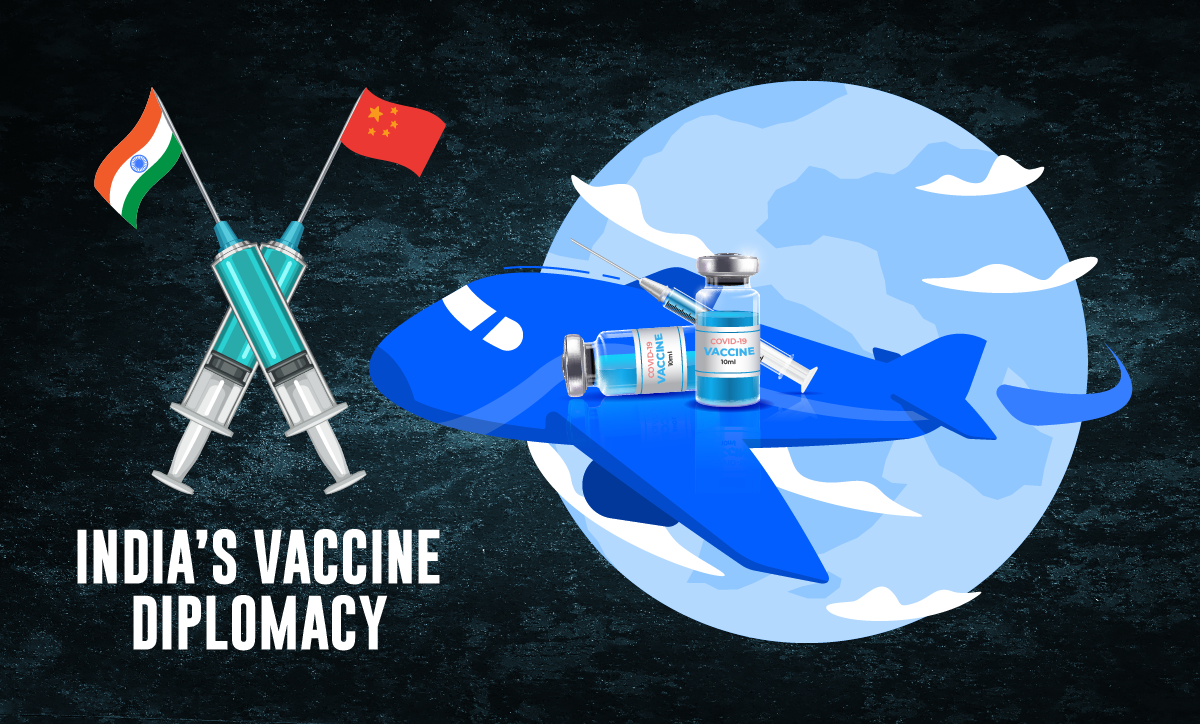
India and China’s Vaccine Wars

India has come up with two vaccines so far – COVAXIN by Bharat Biotech, COVISHIELD manufactured by Serum Institute of India. On the other hand, China has three vaccines – CoronaVac, CanSino, and BBIBP-CorV. India has the upper hand in vaccine production since, even before the COVID-19 pandemic, India manufacture 60% of all vaccines across the world. India is using this as a tool for diplomacy. Seeing this, Chinese Manufacturers like Sinopharm, Sinovac, and many other vaccine producers have started ‘ramping up’ their annual production capacity. 

India has so far donated eight crore vaccines to developing countries. Developing countries do not have that kind of money to buy these vaccines and vaccinate their citizens extensively. India and China are trying to win the goodwill of these very countries. China has donated vaccines to more than 52 countries globally, mostly middle and low-income in the Asia-Pacific and Carreibian Region.

Both China and India are trying to generate popularity through vaccines. India is doing so through its Vaccine MAITRI program, wherein it donates vaccines to friendly developing nations.

While some countries awaited vaccines from China, India had already delivered the vaccines to them. Sri Lanka was awaiting Chinese vaccines in January when it put the Chinese vaccines on hold and got its first lot of vaccines from India as a part of the Vaccine MAITRI program. At the same time, India has also bagged orders for exporting several million vaccines on a commercial basis.

A question remains, is India compromising on its citizens while making an applaudable humanitarian and political move? While India is facing a surge in COVID-19 cases, it has already exported a few crore vaccines in the form of grants. Delhi High Court has questioned this move. 

“We are not utilizing it fully. We are either donating or selling it to foreign countries and are not vaccinating our own people. So there has to be that sense of responsibility and urgency,” a bench led by Justices Vipin Sanghi and Rekha Palli said.

While developed countries like the USA have managed to vaccinate close to 16% of their population, countries like India and China that have the upper hand in vaccine production barely managed to vaccinate even 2% of their citizens. China has only recently started vaccinating its citizens above the age of 60; before that, the vaccine was available to only critical COVID-19 frontline workers. 

India’s Advantage In Vaccine Diplomacy

India has managed to earn goodwill among countries that could not rely on US or UK-based vaccines, which might be expensive. India’s ‘Neighbourhood First Policy’ has ensured that it provides its neighbours like Bangladesh, Bhutan, Sri Lanka, Seychelles, and Mauritius with the vaccine before delivering it to other countries. Such a move will strengthen India’s geopolitical position with the neighbouring countries. 

India will have an advantage over China in terms of diplomacy. China did offer vaccines to India’s neighbouring countries, but India’s efficiency in producing these vaccines ensured that its vaccine reached them first. 

While the west is dealing with its own political and economic problems, India’s vaccines act as a support system for countries that cannot afford expensive vaccines. India’s Pharmaceutical sector will see a boost.

Since India produces 60% of the world’s vaccines, with increasing demand for the COVID-19 vaccine, even western countries will start importing vaccines from India. India’s vaccines do not have a good brand value in highly developed countries. However, this reputation is changing in the global markets gradually.  If India becomes the global production and supply centre, India’s GDP will benefit from vaccine production.

Categories
Trending

Moderna Vaccine Submitted for Approval

Moderna submitted its 95% success rate vaccine for approval from USFDA(United States Food and Drug Administration). The company said that they have enough information on the trials conducted, and they are proceeding with their application. The clinical trials from more than 30,000 volunteers showed the vaccine prevented virtually all symptomatic cases of Covid-19.

Moderna expects that on December 17, the FDA will be ready for a public meeting to discuss this data. They will also seek approval from the European Medicines Agency. Moderna shares price went up by 20% in the US as a reaction to the news. The vaccines may be available for commercial use this month and the supply will also be limited.

To know more about the stocks that could benefit from Covid-19 vaccines, click here.

Moderna received more than $1 billion in U.S federal government funding to develop and produce its vaccine. They have also received $1.5 billion to supply it to the American public as soon as it is available in the market. India is also likely to get Moderna’s vaccine through the COVAX facility, which is a global initiative to bring together governments and manufacturers to ensure and accelerate the development and manufacturing of Covid-19 vaccines. India hasn’t signed any advance purchase agreement for Moderna’s vaccine.

For more details about the approval of Moderna’s vaccine visit here.

Categories
Editorial

Tier-2 Lockdown Declared in London. Is it as Serious as it Sounds?

Why the Lockdown?

The number of coronavirus cases in the United Kingdom is showing a huge spike. As of October 15th, the country has recorded more than 6,57,000 cases of Covid-19, with 43,245 related deaths, as per official data compiled by John Hopkins University. The infection rates are increasing, with the number of cases doubling every 10 days.

Graph showing the rise in Covid-19 cases in the United Kingdom

In order to contain the spread of the virus, The UK Government has introduced ‘Local Covid Alert Levels’ in the country. There would be three levels- medium, high, and very high. Most parts of the country are under a medium alert of Tier-1. As of October 16th, the capital city of London will see a shift to the second-highest coronavirus risk tier. This would mean that millions of people in the city will be unable to meet anybody outside their household, whether at home or in public. Other areas such as Manchester, Nottingham, and Newcastle are some of the worst-hit areas. These cities could be upgraded to Tier-3 (highest alert level) at any given time.

What does it mean?

The rules and regulations under the Tier-2 lockdown are as follows:

  • Not more than 6 people will be allowed to gather outside
  • Schools, universities will remain open.
  • Indoor gatherings will not be permitted. As per the current rules, people are not allowed to meet anyone else other than family members.
  • Indoor sport and exercise classes can take place, but with not more than six people at a time.
  • Weddings or funerals can be attended by a maximum of 15-30 people.
  • People are advised to reduce the number of journeys, if possible. Walking or cycling has been encouraged.
  • Businesses can continue to operate, under Covid-secure conditions.

In case any of these rules are broken by citizens, the police will be able to take action and issue fines. If a person is organizing an illegal gathering, he or she could be fined up to £10,000 (~Rs 9.46 lakh). In his message to the people of London, the UK Health Secretary said: “Thank you for what you’ve done to suppress this virus once. We all need to play our part in getting the virus under control once again.”

What do we understand?

From what we can understand, these restrictions have caused a lot of panic and confusion amongst the people in London, as well as those in other cities. They have not been able to find a clear difference between the rules for Tier-2 and Tier-3 alerts. The rules do not seem to be strict, and have a lot of loopholes in them. In between all this confusion, it has been estimated that most small businesses would be hit, as the number of people visiting small shops or restaurants will further reduce. Also, businesses in Tier-2 regions will not be eligible for government support, as only those businesses in regions imposed with a Tier-3 alert can claim it. 

On October 15th, we saw that the global markets took a big hit, as these lockdown rules were announced. This was one of the major reasons why Indian markets fell that day. When European Markets opened with a huge gap-down, panic selling started in the already bearish Indian market. However, this sentiment seems to have been short-lived as global markets have recovered after knowing the lockdown is not that serious. 

But, do watch out if a shift to Tier-3 lockdown is announced in London. After the Covid crash, world markets have recovered partly because lockdown restrictions have lifted and economic activity has restarted. If nations are forced to re-introduce lockdowns, stock markets won’t be happy.

Categories
Market News

Cadila shares gain as it aims to complete trial of COVID-19 vaccine by March

Cadila Healthcare stock price gained over 4% during the day before closing at Rs 377.60 after its Chairman Pankaj Patel announced that they aim to complete late-stage trials for its coronavirus vaccine candidate ‘ZyCov-D’ by March 2021. Cadila will start production of 100 million doses of potential Covid19 vaccine annually after Phase 3 trial concludes successfully.

The Phase 1 trial will begin this month on over 1,000 patients across multiple sites according to the company Chairman. In addition to starting clinical trials, it is also planning to produce up to 400,000 doses of the drug Remdesivir after it showed positive results in treating patients with COVID-19. Zydus Cadila aims to fulfill India’s Remdesivir requirements before accepting export orders after it wins regulatory approval to make it in India. It had received approval from COFEPRIS(Medical regulatory body of Mexican government) to conduct clinical trials in Mexico with ‘PegiHepTM’ to evaluate safety, efficacy and tolerability in patients with COVID-19.

In conclusion, Cadila is hopeful that it will be able to complete the clinical trials by March 2021 and possesses the ability to mass-produce the vaccine