Categories
Editorial

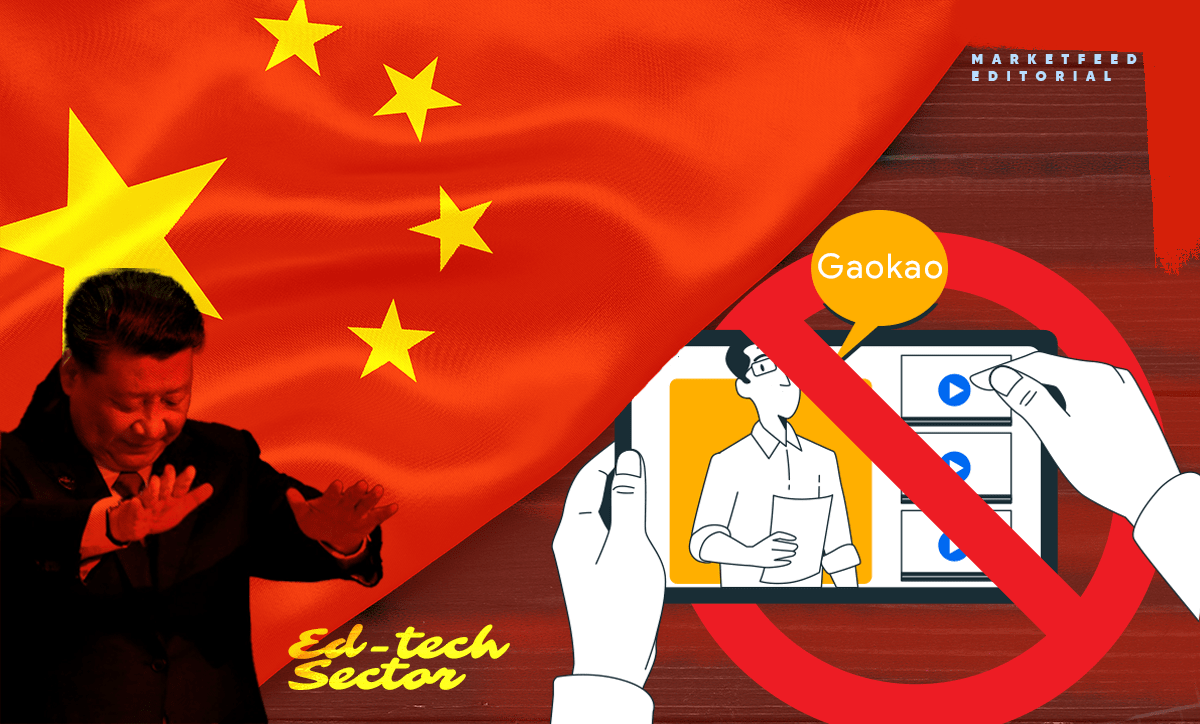
China’s Attack on Edtech Companies: Explained

As part of their continued crackdown on tech companies, the Chinese government has asked after-school tutoring institutions in the education technology (ed-tech) sector to convert into not-for-profit entities. Ed-tech companies would also be barred from raising funds, launching a public issue (IPO), or acquiring other educational services. This has led to a massive sell-off of popular tech stocks in the Asian markets over the past few days. Chinese tech companies have collectively lost nearly $1 trillion in market cap!

In this article, we shall understand why China has introduced such severe measures that could ultimately wipe out the country’s $100 billion ed-tech industry. 

Reasons Behind China’s Crackdown on Edtech Firms

Over the past year, Chinese authorities have asked all private educational institutions to scale back on operations. They are being forced to cap fees and suspend tutoring programs during the weekends and holidays. Many institutions were also fined for false advertising. Now, the government wants to limit the influence of ed-tech companies on the Chinese population. All these restrictions were formed as a result of changes in perceptions around education in China.

The country’s labour force is shrinking rapidly. Unfortunately, most college graduates are unemployable as there are very few white-collar jobs (lawyers, accountants, bankers, etc) available. China has been promoting vocational training for creating a skilled blue-collar workforce. These are practical courses that impart skills and knowledge on a specific trade or occupation (such as technician, machine operator, electrician). However, most people do not opt for such jobs as it is considered ‘inferior’ and the pay is terrible.

Edtech Firms Causing Social Inequalities?

The Chinese government has started questioning the very existence of private tutoring services. The ed-tech industry primarily targets students who are appearing for China’s main university entrance exam— the gaokao. It is a nine-hour-long test (spread over two days) that determines whether a student will attend an undergraduate institution or not. Similar to the IIT-JEE and NEET exams in India, the gaokao is considered a high-stakes exam. It is one of the most brutal educational assessments in the world. 

The Chinese strongly believe that passing the gaokao is the ultimate pathway to success. Students spend years preparing for it. As a result, ed-tech firms have capitalised on this opportunity to a large extent.

According to reports, major ed-tech companies have been accused of triggering social inequality among urban and rural citizens of China by providing additional coaching to those who can afford it. Moreover, excessive tutoring has led to increased pressure and anxiety among the country’s youth. It has also burdened parents with expensive fees. Now, the government authorities feel that the ed-tech industry does not serve any real purpose and may actually limit the country’s true potential.

The new regulations on ed-tech are also said to be in line with Chinese President Xi Jinping’s top priority at the moment— boosting the declining birth rate in the country. They had recently announced a three-child policy to counteract its aging population and declining workforce. The concerned authorities believe that restricting large ed-tech firms and providing affordable education is likely to encourage citizens to have more than one child. 

Similar Events That Have Transpired

Over the past year, Chinese officials have been suppressing large and upcoming tech companies. Jack Ma, the founder of the Alibaba Group, had alleged that Chinese regulators have been restraining innovation. Soon after making certain comments against the government’s anti-development policies, he disappeared from the public eye. His company, Ant Financial, was all set to launch a record-breaking ~$35 billion IPO during this period. Unfortunately, the IPO was called off as Chinese regulators tightened rules for companies to go public in American markets. 

In a more recent case, Didi (a cab-hailing company in China) launched a $4.4 billion IPO in the US, which received a great response from investors. Within two days of its listing, Chinese regulators launched a full-fledged investigation into the company. The Didi app was pulled off from all app stores as Chinese officials alleged that Didi was illegally collecting and using the personal data of its users.

Tencent, a well-known multinational technology conglomerate, was ordered to give up exclusive music licensing rights by China’s antitrust regulator. They also slapped a fine on the company for anti-competitive behavior. On July 26, the country’s State Administration for Market Regulation issued new guidelines for food delivery platforms as well.

These are all part of China’s efforts to minimise the interaction between Chinese companies and the Western markets. According to experts, President Xi Jinping and the Chinese Communist Party are sending messages to corporates and entrepreneurs to show them “who’s boss”. They simply do not want data collected from their citizens to fall into foreign hands. China will continue to introduce new policies and regulations that suppress all forms of innovation and development.  

Conclusion

Now you know why China has started an all-out war against tech companies to limit their influence. The country is returning to state-controlled capitalism in a holistic manner. It has caused quite a stir amongst global investors of these firms. As per the draft rules issued by the government, ed-tech companies will not be able to issue stock or raise money in the stock markets. Thus, large equity investors such as Tiger Global Management and Temasek Holdings Pte will not be able to get their desired exits. This has turned out to be one of the major factors for the bearishness in stock markets across the globe. 

There is another interesting point to be noted here. Currently, China is the largest education market in the world. Out of 28 edtech unicorns (valued at more than $1 billion) in the world, eight are Chinese companies. If their government enforces strict restrictions on the operations of edtech firms, global investors may turn to countries such as India. This would benefit our country’s popular edtech unicorns, BYJUS and Unacademy. As the saying goes, one man’s loss is another man’s gain.

Let us look forward to seeing how the situation unfolds in the days to come. Let us know your views on this topic in the comments section of the marketfeed app.

Categories
Market News Top 10 News Top Global News

Major Bankers move from Hong-Kong to Mainland China – Top10 Global News

1. U.S. Stocks Climbed Up After Powell’s Reassurance

The S&P 500 Index erased a drop to end the day higher after reassuring comments from Federal Reserve Chairman Jerome Powell on inflation and the outlook for growth spurred traders to buy the dip. The benchmark stock gauge closed 0.1% higher after declining as much as 1.8% amid a rout in technology shares on concern the high-flying stocks had become overvalued. The Nasdaq 100 ended just slightly lower, mostly erasing a loss that reached 3.5% after Powell signalled the Federal Reserve was nowhere close to pulling back on its support for the economy. Airlines, lodging companies and cyclical shares set to benefit from the end of pandemic lockdowns outperformed.

Futures on the S&P 500 Index fell 0.2% as of 8:54 a.m. New York time.

The Stoxx Europe 600 Index gained 0.1%.

The MSCI Asia Pacific Index fell 1.8%.

The MSCI Emerging Market Index fell 1.1%.

2. J&J Single-Shot Vaccine Found Effective Before FDA Review

Johnson & Johnson’s Covid-19 vaccine is safe and effective, U.S. regulators said, a key milestone on the path toward giving Americans access to the first such shot to work in a single dose. The vaccine was 72% effective in a U.S. clinical trial, Food and Drug Administration staff wrote in a document summarizing the company’s trial data, confirming findings J&J released earlier this month. There were no Covid-related deaths in the vaccinated group, the staff wrote. The analysis supported a favourable safety profile with no specific safety concerns identified that would preclude the issuance of a EUA.

3. More Than 150 Executives Back $1.9 Trillion Stimulus Plan

Senior executives from more than 150 companies are voicing support for President Joe Biden’s $1.9 trillion stimulus package in a letter to congressional leaders urging them to pass coronavirus relief. The letter is signed by leaders across industries, including David Solomon, chairman and chief executive officer at Goldman Sachs; Stephen Schwarzman, the chairman and CEO of Blackstone; Sundar Pichai, the CEO of Google; and John Stankey the CEO of AT&T. “We write to urge immediate and large-scale federal legislation to address the health and economic crises brought on by the COVID-19 pandemic,” the executives wrote in the letter, first reported by CNN. “Congress should act swiftly and on a bipartisan basis to authorize a stimulus and relief package along the lines of the Biden-Harris administration’s proposed American Rescue Plan.”

4. Chinese Ride-Sharing Giant Didi Plans Entry Into Europe

Chinese ride-hailing giant Didi Chuxing Technology Co. plans to make its debut in Western Europe, people familiar with the matter said, as the company seeks new growth markets ahead of a long-awaited initial public offering. Beijing-based Didi is considering rolling out ride-sharing services in markets that could include the U.K, France and Germany by the first half of this year. The company has already set up a team dedicated to the European market and is hiring locally. Shares in rival Uber slumped 2.7% in premarket trading Wednesday, while Lyft slipped 0.7%. Didi is turning to new arenas as its momentum starts to slow in China, where it has a dominant market share after ousting Uber in 2016.

5. Hong Kong Shocks Traders with Stamp-Duty Hike

The stamp-duty increase for the first time since 1993 contributed to a selloff in Hong Kong’s $7.6 trillion market and sent shares of the city’s exchange operator down the most in five years, shows that even one of the world’s most capitalist-friendly governments is under growing pressure to target financiers and wealthy investors as it tries to address worsening inequality. In the U.S., a growing cohort of Democrats including Sanders have pushed for a financial transaction tax to the dismay of Wall Street. Both stock markets have boomed over the past year even as the economies tanked and unemployment rates soared.

6. France Contemplates ‘Targeted Measures’ To Avoid Lockdown

France is reviewing local coronavirus hot spots on a case-by-case basis and has decided to implement “targeted measures” to prevent the spread of new and more virulent variants. The situation is worrying in about 10 areas,” government spokesman Gabriel Attal said during a press briefing on Wednesday. President Emmanuel Macron’s government is seeking to avoid a third full lockdown, which would crush the economy and could prove politically costly some 14 months before presidential elections. The country is already implementing a nationwide curfew that runs from 6 a.m. to 6 p.m., but amid a sluggish vaccine roll out officials have warned that isn’t enough.

7. GS-Backed ReNew Power Agrees To Merge With RMG-II SPAC

ReNew Power, India’s biggest renewable power producer, has agreed to merge with blank-check company RMG Acquisition Corp. II. The deal will give Goldman Sachs Group Inc.-backed ReNew an enterprise value of $8 billion and will close in the second quarter. An $855 million private placement to support the transaction is being raised from investors including serial dealmaker Chamath Palihapitiya, TT International Asset Management, a fund managed by BNP Paribas SA, funds and accounts managed by BlackRock Inc. and Sylebra Capital. The merger will extend a wave of clean-tech SPAC deals in the U.S. to include India’s growing renewables market. India’s electricity demand is surging as the country pushes to slash emissions and improve air quality.

8. Volvo and Geely Call Off Merger, Agree to More Collaboration

China’s Geely and its Swedish affiliate Volvo will collaborate more closely on electric and self-driving vehicles while putting off earlier plans to merge. The manufacturers will preserve their separate corporate structures while cooperating more closely on powertrains, electrification and autonomous-driving technology. While they’ll no longer pursue a combination as announced in February of last year, new listings could be on the table. “The deeper collaboration will enable existing stakeholders and potential new investors in Volvo Cars and Geely Auto to value their respective standalone strategies, performance, financial exposure and returns,” the companies said Wednesday. “We will also have the opportunity to explore capital market options.”

9. Credit Suisse, UBS Moving Bankers to China From Hong Kong

Credit Suisse Group and UBS Group are relocating a number of bankers to mainland China from Hong Kong to better compete for deals after the world’s fastest-growing major economy relaxed curbs on foreign financial firms. Having bankers in Hong Kong, long a bridge between the West and China, is becoming less crucial as the mainland market opens, while Beijing’s tightening political grip has dimmed the city’s appeal. The moves are also in part prompted by concerns over continued restrictions on travel to and from Hong Kong, which is making it hard to do deals on the mainland. Competition is heating up in China after the nation last year allowed foreign firms to fully own their onshore securities businesses. Credit Suisse and UBS, as well as U.S. rivals such as Goldman Sachs Group Inc. and JPMorgan Chase & Co., are boosting their presence.

10. 91-Year-Old Suzuki Chairman to Step Down After Longest Reign in Auto Industry

Suzuki’s 91-year-old chairman Osamu Suzuki is stepping down after leading an automaker for longer than anyone else in the industry. Suzuki, who served as the Japanese carmaker’s chief executive for 22 years and then as chairman for another two decades, will step down from his current role following a shareholders meeting in June. He will remain as a senior adviser. With almost half a century at the helm, Suzuki is widely credited with turning the carmaker into what it is today: one of the largest small-vehicle manufacturers in the world. Instead of taking Japan’s biggest auto giants like Toyota head-on, Suzuki worked to grow the company by finding new markets around the world for its compact automobiles, building a dominant share in India during his first of two terms as president from 1978 to 2000.