Categories
Jargons

What is a Balance Sheet?

A company communicates its financial performance to its stakeholders through financial statements. Balance sheet is one of the five financial statements that a company provides. It presents a company’s financial position, i.e. its worth. In this article, we will understand what a balance sheet is, why you should analyse it, its contents and where to find it.

What is a Balance Sheet?

A balance sheet is a financial statement that shows the current financial position of an entity. The balance sheet provides information on a company’s resources (assets) and sources of capital (equity and liabilities/debt) at a given point in time. It shows the net worth of a company. Balance sheet is also known as a statement of financial position or statement of financial condition.

The balance sheet is based on the following equation:

Assets = Liabilities + Capital

Why Should You Analyse a Balance Sheet?

  • A balance sheet contains all details regarding how much a company has and how much it owes to others, which can be used to calculate the company’s net worth.
  • It shows the details of a company’s different assets and the value of each asset.
  • A balance sheet shows the details of a company’s liabilities and how much it owes to others.

Where to Find the Balance Sheet?

You can find a company’s balance sheet from its annual report. An annual report is a company’s yearly report to shareholders, documenting its activities and finances of the previous financial year. It is a 300-400 page document containing all vital information about a company. It is the yearly official communication from the company. The annual report contains information regarding a company’s overall business outlook, industry outlook, financial statements, marketing content, and forward-looking statements.

Standalone vs Consolidated Financial Statements

Companies with subsidiaries have two sets of financial statements in their annual report: 

  • Standalone financial statements: They only include the financials of a company itself and do not include the financials of their subsidiaries. 
  • Consolidated financial statements: They include the financials of a company and its subsidiaries. 

For example, let’s imagine that Company B is a subsidiary of Company A. The standalone financial statements of Company A will only include the transactions of Company A. Meanwhile, a consolidated financial statement includes the transactions of both Company A and Company B.

We always consider the consolidated financial statements because the business transactions of the subsidiary also affect its parent company, as the ownership lies with the company.

What are the Components of a Balance Sheet?

The main components and the structure of a balance sheet are:
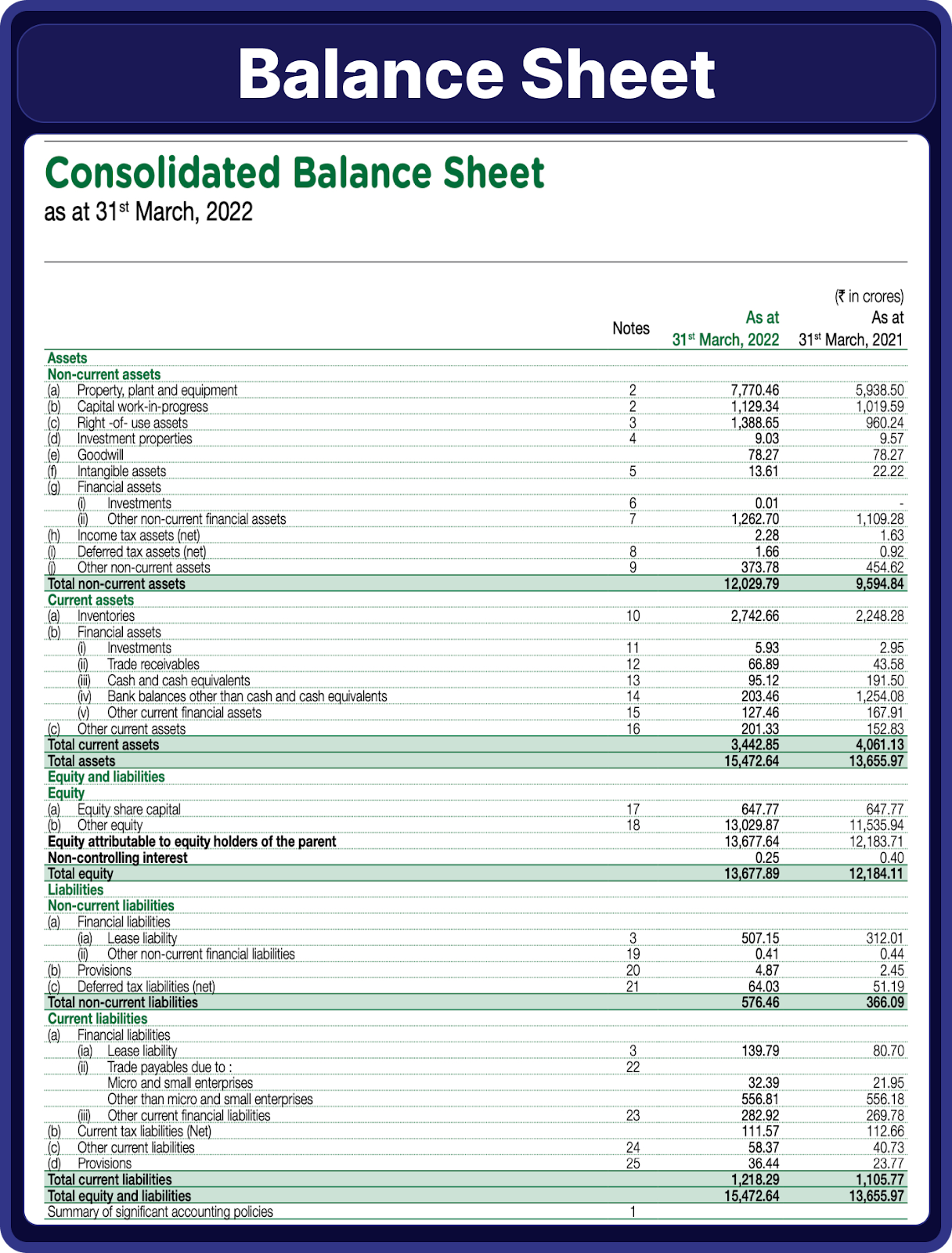
balance sheet | marketfeed
Consolidated Balance Sheet of Avenue Supermarts (DMart)

There are two sections in a balance sheet: an asset section and an equity & liabilities section. Even though equity and liabilities are separate components, a balance sheet combines them into a single section named equity and liabilities. We will learn the different elements and their components by analysing the consolidated balance sheet of DMart.

1. Assets 

Assets are anything of value that a company owns and controls. These are the resources available to a company. For example, a plant and machinery that the company uses to produce products is its asset. Assets are classified into two types:

Current Assets

Current assets are those assets held primarily for trading or expected to be sold, used up, or realized in cash within one year. This category also includes assets convertible into cash within one operating cycle. An operating cycle is the time period a company takes to convert its raw materials into finished goods. It includes cash and cash equivalents, inventories, short-term investments, etc.

current assets | marketfeed
  • Inventories are physical products that will eventually be sold to a company’s customers.
  • Financial Assets are liquid assets that get their value from a contractual right or ownership claim. Mutual funds, stocks, cash, etc, are financial assets.
  • Investments represent the amount that a company has invested into various instruments that can be converted to cash within one year or one operating cycle.
  • Trade Receivables refer to the amount that is yet to be received from customers for goods or services sold in credit.
  • Cash and cash equivalents show the amount that a company has in the form of cash. It also includes the cash in a company’s bank accounts.
  • Bank balances other than cash and cash equivalents show the amount of money in banks held as guarantees and commitments. These balances have restrictions on liquidity.
  • Other current financial assets represent all other financial assets that the company holds.
  • Other current assets include all the current assets which do not belong to the above categories.

Total current assets represent the sum of the values of all current assets.

Non-Current Assets (Fixed Assets)

Non-current assets refer to assets not anticipated to be sold or used up within one year or one operating cycle (whichever is greater) of the business. There are two types of fixed assets: 

Tangible assets, such as buildings and machinery, are physical assets that can be seen and touched.

Intangible assets are assets that cannot be seen or touched but are characterised by their impact and value, rather than physical presence. Assets like copyrights, patents, goodwill, etc are intangible assets. These assets are shown after deducting depreciation and amortization. Non-current assets include tangible and intangible assets, capital work in progress, investments, etc.
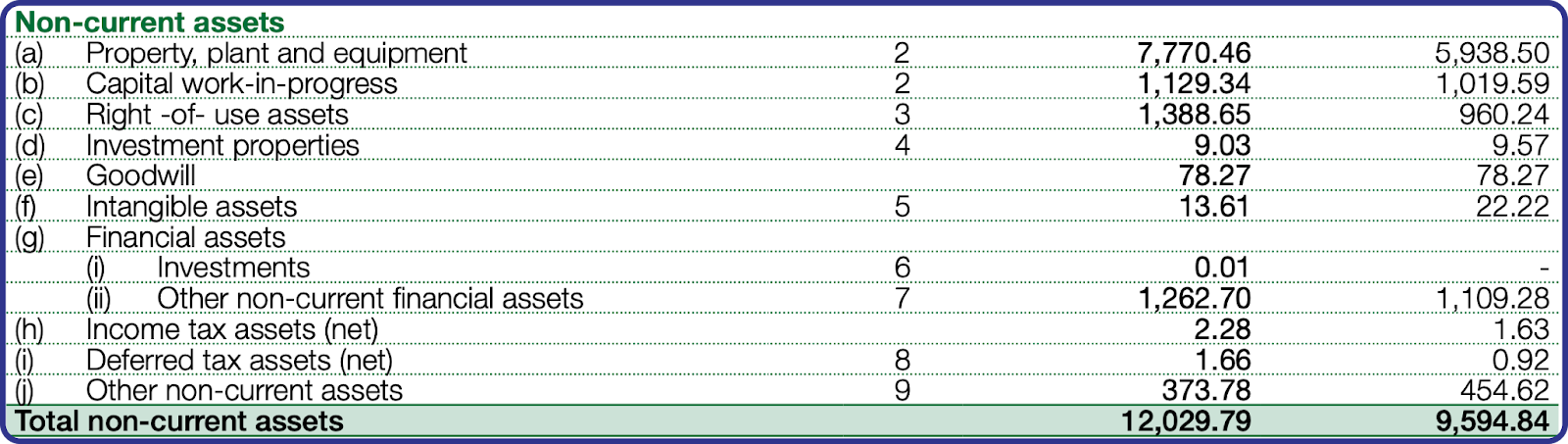
non-current assets | marketfeed
  • Property, plant, and equipment represent the value of all the properties, plants, equipment, and machinery that a company owns.
  • Capital work-in-progress is the value of tangible fixed assets that are under construction.
  • Right-of-use assets are the assets that a company has leased and has the right to use.
  • Investment properties are the properties that a company has invested in for purposes other than production. It includes properties that the company may buy for capital appreciation.
  • Goodwill is a value addition to the company due to its reputation.
  • Intangible assets are assets that do not have a physical form. It includes computer software, patent rights, etc.
  • Financial assets under non-current investments are the value of financial assets such as stocks, bonds, debentures, etc that a company is planning to hold for more than one year.
  • Income tax assets represent the amount that is to be received as tax refunds, rebates, etc
  • Deferred tax assets represent any amount of tax that has been overpaid or paid in advance, which reduces the future tax liabilities of a company.
  • Other non-current assets represent the value of all non-current assets that are not included in the above categories.

2. Liabilities

Liabilities are what the company owes. It represents the obligations of a company. Bank loans, money owed to creditors, etc are examples of liabilities. Liabilities are further classified into two types:

Current Liabilities

Liabilities expected to be settled within one year or one operating cycle of the business are categorised as current liabilities. An example is loans due for payment within one year.
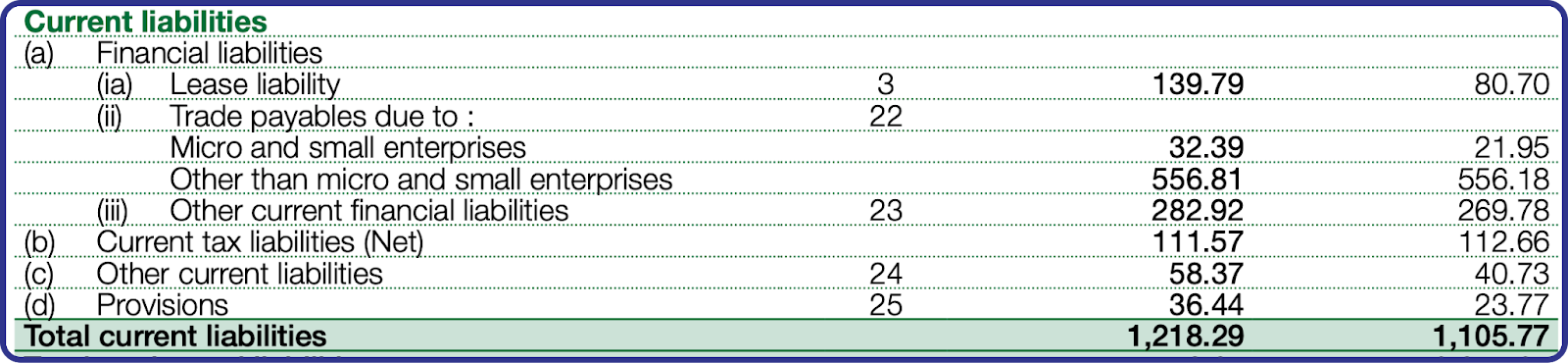
current liabilities | marketfeed
  • Financial liabilities are contractual obligations that require payment of cash.
    • The lease liability is the amount paid for leases.
    • Trade payables are the amount owed to creditors for credit purchases.
    • Other current financial liabilities are current financial liabilities that are not included in the above categories.
  • Current tax liabilities are the amount payable to tax authorities.
  • Other current liabilities represent all the current liabilities that are not included in the above categories.
  • Provisions in the current liabilities are the amount set aside from profit as provisions to meet future expenses. Warranty is an example of provision.

Non-Current Liabilities

Liabilities projected to be settled over one year or longer, or beyond one operating cycle of the business, are categorized as non-current liabilities. Non-current liabilities include loans with a repayment period of one year or more. It also includes bonds and debentures issued by a company to finance itself. All the items in this category are the same as items from current liabilities except for the duration, which is more than 1 year in the case of non-current liabilities.

Working capital is the surplus of current assets over current liabilities.

3. Equity

Equity represents the owners’ residual interest in a company’s assets after deducting its liabilities. It is commonly known as shareholders’ equity or owner’s equity. Equity is calculated by subtracting a company’s liabilities from its assets. Simply put, equity represents the amount invested by the shareholders of the company. It also includes reserves and surplus of the company. Surplus is the net profit that the company made.

Non-controlling interest is the equity of DMart’s subsidiaries, not owned by DMart. 

In conclusion, a balance sheet tells us what the company is worth. This statement is indispensable for investors, creditors, and management to gauge a firm’s solvency and liquidity. Make sure to download the balance sheet of a company and try to understand what you learned here. 

Categories
Jargons

What is a Statement of Profit & Loss?

A company communicates its financial performance to all stakeholders through financial statements. The statement of profit and loss (P&L) or earnings statement is the first of five statements that a company provides. It presents a company’s financial result, i.e. profit or loss. In this article, we will understand what a statement of profit and loss is, why you should analyse it, its contents and where to find it.

What is a Statement of Profit & Loss?

A statement of profit and loss presents information on the financial results of a company’s business activities over a particular time (usually a quarter or year). It is also known as income statement, P&L statement, statement of operations and earnings statement. The income statement communicates how much revenue a company generated during a period and the costs incurred for generating that revenue. 

The basic equation underlying the income statement is ‘Income – Expense = Profit’.

Where to Find Statement of Profit and Loss?

You can find the statement of P&L from the annual report of a company. An annual report is a company’s yearly report to shareholders, documenting its activities and finances of the previous financial year. It is a 300-400 page document containing all vital information about a company. It is the yearly official communication from a company. The annual report contains information regarding a company’s overall business outlook, industry outlook, financial statements, marketing content, and forward-looking statements.

You can download a company’s annual report from its website or other sources like screeners.

Standalone vs Consolidated Financial Statements

Companies with subsidiaries have two sets of financial statements in their annual reports: standalone financial statements and consolidated financial statements. Standalone financial statements only include the financials of a company itself and do not include the financials of its subsidiaries. On the other hand, consolidated financial statements include the financials of the company and its subsidiaries. 

For example, let’s imagine that Company B is a subsidiary of Company A. The standalone financial statements of Company A will only include the transactions of Company A. Meanwhile, a consolidated financial statement includes the transactions of both Company A and Company B.

We always consider consolidated financial statements as the business transactions of the subsidiary also affect its parent company, as the ownership lies with the company.

Why Should You Analyse the Statement of P&L?

  • To Understand Income Growth: The statement of profit and loss provides all details about the growth in a company’s revenue and income.
  • To Study Expenses: Expenses and other areas where a company spends money can only be analysed from the income statement. We should also compare the expenses of a company to its peers to understand how efficiently it can create revenue.
  • To Understand Profitability and Growth: It is necessary to understand the profitability of a business. The final result of the income statement is the profit/loss. Profitability is a measure of an organisation’s profit relative to its expenses. We should analyse the growth in revenue, profits and expenses to understand if the company is growing.

What are Notes to Accounts?

​​Notes to accounts, also known as footnotes or financial statement notes, are additional explanations, disclosures, and details provided in a company’s financial statements. They accompany the main financial statements (such as the balance sheet, income statement, and cash flow statement) to provide further context, explanations, and additional information that cannot be conveyed in the primary financial statements alone. 

These notes help investors, analysts, and auditors to better understand the company’s financial performance and position. Notes to accounts typically cover topics like accounting policies, contingent liabilities, significant events, changes in accounting methods, and other relevant details to ensure transparency and compliance with accounting standards. They are an integral part of a company’s financial reporting and provide important context to interpret the numbers presented in the primary financial statements.

What are the Components of a Statement of Profit and Loss?

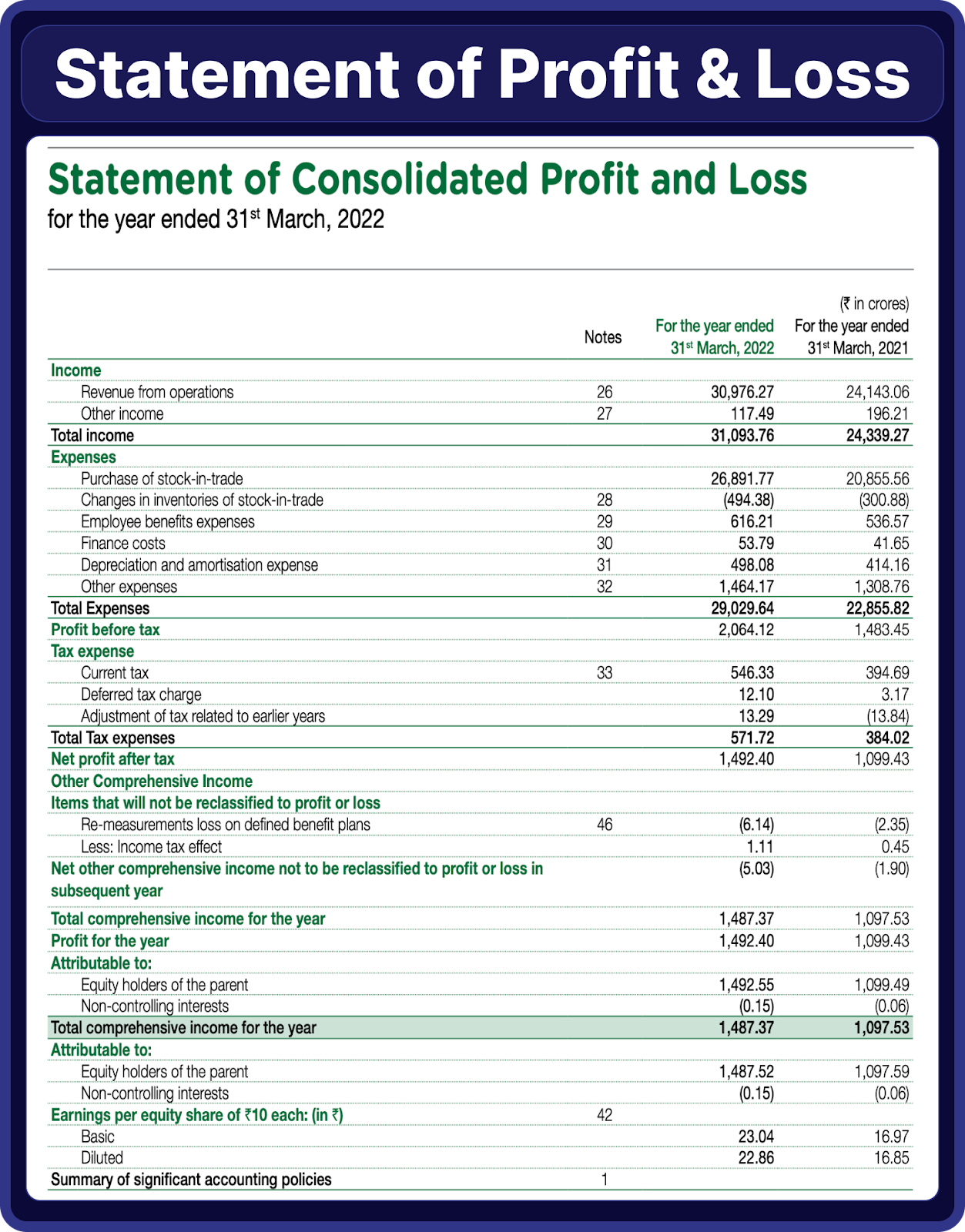
The main components and the structure of a statement of profit and loss are (we’ve taken the example of DMart here):

statement of profit & loss | marketfeed

There are four columns in the income statement. They are particulars, notes, current year financials, and previous year financials. The particulars of the income statement are:

1. Income (Topline)

The first section in the income statement is income or topline. Revenue or turnover generally refers to the amount charged for the delivery of goods or services in the ordinary activities of a business. 

  • Revenue from operations is a company’s revenue from operating activities or its main activities (things a company does to bring its products and services to market). 
  • Other income is the income from non-operating activities (like investment income, gains or losses from foreign exchange, interest income, etc).
  • Total Income is the sum of revenue from operations and other income.

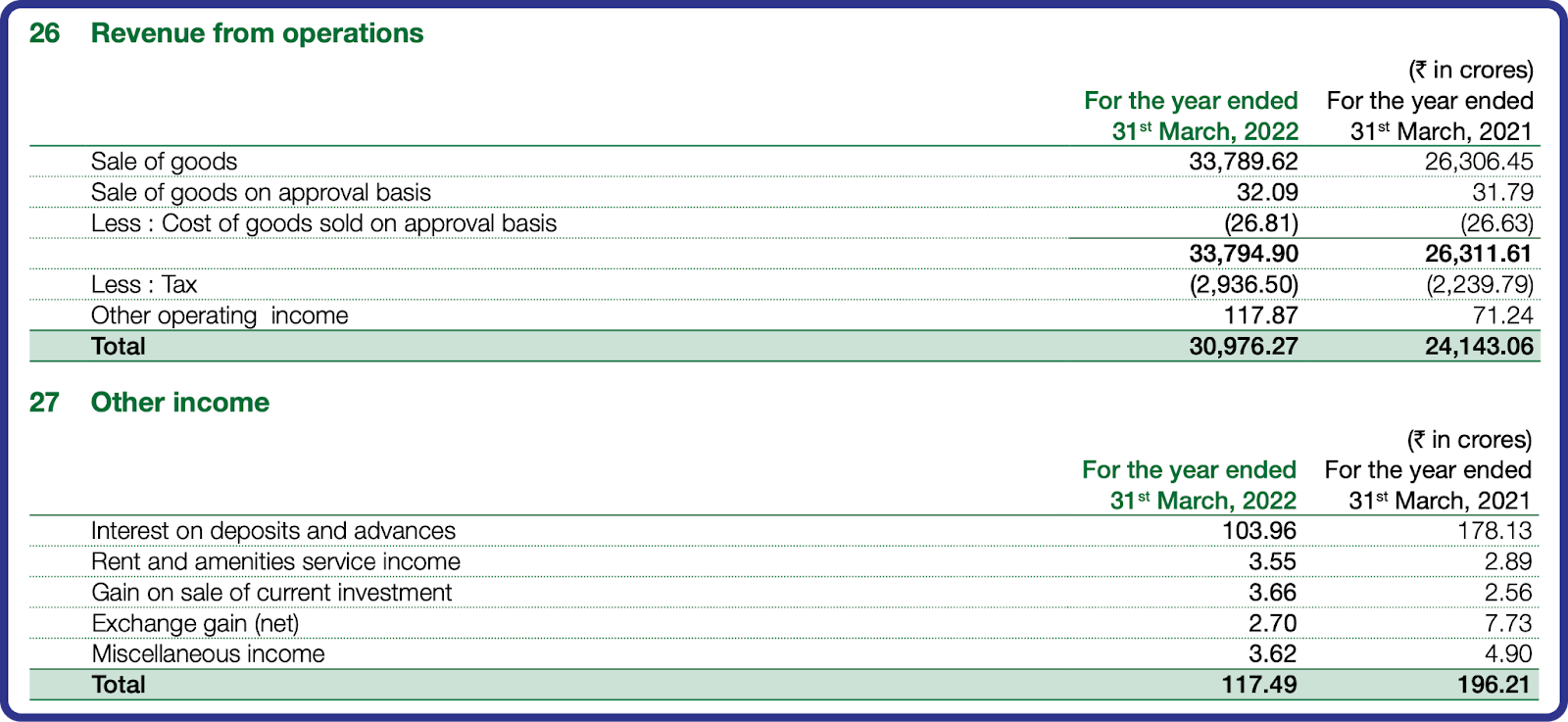
Its respective notes give a detailed breakdown of revenue from operations and other income.

revenue from operations | marketfeed

2. Expenses

Expenses reflect outflows, depletions of assets, and incurrences of liabilities in the course of the activities of a business.

  • Purchase of stock-in-trade contains the expense incurred for the purchase of products that are to be sold and related expenses. Since DMart operates retail outlets, its major expense will be the purchase of stock.
  • Changes in inventories of stock-in-trade are the difference between the amount of the last period’s ending inventory and the amount of the current period’s ending inventory.
inventories | marketfeed
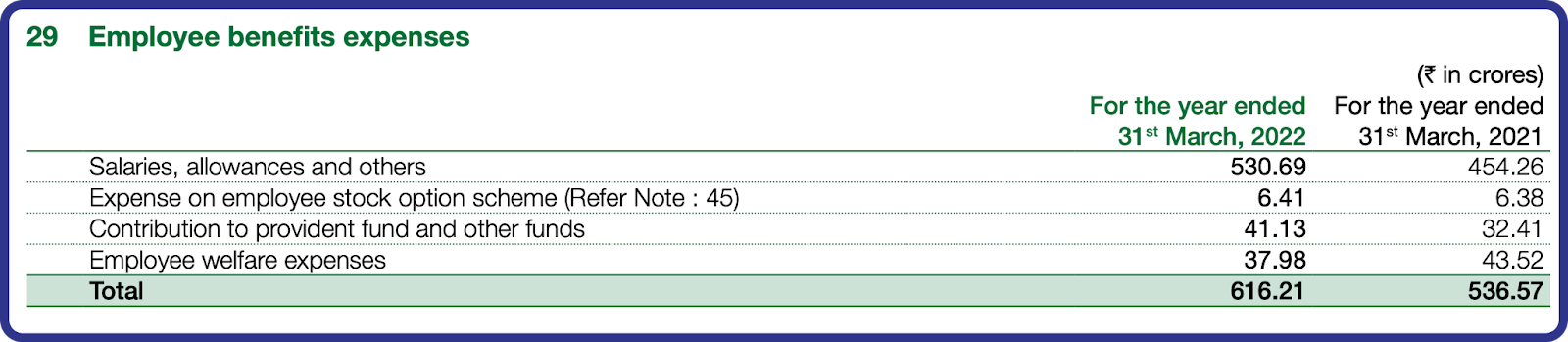
  • Employee benefits expenses are the costs incurred for the benefit of employees. It contains salaries and wages, welfare expenses, etc.
employee benefits expenses | marketfeed
  • Finance costs refer to the cost, interest, and other charges involved in the borrowing of money to build or purchase assets.
finance costs | marketfeed
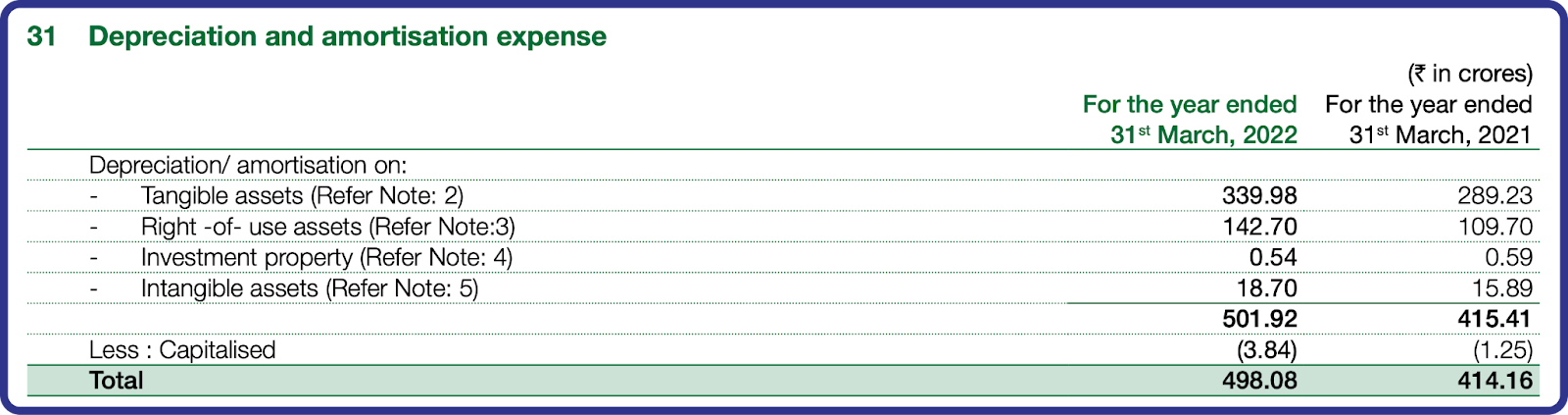
  • Depreciation and amortization expenses are the expenses incurred due to the loss of value of assets. Depreciation is the reduction in the value of a tangible asset over time due to wear and tear. Amortization is the reduction in the value of intangible assets such as goodwill.
depreciation | marketfeed
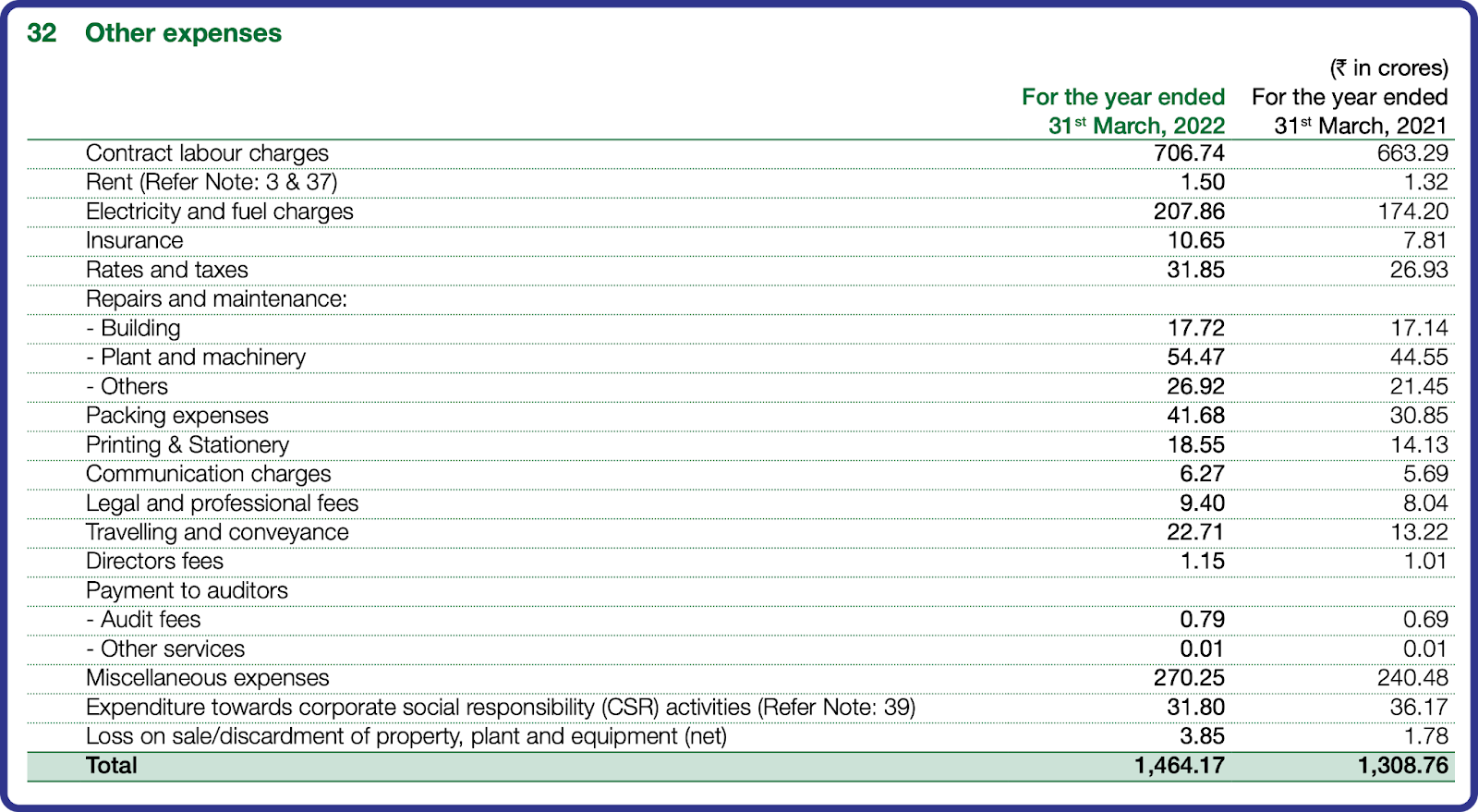
  • Other expenses are all the expenses that do not fall within the above categories. 
other expenses | marketfeed

You can go through all the notes to accounts to view the split-up of each cost.

Total expenses are the sum of all the expenses. 

3. Profit Before Tax (PBT)

Profit before tax is the difference between revenue and expenses, but before deducting tax liabilities. PBT = Total Income – Total Expenses.

4. Tax Paid

When a company makes profits, it must pay taxes to the government. This line provides comprehensive details on taxes. Meanwhile, notes to accounts provide in-depth information about all tax expenses. It is not necessary to analyse it.

5. Profit / Loss After Tax

Profit after tax (PAT) or bottom line represents the total profit earned after subtracting all expenses and taxes from revenue.

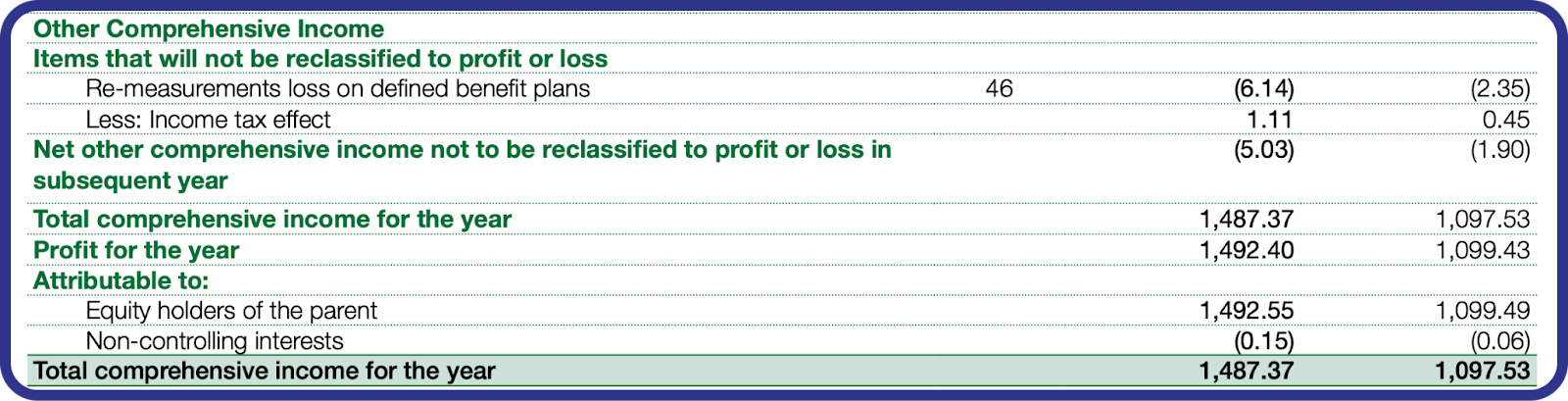
6. Other Comprehensive Income

In business accounting, revenues, expenses, gains, and losses that are yet to be realized and not included in the net income on an income statement are mentioned under other comprehensive income (OCI). It comprises both net income and other revenue and expense items excluded from the net income calculation.

Foreign currency translation adjustments, unrealised gains or losses on derivatives contracts accounted for as hedges, unrealised holding gains and losses on a certain category of investment securities, and certain costs of a company’s defined benefit post-retirement plans that are not recognised in the current period are the most common items treated as other comprehensive income. It is not necessary to analyse other comprehensive income.

other comprehensive income | marketfeed

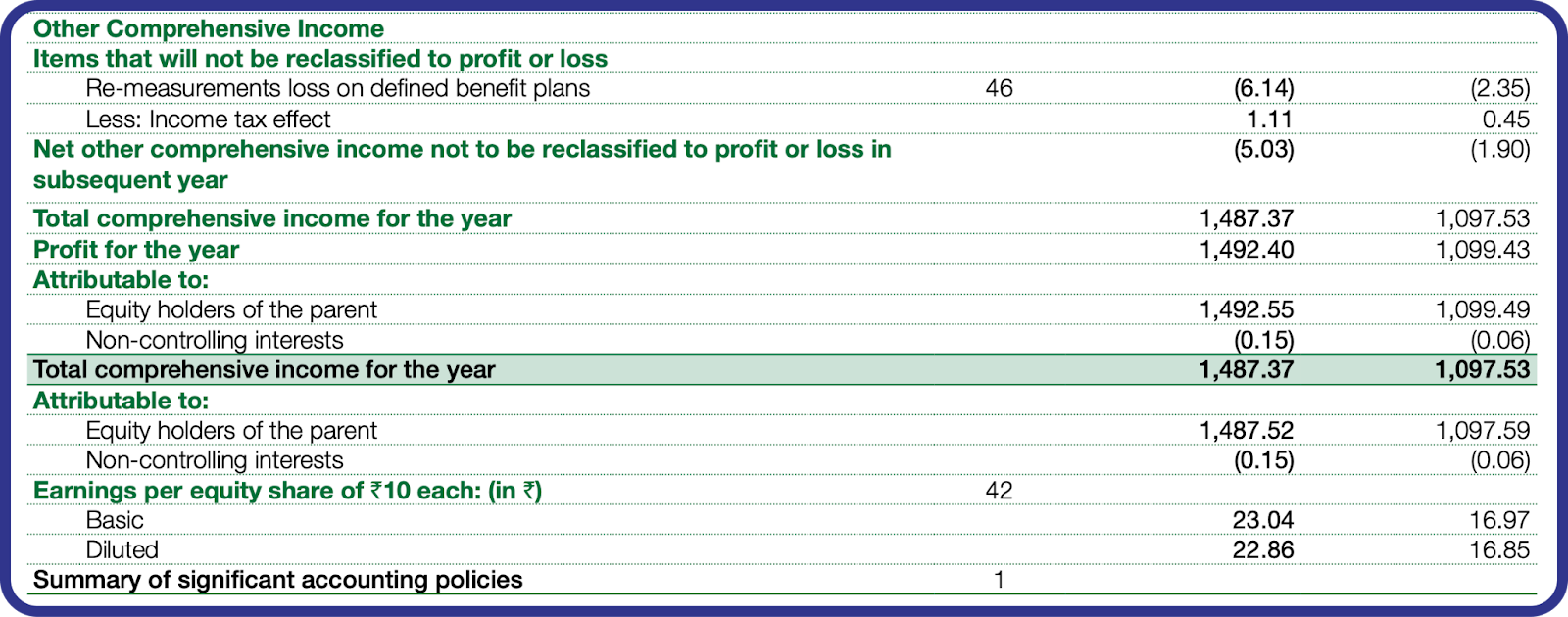
7. Profit Attributable to Equity Holders of the Parent and Non-Controlling Interests

The profit after tax in the consolidated income statement includes the financials of the subsidiary companies as well. Meanwhile, non-controlling interest is the portion of a subsidiary company’s stock that is not owned by the parent corporation. It signifies the profit allocated to the other owners of a subsidiary company.

The profit attributable to equity holders of the parent is the profit allocated to the parent company itself.

statement of profit & loss | marketfeed

8. Earnings Per Share (EPS)

Earnings per share is the monetary value of earnings per outstanding share of common stock for a company. It is a key measure of profitability and is commonly used to evaluate stocks. The higher the EPS, the better.  EPS includes retained earnings and dividends. Basic and Diluted EPS are the two types of EPS in the financial statements. 

Basic Earnings Per Share (EPS) is a financial metric that represents a company’s profit allocated to each outstanding common share. It is calculated by dividing the net income by the total number of common shares. Basic EPS provides a straightforward view of a company’s earnings on a per-share basis.

Diluted Earnings Per Share takes into account potential dilution from securities like stock options and convertible bonds. It assumes all such securities are exercised or converted, potentially increasing the number of shares outstanding. Diluted EPS is typically lower than basic EPS, as it considers the impact of potential future share issuances. If the Diluted EPS is higher than the basic EPS, then the diluted EPS will be the basic EPS.

In conclusion, a statement of profit and loss outlines a company’s revenues, expenses, and net profit for a specific time period. This statement is indispensable for investors, creditors, and management to gauge a firm’s profitability. Make sure to download the income statement of a company and try to understand what you learned here!