Categories
Jargons

Introduction to Fundamental Analysis of Stocks

We have discussed the basics of long-term investing in one of our previous articles, which is buying and holding shares for a long period (>1 year). In this article, we will learn how to identify good quality stocks to invest in, when to invest, and how much to invest. Discover how to evaluate a company’s financial health, assess its growth potential, and make wise investment choices!

Long-Term Investing in Stocks vs Fixed Deposits

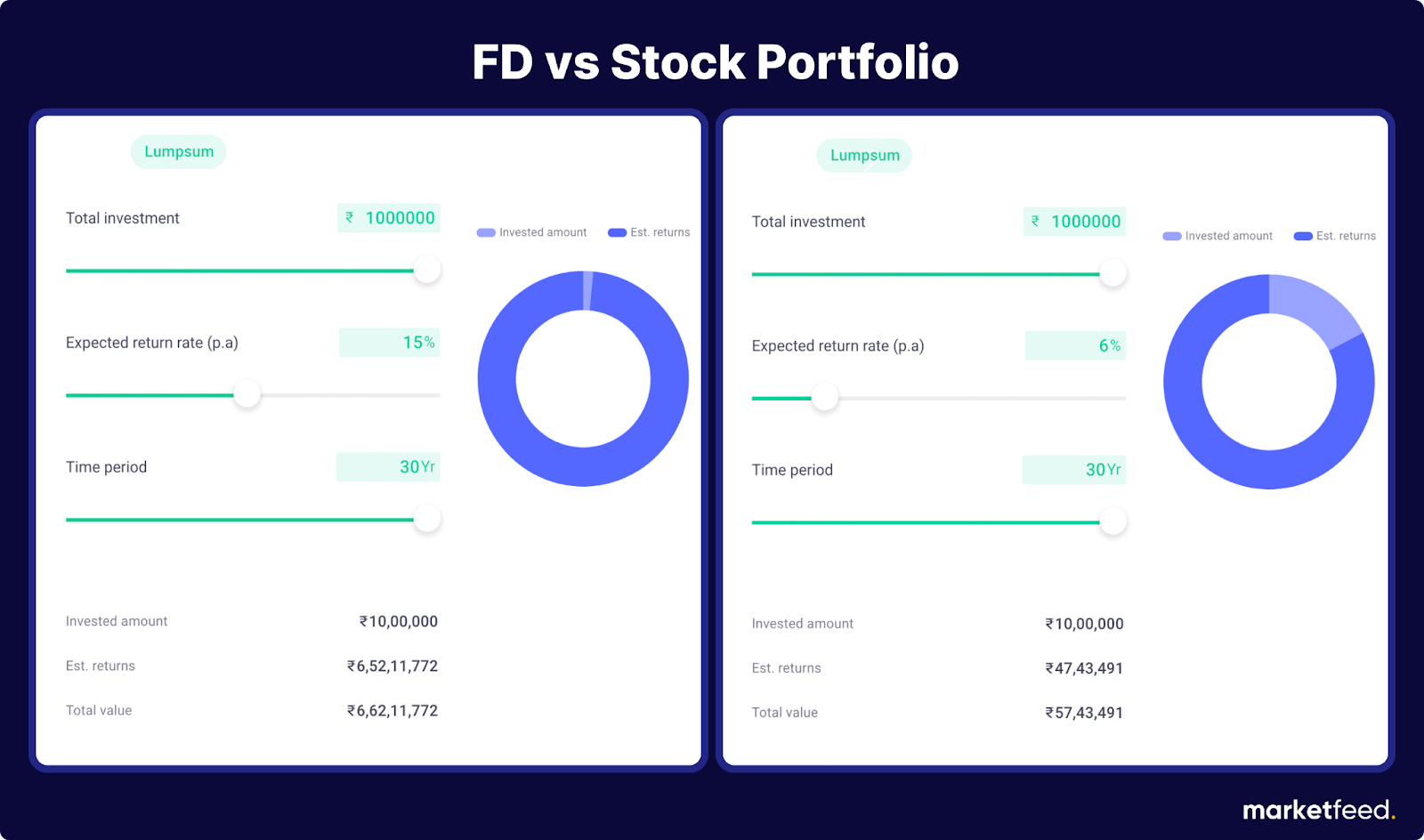
Investing in high-quality stocks will allow your hard-earned money to grow at a fast pace and become a sizable corpus over time. With this money, you can meet your financial goals can be met later in life. In contrast, if you simply deposit your money in a fixed deposit, it will only grow at a rate of 5-6% annually. However, investing in a good portfolio of stocks will grow at a rate of 15-18% or even higher each year. The returns between an FD and a stock portfolio differ wildly:
FD vs Stock Portfolio | marketfeed
(Stock Portfolio on the left side, FD on the right)

The lump sum invested in a stock portfolio giving a 15% CAGR grew to ₹6.62 crores, while the amount invested in a fixed deposit giving a return of 6% every year grew to just ₹57 lakhs. The difference in the corpus is wildly different. This is why you should invest in a stock portfolio instead of traditional methods like fixed deposits or bank savings accounts. 

How to Find Good Quality Stocks to Invest in?

The direct answer to the question is: carefully analyze companies thoroughly. To find high-quality stocks, we should deeply study the overall business and financials of various companies across sectors. We must understand and analyze a company’s business model, its financial performance and position, its market, its competitors, its management, and even the economic factors that could affect the future growth and prospects of the business. This type of study is known as fundamental analysis. Fundamental analysis is a method of determining a stock’s real or “fair market” value. We will learn how to do fundamental analysis in the upcoming modules.

You can do fundamental analysis to understand if a company can be invested in. However, when it comes to picking companies for long-term investments, there are two schools of thought in the market. They are:

1. Value Investing

By doing a fundamental analysis, we will arrive at the intrinsic or true value of a company. In value investing, if the intrinsic value of the company is lower than the current market value, then that company is a buy candidate. We will buy the stock and eventually make a profit when the current value increases to the intrinsic value. Veteran investors like Warren Buffet and the late Rakesh Jhunjhunwala are renowned value investors. 

2. Growth Investing

In growth investing, investors do not give much importance to the true valuation of a company. Suppose the fundamentals of a company are good and its business is growing. In that case, the investor buys the stock even though the current market value is higher than the true value, assuming that the company will keep growing in the future and hence profit from it. 

What to Study in Fundamental Analysis?

While doing fundamental analysis, there are three things we should study:

1. Management

We should study the management of a company. Efficient and effective management is the key to the success of a business. If the management is poor, then the business is on a path to failure. While analyzing the management, we must study the executives who run the business, what their strengths and weaknesses are, their background, their potential, their past, and current performance, etc. We must also see if the management is drawing a high salary even though the business is doing poorly. 

2. Business

We must study the business model of a company and its current & future relevance. Find out if the business excites you as well. 

3. Valuation

While studying a business, we must look into its financials such as revenue, expenses, profits, etc. We can also look into the dividends the company distributes to its shareholders. We can judge a company from a purely financial perspective based on its future prospects and potential. 

The three main areas of study can be called MBV, which stands for Management, Business, and Valuation.

Factors to Consider in Fundamental Analysis

The two factors to be considered when doing fundamental analysis are:

Qualitative Factors

1. Business Model – A business model is an outline of how a company plans to make money. Understanding the business model is an important factor to consider while doing fundamental analysis. You should only consider a company for investments if its business model excites you. 

2. Management Background – A strong idea of who runs the business is an important element of fundamental analysis. We need to analyze if the management is capable of running the business and taking it to new heights. 

3. Ethics – All businesses need to be ethical in all their activities. It also has to be ethical toward all its stakeholders.

4. Corporate Governance – It refers to the corporate structure of a company. The efficiency and productivity of a business depend on its corporate governance. 

5. MOAT – A MOAT is a company’s competitive edge over its competitors. It’s a feature that makes the company highly resistant to competition from other firms. For example, Fevicol (produced by Pidilite Industries) has a moat advantage because it is extremely difficult for another company to reach its level of brand value and sales.

6. Industry – It is also important to analyze the industry in which a company operates. Even if a company is performing well now, it may not be in the future due to a lack of opportunities for the company to grow.

Quantitative Factors

1. Earnings & Growth – We should analyze the earnings or revenue of a company to understand how much money it’s making. An analysis of the trend of revenue over different years should also be considered to understand if a company is growing or not.

2. Expenses – We should be aware of how much money a company is spending and where those expenses are going. Excessive spending is not favourable. However, if the money is allocated toward activities for business expansion and development, it will lay the foundation for future growth.

3. Profit & Margin – The profit that a company makes helps us to understand if its business is growing.

4. Assets & Liabilities – A thorough analysis of the assets and liabilities of a company is a must.

5. Debt – If a company has too much debt burden, it’s unfavourable as there is a high chance of falling into a debt trap. 

Where to Find Qualitative & Quantitative Data of Listed Companies?

The annual report of a company contains all the necessary information from which we can collect quantitative and qualitative data. An annual report is a company’s yearly report to shareholders, documenting its activities and finances of the previous financial year. It is a 300-400 page document containing all vital information about a company. 

  • The qualitative factors of a company can be found in its annual report across various sections. 
  • The quantitative factors of a company can be found in the financial statements section of its annual report.
  • In addition to the annual report, other sources such as videos related to the company, interviews with the founders and management, business magazines, articles, etc., can be used to collect data.

When to Buy Stocks?

The two ways in which people invest in stocks are:

1. Lump Sum Investment

When we invest a large amount into stocks all at once, it is called a lump sum investment. People usually do this when they receive bonuses or any other large sum of money. However, the drawback of this method is that we cannot maintain a better average price. If we do a lumpsum investment and the stock keeps on falling, we cannot take advantage of this price discount as all the money was invested in a single go previously.

2. Systematic Investment Plan (SIP)

SIP is a method of investing a fixed sum regularly into a portfolio. Most salaried people have a regular income every month. Out of this, they invest a certain percentage as SIP. A better average price can be maintained in this method as the purchase price will be lower and higher sometimes. 

When to do SIP?

The two approaches to SIP investments are:

1. Fixed Date/Time

The most common method is to invest on a particular date or time. Some people invest every month, while others invest every week. People buy stocks blindly on a specified date or maybe the first working day of every month.

2. At low prices using technical analysis

Some people also do technical analysis to find if the stock prices are low or high and invest if the prices are low. If technical analysis implies that the stock is overpriced now, the investor waits until the stock price is low. We will discuss Technical analysis in detail in the upcoming module.

The first method, i.e., investing regularly on a fixed date/time is the most convenient. As our aim is to meet the benchmark, it is not necessary to take the extra effort of technical analysis for doing SIPs in the long term. 

How Much to Invest For the Long Term?

The most commonly used method of investing is the 50-30-20 rule, which suggests that 50% of your income should cover your basic needs, 30% should go towards your wants, and the remaining 20% should be invested. However, this method cannot be used by people with low incomes as most of the amount will be used for basic needs. Also, if our income increases, our expenses will more or less be similar so that we will be able to invest. So our aim should be to invest as much as possible. However, it is a very subjective question as needs and financial goals vary from person to person. 

The best way to determine how much you should invest is to calculate how much money you will need during retirement. To reach that number, you should consider your current lifestyle and what your lifestyle will be after retirement, among other things. 

In one of our next articles, we will learn how to calculate the corpus you’ll need when you retire, how much to invest to reach that corpus and plan long-term & short-term financial goals using an Excel calculator. 

Categories
Jargons

Best Stocks to Invest for Long Term

Investing your hard-earned income in stocks can be quite challenging. There are thousands of companies across diverse segments to choose from. However, it’s vital that we invest in those enterprises that have a solid business model, strong financial growth, and follow good corporate governance practices. Historical records have proven that investing in such reputed firms over the long term can help us beat inflation and secure our financial goals. In this article, we analyse some of the best stocks to invest in for the long term in India.

Factors to Consider While Looking for Stocks to Invest for Long Term:

  • Company Fundamentals: Evaluate the financial health of all companies, their profitability, competitive advantage, and growth prospects to ensure they have a solid foundation for long-term success.
  • Industry Analysis: Assess the growth potential of the industry a company operates in, market dynamics, and competitive landscape. Investing in sectors with favourable long-term prospects can increase the chances of sustained stock performance.
  • Management Quality: Examine the experience and track record of the company’s management team. Strong leadership and effective execution are crucial for long-term value creation.
  • Valuation: Consider a stock’s valuation relative to its earnings, cash flows, and industry peers. Buying stocks at reasonable prices or at a discount to their intrinsic value improves the potential for long-term returns.
  • Dividends and Shareholder Returns: Look for companies with a history of consistent dividend payments or share buybacks. These factors indicate a commitment to returning value to shareholders and can contribute to long-term total returns.

Stocks to Invest for the Long Term:

Stock5-Year Return
Reliance Industries Ltd. 122.3%
Tata Power Company Ltd. 202.5%
Tata Consultancy Services Ltd. 74.5%
Asian Paints147%
HDFC Bank52.5%
(Returns as of July 24, 2023)

Note: These are not stock recommendations. Please do your own research before investing.

Reliance Industries Ltd. 

Reliance Industries Ltd (RIL) is the largest private-sector corporation in India. The Mukesh Ambani-led conglomerate is primarily involved in the energy, petrochemicals, retail, textiles, telecom, entertainment, and digital services sectors. RIL owns the world’s largest refining hub in Jamnagar (Gujarat), which has a crude processing capacity of 1.24 million barrels per day. 

The company’s subsidiary, Reliance Retail Ventures, is our country’s largest retailer in terms of revenue and profitability. Meanwhile, Reliance Jio is the biggest player in the telecom sector, with a 37% market share and nearly 43 crore subscribers. RIL is currently focusing on dominating the gradually evolving green energy sector. Thus, Reliance’s products and services portfolio touches almost all Indians every day.

Over the past five years (FY19-FY23), RIL’s revenue and net profit have shown an impressive Compounded Annual Growth Rate (CAGR) of 17.25% and 13%, respectively. [In simple terms, CAGR is a measure of the average year-on-year growth rate of a metric over several years.] They have been able to significantly reduce debt during this period. Reliance has cemented its position as a market leader in almost all sectors it operates in.

Tata Power Company Ltd. 

Tata Power Company Ltd is engaged in the generation, transmission, and distribution of electricity across India. It has a total generation capacity of 14,110 megawatts (MW) from thermal, hydro, and renewable power (solar, wind) projects. Since its inception in 1915, Tata Power has developed expertise in executing critical projects and driving green initiatives. The company holds a dominant position in the growing electric vehicle (EV) charging station market in our country.

Going forward, the integrated power company plans to expand its clean & green energy capacity to 80% by 2030. It aims to become carbon neutral by phasing out thermal projects by 2050. Additionally, it plans to construct 1 lakh EV charging stations by 2025. 

Tata Power currently holds a ~41.83% market share in India’s power transmission & distribution sector. Its revenue has grown at a CAGR of 14.76% over the past five years, while net profit has grown at 6.74%. The company has also been maintaining a healthy dividend payout of 31.7%. Based on its recent order wins and top-class project execution capabilities, Tata Power is expected to post good results in the upcoming quarters.

Tata Consultancy Services Ltd. 

Tata Consultancy Services (TCS) is the flagship company of the Tata Group. It is a management and technology consultant, which means that they provide services to other enterprises and government agencies and help them transform the way technology is used. The company’s services include application development, business processing outsourcing (BPO), payment processing, and much more. TCS essentially helps organizations simplify their digital systems and reduce costs.

TCS is almost debt-free. Over the last 5 years, its revenue has grown at a yearly rate of 12.5%. The company’s Return on Capital Employed (ROCE) is the highest amongst its competitors in the IT sector at 59.1%. [It means that for every ₹100 worth of capital employed, TCS earns ₹59.1 on it.] The company has been maintaining a healthy dividend payout of 61.4%. As the flagship company of Tata Group, Tata Consultancy Services has time and again exceeded its targets and is continuing its path as a global leader in the IT industry.

HDFC Bank

Housing Development Finance Corporation (HDFC) was one of the pioneering institutions to receive preliminary approval from the Reserve Bank of India (RBI) to establish a private sector bank. In August 1994, HDFC Bank was incorporated with its headquarters in Mumbai, India. It offers a comprehensive range of banking and financial services, including retail banking, wholesale banking, and treasury operations. Today, it stands as the largest private-sector bank in India. It is a market leader in the credit card business in India. As of 31 March 2023, the bank’s distribution network was at 7,821 branches across 3,203 cities.

The bank’s revenue has grown at a CAGR of 15.09% over the past five years, while net profit has grown at 19.97%. It has been maintaining a healthy dividend payout of 19%. 

HDFC Bank aims to launch more products and services under its ‘Digital 2.0’ drive in the upcoming years.

Hindustan Unilever Ltd. 

Hindustan Unilever Ltd is a consumer goods company headquartered in Mumbai. It is a subsidiary of the UK-based Unilever plc. Foods, drinks, cleaning supplies, toiletries, water purifiers, and other fast-moving goods are among its offerings. The company’s Beauty & Personal Care segment forms a majority of its revenue (42%). This is followed by the Home Care segment (29%) and Food and Refreshment Segment (29%). 

HUL’s revenue has grown at a yearly rate of 11.2% over the past five years, while its net profit has grown at 14.18%. The company is almost debt free. It has also been maintaining a healthy dividend payout of 99.9%.

Now you know some of the best stocks to invest for long term. In conclusion, invest in well-established companies for the long term, and you will understand the magic of the eighth wonder of the world— compounding! You will be safe from short-term market volatility and risks. Develop patience and let your money grow multifold.

Disclaimer: The stocks mentioned in the article are solely for educational purposes. Please do your own research before investing.

Categories
Editorial

The Success Story of Vijay Kedia

India has its fair share of inspirational and highly successful stock market investors. One such ace investor is Vijay Kedia, who has developed unique skills and expertise to pick stocks over his 30-year career. Kedia and his investment firm, Kedia Securities Pvt Ltd, are the largest shareholders of several listed companies in India. His success story can be a motivation for all aspiring investors out there. In today’s article, learn more about Dr. Vijay Kishanlal Kedia and his journey in the stock market so far.

Vijay Kedia – A Brief Profile

Kedia was born into a family of stockbrokers based in Kolkata. He is part of the Marwari community, an ethnic group well-known for its strong business acumen. At the age of just 14, he started to develop a passion for trading and learnt several strategies from his grandfather. Kedia joined his family’s stockbroking business after his father passed away. He was 19 at the time. However, he was never really interested in stockbroking and thus, decided to leave the business after working for three years. He began to focus on his trading career.  

Initially, Kedia was able to make sufficient profits from several trades. He built the confidence to increase his capital gradually. Unfortunately, he started incurring huge losses that ultimately ate up all realized profits and some part of his capital. Highly relatable, right? After analysing the mistakes he made, Kedia decided to make a transition towards investing. This would turn out to be one of the most important decisions in his life. He began to learn the different concepts behind fundamental analysis and growth investing. Around the same period, he moved to Mumbai to try his luck in conquering Dalal Street.

Since the early 1990s, Vijay Kedia had developed the ability to identify numerous multi-bagger stocks. In 1992-93, he bought ACC shares at Rs 300 per share and sold them at ~Rs 3,000/share within a year and a half. Similarly, Atul Auto, Aegis Logistics, and Cera Sanitaryware are some of the stocks that gave him a return of over 1,000% each within 10-12 years. He could analyse and pick a stock way before the market realised its true potential. In 2012, Kedia rightly predicted the beginning of the structural bull run in India, at a time when most analysts were bearish. The Economic Times has described him as a “market master”.

As per corporate shareholdings filed for June 30, 2021 (Q1 FY22), Vijay Kedia and his firm publicly hold 16 stocks with a net worth of over Rs 810.6 crore.

Vijay Kedia’s shareholdings as of June 30, 2021 (Source: Trendlyne)

Important Lessons from Vijay Kedia’s Life & Career 

Vijay Kedia’s initial losses or failures in his trading days are what drove him to become one of the most successful investors in India. He was able to learn from his mistakes, as well as observe the success and failures of those in the same field. He keeps himself updated by reading newspapers, business magazines, and annual reports of listed companies. Kedia often watches interviews of CEOs and managers to frame an idea about a firm’s future plans and growth targets.

To become a successful investor, Kedia says one must acquire the knowledge to search for the best stocks and have the courage to purchase them at a sufficient cost. Most importantly, one must develop the patience to hold stocks until the market finds its real value. “Invest like a bull, sit like a bear, and watch like an eagle (mantra for long-term investing)”.

Kedia adheres to the SMILE principle of investing, which refers to Small in size (small-medium market cap), Medium in management experience, Large in Aspiration, and Extra-large in market potential. He has time and again emphasized the importance of a strong management team while selecting a stock to invest in. He believes that the best businesses can be ruined by bad management and bad businesses can be revived by the best management. An experienced team will protect your investment in order to safeguard their own wealth and reputation. Investors must carefully analyse the future projection of a company, and check whether its management is ambitious towards achieving its goals. 

Here is an inspiring quote from Vijay Kedia. “One must understand that the stock market is a ‘high risk-high gain’ business. It is a full-time business which has its own rules which need to be strictly followed. One has to fall in love with the market. The market rewards you as per your perception of it. If you treat it as a gambling den, it will prove a gamble for you”.