Categories
Editorial

India’s Electric Two-Wheeler Market: An Analysis

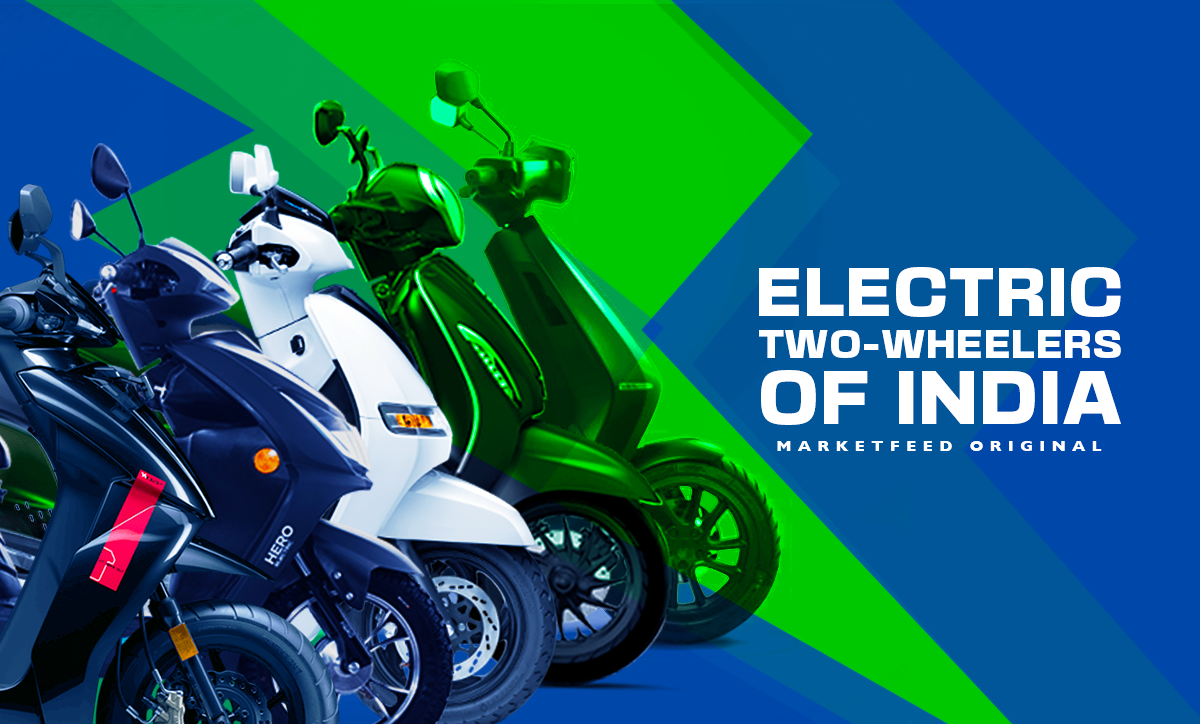
Electric two-wheelers (E2Ws) have become widely popular in India. Over the past few years, numerous companies have launched long-range, efficient scooters and e-bikes to meet the rising demand. There is a wide variety of super affordable E2Ws available in the market today. The total registered sales of E2Ws jumped 132% year-on-year (YoY) to 2,33,971 units in 2021! Things are definitely looking up for India’s EV revolution.

In this piece, we dive into India’s electric two-wheeler market and the leading companies involved in it.

Hero Electric

Hero Electric is the largest player in the Indian electric two-wheeler market. The company launched its first lithium-ion battery-based scooter in 2017. It operates more than 600 dealership networks across 325 cities in the country. 

The Gurugram-based firm offers around 9 different E2W models, with a price range of Rs 46,640 to Rs 83,940. In 2021, Hero Electric sold around 46,260 units. The company sold ~6,058 units of E2Ws in just December alone. They have partnered with several online retail and logistics firms to offer last-mile services.   

Hero Electric has secured a market share of 30-31% in the Indian electric E2W market. In the upcoming years, the company aims to expand its production capacity, invest in new technologies, and enhance its footprint across markets.

Ather Energy

Established in 2013, Ather Energy Pvt. Ltd is an Indian electric vehicle startup. It is backed by Hero MotorCorp, which holds around a 32% stake. The company has raised more than $160 million (~Rs 1,200 crore) since its inception.

The Bengaluru-based e-scooter manufacturer offers two premium models in India— the 450X and 450 Plus. It registered total sales of 15,921 units in the calendar year 2021 and holds an 11% market share.

Ather Energy has started working on new variants of electric scooters that will offer a longer range and better value for money. It also aims to raise more funds to ramp up its annual production capacity to one million scooters over the next three years. They have also announced plans to install 5,000 fast chargers across India and increase its network to 600 stores.

TVS Electric Mobility

TVS Electric Mobility Ltd is the EV arm of TVS Motor Company Ltd. It has entered into a partnership with BMW Motorrad to co-produce electric vehicles. It had also forged a strategic collaboration with Tata Power to set up electric charging infrastructure across our country. 

TVS iQube is the first electric two-wheeler launched by the TVS Group. It posted annual sales of 5,976 units in 2021.

Bajaj Auto Ltd

In January 2020, Bajaj Auto Ltd launched the electric version of its iconic scooter Chetak in two variants: Urbane and Premium. With this rollout, the company has been able to gain a ~4% market share in the electric two-wheeler space. 

The two- and three-wheeler manufacturer aims to double the network for its e-scooter Chetak in the coming weeks. It had initially opened bookings in eight cities in 2021 and had already added 12 new cities in the network in the first six weeks of 2022. They had also announced plans to invest Rs 300 crore to ramp up its EV production capacity. As per reports, Bajaj Auto has started testing a new electric scooter which is expected to be announced shortly. 

Ola Electric

Ola Electric Mobility is an Indian electric two-wheeler manufacturer based in Bangalore. The company made news in December 2021 when it announced the launch of the Ola S1 and Ola S1 Pro e-scooters. They recorded one lakh bookings for its e-scooters within just 24 hours of opening. However, it sold just 1,102 E2Ws in January. Ola Electric has been hit with production delays. Some customers are also unhappy with the quality of the electric scooters delivered to them.

Last month, Ola Electric raised $200 million (~Rs 1,490.5 crore) in funding at a valuation of $5 billion. 

The Way Ahead

The sales of electric scooters more than doubled in 2021, mainly due to high fuel prices that pushed Indian citizens to look for alternatives. Various subsidies from the government (such as the FAME initiative) have helped narrow the price gap between electric and petrol scooter models. Unfortunately, electric models made up just 1% of total Indian motorcycle and scooter sales of 1.45 crore units last year. The government aims to increase this share to reach 40% by 2030, as it looks to reduce its oil imports and counter pollution.

As we know, the electric vehicle (EV) segment is still at an evolutionary stage in India. As per a report by investment banking firm Avendus Capital, the EV market is estimated to be a Rs 50,000 crore opportunity in India by 2025. Moreover, two- and three-wheelers are expected to drive higher electrification of vehicles in the medium term. India’s rising startups and legacy automakers together have committed investments of more than Rs 10,000 crore over the next 3-5 years towards their electric two-wheeler business! However, the EV battery swapping and charging infrastructure has to improve significantly across India.

What are your views on the E2W market? Do you own an electric scooter? Let us know in the comments section of the marketfeed app.

Categories
Market News Top 10 News

MobiKwik Files DRHP For Rs 1,900 crore IPO – Top Indian Market News

MobiKwik files DRHP for Rs 1,900 crore IPO

Digital payments firm MobiKwik has filed a Draft Red Herring Prospectus (DRHP) with market regulator SEBI to raise Rs 1,900 crore via an initial public offering (IPO). The IPO consists of a fresh issue of shares worth Rs 1,500 crore and an offer for sale (OFS) of up to Rs 400 crore. The company will use the IPO proceeds for funding organic and inorganic growth initiatives. One MobiKwik Systems Ltd was previously valued at $700 million (~Rs 5,200 crore) when it raised $20 million from Abu Dhabi Investment Authority (ADIA) in June 2021.

Read more here.

SJVN signs pact with Investment Board of Nepal to develop 679 MW hydroelectric project

SJVN Limited has signed a pact with the Investment Board of Nepal to develop a 679 megawatt (MW) Lower Arun Hydro Electric Project in eastern Nepal. The estimated cost of the project is $1.3 billion (~Rs 9,700 crore). This will be the second-largest foreign investment project to be undertaken by India. SJVN is required to complete a detailed report on the hydroelectric project and submit it for approval at the board within two years. The project will be developed under a build, own, operate, and transfer (BOOT) model.

Read more here.

Steel Strips Wheels Q1 Results: Net profit at Rs 51.08 crore

Steel Strips Wheels Ltd reported a standalone net profit of Rs 51.08 crore for the quarter ended June (Q1 FY22). It had posted a net loss of Rs 38.09 crore in the corresponding quarter last year (Q1 FY21). The company’s revenue from operations jumped 463.9% YoY to Rs 678.13 crore in Q1 FY22. Steel Strips Wheels is a leading manufacturer of automotive steel and alloy wheels. 

Cyient to support HMLR to centralise, digitise local land charges records

Her Majesty’s Land Registry has selected Cyient Limited to support its Local Land Charges (LLC) Programme. HMLR is a non-ministerial department of the Government of the United Kingdom. It registers the ownership of land and property across England and Wales. The LLC program aims to digitise and migrate millions of separately held local land charge records from local authorities into a centralized digital register. Cyient will own the entire process and provide a central management information platform.

Read more here.

Ashoka Buildcon secures project worth Rs 726 crore from NHAI

Ashoka Buildcon Ltd has received the Letter of Acceptance (LoA) for an engineering, procurement, and construction (EPC) project from the National Highways Authority of India (NHAI). The order consists of six-laning of the Memmadpur (Ambala)-Banur (IT City Chowk) -Kharar (Chandigarh) corridor in Punjab on EPC mode. The total value of the project is Rs 726 crore.

Ola Electric signs pact with Bank of Baroda to raise $100 million in long-term debt

Ola Electric Pvt Ltd has signed a long-term debt financing agreement with Bank of Baroda to raise $100 million (~Rs 744 crore). The 10-year debt of $100 million will be utilised for the funding and financial closure of Phase-1 of its electric two-wheeler factory in Hosur, Tamil Nadu. The company is setting up Ola Futurefactory, a global manufacturing hub for its electric two-wheelers. In December 2020, Ola said it would invest Rs 2,400 crore for Phase-1 of the factory.

Read more here.

TCS partners with Converge to enhance customer experience

Tata Consultancy Services (TCS) has partnered with Converge ICT Solutions Inc. to help them enhance customer experience for their fast-growing subscriber base. TCS’ digital services platform will help the Philippines-based broadband provider speed up product innovation and personalise customer engagement. The IT company will help Converge reduce complexity in operations and enable faster service delivery.

Read more here.

ABB commissions modernisation project for BGPPL

ABB India Limited has completed the commissioning of the Induction xP Plus Profiler system on PM3 at Bilt Graphic Paper Products Ltd (BGPPL), Ballarpur (Maharashtra). The world-class domain expertise of ABB’s team helped them seamlessly deliver the modernisation project. The new Induction xP Plus is the best-in-class cross direction (CD) caliper profile control that achieves maximum induction heating in the shortest time possible. It offers reduced product variability and rapid corrections to sheet finishing profiles. 

Read more here.

HFCL Q1 Results: Net profit jumps 316% YoY to Rs 87 crore

HFCL Limited reported a 316.4% YoY jump in consolidated net profit to Rs 87.82 crore for the quarter ended June (Q1 FY22). Net profit has increased by 3.73% when compared to the previous quarter. Its revenue from operations rose 72.47% YoY to Rs 1,206.87 crore during the same period. HFCL is a leading manufacturer of telecom products in India.

FDC launches Favipiravir oral suspension to treat Covid-19 in India

FDC Limited has announced the launch of an oral suspension of Favipiravir to treat mild to moderate cases of Covid-19 in India. The drug will be available at all retail medical outlets and hospital pharmacies across India. The pharma company said it is offering the best efficacy and convenience to patients. It has focused its efforts on making the process of Covid-19 treatment hassle-free 

Read more here.

Vodafone Idea loses 18 lakh subscribers in April

After posting two straight months of subscriber growth, Vodafone Idea (Vi) lost 18.1 lakh subscribers in April 2021. Meanwhile, Reliance Jio added 48 lakh subscribers during the same month. Bharti Airtel registered a net addition of 5.17 lakh subscribers. Jio’s market share in the wireless category rose to 36.15% in April. Bharti Airtel and Vi’s market share stood at 29.83% and 23.93%, respectively. The data was released by the Telecom Regulatory Authority of India (TRAI).

Read more here.

Categories
Editorial

Ratan Tata – The ‘Accidental’ Startup Investor

One of India’s most influential and successful industrialists that we respect and look up to is Ratan Tata. The stories behind his vision for the Tata Group is truly inspiring. His passion for addressing the concerns of all types of sectors is exactly what made the Tata Group so successful. Even after stepping down as the Chairman of the Group in 2012, he continues to amaze us with his intuition for doing business. Ratan Tata has turned into an angel investor for more than a dozen startups. Many people state that he has a ‘Midas Touch’. This means that any firm he invests in turns out to be very successful in their respective fields. Let us take a look at some of the prominent startups that Ratan Naval Tata has invested in.

Snapdeal

The first e-commerce company that Ratan Tata invested in was Snapdeal. In 2014, he made a personal investment in the company. Once he resigned from the chairman post at Tata Group, he saw a huge potential in the virtual or e-commerce world. He wanted to become a part of India’s digital revolution and Snapdeal was the entry point for him. During that period, he became the most high-profile individual investor in India’s highly competitive e-commerce industry.

With investors such as Tata backing them, Snapdeal was able to raise enough funds to undergo a major rebranding process in 2016. The company was able to attract more customers to its website and mobile application through special offers. Tata’s investment in the company not only helped it from losing its market share but also prevented Flipkart’s potential attempt to become a monopoly in the e-commerce segment (after the acquisition of Myntra).

UrbanLadder

The Bengaluru-based online furniture website, UrbanLadder, was launched in 2012. Two years later, they received a major investment from Ratan Tata. This was the second e-commerce venture that he invested in, after Snapdeal. An investment from a business legend such as Ratan Tata gave the company a major boost. The founders of the furniture retail firm stated that Tata, who has a degree in architecture, loved the designs of their products. 

UrbanLadder currently has 3 stores in Bengaluru and distributes its products across 75 cities in India through its website. On November 15, Reliance Retail acquired a 96% stake in the company from its existing investors such as Ratan Tata. However, Reliance was able to buy out UrbanLadder for just Rs 182 crore, which is nearly 1/6th of what it was worth in 2019.

CarDekho

In 2015, Ratan Tata invested an undisclosed amount in Jaipur-based Girnar Software and acquired shares of the company. GirnarSoft is the parent company of CarDekho.com, BikeDekho.com, and PriceDekho.com. Out of these 3, Cardekho is the most popular one. It is one of India’s leading car search ventures that helps users buy cars. The company has tie-ups with many auto manufacturers, more than 4000 car dealers, and numerous financial institutions to facilitate the purchase of vehicles.

It has been reported that Tata’s entry into CarDekho has helped it to scale up geographically. In 2019, the company also launched InsuranceDekho, which was its entry into the motor and health insurance sector. The interest shown by Ratan Tata has allowed the company to raise funds very easily for its expansion plans.

PayTM

Since its launch in 2010, PayTM has had a huge user base. This was due to its features such as multiple payment options. It was a major platform that helped in India’s shift towards digital payments. One97 Communications, the parent company of Paytm, had received support from major investors such as Alibaba in 2015. During the same year, Ratan Tata understood the potential of the company and picked up a stake in One97. This was Ratan Tata’s 5th investment in an e-commerce platform. He even worked as an advisor for the firm.

After 10 years of Paytm’s launch, it has become one of the most widely used applications by Indians. It is also the country’s first payment bank. They have introduced a large number of features such as Paytm Mall, and even has a platform for trading in stocks. Paytm has become a one-stop destination for all payment and shopping needs.

Lenskart

Lenskart, the online retailer that sells eyewear, was able to secure funding from Ratan Tata in 2016. He was inducted as an advisor and mentor for the company. As we know, Lenskart sells sunglasses, eyeglasses, contact lenses, and eyewear accessories. This company was able to improve upon its sales from both online and offline modes. From various sources of funding, the company was able to launch stores in almost all cities in India. They also introduced advanced technology and special offers on its website and mobile application. Thus, they have been able to attract more customers over the years.

Cure.fit

Cure.fit is a health and wellness startup that was launched by the co-founder of Myntra, Mukesh Bansal. Ratan Tata was one of the initial investors of the firm. In 2017, after a year of its launch, the company was able to raise a total of Rs 19.2 crore from Ratan Tata’s UC-RNT Fund and many others. The UC-RNT Fund is a partnership between the University of California and RNT (Ratan Naval Tata) Associates.

Cure.fit has a chain of fitness centers (under the ‘Cult.fit’ brand), a food delivery platform called ‘Eat.fit’, a chain of healthcare clinics called ‘Care.fit’, and an online mental wellness platform called ‘Mind.fit’.

Tork Motors

As we know, electric modes of transport will become the future of commuting in India. This is exactly what Ratan Tata strongly believes as well. In 2019, he chose to invest in Mumbai-based Tork Motors. The e-bike startup had initially raised funds from Bharat Forge and Bhavish Aggarwal (the co-founder of Ola Cabs). Tata analysed the research and development (R&D) activities of the company and was impressed by the work conducted by the team. After Tata invested in Tork Motors, it has received a lot of interest from other investors and bike enthusiasts.

Tork Motors is gearing up to launch its flagship motorcycle, the T6X soon. It reportedly has a top speed of 100 km/h, and a range of 100 km on a single charge. The company has the potential to become one of the best electric vehicle (EV) manufacturers in our country.

Ola Electric

Ratan Tata was one of the first investors in Ola Cabs’ parent company, ANI Technologies Pvt Ltd. However, in 2019, he invested an undisclosed amount in Ola Electric Mobility Pvt Ltd. As mentioned above, he believes in the growth and evolution of the electric vehicle ecosystem in India. The CEO of Ola had stated that Ratan Tata has been an inspiration and a mentor for him in shaping Ola’s journey over the years.

Ola Electric has announced that they will roll out 10 lakh electric vehicles in India by 2021.

What We Can Learn from Ratan Tata

Ratan Tata, in an interview in 2019, said that he became an investor in these new-age startups “by accident”. Whether it was an accident or not, he has helped in providing a major boost to every company he has invested in. We can now see that many of the startups mentioned above have become very profitable over the years. 

His ability to analyse and select these highly interesting companies, since its very inception, is indeed commendable. He invests in those products or services that drives or excites him. He has also invested in popular discount-broker Upstox, which recently hit 2 million users. Tata always looks into how passionate a company’s founders are. He makes it a point to draw conclusions from their attitude and their seriousness towards their company. Moreover, he believes in his own business intuition. 

Despite what background we come from, Ratan Tata has an important lesson for all of us: While making any sort of investment, do remember that each point will be a learning experience. Even while selecting stocks to invest in, make sure that the company and its products excite you. Learn to build trust on your own analysis and become better stock market participants. Thus, your journey towards obtaining financial freedom will become a strong and exciting one.