Categories
Editorial

Reliance to exit Oil & Gas Industry in Near Future?

The Story

Recently, Mukesh Ambani was spotted speaking to economist and business journalist Omkar Goswami during a book launch event. In the conversation, the chairman of Reliance Industries revealed he is working towards these three things:

  1. Transforming India into a digital society.
  2. Transforming the education sector in India.
  3. To move India away from fossil fuels to renewable energy.

We have seen Reliance already putting a lot of efforts in the digital transformation of India. We did a separate write-up Reliance Jio: The driving force behind India’s digital transformation“. Here, you can read how the company has built itself as one of the leaders of digital change in the country.

Coming back to the interview, the point which surprised us was the thought process of Mukesh Ambani to aid India in shifting from fossil fuels to renewable energy. He said “the third thing that we are working towards is really the transformation of energy. And we think again that the world is right and India is in the right mindset to completely, in the next few decades, move away from fossil fuels to completely renewable energy.”

The core business of Reliance is oil. They came to the global map with unimaginable success in the oil & gas industry. Oil and hydrocarbon are two of the primary fossil fuels. So if Reliance wants to drive the change to renewable energy, doesn’t it counters their own business? What does this statement really signal?

Reliance has grown exponentially this year. They have expanded and received several investments from foreign firms. During the last few months, Nifty 50 rallied mostly due to the heavy presence of Reliance. But all the developments have come either in the Jio front or in the retail domain of Reliance. Its oil & gas business has not expanded much. In fact, a deal with Saudi Aramco in the oil & gas business is pending even after one year of announcement. This situation is completely opposite to what they are facing in different business verticals like telecom and retail, where investors are waiting in line to throw money at Reliance. 

How has the business’ numbers changed?

Reliance has operated in several spaces since their inception. From trading yarn to oil to telecom and now to digital transformation and retail segment. One of the key aspects of any business is how they adapt to the changing times. Reliance is a perfect example of how a company should evolve with the market. “Data is the new oil”.  We are sure that you have heard this several times in the last few years. It seems like Reliance would accept this literally and think of moving their business line in the future. 

The numbers show a downtrend in the oil & gas business for Reliance in the last four years. Also, it shows massive growth in retail and Jio segment. The table below shows the revenue contribution from the different segments in the last four years. 

2017201820192020
Refining63.7%56.4%50.9%47.8%
Petrochemicals23.5%23.1%22.3%17.9%
Crude Petroleum2.7%2.3%2.9%5.2%
Digital Services0.2%4.4%6.3%8.4%
Organized Retail8.6%12.8%16.9%20.1%
(Segment-wise Revenue Contribution)

The table shows how the revenue contribution from the refining and petrochemicals segment has been falling. At the same time, digital services and retail has been on a continuous uptrend. The Compounded Annual Growth Rate, CAGR, (2017-20) for the digital services segments, which stands at 226%, beats all other four segments. It is followed by Organised Retail (49%), petrochemicals (11.9%) and refining (11.4%).

We find a similar pattern when we compare the profits from the oil & gas business with other business. From 2017 to 2020, the profit contribution of the refining segment has been halved from 65% to 30%. Profit generated from petrochemicals has remained constant at around 35%. Contrary to them, organised retail and digital services has jointly contributed more than 30% of the profits in 2020. This percentage was even below 2% in 2017.

No long-love for fossil fuels

Crude oil, hydrocarbon, natural gas or other fossil fuels are limited in nature. Earth does have them in abundance quantity but the rate of its depletion has been very rapid in recent years. In future, there will be a time when oil becomes a scarcity. How would the oil firms conduct exploration then?

The main work of an exploration & production (E&P) company in the oil & gas industry is to search and extract oil and gas. This requires heavy machinery and very high use of technology. Thus, it is no surprise that the companies working in this industry are highly leveraged.

Reliance’s primary work is not in the E&P horizontal (or the upstream segment) but in the downstream segment (Refining and marketing). But if the E&P companies find the level of oil in the surface very low, they won’t be able to sustain their cash inflows. If the E&P companies fail to find oil, how will the Refining and Marketing (R&M) companies like Reliance survive in the long-run?

Again, this is not something which will happen in the next 2-5 years. But, there are high chances of depletion of fossil fuels in the long-run (10-30 years). When this happens, what is left for the core business of Reliance? 

Decreasing oil portfolio

Currently, the company holds two shale gas joint-ventures with Ensign Natural Resources and Chevron. Three years back they exited two oil blocks it held in Myanmar. In 2016, they exited their Peru’s oil and gas block. These move to sell off blocks signalled their aspiration to leave the upstream segment and rely more on the downstream segment.

At one time, the company had 42 oil & gas blocks domestically. Currently, they hold only 5 of these domestic oil & gas blocks. Also, only two of these blocks are fully owned by the company. BP holds almost 33% of the stake in each of the remaining three domestic blocks.

Leading the change

Not once, but many times, Reliance has voiced their desire to lead India’s change to renewable energy. According to Mukesh Ambani, “Energy is an essential requirement for all 8 billion people on this earth. There is a need to provide efficient, clean, affordable energy. And we have to do it in a responsible way. That’s the business. We should not confuse that between clean and unclean.”

India has pledged to decrease the emissions concentration of its GDP by 33%-35% by 2030 from the levels of 2005. On those lines, Reliance also declared its plans to become net-carbon zero by 2035. The government of India also wish to double their consumption of renewable energy to 20% by 2025. Transforming the energy business of the country will give new growth opportunity to the company.

It is also crucial to mention that entering into renewable energy business does not mean leaving fossil fuels instantly. The use of fossil fuels can be decreased by huge amounts but completely replacing them is not possible. So does Reliance wants to lead the fight in both the domains? Or they want to leave one for another? This is something we have to wait and watch in the next two years. But surely, India is geared for a big change in the renewable energy sector and Reliance could be a very big part of that. Until, next time.

Categories
Editorial

Reliance Jio: The Driving Force Behind India’s Digital Transformation

The world around us is changing at a very rapid pace due to advancements in technology. Like other countries, India has also undergone a lot of changes. One of the major reasons for this transformation in India is Mukesh Ambani-led Reliance Jio. Ever since Reliance Communications (RCom), Mukesh Ambani’s brainchild, was snatched away from him by his younger brother, Asia’s richest man was planning his comeback to telecom. Today, we are going to dig deep into what could be one of the most exciting businesses in Indian history. 

A Brief Profile of Reliance Jio

Reliance, through Jio, aims to transform India into a digital society. Their mantra is quite simple: connect everyone and everything, everywhere. Jio’s services span across various sectors. From cloud and media to gaming, healthcare, education and much more.

Jio came into the market in 2016 with only 4G services. Yes, no 2G, no 3G, just 4G. Before its launch, they made sure that they had a robust and stable infrastructure to support future growth. It came to the market by offering customers three months of free services followed by free calls and various data plans. With this disruptive move, they were able to start a price war in the telecom sector.

But this disruption was easier than you think. Internet Service Providers (ISPs) do not incur any additional cost if you use 100MB of data or 1GB of data, so Jio came in by offering high data plans but did not lose out any money because of it, which is the best kind of disruption. Their infrastructure was strong enough to back the large number of users who joined their network.

Jio vs Bharti Airtel & Vi

Reliance Jio was India’s first telecom operator to offer the 4G Voice over LTE (VoLTE) services. This essentially meant that voice calls were placed through the internet, and hence no separate infrastructure was needed for calls. They were able to offer free national roaming as well, with their pan-India license.

On the other hand, Bharti Airtel and other Telcos stuck to their 2G and 3G services and hardly ventured into the 4G market. Their weak strategy towards the investment in new infrastructure created several obstacles for them to move into 4G completely. If Airtel wants to set up a tower in a village, it has to first set up its 2G tower, then install 3G towers, and then maybe install 4G towers. But Jio only installs 4G towers and provides high-quality data, very efficiently.

Also remember, neither did Jio invent 4G nor did they invent VOLTE. These were widely used technologies in international markets that old players did not implement due to less flexibility of high debt and old-school thinking. Even now, companies like Airtel and Vi have failed to move into 4G services completely.

According to the Telecom Regulatory Authority of India (TRAI) data, Jio’s total number of subscribers has steadily increased over the years from zero to 38.8 crore in March, making it the market leader. Airtel and Vi have 28.36 crore and 29.11 crore, respectively, in their March quarter earnings numbers.

Jio’s average per capita data consumption was 11+ GB per month for the previous financial year. With rising population and more awareness, the requirement for smartphones will only increase Jio’s customer base. Unlike other players, Ambani had the game-changing idea of providing cheap data and charging for other services like the ones below.

Source: Reliance’s Annual Report 2019-20

Who Rules the Market?

Telecom Regulatory Authority of India (TRAI) stated that the top five telecommunication operators in India are Reliance Jio, Bharti Airtel, Vodafone Idea, BSNL and MTNL. Reliance Jio dominates the industry with a 33% market share. They are followed by Bharti Airtel and Vi with 28.35% and 28.05% market share respectively. (Data as of February 2020)

Jio’s Performance

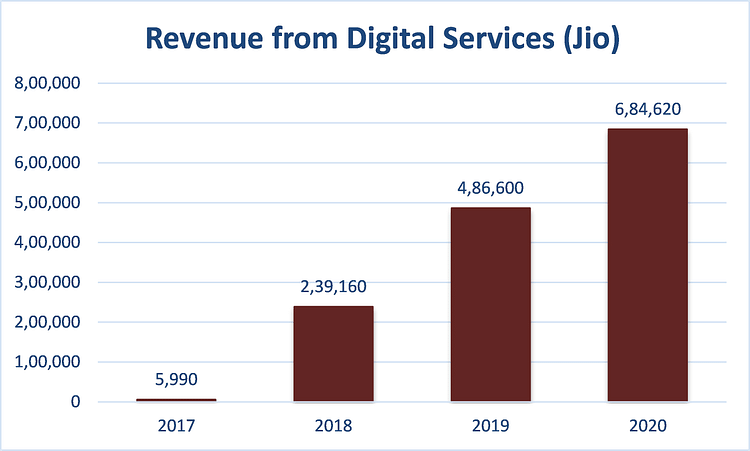
In 2017, Reliance Jio had a mere share of 0.2% in RIL’s total revenue. That year, they were making losses for the company. Fast-forward three years, Reliance Digital Services are booming at neck-breaking speed. Their share in Reliance’s total revenue has increased to more than 8%.

The biggest positive has been noticed on the bottom line side. Reliance Jio was the reason for more than one-fifth (20.5%) of the total profits to the company this year. It recorded a revenue worth Rs 5,990 crore in 2016. This increased to Rs 6,84,620 crore in 2019-20. A mighty increase of 226% in CAGR terms for the last four years.

Source: Author’s own creation

Jio recorded an Average revenue per user (APRU) of Rs 130.6 per month for the quarter ending March 2020. Their APRU increased to Rs 140.3 for the first quarter of FY21 which ended in June. Average data per usage increased to 12.3 GB per month per user in Q1FY21. This number was 11.3 GB per month per user for the quarter January-March 2020. In fact, Jio had the highest user engagement last year in the world with 5 hours spent by each subscriber per day on the Jio ecosystem.

The founder of Airtel, Sunil Mittal has mentioned multiple times that the company needs an average revenue per user (ARPU) of Rs 300 or more to survive from its current level of Rs 147. Yes, he says that this metric should double for Airtel to survive! Meanwhile, Jio is looking comfortable at its current levels and making profits while Airtel and Vi are facing huge losses. This is again tied into the logic of selling data for cheap and charging for other services.

Acquisitions by Reliance Jio

Saavn

Saavn is one of the most popular music streaming platforms in India. In 2018, Reliance merged its product, JioMusic, with Saavn by acquiring a nearly 80% stake. The merged entity was named JioSaavn so that the audience can know still associate themselves with Saavn as well as understand the presence of Jio. This backed Jio to directly compete with their telecom rival, Bharti Airtel’s Wynk, in a different sector. 

Embibe

Reliance Jio ventured into the EdTech sector by acquiring an almost 73% stake in Embibe in 2018. Bengaluru-based Embibe is an artificial intelligence-based education technology provider and a competitor to Byju’s. Embibe is a very powerful entity which depends on AI and analytics to find the weaknesses of students.

It points out where the students are lagging whether is it time management, stamina, knowledge, confidence, accuracy or speed. In the middle of the pandemic, when companies were finding a way to survive, Reliance Jio invested Rs 500 crore in Embibe in April. This was the second investment in the EdTech startup in 2020. Early in February, Embibe raised a funding of nearly Rs 90 crore from Reliance Industries.

Haptik

In the first half of 2019, Reliance Jio announced that will hold about 87% of Haptik by investing Rs 700 crore over the next five years. Out of this Rs 700 crore, Rs 230 crore has already been paid. This acquisition was another move from the company to expand itself into voice-based and AI-enabled conversational products. If you were a Samsung user in 2014, you would have noticed the Hand logo of Haptik. The company has some big clients in the form of Future Retail (which is bought by Reliance Retail now. Click here to read more about it), KFC, Coca-Cola, Oyo Rooms, Samsung and more.

Reverie

In the same year, Reliance acquired Bengaluru-based technology service startup Reverie. Approximately 83.3% of the startup’s equity stake was acquired by Reliance Jio. Reverie is another company which offers voice-based products. It offers voice assistant ‘Gopal’ in 12 Indian languages like Hindi, Bengali, Marathi, Gujarati, Telugu, Tamil and more.

Tesseract

Reliance acquired a stake of 80-85% in Mumbai-based VR startup Tesseract in August of 2019. At RIL’s 43rd AGM, Isha Ambani unveiled the JioGlass which was built by Tesseract. This JioGlass is designed to enable 3D virtual rooms and conduct holographic classes. Thus, building a completely different and exciting virtual experience.

Hathway Cable and DEN

Reliance Jio acquired a 51.3 % stake in Hathway Cable & Datacom and a 66 % stake in Den Networks. This deal went through in 2019 when Reliance received the Competition Commission of India’s nod to proceed. The main reason behind this move was to procure a substantial market to launch its ambitious high-speed broadband network under JioGigaFiber. This Jio product is a fibre-to-the-home (FTTH) broadband service. It aims to provide ultra-high-definition experience on television sets, voice-activated virtual assistance and virtual reality gaming.

Shaping India’s digital future?

There are 45 crore unique smartphone users in India until March 2020. Jio has successfully become the face of Indian digital transformation.

India is still finding it very hard to contain the coronavirus. While global sentiments are weak, big players like Google, Facebook, General Atlantic, KKR, Abu Dhabi Investment Authority, and other companies are investing in Reliance Jio. This shows the high level of confidence of global leaders in the Jio model. It’s not only the investment or the funds which are coming in. But, also the guidance and suggestions from the top global leaders who are running these companies. Jio has now four strategic partners Facebook, Intel, Qualcomm and Google.

Now, Reliance Jio is coming up with plans to get 2G subscribers from Airtel and Vi to convert. An ultra-cheap Rs 4,000 smartphone is in the works to get more people in India familiarised with the internet and other services. If this happens, the user base of Jio will expand further and the market share of other telcos might shrink again. An India-made 5G solution is also ready for testing from Jio.

With Jio already being the market leader, and showing no plans to slow down, it has surely cemented its position in the Indian telecom space within 4 short years. Will it turn out to be the only player, and make the sector a monopoly? Will have to wait and watch for that.

Categories
Market News

Reliance Jio seeks spectrum for 5G trials, plans to sell overseas

Reliance Jio has sought spectrum in certain frequencies from the Department of Telecom for holding trials of the latest 5G technology, according to sources. The company’s wholly-owned US-based subsidiary Radisys has already started selling some of the 5G solutions to foreign companies.

Reliance Jio on July 17 requested for 800 megahertz of frequencies in the 26 gigahertz (GHz) and 24 GHz band as well as 100 Mhz in 3.5 GHz band for running field trials in “urban centres like Delhi and Mumbai“.

The company has sought spectrum frequencies between 26.5 – 29.5 GHz and 24.25-27.5 GHz band. The auction for these high-frequency bands is expected to be held next year. UN body International Telecommunication Union approved 5G standards for 26 gigahertz band in November last year while the standards for other bands are yet to be decided.

In its pitch for starting trials in higher spectrum band, Jio in the letter has said that the US, South Korea, Japan etc have started working in 28 GHz band and some other countries in 26 GHz band and therefore it wants to run trials of its 5G technology before selling it abroad.

In the 43rd annual general meeting, Reliance Industries Limited Chairman Mukesh Ambani had said that Jio has designed and developed a complete 5G solution from scratch. They also want trails in these bands should start in India to make India “Aatmanirbhar“.

In conclusion, Reliance Jio has made it clear that it is just starting out and will soon cater to domestic and foreign markets through its aggressive approach be it towards fundraising in order to clear debt or introducing cutting edge technology like 5G to emerging markets.

Categories
Daily Market Feed

Share Market Today – 16 June 2020

News Shots

  • US FDA (Food and Drug Administration) revokes emergency use status of hydroxychloroquine drug touted by Trump for COVID-19. Zydus Cadila and IPCA, the largest producers of these drugs in the world, had benefited from the huge spike in demand.
  • Joining the fund raising bandwagon, Shriram Transport Finance approved fund raising up to Rs 1,500 crore via rights issue and up to Rs 2,500 crore via specified securities. 
  • Tata Motors posts Q4 net loss at Rs 9,894 crores versus profit at Rs 1,117 crores during March quarter FY19
  • Saudi Arabia’s wealth fund Public Investment Fund (PIF) is all set to pick up a 2.33 per cent stake in Reliance Jio, for an estimated $1.5 billion (Is this even news anymore?)
  • Lakshmi Vilas Bank has received a preliminary proposal from the Aion Capital-backed non-banking lender Clix Capital for a merger that will increase the Chennai-based lender’s capital base by around Rs 1,900 crore.
  • InterGlobe Aviation (IndiGo) has shown optimism and said they want to operate 50% of its pre-Covid daily capacity of 1,500 plus flights in July and resume international operations possibly to the middle east during that month.
  • Tata Power Company’s renewable energy arm Tata Power Renewable Energy has received an order from Gujarat Urja Vikas Nigam to develop a 120 megawatt solar project in Gujarat
  • Bayer CropScience has partnered with the agri business division of ITC to extend the reach of its crop protection products through ITC’s e-Choupal 4.0 platform. 
  • Shilpa Medicare has done well in these testing times and have posted a fairly good result with 40% increase in profits.
  • Can Fin Homes (The housing finance arm of Canara Bank) also surprised with a 35% jump in profits
  • Kerala-based CSB Bank reported narrowing of losses in the March quarter to Rs 59.69 crore as against Rs 150.64 crore in the year-ago period

What to expect today?

  • The global market was highly volatile, making huge dips but regaining afterwards. Asian markets are all up and with high percentages. SGX NIFTY is currently trading lower at 10,022, indicating a huge gap up opening in the Indian Market!
  • NIFTY is likely to trade between 9,800 and 10,100 today. There is a support at 9700 and resistance at 10,050. 
  • Highest Call Open Interest at 10,000, followed by 10,500. Highest Put Open Interest at 9,500, followed by 9,600. 
  • FIIs continue to sell and DIIs continue to buy heavily
  • Banking sector was under huge selling pressure. A short covering is expected.
  • Reliance tested 1620 again. It may give good upside movement if 1620 is broken.
  • Again, volatility can be expected as there are chances for profit booking when NIFTY is above 10,000