Google partners with Coinbase to accept crypto payments
Google Cloud has partnered with crypto exchange Coinbase to drive Web3 innovation. The tech giant will receive crypto payment via an integration with Coinbase. Crypto payments will initially be rolled out to a handful of customers involved in the Web3 industry. Google will also use Coinbase’s custody service, Coinbase Prime.
Under the agreement, Coinbase will use Google Cloud to build its advanced exchange, grow data services, and process blockchain data at scale.
Crypto prices today: Bitcoin falls 0.5%, ETH down 1.1%
Bitcoin is currently trading at $19,031.7, a decline of 0.54% over the previous day. Ethereum is down 1.13% over the last 24 hours to $1,281.16. Solana fell 3.98% to $30.07, while Cardano is trading lower by 7.18% at $0.365. Avalanche (AVAX) fell 4.69% to $15.28. The global crypto market cap stands at $908.69 billion, a 1.62% decline over the previous day.
Crypto.com enters France, invests $145M in Paris HQ
Crypto platform Crypto.com will set up its European regional headquarters in Paris. The firm will invest 150 million euros ($145.7 million) in France to support the establishment of its market operations. The cash will go towards setting up its European HQ in the capital and hiring local talent in the fields of compliance, business development, and product.
Last month, France’s market authority AMF gave Crypto.com regulatory approval, registering it as a digital asset service provider.
Crypto platform Pillow raises $18 million in Series A round
Crypto investment platform Pillow (run by Pillow Digital Technologies Pte Ltd) has secured funding of $18 million in a Series A round co-led by Accel, Quona Capital, and Jump Capital. The digital personal finance platform aims to accelerate the adoption of crypto services in emerging economies including those in Africa and Southeast Asia.
Indian crypto exchanges praise OECD reporting framework
Indian crypto exchanges are cheering the new tax reporting framework released by the Organization for Economic Co-operation & Development (OECD). The framework ensures “the collection and automatic exchange of information on transactions for relevant crypto assets”. It covers exchanges, brokers, and ATM operators that facilitate exchanges between crypto assets.
Crypto exchanges are also hoping the Crypto-Asset Reporting Framework (CARF) of the OECD will prompt the Indian government to frame its own regulations and lower taxes, helping revive the crypto market.
GST Council to consider levying 28% GST on crypto: Report
As per a CNBC-TV18 report, the Goods and Service Tax (GST) Council is likely to consider levying 28% GST on cryptocurrencies. The government’s view is to bring crypto taxation at par with lotteries, casinos, racecourses, and betting. The council has nominated a law committee to take up the proposal to levy 28% GST on all services and activities related to crypto soon.
Crypto prices today: Bitcoin falls 3.3%, ETH down 4%
Bitcoin is currently trading at $33,673.7, a 3.3% decline over the previous day. Ethereum is down 4.1% over the last 24 hours to $2,460.2. Solana fell 5% to $74.5, while Cardano is trading lower by 6.35% at $0.70. Avalanche (AVAX) fell 6.6% to $50.82. The global crypto market cap stands at $1.54 trillion, a 3.43% decline over the previous day.
Experts say that panic over inflation and fears of a potential recession are reasons behind the ongoing crypto market crash.
Google forms Web3 team to tap the market’s potential
Google’s cloud unit is forming a team to build services for developers running Web3 and blockchain applications. The tech giant is trying to capitalize on the surging popularity of crypto and related projects. It wants to offer back-end services to developers interested in composing their own Web3 software as the company battles for market share in cloud infrastructure.
Instagram to support NFTs from Ethereum, Polygon, Solana
Meta’s Instagram is planning non-fungible token (NFT) integrations for Ethereum, Polygon, Solana, and Flow. The pilot project will feature a small group of NFT experts based in the US. Instagram intends to support widely used crypto wallets such as MetaMask. Users will be able to prove NFT ownership using their crypto wallets, showcase NFTs on their profiles, and tag the creators who made them.
$1B worth crypto “bridge” hacks spur secure alternative offers
High-profile hacks on crypto “bridges” are creating opportunities for exchanges and other businesses to offer more secure alternatives. Bridges allow users to swap digital tokens across blockchains. Over the past few months, hackers have siphoned more than $1 billion from popular crypto bridges like Wormhole and Ronin.
Now, crypto exchanges FTX and Coinbase are deepening their capabilities to provide bridge-like services on various blockchains. Users invested in Bitcoin or Ethereum can easily participate in other networks’ financial or gaming apps.
Future Retail Files New Case Against Amazon Over Deal
Kishore Biyani’s Future Retail has filed a fresh lawsuit against Amazon in the Supreme Court. Amazon owns a critical stake in Future Retail. Amazon won an arbitration order that stalled Reliance’s decision to acquire Future Group. Future Group has argued that if the deal with Reliance doesn’t go through, it would cause unimaginable damage to the group, It could mean possible job losses for 35,575 employees and risk Rs 28,000 crore in loans and debentures.
Specialty Chemical maker Ami Organics is set to launch its IPO next week on September 1, 2021. The company manufactures different types of Advanced Pharmaceutical Intermediates and Active Pharmaceutical Ingredients (API). The company has three manufacturing plants in Gujarat situated at Sachin, Ankleshwar & Jhagadia, with an installed capacity of 6,060 MTPA. The company intends to raise Rs 570 crore through the IPO. The price band is set at Rs 603 to Rs 610 per equity share
According to a TOI report, Google is now planning to invest money in telecom operator Bharti Airtel. It is reported that Google’s investment in Airtel could be substantially large running into several thousand crores of rupees. Google has invested a whopping Rs 33,737 crore and currently holds a 7.73% stake in rival platform Reliance Jio.
The Employees’ Provident Fund Organisation(EPFO) has tweaked some rules regarding PF accounts. As per the latest update, your employer can credit money to your PF account only if your account is linked to your Universal Aadhar Number(UAN).
Aditya Birla Group’s Grasim Industries has approved a Rs 5000 crore CAPEX mainly towards its paint business. It has earmarked Rs 2600 crore CAPEX for the current financial year FY22. The proceeds would be mainly towards its viscose staple fiber (VSF) and chemicals business.
FDI Equity Inflows Up 168% to Rs 1.3 Lakh Crore in Q1
Foreign direct investment (FDI) into the country increased twofold to Rs 1.3 Lakh Crore or USD 17.57 billion during April-June this fiscal. The rise is attributed to measures such as policy reforms and ease of doing business. The FDI in the same quarter last year was USD 11.84 billion or Rs 87,000 Crore.
Jandhan Bank Accounts Rise to 43 Crores, Amount to Rs 1.46 Lakh Crore
As of August 18, 2021, Pradhan Mantri Jan Dhan Yojana accounts stood at 43 crores, totaling a Rs 1.46 crore balance in beneficiary accounts. Of this close to 55.47 percent (23.87 crores) Jan-Dhan account holders are women and 66.69 percent (28.70 crores) holders are in rural and semi-urban areas. Moreover, 36.86 crores or 85.6 percent are operative, and the average deposit per account is Rs 3,398, as per the statement
Global tech giants Alphabet, Amazon, and Facebook reported their third quarter (Q3) results on October29. Apple released its fourth-quarter results as well. During the current financial year, these companies have exceeded all expectations and have emerged as the world’s top-earning corporations. As we know, there has been a massive transformation and growth in online businesses amidst the Covid-19 pandemic. And, the recent results from these companies have completely crushed all street estimates. Let us find out how they performed during the July-September period.
Alphabet Quarterly Report
Google’s parent company, Alphabet Inc, had its first-ever revenue decline in Q2. However, the company has reported a very impressive 14% year-on-year (YoY) increase in revenue to $46.17 billion, for the quarter ended September (Q3). The company has completely beaten estimates that were made by financial analysts, and has returned to sales growth. A major portion of its revenue comes from advertising through its platforms such as YouTube. During the July-September period, revenue from YouTube ads has seen a 32% YoY jump to $5.04 billion. We can also see more businesses and individuals using Google’s Cloud Platform to perform their daily tasks efficiently. Hence, there has been a major increase in earnings from that segment as well.
From what we can understand, the company has made a complete rebound in its revenue generation from Google Ads, as compared to the previous two quarters. Businesses around the world had seen a major decline in sales during lockdowns, and are now investing more in advertising through various Google platforms. The Cloud Platform has also helped to provide support to the work-from-home (WFH) model for corporations. Alphabet CEO Sundar Pichai has stated that Q3 has been ‘a strong quarter, consistent with the broader online environment’.
Last month, the US Justice Department filed one of the biggest antitrust lawsuits against Google. The IT company has been accused of partnering with other tech giants for ensuring that its rival companies do not rise to power. Google has also been criticized for using its search platform illegally to maintain its power.
Amazon Quarterly Report
Amazon.com, Inc is another company that completely beat estimates provided by analysts such as Yahoo Finance. The company has reported a 37% year-on-year (YoY) increase in revenue at $96.1 billion, for the quarter ended September (Q3). Even though lockdown restrictions were lifted in most countries, people preferred to get essential commodities through online methods. Third-party merchants also pay Amazon to advertise their products on its online shopping platform. The company has also created more than 4 lakh jobs this year, in order to support the surge in online sales.
The retail giant also receives a major part of its revenue from Amazon Web Services (AWS). It is one of the leading cloud technology platforms in the world, and accounts for a majority of Amazon’s total profits. There has been a 29% YoY increase in revenue from AWS to $11.6 billion, in the third quarter of the current financial year. On the other hand, Amazon’s video streaming service has been constantly registering a massive spike in viewership. Those movies which could not be released in theatres were also launched through Amazon Prime Video.
This year, Amazon has come under the scanner of regulatory authorities over a number of cases. It was found that the prices of essential items were increased in the US. Merchants who sell their products through Amazon have been under massive pressure. These sellers have not received any support from the retail giant. The company was also criticized for its treatment of warehouse workers. Interestingly, amidst all these accusations, it had been reported that Amazon employees were given very high bonuses during the lockdown period.
Apple Quarterly Report
The revenue for Apple Inc. was supported by international sales, which makes up 59% of its overall sales. The company has reported a 1% year-on-year (YoY) increase in revenue to $64.7 billion, for the fourth quarter ended September. The company’s financial year is calculated as the 52-week period that ends on the last Saturday of September. Apple’s iPhone sales were down by 20% YoY to $26.44 billion. Even though there had been strong iPad and Mac sales, it was not enough to make up for the decline of iPhones.
With the launch of its new iPhone 12 and entry into 5G support, Apple is highly optimistic about a major boost in sales within the next few quarters. The company is also changing its focus to improve its streaming services, which include Apple TV+ and Apple Music.
Over the last few months, the company has been criticized for increasing its cut in Apple Store purchases to 30%, which is very high. Apple has also been accused of anti-competitive behaviour, and illegally maintaining power over its iPhone and iPad apps.
Facebook Quarterly Report
Facebook Inc. has reported a 22% year-on-year (YoY) increase in sales to $21.47 billion. Just like the previous three companies, the social media giant has also beaten street estimates. Facebook, which also owns Instagram and WhatsApp, stated that its daily active user base has increased by 12% YoY to 1.82 billion. With families and friends being separated due to Covid-related restrictions, there had been a spike in the use of these apps in the previous quarters. Interestingly, this growth in user base in the US and Canada has slowed down in Q3. Certain analysts have termed it as a ‘very rare decrease’, and was probably due to TikTok gaining all attention.
Facebook also receives a major part of this revenue from digital advertising, which has shown a great recovery as compared to previous quarters. Last week, the company also added shopping and pricing features to WhatsApp Business, in a move to help small enterprises to boost their sales. Facebook CEO Mark Zuckerberg has announced that the company would be focusing on services related to virtual and augmented reality. As we can see, there is a huge demand for these platforms in the global markets today.
There had been a lot of criticism aimed at Facebook, especially regarding the handling of political content on its social media platforms. Also, there was an ad boycott movement by major companies to support #StopHateForProfit, over the last few months. However, these issues have not created an impact on the company’s revenue.
The Attack Against US Big Tech
Now, we shall keep these outstanding results aside for a moment. When people found out the methods through which the US Big Tech companies operate, many red flags had been raised. The non-ending competition amongst these companies has made them extremely greedy for more profits. Several institutions and individuals have protested against these ‘monopolistic acts’. Like many who watched ‘The Social Dilemma’ on Netflix, I too was pretty astonished by the various methods by which these companies used to attract more ‘customers’. The use of artificial intelligence (AI) to manipulate the behavior of individuals is evident by the high rise in the number of active users.
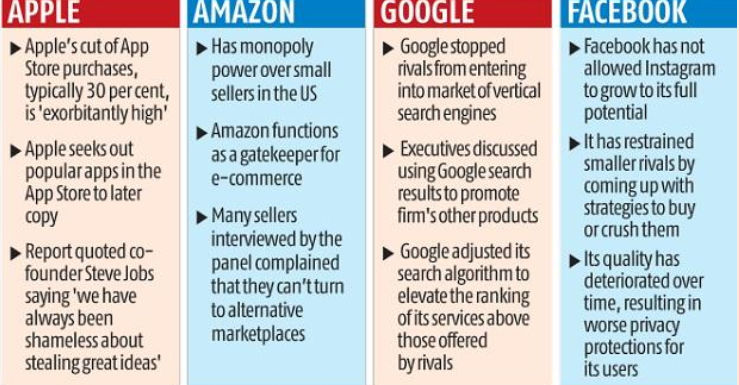
The US legislators have studied the long-standing issues surrounding the matter. They have created a panel to make Amazon, Google, Facebook, and Apple more accountable for their actions. Here are some of the factors for which the companies are under the scanner of US lawmakers:
Source: Business Standard
The Antitrust Subcommittee of the Judiciary Committee in the US is currently looking into the matter. The CEOs of all four companies have already made several appearances before the panel. However, like most cases, these tech companies find loopholes and seem to simply not mind about its consequences.
With these impressive Q3 results, we can see that no factors seem to affect the growth in their high revenues. At a point when all economic activities were hit, these companies used their position to make the best out of every new possibility. A fine of thousands of crores is okay for these companies when they are making ten thousand crores of profits. Do not forget that these companies are also heavily involved in India, and its development. Let us wait and watch how the Big Tech companies are planning to further dominate in their respective fields.
The world around us is changing at a very rapid pace due to advancements in technology. Like other countries, India has also undergone a lot of changes. One of the major reasons for this transformation in India is Mukesh Ambani-led Reliance Jio. Ever since Reliance Communications (RCom), Mukesh Ambani’s brainchild, was snatched away from him by his younger brother, Asia’s richest man was planning his comeback to telecom. Today, we are going to dig deep into what could be one of the most exciting businesses in Indian history.
A Brief Profile of Reliance Jio
Reliance, through Jio, aims to transform India into a digital society. Their mantra is quite simple: connect everyone and everything, everywhere.Jio’s services span across various sectors. From cloud and media to gaming, healthcare, education and much more.
Jio came into the market in 2016 with only 4G services. Yes, no 2G, no 3G, just 4G. Before its launch, they made sure that they had a robust and stable infrastructure to support future growth. It came to the market by offering customers three months of free services followed by free calls and various data plans. With this disruptive move, they were able to start a price war in the telecom sector.
But this disruption was easier than you think. Internet Service Providers (ISPs) do not incur any additional cost if you use 100MB of data or 1GB of data, so Jio came in by offering high data plans but did not lose out any money because of it, which is the best kind of disruption. Their infrastructure was strong enough to back the large number of users who joined their network.
Jio vs Bharti Airtel & Vi
Reliance Jio was India’s first telecom operator to offer the 4G Voice over LTE (VoLTE) services. This essentially meant that voice calls were placed through the internet, and hence no separate infrastructure was needed for calls. They were able to offer free national roaming as well, with their pan-India license.
On the other hand, Bharti Airtel and other Telcos stuck to their 2G and 3G services and hardly ventured into the 4G market. Their weak strategy towards the investment in new infrastructure created several obstacles for them to move into 4G completely. If Airtel wants to set up a tower in a village, it has to first set up its 2G tower, then install 3G towers, and then maybe install 4G towers. But Jio only installs 4G towers and provides high-quality data, very efficiently.
Also remember, neither did Jio invent 4G nor did they invent VOLTE. These were widely used technologies in international markets that old players did not implement due to less flexibility of high debt and old-school thinking. Even now, companies like Airtel and Vi have failed to move into 4G services completely.
According to the Telecom Regulatory Authority of India (TRAI) data, Jio’s total number of subscribers has steadily increased over the years from zero to 38.8 crore in March, making it the market leader. Airtel and Vi have 28.36 crore and 29.11 crore, respectively, in their March quarter earnings numbers.
Jio’s average per capita data consumption was 11+ GB per month for the previous financial year. With rising population and more awareness, the requirement for smartphones will only increase Jio’s customer base. Unlike other players, Ambani had the game-changing idea of providing cheap data and charging for other services like the ones below.
Source: Reliance’s Annual Report 2019-20
Who Rules the Market?
Telecom Regulatory Authority of India (TRAI) stated that the top five telecommunication operators in India are Reliance Jio, Bharti Airtel, Vodafone Idea, BSNL and MTNL. Reliance Jio dominates the industry with a 33% market share. They are followed by Bharti Airtel and Vi with 28.35% and 28.05% market share respectively. (Data as of February 2020)
Jio’s Performance
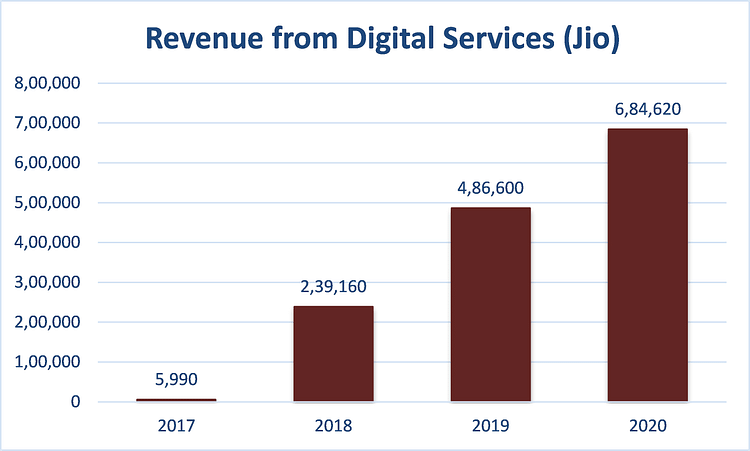
In 2017, Reliance Jio had a mere share of 0.2% in RIL’s total revenue. That year, they were making losses for the company. Fast-forward three years, Reliance Digital Services are booming at neck-breaking speed. Their share in Reliance’s total revenue has increased to more than 8%.
The biggest positive has been noticed on the bottom line side. Reliance Jio was the reason for more than one-fifth (20.5%) of the total profits to the company this year. It recorded a revenue worth Rs 5,990 crore in 2016. This increased to Rs 6,84,620 crore in 2019-20. A mighty increase of 226% in CAGR terms for the last four years.
Source: Author’s own creation
Jio recorded an Average revenue per user (APRU) of Rs 130.6 per month for the quarter ending March 2020. Their APRU increased to Rs 140.3 for the first quarter of FY21 which ended in June. Average data per usage increased to 12.3 GB per month per user in Q1FY21. This number was 11.3 GB per month per user for the quarter January-March 2020. In fact, Jio had the highest user engagement last year in the world with 5 hours spent by each subscriber per day on the Jio ecosystem.
The founder of Airtel, Sunil Mittal has mentioned multiple times that the company needs an average revenue per user (ARPU) of Rs 300 or more to survive from its current level of Rs 147. Yes, he says that this metric should double for Airtel to survive! Meanwhile, Jio is looking comfortable at its current levels and making profits while Airtel and Vi are facing huge losses. This is again tied into the logic of selling data for cheap and charging for other services.
Acquisitions by Reliance Jio
Saavn
Saavn is one of the most popular music streaming platforms in India. In 2018, Reliance merged its product, JioMusic, with Saavn by acquiring a nearly 80% stake. The merged entity was named JioSaavn so that the audience can know still associate themselves with Saavn as well as understand the presence of Jio. This backed Jio to directly compete with their telecom rival, Bharti Airtel’s Wynk, in a different sector.
Embibe
Reliance Jio ventured into the EdTech sector by acquiring an almost 73% stake in Embibe in 2018. Bengaluru-based Embibe is an artificial intelligence-based education technology provider and a competitor to Byju’s. Embibe is a very powerful entity which depends on AI and analytics to find the weaknesses of students.
It points out where the students are lagging whether is it time management, stamina, knowledge, confidence, accuracy or speed. In the middle of the pandemic, when companies were finding a way to survive, Reliance Jio invested Rs 500 crore in Embibe in April. This was the second investment in the EdTech startup in 2020. Early in February, Embibe raised a funding of nearly Rs 90 crore from Reliance Industries.
Haptik
In the first half of 2019, Reliance Jio announced that will hold about 87% of Haptik by investing Rs 700 crore over the next five years. Out of this Rs 700 crore, Rs 230 crore has already been paid. This acquisition was another move from the company to expand itself into voice-based and AI-enabled conversational products. If you were a Samsung user in 2014, you would have noticed the Hand logo of Haptik. The company has some big clients in the form of Future Retail (which is bought by Reliance Retail now. Click here to read more about it), KFC, Coca-Cola, Oyo Rooms, Samsung and more.
Reverie
In the same year, Reliance acquired Bengaluru-based technology service startup Reverie. Approximately 83.3% of the startup’s equity stake was acquired by Reliance Jio. Reverie is another company which offers voice-based products. It offers voice assistant ‘Gopal’ in 12 Indian languages like Hindi, Bengali, Marathi, Gujarati, Telugu, Tamil and more.
Tesseract
Reliance acquired a stake of 80-85% in Mumbai-based VR startup Tesseract in August of 2019. At RIL’s 43rd AGM, Isha Ambani unveiled the JioGlass which was built by Tesseract. This JioGlass is designed to enable 3D virtual rooms and conduct holographic classes. Thus, building a completely different and exciting virtual experience.
Hathway Cable and DEN
Reliance Jio acquired a 51.3 % stake in Hathway Cable & Datacom and a 66 % stake in Den Networks. This deal went through in 2019 when Reliance received the Competition Commission of India’s nod to proceed. The main reason behind this move was to procure a substantial market to launch its ambitious high-speed broadband network under JioGigaFiber. This Jio product is a fibre-to-the-home (FTTH) broadband service. It aims to provide ultra-high-definition experience on television sets, voice-activated virtual assistance and virtual reality gaming.
Shaping India’s digital future?
There are 45 crore unique smartphone users in India until March 2020. Jio has successfully become the face of Indian digital transformation.
India is still finding it very hard to contain the coronavirus. While global sentiments are weak, big players like Google, Facebook, General Atlantic, KKR, Abu Dhabi Investment Authority, and other companies are investing in Reliance Jio. This shows the high level of confidence of global leaders in the Jio model. It’s not only the investment or the funds which are coming in. But, also the guidance and suggestions from the top global leaders who are running these companies. Jio has now four strategic partners Facebook, Intel, Qualcomm and Google.
Now, Reliance Jio is coming up with plans to get 2G subscribers from Airtel and Vi to convert. An ultra-cheap Rs 4,000 smartphone is in the works to get more people in India familiarised with the internet and other services. If this happens, the user base of Jio will expand further and the market share of other telcos might shrink again. An India-made 5G solution is also ready for testing from Jio.
With Jio already being the market leader, and showing no plans to slow down, it has surely cemented its position in the Indian telecom space within 4 short years. Will it turn out to be the only player, and make the sector a monopoly? Will have to wait and watch for that.
Yesterday, after the market hours Apple, Alphabet, Amazon and Facebook reported their Q2 earnings of 2020. As millions of people have lost their jobs, it was interesting to see how the big tech giants of the US has fared during the worldwide pandemic.
Apple
Apple reported Q2 2020 results which destroyed the Wall Street estimates. Total net revenue of $59.7 billion was declared, which is a mighty 11% higher than what was recorded in the same period last year. Net profits also increased by 12% from $10.04 billion to $11.2 billion. The major chunk of the increase in revenue has come through the services domain. Revenue from the services segment has increased by 14% whereas from products segment has increased by 10%.
Better financial performance in the quarter has forced Earning per share to rise by almost 19% to reach $2.6. Again, the rise in EPS has beaten the estimates of Yahoo Finance data.
“We’re conscious of the fact that these results stand in stark relief during a time of real economic adversity for businesses, large and small, and certainly for families. We do not have a zero-sum approach to prosperity, and especially in times like this, we are focused on growing the pie, making sure our success isn’t just our success.” – Chief Executive Officer Tim Cook.
Apple also delivered on its commitment to double its annual service revenue within four years. All this had a positive effect on the company’s stock price. Apple shares went up by 4.7% in after-hours trading. The booming performance in the stock market has prompted them to go for a stock split for the fifth time in their history.
The aim behind the stock split is to make the stock cheaply accessible to the investors who are interested to buy the stock. To know more about the stock split, click here. As coronavirus forced offices, schools and colleges to operate from home, demand for products like iPad and Mac surged. iPad had its best June quarter in eight years whereas the Mac had its second strongest quarter in its history.
Amazon
Amidst the global pandemic, when companies are reporting losses, Amazon has just declared the biggest profit in its 26-year history. As compared to the same quarter previous year, Amazon has reported an increase of 29% in their total revenues, from $63.2 billion to $88.9 billion. With the retail shops shut around the world and fears of stepping out in the mind of people has forced them to look for e-commerce to buy things.
This has worked hugely in favours of Amazon whose Online grocery sales tripled year over year. Also, their streaming video platform has seen video hours doubled. The sales in online stores have increased exponentially by more than 48% to reach $45.9 billion in the second quarter.
“Everyone was looking for masks; everyone was looking for gloves; everyone was buying groceries online. That mix is not super profitable,” he said. “What we saw in Q2 was not only did the mix start to shift back to a more normal mix” but that “we also were able to ship a lot more than we had originally thought.” – Brian Olsavsky, Amazon’s chief financial officer.
As the demand for online shopping increased, third-party merchants paid Amazon more to sponsor their products extensively. The companies worldwide are forced to shift to the online mode. Thus, Amazon’s cloud services also saw higher demand as the revenue from Amazon Web Services (AWS) increased by 28% $10.81 billion.
As the demand soared up, Amazon hired 175,000 people in recent months. The costs related to COVID-19 also increased as the company spent around $4 billion on protective equipment for staff. Yet, after incurring high operational expenses, Amazon was able to double in net profit from $26.2 billion to $52.4 billion in just one year.
Alphabet
Alphabet reported Q2 2020 earnings with a 2% dip in total revenue but still beating the street estimates. Total revenue and net income were amassed to be $38.3 billion and $6.96 billion in COVID-hit quarter. A big note of worry for the company is the falling revenue from Google ads for the second straight quarter. Revenue from google ads this quarter was $29.8 billion which is 8% less than what was amassed in the same quarter last year.
“We’re working to help people, businesses and communities in these uncertain times,” said Sundar Pichai, Chief Executive Officer of Google and Alphabet. “As people increasingly turn to online services, our platforms — from Cloud to Google Play to YouTube — are helping our partners provide important services and support their businesses.”
On a brighter side, revenue from Youtube ads and Google Cloud shot up by 5.4% and 43% respectively. The strong growth in both of these segments has aided Alphabet to beat the market estimates. With people putting in their home, video hours of Youtube platform increased which also forced merchants to pay more for their ads to come up. Similarly to AWS, Google Cloud grew massively as offices are switching to the work-from-home model.
Facebook
Just like the previous three tech giants, Facebook went past all the street estimates and registered an 11% rise in revenue from $16.9 billion last year to $18.7 billion. Due to the lower tax rate, their net income has shot up by more than 90%. Facebook daily active users (DAUs) has increased by 12% year-on-year to reach 1.79 billion in June 2020.
Facebook monthly active users (MAUs) also rose by 12% to stand at 2.70 billion. A 15% rise Family monthly active people (MAP) took the number to 3.14 billion as of June 30, 2020. The company has been under severe social pressure in this quarter. A public campaign was run against the company a while ago. Mark Zuckerberg failed to remove one of the comments of President Donald Trump which was deemed instigating by twitter and the public.
A worldwide ad boycott by more than 1,100 companies took place to support #StopHateForProfit campaign. Some of the major brands that have pulled their ads are Coca-Cola, Ford Motor, Puma, Unilever, etc. Even after so many issues, Facebook has managed to do well financially and overcome the street estimates.
Conclusion
The more this pandemic continues, more these tech giants are going to benefit as people shift to online medium for every reason. Whether they want to study or teach, whether they want to buy or sell, whether they want to talk or meet, all of this will be done via online medium. And, the business models of these tech giants readily support this movement of people during the pandemic.
The large tech giants have seen a huge surge in the demand for their products. The dependence of people has increased on them which has helped them to thrive during this pandemic. Every segment of the economy is depending on the tech facilities and this has created a huge boom for these companies. All in all, it has shaped a perfect Tech world.