Categories
Market News Top 10 News

Godrej Properties Acquires 28-acre Land Parcel in Bengaluru – Top Indian Market Updates

Here are some of the major updates that could move the markets tomorrow:

Godrej Properties acquires 28-acre land parcel in Bengaluru

Godrej Properties has acquired a land parcel spread over 28 acres in Bengaluru to develop a mixed-use project consisting of apartments and retail development. The land acquisition is in line with the company’s plan of strengthening its presence across key property markets in India. The land parcel is located near Outer Ring Road and Whitefield, a neighbourhood known for technology parks, upmarket apartments, and shopping & entertainment hubs.

Read more here.

Retail inflation drops to 6.44%

India’s retail inflation for February declined to 6.44% in February, compared to 6.52% in January 2023. Inflation in the food basket in Feb 2023 was at 5.95%, up from 5.94% in January (mainly due to higher cereal and milk prices). The risk of heat waves in India is a concern that could impact food production and prices.

Read more here.

LIC’s debt exposure in Adani Group companies falls marginally to Rs 6,183 crore

The Life Insurance Corporation of India (LIC) has informed that its debt exposure to Adani Group of Companies has fallen from Rs 6,347.32 crore on Dec 31, 2022, to Rs 6,182.64 crore as on March 5, 2023. LIC has a debt exposure of Rs 5,388.60 in Adani Ports and SEZ, Rs 266 crore in Adani Power (Mundra), and Rs 81.60 crore in Adani Power Maharashtra Ltd – Phase I.

Read more here.

Ten more banks to join syndication for RIL’s $3 billion loan

Ten more lenders are set to join the syndication of Reliance Industries Ltd (RIL) and Reliance Jio Inforcomm’s $3 billion loans. It is the largest syndicated loan by an Indian corporate house in the last five years. The loan proceeds are to fund RIL’s capital expenditure and the 5G expansion of Jio. 

Read more here.

Amazon signs deal with DLF Downtown, Jayabheri Properties to acquire 8 lakh sq. ft. of space

Amazon and its affiliates have acquired over 8 lakh square feet of space from DLF Downtown and Jayabheri Properties for 15 years in Gurgaon and Hyderabad for web services, development centres, seller services, and transportation services. The e-commerce giant will be paying a rent of Rs 45-52 per sq. ft. for the Orange Towers property in Hyderabad, while the Downtown property in Gurugram will attract a rent of Rs 110.5 per sq. ft.

Read more here.

Capacite Infra secures non-fund based limit worth Rs 150 crore from SBI

State Bank of India (SBI) has sanctioned a non-fund based limit of Rs 150 crore to Capacite Infraprojects Ltd. Capacite also announced that it is continuously engaging with members of a lenders’ consortium to expedite the process of sanctioning additional non-fund-based limits. Engineering and construction company Capacite works with almost all major real estate developers in India.

Read more here.

USFDA completes inspection at Alembic Pharma’s Derma facility

Alembic Pharmaceuticals’ Derma facility at Karakhadi in Vadodara, Gujarat, has successfully undergone inspection by the US Food & Drug Administration (USFDA) with no observation. The inspection was conducted by the regulator between March 6 to March 10, 2023. The company manufactures and markets generic pharmaceutical products across the globe. 

Read more here.

Elgi Equipments’ US subsidiary acquires 33.33% stake in CS Industrial Services

Elgi Equipments has announced that its US subsidiary has acquired a 33.33%  stake in CS Industrial Services LLC to expand its reach in the US market. The company is engaged in the manufacturing and trading of air compressors. The total cost to acquire both class A and class B shares is worth $125,000. The all-cash transaction is likely to be executed by the end of this month.

Read more here.

Nazara Tech’s 2 subsidiaries hold Rs 64 cr in SVB

Nazara Technologies said that its two step-down subsidiaries, Kiddopia Inc and Mediawrkz Inc, hold cash balances at Silicon Valley Bank (SVB). However, both subsidiaries continue to be well-capitalised and are generating positive cash flows along with profitability. Nazara Tech also continues to maintain healthy reserves of cash and cash equivalents in excess of Rs 600 crore, excluding the SVB-impacted funds. 

Read more here.

Indian Navy halts HAL’s ALH Dhruv Helicopter operations after accident

An Indian Navy helicopter manufactured by Hindustan Aeronautics Ltd (HAL) met with an accident off the Mumbai coast, triggering the navy to halt operations of the entire fleet of ALH Dhruv choppers. The ALH choppers are flown by all three defence forces (Army, Navy and Air Force), along with the Indian Coast Guard.

Read more here.

Shriram Finance aims to raise $2.44 billion in FY24 to fund growth

Non-banking finance company (NBFC) Shriram Finance aims to grow its assets under management (AUM) by 15% in the financial year 2024 (FY24) to around Rs 20,000 crore. The company’s total AUM was Rs 1.7 lakh crore as of December 31, 2022. The company will also raise funds from local banks and the domestic capital market among others, alongside external commercial borrowings (ECBs).

Read more here.

M&M sells over 6% stake in Mahindra CIE Automotive

Mahindra & Mahindra (M&M) has sold 2.29 crore equity shares of Mahindra CIE Automotive Ltd (representing 6.05% of the paid-up share capital). The sale has been executed on the stock exchanges at a gross price of Rs 357.39 per share. Following the sale, M&M’s shareholding in Mahindra CIE Automotive has come down from 9.25% to 3.19%.

Read more here.

Categories
Editorial

Will ONDC Disrupt E-Commerce in India?

Suppose there’s a small bakery in Bengaluru that sells delicious cookies. The owner wants to take his business online, but he feels it will be extremely difficult. He’ll need to make a sizeable investment for creating an online store, inventory management, and order fulfillment. Even after all this, it’s an exhausting process to get customers online. The owner will have to spend a hefty amount for ads and believes it’s not worth the time and effort.

Sure, he could list his products on large platforms like Amazon.com and Walmart-owned Flipkart. However, these global corporations control over 60% of the e-commerce market and give preferential treatment to top sellers.

So how can the bakery owner sell his products online?

Well, he could look into the Open Network for Digital Commerce (ONDC)! And no, it’s not a separate e-commerce platform or app. In this article, let’s understand what ONDC is all about!

What is ONDC?

ONDC is a non-profit company established by our govt’s Department for Promotion of Industry & Internal Trade (DPIIT). It is a network that will allow any seller to display their products and services in search results across all apps registered in it. ONDC will have open protocols and rules for the entire chain of activities involved in the exchange of goods and services (similar to the Unified Payments Interface or UPI for payments in India). Thus, buyers and sellers can trade goods and services irrespective of the applications they use.

For instance, small and medium-sized businesses can now set up a simple website with the help of ONDC’s technology partners and list their products and services on it. And once they integrate with ONDC, their products will be easily visible to consumers on different apps and platforms! ONDC would standardise operations like time-based pricing, inventory & order management, delivery, and digital cataloging for small retailers.

On a wider scale, ONDC network is designed to facilitate any digital transaction between a buyer and seller for goods or services, including wholesale, mobility, food delivery, logistics, and travel services. It will also cover business-to-business (B2B) transactions.

We’ve all seen UPI revolutionising payment systems in India. Similarly, ONDC aims to democratise e-commerce and give small merchants or family-owned stores access to the systems and technology used by giant e-tailers like Amazon & Flipkart. ONDC is expected to increase competition in the e-commerce industry and boost startup innovation.

How Does it Work?

  • ONDC lies in the middle of the interfaces hosting the buyers and the sellers.
  • Sellers will have apps to place their products for sale and accept orders.
  • As consumers, we can use any app registered on the ONDC network to browse and buy products. 
  • The ONDC network will also have apps that broadcast the search request received from buyer-side apps to seller-side apps listed on the ONDC registry.
  • The network will be supported by logistics firms (to facilitate deliveries) and e-commerce store hosting service providers. 

For example, when you’re searching for a laptop on Paytm → The app will connect to the ONDC network → ONDC will connect it to seller-side apps that list all firms from where you can buy the item.

You will be able to download any ONDC app of your choice (similar to UPI) and use it to buy products & services from sellers that offer them.

Major Challenges

  • ONDC is a complex ecosystem to implement. E-commerce has a lot of variables involved, including the quality of the product, payments, returns, customer complaints, etc.
  • Brands that make misleading or inferior products and offer poor after-sales support may get undeserved exposure through the network. Users would find it difficult to trust new brands or platforms that integrate with ONDC.
  • It will require a massive, well-funded adoption campaign to bring in lakhs of existing Kirana stores to the ONDC network.

The Way Ahead

Since 2020, the Competition Commission of India (CCI) has been investigating the alleged anti-competitive practices of Amazon and Flipkart. As per reports, both firms promote specific sellers based on exclusive arrangements and offer them deep discounts. E-commerce giants also allegedly use data derived from users’ buying patterns to help their seller “partners” launch products.

Rather than concentrating power among a few players, ONDC will allow consumers and sellers to choose which apps they want to use to access a single network. With the ONDC network, these big online e-commerce platforms will have to compete with smaller stores, websites, and brands! ONDC expects to increase e-commerce penetration in India from 8% to 25% in the next two years. It also plans to sign up 90 crore buyers and 12 lakh sellers to the network within five years! 

ONDC has commenced trials with select buyers and sellers across major cities in India. We’ve seen numerous companies integrating with ONDC over the past few months. Microsoft, Paytm, Snapdeal, Dunzo, eSamudaay, PhonePe, SBI, HDFC Bank, ITC Store, and India Post have shown interest in joining ONDC. Even Flipkart, Reliance Retail, and Amazon are reportedly in talks to join the network! We’ll have to wait and see how well it is implemented.

What are your thoughts on ONDC? Let us know in the comments section of the marketfeed app.

Categories
Editorial

Why Did Reliance Shelve its E-Commerce Marketplace Plans?

Reliance Industries Ltd (RIL) is reportedly postponing its plans to launch a standalone e-commerce platform for third-party sellers and compete with Amazon and Flipkart. The company aimed to create a mega online platform for users to buy groceries, clothes, electronics, home, appliances, and more. Meanwhile, thousands of independent sellers have been integrated into its existing platform (JioMart) already. 

In this article, we explain why the Mumbai-based multinational conglomerate decided to halt its plans to develop its e-commerce platform.

Reliance’s Entry Into the E-Commerce Space:

India’s biggest retailer, Reliance Retail Ventures Ltd, has more than 12,000 stores across India. The company expanded its e-commerce operations in recent years with ventures including Ajio, JioMart, and the webstore of Reliance Digital. Ajio, launched in 2016, is Reliance’s fashion e-commerce venture. JioMart (launched in 2019) is the umbrella marketplace for grocery, value fashion, electronics, and a few other categories. The electronics retail chain, Reliance Digital, operates its own app and webstore. 

Despite the bleak conditions of the pandemic, JioMart, Ajio, and Reliance Digital’s webstore performed well when consumers heavily relied on online channels to make purchases. Reliance Retail also hired more than 65,000 people during the pandemic, out of which more than 53,000 were freshers. Reliance attained e-commerce sales of around ₹3,496 crore in 2021, yet it still lags market leaders (and key rivals) Amazon and Flipkart.

RIL’s Further Expansion in E-Commerce 

In order to compete with industry giants Amazon and Flipkart, the Mukesh Ambani-led business is now developing JioMart as a full-fledged marketplace with a strong presence across all categories. According to reports that surfaced in August 2022, RIL was building a separate online marketplace called JioMarket and onboarding third-party sellers to the platform. This would have allowed Reliance to comply with the Indian government’s draft e-commerce policy. Let’s learn what this policy entails:

The policy proposes to ban marketplace operators from having related parties or associated enterprises as sellers on their platforms. The companies or brands associated with e-market organisations will not be listed in their marketplaces. Only third-party sales are to be permitted. The government is promoting “algorithm fairness,” which forbids e-marketplaces from giving certain sellers preferential consideration. Such a policy would ensure that independent sellers receive fair treatment. E-market organisations are also frequently accused of sharing consumer data and purchasing habits with some preferred sellers. Thus, strict laws will be pushed to safeguard consumer rights.

Now, the government has put the proposed e-commerce policy on hold. So Reliance Industries has abandoned its plan to create a separate e-commerce marketplace for third-party sellers. Instead, it has integrated thousands of independent sellers into its prevailing platform, JioMart. 

JioMarket was designed to adhere to the suggested e-commerce policy standards. RIL intends to establish a single platform, JioMart, which it will construct to the scale of Amazon and Flipkart to compete against them. Now that the policy is taking a backseat, it would have been challenging to grow two platforms to fight against these formidable competitors.

The Way Ahead

JioMart has already onboarded more than 15,000 third-party independent sellers and direct-to-consumer (D2C) brands that Reliance Retail had roped in over the last 3-4 months for JioMarket. The total collection on the platform has gone up 80 times as compared to last year’s Diwali. It has also begun a month-long festive sale with discounts comparable to those offered by Amazon and Flipkart, with some undertaken by third-party sellers and D2C brands.  

E-commerce has revolutionised how businesses operate in India. As per an IBEF report, the Indian e-commerce market is predicted to grow by 21.5% to reach $74.8 billion by the end of 2022! Amazon is hailed as the  #1 e-commerce company in India, while Flipkart is neck-to-neck in competition for supremacy. 

Will JioMart face an uphill task to compete with Amazon and Flipkart, or will it give a tough fight to e-commerce giants like Amazon and Flipkart? Let us know your views in the comments section of the marketfeed app!

Categories
Market News Top 10 News

Retail Inflation at 7.04% in May – Top Indian Market Updates

Here are some of the major updates that could move the markets tomorrow:

Retail inflation at 7.04% in May

India’s retail inflation fell to 7.04% in May 2022 from an eight-year high of 7.79% in April, aided by a favourable base effect. Sequentially, price increases remained elevated with the Consumer Price Inflation (CPI) index rising 0.94% over the previous month. Inflation in food and beverages stood at 7.97% in May, compared with 8.31% in April. Fuel and light inflation stood at 9.54% in May against 10.8% in April.

Read more here.

Amara Raja secures contract from NTPC to set up green hydrogen fuelling station in Leh

Amara Raja Power Systems (ARPS) has secured a contract from NTPC Ltd to set up India’s first green hydrogen fuelling station in Leh. The pilot project will be established in Leh’s extreme conditions, 3,600 meters above sea level. This project is in line with the government’s vision of achieving net-zero carbon emission by 2070. 

Read more here.

Crompton Greaves Consumer Electricals to raise Rs 925 crore via NCDs

Crompton Greaves Consumer Electricals Ltd plans to raise long-term funds up to Rs 925 crore by issuing non-convertible debentures (NCDs) on a private placement basis. The company’s board has also approved the buyback of rated, listed commercial paper aggregating to up to Rs 600 crore. These are part of a proposal to modify the company’s debt profile.

Read more here.

SpiceJet acquires certifications for cargo delivery to EU and UK

SpiceJet Ltd has secured RA3 (Regulated Agent Third country) and ACC3 (Air Cargo or Mail Carrier operating into the Union from a Third Country Airport) certifications. These certifications will allow SpiceJet to transport mail and cargo of other airlines to or via the European Union and the United Kingdom. The airline has also cleared the cargo security audit and on-site verification to check whether everything matches the standards maintained in the EU and UK. 

Read more here.

NCLAT rejects Amazon’s plea against CCI order

The National Company Law Appellate Tribunal (NCLAT) has rejected Amazon’s plea challenging the decision of the Competition Commission of India (CCI) to suspend the approval for the e-commerce major’s deal with Future Coupons. NCLAT has also imposed a penalty of Rs 202 crore on Amazon for the suppression of information regarding the deal.

Read more here.

CBI conducts raids at GR Infra’s offices: Reports

As per reports, the Central Bureau of Investigation (CBI) conducted searches at several offices of GR Infraprojects Ltd in Shillong, Guwahati, Gurgaon, and Bangalore. The raids were in connection with alleged irregularities in a national road highway project in Assam. The central agency has apprehended a few officials of the National Highways Authority of India (NHAI) and GR Infra Projects.

Read more here.

Lemon Tree Hotels signs new property in Visakhapatnam

Lemon Tree Hotels Ltd has signed a new hotel in Visakhapatnam, Andhra Pradesh, under the brand ‘Keys Lite’. This property will feature 44 rooms, complemented by a multi-cuisine restaurant. It will also have a conference room and a fitness center. The hotel is expected to be operational by March 2023.

Read more here.

Torrent Power acquires 50 MW solar plant for Rs 416 crore in Telangana

Torrent Power Ltd has completed the acquisition of a 50 megawatt (MW) solar power plant in Telangana from SkyPower Group for Rs 416 crore. The plant has a long-term power purchase agreement with Nothern Power Distribution Company of Telangana for 25 years at a fixed tariff rate of Rs 5.35 per unit. With this acquisition, Torrent Power’s total generation capacity will reach 4.7 gigawatts (GW).

Read more here.

Bharti Airtel’s Xstream reaches 20 lakh paid subscriber mark

Bharti Airtel’s video streaming service, Airtel Xstream, has achieved the 20 lakh paid subscriber mark, demonstrating a strong pace of growth as an OTT aggregator platform. Airtel Xstream offers a bouquet of over-the-top (OTT) platforms to consumers across mobile and large screen formats. The service saw significant user interest through repeat recharges and subscriptions from Maharashtra, Karnataka, and Andhra Pradesh.

Read more here.

Categories
Market News Top 10 News

TVS Motors to Invest Rs 1,200 crore in Future Tech and EV – Top Indian Market News

TVS Motors to invest Rs 1,200 crore in future technologies and EV

TVS Motor Company Ltd has signed a Memorandum of Understanding (MoU) with the Govt of Tamil Nadu to invest Rs 1,200 crore in future technologies and electric vehicles (EVs) over the next four years. The investment would be for the design, development, and manufacturing of new products and capacity expansion in the EV space. TVS Motor said the signing of the MoU was in line with its firm belief in the potential of the state in terms of human resources, infrastructure, and overall business environment. 

Read more here.

NCLAT stays Rs 200 crore penalty imposed by CCI on Maruti Suzuki

The National Company Law Appellate Tribunal (NCLAT) has stayed the Rs 200 crore penalty imposed by the Competition Commission of India (CCI) on Maruti Suzuki India Ltd. However, NCLAT directed the automaker to deposit 10% of the total penalty amount with the NCLAT’s Registrar within three weeks. It will take up the appeal filed by Maruti Suzuki for admission on December 15.

On August 23, 2021, CCI had imposed a penalty of Rs 200 crore on MSIL for allegedly restraining competition with its policy of controlling the discounts that dealers could offer customers. 

Read more here.

NPCI Bharat BillPay onboards Tata Power to facilitate electricity bill payments

NPCI Bharat BillPay has onboarded Tata Power on its platform ClickPay— making it the first power company to go live on the newly launched platform. Tata Power will generate the ClickPay link and share it with customers, which will redirect them to the payment page. This initiative will enable more than seven lakh customers of Tata Power to pay their electricity bills in a hassle-free and seamless manner. 

Read more here.

KIOCL signs pact with Truman Engineering to set up heat recovery coke oven plant

KIOCL Ltd has entered into an agreement with Tauman Engineering Ltd for setting up a heat recovery coke oven plant at a contract price of Rs 185 crore. The plant will have a production capacity of 1,80,000 tonnes per annum (TPA). The company has signed a tripartite agreement with Tauman Engineering and CSIR-Central Institute of Mining and Fuel Research for providing the technology and know-how. 

Read more here.

Alembic Pharma gets USFDA approval for formoterol fumarate inhalation solution

Alembic Pharmaceuticals Ltd has received final approval from the US Food & Drug Administration (USFDA) for its generic version of formoterol fumarate inhalation solution. The drug is indicated for the treatment of constriction of airways in patients with chronic obstructive pulmonary disease. According to IQVIA data, the inhalation solution had a market size of $310 million (~Rs 2,308 crore) for twelve months ended September 2021.

Read more here.

TCS expands partnership with Swiss Re to build cloud-based digital workplace

Tata Consultancy Services (TCS) has expanded its strategic partnership with Swiss Re to help them build a more social and open digital workspace. As part of this initiative, TCS will support the reinsurance company to develop its future-ready, cloud-based digital workplace using Microsoft technologies. It will enable Swiss Re to accelerate the innovation pipeline within the organisation.

Read more here.

Future Retail employees urge Supreme Court to clear asset sale in Amazon dispute

The Future Retail Employee Welfare Association has filed a special leave petition in the Supreme Court (SC), seeking to intervene in the current proceedings of the company’s dispute with Amazon over its 2019 deal with Reliance. The association has stated that the interests of nearly 27,000 employees of Future Retail have been affected by the orders passed in arbitral proceedings. Amazon is trying to block the sale of Future Group’s retail, wholesale, and logistics business to Reliance Industries Ltd (RIL) for Rs 24,713 crore for allegedly breaking contracts.

In other news, the SC has deferred the hearing in the legal tussle between Amazon and Future Group to December 8. This is on account of the inconvenience caused by the bulky documents placed on record by the parties.  

Read more here.

Nxtra by Airtel launches new hyperscale data centre park in Chennai

Bharti Airtel Ltd’s subsidiary Nxtra launched its new 38 megawatts (MW) hyperscale data centre park in Chennai on Tuesday. The centre is fully integrated with Airtel’s global submarine cable network, providing an end-to-end secure connectivity solution to hyperscalers. Nxtra claims to operate the largest network of data centres in India. It aims to invest Rs 5,000 crore by 2025 to increase its data centre capacity three times to over 400 MW. 

Read more here.

Greaves Electric Mobility inaugurates its largest EV production facility in Tamil Nadu

Greaves Cotton Ltd’s e-mobility arm, Greaves Electric Mobility, announced the opening of its largest EV production facility at Ranipet in Tamil Nadu. Spread across 35 acres, the plant is located in the industrial centre of Tamil Nadu. It will serve as an e-mobility hub for both domestic and export markets. The manufacturing facility with additional assembly lines will produce up to 10 lakh vehicles a year. 

Read more here.

Equitas SFB partners with HDFC Bank to offer co-branded credit cards

Equitas Small Finance Bank (SFB) has partnered with HDFC Bank to launch its new co-branded credit cards. This strategic partnership draws on HDFC Bank’s strengths as India’s leading issuer of credit cards and superior customer engagement to extend best-in-class services to Equitas SFB’s customer base. The credit card is available in two categories— Excite Credit Card (offers a credit limit of Rs 25,000-2 lakh) and Elegance Credit Card (provides a credit of over Rs 2 lakh).

Read more here.

SpiceJet brings back Boeing 737 Max; customers to enjoy free onflight WiFi

SpiceJet Ltd has brought back Boeing 737 MAX aircraft into operation after a gap of around two-and-a-half years. Earlier this month, the airline had entered into an agreement with Boeing to settle outstanding claims related to the grounding of 737 Max aircraft and its return to service. SpiceJet has started flying two Boeing 737 Max planes in India, and 11 more such aircraft will start flying in India in the next 15-20 days. The domestic carrier will also offer free onboard WiFi on the Boeing 737 Max.

Read more here.

Categories
Market News Top 10 News

Future Retail Files New Case Against Amazon Over Deal – Top Indian Market News

Future Retail Files New Case Against Amazon Over Deal

Kishore Biyani’s Future Retail has filed a fresh lawsuit against Amazon in the Supreme Court. Amazon owns a critical stake in Future Retail. Amazon won an arbitration order that stalled Reliance’s decision to acquire Future Group. Future Group has argued that if the deal with Reliance doesn’t go through, it would cause unimaginable damage to the group, It could mean possible job losses for 35,575 employees and risk Rs 28,000 crore in loans and debentures.


Read More Here

Ami Organics IPO to Open Next Week

Specialty Chemical maker Ami Organics is set to launch its IPO next week on September 1, 2021.  The company manufactures different types of Advanced Pharmaceutical Intermediates and Active Pharmaceutical Ingredients (API). The company has three manufacturing plants in Gujarat situated at Sachin, Ankleshwar & Jhagadia, with an installed capacity of 6,060 MTPA. The company intends to raise Rs 570 crore through the IPO. The price band is set at Rs 603 to Rs 610 per equity share

Read More Here

Airtel to Get Investment From Google

According to a TOI report, Google is now planning to invest money in telecom operator Bharti Airtel. It is reported that Google’s investment in Airtel could be substantially large running into several thousand crores of rupees. Google has invested a whopping Rs 33,737 crore and currently holds a 7.73% stake in rival platform Reliance Jio.

Read More Here 

EPF-Aadhar Link Mandatory From September 2021

The Employees’ Provident Fund Organisation(EPFO) has tweaked some rules regarding PF accounts. As per the latest update, your employer can credit money to your PF account only if your account is linked to your Universal Aadhar Number(UAN). 

Read More Here

Grasim to Invest Rs 5000 Crore in Paints Business

Aditya Birla Group’s Grasim Industries has approved a Rs 5000 crore CAPEX mainly towards its paint business. It has earmarked Rs 2600 crore CAPEX for the current financial year FY22. The proceeds would be mainly towards its viscose staple fiber (VSF) and chemicals business.

Read More Here

FDI Equity Inflows Up 168% to Rs 1.3 Lakh Crore in Q1

Foreign direct investment (FDI) into the country increased twofold to Rs 1.3 Lakh Crore or USD 17.57 billion during April-June this fiscal. The rise is attributed to measures such as policy reforms and ease of doing business. The FDI in the same quarter last year was USD 11.84 billion or Rs 87,000 Crore.

Read More Here

Jandhan Bank Accounts Rise to 43 Crores, Amount to Rs 1.46  Lakh Crore

As of August 18, 2021, Pradhan Mantri Jan Dhan Yojana accounts stood at 43 crores, totaling a Rs 1.46 crore balance in beneficiary accounts. Of this close to 55.47 percent (23.87 crores) Jan-Dhan account holders are women and 66.69 percent (28.70 crores) holders are in rural and semi-urban areas. Moreover, 36.86 crores or 85.6 percent are operative, and the average deposit per account is Rs 3,398, as per the statement

Read More Here

Categories
Editorial

The Truth behind No-Cost EMIs

When you purchase a product, you have two options for how you want to pay. Either you can pay the total amount upfront or you can pay in installments. We all love paying in installments, be it our loans and if given an option, even on our phones we buy from Amazon or Flipkart.

The process of paying in instalments is known to us as Equated Monthly Installments or EMI. This EMI will sometimes even carry some interest charges. But still many people find it interesting. This is because many of us don’t want to pay at one time. Sometimes we don’t have enough money or even we have, we want to allocate it to different things. 

And in the last few years, when we buy products online we see an option of Zero-Cost EMI or No-cost EMI. 

That means you don’t have to pay any interest even if you pay in instalments. If the product is worth Rs 30,000, you have to pay this amount only in 3,6 or even 9 months without any interest! But hey! Why are companies or retailers so generous? Do they really care so much about the customers that they are ready to cause trouble to their own books? We don’t think so. Why? Checkout below.

RBI’s notice on No-cost EMI (2013)

In 2013, The Reserve Bank of India (RBI) released a statement on the prevailing and rising use of the concept of zero percent interest. RBI clearly stated that no-cost EMI or zero cost EMI does not exist. Money always comes with a cost associated with it. 

In the zero percent EMI schemes offered on credit card outstandings, the interest element is often hidden and passed on to the customer in the form of processing fee. Since the very concept of zero percent interest is non-existent and fair practice demands that the processing charge be kept away, it is cheating the customer. 

This statement disregards the practice of zero-cost EMIs. It can only be offered to those people who offer absolutely no risk. But in the real world, every borrower or customer possesses a risk of default. 

The Normal Scenario

You will think that you are not paying any interest rate, but in reality, you are paying a hefty interest rate. Suppose that the retailer has to pay Rs 16,000 to the manufacturer of the handset. The extra Rs 4,000 it gets from the customers like you and me will be the retailer’s profits. The MRP of the smartphone is Rs 20,000 and the manufacturer requires Rs 16,000 from the retailer. From Rs 16,000-Rs 20,000, the retailer can sell the product at any cost. 

To increase their revenue, they can either increase the price of the smartphone or can sell a higher number of products. They cannot afford to sell at a higher price because the MRP is Rs 20,000. The only way to increase revenue is to generate higher sales. How can that be done? “No-Cost EMIs!”

Decoding No-Cost EMIs

Suppose you want to purchase a smartphone worth Rs 20,000 online. The first option is to pay Rs 20,000 at one go and get your handset. The second option is to buy the device at no-cost EMI of Rs 1,667 for next 12 months. This means that you have to pay Rs 1,667 every month for the next year. This adds up to Rs 20,004 (Rs 1,667 x 12). Obviously, the second option makes more sense. You don’t have to pay anything more and at the same time, you are saved from spending a large amount at one time. 

This is where banks enter into the frame. They tell retailers to offer their customers the option of no-cost EMIs. In return, banks will take half of the profit (as per the above example: Rs 2,000). If the retailers were able to sell 100 smartphones at the upfront cost of Rs 20,000, the no-cost EMI scheme will help them to drive the demand up. Now they will be selling 250 smartphones at the same Rs 20,000, thus, generating a revenue of Rs 50,00,000. Banks take Rs 5,00,000 as their share and retailers will have a profit of Rs 5,00,000.

Conclusion

As a customer, you are benefitting because you don’t have to pay the money upfront. The retailer is benefitting from higher revenue and profits due to increased sales. The banks are benefitting as they are getting their share. The smartphone manufacturer company is already receiving the amount they wanted for their handset. So, in all, no-cost EMIs are helping everyone. Then, what is the bad part about it?

The economy has to bear the brunt of this higher demand. This artificial increase in demand lures customers to buy products at the no-cost EMIs. As they have to pay less upfront, they buy more products. The retailers have the option to sell the device at a lower price but because they have to pay a share of their profit to the banks, they charge you more. 

In our example, the retailers could have sold the product at Rs 18,000 and still had Rs 2,000 profit. But to increase their sales, they take Rs 2,000 from your pockets and give it to the banks. So, indirectly, you are already paying 10% of the interest rate to the bank as per the example. 

In the short term, yes it is indeed beneficial for us! So we benefit from being able to buy expensive products in installments without any interest. Banks make profits by taking money from the seller. And sellers make more money because sales will increase!

But in the long term, prices of products will go up, and inflation will occur. Definitely not something good for the consumer, or for the economy. Let us just enjoy it while the fun lasts.

Categories
Market News Top 10 News

CAIT Demands Ban on Amazon’s E-commerce Operations in India – Top Indian Market News

CAIT demands ban on Amazon’s e-commerce operations in India

The Confederation of All India Traders (CAIT) demanded that the government should impose a ban on Amazon’s e-commerce portal and its operations in India. The traders’ body has accused the US-based company of indulging in predatory pricing, deep discounting, and inventory control. CAIT has also urged the government to probe the business practices of Amazon and Flipkart.

Read more here.

Ambuja Cements Q4 Results: Net profit rises 24% YoY to Rs 732 crore

Ambuja Cements Ltd reported a 24% YoY increase in consolidated net profit to Rs 732.24 crore for the fourth quarter ended December (Q4 CY20). The company follows the January-December financial year cycle. Its revenue from operations grew 4.58% YoY to Rs 7,452.87 crore during the same period. The company witnessed significant growth in sales volumes under its Master Supply Agreement (MSA) with ACC Ltd.

The Board of Ambuja Cements has approved the renewal of the existing MSA with ACC Limited for a period of 3 years. 

Read more here.

L&T Construction receives contract to build 2 units of Kudankulam plant

The construction arm of Larsen & Toubro (L&T) has secured a contract from Nuclear Power Corporation of India Ltd (NPCIL) for civil work at the main plant of Kudankulam Nuclear Power Plant’s units 5 and 6. The value of the contract is in the range of around Rs 1,000-2,500 crore. The scope of the order includes the construction of the reactor building, turbine building, and safety structures.

Read more here.

India’s domestic air passenger traffic declines 40% YoY to 77.34 lakh in January

India’s domestic air passenger traffic declined 39.60% year-on-year (YoY) to 77.34 lakh in January 2021. IndiGo flew the most number of passengers at 42.03 lakh and obtained a market share of 54.30% of the total domestic traffic. This is followed by Vistara, which carried 9.92 lakh passengers, and secured a 12.8% market share. The air traffic data for January was released by the Directorate General of Civil Aviation (DGCA).

Read more here.

GAIL share buyback offer to open on February 25

GAIL (India) Limited will open its share buyback offer on February 25 for 6.97 crore fully paid-up equity shares of the face value of Rs 10 each. This represents 1.55% of the total number of equity shares issued by the company. GAIL will buy back shares from all existing shareholders and beneficial owners as on the record date- January 28. The share buyback will close on March 10.

Read more here.

Arvind Fashions to raise Rs 200 crore via rights issue

Arvind Fashions said its Committee of Directors has approved raising around Rs 200 crore through a rights issue. The company will issue 1.48 crore partly paid-up equity shares (of the face value of Rs 4 each) at an issue price of Rs 135 per share to all existing shareholders. The rights entitlement ratio is 3 rights equity shares for every 20 equity shares held in the company. 

Read more here.

RBI approves Piramal’s resolution plan for DHFL

The Reserve Bank of India (RBI) has approved the resolution plan submitted by the Piramal Group to revive debt-ridden Dewan Housing Finance Ltd (DHFL). The Committee of Creditors (CoC) will now take the proposal to the National Company Law Tribunal (NCLT). On January 15, 2021, the creditors to DHFL gave more than 94% votes in favour of the resolution plan submitted by the Piramal Group.

Read more here.

Dr Reddy’s launches Fluphenazine Hydrochloride tablets 

Dr Reddy’s Laboratories has launched Fluphenazine Hydrochloride tablets in the US market. The tablets are used for treating manifestations of psychotic disorders. The product is a therapeutic equivalent generic version of Prolixin tablets approved by the US Food and Drug Administration (USFDA). According to IQVIA Health data, the Prolixin brand had US sales of approximately $134 million (~Rs 9.72 crore) during the calendar year 2020.

Read more here.

RailTel IPO subscribed 42 times on final day of bidding

The Rs 819-crore initial public offering (IPO) of RailTel Corporation of India was subscribed 42.39 times on the final day of bidding. The issue received bids for 259.4 crore equity shares against an offer size of 6.11 crore shares. The portion reserved for retail investors was subscribed 16.79 times, while that of employees was subscribed 3.36 times. The portion set aside for non-institutional investors (NIIs) witnessed a subscription of 73.25 times. The reserved portion for qualified institutional buyers (QIBs) was subscribed 65.14 times.

Read more here.

RPP Infra Projects JV secures order worth Rs 176 crore

RPP-SMC JV (a joint venture between RPP Infra Projects and SMC Infrastructures) has received a Letter of Acceptance (LoA) for a project worth Rs 176.58 crore. The scope of the project includes the strengthening and widening of Triuneveli-Sengottai-Kollam Road of SH-39.  

Read more here.

Bharti Airtel adds 40 lakh subscribers in December; Vodafone Idea loses 57 lakh: TRAI

Bharti Airtel added more subscribers than market leader Reliance Jio for the fifth straight month in December. According to data collected by telecom regulator TRAI, Airtel gained 40.5 lakh subscribers, while Jio added 4.7 lakh subscribers in December 2020. Vodafone Idea lost nearly 57 lakh subscribers during the same month.

Read more here.

Categories
Market News Top 10 News Top Global News

Jeff Bezos to Step Down as Amazon CEO – Top 10 Global News

1. Global Stocks Extend Rally as Tech Leads Gains

The rally in global stock markets extended into a third day as companies from Amazon.com to Vodafone Group posted strong results and the retail-trading frenzy subsided. Tech was firmly back in favour in the U.S., with Nasdaq 100 contracts climbing as earnings from Alphabet and Amazon impressed investors, while futures on the Russell 2000 Index of small-cap stocks dipped. Treasury yields rose after Senate Democrats put President Joe Biden’s $1.9 trillion stimulus plan on a fast track to passage. The Stoxx 600 Index climbed 0.6%, with most sectors in the green as corporate results rolled in. Italian stocks and bonds surged after Mario Draghi, the former European Central Bank president, was tapped to be the country’s next prime minister.

Futures on the S&P 500 Index climbed 0.4% as of 8:23 a.m. New York time.

The Stoxx Europe 600 Index gained 0.5%.

The MSCI Asia Pacific Index advanced 0.9%.

The MSCI Emerging Market Index increased 0.5%.

2. Jeff Bezos to Step Down as CEO: Opens a New Age for Amazon

Bezos said he will resign as chief executive officer of Amazon.com and become executive chairman later this year. He will hand day-to-day control to Andy Jassy, his longtime head of Amazon Web Services, a swiftly growing division that has almost single-handedly changed the way companies buy the technology that powers their businesses. With that comes at least a partial end to one of the most epic runs in modern business history. Over the last 25 years, the Amazon founder, now 57, led the company through perhaps the most fertile period of any American business ever. Over the last decade, he has piloted Amazon to a $1.7 trillion market capitalization, where it currently occupies the same rarified trillion-dollar air as Microsoft and Apple.

3. Ant Reaches Agreement With China Regulators on Overhaul

Ant Group and Chinese regulators have agreed on a restructuring plan that will turn Jack Ma’s fintech giant into a financial holding company, making it subject to capital requirements similar to those for banks. The plan calls for putting all of Ant’s businesses into the holding company, including its technology offerings in areas like blockchain and food delivery. One of Ant’s early proposals to regulators had envisioned putting only financial operations into the new structure. An official announcement on the overhaul could come before the start of China’s Lunar New Year holiday next week.

4. Tesla Puts China Supercharger Plant Into Production

Tesla Inc. will start making superchargers in a newly built plant in Shanghai, the American electric automobile maker said in a statement on Wednesday. The move marks Tesla’s latest effort to grow its business in the world’s most populated country. The 42-million-yuan ($6.5 million) plant will make up to 10,000 supercharger poles annually, the statement said. China has built more than 410 charging stations for Tesla in 2020, the statement said.

5. Yellen Summons Regulators to Discuss Financial Market Volatility

Treasury Secretary Janet Yellen has summoned U.S. financial regulators to discuss recent volatility in financial markets, in her first public effort to address the tumult involving GameStop shares and broker-dealer Robinhood. Yellen called a meeting with the Securities and Exchange Commission, the Federal Reserve Board, the Federal Reserve Bank of New York and the Commodity Futures Trading Commission. “Secretary Yellen believes the integrity of markets is important and has asked for a discussion of recent volatility in financial markets and whether recent activities are consistent with investor protection and fair and efficient markets,” the department said.

6. Reddit Stocks Lose $167 Billion as Crowd Preaches Defiance

The 50 stocks that Robinhood originally put on its restricted list had added $276 billion in value from the end of 2020 to the height of the recent mania. But now, $167 billion has been wiped out in just a matter of days, and there’s little sign the pain is easing. GameStop plummeted 60% Tuesday to $90 a share, bringing its two-day loss to 72%. If anything, the last few days have served as a reminder that in spite of a popular mantra that they do, stocks don’t always go up. 

7. U.S. Plans Record Debt Sale; No Changes Before New Stimulus

The U.S. Treasury held steady its planned issuance of longer-dated securities at a quarterly debt auction next week as the department awaits the result of the Biden administration’s push for a fresh coronavirus relief package. The Treasury already boosted its so-called quarterly refunding in each of the last three quarters, and its stockpile of cash remains near an all-time high. With the outcome of President Joe Biden’s push for a $1.9 trillion stimulus bill uncertain, the department held off on tweaking its issuance of longer-dated securities. The Treasury will sell $126 billion in long-term debt next week.

8. U.K. Offers to Help Save Eurostar, Says France Must Take Lead

The U.K. said it’s ready to pitch in with state funding to help rescue Eurostar International if France takes the lead on bailing out the Channel Tunnel rail business that’s been savaged by pandemic travel restrictions. British Transport Secretary Grant Shapps said options including the Bank of England’s coronavirus loans and the U.K.’s export finance regime could be available to help London-based Eurostar, which operates a passenger train link with the continent. But he insisted that the primary responsibility for the bailout remains with France, which controls the company via state railway SNCF. The coronavirus crisis has wiped out 95% of Eurostar’s passenger traffic and SNCF has warned that there is a real risk to the business’s survival without government aid.

9. Kuwait Taps Into Wealth Fund as Cash Dries Up

Kuwait’s government has transferred the last of its performing assets to the country’s sovereign wealth fund in exchange for cash to plug a monthly budget deficit of $3.3 billion, leaving one of the world’s richest nations with few options to pay its bills. Fitch on Wednesday cut Kuwait’s outlook to negative from stable, citing “the imminent depletion of liquid assets” in the absence of parliamentary authorization for the government to borrow.” The rating was affirmed at AA. The assets include stakes in Kuwait Finance House and telecoms company Zain. State-owned Kuwait Petroleum Corp. was also transferred from the government’s treasury to the $600 billion Future Generations Fund, meant to safeguard the Gulf Arab nation’s wealth for a time after oil.

10. UAE Job Market Improves as Vaccine Rollout Boosts Confidence

Business activity in the Arab world’s two largest economies improved at the start of 2021, with the United Arab Emirates seeing growth in its job market for the first time in over a year. Non-oil private sector activity in Saudi Arabia soared during January as new work levels increased and operating conditions improved marginally in neighbouring UAE, helped by an expansion in new orders and output. Purchasing Managers’ Index surveys last month for the two Gulf nations were above the threshold of 50 that separates growth from contraction. The rapid roll-out of Covid-19 vaccines in the UAE should help to restore confidence in markets over the first half of 2021, although firms were still relatively downbeat about future growth in January.

Categories
Editorial

US Tech Giants’ Results and AntiTrust Cases

Global tech giants Alphabet, Amazon, and Facebook reported their third quarter (Q3) results on October 29. Apple released its fourth-quarter results as well. During the current financial year, these companies have exceeded all expectations and have emerged as the world’s top-earning corporations. As we know, there has been a massive transformation and growth in online businesses amidst the Covid-19 pandemic. And, the recent results from these companies have completely crushed all street estimates. Let us find out how they performed during the July-September period.

Alphabet Quarterly Report

Google’s parent company, Alphabet Inc, had its first-ever revenue decline in Q2. However, the company has reported a very impressive 14% year-on-year (YoY) increase in revenue to $46.17 billion, for the quarter ended September (Q3). The company has completely beaten estimates that were made by financial analysts, and has returned to sales growth. A major portion of its revenue comes from advertising through its platforms such as YouTube. During the July-September period, revenue from YouTube ads has seen a 32% YoY jump to $5.04 billion. We can also see more businesses and individuals using Google’s Cloud Platform to perform their daily tasks efficiently. Hence, there has been a major increase in earnings from that segment as well. 

From what we can understand, the company has made a complete rebound in its revenue generation from Google Ads, as compared to the previous two quarters. Businesses around the world had seen a major decline in sales during lockdowns, and are now investing more in advertising through various Google platforms. The Cloud Platform has also helped to provide support to the work-from-home (WFH) model for corporations. Alphabet CEO Sundar Pichai has stated that Q3 has been ‘a strong quarter, consistent with the broader online environment’.

Last month, the US Justice Department filed one of the biggest antitrust lawsuits against Google. The IT company has been accused of partnering with other tech giants for ensuring that its rival companies do not rise to power. Google has also been criticized for using its search platform illegally to maintain its power.

Amazon Quarterly Report

Amazon.com, Inc is another company that completely beat estimates provided by analysts such as Yahoo Finance. The company has reported a 37% year-on-year (YoY) increase in revenue at $96.1 billion, for the quarter ended September (Q3). Even though lockdown restrictions were lifted in most countries, people preferred to get essential commodities through online methods. Third-party merchants also pay Amazon to advertise their products on its online shopping platform. The company has also created more than 4 lakh jobs this year, in order to support the surge in online sales.

The retail giant also receives a major part of its revenue from Amazon Web Services (AWS). It is one of the leading cloud technology platforms in the world, and accounts for a majority of Amazon’s total profits. There has been a 29% YoY increase in revenue from AWS to $11.6 billion, in the third quarter of the current financial year. On the other hand, Amazon’s video streaming service has been constantly registering a massive spike in viewership. Those movies which could not be released in theatres were also launched through Amazon Prime Video.

This year, Amazon has come under the scanner of regulatory authorities over a number of cases. It was found that the prices of essential items were increased in the US. Merchants who sell their products through Amazon have been under massive pressure. These sellers have not received any support from the retail giant. The company was also criticized for its treatment of warehouse workers. Interestingly, amidst all these accusations, it had been reported that Amazon employees were given very high bonuses during the lockdown period.

Apple Quarterly Report

The revenue for Apple Inc. was supported by international sales, which makes up 59% of its overall sales. The company has reported a 1% year-on-year (YoY) increase in revenue to $64.7 billion, for the fourth quarter ended September. The company’s financial year is calculated as the 52-week period that ends on the last Saturday of September. Apple’s iPhone sales were down by 20% YoY to $26.44 billion. Even though there had been strong iPad and Mac sales, it was not enough to make up for the decline of iPhones. 

With the launch of its new iPhone 12 and entry into 5G support, Apple is highly optimistic about a major boost in sales within the next few quarters. The company is also changing its focus to improve its streaming services, which include Apple TV+ and Apple Music.

Over the last few months, the company has been criticized for increasing its cut in Apple Store purchases to 30%, which is very high. Apple has also been accused of anti-competitive behaviour, and illegally maintaining power over its iPhone and iPad apps.

Facebook Quarterly Report

Facebook Inc. has reported a 22% year-on-year (YoY) increase in sales to $21.47 billion. Just like the previous three companies, the social media giant has also beaten street estimates. Facebook, which also owns Instagram and WhatsApp, stated that its daily active user base has increased by 12% YoY to 1.82 billion. With families and friends being separated due to Covid-related restrictions, there had been a spike in the use of these apps in the previous quarters. Interestingly, this growth in user base in the US and Canada has slowed down in Q3. Certain analysts have termed it as a ‘very rare decrease’, and was probably due to TikTok gaining all attention.

Facebook also receives a major part of this revenue from digital advertising, which has shown a great recovery as compared to previous quarters. Last week, the company also added shopping and pricing features to WhatsApp Business, in a move to help small enterprises to boost their sales. Facebook CEO Mark Zuckerberg has announced that the company would be focusing on services related to virtual and augmented reality. As we can see, there is a huge demand for these platforms in the global markets today. 

There had been a lot of criticism aimed at Facebook, especially regarding the handling of political content on its social media platforms. Also, there was an ad boycott movement by major companies to support #StopHateForProfit, over the last few months. However, these issues have not created an impact on the company’s revenue.

The Attack Against US Big Tech

Now, we shall keep these outstanding results aside for a moment. When people found out the methods through which the US Big Tech companies operate, many red flags had been raised. The non-ending competition amongst these companies has made them extremely greedy for more profits. Several institutions and individuals have protested against these ‘monopolistic acts’. Like many who watched ‘The Social Dilemma’ on Netflix, I too was pretty astonished by the various methods by which these companies used to attract more ‘customers’. The use of artificial intelligence (AI) to manipulate the behavior of individuals is evident by the high rise in the number of active users. 

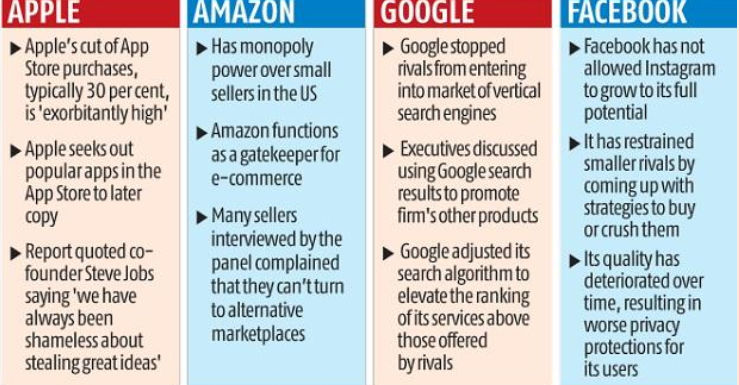
The US legislators have studied the long-standing issues surrounding the matter. They have created a panel to make Amazon, Google, Facebook, and Apple more accountable for their actions. Here are some of the factors for which the companies are under the scanner of US lawmakers:

Source: Business Standard

The Antitrust Subcommittee of the Judiciary Committee in the US is currently looking into the matter. The CEOs of all four companies have already made several appearances before the panel. However, like most cases, these tech companies find loopholes and seem to simply not mind about its consequences. 

With these impressive Q3 results, we can see that no factors seem to affect the growth in their high revenues. At a point when all economic activities were hit, these companies used their position to make the best out of every new possibility. A fine of thousands of crores is okay for these companies when they are making ten thousand crores of profits. Do not forget that these companies are also heavily involved in India, and its development. Let us wait and watch how the Big Tech companies are planning to further dominate in their respective fields.

Categories
Editorial

Reliance vs Amazon: The Future Retail War

India’s retail market is estimated to be worth Rs 60 lakh crores in FY 2019-20 and is expected to grow at a CAGR of 10% over the next 5 years to reach Rs 90 lakh crores by FY 2024-25. Reliance and Amazon are indulging in a serious war to capture this retail market in India.

Reliance and Amazon have been pursuing to buyout the cash-strapped Future Group, which owns retail brands like Big Bazaar, HyperCity, etc. This deal can give access to around 1,800 stores across Future Group’s brands and subsidiaries such as Big Bazaar, FBB, Easyday, Central, which are spread across 420 cities in India. 

Right after Reliance finalized its deal to acquire the Future Group for Rs 24,700 crores, Amazon opposed the deal and approached an international arbitration court to try and stall the deal. The court has given a temporary decision in favor of Amazon. A permanent injunction order is awaited. On the other hand, Reliance refuses to take a step back either. Let’s find out what the mess is all about. 

Why is Amazon Opposed to the Reliance-Future Deal?

After Reliance finalized its deal to acquire the Future Group, Amazon approached the Singapore International Arbitration Centre(SIAC) to appeal against Reliance for buying out Future Group. Amazon stated that this would be a violation of a contract that Future and Amazon had signed when Amazon had acquired a 49% stake in Future Coupons Limited, in November 2019. This acquisition gave Amazon a 3.58% stake indirectly in Future Retail Limited. 

Coming to the contract between the two companies, they had mutually agreed that Amazon would have an option to acquire all or a part of the Promoter’s Shareholding in Future Retail Limited in the near future, under certain circumstances. Additionally, Amazon would have the first right of offer. The Promoters had also agreed to not sell their stake to ‘specified persons’  and agreed to certain restrictions. We can get a smell of who the ‘specified persons’ might be. 

Amazon says that according to the contract it has the first right of refusal. This means that a company can buy a stake in Future Retail only after Amazon refuses to buy it in the first place. The interpretation of the contract is debatable. 

Is it a Retail War?

  • Reliance wishes to capture the e-commerce market through its brand JioMart(a subsidiary of Reliance Retail Ventures Ltd.), which was recently launched in January 2020. The company gained momentum during the COVID-19 lockdown. Amazon, on the other hand, wishes to acquire a better logistics, warehousing, and supply chain for its already existing e-commerce platform.
  • In January 2020, Future Retail and Amazon had ‘joined hands’ to ‘take-on’ Reliance’s JioMart.They were strategizing for a partnership and possibly an investment. The relationship between Amazon and Future was steady. Future saw hope in partnering with Amazon. However, Reliance offered to acquire the group for a lucrative amount which could prevent the company from going bust. The deal was too good to let go. Future Group jumped off Amazon’s Boat and got into Reliance’s Boat. At the same time, Reliance being an Indian entity faced no restrictions of Foreign Direct Investments(FDI), unlike Amazon.
  • Future Group might face insolvency and eventually shut shop: Arbitrations are long and lengthy, they aren’t as effective as litigation. Reliance has its own set of tricks up its sleeve. If the arbitration proceeding continues for long, Future Group won’t get the cash it needs. This means that it won’t be able to operate for long and eventually go bust. What would follow is a set of insolvency proceedings which would last long enough, such that neither Amazon nor Reliance would be able to acquire the assets. Since the assets would be auctioned off to pay back the debt that Future Group owes to its creditors. Essentially, this would be collateral damage. 
  • Amazon was in talks with Reliance to buy a 26% stake in Reliance Retail in August 2019. In September, there were unconfirmed reports that Amazon was in talks with Reliance to acquire a 40% stake in Reliance Retail for $20 Billion(1.4 Lakh Crores). The deals didn’t go through. The liquidity would have allowed Reliance to get rid of its huge debt. However, with foreign investments flowing in Reliance managed to go net-debt free without giving Amazon a piece of its cake.
  • Not just Retail, there’s more to it: Reliance, Amazon, and Flipkart, the three major competitors, are all arms out against each other. All three own a food retail license, All three have their own OTT platforms, All three have their own UPI/Wallet payment services. All three have an established fashion brand. There could be more than just Retail in the picture.

Who Wins, Who Loses?

Reliance is an old and home-grown company, with a strong lobbying ground and sources in the government. Amazon on the other hand is a relatively newer foreign company with not as much lobbying power as Reliance. Amazon might therefore face problems on FDI and regulation even if things run in its favor. Reliance and Future have both come out in support of the acquisition. Reliance has stated that ‘it intends to enforce its rights and complete the transaction in terms of the scheme and agreement with Future group without any delay’. Reliance and Future both want to go forward with the deal. 

Amazon faces a challenge since enforcement of emergency arbitration orders is contestable in the Indian court of law. Future Group or Reliance might approach the respective court and stall the interim order by SIAC. Whatever is the course of action needs to be taken fast, time is ticking.  

Categories
Editorial

Flipkart – Aditya Birla Fashion Deal. Future of Indian Retail Getting Re-written?

About Aditya Birla Fashion & Retail Limited 

Mumbai-headquartered Aditya Birla Fashion & Retail Limited (ABFRL) is an Indian clothing retail chain. ABFRL emerged after the consolidation of two businesses in 2005. These two businesses were Pantaloons Fashion and Retail (PFRL) and Madura Fashion & Lifestyle (MFL).

The company has 3,000+ brand stores and 25,000 multi-brand outlets all over the country. They span around a retail space of 8.1 million sq.ft. Big apparel names like Allen Solly, Louis Philipe, Peter England, Forever 21, Pantaloons, Ted Baker, Ralph Lauren, and Van Heusen are part of ABFRL’s brands. These are some of the most desirable brands for upper-middle-class families in our country!

Source: ABFRL’s Quarter Report

Based on Market Capitalization, ABFRL is the leading company Retail sector (Industry: Textiles-Products) with a market cap of Rs 13,720.05 crore. It is well ahead of its listed competitors Future Lifestyle Fashion Limited and Shoppers Stop.

Focussing on the deal

Aditya Birla Fashion & Retail Limited announced on Friday that the company is raising Rs 1,500 crore from Flipkart Group. Walmart-owned Flipkart will buy a 7.8% stake in Aditya Birla Fashion for Rs 1,500 crore at Rs 205 per share. The promoters will be left with a 55.13% stake in the company after the completion of the issuance, which is a respectable number.

The rumours of Flipkart buying a minority stake in the retail company started surfacing earlier. On Friday morning, the company’s board approved the issuance of equity shares on a preferential basis to Flipkart Investments Private Limited. You can refer to the press release from ABFRL here. This news was taken positively by the market participants. ABFRL’s share price rose by 7.59% to close at Rs 165.05. The stock hit an intraday high of Rs 178.80.

Aditya Birla Fashion & Retail plans to invest this capital to strengthen its balance sheet and accelerate its growth in the apparel segment. This deal reflects how well the apparel industry of the country is expected to do in the near future.

According to Kumar Mangalam Birla, Chairman of Aditya Birla Group, the apparel industry in India will touch $100bn in the next 5 years. With the rise in disposable income of the middle class, people are aspiring to wear clothes from famous brands. Companies in the sector are also following different digital transformation strategies. They believe that the future would comprise both online and offline sales. Thus, the company needs to transform digitally as well.

Covid-19 slowing the business

The business of manufacturing and retailing of branded apparel suffered massively during the lockdown. Aditya Birla Fashion & Retail reported a revenue of Rs 323 crore in Q1FY20. This was 85% below of Rs 2,065 crore they reported in the same quarter the previous year. The company reported a net loss of Rs 410 crore as compared to Rs 21 crore profits they declared in June 2019. Due to poor earnings, their EPS also dropped into negative.

Even though the company reported disappointing first-quarter results, they are expected to bounce back in Q3. As the lockdowns are getting eased, people are returning to the shops as they start to return to offices. Also, Diwali, Navaratri, and Dussehra are just around the corner. The company is optimistic about its sales during this festive season. This cash infusion will help ABFRL revive its business post Covid-19.

A win for both the parties?

Flipkart will benefit from this deal by strengthening the range of brands offered on its e-commerce platforms. It acquired Myntra in 2014 in a deal valued at Rs 2,000 crore. Getting international and domestic brands associated with ABFRL on its platforms will attract more customers to the company. Also, they are getting this deal at Rs 205 per share. This is at a discount as ABFRL was trading above Rs 250 during February 2020. Due to the COVID-19, the company’s share tumbled to Rs 102 in May.

But yes, compared to Flipkart is paying more than the current market price of the stock. So what is the catch? It is that Flipkart gets pre-emptive rights, or the right to buy additional shares from ABFRL before the general public for a period of 1-5 years. That means there is a chance of Flipkart increasing their stake in the future.

Kalyan Krishnamurthy, CEO, Flipkart Group said: “Through this transaction with ABFRL, we will work towards making available a wide range of products for fashion-conscious consumers across different retail formats across the country.”

Covid has forced the ABFRL to relook at their business. Engaging with e-commerce platforms will make them less vulnerable during these times and also help them save rental or other asset-heavy costs. Rather than fighting against the growing prominence of online retail, the decision to collaborate with them makes more sense.

The coming together of two large fashion houses will help them to make use of synergies in manufacturing and supply chain. It will help them to get more customers to derive more sales. Due to synergies in business, the cost of operations will also decrease. Thus, boosting both, the profits and revenue in the long run. According to market analysts, this deal will aid ABFRL to receive the most favoured status on Flipkart’s website.

Hopefully, the brands will refrain from offering their premium products at huge discounts, as Flipkart is notoriously known for doing this. This will decrease the ‘premium’ appeal of the brands of Aditya Birla Fashion like Van Heusen and Louis Philippe.

This new deal does give birth to positive sentiments about the apparel industry but to what extent Flipkart will be able to help ABFRL recover their lost business will be a thing to watch. Either way, ABFRL will surely appreciate this new capital along with the possibility of improved sales. Flipkart is also seeking to brand itself as “India’s Fashion Capital” and ABFRL will help them tackle the premium clients.