Categories
Editorial

Can Tata’s Trent Be The Next Retail King?

The Indian retail sector is witnessing rapid growth with a higher disposable income amongst citizens and changing consumer tastes and preferences. We can see domestic and global players such as Reliance Industries, Amazon, and Walmart entering into heavy competition to obtain more customers. These firms have primarily focused on revolutionising our country’s e-commerce space, which has proved to work in their favour. Trent is Tata’s shot at this market.

The Tata Group, one of the largest business houses in the world, has been trying to expand and develop its retail segment as well. At a time when most companies have already made their mark in online retailing, it feels that the Tata Group is too late to enter the field. However, they have focused on improving its wide network of physical retail stores that come under its wholly-owned subsidiary, Trent Limited. Let us take a closer look at the company and its performance.

Trent – Company Profile

Trent Limited operates a chain of retail stores primarily under the Westside brand in India. It was incorporated in 1998 and is headquartered in Mumbai. The company’s Westside stores provide a wide variety of apparel, footwear, lingerie, cosmetics, perfumes, accessories, and home furniture products.

  • Trent operates hypermarket and supermarket stores under the Star Market brand. It offers food and groceries, staple foods, beverages, health and beauty products, home furnishings, dairy and poultry products, and much more. 
  • Through its chain of Landmark stores, the company provides lifestyle products, including toys, music, books, stationery, gadgets, and sports merchandise. 
  • Further, Trent offers fashion apparel, footwear, and accessories under the Zudio brand. 
  • Through the Utsa brand, the company provides ethnic apparel, beauty products, and accessories.

As of March 31, 2020, the retail company operates around 169 Westside stores, 10 Hypermarket and 39 Star Market stores, and 80 Zudio stores. Trent also operates 4 Landmark stores and 2 Utsa stores. It has been able to expand these brands across all major towns and cities in India. Notably, Inditex Trent Retail India (a 51:49 joint venture between Trent and Spain-based Inditex SA) runs Zara stores in India.

Financial Performance

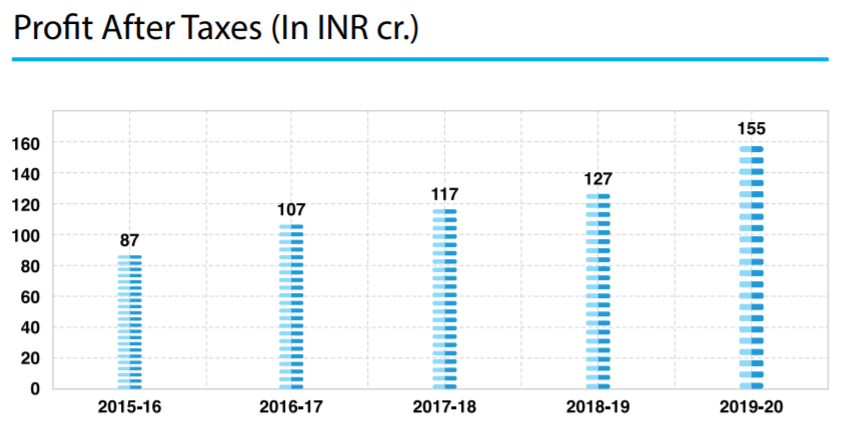
As we know, the retail sector in our country is highly competitive. Large players such as Avenue Supermart (DMart) and V-Mart have shown exponential growth and continue to dominate the retail space. Amidst heavy competition, Trent has been able to report a modest increase in revenues and profits through its diverse portfolio. Over the last 5 years, the company’s revenue has grown at a yearly rate of 6.59%, whereas the industry average stood at 19.21%. 
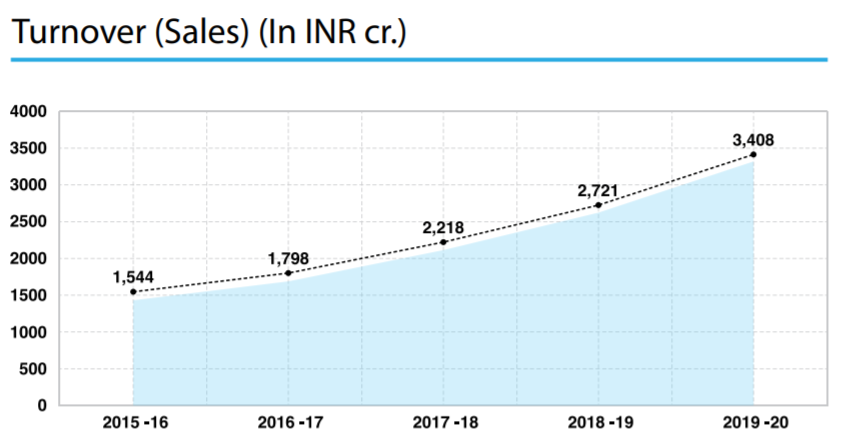
As we can see, Trent has shown very impressive growth in overall sales over the past 5 years. The company is also virtually debt-free and has been able to introduce effective cost-control measures. It has a Return on Capital Employed (ROCE) of 16.94%, which is at par with the market leaders. This means that for every Rs 100 worth of capital employed, Trent earns Rs 16.94 on it. The retail firm has been maintaining a healthy dividend payout of 39.15%. As of February 2021, Trent Ltd has obtained a market share of 18.48%.

Trent’s Q3 Performance

Amidst the Covid-19 pandemic and subsequent lockdowns, Trent faced significant losses. In the April-June quarter (Q1), The retail company’s revenues declined sharply by 87% on a year-on-year (YoY) basis. However, with the easing of restrictions and improving consumer sentiments, the company has witnessed an improvement in sales turnover. 

Trent Limited reported a 30.2% YoY jump in consolidated net profit to Rs 64.03 crore for the quarter ended December (Q3). Its consolidated revenue increased by 13.6% YoY to Rs 853.63 crore during the same period. The company had focused extensively on improving its digital presence. Thus, its online channel registered a high growth of 80% YoY in Q3. Westside revenues during the October-December quarter were up by 78%. This was also driven by huge demand during the festive season.

Noel Tata, the chairman of Trent Ltd, stated that the company’s store expansion plans are on track. The firm has plans to launch a significant number of stores across strategic locations in India.

Is Trent Limited Overvalued?

At ~Rs 24,100 crore, Trent has one of the largest market capitalisations in the retail sector of India.

1-Day chart of Trent Ltd. Source: TradingView

However, we can see that the stock is seen to be trading at 11.67 times its book value. [The book value of a company is equal to its total assets minus total liabilities]. The company’s Price-to-Earnings (PE) ratio stands at 192.04, which is very high when compared to its peers in the retail sector. A high PE ratio shows that investors are willing to pay a higher share price today due to better growth expectations in the future. All these factors tell us that Trent is overvalued. However, upon further analysis, it was interesting to find that almost all of its biggest competitors (such as Avenue Supermarts) are also overvalued. 

An investor who focuses on such strong revenue figures and growth (rather than looking at its value) will find the stock to be very favourable. 

The Way Ahead

From its highly-promising revenue and profit growth, Trent Limited seems to be a great bet for investors. This can be linked to the company’s progressive management, which has set adequate targets for the upcoming financial years. They have planned to open around 30-40 Westside stores and 80-100 Zudio stores every year. This is primarily because private label brands account for nearly 90-95% of Westside sales, and launching new stores in key areas is likely to improve sales margins. Also, the Landmark and Star Market stores tend to be unaffected by seasonal changes. The management is confident that these stores will continue to show strong growth by catering to the requirements of all types of customers.

Trent has also collaborated with other Tata Group companies to establish a unique or pleasurable customer experience. For example, they have launched Starbucks outlets (operated by Tata Consumer Products) in Westside stores. The company has announced plans to bring about more innovations in its wide network of physical stores. To adapt to the present market conditions, Trent will also focus on introducing a seamless online platform for its products. Due to this multi-fold approach to securing more customers, the future prospects of Trent remain to be very promising. It has the potential to become one of the largest retailers in the world.

Categories
Editorial

Stocks That Could Rally During Christmas Season

Christmas, the season of joy and hope, is officially upon us! This is a special period when people all over the world take a break from their busy schedules and spend time with family. Even though it is considered to be a holiday season in Western countries, all stock markets remain open throughout this period (except for December 25). By going through historical data and trends, we have noticed that certain specific stocks show an impressive rally in the month of December. 

Our mission here at marketfeed is to help you make smart and informed decisions, which ultimately help you win in the stock market. Let us understand the interesting concept of a ‘Santa Claus Rally’ and find out specific stocks that could show a surge in the coming weeks.

What is a Santa Claus Rally?

A Santa Claus Rally is a sustained increase in the stock market that usually occurs in the second half of December. To be more specific, the period consists of the final five trading days of the year, combined with the first two days of the next year. This means that for the present financial year (FY20), we could witness a rally between December 27, 2020, to January 2, 2021. Multiple studies show that investors receive better-than-normal returns during the Santa Claus Rally. This particular phenomenon is very prominent in the US markets.

There are several theories used to explain the cause of a Santa Claus rally in December. Certain stock market experts believe that a general feeling of optimism during this season is one of the major reasons for such a rally. Investors would be in a festive mood and tend to infuse more money to buy stocks. Some people believe in buying more stocks in anticipation of a general rise in stock prices during the month of January. Individuals would receive holiday bonuses, which they utilise for making investments in the stock market. Traders may also like to wind down their (short) trading positions early in December to enjoy the holiday season with their families.

Another theory is that large institutional investors, who are often pessimistic (bears), tend to go on vacation during this period. This leaves the stock markets for small retail investors, who tend to be more bullish. However, do bear in mind that stock markets could become highly volatile during the Christmas-New Year period.

Interestingly, over the last few decades, our Indian stock markets have shown an impressive rally throughout December.

Specific Sectors That Could Benefit During Christmas

Retail Sector

The Indian retail sector had received a massive boost as a result of high demand during the festive season (Diwali) in November. As we know, the Covid-related lockdowns caused major difficulties in terms of supply chain disruptions. However, we can now see that the operations of retail firms have returned to normal. The surge in demand seen during the October-November period has continued or sustained onto December. 

The Christmas season is one of the busiest periods for all retail companies. At the same time, it is the most profitable season for them. They often receive huge orders from the domestic as well as international markets. The retail firms that supply or sell good quality Christmas-related products would perform relatively well. There is a great demand for products such as interior holiday decorations, bakery items, electronic items, Christmas trees & lights, Christmas stars, and much more. We also see a huge consumption of poultry during Christmas and New Year. This is also a period when retail firms come up with attractive offers to increase sales.

Do keep a close watch on stocks such as Avenue Supermart, Trent, V-Mart Retail, Spencer Retail, and V2 Retail.

Logistics Sector

The Indian manufacturers of certain Christmas items often export their products to countries around the world. Logistic firms are the heroes that ensure that orders are accurately shipped and delivered. The international distribution chains work 24/7 and help people around the world to get their Christmas gifts/orders on time. These companies have established a proper distribution network in India as well.

Stocks such as Snowman Logistics, Mahindra Logistics, Blue Dart Express, Gati, Navkar, Allcargo can be closely watched.

With the arrival of the Covid-19 vaccine, Indian logistics firms are expanding their operations to meet any demand that may arise for its distribution. marketfeed had prepared a very detailed article on certain logistics stocks that could show a rally in the coming months. You can read it here.

Textiles & Apparel Sector

Christmas is a period when we see a huge increase in the demand for clothes or clothing materials. Since it is a holiday period, people would be flooding branded stores to be ready for the next year. We also see a great demand for Indian-made dress materials and cloth from the international market as well. There are specific companies such as Kitex and Bombay Dyeing that have established a great market for their products in multiple countries.

Stocks of companies such as Page Industries, Kitex Garments, Raymond, Bombay Dyeing, Arvind, Aditya Birla Fashion & Retail, and KPR Mill could be watched closely. 

Automobile Sector

Historically, we have seen the automobile industry as a whole show an increase in revenue or sales during the period between November and January. The positivity surrounding Diwali, the festival of lights, had helped certain automobile manufacturers to reach pre-Covid sales levels. We could see this sustained growth during the Christmas period as well. Prominent Indian automobile brands that have a well-established market in foreign countries could be specifically looked into.

There have been reports stating that many automobile manufacturers are going to increase the prices of their cars or two-wheelers from January 2021. Thus, we could see an increase in vehicle bookings this month. The offers and discounts offered by these companies during the holiday season would also encourage people to purchase cars in December. 

Do keep a close eye on prominent automobile stocks such as Maruti Suzuki, Tata Motors, Hero MotoCorp, Bajaj Auto, TVS Motors, Eicher Motors, etc.

Conclusion

We have only stated a few examples of how specific sectors could show positive growth during the next two weeks. Do let us know in the comments about your thoughts on certain other stocks that could show a rally during the Christmas season.

As mentioned before, historical data shows that stock markets typically show a bullishness during the Christmas season. At the same time, the markets could become volatile during this period. So, investors will have to be very cautious and disciplined while entering into trades. Our own Nifty 50 and Sensex had already crossed their all-time highs, and have started consolidating. Will we witness a Santa Claus rally in our markets this time? We will have to patiently wait and watch. Until then, marketfeed wishes all our readers a very Happy Christmas!

Categories
Editorial

Flipkart – Aditya Birla Fashion Deal. Future of Indian Retail Getting Re-written?

About Aditya Birla Fashion & Retail Limited 

Mumbai-headquartered Aditya Birla Fashion & Retail Limited (ABFRL) is an Indian clothing retail chain. ABFRL emerged after the consolidation of two businesses in 2005. These two businesses were Pantaloons Fashion and Retail (PFRL) and Madura Fashion & Lifestyle (MFL).

The company has 3,000+ brand stores and 25,000 multi-brand outlets all over the country. They span around a retail space of 8.1 million sq.ft. Big apparel names like Allen Solly, Louis Philipe, Peter England, Forever 21, Pantaloons, Ted Baker, Ralph Lauren, and Van Heusen are part of ABFRL’s brands. These are some of the most desirable brands for upper-middle-class families in our country!

Source: ABFRL’s Quarter Report

Based on Market Capitalization, ABFRL is the leading company Retail sector (Industry: Textiles-Products) with a market cap of Rs 13,720.05 crore. It is well ahead of its listed competitors Future Lifestyle Fashion Limited and Shoppers Stop.

Focussing on the deal

Aditya Birla Fashion & Retail Limited announced on Friday that the company is raising Rs 1,500 crore from Flipkart Group. Walmart-owned Flipkart will buy a 7.8% stake in Aditya Birla Fashion for Rs 1,500 crore at Rs 205 per share. The promoters will be left with a 55.13% stake in the company after the completion of the issuance, which is a respectable number.

The rumours of Flipkart buying a minority stake in the retail company started surfacing earlier. On Friday morning, the company’s board approved the issuance of equity shares on a preferential basis to Flipkart Investments Private Limited. You can refer to the press release from ABFRL here. This news was taken positively by the market participants. ABFRL’s share price rose by 7.59% to close at Rs 165.05. The stock hit an intraday high of Rs 178.80.

Aditya Birla Fashion & Retail plans to invest this capital to strengthen its balance sheet and accelerate its growth in the apparel segment. This deal reflects how well the apparel industry of the country is expected to do in the near future.

According to Kumar Mangalam Birla, Chairman of Aditya Birla Group, the apparel industry in India will touch $100bn in the next 5 years. With the rise in disposable income of the middle class, people are aspiring to wear clothes from famous brands. Companies in the sector are also following different digital transformation strategies. They believe that the future would comprise both online and offline sales. Thus, the company needs to transform digitally as well.

Covid-19 slowing the business

The business of manufacturing and retailing of branded apparel suffered massively during the lockdown. Aditya Birla Fashion & Retail reported a revenue of Rs 323 crore in Q1FY20. This was 85% below of Rs 2,065 crore they reported in the same quarter the previous year. The company reported a net loss of Rs 410 crore as compared to Rs 21 crore profits they declared in June 2019. Due to poor earnings, their EPS also dropped into negative.

Even though the company reported disappointing first-quarter results, they are expected to bounce back in Q3. As the lockdowns are getting eased, people are returning to the shops as they start to return to offices. Also, Diwali, Navaratri, and Dussehra are just around the corner. The company is optimistic about its sales during this festive season. This cash infusion will help ABFRL revive its business post Covid-19.

A win for both the parties?

Flipkart will benefit from this deal by strengthening the range of brands offered on its e-commerce platforms. It acquired Myntra in 2014 in a deal valued at Rs 2,000 crore. Getting international and domestic brands associated with ABFRL on its platforms will attract more customers to the company. Also, they are getting this deal at Rs 205 per share. This is at a discount as ABFRL was trading above Rs 250 during February 2020. Due to the COVID-19, the company’s share tumbled to Rs 102 in May.

But yes, compared to Flipkart is paying more than the current market price of the stock. So what is the catch? It is that Flipkart gets pre-emptive rights, or the right to buy additional shares from ABFRL before the general public for a period of 1-5 years. That means there is a chance of Flipkart increasing their stake in the future.

Kalyan Krishnamurthy, CEO, Flipkart Group said: “Through this transaction with ABFRL, we will work towards making available a wide range of products for fashion-conscious consumers across different retail formats across the country.”

Covid has forced the ABFRL to relook at their business. Engaging with e-commerce platforms will make them less vulnerable during these times and also help them save rental or other asset-heavy costs. Rather than fighting against the growing prominence of online retail, the decision to collaborate with them makes more sense.

The coming together of two large fashion houses will help them to make use of synergies in manufacturing and supply chain. It will help them to get more customers to derive more sales. Due to synergies in business, the cost of operations will also decrease. Thus, boosting both, the profits and revenue in the long run. According to market analysts, this deal will aid ABFRL to receive the most favoured status on Flipkart’s website.

Hopefully, the brands will refrain from offering their premium products at huge discounts, as Flipkart is notoriously known for doing this. This will decrease the ‘premium’ appeal of the brands of Aditya Birla Fashion like Van Heusen and Louis Philippe.

This new deal does give birth to positive sentiments about the apparel industry but to what extent Flipkart will be able to help ABFRL recover their lost business will be a thing to watch. Either way, ABFRL will surely appreciate this new capital along with the possibility of improved sales. Flipkart is also seeking to brand itself as “India’s Fashion Capital” and ABFRL will help them tackle the premium clients.

Categories
Editorial

Can Tata Group be the King of Indian Retail?

The retail sector in our country is filled with a lot of companies that compete with each other to reach the top. And at a time when global players like Amazon and Walmart are competing for customers in India, it is no surprise that India’s biggest business houses would want to get into the scene too. 

During the Covid-19 lockdown, companies such as Reliance Retail, Amazon, and Walmart were preparing for the retail war ahead. The retail segment in India is anyway growing with the increasing population of the country. But what these huge companies want is a piece of the organized retail market in India, which is exploding as more and more young citizens are getting high paying jobs. More specifically, it is a race of giants to become the king of India’s booming e-commerce space.

Interestingly, there are reports flying around, about Tata Group’s plans to expand their online retail presence. Let us understand how Tata is preparing to up its game in this space, and find out if it is too little too late.

  1. Race to the Top
  2. The Super App
  3. Tata to acquire BigBasket?
  4. Tata Consumer Products expanding
  5. Will these plans be enough?

Race to the Top

Based on a report from the Indian Business Equity Foundation (IBEF), the retail industry in India is expected to reach Rs 76.87 lakh crore (USD 1.1 trillion) by 2020. We have seen that the Covid-19 pandemic had a devastating impact on the organized retail sector. However, the situation is projected to get better, as lockdown restrictions have now been lifted. Amazon.in, Reliance Industries, and Walmart have all shown how this particular sector is going to become a battleground in the months to come. 

Over the last few months, we keep hearing about the expansion of Mukesh Ambani’s Reliance Industries Limited (RIL) in the retail sector. Reliance Retail Ventures Limited (RRVL) has raised Rs 37,440 crore this year from private equity firms. Currently, it is the largest retail company in India. All these highly competitive factors could make it difficult for a company like Tata to expand and develop in this particular market. However, over the past few months, we have heard reports stating that Tata Group is not going to back down without a fight. They have come up with solutions to bring about more competition in the organized retail space. Let us look at a few of these:

The Super App

In August, Tata Group stated that it had plans to launch a ‘Super App’ to take on Reliance and Amazon. The app would be a one-stop destination for all of Tata’s products. We hope you can imagine the magnitude of this product. Tata Group sells salt to jewellery and everything in between, including cars and even trucks. Imagine using the Super App could be used by you to order a Fastrack watch, or maybe even to book a Tata Harrier SUV.

It is expected that the Super App will also merge services from food and grocery ordering to fashion, electronics, insurance, healthcare, and bill payments. Currently, the services can be found in Tata CLiQ and Croma for electronics, StarQuick for groceries, and streaming services in Tata Sky. The app is also set to have its own payment system, and the loss-making Tata Teleservices is said to be the one that could provide technical support and enterprise solutions.

The concept of a Super App can be seen from applications such as PayTM and PhonePe. When these apps started in India, they were just payment platforms. However, this model has seen massive growth in terms of the services that they provide, and the customers seem to be giving positive feedback for this new model.

Another report came up in September, stating that retail giant Walmart Inc, (who owns Flipkart and PhonePe) was in talks with Tata Group for a potential investment in the super app for up to $25 billion (~Rs 1.8 lakh crore). The app is likely to be launched between December and January, as a joint venture between the two companies.

Tata to acquire BigBasket?

On 15th October, reports were sent out by major publications stating that Tata Group was in talks to acquire BigBasket. The Bengaluru-based company is one of the best online grocery stores in India. The company delivers groceries in about 26 major cities and towns. As the Covid-19 pandemic hit our country and people were stuck at home, the demand for these online services has seen an all-time high. The company is backed by China’s Alibaba Group, and has reported a valuation of nearly $1.2 billion (~Rs 8,809 crore) as of March. Last month, BigBasket said that the number of new users on its platform had increased by 84%, as compared with the pre-Covid levels. On 25th May, BigBasket had appointed financial services companies Goldman Sachs and Morgan Stanley to help raise funds, and are now looking to increase their valuation to $2 billion (~Rs 14,682 crore). A business valuation is a process of determining the total economic value of a whole business or a company, and raising the valuation would help them sell stake, and raise more funds.

Another report which has come up in the past few weeks is that Tata Group has also made plans to acquire IndiaMart InterMesh Ltd, a business-to-business (B2B) marketplace. It is an e-commerce company that sells to normal consumers and to other small businesses. Basically, the company helps Indian manufacturers to connect with buyers. IndiaMart’s shares have surged almost 142% this year, giving it a market value of about Rs 14,682 crore. According to their website, IndiaMart says it controls almost 60% of the Indian online B2B market, providing a platform for small and medium enterprises. The point to be noted is that Flipkart and Amazon have been expanding their B2B presence as well. You can read about it here. Through this acquisition, the Tata Group would be able to obtain a major hold of the online e-commerce retail market in India.

Tata Consumer Products

The new CEO of Tata Consumer Products Limited (TATACONSUM), Sunil D’Souza, has announced plans to transform the company as the new face of Tata Group’s fast-moving consumer goods (FMCG) company. TATACONSUM had been formed recently through the merger of Tata Global Beverages and Tata Chemicals.

TATACONSUM is also planning to contribute to Tata Group’s ultimate goal to strengthen its retail presence. Currently, the firm’s products include Tata Tea, Tetley, and Tata Salt, and also has a joint venture with Starbucks Corporation in India. In September, they made a non-binding bid for the vending machine business of Coffee Day Enterprises Ltd. Coffee Day is one of the largest coffee chains in India, and has over 60,000 vending machines across malls, public spaces, and schools in India. This could help TATACONSUM obtain more access to the premium coffee platform in India, along with the help of Starbucks.

The company has also declared plans to bring about changes to its entire sales and distribution system. In order to double its reach to customers, they are creating a more direct, active, and digitized system. During the beginning of the financial year, Tata Consumer Products also bought out partner PepsiCo’s stake in NourishCo Beverages Limited, whose products include Himalayan mineral water. This has been seen as an aggressive move by the company. We can see that this trend of acquisitions would largely have a positive impact on the growth of the company.

We see that the shares of Tata Consumer have so far increased 52% this year, thus giving them a market value of about Rs 44,046 crore.

Will these plans be enough?

Through a series of acquisitions, expansion of Tata Consumer Products, and through investments in its new Super App, the Tata Group will be able to compete against India’s retail giants. But, a question arises here-  Is the Tata Group too late to improve on its retail presence? Except for a few companies like Tata Consultancy Services, most of the other subsidiary companies of Tata Group are making huge losses. If the integration of all these new expansion plans is precisely calculated and achieved, the retail business of the Tata Group of Companies will be able to bring in better returns. In order to make a mark on the organized retail sector in India, companies would have to go all out and play the best strategies. 

All eyes are focused on how the Tata Group is planning to execute these huge plans. Will the Super App be as great as it sounds? Let us wait and watch for the results.