Categories
Editorial

An Analysis of Ashok Leyland

The Hinduja Group’s Ashok Leyland has produced some of India’s best buses and trucks over the past seven decades. From school buses to army trucks, the company continues to play a vital role in our country’s development. In this article, learn more about Ashok Leyland Ltd, the second-largest manufacturer of commercial vehicles in India.

Ashok Leyland Ltd – Company Profile

Ashok Leyland Ltd manufactures and sells commercial vehicles (CVs) in India and across the globe. Incorporated in 1948, it is the flagship company of the Hinduja Group. They primarily manufacture distribution trucks, light & small commercial vehicles, tractors, and goods carriers. The company offers city, intercity, school and college, staff, tourist, and airport shuttle buses. Their range of defence vehicles comprises logistics, high mobility, armoured, light tactical, tracked, and simulator vehicles. Ashok Leyland also provides power solutions, including diesel generators, agriculture engines, industrial engines, and marine engines.

Further, the Chennai-based automaker provides manpower supply services, air charter services, and driver training services. They also operate retail stores and LeyKart, an e-commerce store for spare parts. Ashok Leyland serves its customers through an all-India sales and service network.

The company markets its vehicles under the Ecomet, CHEETAH, Oyster Wide, SUNSHINE, Viking Diesel, and STALLION brands. The company’s UK-based subsidiary Switch Mobility manufactures next-generation electric buses as well. 

Factsheet

  • Ashok Leyland is the second-largest manufacturer of commercial vehicles in India (after Tata Motors).
  • It is the fourth largest manufacturer of buses in the world and the 19th largest manufacturer of trucks.
  • The company operates nine manufacturing plants– 7 in India, 1 in the United Arab Emirates, and 1 in the United Kingdom.
  • Ashok Leyland has a presence in 50 countries and is one of the most fully integrated CV manufacturing companies.
  • The automaker launched India’s first electric bus in 2016.

Financial Performance
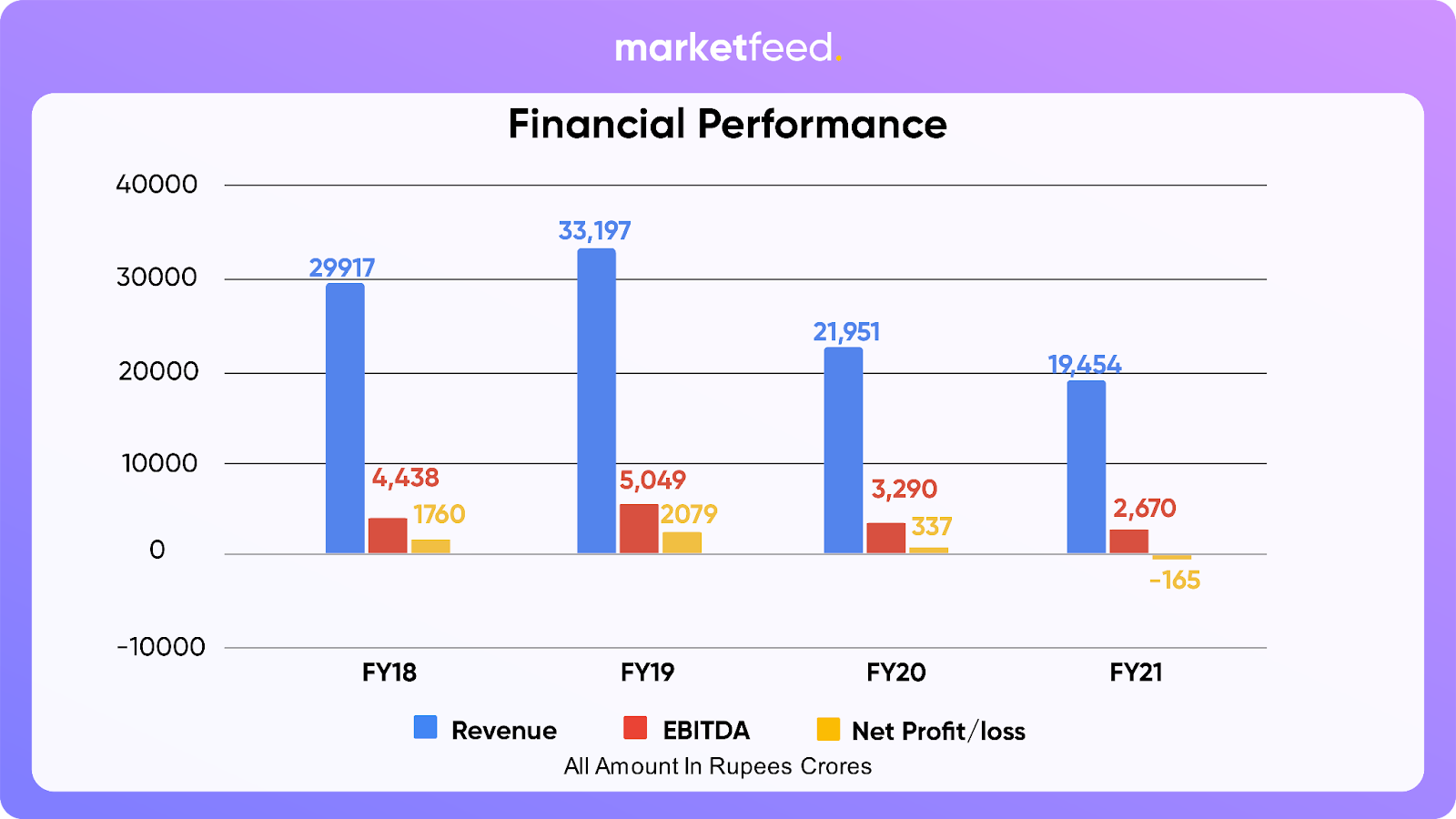
Unfortunately, Ashok Leyland’s revenues and profits have been on a decline. The company reported an 11.4% year-on-year (YoY) decline in sales revenue to Rs 19,454 crore for the financial year 2020-21. It posted a net loss of Rs 165.23 crore in FY21, compared to a net profit of Rs 336.67 crore in FY20. The challenges in the commercial vehicle market due to the Covid-19 pandemic continue to impact Ashok Leyland’s sales volumes and overall performance. A sharp increase in the prices of raw materials and the global semiconductor shortage forced the CV major to hike prices last year.

The company’s revenue has grown at a CAGR of -1.76% over the past five years, whereas the CV industry average stands at 0.24%. Currently, Ashok Leyland has a 67.17% market share in India’s commercial vehicle segment.

For the quarter ended September (Q2 FY22), Ashok Leyland reported a consolidated net loss of Rs 84 crore. It had posted a net loss of Rs 96 crore in the corresponding quarter last year (Q2 FY21). Revenue rose 44% YoY to Rs 5,562 crore in Q2 FY22. Meanwhile, EBITDA remained flat at Rs 576 crore. The company has significant long-term and short-term debt liabilities in its books. 

Ashok Leyland will report its financial results for the October-December quarter (Q3 FY22) in February. 

Stock Performance
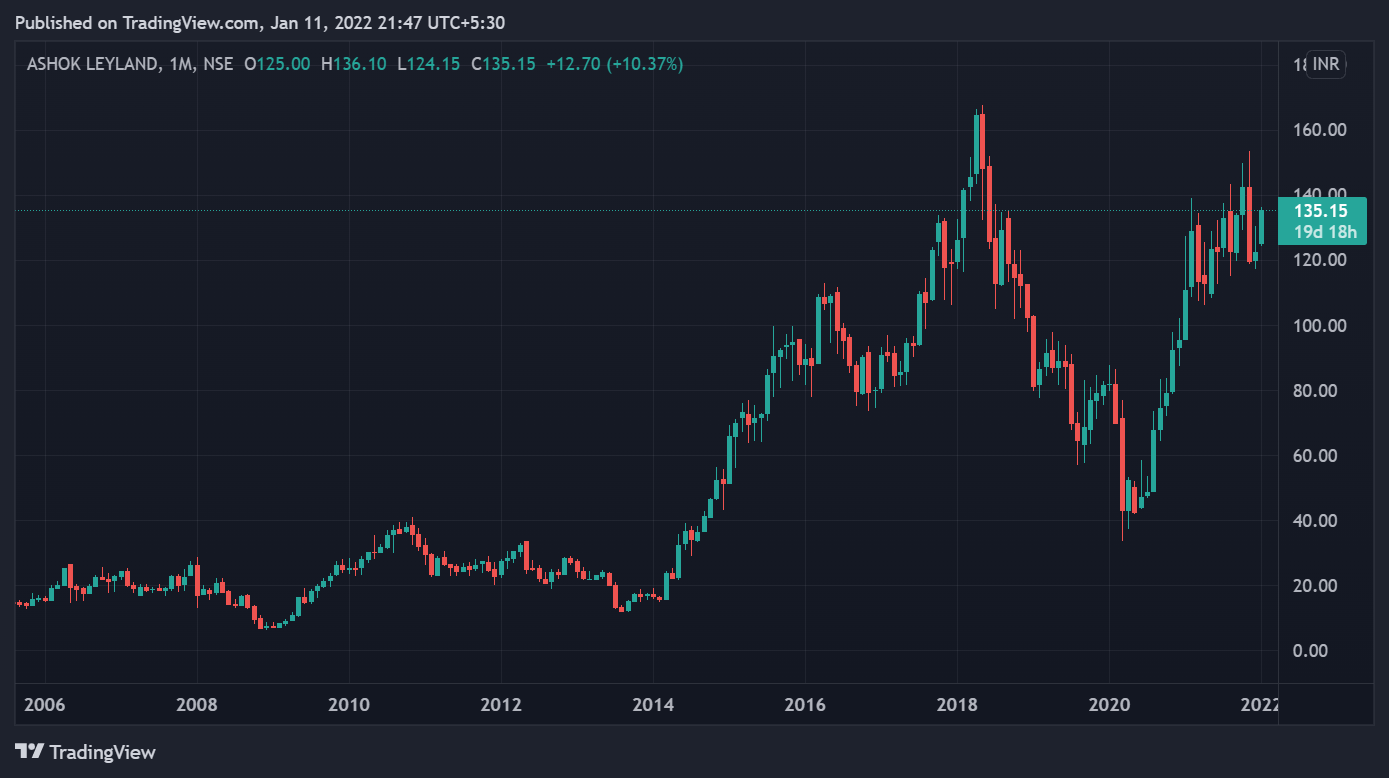
After a significant rally (nearly 5x) from 2014-2016, Ashok Leyland’s shares fell on account of a failed joint venture (JV) with Nissan Motor Company. The partnership turned sour when the Japanese automaker served a termination notice for one of its JVs. This move was reportedly due to a delay in bill payment by Ashok Leyland. Moreover, the two firms were engaged in legal battles due to alleged breach of contracts. The Indian CV manufacturer also failed to pay a royalty of around Rs 200 crore to Nissan. 

The company’s shares touched an all-time high of ~Rs 165 in April 2018. However, it started falling heavily from that point. Sales of medium and heavy-duty CVs began to decline sharply due to poor conditions in the global automobile industry. Rising commodity prices, fuel efficiency and BSVI regulations, affordability issues for customers, and drastic effects of the Covid-19 pandemic ultimately led Ashok Leyland’s shares to crash 75% within two years.

Ashok Leyland’s stock price is currently trading at Rs 135.15, down 11.95% from its 52-week high.

The Way Ahead

Ashok Leyland has a long-standing presence in India’s medium and heavy commercial vehicle (M&HCV) segment. It has a well-diversified distribution and service network across the country. However, the company is scrambling to regain its lost market share due to unfavourable market conditions. Industry experts expect Ashok Leyland to be a key beneficiary of the anticipated upcycle in the Indian CV segment.

The CV major had lined up a capital expenditure (capex) of Rs 750 crore for FY22 to strengthen its product portfolio. Recently, Ashok Leyland announced its entry into the used vehicles business via a partnership with Shriram Automall. The companies will launch a physical and digital platform for facilitating the exchange, disposal, and purchase of old CVs.  

The company has lined up its electric vehicle (EV) roadmap and also set a target of becoming one of the top 10 commercial vehicle brands in the world. The company’s EV push will be led by its UK-based subsidiary, Switch Mobility. The EV arm plans to launch its first electric light commercial vehicle (e-LCV) in India soon. Ashok Leyland also plans to invest $150-200 million in the EV space in the next few years. Based on estimates, the global electric bus market is likely to reach $70 billion by 2030. Switch Mobility will be well-positioned to address this market. Let us look forward to seeing how the automaker executes its strategic plans.

What are your views on Ashok Leyland? Are you invested in it? Let us know in the comments section of the marketfeed app.

Categories
Editorial

ONGC Limited: The Indian Energy Giant

Since its inception around 65 years ago, ONGC has played a critical role in transforming India’s upstream (oil & gas exploration) sector. With operations spread across the country and the globe, they ensure a steady supply of raw crude oil and gas. The PSU has recently ventured into the production of renewable sources of energy as well. Many are not aware of how big the company really is. In this article, learn more about ONGC and its recent financial performance.

Company Profile – ONGC

Oil and Natural Gas Corporation (ONGC) Limited is the largest producer of crude oil and natural gas in India. It was established in 1956 under the leadership of Pandit Jawaharlal Nehru. The Government of India (GoI) holds a majority stake (60.4%) in the company. ONGC comes under the administrative control of the Ministry of Petroleum & Natural Gas. It was conferred the ‘Maharatna’ status in 2010.

They primarily operate through two segments— Exploration & Production (E&P) and Refining & Marketing (R&M). The company has established itself as one of the leading oil drilling companies in our country. It operates around 104 oil drilling rigs and 74 workover (portable) rigs. ONGC contributes nearly 71% to India’s total production of crude oil. The crude extracted by the company is used as raw material by downstream companies such as Indian Oil Corp. (IOCL), BPCL, and HPCL. Moreover, ONGC contributes ~63% to the total gas production in our country.

The state-owned company extensively produces liquefied petroleum gas (LPG), ethane/propane, superior kerosene oil, aviation turbine fuel, and high-speed diesel. 

Interestingly, ONGC is also one of the top wind energy companies in India. It owns and operates a 51 megawatt (MW) wind power project in Surajbari, Gujarat, and a 102 MW wind power project in Rajasthan. They also generate solar power through a total installed capacity of 23 MW. The ONGC Energy Centre (OEC) is developing innovative methods to generate hydrogen as well.

Financial Performance

(Consolidated Figures)

From the graph shown above, it is clear that ONGC’s revenues have been declining over the past two years. Profit figures are also highly inconsistent. A primary reason for this can be attributed to an increase in overall expenses. Amidst the Covid-19 pandemic, the company had faced a sharp rise in statutory levies (royalty and cess), exploration costs, and tax expenses. At the same time, ONGC could not efficiently use its budgeted capital expenditure (capex) for FY21. This was because the implementation of several key projects (including oil & gas exploration) got delayed due to strict lockdowns globally. The sharp fall in crude oil prices also affected ONGC’s margins.

ONGC’s Q4 and FY21 Results

ONGC posted a consolidated net profit of Rs 9,404.16 crore for the January-March quarter of 2021 (Q4 FY21). This is compared to a net loss of Rs 6,338.12 crore in the corresponding quarter last year (Q4 FY20)— the company’s first-ever quarterly loss. However, net profit had jumped 273.5% when compared to the previous quarter (Q3 FY21). The total income in Q4 FY21 increased by 9.45% YoY (or 15.42% QoQ) to Rs 1,18,206.16 crore. 

The consolidated net profit for the entire financial year 2020-21 (FY21) increased by 49% YoY to Rs 16,248.69 crore. Total income fell by 8.5% YoY to Rs 3,71,833.46 crore in FY21. The Earnings Per Share (EPS) increased from Rs 8.67 in FY20 to Rs 12.92 per share in FY21.

Over the past five years, ONGC’s total revenue has grown at a CAGR of 19.44%, whereas the industry average stood at 18.73%. It has obtained a market share of 96.44% in India’s Exploration & Production (E&P) sector. The company’s Return on Equity (ROE) of 7.61% is very low when compared to its peers. Currently, the Return on Capital Employed (ROCE) is also low at 10.21%. It means that for every Rs 100 worth of capital employed, ONGC receives just Rs 10.21 on it.

Recent Announcements

  • ONGC has declared a total of 10 discoveries (3 in onland, 7 in offshore) during the financial year 2020-21 (FY21) in its operating oil & gas acreages. Out of these, six are new prospects (1 in onland, 5 in offshore) and four are pools of existing finds (2 in onland, 2 in offshore).
  • With the monetisation of ONGC’s Ashoknagar-1 discovery (oilfield), the Bengal basin has become the 8th sedimentary basin of India from which hydrocarbon has commercially been produced. Thus, the Bengal basin has been upgraded to a Category-I basin as per the new three-tier category classification of sedimentary basins in India.
  • An official of the state-owned firm said they expect gas prices to increase by around 50-60% in the second half of FY22, which will help boost margins. 

The Way Ahead

In 2019, the company had announced the adoption of a comprehensive roadmap for the future, termed as ‘ONGC Energy Strategy 2040’. They have set a target to double oil and gas output from its domestic and overseas fields. ONGC will work towards achieving a three-fold increase in revenue, distributed across the exploration & production (E&P), refining, and other businesses. The company has also targeted a four-fold increase in profit after tax (PAT), with a 10% contribution from the non-oil and gas business by 2040. They have prioritised the expansion of their oil refining capacity from 70 million tonnes per annum (MTPA) to 90-100 MTPA. 

As mentioned earlier, ONGC is also focusing its efforts on developing and producing cleaner sources of energy (wind, solar, hydrogen, etc). The company plans to make large investments in these renewable energy sources with an aim to create a 5-10 gigawatt (GW) portfolio. Let us look forward to seeing how they implement these strategic plans. 

ONGC’s shares have gained by ~46% over the past year. Most people invest in this public sector undertaking (PSU) for dividends. Fortunately, the company has been maintaining a healthy dividend payout of 38.12%. 

Have you invested in the company? Let us know your views on ONGC in the comments section of the marketfeed app.

Categories
Editorial

Company Analysis: CRISIL Limited, an S&P Global Company

In India, when we go through the content on bonds, shares, and how they are rated, CRISIL comes as a common name. CRISIL Limited is an Indian analytical company providing ratings, research, and risk and policy advisory services. It is listed on both NSE and BSE. It is owned by a quite popular American financial giant, S&P Global

In this piece, I shall take you through the company’s business model, its recent financials, and the future prospects of the company.

Business Model

  • CRISIL Limited is a Credit Rating Agency(CRA). The role of a credit rating agency is to ‘rate’ or rank securities like bonds, shares, debt instruments, etc. based on their risk and ability to pay back its investors. Based on the ratings, investors can get an insight into the risk factor of the security they are investing in. Bond issuing companies can even decide the price of the bond or interest they pay based on the rating that the bond gets. It is recommended that you go through a piece we did at market feed on How Credit Rating Agencies In India Earn Money’. 
  • Before we move any further, let me summarize the Credit Rating Industry for you. The industry is an oligopoly. This means that there are barely 4-5 established CRAs in India. It is virtually impossible to compete against these giants. Most of these giants are owned by the ‘Big Three’ credit rating agencies. Those are S&P Global, Moody’s, and Fitch Ratings. 
  • The company isn’t limited to just its India operations. The company receives most of its business from North America and a major chunk of it from Europe as well. 
  • CRISIL, just like any other CRA, makes money through three segments. Ratings, Research and Advisory. Looking at the revenue mix it is clear that CRISIL earns most (~63%) of its revenue from its Research business followed by Ratings and the Advisory.

Rating Business 

The cash flow over here comes from two places, Bonds and Bank Loan Ratings. It is mandated by SEBI that every company issuing bonds must be rated by at least one of the Credit Rating Agencies in India. Additionally, whenever a big company borrows money from a bank, the bank assigns the task of rating the borrower company to a CRA, in our case, CRISIL. CRISIL owns close to ~68% of market space in the Rating business. When more bonds are issued, and more companies start borrowing money fuelling banking credit in the economy, CRISIL eventually ends up making money. In India, Banking credit has grown by ~6.2% CAGR and bonds issuances by ~9.35% CAGR, both over a period of 5 years. In the past year, the bond market has increased by 8% YoY, despite a stressful year for businesses. 

Research Business

CRISIL allots maximum capital to this segment. In the quarter ended March 2021, CRISIL allotted ~Rs 642 crore against ~Rs 78 crore and ~Rs 89 crore to the Advisory and Rating segment respectively. 

The Research segment doesn’t require much elaboration. Most decisions taken in the market are based on research. Research requires data, the data is then analyzed, and a conclusion is reached. Gross Revenue from Research business has grown by 14.2% CAGR  over the past 5 years. The company acquired a US-based research and analytics company Greenwich Associates and its subsidiaries for $40 million or Rs 296 crore. This was a major addition to the segment. What makes this segment unique is that it isn’t impacted by the cyclicity of the market. In the financial world, whether the market is down or up, the demand for a good research report never ends. 

Advisory Business

CRISIL provides advisory services in s in areas of regulatory reporting, credit risk, and select city infrastructure projects. The advisory business of CRISIL is picking up. CRISIL’s advisory services see great potential growth since they have access to lots of data and research material. This gives them an edge when it comes to giving the right business advice. Even though the contribution to the revenue segment is small, one can expect it to grow in the future. 

Financial Vitals

.Q4 2020Q3 2020Q4 2019
Revenue508.65612.2462.6
Net Profit83.511088.1
All Amount in Rs Crores
  • In the above-given chart, we can clearly see that the revenue of the company is increasing steadily, but the profit margin isn’t responding to the rise in revenue. Apparently, CRISIL is unable to trim down on its expenses.
  • Coming to CRISIL’s expenses, more than 65% of it goes into paying for the salaries and benefits of its employees. Another sizable chunk goes in availing ‘Professional Services’ from third parties. CRISIL can utilize its capital more efficiently. In a world of automation and artificial intelligence, maybe it’s time to upgrade its technology. 
  • The stock seems to have gained quite some traction in the past one month more than other months. CRISIL stock has gained ~36% in the past month and ~76% in the past year. The stock traded pretty much sideways for quite a few months before ‘freeriding’ the bull run post the COVID-19 lockdown.  

The Big Picture

In the chart give above, we get a clear picture of CRISIL’s financial efficiency. All vital ratios like Return on Equity %, Return On Capital Employed %, Net Profit Margin Annual % have declined over the past decade, yet CRISIL’s stock seems to have rallied more than 36.66% over  Despite this, CRISIL seems to be rallying over the past month. 

CRISIL stock happens to be in ace-investor Rakesh Jhunjhunwala’s portfolio, the stock seems to have gained a special interest from Foreign Investors and Mutual Fund in the past month. A breakout from a long-borne consolidation spiked interest in retail traders that could have probably caused the breakout. From the data given above, we can concur that the rally isn’t supported by the company’s financials and could possibly be a short-lived one. Another possibility could be that the company turns around its financials in the coming quarter and the quarterly results become supportive of the rally. 

Categories
Editorial

Happiest Minds Technologies: A Strong Pick for the Long Term?

A mid-cap IT company has given stellar returns to its investors ever since its listing in September last year. It had recently posted remarkable growth in earnings as well. They have turned out to be one of the fastest-growing companies in the highly competitive IT industry in India. We are talking about Happiest Minds Technologies. In this article, learn more about the company and its recent performance.

Company Profile – Happiest Minds Technologies

Happiest Minds Technologies Limited is a leading IT solutions and services provider based in Bengaluru. It is a relatively young company (established in 2011), and its shares were listed on the stock exchanges in September 2020. They primarily operate through three segments: 

  1. Infrastructure Management & Security Services (IMSS) – This segment provides cyber and infrastructure security, risk and compliance, data privacy, access management, and threat & vulnerability management services. The infrastructure management services provided by the firm include hybrid cloud services, workspace services, service automation, and software-defined infrastructure services.
  1. Digital Business Solutions (DBS) – This segment offers enterprise applications and customised solutions that include advisory, design & architecture, custom-app development services. It also comprises package implementation, testing, and ongoing support services to IT initiatives. 
  1. Product Engineering Services (PES) – The segment assists software product companies in building products and services that integrate mobile, cloud, and social technologies. Happiest Minds also provides Internet of Things (IoT) solutions, consisting of digital strategy creation consultation, end-to-end system integration on IoT platforms, IoT security and managed services, and implementation of IoT roadmaps.
(Approximate figures)

Other Offerings

Apart from these three verticals, Happiest Minds offers analytics/artificial intelligence (AI) solutions, including the implementation of advanced analytics using AI, machine learning, and statistical models. They also provide digital process automation solutions, such as robotic process automation and intelligent business process management (BPM).

The IT company offers its services across India, the United States, Canada, the United Kingdom, Australia, and the Middle East. Over the years, they have partnered with major players such as Google, Microsoft, Amazon Web Services (AWS), and Salesforce. By leveraging these partnerships, the firm has been able to secure large orders.  As of March 31, 2021 (FY21), they have a total of 173 clients spread across the Banking, Financial Services & Insurance (BFSI), Edutech, Retail, Manufacturing, and Travel, Media & Entertainment sectors.

Ashok Soota, widely recognised as one of the pioneering leaders of the Indian IT industry, is the Executive Chairman and Promoter of Happiest Minds. [He previously led Wipro’s IT business for around 15 years and was a driving force behind its exponential growth]. Moreover, Happiest Minds is considered one of the best places to work in India. They have also launched corporate social responsibility (CSR) initiatives that support poorer sections of society.

Financial Performance

Similar to most companies in the Indian IT & ITeS sector, Happiest Minds has posted a phenomenal increase in its revenue and profits over the past few years. More businesses and even government entities are being forced to adopt digital transformation practices to improve efficiency and cut costs. There has been an increase in demand for the services and products of IT firms, especially amidst the Covid-19 pandemic. 

Happiest Minds reported a 580.19% year-on-year (YoY) jump in consolidated net profit to Rs 36.05 crore for the quarter ended March (Q4 FY21). However, net profit had declined by 14.47% when compared to the previous quarter (Q3 FY21). Its total income in Q4 stood at Rs 223.74 crore, up 17.64% YoY and 11.16% on a quarterly basis.

Net profit for the full financial year 2020-21 (FY21) jumped 126.55% YoY to Rs 162.46 crore. The company’s total income rose 11.68% YoY to Rs 797.65 crore in FY21. They have reported an Earnings Per Share (EPS) of Rs 11.45 in FY21, a 113.6% jump over FY20. The attrition rate declined from 18.7% in FY20 to 12.4% in FY21, which is a great sign that shows increased job satisfaction amongst employees.  

Over the past five years, its revenue has grown at an amazing CAGR of 20.93%, whereas the industry average stood at just 9.78%. EBITDA has grown at a CAGR of 205% between FY18-FY21! However, Happiest Minds has only been able to secure a market share of 0.14%. As we all know, the level of competition in the IT services industry is extremely high. Overall, the fundamentals of the firm look very strong.

The Way Ahead

In March 2021, Happiest Minds announced a change in its shareholding structure. Most of Ashok Soota’s shareholding (~53%) will go into a holding trust and a medical research trust. However, there will not be any decline in total promoter holding. The IT firm has also indicated that it will continue with the Executive Board (EB) structure. Currently, the EB structure consists of three executives under each business segment (instead of a single Chief Executive Officer). This arrangement has proved to work in their favour for years. 

The company has targeted an organic revenue growth of 20% for the current financial year (FY22). Its management has stated that the growth will exceed its medium-term target in FY22 due to a series of acquisitions. In February 2021, they had completed the acquisition of US-based Pimcore Global Services for $8.25 million (~Rs 61 crore). PGS is a leading digital e-commerce and data management solutions firm. It will continue to focus on partnering with leading industry players and improve its offerings across key business segments. Happiest Minds plans to announce its vision for the next decade (2021-2031) before its 10th anniversary on August 29. 

Since its listing in Sept 2020, the shares of Happiest Minds Tech have rallied by ~160%! The strong fundamentals of the company and its future growth prospects could continue to drive up stock prices in the years to come. 

Have you invested in the company? Let us know your views on Happiest Minds in the comments section of the marketfeed app. 

Categories
Editorial

An Analysis of Laxmi Organic Industries

India is considered the fastest-growing market for speciality chemicals in the world. The agrochemical, pharmaceutical, and textile industries depend on a steady supply of speciality chemicals for their day-to-day production activities. There are a large number of companies in our country that manufacture such chemicals in bulk. In this article, learn more about Laxmi Organic Industries, a leading company in this highly promising industry.

Laxmi Organic Industries – Company Profile

Laxmi Organic Industries Limited is a speciality chemicals manufacturing company based in Mumbai. It primarily operates through two segments: Acetyl Intermediates (AI) and Specialty Intermediates (SI). Its acetyl intermediates include ethyl acetate, acetaldehyde, fuel-grade ethanol, and other proprietary solvents. The company’s specialty intermediates include ketene, acetic anhydride, amides, and arylides. All these are chemical products that have multiple applications across the pharmaceutical and agrochemical industries. These are also essential inputs for manufacturing dyes, pigments, coatings, paints, fragrances, and adhesives.

(Approximate figures)

The company has secured a nearly one-third market share in the Indian ethyl acetate market. It also has a market share of ~55% in the Indian diketene derivatives market. Dr Reddy’s Laboratories, Laurus Labs, Granules India, UPL Limited, Suven Pharma, and Colourtex Industries are some of its prominent clients. Laxmi Organic exports its products to nearly 30 countries, including China, the Netherlands, Russia, the United Arab Emirates, the United Kingdom, and the United States. It currently has two state-of-the-art manufacturing facilities and two distilleries in Maharashtra.

Laxmi Organic launched its initial public offering (IPO) in March 2021 for raising Rs 600 crore. The listing price of its shares on the NSE was Rs 155.50, a gain of 19.6% over the issue price of Rs 130. The total promoter holding by the Goenka Group and US-based Yellowstone Trust currently stands at 72.92%. 

Financial Performance

It seems that the negative impacts triggered by the Covid-19 pandemic have not caused any serious damage to the company’s financial growth. This could mainly be due to increased demand for the products they offer. The agrochemical and pharma sectors require a regular supply of these speciality chemicals for their production activities. Laxmi Organic reported a 261.95% year-on-year (YoY) jump in consolidated net profit to Rs 36.44 crore for the quarter ended March 2021 (Q4 FY21). However, net profit has declined by 19.62% when compared to the previous quarter (Q3 FY21). Its total income in Q4 stood at Rs 521.27 crore, up 34.38% YoY and 19.17% on a quarterly basis. 

Laxmi Organic’s net profit for the entire financial year 2020-21 (FY21) increased by 81.21% YoY to Rs 127.03 crore. The company’s total income for FY21 rose 15.2% YoY to Rs 1,773.06 crore. Thus, both revenues and profits have rebounded strongly in FY21. Over the past five years, its revenue has grown at a CAGR of 7.79%, whereas the industry average stood at 3.62%. Laxmi Organic has secured a market share of 3.3% in the highly competitive speciality chemicals industry.

The Return on Capital Employed (ROCE) stands at 20.34%. Compared to major competitors in the speciality chemicals sector, this figure is quite low. It means that for every Rs 100 worth of capital employed, Laxmi Organic earns Rs 20.34 on it. Return on Equity (ROE) is also comparatively low at 17.38%. Laxmi Organic is almost a debt-free firm. The company reported an Earnings Per Share (EPS) of Rs 5.58 in FY21, a 95% jump over FY20.

Future Plans

Over the years, allocating significant funds to its Research & Development (R&D) segment has helped Laxmi Organic expand in terms of production volume and product portfolio. Thus, the company will continue to focus on improving its product line and manufacturing capabilities through extensive R&D activities. Launching innovative products will help them grow further in a highly competitive market. Last month, they announced plans of setting up a wholly-owned subsidiary in Delaware, United States. This firm will trade the chemical products manufactured by the parent company. Laxmi Organic will invest $1 million (~Rs 7.29 crore) to set up the subsidiary.

The company aims to establish a SI manufacturing facility using a portion of the net proceeds from its IPO. Meeting capital expenditure (CAPEX) requirements and reduction of debts are also of top priority.

Conclusion

Last year, Laxmi Organic had to close down its manufacturing units due to strict lockdowns. A major concern was that all its operations are centered around Maharashtra, the state worst hit by the Covid-19 pandemic in India. However, the company was able to recover well and have posted strong financial growth in FY21. They have maintained high product quality standards over the years, which is evident from the long list of prominent clients.

According to a report from India Brand Equity Foundation (IBEF), the speciality chemicals industry in India is expected to grow at a CAGR of 11-12% over the next five years. It is expected to become a $40 billion (~Rs 3 lakh crore) market by 2025. The leading companies in this industry will continue to benefit from higher demand from multiple end-user industries. Also, there are certain government schemes that support the production activities of domestic chemical manufacturers. Laxmi Organic could greatly benefit from all of this, provided that they launch new and improved products. We will have to wait and see how the management implements its strategic plans.

Since its listing on March 21, the stock price of Laxmi Organic has increased steadily by ~44%. It hit a 52-week high of Rs 244.70 at the time of Q4 results being announced. In our opinion, there is a lot more move coming for the stock in the next 5 years.

What are your views on Laxmi Organic Industries? Do you believe it has the scope to become a market leader in the speciality chemicals industry in India? Let us know in the comments section of the marketfeed app.

Categories
Editorial

Is Tejas Networks Really Your Multibagger Stock?

The telecommunications industry has played a pivotal role in accelerating the growth of economies around the world. Telecom companies (such as Jio, Bharti Airtel, and Vodafone Idea) and other internet service providers have focused on providing high-quality services at affordable rates to individuals, business enterprises, and government entities in India. To ensure that communication networks are in line with global standards, certain companies provide essential networking products and services specifically for telecos. We are witnessing a surge in demand for their products amidst the Covid-19 pandemic. More people and businesses require faster connectivity than ever before.

Let us take a look at one such company that has developed sophisticated networking products and solutions over the past two decades— Tejas Networks.

Company Profile – Tejas Networks

Tejas Networks Limited is engaged in the design, development, and marketing of optical and data networking products for telecom service providers, internet service providers, and web-scale internet companies. It also caters to the large-scale network requirements of defense companies and government entities in India and several countries around the world. The company was established in 2000 and is headquartered in Bengaluru. It is the first deep-technology product company to be publicly listed on the Indian stock exchanges. Deep tech basically refers to technology that is based on cutting-edge engineering innovations or scientific discoveries.

Tejas Networks’ product portfolio consists of:

  • Integrated Optical Products: Used for optical transmission and broadband access
  • Wireless Products: Used for Long-Term Evolution (LTE)/5G wireless services
  • Switches: Primarily ethernet switches, used for building critical infrastructure (including data centers and cloud-based deployments) 
  • Network management software

The company is ranked among the top 10 suppliers in the global optical aggregation segment. They have deployed their products in more than 75 countries. Over the past few years, Tejas Networks have focused extensively on establishing a strong base in India, South & Southeast Asia, Middle East, USA, Mexico, Canada, and Brazil.

Strong Client Base 

Through its well-funded Research & Development (R&D) vertical, Tejas Networks has developed and launched a wide range of products for prominent Indian and international firms. It has received significant orders from RailTel Corp, L&T Construction, Airtel, Tata Communications, Power Grid, GAIL, BSNL, and Mexico-based GigNet. Notably, Tejas Networks helped build India’s first Metro DWDM network in Mumbai. This particular system helps increase bandwidth over existing fiber networks. The company has also built a smart communications network for the Delhi Metro Rail Corporation (DMRC).

It is interesting to note that Tejas Networks had developed an extensive smart city infrastructure for India’s first industrial township— Electronic City in Bengaluru. They are also known for providing smart LTE solutions for broadband connectivity in remote islands.

Financial Performance

Unfortunately, Tejas Networks has been posting inconsistent revenues since 2017. Over the past 5 years, its revenue has grown at a CAGR of 1.39%, whereas the industry average stood at 7.67%. The company had reported a whopping Rs 937.01 crore in total revenue in FY19. In fact, they had also posted a significant rise in profits as well. However, amidst the outbreak of the Covid-19 pandemic, it faced a steep decline in revenue by more than half to Rs 424.19 crore in FY 2019-20. Tejas Networks also incurred a staggering net loss of Rs 237.12 crore in the same financial year.

The company saw a strong turnaround in its financial performance for the quarter ended December (Q3 FY21). It reported a 3.68% year-on-year (YoY) increase in consolidated net profit to Rs 9.23 crore. Revenues jumped 55.6% YoY to Rs 134.88 crore during the same period. This can be attributed to the large inflow of orders from both domestic and international markets. As people were confined to their homes, there was a huge rise in demand for high-speed home broadband connections on optic fiber. Telecom operators had also turned to Tejas Networks to upgrade their backbone network capacities.

The firm’s Return on Capital Employed (ROCE) stands at -11.23%, which is very low when compared to its peers. However, the company is almost debt-free. Tejas Networks has only been able to secure a market share of 2.93%. The company faces stiff competition from its peers in the communication services industry (such as OnMobile Global, Sterlite Technologies, HFCL, GTPL Hathway). 

Stock Performance

The share price of Tejas Networks had been falling constantly since 2018. Moreover, the weak financial performance in FY20 was received negatively by investors. The stock hit a record low of Rs 28.90 in May 2020. Since then, it has surged by around 480% and is currently trading at around Rs 170-levels. This could mean that investors have regained their confidence in the firm based on its future prospects.

However, one important factor to consider is that the total promoter holding in the company is zero. Financial analysts have highlighted that the stock has become technically weak as a result of significant insider selling over the past few months. For example, in February 2021, R. Murali (a promoter) reportedly sold equity shares worth Rs 53 lakh for Rs 175 per share. This was the biggest insider sale of Tejas Network shares in the past year. Thus, retail investors have become very cautious about investing in this stock due to the lack of promoter confidence. This is clear from the low trading volumes shown in the graph below.

1-Day Chart of Tejas Networks. Source: TradingView

Conclusion

The poor financial performance in FY20 and the sale of shares by its promoter group had been a major cause of concern. However, Tejas Networks has shown a strong rebound in order size and product sales. Its R&D segment is constantly developing the latest networking solutions based on the current trends in the domestic and international markets. Going forward, the company is likely to show very gradual yet consistent growth. Let us look forward to seeing how the company has performed in the January-March (Q4 FY21) quarter and how it plans to expand in this highly competitive industry.

Categories
Editorial

Can Tata’s Trent Be The Next Retail King?

The Indian retail sector is witnessing rapid growth with a higher disposable income amongst citizens and changing consumer tastes and preferences. We can see domestic and global players such as Reliance Industries, Amazon, and Walmart entering into heavy competition to obtain more customers. These firms have primarily focused on revolutionising our country’s e-commerce space, which has proved to work in their favour. Trent is Tata’s shot at this market.

The Tata Group, one of the largest business houses in the world, has been trying to expand and develop its retail segment as well. At a time when most companies have already made their mark in online retailing, it feels that the Tata Group is too late to enter the field. However, they have focused on improving its wide network of physical retail stores that come under its wholly-owned subsidiary, Trent Limited. Let us take a closer look at the company and its performance.

Trent – Company Profile

Trent Limited operates a chain of retail stores primarily under the Westside brand in India. It was incorporated in 1998 and is headquartered in Mumbai. The company’s Westside stores provide a wide variety of apparel, footwear, lingerie, cosmetics, perfumes, accessories, and home furniture products.

  • Trent operates hypermarket and supermarket stores under the Star Market brand. It offers food and groceries, staple foods, beverages, health and beauty products, home furnishings, dairy and poultry products, and much more. 
  • Through its chain of Landmark stores, the company provides lifestyle products, including toys, music, books, stationery, gadgets, and sports merchandise. 
  • Further, Trent offers fashion apparel, footwear, and accessories under the Zudio brand. 
  • Through the Utsa brand, the company provides ethnic apparel, beauty products, and accessories.

As of March 31, 2020, the retail company operates around 169 Westside stores, 10 Hypermarket and 39 Star Market stores, and 80 Zudio stores. Trent also operates 4 Landmark stores and 2 Utsa stores. It has been able to expand these brands across all major towns and cities in India. Notably, Inditex Trent Retail India (a 51:49 joint venture between Trent and Spain-based Inditex SA) runs Zara stores in India.

Financial Performance

As we know, the retail sector in our country is highly competitive. Large players such as Avenue Supermart (DMart) and V-Mart have shown exponential growth and continue to dominate the retail space. Amidst heavy competition, Trent has been able to report a modest increase in revenues and profits through its diverse portfolio. Over the last 5 years, the company’s revenue has grown at a yearly rate of 6.59%, whereas the industry average stood at 19.21%. 

As we can see, Trent has shown very impressive growth in overall sales over the past 5 years. The company is also virtually debt-free and has been able to introduce effective cost-control measures. It has a Return on Capital Employed (ROCE) of 16.94%, which is at par with the market leaders. This means that for every Rs 100 worth of capital employed, Trent earns Rs 16.94 on it. The retail firm has been maintaining a healthy dividend payout of 39.15%. As of February 2021, Trent Ltd has obtained a market share of 18.48%.

Trent’s Q3 Performance

Amidst the Covid-19 pandemic and subsequent lockdowns, Trent faced significant losses. In the April-June quarter (Q1), The retail company’s revenues declined sharply by 87% on a year-on-year (YoY) basis. However, with the easing of restrictions and improving consumer sentiments, the company has witnessed an improvement in sales turnover. 

Trent Limited reported a 30.2% YoY jump in consolidated net profit to Rs 64.03 crore for the quarter ended December (Q3). Its consolidated revenue increased by 13.6% YoY to Rs 853.63 crore during the same period. The company had focused extensively on improving its digital presence. Thus, its online channel registered a high growth of 80% YoY in Q3. Westside revenues during the October-December quarter were up by 78%. This was also driven by huge demand during the festive season.

Noel Tata, the chairman of Trent Ltd, stated that the company’s store expansion plans are on track. The firm has plans to launch a significant number of stores across strategic locations in India.

Is Trent Limited Overvalued?

At ~Rs 24,100 crore, Trent has one of the largest market capitalisations in the retail sector of India.

1-Day chart of Trent Ltd. Source: TradingView

However, we can see that the stock is seen to be trading at 11.67 times its book value. [The book value of a company is equal to its total assets minus total liabilities]. The company’s Price-to-Earnings (PE) ratio stands at 192.04, which is very high when compared to its peers in the retail sector. A high PE ratio shows that investors are willing to pay a higher share price today due to better growth expectations in the future. All these factors tell us that Trent is overvalued. However, upon further analysis, it was interesting to find that almost all of its biggest competitors (such as Avenue Supermarts) are also overvalued. 

An investor who focuses on such strong revenue figures and growth (rather than looking at its value) will find the stock to be very favourable. 

The Way Ahead

From its highly-promising revenue and profit growth, Trent Limited seems to be a great bet for investors. This can be linked to the company’s progressive management, which has set adequate targets for the upcoming financial years. They have planned to open around 30-40 Westside stores and 80-100 Zudio stores every year. This is primarily because private label brands account for nearly 90-95% of Westside sales, and launching new stores in key areas is likely to improve sales margins. Also, the Landmark and Star Market stores tend to be unaffected by seasonal changes. The management is confident that these stores will continue to show strong growth by catering to the requirements of all types of customers.

Trent has also collaborated with other Tata Group companies to establish a unique or pleasurable customer experience. For example, they have launched Starbucks outlets (operated by Tata Consumer Products) in Westside stores. The company has announced plans to bring about more innovations in its wide network of physical stores. To adapt to the present market conditions, Trent will also focus on introducing a seamless online platform for its products. Due to this multi-fold approach to securing more customers, the future prospects of Trent remain to be very promising. It has the potential to become one of the largest retailers in the world.