Categories
Jargons

What are Credit Ratings? Why Do We Need Them?

Credit ratings play an important role in the world of finance. It indicates the safety or risks associated with different securities (stocks, fixed-income securities like bonds, etc.) and their issuers. It provides crucial insights into the world of investments. In this article, we will discover what credit ratings are, how they work, and their role in the financial markets. We will also explore the different credit rating agencies and their credit ratings.

What are Credit Ratings?

A credit rating is an assessment of the creditworthiness of a borrower, whether it’s an individual, a corporation, or a government.  It is a symbol assigned to a security or issuer that represents its creditworthiness or safety. Credit rating agencies (CRAs) are responsible for assigning these ratings. Their primary goal is to provide a standardised evaluation of credit risk, which allows lenders and investors to make informed decisions regarding lending or investing in debt securities.

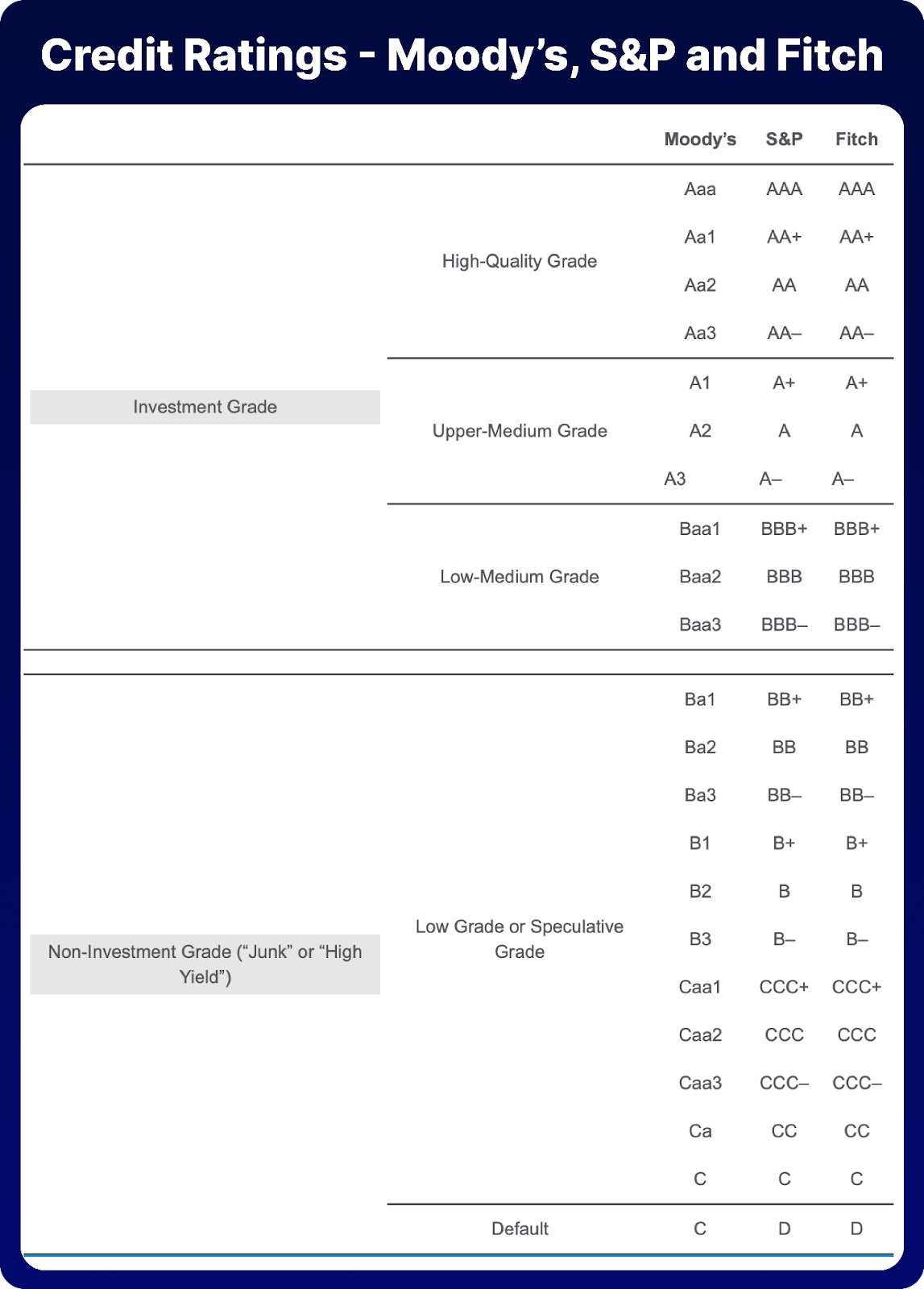
Credit ratings are generally expressed as letter grades, such as “AAA,” “BBB,” or “C.” Each rating corresponds to a level of credit risk and reliability. The specific rating scale may vary slightly between different credit rating agencies, but the core principles remain the same. The three major global credit rating agencies (CRAs) – Moody’s, S&P, and Fitch use similar, symbol-based ratings to assess a bond issue’s risk of default.

The chart given below ranks the long-term ratings of CRAs from highest to lowest.:
credit ratings table | marketfeed

Bonds with high-quality grade ratings are the safest and carry lower interest rates. On the other hand, low-grade or speculative-grade issues are the riskiest and carry high interest rates as they involve greater risk. Credit rating agencies assign default ratings to bonds that have defaulted on their payment obligations.

Moreover, rating agencies will typically provide outlooks on their respective ratings. The outlook can be positive, stable, or negative. They may also offer additional signals about the possible future direction of their ratings, like indicating that a bond is ‘On Review for Downgrade’ or ‘On Credit Watch for an Upgrade’.

What is Credit Risk?

Credit risk is the risk of loss resulting from the issuer’s failure to make full and timely payments of interest and/or principal. Credit risk has two components:

1. Default Risk/Default Probability: It is the probability that a borrower defaults. A borrower is said to be in default if they fail to make full and timely payment of principal and interest as per the terms of the debt security. 

2. Loss Severity: The second component is the loss severity in the event of default. It is the portion of a bond’s value (including unpaid interest) an investor loses. A default can lead to losses of various magnitudes.

You can summarize the credit risk of a security or issuer as the expected loss.

Expected loss = Default probability × Loss severity

You can express the expected loss either as a monetary amount (e.g., ₹4,50,000) or as a percentage of the principal amount (e.g., 45%).

What are Credit Rating Agencies?

Credit Rating Agencies (CRAs) are independent entities that assess and assign credit ratings to various debt issuers and their securities. These agencies provide valuable insights into the creditworthiness of governments, corporations, and other entities. 

CRAs are independent organisations, which means that they are separate from the entities they rate. These agencies must be independent to avoid conflict of interest. They evaluate the issuer based on various criteria and assign a credit rating. The rating symbols vary depending on the rating agency. Moody’s, Standard & Poor’s (S&P), Fitch Ratings, Credit CRISIL, CARE, and ICRA are among the top credit rating agencies.

Common Credit Rating Categories

Here are some of the common credit rating categories:

  1. Investment Grade:
    • AAA (or Aaa): The highest credit quality with the lowest risk of default.
    • AA (or Aa): High credit quality with a very low risk of default.
    • A: Good credit quality with a low risk of default.
    • BBB (or Baa): Adequate credit quality with a moderate risk of default.
  2. Speculative Grade (or Non-Investment Grade):
    • BB: Speculative credit quality with a moderate risk of default.
    • B: Highly speculative credit quality with a significant risk of default.
    • CCC: Substantial credit risk with a high risk of default.
    • D: In default or near default.

How Do CRAs Assign Credit Ratings?

Credit rating agencies evaluate both quantitative and qualitative aspects of borrowers, including:

  • Financial Statements: They review financial statements such as balance sheets, income statements, and cash flow statements to assess the financial health and stability of the borrower.
  • Credit History: CRAs analyse the credit history of individuals and the repayment history of corporations and governments to assess their ability to meet financial obligations.
  • Economic and Industry Factors: Agencies consider the broader economic environment and the specific industry or sector in which the borrower operates to understand the challenges and growth opportunities it may face.
  • Debt Structure: CRAs examine the structure of the borrower’s debt, including the types of debt securities issued and their terms to evaluate repayment capacity.
  • Market Conditions: Current market conditions and trends, including interest rates and inflation, are considered to assess potential risks.
  • Management and Governance: Credit rating agencies scrutinize the quality of management and governance practices of corporations to understand how effectively the entity is managed.

After analysing these factors, credit rating agencies assign a rating that reflects the borrower’s creditworthiness and likelihood of default. The specific rating categories can vary between agencies, but they generally follow a similar pattern.

How do Credit Ratings Affect Borrowing Costs?

Lenders and investors consider borrowers with higher credit ratings as less risky. As a result, they can access loans and credit at lower interest rates. Meanwhile, borrowers with lower credit ratings are considered riskier. So lenders charge higher interest rates to compensate for the increased risk. Entities with better credit ratings pay lower interest rates on their debt.

For example, a bond with an AAA rating will have lower interest rates, compared to a BBB-rated bond (if all other factors remain the same).

Why are Credit Ratings Important?

  • Risk Assessment: Credit ratings help investors and lenders assess the credit risk associated with a particular borrower. A higher credit rating indicates lower risk, while a lower rating suggests higher risk.
  • Pricing of Debt: Borrowers with better credit ratings can access credit (loans) at lower interest rates because they are considered less risky. Meanwhile, borrowers with lower ratings may face higher borrowing costs.
  • Investment Decisions: Investors, including individuals, mutual funds, and institutional investors, use credit ratings to make informed decisions about investing in debt securities. Investors often consider higher-rated securities as safer investments.
  • Regulatory Compliance: Many financial institutions and regulations require a minimum credit rating for certain types of investments or transactions to ensure a level of risk management.
  • Risk Diversification: Credit ratings help diversify risk in investment portfolios by allowing investors to allocate funds to securities with varying risk levels.

What are the Risks of Relying on Credit Ratings?

  • Credit rating agencies are paid by the companies and governments that they rate. This can create a conflict of interest, as the agencies may be incentivized to give higher ratings to their clients.
  • CRAs can make mistakes, and these mistakes can have a significant impact on investors. For example, in 2008, Standard & Poor’s gave high ratings to many mortgage-backed securities in the US that later defaulted. This led to billions of dollars in losses for investors.
  • These agencies are not required to disclose their rating methodologies. This makes it difficult for investors to assess the accuracy of their ratings.
  • Credit ratings tend to lag the market’s pricing of credit risk.

It’s important to note that investors should use credit ratings in combination with other factors, especially their own research & analysis, while making investment decisions.

In conclusion, credit ratings are essential tools in the financial world, providing a standardized way to assess credit risk and make informed investment and lending decisions. Whether you’re an investor looking to diversify your portfolio or a borrower seeking to access capital, understanding credit ratings is key to navigating the complex landscape of finance.

Categories
Market News Top 10 News

Tata Motors Secures Order for 1,300 CVs – Top Indian Market News

Tata Motors secures order for 1,300 CVs from VRL Logistics

Tata Motors has secured an order for 1,300 commercial vehicles (CVs) from VRL Logistics. The order comprises medium & heavy commercial vehicles (MHCV) and intermediate & light commercial vehicle (ILCV) range, which suit the logistics operations of VRL Logistics. The vehicles provide superior drivability, high fuel efficiency, and a low total cost of ownership.

Read more here.

NCLT approves Tata Steel Mining’s resolution plan for Rohit Ferro-Tech

The Kolkata bench of the National Company Law Tribunal (NCLT) has approved the resolution plan submitted by Tata Steel Mining Ltd (TSML) for the acquisition of debt-ridden Rohit Ferro-Tech Ltd. TSML is a wholly-owned subsidiary of Tata Steel. Tata Steel is also in the process to acquire Odisha-based Stork Ferro & Mineral Industries for Rs 155 crore. This move will augment the company’s ferro-alloys processing capacities.

Read more here.

Hester Biosciences gets Rs 60 crore grant from govt to make Covaxin drug substance

Hester Biosciences Ltd has received a grant of Rs 60 crores from the government’s Biotechnology Industry Research Assistance Council (BIRAC) to manufacture Covid-19 vaccine under Mission Covid Suraksha. The Ahmedabad-based poultry and animal vaccine maker is a part of the Gujarat Covid Vaccine Consortium (GCVC). In May 2021, GCVC signed an agreement with Bharat Biotech for manufacturing Covaxin drug substance.

Read more here.

Bank of Maharashtra to divest entire 4% stake in ISARC

Bank of Maharashtra will divest its entire stake in India SME Asset Reconstruction Company (ISARC) for Rs 4 crore. The bank’s 4% stake, equivalent to 40 lakh equity shares, will be sold at Rs 9.80 per share for a cash consideration of Rs 3.92 crore. The transaction is expected to be completed by the end of December 2022.

Read more here.

Lupin launches generic contraceptive drug in the US

Lupin Limited has launched Merzee capsules, a medication used to prevent pregnancy, in the US market. The product was launched under an exclusive license, marketing, and distribution agreement with Slayback Pharma LLC. As per IQVIA data, the generic version of the drug had estimated annual sales of $90 million (~Rs 685 crore) in the US during the 12 months ended February 2022.

In other news, Lupin has completed the acquisition of a portfolio of brands from Anglo-French Drugs & Industries Ltd (AFDIL) and its associates. The acquisition will strengthen the company’s India formulation business.

Read more here.

Axis Bank signs partial guarantee pact with ADB to support supply chain financing

Axis Bank has partnered with Asian Development Bank (ADB) for a partial guarantee program with an initial outlay of $150 million (~Rs 1,139.85 crore). The program is aimed at supporting supply chain financing for impact sectors. ADB will provide guarantees for the loans issued by Axis Bank. It will have a special focus on environmental, social, and governance (ESG) and priority sectors. 

Read more here.

Domestic pharma industry revenues to grow by 6-8% in FY23: ICRA

According to rating firm ICRA, the revenues of leading domestic pharma companies are likely to grow by 6-8% in the current financial year (FY23). Sales growth in FY23 is expected to be supported by a growth of 7-9% in the domestic market, 12-14% in the emerging markets, and 7-9% in the European business. Meanwhile, growth in the US business is expected to remain muted due to a subdued pricing environment in the market in the near to mid-term.

Read more here.

L&T Construction secures contracts under various businesses

Larsen & Toubro Ltd’s construction arm has secured significant orders (in the range of Rs 1,000-2,500 crore) under various businesses. The Water & Effluent Treatment business has bagged a contract from the Rural Drinking Water & Sanitation Division, Karnataka, to construct drinking water supply facilities for 396 rural habitations in Dharwad and Belagavi. L&T GeoStructure has received an order from Tata Chemicals to commission a jetty-based marine outfall system and allied works in Gujarat.

Read more here.

Godrej Consumer gains market share in 85% of its categories 

Godrej Consumer Products Ltd (GCPL) said it has been gaining market share in 85% of its categories despite the Indian FMCG industry witnessing a consumption slowdown over the past few months. “In India, we expect to deliver close to double-digit sales growth, driven entirely by pricing. Our 2-year [sales] CAGR would be in the early twenties. We witnessed a mixed performance in our Personal Care and Home Care categories,” said GCPL in an exchange filing. 

Read more here.

Motherson Sumi completes acquisition of 55% stake in CIM Tools

Motherson Sumi Systems Ltd (MSSL) has completed the acquisition of a majority stake in Bengaluru-based CIM Tools Private Ltd. In October 2021, MSSL had announced the acquisition of a 55% stake in CIM, a leading supplier in the aerospace supply chain. This acquisition marks MSSL’s entry into the aerospace industry. It also provides access to an existing and well-established customer base.

Read more here.

Invesco divests 7.8% stake in ZEEL

Invesco Developing Market Funds sold a 7.8% stake in Zee Entertainment Enterprises Ltd (ZEEL) via a block deal today. It will sell 7.74 crore shares, which are worth around Rs 2,200 crore. Invesco will continue to hold an 11% stake in ZEEL. To learn more about ZEEL’s boardroom battle, click here.

Read more here.

Bandhan-led consortium to acquire IDFC Mutual Fund biz for Rs 4,500 crore

IDFC Ltd has decided to sell IDFC Asset Management Company and IDFC AMC Trustee Company Ltd to a consortium comprising Bandhan Financial Holdings (BFHL), GIC, and ChrysCapital for Rs 4,500 crore. IDFC AMC manages over Rs 1.15 lakh crore of assets under management (AUM) as of FY22. It has a presence in over 50 cities and investors in 750 cities and towns nationwide.

Read more here.

Categories
Editorial

Company Analysis: CRISIL Limited, an S&P Global Company

In India, when we go through the content on bonds, shares, and how they are rated, CRISIL comes as a common name. CRISIL Limited is an Indian analytical company providing ratings, research, and risk and policy advisory services. It is listed on both NSE and BSE. It is owned by a quite popular American financial giant, S&P Global

In this piece, I shall take you through the company’s business model, its recent financials, and the future prospects of the company.

Business Model

  • CRISIL Limited is a Credit Rating Agency(CRA). The role of a credit rating agency is to ‘rate’ or rank securities like bonds, shares, debt instruments, etc. based on their risk and ability to pay back its investors. Based on the ratings, investors can get an insight into the risk factor of the security they are investing in. Bond issuing companies can even decide the price of the bond or interest they pay based on the rating that the bond gets. It is recommended that you go through a piece we did at market feed on How Credit Rating Agencies In India Earn Money’. 
  • Before we move any further, let me summarize the Credit Rating Industry for you. The industry is an oligopoly. This means that there are barely 4-5 established CRAs in India. It is virtually impossible to compete against these giants. Most of these giants are owned by the ‘Big Three’ credit rating agencies. Those are S&P Global, Moody’s, and Fitch Ratings. 
  • The company isn’t limited to just its India operations. The company receives most of its business from North America and a major chunk of it from Europe as well. 
  • CRISIL, just like any other CRA, makes money through three segments. Ratings, Research and Advisory. Looking at the revenue mix it is clear that CRISIL earns most (~63%) of its revenue from its Research business followed by Ratings and the Advisory.

Rating Business 

The cash flow over here comes from two places, Bonds and Bank Loan Ratings. It is mandated by SEBI that every company issuing bonds must be rated by at least one of the Credit Rating Agencies in India. Additionally, whenever a big company borrows money from a bank, the bank assigns the task of rating the borrower company to a CRA, in our case, CRISIL. CRISIL owns close to ~68% of market space in the Rating business. When more bonds are issued, and more companies start borrowing money fuelling banking credit in the economy, CRISIL eventually ends up making money. In India, Banking credit has grown by ~6.2% CAGR and bonds issuances by ~9.35% CAGR, both over a period of 5 years. In the past year, the bond market has increased by 8% YoY, despite a stressful year for businesses. 

Research Business

CRISIL allots maximum capital to this segment. In the quarter ended March 2021, CRISIL allotted ~Rs 642 crore against ~Rs 78 crore and ~Rs 89 crore to the Advisory and Rating segment respectively. 

The Research segment doesn’t require much elaboration. Most decisions taken in the market are based on research. Research requires data, the data is then analyzed, and a conclusion is reached. Gross Revenue from Research business has grown by 14.2% CAGR  over the past 5 years. The company acquired a US-based research and analytics company Greenwich Associates and its subsidiaries for $40 million or Rs 296 crore. This was a major addition to the segment. What makes this segment unique is that it isn’t impacted by the cyclicity of the market. In the financial world, whether the market is down or up, the demand for a good research report never ends. 

Advisory Business

CRISIL provides advisory services in s in areas of regulatory reporting, credit risk, and select city infrastructure projects. The advisory business of CRISIL is picking up. CRISIL’s advisory services see great potential growth since they have access to lots of data and research material. This gives them an edge when it comes to giving the right business advice. Even though the contribution to the revenue segment is small, one can expect it to grow in the future. 

Financial Vitals

.Q4 2020Q3 2020Q4 2019
Revenue508.65612.2462.6
Net Profit83.511088.1
All Amount in Rs Crores
  • In the above-given chart, we can clearly see that the revenue of the company is increasing steadily, but the profit margin isn’t responding to the rise in revenue. Apparently, CRISIL is unable to trim down on its expenses.
  • Coming to CRISIL’s expenses, more than 65% of it goes into paying for the salaries and benefits of its employees. Another sizable chunk goes in availing ‘Professional Services’ from third parties. CRISIL can utilize its capital more efficiently. In a world of automation and artificial intelligence, maybe it’s time to upgrade its technology. 
  • The stock seems to have gained quite some traction in the past one month more than other months. CRISIL stock has gained ~36% in the past month and ~76% in the past year. The stock traded pretty much sideways for quite a few months before ‘freeriding’ the bull run post the COVID-19 lockdown.  

The Big Picture

In the chart give above, we get a clear picture of CRISIL’s financial efficiency. All vital ratios like Return on Equity %, Return On Capital Employed %, Net Profit Margin Annual % have declined over the past decade, yet CRISIL’s stock seems to have rallied more than 36.66% over  Despite this, CRISIL seems to be rallying over the past month. 

CRISIL stock happens to be in ace-investor Rakesh Jhunjhunwala’s portfolio, the stock seems to have gained a special interest from Foreign Investors and Mutual Fund in the past month. A breakout from a long-borne consolidation spiked interest in retail traders that could have probably caused the breakout. From the data given above, we can concur that the rally isn’t supported by the company’s financials and could possibly be a short-lived one. Another possibility could be that the company turns around its financials in the coming quarter and the quarterly results become supportive of the rally. 

Categories
Editorial

How Credit Rating Agencies In India Earn Money

Credit Rating Agencies(CRAs) are generally privately-owned entities that do the job of rating securities like bonds, debentures, shares, and other instruments. Believe it or not, but Credit Rating Agencies(CRAs) seem to be running the show globally. 

Standard and Poor(S&P), Moody’s, and Fitch group are known as the ‘Big Three’ and own close to 80% in the international credit rating. Each of the three has a setup in India, that is:

  • CRISIL, an S&P Global Company
  • India Ratings(Ind-Ra), a wholly-owned subsidiary of Fitch Ratings 
  • ICRA, a subsidiary of Moody’s 
  • CARE, not owned by either of the Big Three. 

CARE, CRISIL, and ICRA are listed on National Stock Exchange(NSE) and Bombay Stock Exchange(BSE). 

CRAs have been controversial for almost half a century. They have been deemed responsible for a few of the many financial or industry crises throughout history; Penn Central Rail Road Crisis and the infamous 2008 Housing Market Crisis to name a few. In India, the IL&FS crisis is said to have taken place due to improper credit ratings. 

In this piece, we explore how credit rating agencies make money, what is so special about them and how they perform on Dalal Street. 

The Business Model 

Broadly speaking, a CRA has three sources of revenue:

  • Ratings
  • Research
  • Advisory

Ratings

Every time a company issues a bond, it has to get rated by a CRA as per norms set by regulatory agencies globally. Based on risk and credit analysis, credit ratings of bonds range from AAA(+/-), AA(+/-), A(+/-) to………. CCC, CC, C D. AAA is considered as the highest grade, and D is considered the lowest grade. If a bond is rated higher, generally it shall receive more buyers in the market since it is less risky. If the bond is rated lower, it shall be deemed risky and generally receive fewer holders. 

Every time a company issues a bond, it has to get the bond rated for a price. The rating markets follow the more popular ‘Issuer-Pays Model’ where the issuer or the company issuing the bond pays the CRA to get itself rated. This wasn’t always the case though, 

In the 1970s, there was an ‘Investor-Pays Model’ that lost popularity over time, where the buyer of the bond had to actually pay the CRA to access the ratings. 

Another major source of income for CRAs is Bank Loan Ratings. Every time a company or an individual borrows money from a bank, a Credit Rating Agency has to rate the borrower based on several factors. Bank refers to the credit report before granting a loan. 

Apart from bonds and loans, CRAs have to rate MSMEs, companies, other debt instruments, shares and even the economy of countries. All of these contribute to the revenue stream. 

Research

If you have ever gone through a Red Herring Prospectus(RHP) or a report a company files before an IPO, chances are that the report contains research done by a CRA. Banks, companies, and even governments hire credit rating agencies to conduct research on a requirement basis. Sometimes CRAs release reports in the public domain for marketing and maintains their position and reputation in the market. 

There have been instances where CRAs have released a negative outlook towards a company or a sector its share price fell on the stock markets. This is how important a research report by a CRA is. A research report by an established CRA gives a clear picture to investors as well as organizations to make well-informed decisions. 

Advisory

CRAs have all the data they need in the world. This gives them a better insight into global markets than many businesses. This is why businesses even avail advisory services offered by CRAs. This is done on a contractual basis for the necessary period.

Credit Rating Agencies As An Investment Option

Credit Rating Agencies despite running the show haven’t been running up themselves when it comes to investor returns. Their stocks have caught up only in the past year because of the bull run seen in the Indian markets. Even there, the stocks of ICRA, CRISIL and CARE ratings have barely managed to beat the NIFTY 50 benchmark index. Coming to return on investment for the past one year, CRISIL has returned ~76%, CARE Ratings returned ~69% and ICRA returned ~29%. Even here, the shares did not spike up in one go, rather they moved up in a consolidated manner over a period of time. 

The Revenue and Net Profit of CRAs haven’t been consistent for the past three years. This is since CRAs aren’t selling a straightforward product. They are selling an opinion. If their customer doesn’t like it, they can always move on to the rival CRA and get a better rating.

The Big Picture  

In 2008, there was a global financial crisis. It all started when CRAs gave a higher rating to bonds with a poor asset or credit quality. They were bribed/incentivized to do so. Yet, there was no action taken against them even after a global downturn.

In India, something similar happened during the IL&FS crisis in 2016. CRAs gave the now failed IL&FS securities a good rating despite knowing of poor asset quality and financial condition of the company. IL&FS did not pay back the money it had borrowed from banks and lenders. Finally, it led to a major credit crunch in the system where banks and financial services companies were hesitant to lend money and the economy remains affected by it even in 2021.

The sector runs in an Oligopoly. Apart from the Big Three, there are only a few independent CRAs, this means that only a few entities get all the business. Barriers to entering the market are high and opportunities are less. Even if the CRAs play foul, SEBI can atmost fine them as they did in the IL&FS crisis in 2016. 

In popular opinion, there is rising support for the ‘Regulator Pays Model’ for CRAs where market regulators like SEBI(India) or SEC(USA) would pay the credit rating agencies to rate bonds. The benefit of it could be that CRAs would not play foul or give false ratings to companies. The disadvantage could be that the reports of the CRAs could be influenced by the opinions of the ruling majority or the government. 

How do you think we can solve the loopholes in the credit rating industry? What are the growth opportunities for them? Let us know in the comment section in the marketfeed app available on Android and iOS.