Categories
Jargons

What are Credit Ratings? Why Do We Need Them?

Credit ratings play an important role in the world of finance. It indicates the safety or risks associated with different securities (stocks, fixed-income securities like bonds, etc.) and their issuers. It provides crucial insights into the world of investments. In this article, we will discover what credit ratings are, how they work, and their role in the financial markets. We will also explore the different credit rating agencies and their credit ratings.

What are Credit Ratings?

A credit rating is an assessment of the creditworthiness of a borrower, whether it’s an individual, a corporation, or a government.  It is a symbol assigned to a security or issuer that represents its creditworthiness or safety. Credit rating agencies (CRAs) are responsible for assigning these ratings. Their primary goal is to provide a standardised evaluation of credit risk, which allows lenders and investors to make informed decisions regarding lending or investing in debt securities.

Credit ratings are generally expressed as letter grades, such as “AAA,” “BBB,” or “C.” Each rating corresponds to a level of credit risk and reliability. The specific rating scale may vary slightly between different credit rating agencies, but the core principles remain the same. The three major global credit rating agencies (CRAs) – Moody’s, S&P, and Fitch use similar, symbol-based ratings to assess a bond issue’s risk of default.

The chart given below ranks the long-term ratings of CRAs from highest to lowest.:
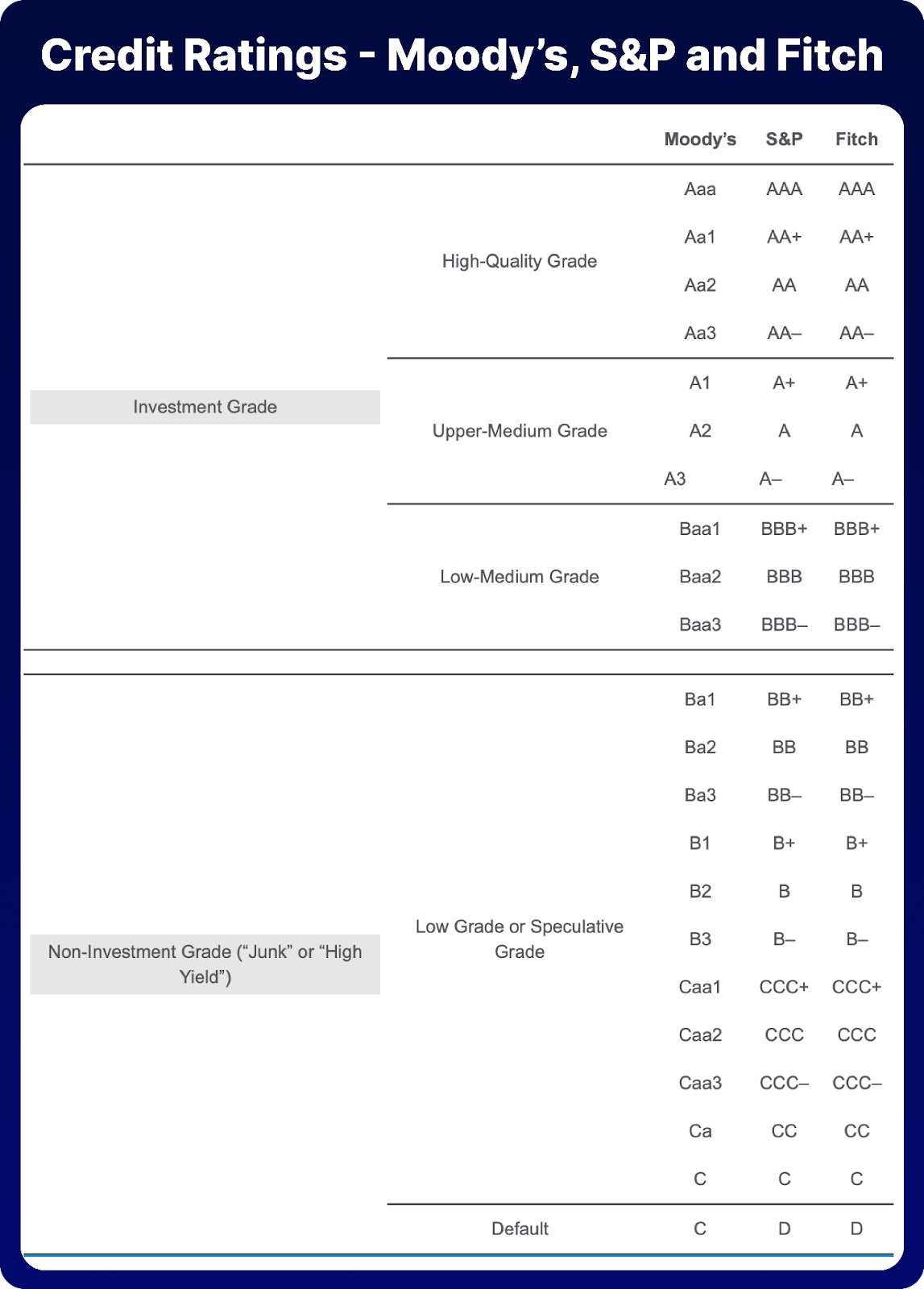
credit ratings table | marketfeed

Bonds with high-quality grade ratings are the safest and carry lower interest rates. On the other hand, low-grade or speculative-grade issues are the riskiest and carry high interest rates as they involve greater risk. Credit rating agencies assign default ratings to bonds that have defaulted on their payment obligations.

Moreover, rating agencies will typically provide outlooks on their respective ratings. The outlook can be positive, stable, or negative. They may also offer additional signals about the possible future direction of their ratings, like indicating that a bond is ‘On Review for Downgrade’ or ‘On Credit Watch for an Upgrade’.

What is Credit Risk?

Credit risk is the risk of loss resulting from the issuer’s failure to make full and timely payments of interest and/or principal. Credit risk has two components:

1. Default Risk/Default Probability: It is the probability that a borrower defaults. A borrower is said to be in default if they fail to make full and timely payment of principal and interest as per the terms of the debt security. 

2. Loss Severity: The second component is the loss severity in the event of default. It is the portion of a bond’s value (including unpaid interest) an investor loses. A default can lead to losses of various magnitudes.

You can summarize the credit risk of a security or issuer as the expected loss.

Expected loss = Default probability × Loss severity

You can express the expected loss either as a monetary amount (e.g., ₹4,50,000) or as a percentage of the principal amount (e.g., 45%).

What are Credit Rating Agencies?

Credit Rating Agencies (CRAs) are independent entities that assess and assign credit ratings to various debt issuers and their securities. These agencies provide valuable insights into the creditworthiness of governments, corporations, and other entities. 

CRAs are independent organisations, which means that they are separate from the entities they rate. These agencies must be independent to avoid conflict of interest. They evaluate the issuer based on various criteria and assign a credit rating. The rating symbols vary depending on the rating agency. Moody’s, Standard & Poor’s (S&P), Fitch Ratings, Credit CRISIL, CARE, and ICRA are among the top credit rating agencies.

Common Credit Rating Categories

Here are some of the common credit rating categories:

  1. Investment Grade:
    • AAA (or Aaa): The highest credit quality with the lowest risk of default.
    • AA (or Aa): High credit quality with a very low risk of default.
    • A: Good credit quality with a low risk of default.
    • BBB (or Baa): Adequate credit quality with a moderate risk of default.
  2. Speculative Grade (or Non-Investment Grade):
    • BB: Speculative credit quality with a moderate risk of default.
    • B: Highly speculative credit quality with a significant risk of default.
    • CCC: Substantial credit risk with a high risk of default.
    • D: In default or near default.

How Do CRAs Assign Credit Ratings?

Credit rating agencies evaluate both quantitative and qualitative aspects of borrowers, including:

  • Financial Statements: They review financial statements such as balance sheets, income statements, and cash flow statements to assess the financial health and stability of the borrower.
  • Credit History: CRAs analyse the credit history of individuals and the repayment history of corporations and governments to assess their ability to meet financial obligations.
  • Economic and Industry Factors: Agencies consider the broader economic environment and the specific industry or sector in which the borrower operates to understand the challenges and growth opportunities it may face.
  • Debt Structure: CRAs examine the structure of the borrower’s debt, including the types of debt securities issued and their terms to evaluate repayment capacity.
  • Market Conditions: Current market conditions and trends, including interest rates and inflation, are considered to assess potential risks.
  • Management and Governance: Credit rating agencies scrutinize the quality of management and governance practices of corporations to understand how effectively the entity is managed.

After analysing these factors, credit rating agencies assign a rating that reflects the borrower’s creditworthiness and likelihood of default. The specific rating categories can vary between agencies, but they generally follow a similar pattern.

How do Credit Ratings Affect Borrowing Costs?

Lenders and investors consider borrowers with higher credit ratings as less risky. As a result, they can access loans and credit at lower interest rates. Meanwhile, borrowers with lower credit ratings are considered riskier. So lenders charge higher interest rates to compensate for the increased risk. Entities with better credit ratings pay lower interest rates on their debt.

For example, a bond with an AAA rating will have lower interest rates, compared to a BBB-rated bond (if all other factors remain the same).

Why are Credit Ratings Important?

  • Risk Assessment: Credit ratings help investors and lenders assess the credit risk associated with a particular borrower. A higher credit rating indicates lower risk, while a lower rating suggests higher risk.
  • Pricing of Debt: Borrowers with better credit ratings can access credit (loans) at lower interest rates because they are considered less risky. Meanwhile, borrowers with lower ratings may face higher borrowing costs.
  • Investment Decisions: Investors, including individuals, mutual funds, and institutional investors, use credit ratings to make informed decisions about investing in debt securities. Investors often consider higher-rated securities as safer investments.
  • Regulatory Compliance: Many financial institutions and regulations require a minimum credit rating for certain types of investments or transactions to ensure a level of risk management.
  • Risk Diversification: Credit ratings help diversify risk in investment portfolios by allowing investors to allocate funds to securities with varying risk levels.

What are the Risks of Relying on Credit Ratings?

  • Credit rating agencies are paid by the companies and governments that they rate. This can create a conflict of interest, as the agencies may be incentivized to give higher ratings to their clients.
  • CRAs can make mistakes, and these mistakes can have a significant impact on investors. For example, in 2008, Standard & Poor’s gave high ratings to many mortgage-backed securities in the US that later defaulted. This led to billions of dollars in losses for investors.
  • These agencies are not required to disclose their rating methodologies. This makes it difficult for investors to assess the accuracy of their ratings.
  • Credit ratings tend to lag the market’s pricing of credit risk.

It’s important to note that investors should use credit ratings in combination with other factors, especially their own research & analysis, while making investment decisions.

In conclusion, credit ratings are essential tools in the financial world, providing a standardized way to assess credit risk and make informed investment and lending decisions. Whether you’re an investor looking to diversify your portfolio or a borrower seeking to access capital, understanding credit ratings is key to navigating the complex landscape of finance.

Categories
Market News Top 10 News

India’s GDP Growth Slows to 4.4% in Q3 – Top Indian Market Updates

Here are some of the major updates that could move the markets tomorrow:

India’s GDP growth slows to 4.4% in Q3

India’s gross domestic product (GDP) for the October-December quarter (Q3 FY23) slowed down to 4.4%. The GDP had moderated to 6.3% in Q2 from 13.5% in Q1. GDP at Constant (2011-12) prices in Q3 2022-23 is estimated at ₹40.19 lakh crore in Q3, as against ₹38.51 lakh crore in Q3 2021-22. The Indian economy is expected to grow at 7% in FY23.

Read more here.

Geological Survey of India finds Gold Deposits in Odisha

Surveys from the Geological Survey of India (GSI) have found gold deposits in three districts of Odisha. State Steel and Mines Minister Prafulla Mallik said that the gold reserves were found in Deogarh, Keonjhar and Mayurbhanj.

Read more here.

SBI enters social loan market

State Bank of India has concluded a landmark $1 billion (~₹8,200 crore) syndicated social loan, making it the largest Environmental, Social, and Governance (ESG) loan raised by a commercial bank in the Asia Pacific market. The loan is of $500 million of the primary issue and an equal amount in greenshoe (or overallotment) option. It is also the first issue of such kind from the bank. 

Read more here.

IDFC, Federal Bank partner with Sa-Dhan on UPI123PAY

IDFC First and Federal Bank will partner with association of microfinance institutions Sa-Dhan and Delhi-based fintech solutions provider NextGen to promote digital payments by feature phone users. The banks will help in developing a new payment and collection system by using feature phones with the technological intervention being provided by them.

Read more here

India approves $3.9 billion hydropower project near China border

India has approved its largest-ever hydropower project in the mountainous northeastern region bordering China as it seeks to build renewable generation to meet rising power demand. The govt approved the estimated investment of $3.9 billion for the 2,880-megawatt Dibang project in Arunachal Pradesh. The project is estimated to take nine years to build.

Read more here.

India’s passenger vehicle sales to grow 9-10% in 2024: CRISIL

Rating agency CRISIL has forecast that India’s passenger vehicle sales are expected to grow about 9-10% in the next financial year (FY24), which is 20% more than the pre-pandemic levels. The forecast is owed to strong demand and easing chip shortages. India is currently the world’s fourth-largest car market.

Read more here.

Zydus Lifesciences receives USFDA approval to market generic drug

Zydus Lifesciences has received approval from the US Food & Drug Administration (USFDA) to market Apixaban tablets. The drug blocks the activity of certain clotting substances in the blood. It is used to lower the risk of stroke or a blood clot in people with a heart rhythm disorder called atrial fibrillation.

Read more here.

Indian Bank ties up with Toyota Kirloskar Motor to offer vehicle financing

Indian Bank has signed a pact with automaker Toyota Kirloskar Motor to offer vehicle financing options to its customers. The tie-up would offer various initiatives including 90% on-road funding with no processing fee, foreclosure, and party payment charges to prospective customers.

Read more here.

Bharti Airtel outpaces Jio in revenue market share growth in Q3

For the second time in a row, Bharti Airtel has grabbed more revenue market share (RMS) than Reliance Jio Infocomm in the third quarter of FY23. This is mainly due to the sharp hike in base prepaid rates Airtel took last November in Odisha and Haryana along with share gains in rural markets. Loss-making Vodafone Idea (Vi) continued to lose RMS share in Q3.

Read more here.

PNC Infratech bags ₹771 crore railway project in Haryana

PNC Infratech has secured a ₹771.46 crore railway project from the Haryana Orbital Rail Corporation Ltd. The scope of work includes construction design and construction of civil works at Sultanpur station in connection with the laying of a new double railway line. The construction is to be completed in 30 months.

Read more here.

MRF raises ₹150 crore through NCDs via private placement

MRF Ltd has raised ₹150 crore via non-convertible debentures (NCDs) on a private placement basis. The NCDs have been listed on the debt segment of the National Stock Exchange of India with effect from February 2023. The date of maturity of these debentures is February 24, 2026.

Read more here.

Categories
Market News Top 10 News

Advent Buys Significant Stake in Suven Pharma – Top Indian Market Updates

Here are some of the major updates that could move the markets tomorrow:

Advent International acquires significant stake in Suven Pharma

Global private equity investor Advent International has entered into a definitive agreement to acquire a 50.1% stake in Suven Pharmaceuticals Ltd from the Jasti family (promoters) for ₹6,313 crore. Advent will also launch an open offer to acquire an additional 26% of the pharma company. The total deal size would add up to ₹9,589 crore. After the acquisition, Advent intends to explore the merger of its portfolio company Cohance Lifesciences with Suven Pharma.

Read more here.

Central Bank of India to raise up to ₹1,500 crore in FY23

Central Bank of India’s board has approved a proposal to raise up to ₹1,500 crore this financial year (FY23) by issuing Basel III compliant bonds. The base issue size is ₹500 crore with a greenshoe option of up to ₹1,000 crore. Under the Basel-III capital regulations, banks globally need to improve and strengthen their capital planning processes.

Read more here.

Electronics industry push for tax rationalisation in Union Budget 2023

The Indian electronics industry wants the government to rationalise tariffs and remove small tariffs of 2.75% on parts and components of mobile phones, sub-assemblies, and mechanics. They want the Centre to reduce Goods & Services Tax (GST) from 18% to 12%. India Cellular and Electronics Association (ICEA) also wants the 20% basic customs duty on high-end phones to be pegged at ₹4,000 per device. This measure could limit the smuggling of high-end phones, which ICEA said will add ₹1,000 crore to the GST collection.

Read more here.

Agrochemical players likely to see 15-17% growth this fiscal: CRISIL

According to a report from CRISIL Ratings, agrochemical players will grow at 15-17% in FY23, primarily driven by continued strong exports and stable domestic demand. Major agrochemical firms registered a stellar 23% growth in FY22. Their revenue could further grow by 10-12% next financial year as India continues to benefit from the China+1 strategy of global players.

Read more here.

Alembic Pharma gets USFDA approval for Fulvestrant injection

Alembic Pharmaceuticals Ltd has received final approval from the US Food & Drug Administration (USFDA) for its generic Fulvestrant injection. The drug is used in the treatment of breast cancer. As per IQVIA data, Fulvestrant injection had an estimated market size of $71 million for the 12 months ended September 2022.

Read more here.

Godrej Properties acquires 62-acre land in Kurukshetra

Godrej Properties Ltd (GPL) has acquired nearly 62 acres of land in Kurukshetra, Haryana, to develop 1.4 million sq. ft. of plotted residential development. Kurukshetra is a self-sufficient city with good infrastructure consisting of schools, colleges, and hospitals. It also has significant historical and religious importance. GPL has been acquiring land in the National Capital Region (NCR) and peripheral areas to expand its presence.

Read more here.

Noida authority directs DLF to pay ₹235 crore for Mall of India land

Noida authority has issued a notice to realty developer DLF, asking it to pay ₹235 crore within 15 days for the dispute related to the land of Mall of India (the biggest mall in the country). The move has come after the Supreme Court ordered the Noida authority to pay ₹295 crore to Veerana Reddy. The authority acquired the land from Veerana Reddy in 2005 and later auctioned it to DLF, who developed the mall there.

Read more here.

Jet Airways pilots, cabin crew exit amid relaunch uncertainty

According to a CNBV-TV18 report, many standby pilots and cabin crew of Jet Airways have exited amid relaunch uncertainty. The report further states that the vice president of in-flight service has been sent on leave, while the salaries of CEO Sanjiv Kapoor and CFO Vipula Gunatilleka have been reduced. Earlier, Bloomberg reported that lenders to Jet Airways are resisting a court-approved resolution plan, further delaying the private airline’s relaunch.

Read more here.

Welspun Enterprises to receive ₹2,339 crore in first close of road asset sale

Welspun Enterprises Ltd. will receive about ₹2,339 crore from the first closing of the sale of six road assets to Actis Highway Infra Ltd., said Managing Director Sandeep Garg. “The enterprise value for the transaction is somewhere in the range of ₹9,049 crore, out of which approx. Rs 3,000 crore were received by us during the construction phase from the client,” he added. The five projects are the Welspun Delhi-Meerut Expressway, Welspun Road Infra, MBL (CGRG) Road, MBL Road Ltd., and Chikhali Tarsod Highways.

Read more here.

Infibeam Avenues receives RBI approval for Bharat Bill Payment licence

Infibeam Avenues Ltd has received a Perpetual Licence from the Reserve Bank of India (RBI) for its bill payments business, BillAvenue. The licence will allow BillAvenue to function as a Bharat Bill Payment Operating Unit (BBPOU) under Bharat Bill Payment System (BBPS). The licence will help the company offer secure and uninterrupted services to 18,000+ billers, agent institutions and a network of ten lakh agents spread across 2,000 cities and towns in India.

Read more here.

Air India Express, AirAsia India exploring synergies ahead of merger

Air India Express and AirAsia India (which has changed its name to AIX Connect) are exploring synergies in terms of having unified customer touchpoints ahead of their proposed merger. An operational review process is underway to integrate budget carrier AirAsia India with Air India Express, and the merger is likely to be completed by the end of 2023. Post-merger, the entity will be branded as Air India Express.

Read more here.

Categories
Market News Top 10 News

Asian Paints Reports 161% YoY Jump in Net Profit in Q1 – Top Indian Market News

Asian Paints Q1 Results: Net profit jumps 161% YoY to Rs 574 crore

Asian Paints Ltd reported a 161.5% year-on-year (YoY) jump in consolidated net profit to Rs 574.3 crore for the quarter ended March (Q1 FY22). Its revenue from operations rose 91.1% YoY to Rs 5,585.4 crore during the same period. Revenue from its paints segment grew 90.4% YoY to Rs 5,464.7 crore in Q1. A steep rise in the prices of raw materials impacted Asian Paints’ margins across all business segments.

Read more here.

Infosys opens digital tech and innovation center in Germany for auto sector

Infosys Limited has set up an Automotive Digital Technology and Innovation Centre in Stuttgart, Germany. As part of the IT company’s partnership with Daimler, automotive IT infrastructure experts based in Germany will transition from Daimler AG to the new innovation centre. Infosys will support Daimler AG to strengthen its IT and data centre infrastructure and drive a competitive edge.

Read more here.

Bajaj Finance Q1 Results: Net profit rises 4% YoY to Rs 1,002 crore

Bajaj Finance Ltd reported a 4.17% YoY increase in consolidated net profit to Rs 1,002.44 crore for the quarter ended June (Q1 FY22). Net profit has declined by 25.56% when compared to the previous quarter. The net interest income (NII) rose 8% YoY to Rs 4,489 crore during the same period. The gross non-performing assets (GNPA) ratio stood at 2.96% in Q1 FY22, compared to 1.79% in Q4 FY21. Bajaj Finance’s assets under management (AUM) grew by 15% YoY to Rs 1.59 lakh crore in Q1.  

Read more here.

Wipro to invest $1 billion over next three years to expand cloud transformation capabilities

Wipro Limited has announced plans to invest $1 billion (~Rs 7,465 crore) over the next three years to build capabilities around cloud technologies. The IT company has launched ‘Wipro FullStride Cloud Services’, a portfolio of services that will help them offer comprehensive cloud transformation capabilities to its customers. The strategic investment and launch are in line with the consistent growth Wipro has witnessed in its cloud business. 

Read more here.

JSW Energy energy to invest Rs 3,000 crore to set up windmills in Tamil Nadu

JSW Energy Ltd has signed an investment agreement worth Rs 3,000 crore with the Tamil Nadu government to set up windmills across the state. The company will establish windmills at Thoothukudi, Tirunelveli, and Tirupur districts. The project will create employment opportunities for more than 600 people.

Read more here.

DCM Shriram Q1 Results: Net profit jumps two-fold to Rs 158 crore

DCM Shriram Ltd reported a 124.68% YoY jump in consolidated net profit to Rs 157.5 crore for the quarter ended June (Q1 FY22). Net profit has declined by 31.9% when compared to the previous quarter. Its total income rose 4.47% YoY to Rs 2,205.11 crore during the same period. DCM Shriram is engaged in the manufacturing of sugar, fertilisers, chloro-vinyl, and bio-seeds.   

Read more here.

Tatva Chintan IPO subscribed 180.36 times on final day of bidding 

The Rs 500 crore initial public offering (IPO) of Tatva Chintan Pharma Chem Ltd was subscribed 180.36 times on the final day of bidding. The IPO received bids for 58.82 crore equity shares against the issue size of 32.61 lakh shares. Retail investors have subscribed 35.35 times against their reserved portion. Non Institutional investors (NIIs) and Qualified Institutional Buyers (QIBs) have subscribed 512.22 times and 185.23 times, respectively, against their reserved portions. To learn more about the IPO, click here.

CRISIL Q1 Results: Net profit rises 51% YoY to Rs 100 crore

CRISIL Limited reported a 51.9% YoY increase in consolidated net profit to Rs 100.8 crore for the quarter ended June (Q1 FY22). Its revenue from operations rose 12% YoY to Rs 528.5 crore during the same period. The company’s board has declared an interim dividend of Rs 8 per share. Revenue from its research segment and advisory segment grew 20.2% YoY and 14% YoY, respectively, in Q1. To learn more about CRISIL, click here.

Isgec Heavy Engineering secures order from Russian firm

Isgec Heavy Engineering has secured a significant order from one of the world’s most prominent soda ash manufacturing companies based in Russia. The order is for two sets of carbonation columns, one set of gas scrubber columns, and a set of distillation columns. The broad scope of the order includes casting, machining, hydro-testing, and painting. Noida-based Isgec Heavy Engineering is a diversified heavy engineering company engaged in manufacturing and project businesses.

Read more here.

Shyam Metalics Q1 Results: Net profit jumps 470% YoY to Rs 458 crore

Shyam Metalics and Energy Ltd reported a 470.4% YoY jump in consolidated net profit to Rs 457.98 crore for the quarter ended June (Q1 FY22). Net profit has increased by 18.2% when compared to the previous quarter. Its revenue from operations rose 170% YoY to Rs 2,464 crore during the same period. The company posted strong volume growth of ~37% in Q1. Shyam Metalics and Energy’s shares were listed on the stock exchanges on June 24.

Read more here.

NTPC emerges winner for 450 MW solar capacity at Rewa

The renewables arm of NTPC Limited has emerged as the winner at the Rewa Ultra Mega Solar Ltd auction for 450 megawatts (MW) of solar projects at the Shajapur Solar Park in Madhya Pradesh. NTPC Renewable Energy won a capacity of 105 MW and 200 MW by quoting the lowest tariff of Rs 2.35 per kilowatt-hour (kWh) and 2.33 per kWh, respectively. NTPC aims to build 60 gigawatts (GW) of renewable energy capacity by 2032.

Read more here.

IOC to build India’s first green hydrogen plant

Indian Oil Corporation (IOC) will build India’s first green hydrogen plant at its Mathura refinery. The company has drawn a strategic growth path that aims to maintain focus on its core refining and fuel marketing businesses over the next 10 years. Meanwhile, IOC will also focus on its advancements in petrochemicals, hydrogen, and electric mobility.

Read more here.

Categories
Editorial

Company Analysis: CRISIL Limited, an S&P Global Company

In India, when we go through the content on bonds, shares, and how they are rated, CRISIL comes as a common name. CRISIL Limited is an Indian analytical company providing ratings, research, and risk and policy advisory services. It is listed on both NSE and BSE. It is owned by a quite popular American financial giant, S&P Global

In this piece, I shall take you through the company’s business model, its recent financials, and the future prospects of the company.

Business Model

  • CRISIL Limited is a Credit Rating Agency(CRA). The role of a credit rating agency is to ‘rate’ or rank securities like bonds, shares, debt instruments, etc. based on their risk and ability to pay back its investors. Based on the ratings, investors can get an insight into the risk factor of the security they are investing in. Bond issuing companies can even decide the price of the bond or interest they pay based on the rating that the bond gets. It is recommended that you go through a piece we did at market feed on How Credit Rating Agencies In India Earn Money’. 
  • Before we move any further, let me summarize the Credit Rating Industry for you. The industry is an oligopoly. This means that there are barely 4-5 established CRAs in India. It is virtually impossible to compete against these giants. Most of these giants are owned by the ‘Big Three’ credit rating agencies. Those are S&P Global, Moody’s, and Fitch Ratings. 
  • The company isn’t limited to just its India operations. The company receives most of its business from North America and a major chunk of it from Europe as well. 
  • CRISIL, just like any other CRA, makes money through three segments. Ratings, Research and Advisory. Looking at the revenue mix it is clear that CRISIL earns most (~63%) of its revenue from its Research business followed by Ratings and the Advisory.

Rating Business 

The cash flow over here comes from two places, Bonds and Bank Loan Ratings. It is mandated by SEBI that every company issuing bonds must be rated by at least one of the Credit Rating Agencies in India. Additionally, whenever a big company borrows money from a bank, the bank assigns the task of rating the borrower company to a CRA, in our case, CRISIL. CRISIL owns close to ~68% of market space in the Rating business. When more bonds are issued, and more companies start borrowing money fuelling banking credit in the economy, CRISIL eventually ends up making money. In India, Banking credit has grown by ~6.2% CAGR and bonds issuances by ~9.35% CAGR, both over a period of 5 years. In the past year, the bond market has increased by 8% YoY, despite a stressful year for businesses. 

Research Business

CRISIL allots maximum capital to this segment. In the quarter ended March 2021, CRISIL allotted ~Rs 642 crore against ~Rs 78 crore and ~Rs 89 crore to the Advisory and Rating segment respectively. 

The Research segment doesn’t require much elaboration. Most decisions taken in the market are based on research. Research requires data, the data is then analyzed, and a conclusion is reached. Gross Revenue from Research business has grown by 14.2% CAGR  over the past 5 years. The company acquired a US-based research and analytics company Greenwich Associates and its subsidiaries for $40 million or Rs 296 crore. This was a major addition to the segment. What makes this segment unique is that it isn’t impacted by the cyclicity of the market. In the financial world, whether the market is down or up, the demand for a good research report never ends. 

Advisory Business

CRISIL provides advisory services in s in areas of regulatory reporting, credit risk, and select city infrastructure projects. The advisory business of CRISIL is picking up. CRISIL’s advisory services see great potential growth since they have access to lots of data and research material. This gives them an edge when it comes to giving the right business advice. Even though the contribution to the revenue segment is small, one can expect it to grow in the future. 

Financial Vitals

.Q4 2020Q3 2020Q4 2019
Revenue508.65612.2462.6
Net Profit83.511088.1
All Amount in Rs Crores
  • In the above-given chart, we can clearly see that the revenue of the company is increasing steadily, but the profit margin isn’t responding to the rise in revenue. Apparently, CRISIL is unable to trim down on its expenses.
  • Coming to CRISIL’s expenses, more than 65% of it goes into paying for the salaries and benefits of its employees. Another sizable chunk goes in availing ‘Professional Services’ from third parties. CRISIL can utilize its capital more efficiently. In a world of automation and artificial intelligence, maybe it’s time to upgrade its technology. 
  • The stock seems to have gained quite some traction in the past one month more than other months. CRISIL stock has gained ~36% in the past month and ~76% in the past year. The stock traded pretty much sideways for quite a few months before ‘freeriding’ the bull run post the COVID-19 lockdown.  

The Big Picture

In the chart give above, we get a clear picture of CRISIL’s financial efficiency. All vital ratios like Return on Equity %, Return On Capital Employed %, Net Profit Margin Annual % have declined over the past decade, yet CRISIL’s stock seems to have rallied more than 36.66% over  Despite this, CRISIL seems to be rallying over the past month. 

CRISIL stock happens to be in ace-investor Rakesh Jhunjhunwala’s portfolio, the stock seems to have gained a special interest from Foreign Investors and Mutual Fund in the past month. A breakout from a long-borne consolidation spiked interest in retail traders that could have probably caused the breakout. From the data given above, we can concur that the rally isn’t supported by the company’s financials and could possibly be a short-lived one. Another possibility could be that the company turns around its financials in the coming quarter and the quarterly results become supportive of the rally. 

Categories
Editorial

How Credit Rating Agencies In India Earn Money

Credit Rating Agencies(CRAs) are generally privately-owned entities that do the job of rating securities like bonds, debentures, shares, and other instruments. Believe it or not, but Credit Rating Agencies(CRAs) seem to be running the show globally. 

Standard and Poor(S&P), Moody’s, and Fitch group are known as the ‘Big Three’ and own close to 80% in the international credit rating. Each of the three has a setup in India, that is:

  • CRISIL, an S&P Global Company
  • India Ratings(Ind-Ra), a wholly-owned subsidiary of Fitch Ratings 
  • ICRA, a subsidiary of Moody’s 
  • CARE, not owned by either of the Big Three. 

CARE, CRISIL, and ICRA are listed on National Stock Exchange(NSE) and Bombay Stock Exchange(BSE). 

CRAs have been controversial for almost half a century. They have been deemed responsible for a few of the many financial or industry crises throughout history; Penn Central Rail Road Crisis and the infamous 2008 Housing Market Crisis to name a few. In India, the IL&FS crisis is said to have taken place due to improper credit ratings. 

In this piece, we explore how credit rating agencies make money, what is so special about them and how they perform on Dalal Street. 

The Business Model 

Broadly speaking, a CRA has three sources of revenue:

  • Ratings
  • Research
  • Advisory

Ratings

Every time a company issues a bond, it has to get rated by a CRA as per norms set by regulatory agencies globally. Based on risk and credit analysis, credit ratings of bonds range from AAA(+/-), AA(+/-), A(+/-) to………. CCC, CC, C D. AAA is considered as the highest grade, and D is considered the lowest grade. If a bond is rated higher, generally it shall receive more buyers in the market since it is less risky. If the bond is rated lower, it shall be deemed risky and generally receive fewer holders. 

Every time a company issues a bond, it has to get the bond rated for a price. The rating markets follow the more popular ‘Issuer-Pays Model’ where the issuer or the company issuing the bond pays the CRA to get itself rated. This wasn’t always the case though, 

In the 1970s, there was an ‘Investor-Pays Model’ that lost popularity over time, where the buyer of the bond had to actually pay the CRA to access the ratings. 

Another major source of income for CRAs is Bank Loan Ratings. Every time a company or an individual borrows money from a bank, a Credit Rating Agency has to rate the borrower based on several factors. Bank refers to the credit report before granting a loan. 

Apart from bonds and loans, CRAs have to rate MSMEs, companies, other debt instruments, shares and even the economy of countries. All of these contribute to the revenue stream. 

Research

If you have ever gone through a Red Herring Prospectus(RHP) or a report a company files before an IPO, chances are that the report contains research done by a CRA. Banks, companies, and even governments hire credit rating agencies to conduct research on a requirement basis. Sometimes CRAs release reports in the public domain for marketing and maintains their position and reputation in the market. 

There have been instances where CRAs have released a negative outlook towards a company or a sector its share price fell on the stock markets. This is how important a research report by a CRA is. A research report by an established CRA gives a clear picture to investors as well as organizations to make well-informed decisions. 

Advisory

CRAs have all the data they need in the world. This gives them a better insight into global markets than many businesses. This is why businesses even avail advisory services offered by CRAs. This is done on a contractual basis for the necessary period.

Credit Rating Agencies As An Investment Option

Credit Rating Agencies despite running the show haven’t been running up themselves when it comes to investor returns. Their stocks have caught up only in the past year because of the bull run seen in the Indian markets. Even there, the stocks of ICRA, CRISIL and CARE ratings have barely managed to beat the NIFTY 50 benchmark index. Coming to return on investment for the past one year, CRISIL has returned ~76%, CARE Ratings returned ~69% and ICRA returned ~29%. Even here, the shares did not spike up in one go, rather they moved up in a consolidated manner over a period of time. 

The Revenue and Net Profit of CRAs haven’t been consistent for the past three years. This is since CRAs aren’t selling a straightforward product. They are selling an opinion. If their customer doesn’t like it, they can always move on to the rival CRA and get a better rating.

The Big Picture  

In 2008, there was a global financial crisis. It all started when CRAs gave a higher rating to bonds with a poor asset or credit quality. They were bribed/incentivized to do so. Yet, there was no action taken against them even after a global downturn.

In India, something similar happened during the IL&FS crisis in 2016. CRAs gave the now failed IL&FS securities a good rating despite knowing of poor asset quality and financial condition of the company. IL&FS did not pay back the money it had borrowed from banks and lenders. Finally, it led to a major credit crunch in the system where banks and financial services companies were hesitant to lend money and the economy remains affected by it even in 2021.

The sector runs in an Oligopoly. Apart from the Big Three, there are only a few independent CRAs, this means that only a few entities get all the business. Barriers to entering the market are high and opportunities are less. Even if the CRAs play foul, SEBI can atmost fine them as they did in the IL&FS crisis in 2016. 

In popular opinion, there is rising support for the ‘Regulator Pays Model’ for CRAs where market regulators like SEBI(India) or SEC(USA) would pay the credit rating agencies to rate bonds. The benefit of it could be that CRAs would not play foul or give false ratings to companies. The disadvantage could be that the reports of the CRAs could be influenced by the opinions of the ruling majority or the government. 

How do you think we can solve the loopholes in the credit rating industry? What are the growth opportunities for them? Let us know in the comment section in the marketfeed app available on Android and iOS.