Categories
Editorial

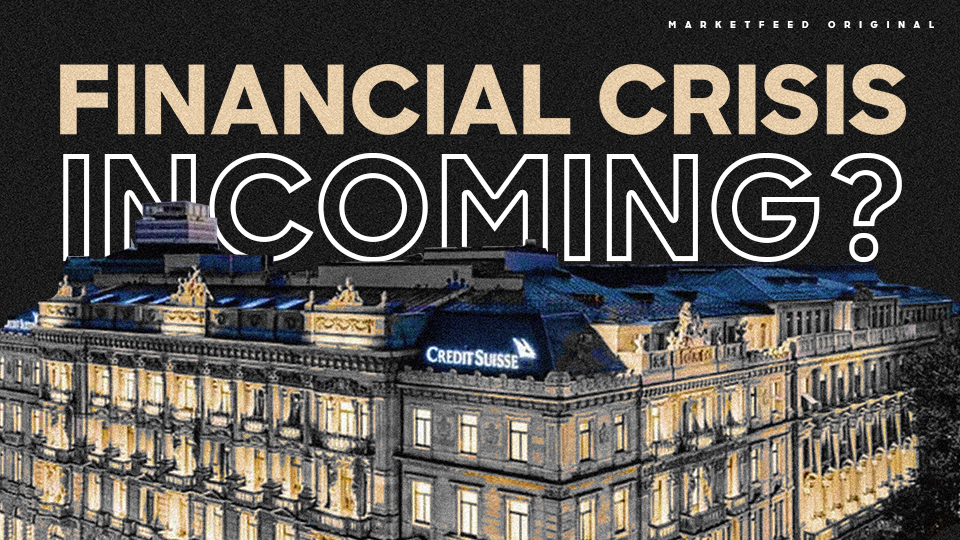
Credit Suisse in Trouble: Another Global Financial Crisis Incoming?

As you might have heard, Europe’s second-largest bank, Credit Suisse, is reportedly under severe financial distress. Many analysts are predicting a collapse of the entire global banking system as a result of its situation. In this article, we discuss the crisis brewing at Credit Suisse and its impact.

About Credit Suisse:

Credit Suisse Group AG was established in 1856 to fund the Swiss railway network. Headquartered in Zürich, Switzerland, the company provides private banking, asset management, and wealth management services. At the end of 2021, Credit Suisse reported over 1.6 trillion Swiss francs in assets and 50,000+ employees in the institution.

Why is it in Trouble?

Credit Suisse’s shares have declined nearly 60% since the beginning of 2022. Investor sentiment has fallen due to a series of losses and high-profile managerial malpractices! It made several risky bets and ended up losing a lot of investor money.

  • For example, Credit Suisse convinced customers to invest up to $10 billion in Greensill Capital, which acted as an intermediated between suppliers and clients. It paid suppliers cash upfront and took their place in waiting for the clients to pay. This business attracted a lot of attention and money in its initial stages. 
  • However, in March 2021, Credit Suisse announced that it was closing and liquidating several investor funds provided to Greensill Capital. Greensill filed for bankruptcy, and investors reportedly lost $3 billion!
  • During the same period, Credit Suisse lost nearly $5 billion when Archegoes Capital Management collapsed.
  • In another instance, a massive leak of over 30,000 of Credit Suisse’s clients in February 2022 revealed over $100 billion in wealth held by people who had profited from “torture, drug trafficking, money laundering, corruption, and other serious crimes”.
  • The bank has changed top leadership multiple times since 2019. They also paid nearly $275 million to settle legacy issues with regulators across the US, UK, and Switzerland last year!

The Issue With Credit Default Swaps

Currently, Credit Suisse’s corporate bonds are losing value. The premiums on their Credit Default Swaps (CDS) are very high. Let’s understand what this means:

Banks like Credit Suisse have to borrow large sums of money (via bonds) to conduct their regular operations. But lenders do not always automatically assume that they’ll get paid in full. So they use credit default swaps to limit their risk.

A CDS is a financial instrument that allows a firm to swap or offset its credit risk with another entity (similar to insurance). To swap the risk of default, the lender buys a CDS from a third party that agrees to reimburse them if the borrower defaults (or is not in a position to pay back). Since a CDS functions as a type of insurance, the buyer pays a premium to the seller (the third party).

So the premiums on Credit Suisse’s CDS have surged now, which indicates that the market feels these bonds are more likely of failing. If Credit Suisse can’t pay off its massive debts, its collapse could trigger a downfall of the global banking system as it’s all deeply interconnected.

What Next?

Earlier this week, Credit Suisse Group AG’s CEO Ulrich Koerner wrote a letter to the bank’s employees:

“I know it’s not easy to remain focused amid the many stories you read in the media— in particular, given the many factually inaccurate statements being made. That said, I trust that you are not confusing our day-to-day stock price performance with the strong capital base and liquidity position of the bank”. 

Unfortunately, many analysts have pointed out that this statement is similar to the one made by Lehman Brothers’ Chief Financial Officer (CFO) in 2008, right before the bank collapsed and led to a global economic recession. Credit Suisse is now trying to repair the damage by strengthening its wealth management business and transforming its investment banking division.

Coming to the Indian scenario, most analysts feel that the Indian banking system is quite resilient to such threats. We could see an impact on cash flows and sentiments, and that can bring high volatility in the stock markets. 

Let’s hope such a financial crisis doesn’t occur again. Do you have any views on the current situation of Credit Suisse? Let us know in the comments section of the marketfeed app.

Categories
Market News Top 10 News

SpiceJet, Credit Suisse AG Resolve Financial Dispute – Top Indian Market Updates

Here are some of the major updates that could move the markets tomorrow:

SpiceJet, Credit Suisse AG tell SC they resolved financial dispute

SpiceJet Ltd and Swiss firm Credit Suisse AG told the Supreme Court they have resolved their financial dispute. The apex court allowed SpiceJet to withdraw its appeal against a Madras High Court verdict ordering that the airline be wound up on account of alleged non-payment of dues to Credit Suisse. As per Credit Suisse AG, SpiceJet had failed to honour its commitment to pay the bills for over $24 million for maintenance and repair of aircraft engines and components.

Read more here.

Tata Motors secures order for 921 electric buses from BMTC

Tata Motors has secured an order for 921 electric buses from the Bengaluru Metropolitan Transport Corporation (BMTC). The automaker is all set to supply, operate and maintain 12-meter electric buses as part of the large tender announced by Convergence Energy Services Ltd (CESL). BMTC Managing Director G Sathyavathi said the order is essential for Bengaluru’s growing requirement for clean and sustainable public transport.

Read more here.

HAL opens office in Kuala Lumpur to explore business operations in Southeast Asia

Hindustan Aeronautics Ltd (HAL) has signed a Memorandum of Understanding (MoU) with its representative in Kuala Lumpur (called Forte Drus) for tapping new opportunities in exporting weaponry to Malaysia. The office in Malaysia will help HAL to tap the new business opportunities for Fighter Lead-in Trainer, Light Combat Aircraft, and other requirements of the Royal Malaysian Air Force (RMAF).

Read more here.

Power Mech Projects secures order worth Rs 6,163 crore from Adani Group

Power Mech Projects Ltd (PMPL) has secured an order for five Flue Gas Desulphurization (FGD) projects with an aggregating value of Rs 6,163.20 crore from Adani Group. The FGD projects will be used to install 15 FGD retrofits to coal-based units at Mundra, Tiroda, Kawai, and Udupi. These units will effectively curb sulphur-dioxide emissions and play a vital part in helping India achieve its ambitious goal of reducing emissions.

Read more here.

IRCTC floats tender to appoint consultant for digital data monetisation

Indian Railway Catering & Tourism Corporation (IRCTC) has floated a tender to hire a consultant to monetise digital assets. The assets mentioned in the tender include rail ticketing data, user base, and passenger travel-related transactions. As per reports, IRCTC has estimated a revenue generation potential of Rs 1,000 crore through the monetisation of its digital assets.

Read more here.

Datamatics Global Services partners with US-based AccessFares

Datamatics Global Services Ltd (DGSL) has entered into a long-term strategic partnership with AccessFares to enhance the customer experience for its premium international airfare services. DGSL will manage the premium international airfare services and help create value across the entire air ticketing, invoicing, and billing process. US-based AccessFares is a market leader in providing premium international airfares with significant discounts to customers globally.

Read more here.

Lupin gets USFDA approval for Rufinamide tablets to treat seizures

Lupin Ltd has received approval from the US Food & Drug Administration (FDA) for Rufinamide tablets. The drug is used to treat the symptoms of Lennox-Gastaut Syndrome (seizures). They are available for oral administration as film-coated tablets. The product will be manufactured at Lupin’s facility in Goa. As per IQVIA MAT June 2022 data, Rufinamide tablets had estimated annual sales of $164 million (~Rs 1,306.4 crore) in the US.

Read more here.

India sees a 7.6% fall in domestic air passengers in July: DGCA

The latest data by the Directorate General of Civil Aviation (DGCA) showed a 7.6% decline in the total number of domestic air passengers in July 2022 to 97 lakh. Around 1.05 passengers travelled by air in June. The rainy season is usually a lean period for India’s aviation sector. IndiGo carried 57.11 lakh passengers in July, a 58.8% share of the domestic market. Meanwhile, SpiceJet carried 7.76 lakh passengers last month.

Read more here.

Tata Power Renewable Energy issues shares to BlackRock-Mubadala consortium for Rs 2,000 crore

Tata Power Renewable Energy’s board has approved the allotment of 8.36 crore equity shares on a preferential basis aggregating ~Rs 2,000 crore to GreenForest New Energies Bidco (GNEB). GNEB is a consortium led by BlackRock Real Assets and Mubadala Investment Company. This transaction is part of an investment deal worth Rs 4,000 crore, which BlackRock and Mubadala will infuse into Tata Power Renewable Energy.

Read more here.

Nykd by Nykaa launches first flagship store in New Delhi

Nykd by Nykaa, the athleisure brand from Nykaa Fashion, has opened its first-ever physical retail space in Rajouri Garden, New Delhi. The store has a wide array of products across the innerwear, sleepwear, athleisure, and loungewear categories.

Read more here.

Categories
Editorial

Company Analysis: CRISIL Limited, an S&P Global Company

In India, when we go through the content on bonds, shares, and how they are rated, CRISIL comes as a common name. CRISIL Limited is an Indian analytical company providing ratings, research, and risk and policy advisory services. It is listed on both NSE and BSE. It is owned by a quite popular American financial giant, S&P Global

In this piece, I shall take you through the company’s business model, its recent financials, and the future prospects of the company.

Business Model

  • CRISIL Limited is a Credit Rating Agency(CRA). The role of a credit rating agency is to ‘rate’ or rank securities like bonds, shares, debt instruments, etc. based on their risk and ability to pay back its investors. Based on the ratings, investors can get an insight into the risk factor of the security they are investing in. Bond issuing companies can even decide the price of the bond or interest they pay based on the rating that the bond gets. It is recommended that you go through a piece we did at market feed on How Credit Rating Agencies In India Earn Money’. 
  • Before we move any further, let me summarize the Credit Rating Industry for you. The industry is an oligopoly. This means that there are barely 4-5 established CRAs in India. It is virtually impossible to compete against these giants. Most of these giants are owned by the ‘Big Three’ credit rating agencies. Those are S&P Global, Moody’s, and Fitch Ratings. 
  • The company isn’t limited to just its India operations. The company receives most of its business from North America and a major chunk of it from Europe as well. 
  • CRISIL, just like any other CRA, makes money through three segments. Ratings, Research and Advisory. Looking at the revenue mix it is clear that CRISIL earns most (~63%) of its revenue from its Research business followed by Ratings and the Advisory.

Rating Business 

The cash flow over here comes from two places, Bonds and Bank Loan Ratings. It is mandated by SEBI that every company issuing bonds must be rated by at least one of the Credit Rating Agencies in India. Additionally, whenever a big company borrows money from a bank, the bank assigns the task of rating the borrower company to a CRA, in our case, CRISIL. CRISIL owns close to ~68% of market space in the Rating business. When more bonds are issued, and more companies start borrowing money fuelling banking credit in the economy, CRISIL eventually ends up making money. In India, Banking credit has grown by ~6.2% CAGR and bonds issuances by ~9.35% CAGR, both over a period of 5 years. In the past year, the bond market has increased by 8% YoY, despite a stressful year for businesses. 

Research Business

CRISIL allots maximum capital to this segment. In the quarter ended March 2021, CRISIL allotted ~Rs 642 crore against ~Rs 78 crore and ~Rs 89 crore to the Advisory and Rating segment respectively. 

The Research segment doesn’t require much elaboration. Most decisions taken in the market are based on research. Research requires data, the data is then analyzed, and a conclusion is reached. Gross Revenue from Research business has grown by 14.2% CAGR  over the past 5 years. The company acquired a US-based research and analytics company Greenwich Associates and its subsidiaries for $40 million or Rs 296 crore. This was a major addition to the segment. What makes this segment unique is that it isn’t impacted by the cyclicity of the market. In the financial world, whether the market is down or up, the demand for a good research report never ends. 

Advisory Business

CRISIL provides advisory services in s in areas of regulatory reporting, credit risk, and select city infrastructure projects. The advisory business of CRISIL is picking up. CRISIL’s advisory services see great potential growth since they have access to lots of data and research material. This gives them an edge when it comes to giving the right business advice. Even though the contribution to the revenue segment is small, one can expect it to grow in the future. 

Financial Vitals

.Q4 2020Q3 2020Q4 2019
Revenue508.65612.2462.6
Net Profit83.511088.1
All Amount in Rs Crores
  • In the above-given chart, we can clearly see that the revenue of the company is increasing steadily, but the profit margin isn’t responding to the rise in revenue. Apparently, CRISIL is unable to trim down on its expenses.
  • Coming to CRISIL’s expenses, more than 65% of it goes into paying for the salaries and benefits of its employees. Another sizable chunk goes in availing ‘Professional Services’ from third parties. CRISIL can utilize its capital more efficiently. In a world of automation and artificial intelligence, maybe it’s time to upgrade its technology. 
  • The stock seems to have gained quite some traction in the past one month more than other months. CRISIL stock has gained ~36% in the past month and ~76% in the past year. The stock traded pretty much sideways for quite a few months before ‘freeriding’ the bull run post the COVID-19 lockdown.  

The Big Picture

In the chart give above, we get a clear picture of CRISIL’s financial efficiency. All vital ratios like Return on Equity %, Return On Capital Employed %, Net Profit Margin Annual % have declined over the past decade, yet CRISIL’s stock seems to have rallied more than 36.66% over  Despite this, CRISIL seems to be rallying over the past month. 

CRISIL stock happens to be in ace-investor Rakesh Jhunjhunwala’s portfolio, the stock seems to have gained a special interest from Foreign Investors and Mutual Fund in the past month. A breakout from a long-borne consolidation spiked interest in retail traders that could have probably caused the breakout. From the data given above, we can concur that the rally isn’t supported by the company’s financials and could possibly be a short-lived one. Another possibility could be that the company turns around its financials in the coming quarter and the quarterly results become supportive of the rally. 

Categories
Editorial

The Collapse of Archegos Capital: Explained

Over the past month, all major global indices have been technically quite weak. Stock markets around the world are witnessing a fall as soon as there are rumors of negative cues. The fear of lockdowns amidst the exponential rise in Covid-19 cases and an increase in US Treasury Bond yield continues to create a state of panic. These factors have often led to major sell-offs in the market. 

Last week, another crisis posed a threat to stock markets. Archegos Capital, a New York-based wealth management firm, has collapsed. Many prominent banks are facing heavy losses due to this incident. Let us understand the details surrounding this collapse and the impact it had on the stock market. There is a lot of financial jargon coming your way, and we will try to make it as clear as possible.

Brief Profile – Archegos Capital

Archegos Capital Management is a family office that primarily invests in the US, Chinese, and Japanese stock markets. A family office is a private entity that provides investment or wealth management services for ultra-high net worth investors. They serve very wealthy families, generally those with over $100 million (~Rs 735 crore) in investable assets. 

Archegos Capital was founded by Bill Hwang, a former equity analyst at US-based Tiger Management (which no longer exists). In 2012, he was found guilty of insider trading and was charged by the Securities and Exchange Commission (SEC). Bill Hwang and the firms he managed had to pay $44 million to settle all charges. He was also forced to stay away from the investment advisory business. Thus, Hwang converted his firms into a family office. A point to be noted is that family offices are outside the regulatory scrutiny of the SEC. Most of their information or transactions are not available in the public domain.

The Collapse of Archegos Capital

Last week, Archegos Capital was forced into a fire sale of securities worth ~$20 billion (~Rs 1.46 lakh crore) after some of its portfolio stocks witnessed a significant fall. A fire sale refers to selling assets or securities at a very low price. Some of the prominent stocks in the firm’s portfolio included ViacomCBS, Discovery Communications, Baidu Inc., GSX Techedu, and Tencent Holdings. The company had huge exposure to these particular stocks due to swaps

What are Swaps and Leverage?

Swaps are a kind of derivative instrument that can be traded over-the-counter (OTC) amongst large institutional investors. Such trades do not have to be reported to the public. It allows investors to take huge positions in securities without having to pay large sums of money upfront. For investing in swaps, financial institutions often borrow millions of dollars from banks— known as leverage. So, the underlying securities were the publicly traded shares (ViacomCBS, GSX Techedu, etc) and swaps gave Archegos Capital the benefit of leverage. Bill Hwang had made huge bets on these stocks and was hoping they would perform well.

He used leverage, which is money borrowed from banks (or even brokers), for buying these shares. Prominent banks agreed to fund these transactions as they believed in Hwang’s expertise in managing money. Moreover, the lenders would also receive a lot of money through commissions. 

When such transactions are conducted, a portion of stocks that a firm intends to buy are often pledged in the form of collateral with banks. More importantly, the investor has to immediately bring in additional money as collateral as soon as the stock prices begin to fall. This is because a decline in share prices leads to a fall in the value of margin with the broker/bank. This demand for additional money or collateral is referred to as margin calls, which are triggered when the value of shares falls below a certain requirement.

What Happened to Archegos?

Swaps often increase the size of investments in stocks by enabling investors to infuse only a limited amount of money. However, when the underlying investments show a decline in value, banks and brokers usually sell the shares they hold on behalf of their clients. If a client is unable to pay when a margin call is made, lenders begin to sell the shares to recover what is owed to them. If the stock prices continue to fall, these lenders would start to incur huge losses.

This is exactly what had happened to Archegos Capital and its lenders. There was a large-scale selling of ViacomCBS, Baidu, and Tencent shares— which led to the stock prices falling sharply. ViacomCBS fell 23% last Wednesday and another 30% on Thursday, as analysts downgraded the stock on account of being overvalued. The shares of other companies Hwang had bet on, such as GSX Techedu (a Chinese ed-tech company) and RLX Technologies, also started falling.

To cover their losses, Archegos Capital initiated a fire sale of the stocks in their portfolio. However, the firm was unable to meet its lenders’ calls for more collateral to secure equity swap trades they had partly financed. Most of the firm’s prime brokers such as Goldman Sachs and Morgan Stanley quickly offloaded the stock in all of Archego’s investments. As shares of the companies mentioned above were being sold or simply dumped, its stock price started falling heavily.

The Impact

As per reports, two major lenders are likely to face severe losses due to their exposure to Archegos Capital. This is because the value of the collateral they were holding in the form of stocks was losing value very quickly. Japan’s largest investment bank, Nomura Holdings, is likely to face a loss of up to $2 billion. Switzerland-based Credit Suisse said a default on margin calls by Archegos could be “highly significant and material” to its first-quarter (Q1 CY21) results. As per sources, Credit Suisse’s losses are likely to cross $4 billion. 

The stocks of all major banking and financial services firms that had exposure to Archego Capital saw a huge fall on Monday (March 29). Morgan Stanley shares fell 2.6% and Goldman Sachs Group took a hit of 1.7%. The shares of Nomura posted a record one-day decline of 16.3%. Credit Suisse shares dropped 14%, its biggest fall in a year. 

Conclusion

Now you know how Bill Hwang and his firm, Archegos Capital Management, caused a mini-crash in the markets over the past week. It clearly shows the risk posed by large firms that are able to operate outside the purview of strong regulators. As mentioned before, family offices do not have to register with the Securities and Exchange Commission, nor do they have to disclose transactions. They continue to deal in securities worth billions based on rash decisions and greed. If such trades are left unchecked, it could lead to major systemic risks. The collapse of Archegos has made entities realise the importance of limits or strong regulations on swaps and leverages.