
Categories
Editorial

Here are the Best Sectors to Look Out For in 2023!

What a thrilling year it’s been! NIFTY50 touched an all-time high of 18,887.60 amidst some heavy volatility. We’ve seen the markets make wild movements in both directions. Fears of an upcoming economic recession and interest rate hikes have spooked most investors. But we’re sure our community continues to be highly bullish on India’s economic growth and are holding on to smart investments. 🚀

In today’s special article, we take a look into some of India’s fastest-growing and promising sectors that could flourish in 2023. You may potentially find better investment opportunities or even your next multibagger!

Green Energy

The Centre, state governments, business groups, and the general public need to recognise the urgency of climate action and advocate it on a wider scale. It’s high time we take coordinated actions to reduce carbon emissions. We need to rapidly increase its renewable energy deployment to meet the rising energy demands:

  • India has pledged to achieve net-zero carbon emissions by 2070
  • The Central Govt. has committed to installing a non-fossil fuel electricity generation capacity of 500 gigawatts (GW) and sourcing 50% of India’s energy requirement from renewable sources by 2030. 
  • It also aims to reduce 1 billion tonnes of projected emissions within the same time frame. As India continues to rely heavily on fossil fuels, it will be a mammoth task to reach these green targets.
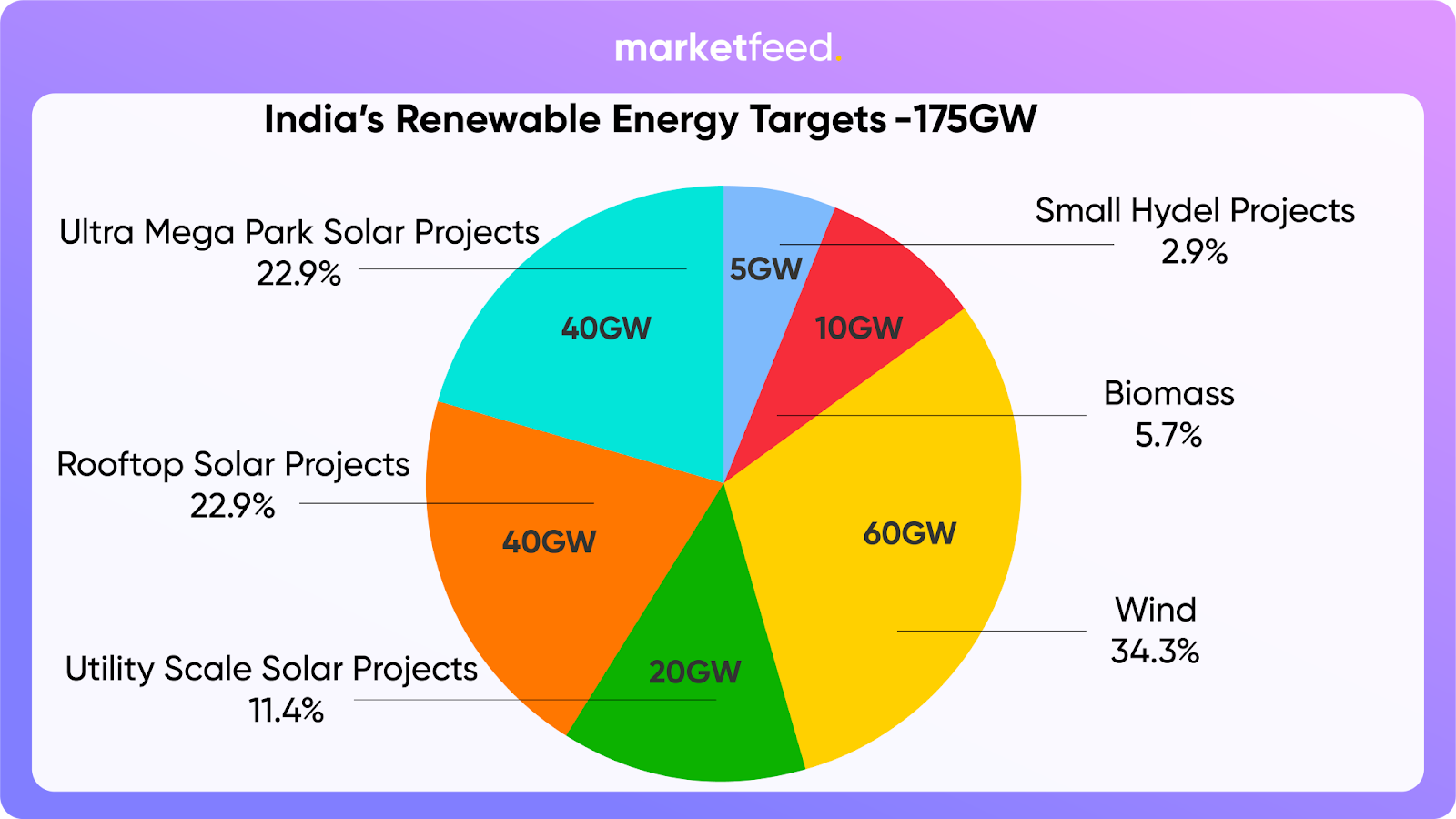
According to India’s Ministry of Power, the Indian renewable energy sector received a total investment of about ₹5.2 lakh crore over the last seven years. By 2028, this sector could reportedly see investments worth $500 billion (~₹37.25 lakh crore). We’re seeing some highly ambitious projects in the solar, wind, green hydrogen, and battery cell manufacturing sectors.

Here are some of the companies that have aligned their business strategies with the government’s green energy targets:

  • Reliance Industries
  • Adani Group (Adani Enterprises, Adani Green Energy)
  • Tata Power
  • Borosil Renewables (solar glass manufacturer)
  • JSW Energy
  • Sterling & Wilson (contract manufacturer of solar power infrastructure)

Speciality Chemicals

India is one of the world’s fastest-growing markets for chemical products of all kinds. According to recent estimates, our country ranks sixth in chemical sales worldwide and contributes 4% to the global chemical industry! Meanwhile, specialty chemicals are a vital segment of chemicals used as finished product ingredients and to improve manufacturing processes. It accounts for 22% of India’s total chemicals market! 

The Indian middle class is showing a significant shift in demand for food, clothing, medicines, and transportation— all of which drive demand for specialty chemicals! As per a report from India Brand Equity Foundation (IBEF), the specialty chemicals sector is expected to grow at a CAGR of 12.4% to $64 billion within the next four years. No wonder there are a large number of players in this industry:

The companies mentioned above have been focusing extensively on enhanced research & development (R&D) capabilities to launch new and improved offerings. The future of the chemical sector is bright indeed. To learn more about leading fertilizer & agrochemical companies, click here

Digital Transformation & Inclusion

We’ve seen the information technology (IT) sector grow to new heights over the past few years, especially in artificial intelligence (AI), data analytics, data science, and big data. Business entities and govt. agencies around the world are shifting from traditional/outdated systems to seamless, customer-driven digital operations. Moreover, government initiatives such as Digital India seek to improve internet connectivity throughout the country. 

5G has been officially launched in India, and telecom operators & network infrastructure providers are gearing up for a pan-India rollout. It will pave the way for new economic opportunities and benefits for Indian societies.

However, there is significant room for expansion as internet penetration is only 47-48% in India, compared to more than 90% in developed countries. Let’s look at some of the listed entities leading the digital revolution:

  • IT majors like Tata Consultancy Services, Infosys, and Wipro
  • Telecom operators like Jio (Reliance Industries), Bharti Airtel
  • Digital payments – SBI Cards & Payment Services, HDFC Bank, IndusInd Bank 
  • Online Communications Services – Route Mobile

Electric Mobility

The Government of India has set a target of achieving sales of 60-70 lakh hybrid and electric vehicles (EVs) every year from 2020 onwards. You may also be aware of several Central and state government initiatives aimed at increasing EV production and sales. The primary goal of such programs is to make a seamless transition from internal combustion engine vehicles (ICEs) to reduce pollution levels. It will also reduce India’s reliance on costly fuel imports.

Source: Bloomberg Green

Several Indian companies have already begun to work toward gaining a foothold in the rapidly evolving EV market:

  • Tata Motors
  • Mahindra & Mahindra
  • JBM Auto Ltd (electric buses for public transportation)
  • Olectra Greentech
  • TVS Motor Company
  • Ashok Leyland (through its UK-based electric mobility arm Switch Mobility)

Make in India! (Or China-Plus-One Strategy) 

For decades, China has been known as the “World’s Factory” as it’s the center of global manufacturing or supply chains. It offered cheap labour and production costs. Unfortunately, China’s Zero-Covid Policy has led to prolonged industrial lockouts and supply chain disruptions. So, large multinational companies are adopting a new strategy to avoid investing only in China and diversify into other countries. It’s called “China Plus One”. 

Thus, Indian firms could benefit from this shift by analysing the demand in global markets and ramping up production capabilities. The government has introduced several initiatives like the Production Linked Incentive (PLI) scheme to offer special subsidies for manufacturers in key sectors.

Many listed companies in our country have a competitive advantage to offer the best speciality chemicals, electronic products (like Dixon Tech, Havells India), and textiles (Trident, Welspun India). 


Now, it’s up to you to figure out the right investment options or themes that fit your profile and financial goals. Go for those investments that you clearly understand from your own research. Let’s hope for a profitable 2023! HAPPY INVESTING

Disclaimer: The stocks mentioned in this article are purely for educational purposes. Invest your hard-earned money only after thorough research.

Categories
Editorial

Aether Industries Ltd IPO: All You Need to Know

The IPO ‘may-hem’ continues in the Indian stock markets! Gujarat-based speciality chemical manufacturer Aether Industries Ltd has launched its three-day initial public offering (IPO) today— May 24. In this article, we analyse the company and its IPO. 

Company Profile – Aether Industries Ltd

Established in 2013, Aether Industries Ltd (AIL) is one of the fastest-growing speciality chemical manufacturing companies in India. It produces advanced intermediates and chemicals involving complex, differentiated chemistry and technology core competencies. They started building an in-house research & development (R&D) team in 2013 and commenced commercial operations in FY17. 

The company operates through three business models:

  1. Large-scale manufacturing of its own intermediates and speciality chemicals.
  2. Contract research and manufacturing services.
  3. Exclusive manufacturing

AIL’s portfolio consisted of over 25 chemical products as of March 31, 2022. Their key customers are based in North America, Europe, and India. Prominent clients include Adama Ltd (Israel), BYK Group (Germany), UPL Limited, Divi’s Labs, and Dr. Reddy’s Labs. The company derives 62.6% of its revenue from the pharma segment and 22.9% from the agrochemical segment. Exports make up ~49% of its total revenue, which also acts as a natural hedge against volatility in raw materials sourced from overseas. It owns and operates two manufacturing facilities in Surat, Gujarat.

Aether Industries grew at an annualized rate (CAGR) of 49.5% between 2019 and 2021. The company’s vision is to create a niche in the global chemical industry with a creative approach to chemistry and technology systems. 

About the IPO

Aether Industries Ltd’s public issue opens on May 24 and closes on May 26. The company has fixed Rs 610-642 per share as the price band for the IPO.

The fresh issue of shares (of the face value of Rs 10 each) aggregates to Rs 627 crore. The IPO also includes an offer for sale (OFS) by promoters and early investors, aggregating to Rs 181.04 crore. Individual investors can bid for a minimum of 23 equity shares (1 lot) and in multiples of 23 shares thereafter. You will need a minimum of Rs 14,766 (at the cut-off price) to apply for this IPO. The maximum number of shares that a retail investor can apply is 299 equity shares (13 lots).

The company will utilise the net proceeds from the IPO for the following purposes:

  • Repayment/prepayment of borrowings – Rs 138 crore
  • Funding capital expenditure requirements (greenfield project in Surat) – Rs 163 crore
  • Funding working capital requirements – Rs 165 crore
  • General corporate purposes.

The total promoter holding in Aether Industries will decline from 96.96% to 87.09% post the IPO.

Financial Performance

AIL has posted a consistent increase in total revenue and profits over three financial years (FY19-21). The three part-business model works in perfect synergy. Its revenue from exports increased at a CAGR of 58.5% from Rs 100.09 crore in FY19 to Rs 251.6 crore in FY21.

The company reported a 32.5% YoY increase in revenue from operations to Rs 442.5 crore during the 9 months ended December 2021 (9M FY22). Net profit rose 72.7% YoY to Rs 82.9 crore during the same period. EBITDA stood at Rs 126 crore, up 64% YoY.

Risk Factors

  • Aether Industries faces various risks associated with operations involving the manufacture, usage, and storage of hazardous substances.
  • The company derives ~73% of its total revenue from top 20 customers (as of Dec 31, 2021). Its operations will be adversely affected if these customers choose not to source their requirements from AIL or if they terminate long-term contracts.
  • Non-compliance with safety, health, and environmental laws will severely harm AIL’s business.
  • The company does not have long-term agreements with suppliers of raw materials. A surge in the cost of raw materials or any shortfall in supply could adversely impact its overall operations.
  • All of AIL’s manufacturing facilities are located in Gujarat, exposing them to regulatory or geography-specific risks.

IPO Details in a Nutshell

The book-running lead managers to the public issue are HDFC Bank and Kotak Mahindra Capital. AIL filed the Red Herring Prospectus (RHP) for its IPO on May 16. You can read it here. Out of the total offer, 50% is reserved for Qualified Institutional Buyers (QIBs), 15% for Non-Institutional Investors (NIIs), and 35% for retail investors.

Ahead of the IPO, AIL raised Rs 240 crore from anchor investors.

Conclusion

The chemical industry is one of the most vital and fastest-growing industries in our country. Numerous companies thrive in this sector, which makes it highly competitive. They have flourished mainly due to the surge in demand from the agricultural, pharmaceutical, material science, and paint industries. As per a report from India Brand Equity Foundation (IBEF), the specialty chemicals sector is expected to grow at an annual growth rate of 12.4% to $64 billion within the next three years. The strong R&D capabilities and differentiated portfolio of products will help Aether Industries effectively compete in this sector.

AIL will be competing with leading players like Clean Science & Technology Ltd, Navin Fluorine International, Vinati Organics, PI Industries, and Fine Organics Ltd once it gets listed. You can read our in-depth analysis of India’s chemical industry here.

AIL’s IPO shares are trading at a premium of Rs 4 in the grey market. Before applying to this IPO, we will wait to see if the portion reserved for institutional investors gets oversubscribed. Do consider the risks associated with the company and come to your own conclusion.

What are your views on Aether Industries Ltd’s IPO? Will you be applying for it? Let us know in the comments section of the marketfeed app!

Categories
Editorial

An Analysis of Laxmi Organic Industries

India is considered the fastest-growing market for speciality chemicals in the world. The agrochemical, pharmaceutical, and textile industries depend on a steady supply of speciality chemicals for their day-to-day production activities. There are a large number of companies in our country that manufacture such chemicals in bulk. In this article, learn more about Laxmi Organic Industries, a leading company in this highly promising industry.

Laxmi Organic Industries – Company Profile

Laxmi Organic Industries Limited is a speciality chemicals manufacturing company based in Mumbai. It primarily operates through two segments: Acetyl Intermediates (AI) and Specialty Intermediates (SI). Its acetyl intermediates include ethyl acetate, acetaldehyde, fuel-grade ethanol, and other proprietary solvents. The company’s specialty intermediates include ketene, acetic anhydride, amides, and arylides. All these are chemical products that have multiple applications across the pharmaceutical and agrochemical industries. These are also essential inputs for manufacturing dyes, pigments, coatings, paints, fragrances, and adhesives.

(Approximate figures)

The company has secured a nearly one-third market share in the Indian ethyl acetate market. It also has a market share of ~55% in the Indian diketene derivatives market. Dr Reddy’s Laboratories, Laurus Labs, Granules India, UPL Limited, Suven Pharma, and Colourtex Industries are some of its prominent clients. Laxmi Organic exports its products to nearly 30 countries, including China, the Netherlands, Russia, the United Arab Emirates, the United Kingdom, and the United States. It currently has two state-of-the-art manufacturing facilities and two distilleries in Maharashtra.

Laxmi Organic launched its initial public offering (IPO) in March 2021 for raising Rs 600 crore. The listing price of its shares on the NSE was Rs 155.50, a gain of 19.6% over the issue price of Rs 130. The total promoter holding by the Goenka Group and US-based Yellowstone Trust currently stands at 72.92%. 

Financial Performance

It seems that the negative impacts triggered by the Covid-19 pandemic have not caused any serious damage to the company’s financial growth. This could mainly be due to increased demand for the products they offer. The agrochemical and pharma sectors require a regular supply of these speciality chemicals for their production activities. Laxmi Organic reported a 261.95% year-on-year (YoY) jump in consolidated net profit to Rs 36.44 crore for the quarter ended March 2021 (Q4 FY21). However, net profit has declined by 19.62% when compared to the previous quarter (Q3 FY21). Its total income in Q4 stood at Rs 521.27 crore, up 34.38% YoY and 19.17% on a quarterly basis. 

Laxmi Organic’s net profit for the entire financial year 2020-21 (FY21) increased by 81.21% YoY to Rs 127.03 crore. The company’s total income for FY21 rose 15.2% YoY to Rs 1,773.06 crore. Thus, both revenues and profits have rebounded strongly in FY21. Over the past five years, its revenue has grown at a CAGR of 7.79%, whereas the industry average stood at 3.62%. Laxmi Organic has secured a market share of 3.3% in the highly competitive speciality chemicals industry.

The Return on Capital Employed (ROCE) stands at 20.34%. Compared to major competitors in the speciality chemicals sector, this figure is quite low. It means that for every Rs 100 worth of capital employed, Laxmi Organic earns Rs 20.34 on it. Return on Equity (ROE) is also comparatively low at 17.38%. Laxmi Organic is almost a debt-free firm. The company reported an Earnings Per Share (EPS) of Rs 5.58 in FY21, a 95% jump over FY20.

Future Plans

Over the years, allocating significant funds to its Research & Development (R&D) segment has helped Laxmi Organic expand in terms of production volume and product portfolio. Thus, the company will continue to focus on improving its product line and manufacturing capabilities through extensive R&D activities. Launching innovative products will help them grow further in a highly competitive market. Last month, they announced plans of setting up a wholly-owned subsidiary in Delaware, United States. This firm will trade the chemical products manufactured by the parent company. Laxmi Organic will invest $1 million (~Rs 7.29 crore) to set up the subsidiary.

The company aims to establish a SI manufacturing facility using a portion of the net proceeds from its IPO. Meeting capital expenditure (CAPEX) requirements and reduction of debts are also of top priority.

Conclusion

Last year, Laxmi Organic had to close down its manufacturing units due to strict lockdowns. A major concern was that all its operations are centered around Maharashtra, the state worst hit by the Covid-19 pandemic in India. However, the company was able to recover well and have posted strong financial growth in FY21. They have maintained high product quality standards over the years, which is evident from the long list of prominent clients.

According to a report from India Brand Equity Foundation (IBEF), the speciality chemicals industry in India is expected to grow at a CAGR of 11-12% over the next five years. It is expected to become a $40 billion (~Rs 3 lakh crore) market by 2025. The leading companies in this industry will continue to benefit from higher demand from multiple end-user industries. Also, there are certain government schemes that support the production activities of domestic chemical manufacturers. Laxmi Organic could greatly benefit from all of this, provided that they launch new and improved products. We will have to wait and see how the management implements its strategic plans.

Since its listing on March 21, the stock price of Laxmi Organic has increased steadily by ~44%. It hit a 52-week high of Rs 244.70 at the time of Q4 results being announced. In our opinion, there is a lot more move coming for the stock in the next 5 years.

What are your views on Laxmi Organic Industries? Do you believe it has the scope to become a market leader in the speciality chemicals industry in India? Let us know in the comments section of the marketfeed app.