
Categories
Editorial

Here are the Best Sectors to Look Out For in 2023!

What a thrilling year it’s been! NIFTY50 touched an all-time high of 18,887.60 amidst some heavy volatility. We’ve seen the markets make wild movements in both directions. Fears of an upcoming economic recession and interest rate hikes have spooked most investors. But we’re sure our community continues to be highly bullish on India’s economic growth and are holding on to smart investments. 🚀

In today’s special article, we take a look into some of India’s fastest-growing and promising sectors that could flourish in 2023. You may potentially find better investment opportunities or even your next multibagger!

Green Energy

The Centre, state governments, business groups, and the general public need to recognise the urgency of climate action and advocate it on a wider scale. It’s high time we take coordinated actions to reduce carbon emissions. We need to rapidly increase its renewable energy deployment to meet the rising energy demands:

  • India has pledged to achieve net-zero carbon emissions by 2070
  • The Central Govt. has committed to installing a non-fossil fuel electricity generation capacity of 500 gigawatts (GW) and sourcing 50% of India’s energy requirement from renewable sources by 2030. 
  • It also aims to reduce 1 billion tonnes of projected emissions within the same time frame. As India continues to rely heavily on fossil fuels, it will be a mammoth task to reach these green targets.
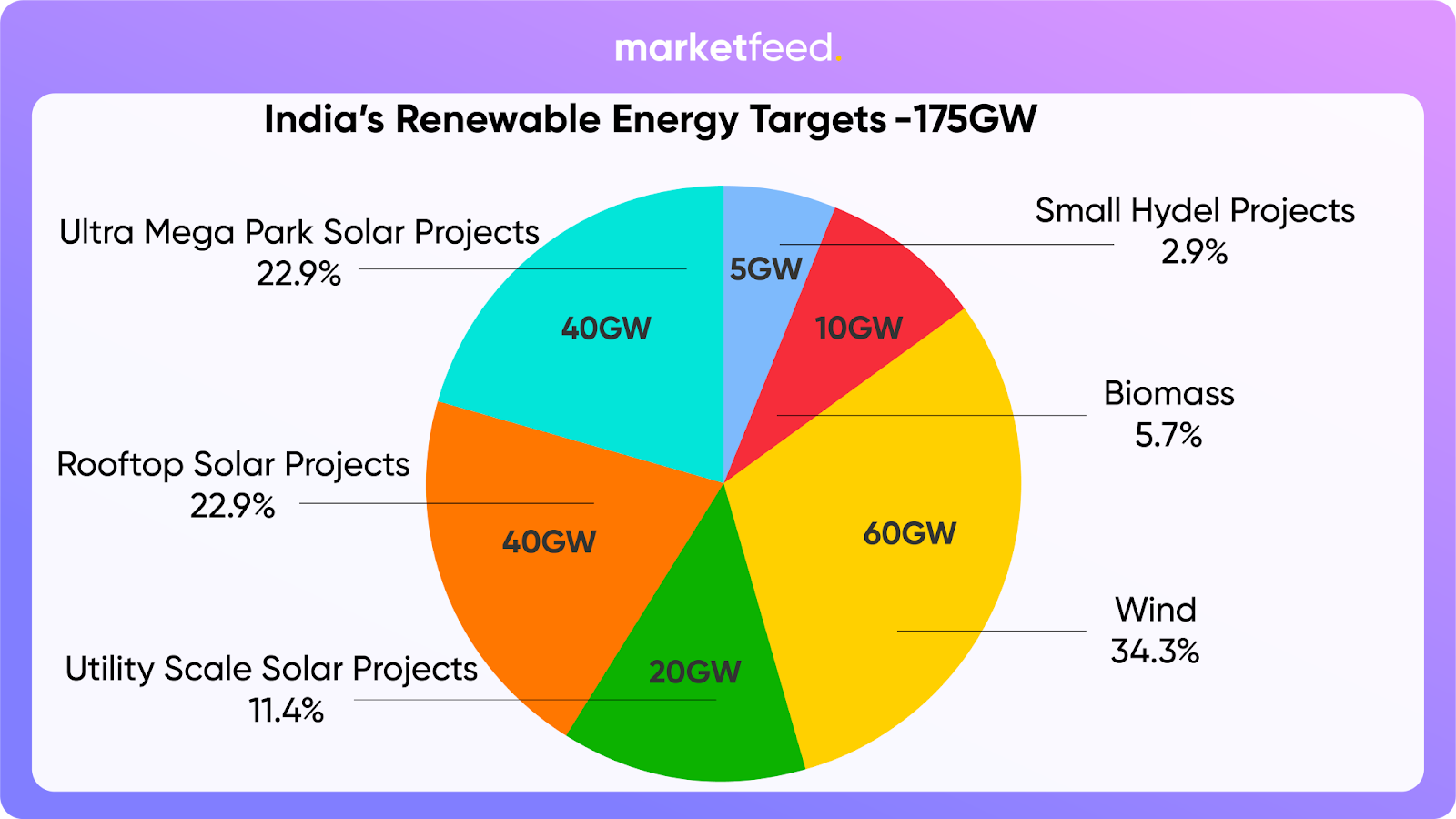
According to India’s Ministry of Power, the Indian renewable energy sector received a total investment of about ₹5.2 lakh crore over the last seven years. By 2028, this sector could reportedly see investments worth $500 billion (~₹37.25 lakh crore). We’re seeing some highly ambitious projects in the solar, wind, green hydrogen, and battery cell manufacturing sectors.

Here are some of the companies that have aligned their business strategies with the government’s green energy targets:

  • Reliance Industries
  • Adani Group (Adani Enterprises, Adani Green Energy)
  • Tata Power
  • Borosil Renewables (solar glass manufacturer)
  • JSW Energy
  • Sterling & Wilson (contract manufacturer of solar power infrastructure)

Speciality Chemicals

India is one of the world’s fastest-growing markets for chemical products of all kinds. According to recent estimates, our country ranks sixth in chemical sales worldwide and contributes 4% to the global chemical industry! Meanwhile, specialty chemicals are a vital segment of chemicals used as finished product ingredients and to improve manufacturing processes. It accounts for 22% of India’s total chemicals market! 

The Indian middle class is showing a significant shift in demand for food, clothing, medicines, and transportation— all of which drive demand for specialty chemicals! As per a report from India Brand Equity Foundation (IBEF), the specialty chemicals sector is expected to grow at a CAGR of 12.4% to $64 billion within the next four years. No wonder there are a large number of players in this industry:

The companies mentioned above have been focusing extensively on enhanced research & development (R&D) capabilities to launch new and improved offerings. The future of the chemical sector is bright indeed. To learn more about leading fertilizer & agrochemical companies, click here

Digital Transformation & Inclusion

We’ve seen the information technology (IT) sector grow to new heights over the past few years, especially in artificial intelligence (AI), data analytics, data science, and big data. Business entities and govt. agencies around the world are shifting from traditional/outdated systems to seamless, customer-driven digital operations. Moreover, government initiatives such as Digital India seek to improve internet connectivity throughout the country. 

5G has been officially launched in India, and telecom operators & network infrastructure providers are gearing up for a pan-India rollout. It will pave the way for new economic opportunities and benefits for Indian societies.

However, there is significant room for expansion as internet penetration is only 47-48% in India, compared to more than 90% in developed countries. Let’s look at some of the listed entities leading the digital revolution:

  • IT majors like Tata Consultancy Services, Infosys, and Wipro
  • Telecom operators like Jio (Reliance Industries), Bharti Airtel
  • Digital payments – SBI Cards & Payment Services, HDFC Bank, IndusInd Bank 
  • Online Communications Services – Route Mobile

Electric Mobility

The Government of India has set a target of achieving sales of 60-70 lakh hybrid and electric vehicles (EVs) every year from 2020 onwards. You may also be aware of several Central and state government initiatives aimed at increasing EV production and sales. The primary goal of such programs is to make a seamless transition from internal combustion engine vehicles (ICEs) to reduce pollution levels. It will also reduce India’s reliance on costly fuel imports.

Source: Bloomberg Green

Several Indian companies have already begun to work toward gaining a foothold in the rapidly evolving EV market:

  • Tata Motors
  • Mahindra & Mahindra
  • JBM Auto Ltd (electric buses for public transportation)
  • Olectra Greentech
  • TVS Motor Company
  • Ashok Leyland (through its UK-based electric mobility arm Switch Mobility)

Make in India! (Or China-Plus-One Strategy) 

For decades, China has been known as the “World’s Factory” as it’s the center of global manufacturing or supply chains. It offered cheap labour and production costs. Unfortunately, China’s Zero-Covid Policy has led to prolonged industrial lockouts and supply chain disruptions. So, large multinational companies are adopting a new strategy to avoid investing only in China and diversify into other countries. It’s called “China Plus One”. 

Thus, Indian firms could benefit from this shift by analysing the demand in global markets and ramping up production capabilities. The government has introduced several initiatives like the Production Linked Incentive (PLI) scheme to offer special subsidies for manufacturers in key sectors.

Many listed companies in our country have a competitive advantage to offer the best speciality chemicals, electronic products (like Dixon Tech, Havells India), and textiles (Trident, Welspun India). 


Now, it’s up to you to figure out the right investment options or themes that fit your profile and financial goals. Go for those investments that you clearly understand from your own research. Let’s hope for a profitable 2023! HAPPY INVESTING

Disclaimer: The stocks mentioned in this article are purely for educational purposes. Invest your hard-earned money only after thorough research.

Categories
Editorial

The PLI Scheme – All You Need to Know

One of the most important strategies to improve the economic growth of a country is to promote domestic production and become self-reliant. This is exactly what our Indian Government has been aiming for. The policies such as Make in India and the Atmanirbhar Bharat Abhiyan are prime examples of this. On November 11, the Union Cabinet announced the approval of a Production Linked Incentive (PLI) Scheme for 10 key sectors. This scheme would help to further strengthen the foundation of India’s path towards self-reliance.

Here at marketfeed, we always make sure to fulfill our promises and provide you with the best insights about such important events. Let us understand what this scheme is all about, and which sectors are included in it.

What is the PLI Scheme?

The Production Linked Incentive (PLI) scheme is a relatively new concept that was introduced in India earlier this year. The Government believed that it was time to initiate concrete steps to boost domestic manufacturing and cut down on huge import bills. Through the PLI scheme, companies would be provided with certain incentives to scale up production activities in India. It has three main objectives:

  1. To encourage foreign companies to set up their production activities in India. When this happens, we could see more foreign investments coming into our country.
  2. To provide support towards the existing domestic companies to expand their manufacturing units.
  3. To ensure that more employment opportunities are provided to Indian citizens in the manufacturing sector.

The PLI Scheme for Electronics Manufacturing

This scheme has become an absolute game-changer. Let us find out how our country adopted it initially. In April 2020, the Government introduced a PLI scheme worth Rs 40,000 crore for large-scale electronics manufacturing. The main aim of this particular scheme was to boost domestic manufacturing of mobile phones in India. The eligible companies were promised an incentive of 4%- 6% on incremental sales of goods that were manufactured in our country. This incentive would be applicable for 5 years. 

A total of 22 companies applied for the PLI scheme in August. And, three of these firms were contract manufacturers for Apple iPhones. We could also see that the share price of companies that had applied for the scheme (for eg, Dixon Technologies) had seen a surge during those periods.

According to Ravi Shankar Prasad, the Minister of Electronics and Information Technology, production worth Rs 11.5 lakh crore and exports valuing Rs 7 crore is expected over the next 5 years. It is very reassuring to learn that this scheme had received quite an overwhelming response from companies around the globe. It has become such a huge success.

The Latest PLI Scheme

In the notification made on November 11, the Government stated that it will offer incentives to an additional 10 vital sectors. The Union Cabinet has approved Production Linked Incentive Scheme worth up to Rs 1.45 lakh crore, for a period of 5 years. 

This would ensure that necessary support is provided to make India a global manufacturing hub, and create more jobs in the economy. The domestic companies would get the necessary push to cater to the local demand. The policy has been strategically targeted to very important sectors and would make Indian goods more competitive.

We can also state that the scheme has come at a very perfect time, in relation to the present global scenario. Most companies around the world are planning to shift their manufacturing operations from China. India could grab this opportunity and transform India into one of the best manufacturing centers in the world. The scheme would accelerate the existing plans of foreign companies that were considering to invest in India.

Which Sectors are Included in the PLI Scheme?

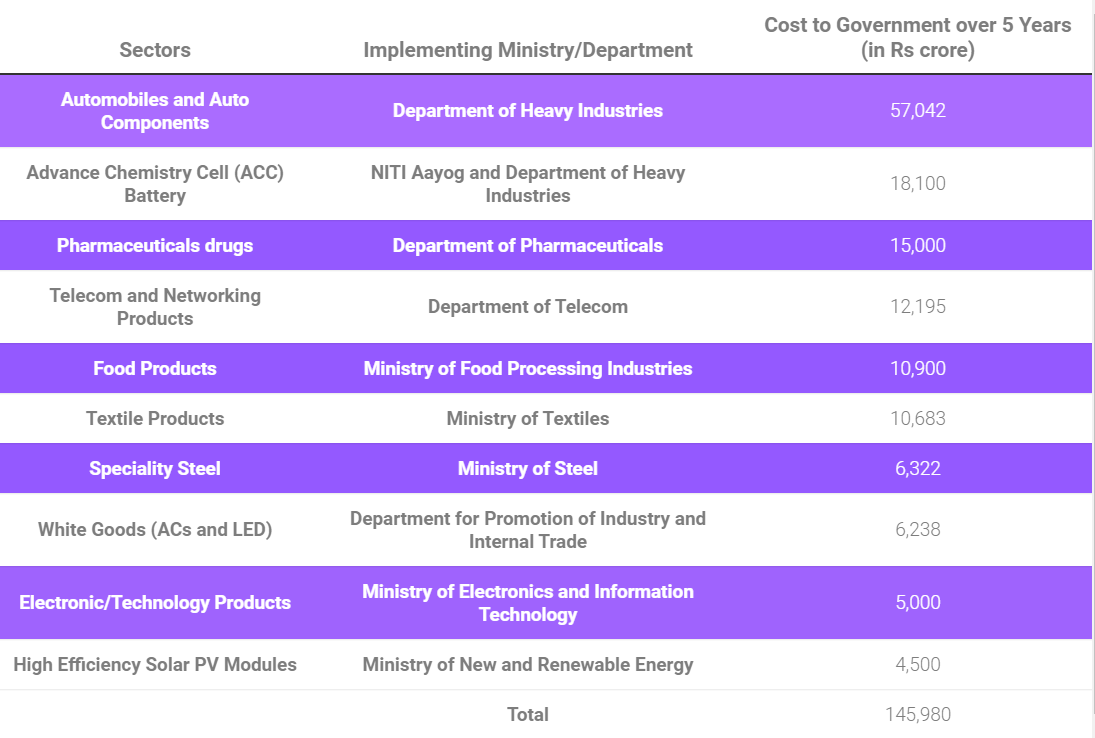
Given below is a table that shows the 10 sectors that will come under the PLI scheme, and the amount allocated to each sector.

Source: BloombergQuint

As we can see, the automobile and auto components sector has been allocated the highest amount in the PLI scheme. This would definitely help the sector to become a large exporter, and reduce import dependence. It has also been ensured that an amount of Rs 18,100 crore has been allocated for advanced chemical cell batteries. This would provide a major boost to the production of electric vehicles, as batteries are a key component of it. 

As per a statement from the Finance Minister, Smt. Nirmala Sitharaman, speciality steel in India could become a potential champion in the country’s exports. Hence, an amount of Rs 6,322 crore has been allocated for incentivizing its production as well.

Similarly, eight other sectors will be provided with sufficient incentives to completely improve the overall manufacturing capacity in India.

India and PLI

India has definitely received a massive Diwali gift from the government. If this scheme goes through precise planning and execution, it could become one of the most vital initiatives that have been adopted in our country. Our producers would certainly get the push to cater to the domestic demand, and foreign firms would be encouraged to invest heavily in India. The citizens of India would obtain more employment opportunities as well. It is a win-win situation for all the parties that would be involved!

At the same time, we would urge our readers to follow the latest updates surrounding this scheme. We could see listed companies applying to get the benefit of these incentives, and ramping up their production activities in India. This would certainly become a factor for many stocks to rally. We would also keep an updated list of the specific stocks that have been selected for the PLI scheme. Let us look forward to a positive outcome and see our country grow into one of the best manufacturing hubs in the world.

Categories
Market News

Apple starts manufacturing of iPhone 11 in India

In a major win for the govt’s Aatamnirbhar India initiative, Apple has started manufacturing of one of its flagship devices, the iPhone 11, at Chennai’s Foxconn plant. This is the first time Apple has manufactured a top-of-the-line model in India.

“Significant boost to Make in India!” Piyush Goyal said in the tweet. “Apple has started manufacturing iPhone 11 in India, bringing a top-of-the-line model for the first time in the country.”

The local assembly of the iPhone 11 would help the company avoid a 20 per cent tax that it is needed to pay for importing the handset from its global manufacturing facilities. Apple has Foxconn, Wistron, and Pegatron as the suppliers for its iPhone models that all are presently making huge investments in the Indian market.

Earlier this month, Foxconn, which is a leading supplier for iPhone and other Apple devices, reportedly planned to invest up to $1 billion (roughly Rs. 7,491 crores) to expand its India factory where it assembles iPhone models. Pegatron — the second-largest iPhone assembler after Foxconn — was also reported to make some investment in the country and set up a local subsidiary in the coming future.

India has become an important market for all smartphone vendors, thanks to the fact that it already has over 50 crore smartphone users. Companies including Samsung and Xiaomi have already invested plenty of resources in the country to meet the growing demands of Indian consumers. The expansion of consumer demand has lately attracted Apple and its suppliers as well.

Production will be stepped up in phases and Apple may consider exporting the India-made iPhone 11, reducing its dependence on China.